• Trade
  • Markets
  • Copy
  • Contests
  • News
  • 24/7
  • Calendar
  • Q&A
  • Chats
Trending
Screeners
SYMBOL
LAST
BID
ASK
HIGH
LOW
NET CHG.
%CHG.
SPREAD
SPX
S&P 500 Index
6870.39
6870.39
6870.39
6895.79
6858.28
+13.27
+ 0.19%
--
DJI
Dow Jones Industrial Average
47954.98
47954.98
47954.98
48133.54
47871.51
+104.05
+ 0.22%
--
IXIC
NASDAQ Composite Index
23578.12
23578.12
23578.12
23680.03
23506.00
+72.99
+ 0.31%
--
USDX
US Dollar Index
98.910
98.990
98.910
98.960
98.730
-0.040
-0.04%
--
EURUSD
Euro / US Dollar
1.16517
1.16524
1.16517
1.16717
1.16341
+0.00091
+ 0.08%
--
GBPUSD
Pound Sterling / US Dollar
1.33190
1.33199
1.33190
1.33462
1.33136
-0.00122
-0.09%
--
XAUUSD
Gold / US Dollar
4212.03
4212.44
4212.03
4218.85
4190.61
+14.12
+ 0.34%
--
WTI
Light Sweet Crude Oil
59.195
59.225
59.195
60.084
59.160
-0.614
-1.03%
--

Community Accounts

Signal Accounts
--
Profit Accounts
--
Loss Accounts
--
View More

Become a signal provider

Sell trading signals to earn additional income

View More

Guide to Copy Trading

Get started with ease and confidence

View More

Signal Accounts for Members

All Signal Accounts

Best Return
  • Best Return
  • Best P/L
  • Best MDD
Past 1W
  • Past 1W
  • Past 1M
  • Past 1Y

All Contests

  • All
  • Trump Updates
  • Recommend
  • Stocks
  • Cryptocurrencies
  • Central Banks
  • Featured News
Top News Only
Share

Temasek CEO Dilhan Pillay: We Are Taking A Conservative Stance On Allocating Capital

Share

Brazil Economists See Brazilian Real At 5.40 Per Dollar By Year-End 2025 Versus 5.40 In Previous Estimate - Central Bank Poll

Share

Brazil Economists See Year-End 2026 Interest Rate Selic At 12.25% Versus 12.00% In Previous Estimate - Central Bank Poll

Share

Brazil Economists See Year-End 2025 Interest Rate Selic At 15.00% Versus 15.00% In Previous Estimate - Central Bank Poll

Share

EU Commission Says Meta Has Committed To Give EU Users Choice On Personalised Ads

Share

Sources Revealed That The Bank Of England Has Invited Employees To Voluntarily Apply For Layoffs

Share

The Bank Of England Plans To Cut Staff Due To Budget Pressures

Share

Traders Believe There Is Less Than A 10% Chance That The European Central Bank Will Cut Interest Rates By 25 Basis Points In 2026

Share

Egypt, European Bank For Reconstruction And Development Sign $100 Million Financing Agreement

Share

Israel Budget Deficit 4.5% Of GDP In November Over Past 12 Months Versus 4.9% Deficit In October

Share

JPMorgan - Council Chaired By Jamie Dimon Includes Jeff Bezos

Share

UK Government: UK Health Security Agency Identified New Recombinant Mpox Virus In England In Individual Who Had Recently Travelled To Asia

Share

European Central Bank Governing Council Member Kazimir: I See No Reason To Change Rates In The Coming Months, Definitely No In December

Share

European Central Bank Governing Council Member Kazimir: Overengineering Policy Around Small Inflation Deviations Would Introduce Unnecessary Policy Uncertainty

Share

European Central Bank Governing Council Member Kazimir: European Central Bank Must Be Vigilant About Some Upside Risks To Inflation

Share

European Central Bank Governing Council Member Kazimir: Forex Pass Through To Prices May Not Be As Strong As Expected

Share

Document: EU Looking At Options For Boosting Lebanon's Internal Security Forces

Share

Thai Foreign Ministry: Military Action Will Continue Until Thai Sovereignty, Territorial Integrity Secure

Share

Ukraine President Zelenskiy: No Accord So Far On Eastern Ukraine In US Talks

Share

NATO: Ukrainian President Zelenskiy Will Meet NATO's Rutte And EU Commission Chief Von Der Leyen And Costa In Brussels On Monday

TIME
ACT
FCST
PREV
France Industrial Output MoM (SA) (Oct)

A:--

F: --

P: --
France Trade Balance (SA) (Oct)

A:--

F: --

P: --
Euro Zone Employment YoY (SA) (Q3)

A:--

F: --

P: --
Canada Part-Time Employment (SA) (Nov)

A:--

F: --

P: --

Canada Unemployment Rate (SA) (Nov)

A:--

F: --

P: --

Canada Full-time Employment (SA) (Nov)

A:--

F: --

P: --

Canada Labor Force Participation Rate (SA) (Nov)

A:--

F: --

P: --

Canada Employment (SA) (Nov)

A:--

F: --

P: --

U.S. PCE Price Index MoM (Sept)

A:--

F: --

P: --

U.S. Personal Income MoM (Sept)

A:--

F: --

P: --

U.S. Core PCE Price Index MoM (Sept)

A:--

F: --

P: --

U.S. PCE Price Index YoY (SA) (Sept)

A:--

F: --

P: --

U.S. Core PCE Price Index YoY (Sept)

A:--

F: --

P: --

U.S. Personal Outlays MoM (SA) (Sept)

A:--

F: --

P: --
U.S. 5-10 Year-Ahead Inflation Expectations (Dec)

A:--

F: --

P: --

U.S. Real Personal Consumption Expenditures MoM (Sept)

A:--

F: --

P: --
U.S. Weekly Total Rig Count

A:--

F: --

P: --

U.S. Weekly Total Oil Rig Count

A:--

F: --

P: --

U.S. Consumer Credit (SA) (Oct)

A:--

F: --

P: --
China, Mainland Foreign Exchange Reserves (Nov)

A:--

F: --

P: --

Japan Trade Balance (Oct)

A:--

F: --

P: --

Japan Nominal GDP Revised QoQ (Q3)

A:--

F: --

P: --

China, Mainland Imports YoY (CNH) (Nov)

A:--

F: --

P: --

China, Mainland Exports (Nov)

A:--

F: --

P: --

China, Mainland Imports (CNH) (Nov)

A:--

F: --

P: --

China, Mainland Trade Balance (CNH) (Nov)

A:--

F: --

P: --

China, Mainland Exports YoY (USD) (Nov)

A:--

F: --

P: --

China, Mainland Imports YoY (USD) (Nov)

A:--

F: --

P: --

Germany Industrial Output MoM (SA) (Oct)

A:--

F: --

P: --
Euro Zone Sentix Investor Confidence Index (Dec)

A:--

F: --

P: --

Canada National Economic Confidence Index

--

F: --

P: --

U.K. BRC Like-For-Like Retail Sales YoY (Nov)

--

F: --

P: --

U.K. BRC Overall Retail Sales YoY (Nov)

--

F: --

P: --

Australia Overnight (Borrowing) Key Rate

--

F: --

P: --

RBA Rate Statement
RBA Press Conference
Germany Exports MoM (SA) (Oct)

--

F: --

P: --

U.S. NFIB Small Business Optimism Index (SA) (Nov)

--

F: --

P: --

Mexico 12-Month Inflation (CPI) (Nov)

--

F: --

P: --

Mexico Core CPI YoY (Nov)

--

F: --

P: --

Mexico PPI YoY (Nov)

--

F: --

P: --

U.S. Weekly Redbook Index YoY

--

F: --

P: --

U.S. JOLTS Job Openings (SA) (Oct)

--

F: --

P: --

China, Mainland M1 Money Supply YoY (Nov)

--

F: --

P: --

China, Mainland M0 Money Supply YoY (Nov)

--

F: --

P: --

China, Mainland M2 Money Supply YoY (Nov)

--

F: --

P: --

U.S. EIA Short-Term Crude Production Forecast For The Year (Dec)

--

F: --

P: --

U.S. EIA Natural Gas Production Forecast For The Next Year (Dec)

--

F: --

P: --

U.S. EIA Short-Term Crude Production Forecast For The Next Year (Dec)

--

F: --

P: --

EIA Monthly Short-Term Energy Outlook
U.S. API Weekly Gasoline Stocks

--

F: --

P: --

U.S. API Weekly Cushing Crude Oil Stocks

--

F: --

P: --

U.S. API Weekly Crude Oil Stocks

--

F: --

P: --

U.S. API Weekly Refined Oil Stocks

--

F: --

P: --

South Korea Unemployment Rate (SA) (Nov)

--

F: --

P: --

Japan Reuters Tankan Non-Manufacturers Index (Dec)

--

F: --

P: --

Japan Reuters Tankan Manufacturers Index (Dec)

--

F: --

P: --

Japan Domestic Enterprise Commodity Price Index MoM (Nov)

--

F: --

P: --

Japan Domestic Enterprise Commodity Price Index YoY (Nov)

--

F: --

P: --

China, Mainland PPI YoY (Nov)

--

F: --

P: --

China, Mainland CPI MoM (Nov)

--

F: --

P: --

Q&A with Experts
    • All
    • Chatrooms
    • Groups
    • Friends
    Connecting
    .
    .
    .
    Type here...
    Add Symbol or Code

      No matching data

      All
      Trump Updates
      Recommend
      Stocks
      Cryptocurrencies
      Central Banks
      Featured News
      • All
      • Russia-Ukraine Conflict
      • Middle East Flashpoint
      • All
      • Russia-Ukraine Conflict
      • Middle East Flashpoint
      Search
      Products

      Charts Free Forever

      Chats Q&A with Experts
      Screeners Economic Calendar Data Tools
      Membership Features
      Data Warehouse Market Trends Institutional Data Policy Rates Macro

      Market Trends

      Market Sentiment Order Book Forex Correlations

      Top Indicators

      Charts Free Forever
      Markets

      News

      News Analysis 24/7 Columns Education
      From Institutions From Analysts
      Topics Columnists

      Latest Views

      Latest Views

      Trending Topics

      Top Columnists

      Latest Update

      Signals

      Copy Rankings Latest Signals Become a signal provider AI Rating
      Contests
      Brokers

      Overview Brokers Assessment Rankings Regulators News Claims
      Broker listing Forex Brokers Comparison Tool Live Spread Comparison Scam
      Q&A Complaint Scam Alert Videos Tips to Detect Scam
      More

      Business
      Events
      Careers About Us Advertising Help Center

      White Label

      Data API

      Web Plug-ins

      Affiliate Program

      Awards Institution Evaluation IB Seminar Salon Event Exhibition
      Vietnam Thailand Singapore Dubai
      Fans Party Investment Sharing Session
      FastBull Summit BrokersView Expo
      Recent Searches
        Top Searches
          Markets
          News
          Analysis
          User
          24/7
          Economic Calendar
          Education
          Data
          • Names
          • Latest
          • Prev

          View All

          No data

          Scan to Download

          Faster Charts, Chat Faster!

          Download App
          English
          • English
          • Español
          • العربية
          • Bahasa Indonesia
          • Bahasa Melayu
          • Tiếng Việt
          • ภาษาไทย
          • Français
          • Italiano
          • Türkçe
          • Русский язык
          • 简中
          • 繁中
          Open Account
          Search
          Products
          Charts Free Forever
          Markets
          News
          Signals

          Copy Rankings Latest Signals Become a signal provider AI Rating
          Contests
          Brokers

          Overview Brokers Assessment Rankings Regulators News Claims
          Broker listing Forex Brokers Comparison Tool Live Spread Comparison Scam
          Q&A Complaint Scam Alert Videos Tips to Detect Scam
          More

          Business
          Events
          Careers About Us Advertising Help Center

          White Label

          Data API

          Web Plug-ins

          Affiliate Program

          Awards Institution Evaluation IB Seminar Salon Event Exhibition
          Vietnam Thailand Singapore Dubai
          Fans Party Investment Sharing Session
          FastBull Summit BrokersView Expo

          China's Property Market Supply Seen Rising At the End Of 2021, Property Investment May Bottom Out In Q2 2022 (I)

          Summary:

          The current demand side is expected to improve, and looking ahead to 2022, the general tone of "housing without speculation" and the goal of achieving "three stability" will remain unchanged, the real estate tax pilot will become a disturbing factor for market expectations in the short term. Some real estate enterprises are still stuck in a liquidity crisis at the current phase. Encouraging high-quality real estate enterprises to merge and acquire high-quality projects of difficult real estate enterprises will help to resolve the negative social effects caused by the difficulties encountered by difficult real estate enterprises; in addition, for high-quality real estate enterprises, mergers and acquisitions will increase their reserves of high-quality projects and expand their market share, and the differentiation of the real estate industry will continue.
          At the end of 2021, the overall environment of the real estate market had rebounded, but it is still far from being an optimistic situation. By collecting the latest data and related industry views, we estimate that real estate investment may bottom out in the second quarter of this year after the rebound when sales on commercial houses will also stabilize, real estate tax pilot work on short-term market expectations may bring a certain impact, while real estate companies continue to differentiate.
          China's Property Market Supply Seen Rising At the End Of 2021, Property Investment May Bottom Out In Q2 2022 (I)_1

          1. Unsteady Property Markets

          With the new house supply increasing, the housing transaction stopped falling and started rebounding. Many property markets see surging at the end of 2021. According to China Real Estate Information Corporation (CRIC), new supply area of 24.91 million square meters was estimated in key cities, an increase of 10%. Among them, Shenzhen has exceeded 1 million square meters of supply in a single month for 2 months in a row, Nanjing, Xi'an, Jinan and other second and third-tier cities with the same increase year-on-year, real estate enterprises are pushing enthusiasm on the market to rebound.
          In addition, the continuing downturn of the property market transactions tends to shift. The scale of commercial house transactions in 29 cities is expected to reach 21.23 million square meters, up 16% from the previous year, with annual transactions in first-tier cities hitting a nearly three-year high, and cumulative year-on-year growth continuing at 15%.

          1.1 The Gradual Thawing of Financing Side

          The total amount of debt issued by 100 typical real estate enterprises monitored by CRIC in December was 31.59 billion yuan, up 7.5% from the previous month. Earlier, in response to the concerns about the financing environment of the real estate industry triggered by the Evergrande risk incident, the central bank, the CBIRC, the SFC and other departments collectively responded on the evening of December 3 that the risk of individual real estate enterprises in the short term is a case-by-case risk and will not affect the normal financing function of the market in the medium and long term. Experts in this area believe that this might be an indication showing that the property financing policy turns positive.
          Since November 2021, the ABS financing environment for real estate enterprises has marginally improved, and the relevant asset securitization business has gradually broken the ice. According to CNABS (China Asset Securitization Analysis Network) statistics, in November last year, the scale of real estate asset securitization products accepted and fed back by the exchange in a single month was about 200 billion yuan, and the approval speed accelerated; in December, private real estate enterprises accelerated their pace entering into the situation. According to the previous Caixin report, private real estate enterprises such as Longguang, Country Garden and Vanke have made public their financing plans for CMBS, supply chain ABS and other asset-based securitization products, and in addition to the above three enterprises, the first batch of private real estate enterprises to be "released" also includes Xuhui, Xincheng and Hershey.
          The issuance of real estate ABS products will continue to accelerate in the future, while financing resources are currently more inclined to high-quality enterprises, and the underlying real estate enterprises are still facing greater financing pressure.

          1.2 Land Market Volume Increased and Price Stabilized, the Phenomenon of Abortive Auction Improved

          According to the CRIC’s statistics, key cities ushered in the third round of concentrated land auctions in December, with as many as 17 cities completing the third round of concentrated land auctions, while third- and fourth-tier cities also ushering in the year-end supply tide. As of December 28, the total floor area of Profit-making land transactions in China's 300 domestic cities was nearly 40,000,000 square meters, doubling from a year earlier, and the number of transactions reached 6,124, up 93% from a year earlier, and the rate of abortive land auctions in key cities fell to 15% in three batches.
          In terms of transaction prices, the total price in December jumped 102% y/y, and the unit price rose 7% y/y though it dropped slightly by 2% m/m. Especially in second-tier cities, Hangzhou's third batch of concentrated land auctions gained its heat, with 24 of the 35 lots hitting the highest price during the land auction, driving the third round of land auction premiums in second-tier cities up 0.8 percentage points.
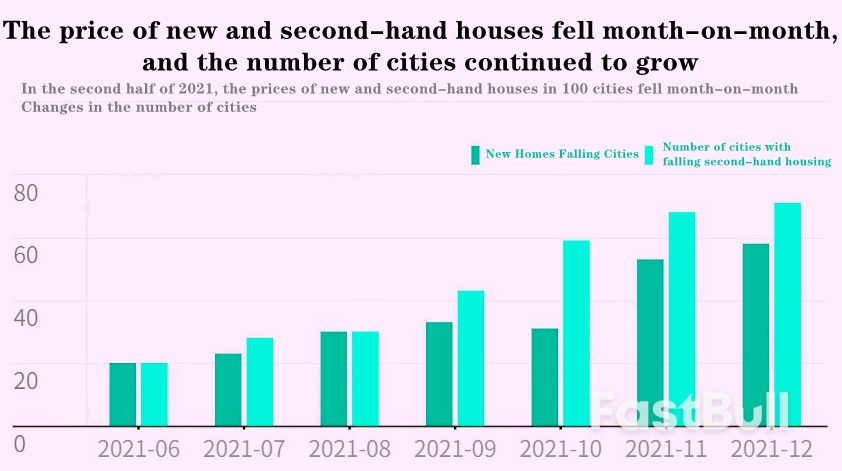
          In terms of the housing prices, the continuation of the double decline in new and second-hand housing shows that real estate enterprises performed poorly. Data from China Real Estate Index System (CREIS) show that in December, its monitoring of the 100 cities of new housing prices fell 0.02% month-on-month, 2.44% cumulative increase in 2021, at the lowest level of nearly seven years; second-hand housing prices fell 0.09% month-on-month, the decline expanded by 0.01 percentage points compared to the previous month. At the same time, rarely negative growth was shown among the scale housing enterprises, top 100 real estate enterprises equity sales amounted to 772.96 billion yuan in December, down 38.1% year-on-year, the cumulative equity sales amount as of the end of December compared to 2020 year-on-year decrease of 6%.
          Risk Warnings and Disclaimers
          You understand and acknowledge that there is a high degree of risk involved in trading. Following any strategies or investment methods may lead to potential losses. The content on the site is provided by our contributors and analysts for information purposes only. You are solely responsible for determining whether any trading assets, securities, strategy, or any other product is suitable for investing based on your own investment objectives and financial situation.
          Comments
          Add to Favorites
          Share

          Quarterly markets review - Q4 2021

          Global equities were stronger in the final quarter of 2021 as investors focused on economic resilience and corporate earnings.In bond markets, government bonds outperformed corporate bonds. Markets began to price a faster pace of interest rate rises in the US.Commodities saw a positive return as industrials metals gained.

          US

          US equities rose in Q4. Overall gains were robust despite a weaker November, during which fears over rising cases of the Omicron variant of Covid-19 and the speed of the Federal Reserve’s asset tapering had weighed. By year-end, these worries had largely subsided, while data continue to indicate that the economy overall remains stable and corporate earnings are robust.
          US economic growth slowed sharply in the third quarter amid a flare-up in Covid-19 infections, but with activity since picking up, the economy remains on track to record its best performance since 1984. GDP increased at a 2.3% (annualised), up from the 2.1% pace estimated. This was still the slowest quarter of growth since the second quarter of 2020, when the economy suffered an historic contraction in the wake of tough mandatory measures to contain the first wave. Unemployment fell to 4.2%, the lowest since February 2020, from 4.6% in October. The participation rate rose slightly but is still about 1.5 percentage points lower than the pre-pandemic level.
          Tech as a sub-sector was one of the strongest performers over the quarter, with chipmakers especially strong. Real estate also performed well, as investors expect e-commerce to continue to grow and drive further demand for industrial warehousing. Energy and financial names made more muted gains over the quarter.

          Eurozone

          Eurozone shares made gains in Q4, as a focus on strong corporate profits and economic resilience offset worries over the new Omicron variant. A number of countries did introduce restrictions on sectors such as travel and hospitality in order to try and reduce the spread of the new variant. The flash composite purchasing managers’ index hit a nine-month low of 53.4 for December, as the service sector was affected by rising Covid cases. However, equity markets drew support from early data indicating a lower risk of severe illness.
          Utilities were among the top performers with IT stocks also registering strong gains. Technology hardware and semiconductor stocks performed particularly well. The luxury goods sector also performed very strongly, recovering from the summer sell-off which was sparked by a focus on “common prosperity” in China. Meanwhile, the communication services and real estate sectors saw negative returns.
          The quarter was marked by volatile gas prices which contributed to higher inflation. The eurozone’s annual inflation rate reached 4.9% in November, compared to -0.3% a year earlier. The European Central Bank said it would scale back bond purchases but ruled out interest rate rises in 2022.
          Germany’s coalition talks reached a conclusion. In December, Olaf Scholz of the Social Democrats (SPD) succeeded Angela Merkel as chancellor. His party is in a coalition government with the Greens and Free Democrats (FDP).

          UK

          UK equities rose over the quarter. Encouraging news around Omicron during December saw a number of economically sensitive areas of the market largely recoup the sharp losses they had sustained in the initial sell-off in late November, such as the banks. Some areas reliant on economies reopening, however, such as the travel and leisure and the oil and gas sector were unable to make up November’s losses and ended the quarter lower.
          A number of defensive areas outperformed, including some of the large internationally diversified consumer staples groups. However, expectations China would maintain a zero tolerance approach to Omicron continued to impact sentiment towards a number of other globally exposed large cap companies. These consistently underperformed over the quarter, despite some uncertainties around increased regulatory oversight in China having abated.
          Some domestically focussed area were particularly volatile and not just the travel and leisure companies directly disrupted by the latest Omicron related restrictions. The share prices of UK consumer facing sectors such as retailers and housebuilders yo-yoed inline with expectations around the timing of a rise in UK base rates, which came in December. Many retailers grappled with supply chain disruptions, resulting in some high profile profit warnings, despite strong demand.

          Japan

          After declines in October and November, the Japanese stock market regained some ground in December to end the quarter with a total return of -1.7%. The yen was generally weaker in the quarter.
          Japan held a general election in October. Expectations for the ruling Liberal Democratic Party’s (LDP) election performance under Mr Kishida’s leadership were modest at best. However, in the event the LDP lost only 15 seats and retained a solid majority in its own right. With the election out of the way, the political focus shifted to a substantial fiscal stimulus package. This includes direct cash handouts to households in an effort to kick-start a consumption recovery in the first half of 2022.
          From late November, renewed short-term uncertainty over the new Covid variant temporarily obscured the increasingly positive outlook for Japan. Japan inevitably imported its first known case of Omicron in December, but overall infection rates remain remarkably low, as they had throughout 2021.
          The US Fed’s discussion of accelerated tapering led to some short-term weakness in stock prices in December, despite the fact that such a move is very unlikely to be followed by Japan in the foreseeable future. The Bank of Japan’s own Tankan survey, released in December, contained no real surprises, although the overall tone was reasonably upbeat. There was some evidence of a slight pick-up in corporate inflation expectations over the next two years. Meanwhile, the current inflation rate crept back into positive territory as several one-off factors begin to drop out, but there still seems little chance of Japan experiencing a short-term inflation spike as seen elsewhere.
          Among other economic data released in December, there was a genuine positive surprise in the strength of the rebound in industrial production as auto output began to recover from the temporary weakness caused by the global semiconductor shortage.

          Asia (ex Japan)

          Asia ex Japan equities recorded a modest decline in the fourth quarter. There was a broad market sell-off following the emergence of the Omicron variant of Covid-19 which investors feared could derail the global economic recovery.
          China was the worst-performing market in the index in the quarter, with share prices sharply lower, along with neighbouring Hong Kong, on investor fears that new lockdown restrictions would be instigated following the rapid spread of the new Covid-19 variant. Share prices in Singapore also ended the fourth quarter in negative territory as investors continued to track developments surrounding the new Omicron variant. There were also fears that the city-state’s government might have to scale back some recently relaxed curbs on activity. India and South Korea also ended the quarter in negative territory although the declines in share prices were more modest.
          Taiwan and Indonesia were the best-performing index markets in the fourth quarter and the only two index markets to achieve gains in excess of 5% in the period. In Taiwan, positive economic data and a rise in exports boosted investor confidence, with chipmakers performing well. Share prices in Thailand, the Philippines and Malaysia also ended the quarter in positive territory.

          Emerging markets

          The MSCI Emerging Markets Index lost value in Q4 and underperformed the MSCI World Index, with US dollar strength a headwind. Turkey was the weakest index market, amid extreme volatility in the currency. The central bank lowered its policy rate by a total of 400bps to 14%, despite ongoing above-target inflation which accelerated to 21.3% year-on-year in November. With the lira coming under significant pressure, President Erdogan announced an unorthodox scheme to compensate savers for lira weakness, in an effort to reduce the use of US dollars.
          Chile lagged the index as leftist Gabriel Boric was elected president. Brazil underperformed as the central bank continued to hike rates in response to rising inflation; the policy rate was increased by a total of 300bps during the quarter. Meanwhile, concerns over the fiscal outlook, and political uncertainty ahead of November 2022’s presidential election, also weighed on sentiment.
          Russia lagged as geopolitical tensions with the West ratcheted up, amid a build-up of Russian troops on its border with Ukraine. China also finished in negative territory as concerns over slowing growth persisted, exacerbated later in the quarter by uncertainty created by rising daily new cases of Covid-19.
          By contrast, Egypt finished in positive territory and was the best performing index market. Peru and the UAE also posted double digit gains in dollar terms. Taiwan, aided by strong performance from IT stocks, Indonesia and Mexico all recorded solid gains and outperformed.

          Global bonds

          Markets were buffeted over the quarter by persistent elevated inflation, hawkish central bank policy shifts and the emergence of the Omicron Covid-19 variant. In bond markets, 10-year government yields were largely unchanged. Yields followed a downward trajectory for most of the quarter before reversing in the final weeks of the year as sentiment improved. Yield curves flattened, with shorter-dated bonds hit as central banks turned more hawkish.
          Most notably, US Federal Reserve (Fed) rhetoric turned increasingly hawkish in November. Chair Jay Powell and other members of the policy committee suggested tapering could be accelerated, which it was in December, and that they may stop referring to inflation as “transitory”.
          The US 10-year Treasury yield was little changed for the quarter, from 1.49% to 1.51%. It reached 1.7% in October amid elevated inflation and expectations of policy tightening, then a low of 1.36% in early-December amid fears over the Omicron Covid-19 variant. The US 2-year yield increased from 0.28% to 0.73%.
          The UK 10-year yield fell from 1.02% to 0.97%, dropping sharply in early November as the Bank of England (BoE) unexpectedly elected not to raise rates. The BoE did, however, raise rates in December and with fears over the Omicron variant fading, yields rose. The 2-year yield sold-off, from 0.41% to 0.68%.
          Germany’s 10-year yield was little changed, from -0.17% to -0.19%, but this reflected a late sell-off with the yield having fallen below -0.40% in December. Italy’s 10-year yield increased from 0.86% to 1.18%. Eurozone inflation picked up considerably, rising to the highest level since 2008 and to a near 30-year high in Germany. European Central Bank President Christine Lagarde broadly affirmed dovish messages, but comments from other ECB officials were more hawkish.
          Corporate bonds lagged government bonds for the quarter. In investment grade, the US market saw modestly positive total returns (local currency), but Europe weakened. US high yield was the standout performer, with positive returns and narrowing spreads. Investment grade bonds are the highest quality bonds as determined by a credit rating agency; high yield bonds are more speculative, with a credit rating below investment grade.
          In emerging markets, local currency bond yields rose, particularly where central banks continued to raise interest rates amid elevated levels of inflation. Central and eastern Europe underperformed. EM currency performance was mixed, influenced by shifting risk sentiment, despite the prospect of higher interest rates.
          EM hard currency bonds declined, with high yield significantly weaker, though investment grade sovereign bonds saw positive returns.
          Global equities enjoyed a strong quarter with the MSCI World index up 6.8% but convertible bonds could not benefit from the equity market tailwind. The Refinitiv Global Focus index of balanced convertible bonds finished the last quarter of 2021 with a disappointing loss of -1.9%. Throughout the quarter, $25 billion of new paper hit the market bringing the total of new issuance to US$160 billion for 2021.

          Commodities

          The S&P GSCI Index recorded a moderately positive return in the fourth quarter despite a sharp decline in the price of natural gas. The industrial metals component was the best-performing segment in the quarter as the global economic recovery gathered pace. There were strong gains in the prices of zinc, nickel, lead and copper.
          The agriculture component also achieved a positive return in the quarter, with robust gains recorded for coffee, cotton, corn and Kansas Wheat. Precious metals also gained in the quarter, with modest price gains for siler and gold.
          The energy component recorded a modest decline in the quarter, with a sharp fall in the price of natural gas offset by modestly higher prices for unleaded gasoline, crude oil and Brent crude.

          Source:Schroders plc

          Risk Warnings and Disclaimers
          You understand and acknowledge that there is a high degree of risk involved in trading. Following any strategies or investment methods may lead to potential losses. The content on the site is provided by our contributors and analysts for information purposes only. You are solely responsible for determining whether any trading assets, securities, strategy, or any other product is suitable for investing based on your own investment objectives and financial situation.
          Comments
          Add to Favorites
          Share

          U.S. Treasuries suffer New Year's sell-off, more risk events are coming

          At the beginning of the new year, the sharp surge in U.S. bond yields had a major impact on many types of assets including technology stocks, cryptocurrencies and precious metals. Market participants seemed to return to the bond market sell-off in the first quarter of last year. But looking forward to the next week, with the advent of many risk events, the direction of the bond market is likely to continue affecting the market performance of the above asset types.
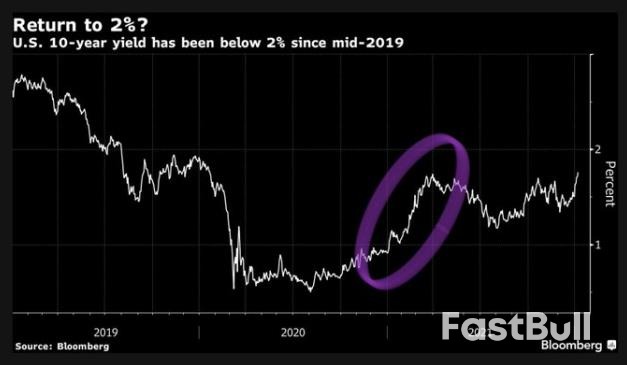
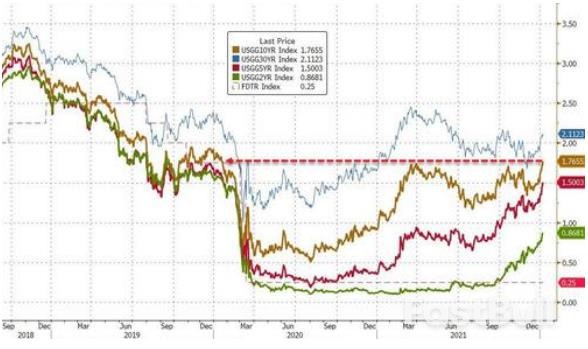
          The market data showed, the 10-year U.S. Treasury bond benchmark yield rose by about 25 basis points last week, the biggest weekly gain since September 2019. Among them, the increase in the first four trading days of 2022 has reached more than 20 basis points, which has never been seen during the New Year in nearly two decades. This condition has directly led to a slump in a variety of assets, from overvalued tech stocks to cryptocurrencies.
          The 10-year U.S. Treasury yield touched 1.801% on Friday, the highest since January 2020. This indicates that it has now surpassed the peak of 1.776% when the bond market sold off appeared last year.U.S. Treasuries suffer New Year's sell-off, more risk events are coming_1
          In other periodical yields, two-year and five-year U.S. Treasury yields, which reflect the outlook for market rates, hit their highest levels since January and March 2020 last week. Moreover, the yield on the 30-year U.S. Treasury bond hit an 11-week high.
          U.S. bond yields rose in the first week of the new year, in large part because the Fed's minutes of December meeting released last Wednesday. The minutes showed that the Fed may raise interest rates earlier than expected and could reduce its bond holdings sooner than many initially expected. Fed funds futures are now implying a roughly 90% possibility of the Fed raising rates by 25 basis points in March and more than three times before the end of the year.U.S. Treasuries suffer New Year's sell-off, more risk events are coming_2

          Traders caught off guard as new year the bond sell off

          Traders had been bracing for the prospect of the Fed starting to withdraw liquidity. That flood of liquidity has fueled a surge in the prices of everything from real estate to internet influencers to speculative tech stocks over the past two years. But even so, the speed with which the bond market adjusted its pricing last week surprised some people.
          Like many traders on Wall Street, Priya Misra, Global Head of Rates Strategy at TD Securities, expected a quiet start to the year.
          'I'm a little bit sleepy, I didn’t expect it to be like this at the beginning of the year. The market is still worried about the COVID pandemic. But it is not interest rates falling and Fed easing policy that we have to consider, but how quickly the Fed will withdraw market support and interest rates and how high will it go up. This can be confusing,' Misra said.
          Misra and her colleagues also advised clients to buy 2-year U.S. Treasuries ahead of the release of the Fed minutes on Wednesday. They expected a rapid increase of Omicron cases will reduce the possibility of the Fed raising interest rates as early as March. However, the minutes showed that the Fed may raise interest rates earlier and faster than originally expected, and the 2-year Treasury bond fell sharply.
          In fact, the roughly 25-basis-point rise in benchmark U.S. Treasury yields this week has far exceeded the average forecast for the next three months by economists and strategists polled by Bloomberg. They had expected the 10-year U.S. Treasury yield to rise to 1.71% until the end of March, while the consensus estimate for the end of 2022 was 2.04%.
          Gargi Chaudhuri, head of investment strategy at iShares Americas at BlackRock, said the rate at which yields have risen was obviously surprising.
          It is worth mentioning that the continued surge in U.S. Treasury yields at the start of 2022 also makes it easy for people to compare them with the sharp rise a year ago. Treasury yields have experienced a similar surge in the first three months of 2021, when the prevalence of reflation trades led people to sell long-term Treasuries. It wasn't until April of that year that the rate shock subsided, giving way to a prolonged period of range trading.U.S. Treasuries suffer New Year's sell-off, more risk events are coming_3
          Right now, the U.S. bond bears are obviously more confident than they were at the time. 'You do get the sense that we've seen this before, but the big difference from 12 months ago is that, this time, the Fed is really moving the market by signaling that it wants to tighten policy sooner rather than later,' said Kevin Flanagan, head of fixed income strategy at WisdomTree.
          Rob Waldner, chief fixed-income strategist at Invesco, said, 'The Fed's policy focus has shifted from achieving full employment to addressing inflation. They will act this year and will be more aggressive. We expect the yields to rise, with the 10-year Treasury yield could rise to just over 2% in the first quarter.'

          Second week of new year: More risk events are about to hit the bond market

          Looking forward to the second week of the new year, it is clear that the performance of the US bond market may still become one of the most important triggers for the stock, foreign exchange and even the commodity market, especially in the context of the upcoming multiple macro fundamental risk events this week.
          Federal Reserve Chairman Jerome Powell will appear at the Senate Finance Committee's hearing on his re-election nomination on Tuesday (January 11). A hearing on the nomination of Fed Governor Brainard as vice chairman will be held on Thursday (January 13). In addition, a number of senior Fed officials including Kansas Fed President George, Richmond Fed President Barkin and Chicago Fed President Evans, New York Fed President Williams, etc. will also appear on public occasions for the first time after entering 2022. For the economic data, the U.S. Department of Labor will also release its most-watched CPI data for December on Wednesday. At present, economists generally expect that the CPI increase in December may further reach 7.1%, which will be the first time in more than 40 years that the US price increase has entered the '7 era'.
          WisdomTree's Flanagan said a strong December headline inflation reading would help continue the current trend of higher U.S. bond yields. Because the Fed will be under pressure to act in March and lay out its thinking at its next meeting in late January.
          The bond market will also usher in three large U.S. bond auctions in the coming week. Among them, 52 billion US dollar of 3-year Treasury bonds will be auctioned on Tuesday, 36 billion US dollar of 10-year Treasury bonds will be sold on Wednesday, and 22 billion US dollar of 30-year Treasury bonds will be sold on Thursday.
          The 10-year U.S. Treasury yield briefly surged past the 1.80% on Friday, and although it has since retreated to around 1.76%, it could easily return to that level in the coming week.
          'At and around these levels, the market will try to find some short-term support,' said Greg Faranello, head of U.S. rates strategy at AmeriVet Securities. He also added that multiple auctions this week could help cap gains in yields for now.
          Gargi Chaudhuri, head of investment strategy at iShares at BlackRock said, 'We don't expect yields to surge, and buyers will emerge when the 10-year U.S. Treasury yield approaches 2%, then creating more two-way fluctuations.'
          Risk Warnings and Disclaimers
          You understand and acknowledge that there is a high degree of risk involved in trading. Following any strategies or investment methods may lead to potential losses. The content on the site is provided by our contributors and analysts for information purposes only. You are solely responsible for determining whether any trading assets, securities, strategy, or any other product is suitable for investing based on your own investment objectives and financial situation.
          Comments
          Add to Favorites
          Share

          Monetary policy and the green transition

          In 2021 the global economy was shaken by a major energy crisis. Prices for oil, gas and electricity surged as our economies reopened after the shutdowns imposed in response to the coronavirus (COVID-19) outbreak.
          Though last year’s events were extraordinary on many levels, spikes in energy prices are a common phenomenon. Since the 1970s, sharp movements in energy prices have been a recurring source of economic dislocations and volatility.
          And yet, the roots of today’s shock are likely to go deeper. While in the past energy prices often fell as quickly as they rose, the need to step up the fight against climate change may imply that fossil fuel prices will now not only have to stay elevated, but even have to keep rising if we are to meet the goals of the Paris climate agreement.
          the challenges that such prospects pose to both fiscal and monetary policymakers in an environment in which the supply of cheaper and greener sources of energy will only gradually be able to meet rapidly rising demand.
          governments will need to push the energy transition forward, while at the same time protecting the most vulnerable members of society from energy poverty.Central banks, in turn, will have to assess whether the green transition poses risks to price stability and to which extent deviations from their inflation target due to a rise in the contribution from energy to headline inflation are tolerable and consistent with their price stability mandates.
          that there are instances in which central banks will need to break with the prevailing consensus that monetary policy should look through rising energy prices so as to secure price stability over the medium term.

          Fast rise in carbon prices helps accelerate the green transition

          The world economy will have to undergo a far-reaching transformation to be able to live up to the Paris agreement to limit the increase in the global average temperature to 1.5° Celsius above pre-industrial levels.
          At the heart of these efforts is the need to radically cut greenhouse gas emissions. According to the United Nations, global emissions would need to drop by 7.6% each year between 2020 and 2030 to reach the Paris target. By way of comparison, in 2020, when global economic activity came to a virtual standstill, emissions fell by only 5.8%.
          There is broad agreement that meeting these ambitious targets requires putting a global price on carbon, and it requires doing so swiftly. At present, only 21.5% of global emissions are covered by carbon pricing instruments and only 4% are covered by a price of more than USD 40.
          According to a recent survey, most climate economists think the price of carbon should be above USD 75 to reach net zero emissions by 2050. The median response of USD 100 is consistent with what Nicholas Stern and Joseph Stiglitz recently estimated to be the carbon price in 2030 necessary to achieve the goals of the Paris Agreement.
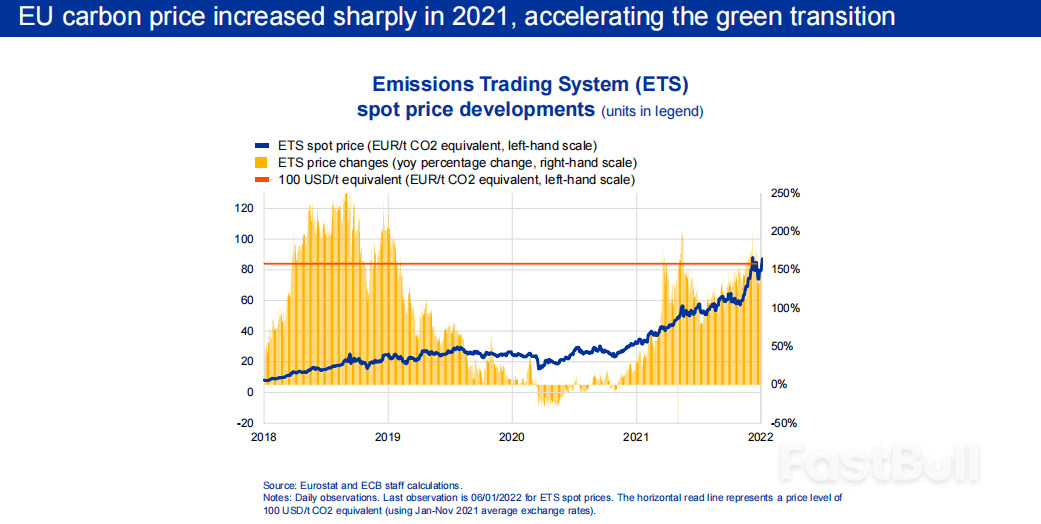
          In the EU, prices under the Emissions Trading System (ETS) have recently started to rapidly approach these levels, in part reflecting expectations that the EU is committed to delivering on the clean energy transition.Monetary policy and the green transition_1
          In early December, ETS prices reached a new record high of nearly €90 per tonne of carbon, almost three times as high as at the beginning of 2021, and a multiple of their level a few years ago.
          The measurable rise of carbon prices will help accelerate the green transition. If persistent, it strongly disincentivises new investments in fossil fuel energy carriers.
          Two parallel developments are reinforcing the effects of a higher carbon price.
          One is the European Commission’s Fit for 55 package – an ambitious set of reform proposals, which was presented in July last year.
          It includes a recommendation to significantly strengthen the ETS and widen its scope, which currently covers only around 40% of the EU’s greenhouse gas emissions. The Fit for 55 package also proposes a review of the EU Energy Taxation Directive, with the aim of raising the minimum tax rate for inefficient and polluting fuels, and lowering those for efficient and clean fuels.
          The second development is the ongoing transformation in financial markets.
          Sustainable investment is no longer a “nice to have” policy but has become an essential ingredient in most investor portfolios. Many institutional investors have started to materially reduce their exposures to fossil fuel energy producers and have redirected capital to more environmentally acceptable low-carbon alternatives.
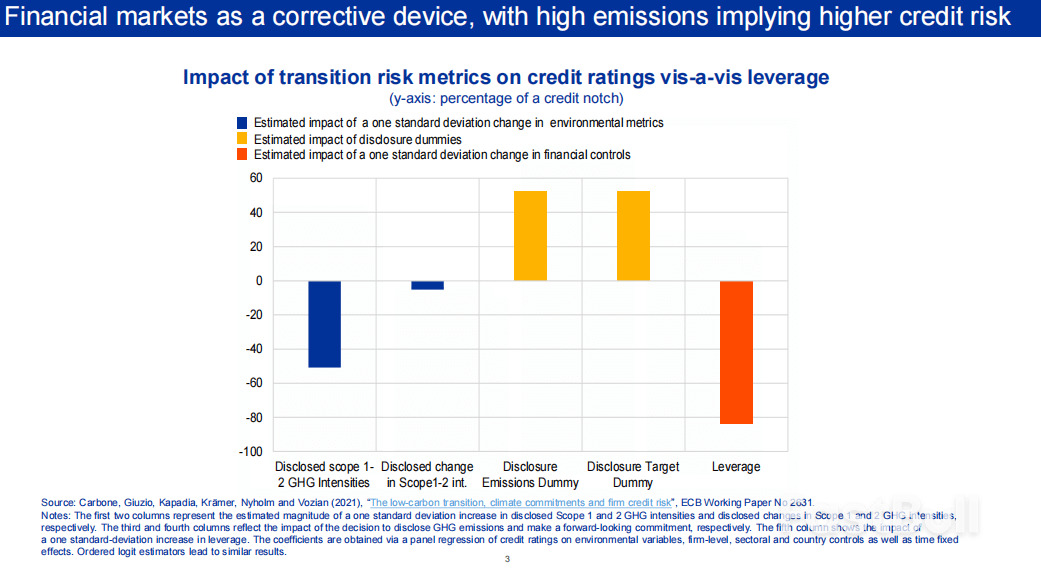
          ECB analysis shows that financial markets are increasingly serving as a corrective device.
          It finds that market prices have started to reflect the premium demanded by investors for exposures to climate-related risks. There is a positive relationship between the greenhouse gas emissions resulting from a firm’s operations and credit risk estimates, as measured by credit ratings and market-implied distance to default.
          The magnitude of the effect is economically relevant. On average, it is comparable to that of traditional determinants of credit ratings, such as leverage. The analysis also finds that disclosing emissions and emission reduction targets helps lower credit risk premia.Monetary policy and the green transition_2
          Since financial markets are global, these developments seem to have started to produce tangible climate-related effects even in countries that do not yet have a national carbon price, such as the United States.
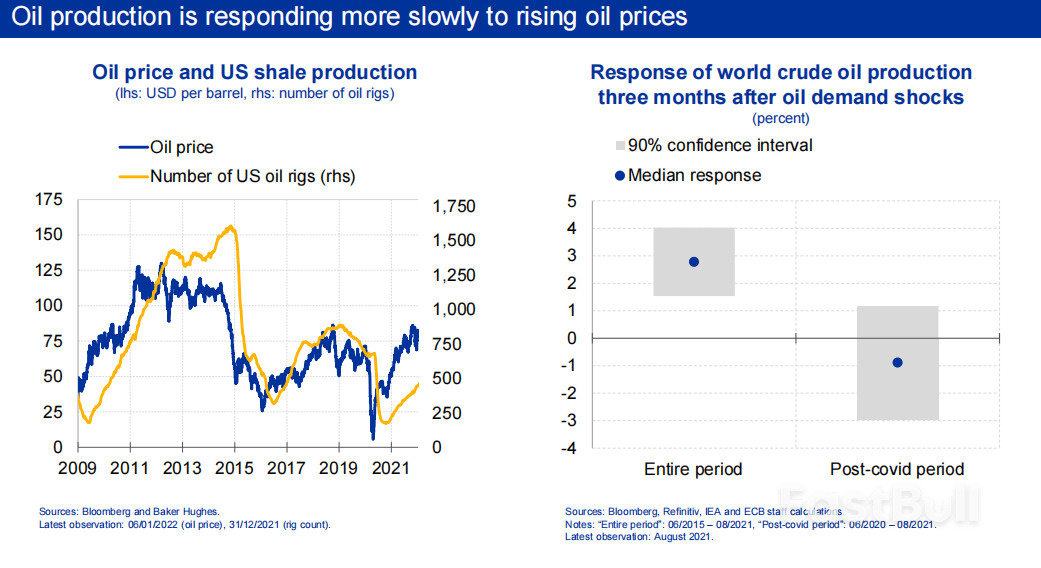
          Last year’s strong economic expansion, for example, was characterised by an atypically slow response of US shale oil production to rising oil prices, as such investments may no longer prove profitable to investors over the medium term − at least not to the same extent as they have done in the past, or as returns may become even more volatile.Monetary policy and the green transition_3
          In other words, even in the absence of a global carbon price, which remains essential, there are growing signs that the green transition is accelerating around the globe.

          Transition phase may bring protracted period of higher energy inflation

          While such relative price changes are desirable and intended, they may weigh on the economy if firms and households cannot substitute more expensive carbon-intensive energy with greener and cheaper alternatives.
          Higher carbon prices work in part by stimulating investments and innovation in low-carbon technologies. But these investments will take time. At present, renewable energy has not yet proven sufficiently scalable to meet rapidly rising demand.
          In the EU, renewable energies currently account for only around 20% of energy consumption. The Fit for 55 package proposes increasing this share in the EU to 40% by 2030.
          The combination of insufficient production capacity of renewable energies in the short run, subdued investments in fossil fuels and rising carbon prices means that we risk facing a possibly protracted transition period during which the energy bill will be rising.
          Gas prices are a case in point.
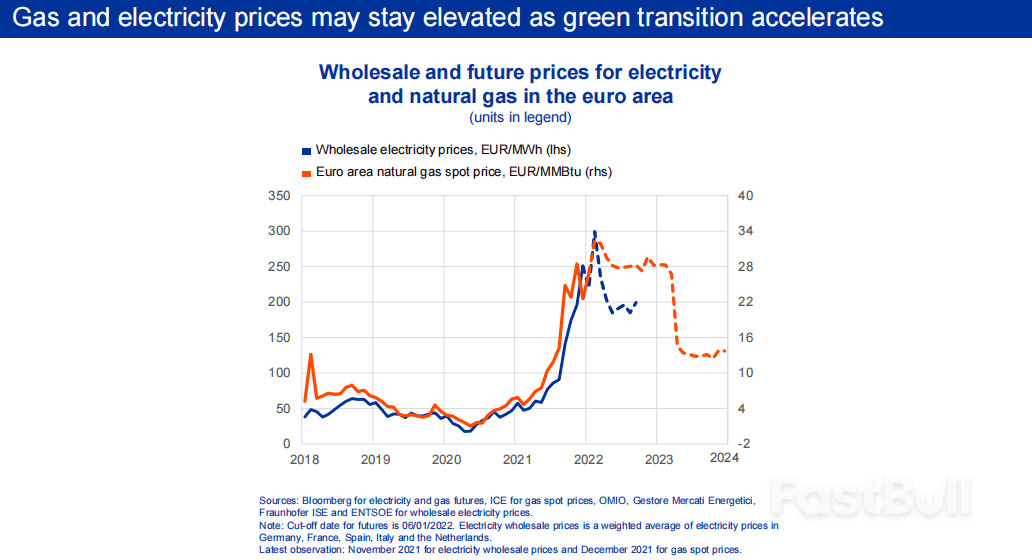
          Last year’s adverse weather conditions, which constrained the production of renewable energy, have led to significant demand and supply imbalances in the gas market as global growth accelerated, pushing gas prices to new record highs (Slide 5).
          The green transition may reinforce these imbalances in the future. In many countries, especially in Asia but also in the euro area, gas − being half as polluting as coal − is seen as a stopgap solution in the secular shift to a greener energy system.
          In the EU, rising gas prices have a direct and immediate impact on wholesale electricity prices, which are linked to the short-run marginal costs of gas-fired power plants.
          In November, wholesale electricity prices in the euro area reached €196 per megawatt hour, nearly four times as much as the average in the two years preceding the outbreak of the pandemic.Monetary policy and the green transition_4
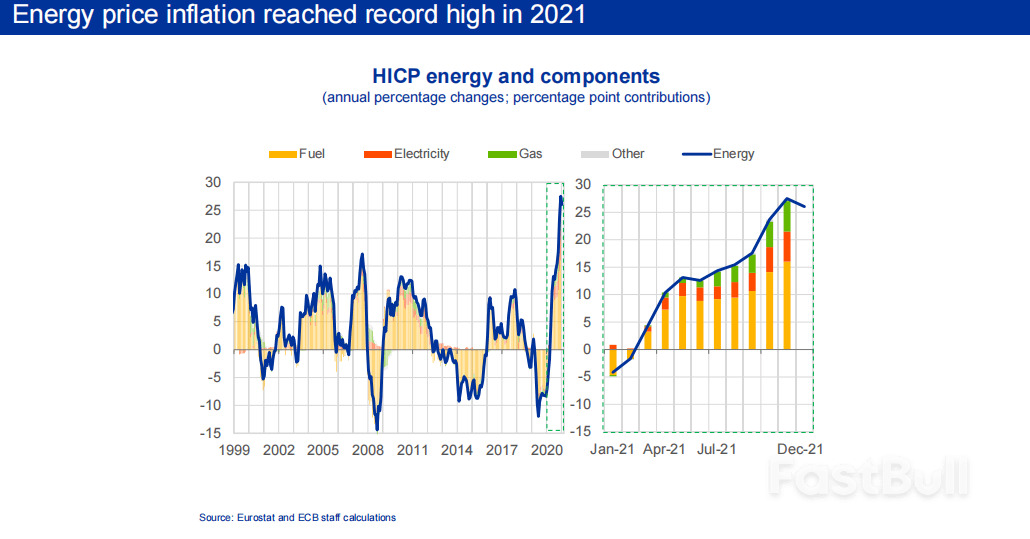
          As a result, energy price inflation in the euro area, as measured by the energy sub-index of the harmonised index of consumer prices (HICP), reached a historical high in November last year, with electricity and gas jointly accounting for more than a third of the total increase, also a new historical high.Monetary policy and the green transition_5
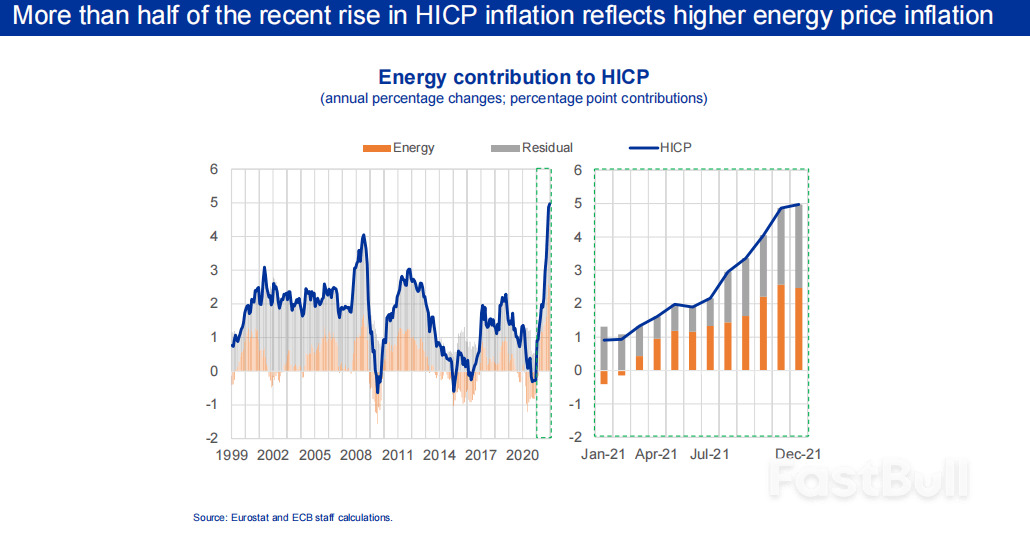
          Energy, in turn, has been the prime factor behind the sharp rise in overall consumer price inflation in the euro area, with the HICP standing at 5.0% in December 2021 according to Eurostat’s flash estimate, which was the highest level recorded since the euro was introduced in 1999. Between April and December 2021, energy contributed, on average, more than 50% to HICP inflation.Monetary policy and the green transition_6

          Governments need to advance the green transition and protect the most vulnerable

          These developments pose significant challenges to policymakers – both governments and central banks.
          On the fiscal side, many governments have responded to rising energy prices by imposing tax cuts, price caps or rebates to shield the most vulnerable households from the sharp rise in gas, fuel and electricity prices.
          Because energy expenditures are typically highly inelastic and constitute a particularly large share of income for less well-off households, carbon taxes tend to be regressive. Already in 2020, 8% of the population in the European Union (EU), or around 36 million people, said that they were unable to keep their home adequately warm.
          Energy poverty is a serious threat to the cohesion of our society and to the support for climate-related policies. Compensation measures are therefore important.
          But such measures need to be designed in a way that does not reduce the incentives to lower carbon emissions.
          It would be a serious mistake if governments, faced with rising energy prices, would backtrack from their commitment to reduce emissions. Governments should also not slow down the pace of the transition or delay the phasing out of fossil fuel subsidies.
          Two recent proposals by the European Commission go in the right direction.
          One is the introduction of the Social Climate Fund, which aims to address the social impact of higher energy prices resulting from the proposed broadening of the scope of the ETS towards the building and transport sectors, both of which will affect households in particular.
          The other is the proposed system for EU countries to jointly procure strategic reserves of gas that can be released in the event of supply shortages. At present, capacity utilisation of gas storage facilities in Europe is just under two-thirds, almost 20% below seasonal norms. Energy buffers will help limit the volatility of gas prices.

          Green transition poses upside risks to medium-term inflation

          For central banks, the challenges are equally profound.
          In the past, central banks have typically looked through energy shocks, for good reasons.
          Most of the time, such shocks have been short-lived, meaning that a policy response would have amplified the negative effect of rising energy prices on aggregate demand and output and, given the long lags in policy transmission, exerted downward pressure on inflation at a time when the shock is likely to have already faded.
          Temporary supply-side shocks therefore typically warrant a deviation from the target in the short run, provided price stability is restored over the medium term and inflation expectations remain anchored.
          This insight also motivates our policy response today. In our baseline scenario, the current energy shock is expected to fade over the projection horizon.
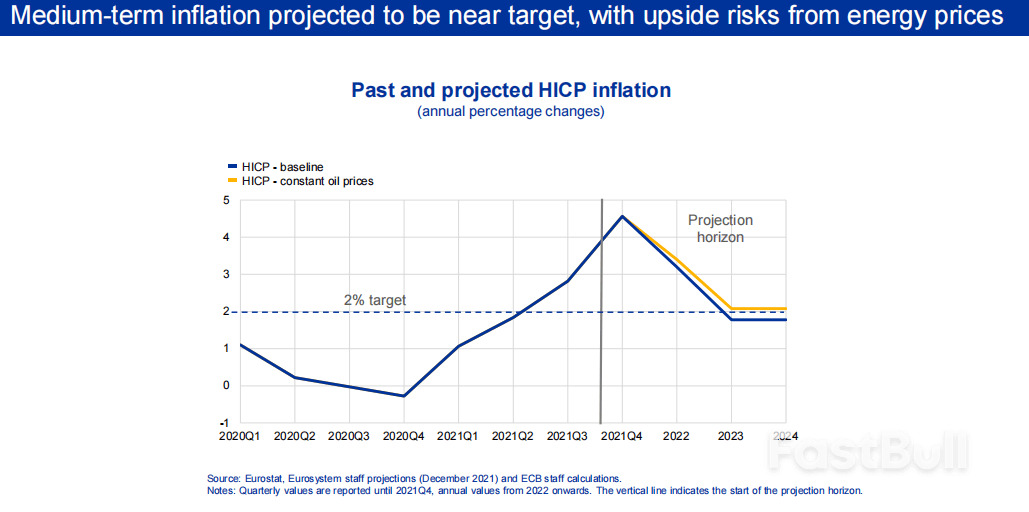
          The Eurosystem staff projections are based on gas and oil futures prices, which suggest that energy prices should decline measurably this year, thereby significantly contributing to the projected decline in HICP headline inflation over the medium term.Monetary policy and the green transition_7
          Such technical assumptions, however, are surrounded by significant uncertainty. In the past, futures prices have often significantly under- or overpredicted energy price inflation. These risks are arguably even larger today.
          To see this, it is enough to look at the profile of the projected inflation path: the decline of headline inflation to levels below 2% at the end of the projection horizon hinges on the assumption, derived from futures curves, that in 2023 and 2024 energy is not expected to contribute to headline inflation.
          History suggests that such a profile would be unusual. Since 1999, energy has contributed, on average, 0.3 percentage points to annual headline inflation. Sensitivity analysis conducted by Eurosystem staff suggests that it is enough for oil prices to remain at November 2021 levels for HICP inflation in 2024 to reach our target.
          The scale of the energy transition, and the political determination behind it, implies that these estimates could be conservative.
          Potentially protracted supply and demand imbalances related to “transition fuels”, such as gas, as well as the fact that carbon prices are likely to rise further, and to extend to more economic sectors, mean that the contribution of energy and electricity prices to consumer price inflation could be above – rather than below – its historical norm in the medium term.
          The energy transition therefore poses measurable upside risks to our baseline projection of inflation over the medium term.
          At our Governing Council meeting in December, such risks were one factor in deciding on a step-by-step reduction in the pace of asset purchases over the coming quarters.
          The pace of the adjustment, with net purchases under our asset purchase programme (APP) falling back to €20 billion by October, is consistent with what Alan Greenspan previously called a “risk-management approach” to monetary policy.
          It prescribes that central banks should not only consider the most likely future path of the economy, but the entire distribution of risks around that path with a view to keeping sufficient optionality to address all inflation contingencies.

          Rising energy prices may require a departure from a “looking through” policy

          The question, then, is: if energy inflation were to prove more persistent than currently anticipated under baseline scenario, at what point could no longer afford to look through such a shock?
          I see two scenarios where monetary policy would need to change course.

          A deanchoring of inflation expectations

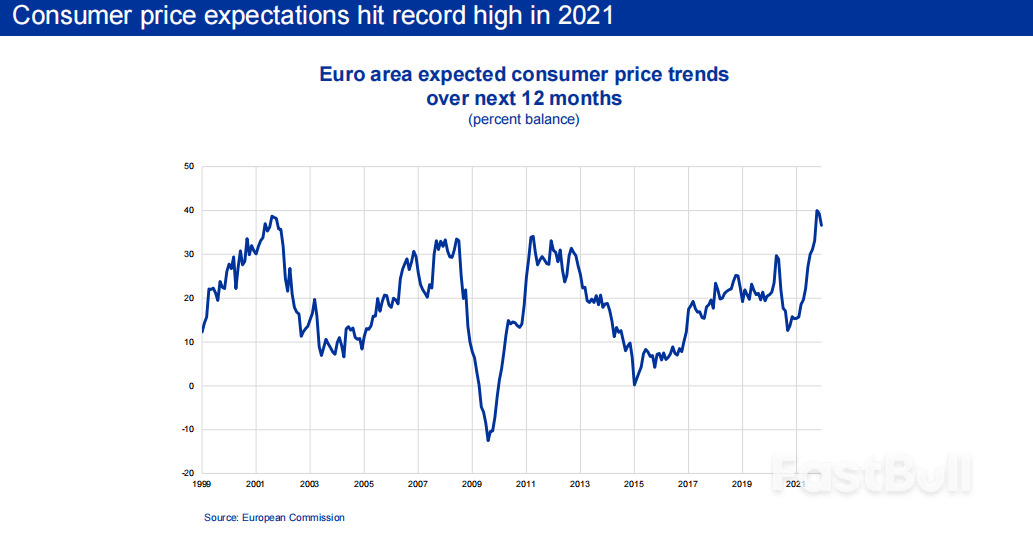
          The first would occur if we were to detect signs that inflation expectations have become deanchored. Consumer price expectations are particularly susceptible to changes in the prices of goods that we purchase frequently. Energy, and petrol in particular, are part of this basket of goods.
          Over the past year, consumer price expectations for the next 12 months have increased sharply. In October, when energy accounted for more than half of the rise in measured inflation, they reached the highest level since the euro was introduced in 1999 and have remained close to record highs since then.Monetary policy and the green transition_8
          The experience of the 1970s, when rising energy prices triggered a harmful price-wage spiral, emphatically demonstrated that allowing inflation expectations to drift away from the target makes it significantly costlier to bring inflation back to target, both in terms of lost output and higher unemployment.
          So far, however, there are no signs of broader second-round effects. Wage growth and demands by unions remain comparatively moderate. But in an environment of large excess savings and protracted supply disruptions, the energy transition may lead to inflation remaining higher for longer, thereby potentially raising the risks of inflation expectations destabilising.
          In this case, monetary policy would need to respond to, rather than look through, higher inflation to preserve price stability over the medium term.

          Not all energy shocks are alike

          The other scenario in which policy would require adjustment is if the nature of the shock were to change.
          More than a decade ago, the seminal paper by Lutz Kilian established that not all oil price shocks are alike. Their effects on the economy critically depend on the underlying source of the shock.
          Rising oil prices due to stronger aggregate demand, for example, are associated with an increase in real economic activity, calling for a different monetary policy response than if oil prices were to rise in response to supply disruptions in the oil market.
          A carbon tax may share some of the characteristics of an adverse oil supply shock. Higher energy prices could weigh on economic activity and thereby put downward pressure on consumer price inflation in the medium term. In this case, monetary policy should “look through” temporary deviations of inflation from its target.
          But a carbon tax differs from an adverse oil supply shock in two fundamental ways.
          One is that the transformation of our economies through large-scale public and private investment programmes and the subsequent adoption of more efficient and greener technologies is expected to boost, rather than weigh on, economic growth and thereby support wages and aggregate demand.
          The second aspect is that, for an energy-importing economy such as the euro area, oil supply shocks are negative terms-of-trade shocks, raising inflation and transferring wealth abroad. But a carbon tax is ultimately a domestic levy that shifts financial resources from the private to the public sector.
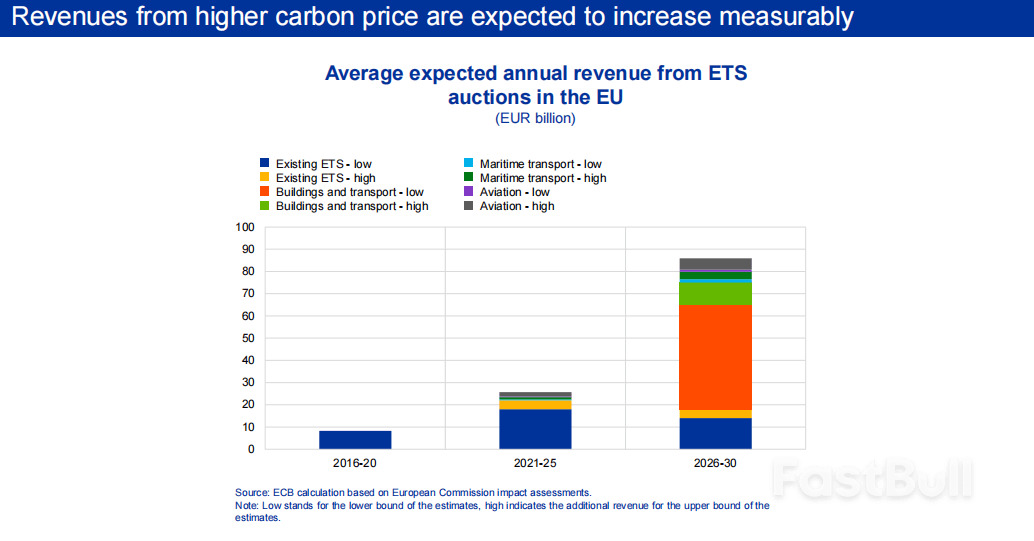
          In the EU, for example, the coming years are expected to see significant increases in ETS revenues. ECB calculations, based on European Commission data, suggest that they will rise from €14 billion in 2019 to up to €86 billion annually in the period 2026-30.Monetary policy and the green transition_9
          The proposed carbon border adjustment tax, which will put a carbon price on selected imports, as well as higher minimum tax rates on fossil fuels and other national tax initiatives, will further raise revenues.
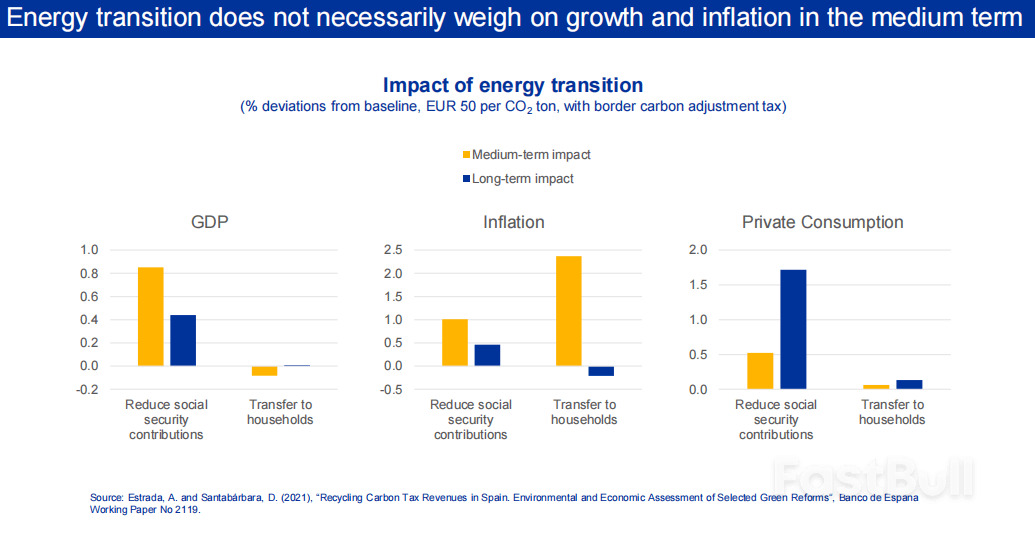
          Eurosystem economists show, based on the example of Spain, that what governments would do with such revenues will shape the response of the economy to the energy transition.
          For example, lump-sum transfers to households and electricity bill subsidies, as currently implemented by many governments, can largely cushion the negative short-term effects of rising energy prices on consumption and GDP.Monetary policy and the green transition_10
          Alternatively, if revenues are used to cut other distorting taxes, such as social security contributions, thereby reducing the labour tax wedge, a carbon tax may in fact boost economic activity, even in the short term. And since new activity will likely arise in greener sectors, part of the increase in GDP will be permanent, potentially raising inflation both over the short and medium term.
          These findings are not just hypothetical. An emerging strand of empirical evidence finds no robust negative effects of carbon taxes on GDP growth and employment. If anything, the evidence is consistent with a modest positive impact.
          As such, if the future path of energy prices threatens to push headline inflation above our target in the medium term, and if growth and demand prospects remain consistent with firm underlying price pressures, monetary policy needs to act to defend price stability.

          Conclusion

          Carbon prices in the EU and elsewhere increased sharply last year, reinforcing efforts to reduce carbon emissions as fast as possible and accelerating investments in green technologies.
          As the shift in the energy mix towards cheaper and less carbon-intensive fuels will take time, a rising carbon price, higher tax rates across a range of fossil fuels, and relatively inelastic energy demand may lead to continuous upward pressure on consumer prices in the transition period.
          These developments pose challenges to both fiscal and monetary policy.
          Governments will have to protect the most vulnerable parts of society from higher energy prices in a way that does not delay the green transition. Monetary policy, for its part, cannot afford to look through energy price increases if they pose a risk to medium-term price stability.
          This could be the case if prospects of persistently rising energy prices contribute to a deanchoring of inflation expectations, or if underlying price pressures threaten to lift inflation above our 2% target as rising carbon prices and the associated shifts in economic activity boost rather than suppress growth, employment and aggregate demand over the medium term.

          Source:ECB,Author:Isabel Schnabel

          Risk Warnings and Disclaimers
          You understand and acknowledge that there is a high degree of risk involved in trading. Following any strategies or investment methods may lead to potential losses. The content on the site is provided by our contributors and analysts for information purposes only. You are solely responsible for determining whether any trading assets, securities, strategy, or any other product is suitable for investing based on your own investment objectives and financial situation.
          Comments
          Add to Favorites
          Share

          Inflation In the UK Going Uncontrolled

          UK's CPI rose by 5.1% year-on-year in November 2021, the highest level since September 2011 and well above the 2% inflation target set by the Bank of England, a level of inflation that also ranks relatively high among European countries, with the Eurozone at 4.9%.
          In terms of disaggregated data, the largest contribution to upward inflation came from transportation (1.34 percentage points), stemming from increases in motor fuel and used car prices, followed by housing and household services (1.28 percentage points), with the rise in housing costs driven primarily by corresponding increases in natural gas and electricity prices following the increase in the energy price cap.
          In coping with inflation, the Central Bank of England raised its benchmark interest rate to 0.25% last December from a record low of 0.1%, making it the first major central bank to raise rates during the epidemic. In addition the Central Bank of England expects inflation to rise to a 6% level in the spring of 2022, compared to a previous forecast of 4%.
          The current pressure of inflation the UK faces shares the same characteristic with other countries in Europe, which are all impacted by the global supply chain shortage and the soaring energy prices under the pandemic. In spite of that, the influence of Brexit plays an important role.
          In terms of energy, the largest contributor to inflation, the UK as an island nation owns scarce resources itself, which has led to its electricity and petrol prices being quite expensive globally.
          In order to achieve energy independence, the UK can be considered a pioneer of energy reform in Europe, the development of offshore wind power in accordance with local conditions has become the inevitable choice. By the year 2020, natural gas had become the important source of electricity generation in the UK energy mix, accounting for 36% of the total, followed by wind power.
          Thus, in comparison to the other European countries like Germany, the energy supply in the UK is more prone to be influenced by factors like weather and natural gas supply.
          Last July, the average wind speed in the UK was 5.7 knots, which is slower than the average wind speed in July every year since 2001. And the wind speed in August and September was weak as well, which had resulted in the UK becoming the "epicenter" of the European energy crisis.
          After the Brexit, it was more difficult for the country to acquire supports in electricity supply from the other European partners.
          Previously in 2015, European countries jointly launched the integration of the European electricity market in order to achieve the complementary advantages of power generation energy resources and mutual assistance in electricity supply and to improve the level of interconnection of power grids in each member state.
          From the data published by the European Commission, the level of grid interconnection in the UK is only 6%, which is a significant gap compared to countries such as Luxembourg (245%), Slovenia (65%) and Croatia (69%). Improving the level of grid interconnection is of great significance to alleviate the tight supply and high price of electricity in the UK.
          According to an estimation from the National Grid plc, each additional GW of cross-country interconnected grid coverage could reduce wholesale electricity prices in the UK by 1%-2%.
          However, because of Brexit, many planned cross-border power grid construction has been slowed or even put on hold. First, Norway asked its electricity regulator to further assess the feasibility of a planned submarine power cable between the country and the United Kingdom.
          And then France grid operator RET announced that it would prioritize the development of power infrastructure links with Spain, Germany and Belgium over the next five years, with the exception of the IFA2 grid interconnection system under construction, other projects with the U.K. would be on standby, and there is no timetable for subsequent projects.
          Even though in 2019 the UK has already reduced its reliance on imported energy by 34.8%, a level lower than the average one of EU (60.5%), through two-year development of renewable energy, it might still face isolation on energy supply after the Brexit when it is constrained by the instability of wind power.

          Labor Shortage

          Despite the issue of the supply chain, the labor shortage after Brexit also exacerbated inflation in the UK. Ever since the Brexit, the population of immigrants to the UK plummeted to 2,340,000, with a surging population from the other countries in the EU leaving the UK. Superimposed on the impact of the epidemic in 2020, net migration of EU nationals was seen negative, with an estimated 94,000 more EU nationals leaving the UK than arriving.
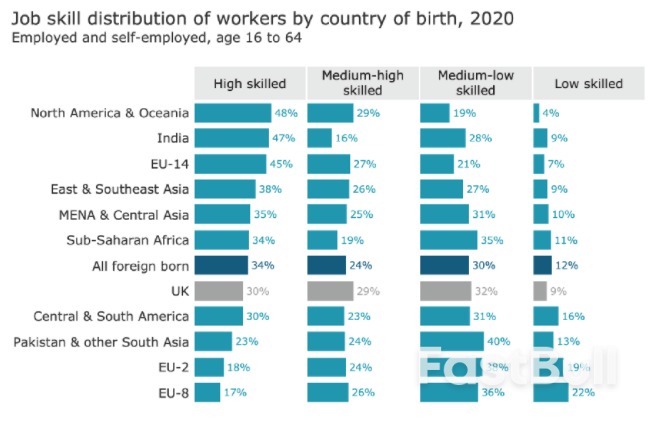
          Since 2004, the proportion of foreign workers employed in the UK has been showing a steady increase, and as of 2021 Q3 the proportion rose to 18.1%, of which the proportion of migrant workers in low-skilled jobs is 12%, higher than that of native British workers (9%), especially in the countries that joined after the EU expansion (including Bulgaria, Romania, Croatia, Slovakia, etc.), engaged in service, packaging, cleaning, transport and other low-skilled occupations are higher.
          Inflation In the UK Going Uncontrolled_1
          In terms of sectors, immigrants are more likely to work in hospitality (28%), transportation and warehousing (26%), information, communication and IT (25%), and health and social (21%).
          According to the new UK immigration law after the Brexit, UK employers who want to recruit employees from the EU must go through the Skilled Worker Route, a policy that keeps many low-skilled immigrants out of the door.
          Home Office figures show that 122,000 work-related visas were issued in the UK between March 2020 and March 2021, a decrease of 37% from the previous year.
          The loss of migrant workers, especially that of the low-skilled ones, exacerbated the supply chain issue in the UK. Enterprises have to consider raising their salary levels so as to attract more comebacks of the laborers.
          Take truck drivers for an example, many British companies complained about the lack of transport workers led to a shortage of local goods, the price of goods naturally also rose. To alleviate the truck driver crisis, the British government previously announced that temporarily by providing drivers from the EU with a three-month short-term visa.
          After the epidemic, the UK's salary growth rate shows higher than the overall level of the EU, salary increases further raised the cost of production, which is part of the pressure naturally passed on to consumers.

          Trade Friction Between the UK And the EU

          On the trade side, the additional customs procedures and inspections after Brexit have caused a significant decline in the UK's trade with the EU. According to the Centre for European Reform, an independent think tank, the UK's trade in goods with the EU is 15.7% lower as of October 2021 than it would have been had the UK remained in the EU.
          What is more worrisome is that new UK customs control regulations for EU goods will come into effect in the year 2022.
          Under the regulations, from January 1, 2022, the original 175-day delayed clearance policy will no longer apply to non-controlled goods entering the UK from the EU, and a large number of companies or freight forwarders will be required to complete a full customs import declaration at the time of clearance in the UK, with the customs department deciding whether to carry out further physical verification depending on the circumstances.
          This may further exacerbate the existing supply chain issues and thus increase the import costs and stimulate inflation. By September 2021, the price of importing goods into the UK had increased by 18.5% from the low point of the epidemic.
          Since the outbreak of the epidemic, the UK's road to fight the epidemic and economic recovery has not gone smoothly, coupled with post-Brexit uncertainty has affected the market's confidence in the pound, as the sluggish performance was shown along the way.
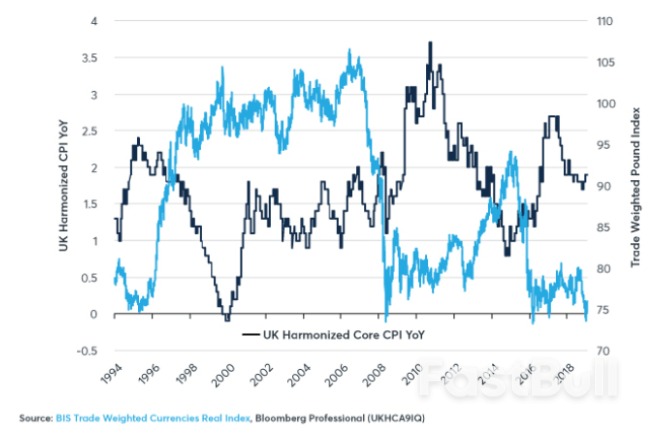
          Considering that total UK imports are 23% of GDP (2019 data), a weaker pound would also have an impact on domestic price levels. According to CME's calculations, for every 10% decline in the pound's trade-weighted index, inflation will correspondingly rise by 1%.
          Inflation In the UK Going Uncontrolled_2

          Source: wallstreet.com

          Risk Warnings and Disclaimers
          You understand and acknowledge that there is a high degree of risk involved in trading. Following any strategies or investment methods may lead to potential losses. The content on the site is provided by our contributors and analysts for information purposes only. You are solely responsible for determining whether any trading assets, securities, strategy, or any other product is suitable for investing based on your own investment objectives and financial situation.
          Comments
          Add to Favorites
          Share

          Fed Signals Readiness to Shrink Balance Sheet. Why That's A Big Deal?

          The Federal Reserve is ready to cut back its holdings of more than $8 trillion of bonds, with a readout of the Fed's meeting last month suggesting that process could get underway later this year. It signals an important difference from how the Fed managed its policy "normalization" after the 2007-2009 financial crisis, and a much swifter removal of extraordinary accommodation overall than last time. It also shows officials have greater confidence in the strength of the current economic recovery from the coronavirus pandemic than they did following the recession more than a decade ago.
          Fed Signals Readiness to Shrink Balance Sheet. Why That's A Big Deal?_1Fed Chair Jerome Powell told reporters after the Dec. 14-15 policy meeting that policymakers may be able to move more quickly than in the past when it comes to shrinking the balance sheet, observing that officials see "a significantly different economic situation that we have at the current time."
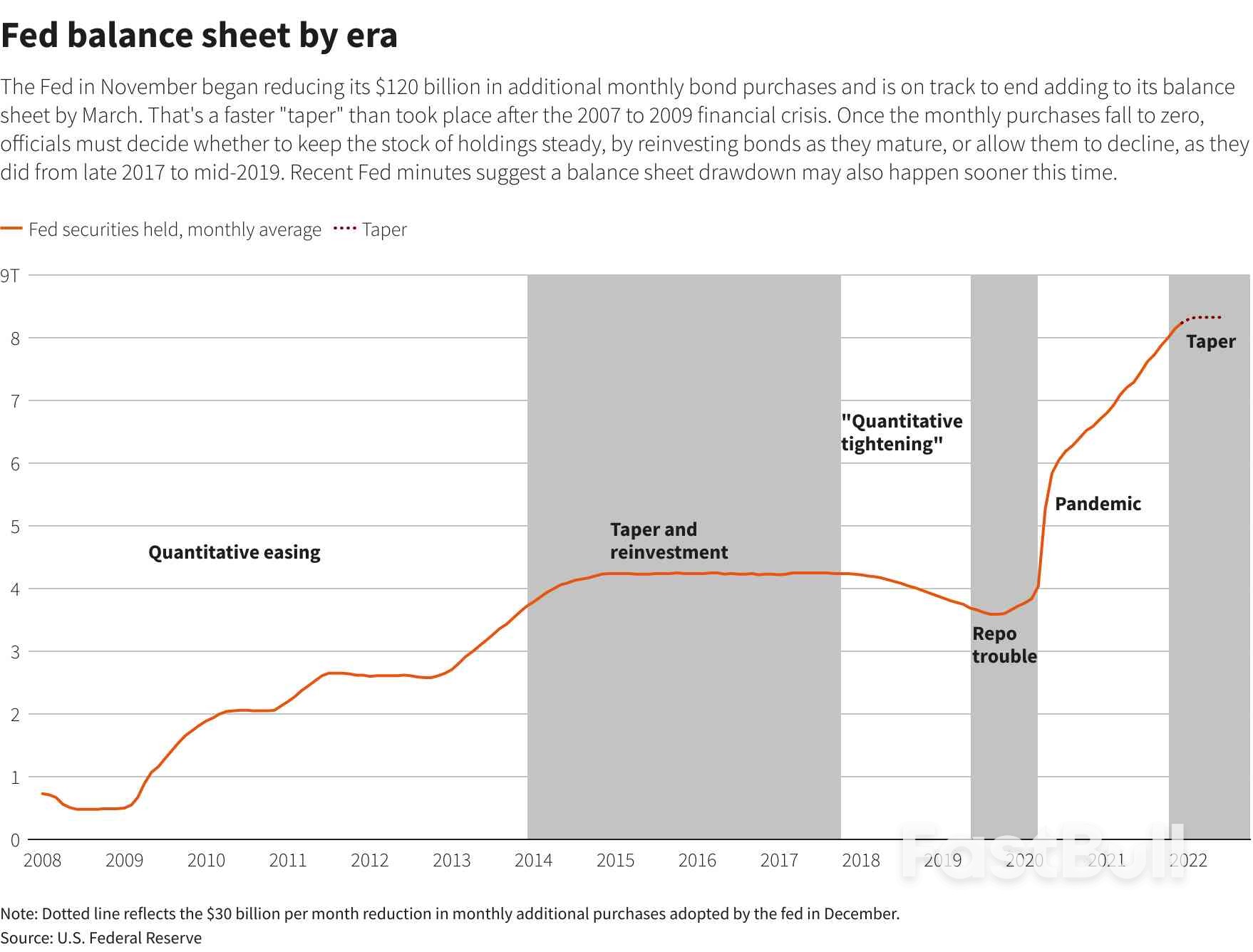
          Minutes of that meeting released on January 6 showed officials had engaged in a lengthy discussion about shrinking the central bank's balance sheet, a move that could have a significant impact. Financial markets are responding, with bond yields marching higher on the Treasury maturities sensitive to the Fed's signals on both interest rates and its balance sheet.

          1) Why are the Fed's asset holdings important?

          The Fed first started using large-scale asset purchases - also called quantitative easing, or QE - during the 2007-2009 financial crisis when it became evident that simply cutting short-term interest rates, its traditional policy lever, would not be sufficient on its own.
          Buying tens of billions of dollars at a time of Treasuries and mortgage-backed securities (MBS) helped lower longer-term borrowing costs for businesses and households, and helped mend a shattered credit market and foster economic recovery, although it took years.
          After three waves of purchase programs between 2008 and 2014, the Fed had amassed roughly $4.25 trillion of bonds, and the yield on the 10-year U.S. Treasury note, influential for rates on everything from car loans to home mortgages, had fallen from above 4% to well below 2%.
          When the coronavirus pandemic unfolded in early 2020, it caused a worldwide panic in financial markets, and the Fed again responded with massive bond purchases as well as interest rate cuts. Its bond holdings now total about $8.3 trillion, with roughly $5.65 trillion in Treasuries and $2.65 trillion in MBS. It owns roughly a quarter of the Treasury market.

          2) Why do Fed officials want to act more aggressively this time?

          Fed officials say the U.S. economy today is much stronger than it was during the previous periods when the central bank was removing policy accommodation. Officials want to make sure they have the leeway to respond to high inflation that is well above their 2% target. They're also encouraged by improvements in the labor market and are convinced they are nearing their maximum employment goal, according to the minutes of the December meeting. That would mean there is not as much of a need for the Fed's support.
          Several policymakers are also worried that the Fed's large balance sheet and its policy of keeping interest rates at an ultra-low level could be contributing to rising asset prices. Home values surged during the pandemic as some families sought to capitalize on low mortgage rates to move away from dense city centers. With equity markets recently reaching record highs, officials also do not want to be seen as fueling unwanted asset bubbles.

          Fed Signals Readiness to Shrink Balance Sheet. Why That's A Big Deal?_2Chart: Overview of the Fed's balance sheet over several major periods

          3) What happened when the Fed reduced its balance sheet last time?

          When the Fed stopped adding to its bond holdings at the end of 2014, it initially held off on reducing the size of its balance sheet for years, even after it had begun raising interest rates in late 2015. Officials viewed the recovery then as much softer than the current rebound from the short but deep recession in early 2020.
          The Fed finally started the shrinkage in 2018, allowing a certain number of bonds to mature each month without the repaid principal being reinvested in new securities, a process that became known as quantitative tightening, or QT. About $650 billion of bonds had rolled off the Fed's portfolio by September 2019 when it was forced to abruptly stop QT after a key short-term credit market went haywire and it became evident that too much money had been drained from the system.

          4) The last QT ended with upheaval in a key market. Can this happen again?

          In 2019, the level of reserves that banks held with the Fed fell too low. That cash shortage led to a spike in short-term borrowing rates and required the Fed to intervene in money markets to keep them functioning.
          Many financial firms are now dealing with the opposite problem – too much cash. The Fed also has a new tool called a "standing repo facility" - or SRF - that can be a backstop for companies that are short of cash, although it has never operated in a QT environment.
          Minutes from last month's policy meeting show Fed officials remain uncertain about just how far they can go in draining reserves, and they say they will keep a close eye on money markets for signs of any cash crunch as they shrink the bond holdings.
          Still, several officials said the SRF could lower demand for reserves, according to the minutes, potentially allowing for a smaller balance sheet than would be manageable in the absence of such a tool.

          Source: Reuters

          Risk Warnings and Disclaimers
          You understand and acknowledge that there is a high degree of risk involved in trading. Following any strategies or investment methods may lead to potential losses. The content on the site is provided by our contributors and analysts for information purposes only. You are solely responsible for determining whether any trading assets, securities, strategy, or any other product is suitable for investing based on your own investment objectives and financial situation.
          Comments
          Add to Favorites
          Share

          Weak Nonfarm Payrolls But Higher Rate Hike Expectations

          Jason
          The U.S. Bureau of Labor Statistics (BLS) released its nonfarm payrolls report on January 7. The December nonfarm payrolls increased by 199,000 new jobs, well below market forecasts of 400,000.
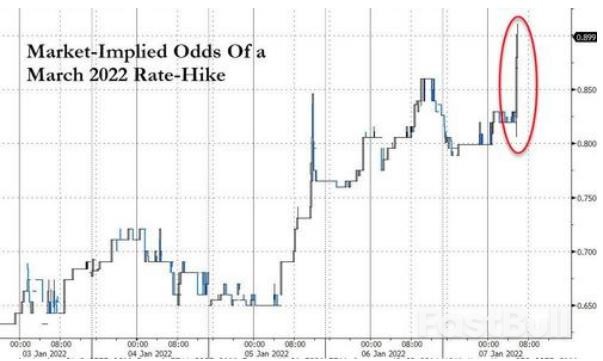
          However, the market expected a 90% probability of a Fed rate hike in March (80% on Wednesday and 50% the week before) after this employment report. Currently, several big Wall Street banks, including JP Morgan, Deutsche Bank, and Citi, support a Fed rate hike in March. How is it possible that the Fed is more likely to raise rates when employment rises less than expected?
          Normally, the Fed should slow down the pace of tightening and continue to support the economy when employment rises less than expected.
          What worries the market most is the staggering increase of average hourly earnings by 0.6% in November compared to the previous data. In such a situation, the Fed will ignore the weaker-than-expected overall employment data. Former Fed Chairs Ben Bernanke and Yellen often consider inflation as transitory unless wages and salaries rise, which shows salary inflation is coming.
          Wall Street speculates on the full-year employment numbers by adding up the monthly employment numbers for 12 months and comparing them to the past few years. The resulting data showed that the U.S. added a record 6.4 million jobs in 2021 (more than any other year).
          This is obviously a script devised by the White House long ago as they had already added up the employment numbers for the previous 11 months which was already a record before the December data was released. No matter how bad the data was in December, the total employment increase in 2021 hit a record-breaking high.
          Biden took his prepared draft and gave a classic and Trump-esque speech after the data was released:

          The Biden economic plan is working after a report showed the U.S. economy added a record 6.4 million jobs in 2021 -- rebounding strongly from unprecedented losses in 2020 caused by the pandemic. That’s the most jobs in any calendar year by any president in history. America is back to work.

          I’m confident that the Federal Reserve will act to achieve their dual goals of full employment and stable prices and make sure that price increases do not become entrenched over the long term, with the independence that they need. But the best way that I as president and the Congress as a legislature can tackle high prices, is by building a more productive economy with greater capacity to deliver for the American people. (Implying a Fed rate hike which might have been set long before Powell was nominated as Fed Chair for a second term).

          By the way, the stock market -- the last guy’s measure of everything -- it’s about 20% higher than it was when my predecessor was there. It has hit record after record after record on my watch while making things more equitable for working-class people. (Disparaging Trump).

          Heading into a midterm election year, Biden's approval rating has fallen below 50%. Americans don't approve of what he's done economically, so he can only boast about the nonfarm data. This is very Trump, but Biden is not as frank as Trump.
          This is the last nonfarm payrolls report available before the Fed releases its interest rate resolution on January 27. With less than 20 days left, a March rate hike has been set, and nothing can be overturned in a short time.
          This is confirmed by the statements of three senior Fed officials this week.
          Minneapolis Federal Reserve Bank President Neel Kashkari (the most dovish Fed official) wrote that he supports two rate hikes this year to address the risks posed by inflation, which is higher and more persistent than he expected.
          St. Louis Federal Reserve Bank President James Bullard (the most hawkish Fed official) said that the Fed could start raising rates as early as March and then shrink its balance sheet as the next step to curb inflation. The subsequent rate hikes in 2022 could be brought forward or pushed back, depending on inflation. QE will end in the coming months, but the Federal Open Market Committee (FOMC) could also choose to allow passive balance-sheet runoff in order to reduce monetary accommodation at an appropriate pace. Shrinking the balance sheet may be one of the next steps.
          San Francisco Federal Reserve Bank President Mary Daly said she favors raising interest rates “gradually” and moving on to shrinking the Fed's balance sheet more quickly than in the last tightening round. “I would not prefer to do it simultaneously,” she said, adding “you could imagine adjusting the balance sheet” after “one or two hikes.”
          As it stands, the Fed's policy may be more aggressive than expected, with more aggressive rate hikes and more aggressive tapering, because the Fed still grossly underestimates the inflation.

          Source: Wall Street Info


          Risk Warnings and Disclaimers
          You understand and acknowledge that there is a high degree of risk involved in trading. Following any strategies or investment methods may lead to potential losses. The content on the site is provided by our contributors and analysts for information purposes only. You are solely responsible for determining whether any trading assets, securities, strategy, or any other product is suitable for investing based on your own investment objectives and financial situation.
          Comments
          Add to Favorites
          Share
          FastBull
          Copyright © 2025 FastBull Ltd

          728 RM B 7/F GEE LOK IND BLDG NO 34 HUNG TO RD KWUN TONG KLN HONG KONG

          TelegramInstagramTwitterfacebooklinkedin
          App Store Google Play Google Play
          Products
          Charts

          Chats

          Q&A with Experts
          Screeners
          Economic Calendar
          Data
          Tools
          Membership
          Features
          Function
          Markets
          Copy Trading
          Latest Signals
          Contests
          News
          Analysis
          24/7
          Columns
          Education
          Company
          Careers
          About Us
          Contact Us
          Advertising
          Help Center
          Feedback
          User Agreement
          Privacy Policy
          Business

          White Label

          Data API

          Web Plug-ins

          Poster Maker

          Affiliate Program

          Risk Disclosure

          The risk of loss in trading financial instruments such as stocks, FX, commodities, futures, bonds, ETFs and crypto can be substantial. You may sustain a total loss of the funds that you deposit with your broker. Therefore, you should carefully consider whether such trading is suitable for you in light of your circumstances and financial resources.

          No decision to invest should be made without thoroughly conducting due diligence by yourself or consulting with your financial advisors. Our web content might not suit you since we don't know your financial conditions and investment needs. Our financial information might have latency or contain inaccuracy, so you should be fully responsible for any of your trading and investment decisions. The company will not be responsible for your capital loss.

          Without getting permission from the website, you are not allowed to copy the website's graphics, texts, or trademarks. Intellectual property rights in the content or data incorporated into this website belong to its providers and exchange merchants.

          Not Logged In

          Log in to access more features

          FastBull Membership

          Not yet

          Purchase

          Become a signal provider
          Help Center
          Customer Service
          Dark Mode
          Price Up/Down Colors

          Log In

          Sign Up

          Position
          Layout
          Fullscreen
          Default to Chart
          The chart page opens by default when you visit fastbull.com