
Markets
News
Analysis
User
24/7
Economic Calendar
Education
Data
- Names
- Latest
- Prev


Signal Accounts for Members
All Signal Accounts
All Contests


U.K. Trade Balance Non-EU (SA) (Oct)A:--
F: --
P: --
U.K. Trade Balance (Oct)A:--
F: --
P: --
U.K. Services Index MoMA:--
F: --
P: --
U.K. Construction Output MoM (SA) (Oct)A:--
F: --
P: --
U.K. Industrial Output YoY (Oct)A:--
F: --
P: --
U.K. Trade Balance (SA) (Oct)A:--
F: --
P: --
U.K. Trade Balance EU (SA) (Oct)A:--
F: --
P: --
U.K. Manufacturing Output YoY (Oct)A:--
F: --
P: --
U.K. GDP MoM (Oct)A:--
F: --
P: --
U.K. GDP YoY (SA) (Oct)A:--
F: --
P: --
U.K. Industrial Output MoM (Oct)A:--
F: --
P: --
U.K. Construction Output YoY (Oct)A:--
F: --
P: --
France HICP Final MoM (Nov)A:--
F: --
P: --
China, Mainland Outstanding Loans Growth YoY (Nov)A:--
F: --
P: --
China, Mainland M2 Money Supply YoY (Nov)A:--
F: --
P: --
China, Mainland M0 Money Supply YoY (Nov)A:--
F: --
P: --
China, Mainland M1 Money Supply YoY (Nov)A:--
F: --
P: --
India CPI YoY (Nov)A:--
F: --
P: --
India Deposit Gowth YoYA:--
F: --
P: --
Brazil Services Growth YoY (Oct)A:--
F: --
P: --
Mexico Industrial Output YoY (Oct)A:--
F: --
P: --
Russia Trade Balance (Oct)A:--
F: --
P: --
Philadelphia Fed President Henry Paulson delivers a speech
Canada Building Permits MoM (SA) (Oct)A:--
F: --
P: --
Canada Wholesale Sales YoY (Oct)A:--
F: --
P: --
Canada Wholesale Inventory MoM (Oct)A:--
F: --
P: --
Canada Wholesale Inventory YoY (Oct)A:--
F: --
P: --
Canada Wholesale Sales MoM (SA) (Oct)A:--
F: --
P: --
Germany Current Account (Not SA) (Oct)A:--
F: --
P: --
U.S. Weekly Total Rig CountA:--
F: --
P: --
U.S. Weekly Total Oil Rig CountA:--
F: --
P: --
Japan Tankan Large Non-Manufacturing Diffusion Index (Q4)--
F: --
P: --
Japan Tankan Small Manufacturing Outlook Index (Q4)--
F: --
P: --
Japan Tankan Large Non-Manufacturing Outlook Index (Q4)--
F: --
P: --
Japan Tankan Large Manufacturing Outlook Index (Q4)--
F: --
P: --
Japan Tankan Small Manufacturing Diffusion Index (Q4)--
F: --
P: --
Japan Tankan Large Manufacturing Diffusion Index (Q4)--
F: --
P: --
Japan Tankan Large-Enterprise Capital Expenditure YoY (Q4)--
F: --
P: --
U.K. Rightmove House Price Index YoY (Dec)--
F: --
P: --
China, Mainland Industrial Output YoY (YTD) (Nov)--
F: --
P: --
China, Mainland Urban Area Unemployment Rate (Nov)--
F: --
P: --
Saudi Arabia CPI YoY (Nov)--
F: --
P: --
Euro Zone Industrial Output YoY (Oct)--
F: --
P: --
Euro Zone Industrial Output MoM (Oct)--
F: --
P: --
Canada Existing Home Sales MoM (Nov)--
F: --
P: --
Euro Zone Total Reserve Assets (Nov)--
F: --
P: --
U.K. Inflation Rate Expectations--
F: --
P: --
Canada National Economic Confidence Index--
F: --
P: --
Canada New Housing Starts (Nov)--
F: --
P: --
U.S. NY Fed Manufacturing Employment Index (Dec)--
F: --
P: --
U.S. NY Fed Manufacturing Index (Dec)--
F: --
P: --
Canada Core CPI YoY (Nov)--
F: --
P: --
Canada Manufacturing Unfilled Orders MoM (Oct)--
F: --
P: --
Canada Manufacturing New Orders MoM (Oct)--
F: --
P: --
Canada Core CPI MoM (Nov)--
F: --
P: --
Canada Manufacturing Inventory MoM (Oct)--
F: --
P: --
Canada CPI YoY (Nov)--
F: --
P: --
Canada CPI MoM (Nov)--
F: --
P: --
Canada CPI YoY (SA) (Nov)--
F: --
P: --
Canada Core CPI MoM (SA) (Nov)--
F: --
P: --


No matching data
Latest Views
Latest Views
Trending Topics
Top Columnists
Latest Update
White Label
Data API
Web Plug-ins
Affiliate Program
View All

No data
China will press on with levying anti-dumping duties on imports of stainless-steel products, including from Indonesia, as it seeks to protect a domestic industry battered by persistent oversupply and trade uncertainty.
Some traders and industry executives had expressed hopes the world’s largest metal consumer would reconsider its tariffs, particularly for Indonesia, given the role that Chinese companies have played in expanding nickel and stainless steel production in Indonesia, today among the top suppliers of both.
Beijing, however, has now ruled that lifting the measures would risk hurting its industry at home, according to a statement posted on the commerce ministry website on Monday. The levies — which cover stainless steel billet and hot-rolled coil from the European Union, the UK, South Korea and Indonesia — will remain in place for another five years.
When they were introduced in July 2019, China’s tariffs surprised the industry, given almost all stainless steel products from Indonesia in particular come from local ventures of large Chinese companies including Tsingshan Holding Group Co. Together, the two nations produce close to three-quarters of the world’s stainless steel.
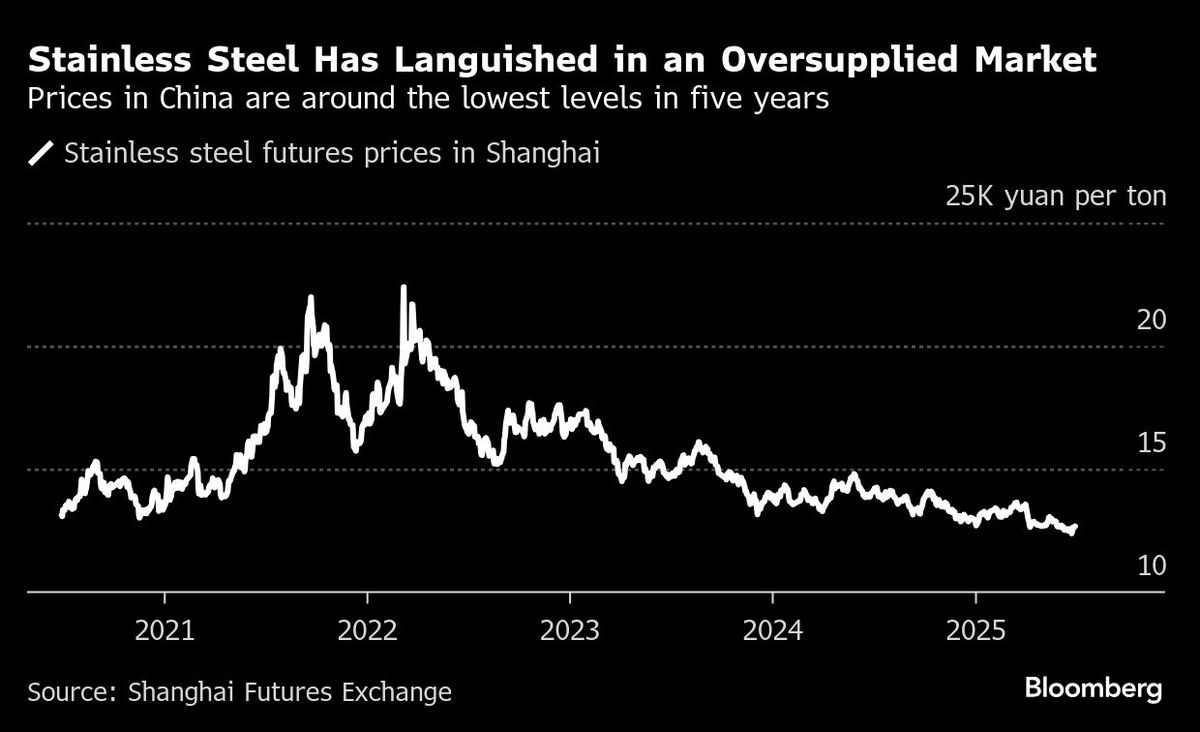
But China’s slowing economy has hit demand, and both countries are threatened by the Trump administration’s aggressive tariff policies. Both nickel traded on the London Metal Exchange and stainless steel in Shanghai hit their five-year lows earlier this year amid sluggish demand and squeezed production margins. Tsingshan has been compelled to start suspending some stainless steel production at the Indonesia Morowali Industrial Park on the island of Sulawesi.
The levies on Indonesian producers will remain unchanged at 20.2%, China’s statement said. The trade ministry also kept a 43% duty on all stainless-steel products from EU and UK companies and 103.1% for most South Korean companies, according to the statement. Levies on products by Posco Holdings Inc, which has a price commitment with the Chinese government, will be kept at 23.1%.
In the domestic stainless market, privately owned Tsingshan and rival Jiangsu Delong Nickel Industry Co compete with state-owned titan China Baowu Steel Group Co.
Donald Trump's April tariff barrage felt like the height of hubris. It infuriated allies, damaged his popularity at home and triggered financial-market chaos so acute the whole thing was paused within days — the latest sign of America’s Icarus-like tendency to try to remake the world every few decades. Yet three months on, as the deadline for a compromise looms, Europe’s own syndrome risks emerging: a tendency to look more like a collection of Asterix villages than a cohesive whole.
It’s now looking increasingly likely that the European Union’s 27 members, whose common trade policy is led by Brussels, will be faced with what is called an “asymmetric” deal. There will be no removal of all tariffs imposed or threatened by Trump, including a baseline levy expected at 10%. If that’s the case, the UK’s bare-bones deal — which failed to cancel its own 10% tariff or a 25% levy on steel and aluminum — has become a kind of precedent: a few carve-outs, a gushing tweet and hope that Trump moves on. Canada has also become a precedent, withdrawing its digital services tax on tech companies after the US made it a red line for talks. Financial markets see cause for cheer as a de-escalation path takes form.
The question then becomes whether — or how — the EU retaliates. Aside from responding to the economic hit against an export flow worth $605.9 billion last year, from Airbus SE airliners to Volkswagen AG cars, not doing so might be a signal that bullying works. Last week, NATO allies agreed to more than double defense spending targets to 5% of gross domestic product (of which 1.5% would go on related infrastructure), addressing a Trumpian bugbear while also ensuring more orders for US arms. G-7 allies also appear to have offered concessions on global taxation of US companies in return for the dropping of a “revenge tax.” The EU has been offering other carrots for months, from buying more US imports to cooperating on China. Hence why Danish Prime Minister Mette Frederiksen warned it might soon be time to “respond in kind.”
The thing about retaliation is that it requires unity, especially if the idea is to go beyond goods and into services provided by dominant US firms like Alphabet Inc. or Amazon.com Inc. And even if the EU Commission is taking a strident tone, the combination of geopolitical risk and weak economic growth doesn’t generally inspire unity. Few heads seem willing to rise above the parapet. German Chancellor Friedrich Merz wants to get on with delivering on lofty promises of national renewal, not get bogged down in a tariff war. Italy’s Prime Minister Giorgia Meloni might want to preserve her relationship with Trump, which was on display at the North Atlantic Treaty Organization summit. Countries to the east, closer to the war in Ukraine, are more focused on access to American hard power, as displayed in spectacular fashion in Iran.
And while French President Emmanuel Macron will want to play the role of trade warrior, even his administration might see the value of a focus on securing protections for its own industries like aerospace. Spain, the most recent target of a verbal lashing from Trump, seems somewhat isolated and hasn’t rallied much of a wave of solidarity. During the Brexit saga, the UK’s oft-repeated mantra was “no deal is better than a bad deal.” Nobody is saying that in Brussels these days, even as officials try to uphold red lines on defending existing regulation. Such is life when faced with the closest thing the world has to a superpower — and when dependency on said superpower runs deep, from security to technology.
To be clear, the EU is hardly powerless in trade; and after deepening cooperation with Japan and Canada, there will be added impetus to cut new deals elsewhere. As for the US, a last dash for the finish line may produce a better outcome than the one currently on the table.
But either way, the lesson for the EU is it must address the dependencies that help the bullying work. That will require collective action: on a defense industrial base that reduces fragmentation and increases innovation, on a capital market that’s failing to create and scale up new companies and on the technological gaps that make talk of sovereignty unconvincing. Icarus syndromes are quickly shaken off, but Asterix syndromes last forever.
Britain's economy expanded at its fastest pace in a year in the first three months of 2025 as homebuyers rushed to beat a deadline on property purchases and manufacturers sped up output ahead of U.S. President Donald Trump's higher import tariffs.
Gross domestic product grew by 0.7% in the first three months of 2025, confirming a preliminary estimate and the fastest pace since the first quarter of 2024, the Office for National Statistics said.
Growth in March alone was revised up to 0.4% from a previous reading of 0.2% but the increase was not enough to bump up the quarterly growth reading, the ONS said.
Household expenditure grew by 0.4% in the January-to-March period, revised up from an initial estimate of an increase of 0.2%, driven by housing and household goods and services as well transport.
The jump in Britain's economic output in early 2025 is not expected to last into the rest of this year.
Data has already shown that gross domestic product fell by 0.3% in April from March although the drop was exacerbated by one-off factors.
Britain's property market saw a sharp increase in activity in the run-up to the March 31 expiry of tax break for some homebuyers.
The ONS said manufacturing grew by a strong 1.1% in the first quarter - ahead of the increase in U.S. import tariffs in April - compared the last three months of 2024.
"The saving ratio fell for the first time in two years this quarter, as rising costs for items such as fuel, rent and restaurant meals contributed to higher spending, although it remains relatively strong," ONS director of economic statistics Liz McKeown said.
White Label
Data API
Web Plug-ins
Poster Maker
Affiliate Program
The risk of loss in trading financial instruments such as stocks, FX, commodities, futures, bonds, ETFs and crypto can be substantial. You may sustain a total loss of the funds that you deposit with your broker. Therefore, you should carefully consider whether such trading is suitable for you in light of your circumstances and financial resources.
No decision to invest should be made without thoroughly conducting due diligence by yourself or consulting with your financial advisors. Our web content might not suit you since we don't know your financial conditions and investment needs. Our financial information might have latency or contain inaccuracy, so you should be fully responsible for any of your trading and investment decisions. The company will not be responsible for your capital loss.
Without getting permission from the website, you are not allowed to copy the website's graphics, texts, or trademarks. Intellectual property rights in the content or data incorporated into this website belong to its providers and exchange merchants.
Not Logged In
Log in to access more features

FastBull Membership
Not yet
Purchase
Log In
Sign Up