• Trade
  • Markets
  • Copy
  • Contests
  • News
  • 24/7
  • Calendar
  • Q&A
  • Chats
Trending
Screeners
SYMBOL
LAST
BID
ASK
HIGH
LOW
NET CHG.
%CHG.
SPREAD
SPX
S&P 500 Index
6870.39
6870.39
6870.39
6895.79
6858.28
+13.27
+ 0.19%
--
DJI
Dow Jones Industrial Average
47954.98
47954.98
47954.98
48133.54
47871.51
+104.05
+ 0.22%
--
IXIC
NASDAQ Composite Index
23578.12
23578.12
23578.12
23680.03
23506.00
+72.99
+ 0.31%
--
USDX
US Dollar Index
98.950
99.030
98.950
99.060
98.740
-0.030
-0.03%
--
EURUSD
Euro / US Dollar
1.16426
1.16443
1.16426
1.16715
1.16277
-0.00019
-0.02%
--
GBPUSD
Pound Sterling / US Dollar
1.33312
1.33342
1.33312
1.33622
1.33159
+0.00041
+ 0.03%
--
XAUUSD
Gold / US Dollar
4197.91
4197.91
4197.91
4259.16
4191.87
-9.26
-0.22%
--
WTI
Light Sweet Crude Oil
59.809
60.061
59.809
60.236
59.187
+0.426
+ 0.72%
--

Community Accounts

Signal Accounts
--
Profit Accounts
--
Loss Accounts
--
View More

Become a signal provider

Sell trading signals to earn additional income

View More

Guide to Copy Trading

Get started with ease and confidence

View More

Signal Accounts for Members

All Signal Accounts

Best Return
  • Best Return
  • Best P/L
  • Best MDD
Past 1W
  • Past 1W
  • Past 1M
  • Past 1Y

All Contests

  • All
  • Trump Updates
  • Recommend
  • Stocks
  • Cryptocurrencies
  • Central Banks
  • Featured News
Top News Only
Share

Egypt's Net Foreign Reserves Rise To $50.216 Billion In November From $50.071 Billion In October

Share

Uganda Opposition Candidate Says He Was Beaten By Security Forces

Share

Benin's Foreign Minister Bakari:Large Part Of The Army And National Guard Still Loyalist And Are Controlling The Situation

Share

Russian Defence Ministry: Russian Troops Complete Capture Of Rivne In Ukraine's Donetsk Region

Share

Russian Defence Ministry: Russian Troops Carried Out Group Strike Overnight On Ukraine's Transport Infrastructure Facilities, Fuel And Energy Complexes, And Long-Range Drone Complexes

Share

Russian Defence Ministry: Russian Forces Capture Kucherivka In Ukraine's Kharkiv Region

Share

US Envoy Kellogg Says Ukraine Peace Deal Is Really Close

Share

US Embassy In India- US Under Secretary Of State For Political Affairs Allison Hooker Will Visit New Delhi And Bengaluru, India, From December 7 To 11

Share

Japan Prime Minister Takaichi: To Respond Calmly And Resolutely To The Development

Share

UBS Plans To Cut Further 10000 Jobs By 2027, Swiss Newspaper Sonntagsblick Reports

Share

India Clean Energy Ministry: No Advisory Issued To Pause Or Halt New Clean Enegry Financing

Share

[Win Surges Over 90% In 24 Hours, Market Cap Reaches $57.5 Million] December 7Th, According To Htx Market Data, Win Surged Over 90% In The Past 24 Hours, Currently Trading At $0.0000575, With A Market Cap Of $57.5 Million

Share

Kuwait August CPI +0.07% Month-On-Month

Share

Kuwait August CPI +2.39% Year-On-Year

Share

Chinese Navy: Japan's Related Claims Are Completely Inconsistent With The Facts

Share

Chinese Navy: Japanese Self-Defense Force Aircraft Repeatedly Approached And Disrupted The Chinese Navy's Training Areas

Share

[Lilly's Mufonta® (Telborpeptide) Included In National Medical Insurance For The First Time] On December 7th, The 2025 National Basic Medical Insurance, Maternity Insurance And Work Injury Insurance Drug Catalog Was Released, And Lilly's Gip/Glp-1 Ra Mufonta® (Telborpeptide Injection) Was Successfully Included. The Medical Insurance Coverage For Telborpeptide Applies To Glycemic Control In Adult Patients With Type 2 Diabetes: Adult Patients With Type 2 Diabetes Whose Glycemic Control Remains Inadequate Despite Treatment With Metformin And/or Sulfonylureas, In Addition To Diet And Exercise. The New Catalog Will Officially Take Effect On January 1, 2026

Share

Russia's Defence Ministry: Russia's Air Defence Units Destroy 77 Ukrainian Drones Overnight

Share

Australia Defence Minister Marles: We Want Most Productive Relationship We Can Achieve With China

Share

Japan Defence Minister Koizumi: Discussed With Marles Our Common Serious Concerns About Situation In South China Sea, East China Sea

TIME
ACT
FCST
PREV
Euro Zone Employment YoY (SA) (Q3)

A:--

F: --

P: --

Euro Zone GDP Final YoY (Q3)

A:--

F: --

P: --

Euro Zone GDP Final QoQ (Q3)

A:--

F: --

P: --

Euro Zone Employment Final QoQ (SA) (Q3)

A:--

F: --

P: --

Euro Zone Employment Final (SA) (Q3)

A:--

F: --

P: --
Brazil PPI MoM (Oct)

A:--

F: --

P: --

Mexico Consumer Confidence Index (Nov)

A:--

F: --

P: --

Canada Unemployment Rate (SA) (Nov)

A:--

F: --

P: --

Canada Labor Force Participation Rate (SA) (Nov)

A:--

F: --

P: --

Canada Employment (SA) (Nov)

A:--

F: --

P: --

Canada Part-Time Employment (SA) (Nov)

A:--

F: --

P: --

Canada Full-time Employment (SA) (Nov)

A:--

F: --

P: --

U.S. Personal Income MoM (Sept)

A:--

F: --

P: --

U.S. PCE Price Index YoY (SA) (Sept)

A:--

F: --

P: --

U.S. PCE Price Index MoM (Sept)

A:--

F: --

P: --

U.S. Personal Outlays MoM (SA) (Sept)

A:--

F: --

P: --

U.S. Core PCE Price Index MoM (Sept)

A:--

F: --

P: --

U.S. Core PCE Price Index YoY (Sept)

A:--

F: --

P: --

U.S. UMich 5-Year-Ahead Inflation Expectations Prelim YoY (Dec)

A:--

F: --

P: --

U.S. Real Personal Consumption Expenditures MoM (Sept)

A:--

F: --

P: --

U.S. 5-10 Year-Ahead Inflation Expectations (Dec)

A:--

F: --

P: --

U.S. UMich Current Economic Conditions Index Prelim (Dec)

A:--

F: --

P: --

U.S. UMich Consumer Sentiment Index Prelim (Dec)

A:--

F: --

P: --

U.S. UMich 1-Year-Ahead Inflation Expectations Prelim (Dec)

A:--

F: --

P: --

U.S. UMich Consumer Expectations Index Prelim (Dec)

A:--

F: --

P: --

U.S. Weekly Total Rig Count

A:--

F: --

P: --

U.S. Weekly Total Oil Rig Count

A:--

F: --

P: --

U.S. Unit Labor Cost Prelim (SA) (Q3)

--

F: --

P: --

U.S. Consumer Credit (SA) (Oct)

A:--

F: --

P: --

China, Mainland Foreign Exchange Reserves (Nov)

A:--

F: --

P: --

China, Mainland Exports YoY (USD) (Nov)

--

F: --

P: --

China, Mainland Imports YoY (CNH) (Nov)

--

F: --

P: --

China, Mainland Imports YoY (USD) (Nov)

--

F: --

P: --

China, Mainland Imports (CNH) (Nov)

--

F: --

P: --

China, Mainland Trade Balance (CNH) (Nov)

--

F: --

P: --

China, Mainland Exports (Nov)

--

F: --

P: --

Japan Wages MoM (Oct)

--

F: --

P: --

Japan Trade Balance (Oct)

--

F: --

P: --

Japan Nominal GDP Revised QoQ (Q3)

--

F: --

P: --

Japan Trade Balance (Customs Data) (SA) (Oct)

--

F: --

P: --

Japan GDP Annualized QoQ Revised (Q3)

--

F: --

P: --
China, Mainland Exports YoY (CNH) (Nov)

--

F: --

P: --

China, Mainland Trade Balance (USD) (Nov)

--

F: --

P: --

Germany Industrial Output MoM (SA) (Oct)

--

F: --

P: --

Euro Zone Sentix Investor Confidence Index (Dec)

--

F: --

P: --

Canada Leading Index MoM (Nov)

--

F: --

P: --

Canada National Economic Confidence Index

--

F: --

P: --

U.S. Dallas Fed PCE Price Index YoY (Sept)

--

F: --

P: --

U.S. 3-Year Note Auction Yield

--

F: --

P: --

U.K. BRC Overall Retail Sales YoY (Nov)

--

F: --

P: --

U.K. BRC Like-For-Like Retail Sales YoY (Nov)

--

F: --

P: --

Australia Overnight (Borrowing) Key Rate

--

F: --

P: --

RBA Rate Statement
RBA Press Conference
Germany Exports MoM (SA) (Oct)

--

F: --

P: --

U.S. NFIB Small Business Optimism Index (SA) (Nov)

--

F: --

P: --

Mexico Core CPI YoY (Nov)

--

F: --

P: --

Mexico 12-Month Inflation (CPI) (Nov)

--

F: --

P: --

Mexico PPI YoY (Nov)

--

F: --

P: --

Mexico CPI YoY (Nov)

--

F: --

P: --

U.S. Weekly Redbook Index YoY

--

F: --

P: --

Q&A with Experts
    • All
    • Chatrooms
    • Groups
    • Friends
    Connecting
    .
    .
    .
    Type here...
    Add Symbol or Code

      No matching data

      All
      Trump Updates
      Recommend
      Stocks
      Cryptocurrencies
      Central Banks
      Featured News
      • All
      • Russia-Ukraine Conflict
      • Middle East Flashpoint
      • All
      • Russia-Ukraine Conflict
      • Middle East Flashpoint
      Search
      Products

      Charts Free Forever

      Chats Q&A with Experts
      Screeners Economic Calendar Data Tools
      Membership Features
      Data Warehouse Market Trends Institutional Data Policy Rates Macro

      Market Trends

      Market Sentiment Order Book Forex Correlations

      Top Indicators

      Charts Free Forever
      Markets

      News

      News Analysis 24/7 Columns Education
      From Institutions From Analysts
      Topics Columnists

      Latest Views

      Latest Views

      Trending Topics

      Top Columnists

      Latest Update

      Signals

      Copy Rankings Latest Signals Become a signal provider AI Rating
      Contests
      Brokers

      Overview Brokers Assessment Rankings Regulators News Claims
      Broker listing Forex Brokers Comparison Tool Live Spread Comparison Scam
      Q&A Complaint Scam Alert Videos Tips to Detect Scam
      More

      Business
      Events
      Careers About Us Advertising Help Center

      White Label

      Data API

      Web Plug-ins

      Affiliate Program

      Awards Institution Evaluation IB Seminar Salon Event Exhibition
      Vietnam Thailand Singapore Dubai
      Fans Party Investment Sharing Session
      FastBull Summit BrokersView Expo
      Recent Searches
        Top Searches
          Markets
          News
          Analysis
          User
          24/7
          Economic Calendar
          Education
          Data
          • Names
          • Latest
          • Prev

          View All

          No data

          Scan to Download

          Faster Charts, Chat Faster!

          Download App
          English
          • English
          • Español
          • العربية
          • Bahasa Indonesia
          • Bahasa Melayu
          • Tiếng Việt
          • ภาษาไทย
          • Français
          • Italiano
          • Türkçe
          • Русский язык
          • 简中
          • 繁中
          Open Account
          Search
          Products
          Charts Free Forever
          Markets
          News
          Signals

          Copy Rankings Latest Signals Become a signal provider AI Rating
          Contests
          Brokers

          Overview Brokers Assessment Rankings Regulators News Claims
          Broker listing Forex Brokers Comparison Tool Live Spread Comparison Scam
          Q&A Complaint Scam Alert Videos Tips to Detect Scam
          More

          Business
          Events
          Careers About Us Advertising Help Center

          White Label

          Data API

          Web Plug-ins

          Affiliate Program

          Awards Institution Evaluation IB Seminar Salon Event Exhibition
          Vietnam Thailand Singapore Dubai
          Fans Party Investment Sharing Session
          FastBull Summit BrokersView Expo

          Bitcoin Sinks Following Hotter-Than-Expected Inflation Print, Bessent Comments on Strategic Reserve

          Manuel

          Cryptocurrency

          Economic

          Summary:

          Last week, President Trump issued an executive order directing the Labor Department to explore allowing 401(k) plans to hold cryptocurrencies and other alternative assets.
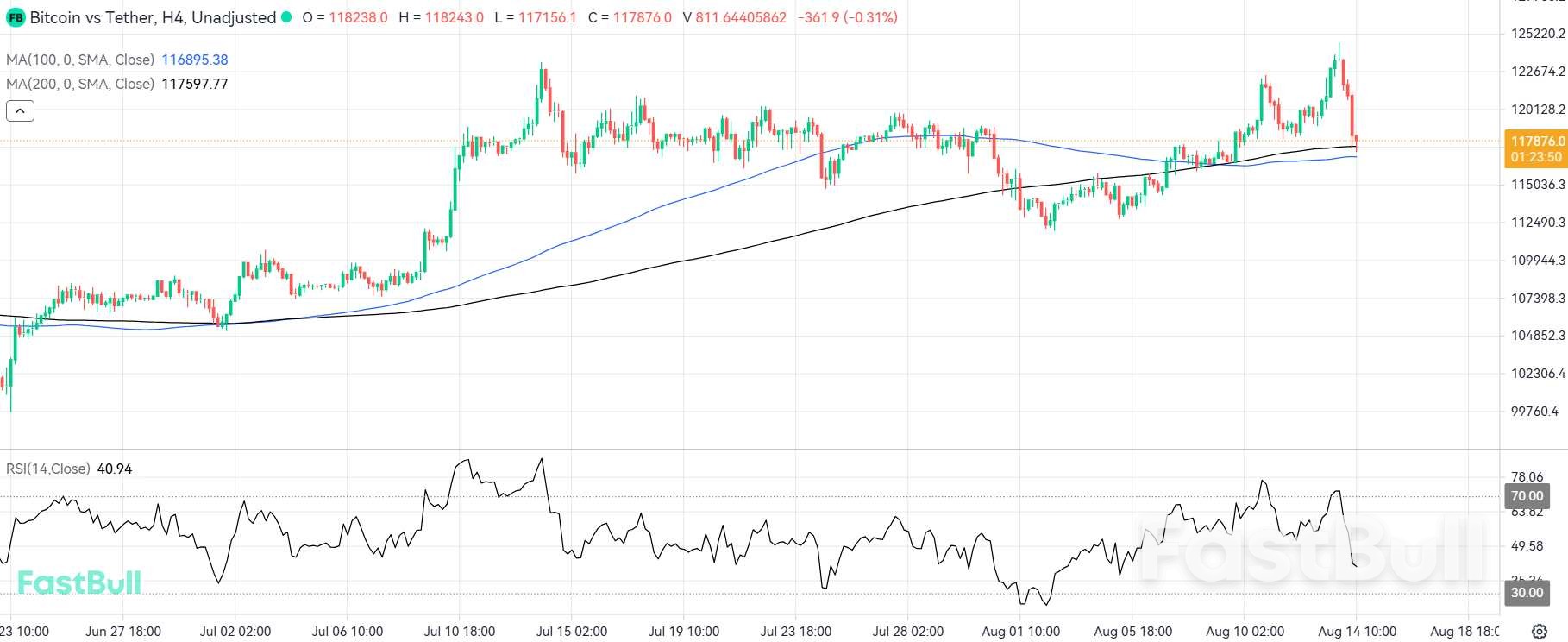
          Bitcoin (BTC-USD) retreated more than 3% from its record highs on Thursday after hotter-than-expected inflation soured expectations of a large rate cut in September and Treasury Secretary Scott Bessent signaled the US won't be purchasing bitcoin for its strategic reserve.
          On Wednesday, bitcoin touched an all-time high past $123,500 per token in anticipation of looser monetary policy and corporate purchases. Crypto rolled over after July's Producer Price Index came in much higher than expected.Bitcoin Sinks Following Hotter-Than-Expected Inflation Print, Bessent Comments on Strategic Reserve_1
          During an interview with Fox Business, Bessent said US reserves of bitcoin amount to around $15 billion or $20 billion at today's prices.
          "We've also started to get into the 21st century — a bitcoin strategic reserve. We're not going to be buying that, but we are going to use confiscated assets and continue to build that up," he said.
          Expectations of Fed rate cuts, coupled with heavy purchases from corporate treasuries, have driven up the price of the asset this year.
          The cryptocurrency has gained 25% year to date and has rallied roughly 57% since the April lows.
          Inflows into spot exchange-traded funds, along with purchases from public companies copying the blueprint of software firm-turned-bitcoin juggernaut Strategy (MSTR) by adding bitcoin to their balance sheets, have been key drivers of this year's rally.
          Strategists also point to the Trump administration’s pro-crypto stance as a major catalyst.
          "The administration is pushing crypto. They are pushing bitcoin. Bitcoin is the lead dog in the crypto market," Tom Essaye, founder of Sevens Report Research, told Yahoo Finance earlier this week.
          "So is it short-term a little frothy? Sure," he added. "But longer term, there are some fundamental changes here that I think are bullish for it."
          Last week, President Trump issued an executive order directing the Labor Department to explore allowing 401(k) plans to hold cryptocurrencies and other alternative assets, a move that could significantly expand retail investor access to crypto.
          The price surge also comes as US equities have notched all-time records on expectations the Federal Reserve will cut interest rates in September and that Trump's next Fed chair pick will likely favor looser monetary policy.
          Meanwhile, ethereum (ETH-USD) prices also retreated more than 3% on Thursday after rising to near record levels as Wall Street grows increasingly bullish on the world's second-largest cryptocurrency by market cap.
          Companies have been adding ether to their balance sheets as a way to gain exposure to the tech infrastructure behind decentralized finance and digital assets, such as stablecoins.

          Source: Yahoo Finance

          To stay updated on all economic events of today, please check out our Economic calendar
          Risk Warnings and Disclaimers
          You understand and acknowledge that there is a high degree of risk involved in trading. Following any strategies or investment methods may lead to potential losses. The content on the site is provided by our contributors and analysts for information purposes only. You are solely responsible for determining whether any trading assets, securities, strategy, or any other product is suitable for investing based on your own investment objectives and financial situation.
          Add to Favorites
          Share

          August’s Highlights in the Financial Markets

          Adam

          Economic

          The main change was the weaker than anticipated NFP release: it was the first downtick for the long time. Although the labor market seemed to be solid, the 73k of added payrolls against 115k anticipated were considered as weak.
          That pushed probabilities of interest rate decline in September to above 90%, according to the Fedwatchtool. While the CPI inflation has not shown any decline, the US dollar has got under pressure, whereas EURUSD and GBPUSD are getting closer to their previous intermediate-term highs from July.
          August’s Highlights in the Financial Markets_1
          The US inflation had stabilized both in CPI and PCE representation, which makes the data controversial: on the one hand, weak NFP print sends potential recessional signals, whereas the inflation is steady. The total economic situation balances on the verge of stagnation, but at least, the latest GDP print for the US was decent, which doesn’t point to any contraction yet.
          Corporate profits posted in July were mixed, showing good performance for tech stocks (especially those AI-related), while other companies have shown
          August’s Highlights in the Financial Markets_2

          US inflation

          The leading economic index (LEI) had triggered the recession signal for the third consecutive month in June. However, the AI narrative keeps the stock market rally moving.
          The Nasdaq index was leading the rally coming closer to the all-time highs, whereas S&P500 and Dow Jones underperformed, indicating the decline in a market breadth.
          The underperformance of Dow Jones is clearly visible, but as the bullish market develops, the rotation mechanism can start with a possible correction or consolidation for techs and industrial stocks, leading the rally.
          August’s Highlights in the Financial Markets_3

          Nasdaq vs Dow Jones.

          In general, the “Sell America” narrative had stepped back in the agenda, pushing US stocks ahead of their European competitors: The DAX index struggled to renew July’s highs.

          Geopolitical Dynamics

          The geo-political situation doesn’t bring any particular changes just yet, except for direct talks between Vladimir Putin and Donald Trump in Alaska, scheduled for Friday, the 15th of August.
          That’s the first meeting between the two presidents after the Russia-Ukraine conflict. After the multiple rounds of talks this year, experts keep their expectations low, as well as the markets don’t display any excessive optimism.
          Crude oil, however, is being pushed down heading to $60: the median price according to the STEO forecast.
          Now, let’s break down some key opportunities of the upcoming period, starting with Dow Jones.

          US30

          The Dow Jones index has been underperforming, as Nasdaq and AI-related stocks have been rising after some strong earnings reports in July. Despite that, we know from the historical standpoint that the rotation mechanism in the bullish markets works like that: one sector rallies, then investors start taking profits and lift the underperforming sector.
          Of course, it works only in the context of sustaining the bullish market. So, if US stocks resume the bullish trend, Dow Jones may speed up to fit the bullish rally.
          August’s Highlights in the Financial Markets_4

          Dow Jones index.

          Gold

          The summertime break for the growth of Gold makes it move sideways, as volume diminishes. The local sell-off after the strong CPI print also had trimmed the volume and cut the speculation for Gold (it could have grown should the inflation moved down).
          Despite that, the overall trend still looks bullish. According to the COT-reports, the speculative demand is still quite high and it consumes the increasing supply from commercial traders. Thus, the massive triangular formation visible on the chart, would probably break to the upside, as shown on the chart below.
          August’s Highlights in the Financial Markets_5

          Bitcoin

          With the massive rise of Ether this July and the relative underperformance of Bitcoin, the latter may finally get back on track, compensating for the difference (the same rotation mechanism as with stocks).
          According to the MVRV indicator (Market value vs Realized value), Bitcoin might be considered as not overbought yet, whereas Ether’s parameters are much more overheated for now.
          Thus, one may expect a rotation of capital in favor of BTC in the near-term should a bullish rally in crypto persist. The area of $130k would be considered as the next resistance – that’s a border of the ascending channel and a psychological level that may initiate profit-taking. Though, the effect of the bullish spike may lead it higher than anticipated.
          August’s Highlights in the Financial Markets_6

          Source: fxempire

          To stay updated on all economic events of today, please check out our Economic calendar
          Risk Warnings and Disclaimers
          You understand and acknowledge that there is a high degree of risk involved in trading. Following any strategies or investment methods may lead to potential losses. The content on the site is provided by our contributors and analysts for information purposes only. You are solely responsible for determining whether any trading assets, securities, strategy, or any other product is suitable for investing based on your own investment objectives and financial situation.
          Add to Favorites
          Share

          US Dollar: Markets Watch Fed and BoJ for Direction on Greenback

          Adam

          Forex

          The US Dollar is mostly firmer today against the G10 currencies, but exceptions are notable. The yen is rising for the third consecutive session, apparently boosted by calls from the US Treasury Secretary for the Bank of Japan to raise rates. The Norwegian krone is slightly higher after the central bank kept rates steady and indicated another rate cut would be forthcoming this year.
          GBP/USD is the other exception to the greenback’s bounce today after a stronger headline Q2 GDP lifted by government spending. The US dollar is firmer against most emerging market currencies. Intervention by Hong Kong Monetary Authority to defend the peg helped the HK dollar tick up and the PBOC set the dollar’s reference rate at a new low for year, supporting the yuan’s resilience today.
          Benchmark 10-year yields are mostly softer today. Japanese and Swiss yields are the exceptions and are a little firmer. Most European yields are off around two basis points, though the Gilts yields are a laggard today and are barely lower. The 10-year Treasury yield is 2.5 bp softer to near the 4.20% threshold. The US 2-year yield is a little softer as it edges toward 3.65%, the low from earlier this month. It has not traded below there in more than three months.
          Asia Pacific equities were mostly lower today. South Korea, Australia, New Zealand, and India are the noted exceptions. The Stoxx 600 in Europe is advancing for the third consecutive session, which if sustained, would be the longest rally in a month. US index futures are little changed but softer.
          Gold has traded on both sides of yesterday’s range and is little changed late in the European morning. September WTI has steadied today (~$62.70-$63.10) after slipping below $62 yesterday for the first time since early June.
          USD: The US Dollar Index tested the trendline connecting last month’s two lows. It held on a closing basis and is found slightly above 97.65 today. However, it did settle below the (61.8%) retracement of last month’s rally found near 97.85. It has steadied today and is holding below 98.00. Chicago Fed’s Goolsbee comments, striking a more cautious tone on the rate outlook, failed to have much impact and the September Fed funds futures are pricing in a small chance of a 50 bp cut next month.
          The expected rise in July PPI that will likely be reported today is unlikely to deter the market. Still, a 50 bp cut, however, does not seem particularly likely now, but before the next FOMC meeting, another employment report (and the BLS preliminary benchmark revisions to the establishment survey) and CPI and PPI will be in hand. Market participants and the media have emphasized the weakness of nonfarm payroll growth and the sharp downward revision of past months.
          Yet, Fed Chair Powell was explicit at last month’s press conference the key is not job growth as the administration’s immigrant policies have reduced the supply of labor at the same moment that the demand has fallen. Therefore, Powell argued the key now is the unemployment rate, which captures the balance of the two forces. Also, today sees weekly initial jobless claims for the week ending August 8. While most survey data have pointed to a deterioration of the labor market, weekly jobless claims were an exception. Initial claims fell from mid-June through mid-July when they reached three-month lows.
          Weekly initial claims rose for the past two weeks, and the median forecast in Bloomberg’s survey anticipates a small decline. The four-week moving average, used to smooth the noisy time series has fallen for the past seven weeks, but likely rose last week. On the other hand, continuing claims are elevated at their highest level since November 2021. The data seems to confirm that businesses may not be laying off workers very aggressively, the hiring has slowed.
          EURO: The euro peaked yesterday near $1.1730 shortly before the North American session. It consolidated after dipping below $1.1700 in early North American turnover. The trendline connecting the July highs comes in near $1.1745 today. If that is taken out the next target is the late July high slightly below $1.1790, but instead, the euro is trading with a heavier bias today and is fraying yesterday’s low (~$1.1670) in the European morning. A break of $1.1660 could see $1.1600.
          There are option at $1.17 for 3.9 bln euros that expire today. The eurozone’s data had a negligible impact. Q2 GDP’s initial 0.1% increase was left unchanged. The quarter ended on a soft note, with industrial output falling by 1.3% after a 1.7% increase in May. Economists do not expect growth here in Q3 to be much better. In fact, the year-over-year rate is seen slowing to below 1% in Q3 for the first time since Q2 24.
          CNY: The dollar was sold from the upper end of its recent range on Monday and Tuesday, slightly shy of CNH7.20 to fray the lower end of its recent range yesterday near CNH7.1755. The losses were extended to about CNH7.1680 today, a nearly three-week low. It bounced back to around CNH7.1770 in the European morning where sellers were met. More important chart support is seen in the CNH7.1600-30 area.
          The PBOC set the dollar’s reference rate at a new low for the year today (CNY7.1337 vs. CNY7.1350 yesterday). Chinese officials are allowing the yuan to appreciate against the dollar but more slowly than some of its critics want. The onshore yuan has risen by a little more than 1.75% against the dollar this year, which is slightly less than the inflation differential and two-year interest rate differential would imply. US Treasury Secretary Bessent is arguing against accepting Chinese investment as part of a trade agreement because of the need to re-shore critical industries away from China.
          JPY: Softer US rates helped pressure the dollar lower against the yen. It fell from a seven-day high on Tuesday near JPY148.50 to a low yesterday around JPY147.10. It is lower for the third consecutive session. Ostensibly with the help of US Treasury Secretary Bessent calling on Japan to raise interest rates, the greenback was sold through the shelf forged last week in the JPY146.60-70 area. It found support near JPY146.20, a three-week low. The next technical target is closer to JPY145.85. The US 10-year yield fell by a little more than five basis points yesterday to settle at a five-day low (~4.23%) and is softer today to test 4.20%.
          The yield has traded below there in three sessions this quarter and two of which took place this month. The swaps market saw an increase to almost 16 bp from 14 bp, the likely rate hike before the end of the year. It is the most this month, but settled July closer to 18 bp. Japan provides its first estimate for Q2 GDP first thing tomorrow. The median forecast in Bloomberg’s survey is for a 0.4% annualized expansion in Q2 after a 0.2% contraction in Q1. The key change may have been net exports, which shaved Q1 GDP by 0.8% and may have contributed 0.1% in Q2. But part of this may be offset by the unwinding of inventory accumulation. Consumer spending looks steady around 0.1%, while capex may have slowed.
          GBP: Sterling rose by about 0.5% yesterday to lead the G10 currencies. It is also the best performer this month, with a 2.75% coming into today. Unlike the euro, sterling recorded the session high yesterday in North American session, late in the European day. The high was about $1.3585, and it has been extended marginally today to slightly above $1.3590, its best level in a month. Options for GBP953 mln at $1.36 expire today. Above $1.3600, may encounter nearby resistance around $1.3630. The UK reported that growth held up better than expected in Q2. The 0.3% expansion compares with 0.1% projections and 0.7% in Q1. The increased government spending (1.2% vs -0.4% in Q1) helped offset the slower consumption (0.1% vs 0.4%) and business investment (-1.1% vs 2.0%). Net exports also deteriorated. Still, the economy appeared to end the quarter on better footing, with June’s monthly GDP rising by 0.4%, twice the median forecast in Bloomberg’s survey, helped by stronger industrial outputs, services, and construction. Growth is expected to remain subdued in H2 25. The Bank of England forecasts 1.3% growth this year. The IMF projects 1.2% and the median forecast in Bloomberg’s survey is 1.1%, the same as last year. The swaps market has 17 bp of easing discounted before the end of the year, of about a 65% chance of a cut, down from 100% before last week’s BOE meeting.
          CAD: The Canadian dollar was sidelined yesterday. During the North American session, the US dollar chopped in a 10-tick range on either side of CAD1.3765. It is posting an outside day by trading on both sides of yesterday’s range. The technical significance depends on the close. A break of the CAD1.3720-25 area would be notable. It could signal a move toward CAD1.3640. On top side, only a move above the CAD1.3800-10 area would undermine this less favorable outlook for the greenback. Still, the pattern for the Canadian dollar to perform relatively better in a strong US dollar environment and typically a laggard in a weak dollar environment continues to be borne out. Last month, during the greenback’s first monthly bonce this year, the Canadian dollar was the best performer in the G10, losing only 1.80%. This month, as the US dollar has weakened, the Canadian dollar is the weakest of the G10 currencies, appreciating by about 0.60%.
          AUD: The Australian dollar stalled yesterday in European late morning turnover slightly below $0.6565. It traded to almost $0.6570 before reversing lower. A break of yesterday’s low near $0.6515 would weaken the technical tone, and a close below $0.6500, which it has not done for six sessions, would be disappointing. Australia grew 24.5k jobs in July, of which a whopping 60.5k were full-time positions (part-time work fell by 35.9k jobs). It had lost 36.6k full-time jobs in June but the July increase was the most since February 2024. The unemployment rate slipped to 4.2% from 4.3%. It was steady at 4.1% in the first five months of the year. The participation rate was steady at 67.0%, after the June estimate was revised down from 67.1% to 67.0%. It is unchanged now from the end of 2024. The report saw the odds of a cut at the next meeting in late September pared to about 30% from the anticipated trajectory of monetary policy. There is about 40% chance of a cut at the next meeting at the end of September from about 45%. The futures market has about 38 bp of cuts discounted before the end of the year, down from 40 bp yesterday. The futures market has a terminal rate of around 3%, while the swaps market sees it closer to 2.75% from the 3.60% current target.
          MXN: The dollar made a new low for year against the Mexican peso and Brazilian real yesterday, but it recovered against both and settled 0.20%-0.25% better. The MXN18.50 area is proving to be formidable. It stopped last month’s descent, and then the market got a running start at it again after having peaked a little below MXN19.00 on August 1. It made a marginal new low yesterday but recovered approaching MXN18.51. It set session highs around midday in NY near MXN18.6650. Initial resistance may be in the MXN18.70-75 area. The dollar recorded the session and year’s low yesterday shortly after the local markets opened, reaching almost BRL5.38. It recovered to around BRL5.41 around the same time that it peaked against the peso. The greenback spent the NY afternoon consolidating in a narrow range, mostly BRL5.3920-BRL5.4030.

          Source :investing

          Risk Warnings and Disclaimers
          You understand and acknowledge that there is a high degree of risk involved in trading. Following any strategies or investment methods may lead to potential losses. The content on the site is provided by our contributors and analysts for information purposes only. You are solely responsible for determining whether any trading assets, securities, strategy, or any other product is suitable for investing based on your own investment objectives and financial situation.
          Add to Favorites
          Share

          Stocks may be at all-time highs, but speculative froth isn't

          Adam

          Stocks

          The market keeps pushing higher. But does that also mean speculation is running rampant without the support of fundamentals?
          A surprising survey from S&P Global Market Intelligence showed risk appetite actually decreased in August, highlighting flagging investor sentiment and a return to levels of risk avoidance last seen during the "Liberation Day" doldrums of April.
          But from the perspective of Wall Street bulls, the languishing mood reflected a moment to regroup and a base from which investors could build the next rally.
          Even with fresh highs, and the idea of the S&P crossing 7,000 back on the table, the current rush hasn't hit a dangerously speculative level, according to analysis by DataTrek co-founder Nicholas Colas. By using S&P 500 sector correlations to the index as a sign of near-term peaks in investor confidence, Colas accurately called the tops in 2023 and 2024, as well as February 2025. "History suggests that we are heading towards an unhealthy level of investor optimism but are not there just yet," Colas wrote in a note to clients this week.
          Growth stocks also continue to outperform value stocks by a statistically significant amount. But Big Tech's concentration in the S&P 500's growth variant, accounting for nearly half of the index's gains, makes the recent outsized run understandable, Colas wrote.
          At the same time, crypto investors are partying like the last winter never happened. Bitcoin (BTC-USD) and ethereum (ETH-USD) are at or near all-time highs. And a parade of altcoins are rallying alongside them, with Washington cheerleading the industry and Wall Street shedding its reluctance to participate in decentralized finance. (Did somebody say new financial instrument?) A string of blockbuster public debuts has also embodied the market's exuberance. But with a momentous Fed cut on the horizon and a settling of the worst tariff-induced fears, the optimism doesn't seem misplaced.
          Still, other measures have signaled that the new highs could flash as warnings, drawing comparisons to historical market tops that, in retrospect, look like bubbles or were driven by circumstances that necessitated a downfall.
          Goldman Sachs analysts recently observed that their Speculative Trading Indicator has risen sharply during the past few months. Behind only the 1998-2001 dot-com bubble era and the acute COVID period of 2020-2021, the gauge has hit its highest level on record, although it still remains well below those prior peaks.
          With enough capital and pluck, every phase of a market cycle is a buying opportunity. Vigilance calls for investors to discern speculative froth from intrinsic value. But that's often a difficult task. It's even more so as the market feeds on attention and momentum. Bulls can already see the next leg upward. And while asset prices can eventually become unsustainable, confidence is harder to suppress.

          Source: finance.yahoo

          Risk Warnings and Disclaimers
          You understand and acknowledge that there is a high degree of risk involved in trading. Following any strategies or investment methods may lead to potential losses. The content on the site is provided by our contributors and analysts for information purposes only. You are solely responsible for determining whether any trading assets, securities, strategy, or any other product is suitable for investing based on your own investment objectives and financial situation.
          Add to Favorites
          Share

          Fed Debate On September Rate Cut To Turn On Inflation, Jobs Data

          Kevin Du

          Central Bank

          A jump in wholesale prices is likely to bolster concerns among Federal Reserve policymakers that rising inflation remains a risk, intensifying debate over the wisdom of a rate cut at their September meeting and leaving the tension between the U.S. central bank and the White House unresolved.

          U.S. producer prices increased a more-than-expected 0.9% in July from June, the Labor Department's Bureau of Labor Statistics said on Thursday. Trade services inflation, a measure of retail and wholesale margins, rose 2%, the fastest pace in a couple of years and a possible signal of prices being passed along to consumers instead of absorbed through lower profits.

          Analysts said the increase could be a precursor of higher consumer prices, which to date have reflected a more limited impact from the Trump administration's higher tariffs than initially expected.

          Shows PPI trade services

          The data virtually eliminated in the minds of investors the likelihood of a larger-than-normal half-point cut at the September meeting, and left policymakers to decide how to rationalize an expected quarter-point cut in September with inflation still well above their 2% target.

          Recent weak job gains have caused a reassessment of the risks facing the economy, St. Louis Fed President Alberto Musalem said in a CNBC interview on Thursday, with slow growth threatening the job market and possibly warranting a cut if the weakness continues. But he said he needs further data before making a call on what to do in September given above-target inflation and the fact the economy is still early in the process of adapting to rising import taxes.

          Inflation by some of the measures most closely watched by the Fed could be nearing 3% following the new Producer Price Index data, and Musalem said he remained noncommittal about a September rate cut until he knows more.

          "I expect ... most of the impact of tariffs on inflation to fade after two to three quarters ... But there is a reasonable probability that they could be more persistent," said Musalem, a voter this year on Fed interest rate policy. "We need to get a better fix on that ... A little more data would be helpful."

          The Fed will receive another employment report covering August, as well as this month's inflation data before its September meeting, releases that could prove pivotal to both a decision on cutting rates and to how that decision is framed - whether as the start of a cutting cycle aimed at moving monetary policy to a "neutral" setting, or as an adjustment that may or may not be followed by further rate moves.

          Two Fed governors, Christopher Waller and Vice Chair for Supervision Michelle Bowman, dissented at the Fed's July meeting against the decision to hold rates steady, favoring a quarter-point cut, an outcome that investors now consider a near certainty for the September meeting.

          BESSENT ARGUES FOR SERIES OF CUTS

          In recent days, Treasury Secretary Scott Bessent has argued that a series of cuts could be warranted to move the benchmark policy rate from the current range of 4.25% to 4.5%, to around 3%, a level considered to neither boost nor discourage economic activity.

          "There is room for a series of cuts ... A model of a neutral rate is approximately 150 basis points lower," Bessent said in a Fox Business interview on Thursday while adding he was not giving advice to the Fed, whose judgments on rate policy are supposed to be made independently of White House influence, but simply noting his analysis of the situation.

          His comments, however, preceded the release of the new wholesale price data that is likely to complicate the Fed's own read of the situation.

          Musalem, while not prejudging the outcome of September, said he did feel a larger half-point cut was "unsupported" by current economic conditions, a view shared by San Francisco Fed President Mary Daly in a Wall Street Journal interview.

          A rise in services inflation that was evident underneath otherwise tame consumer price data released on Wednesday may also worry policymakers who were counting on weaker services prices to offset any tariff-related jump in the cost of imported goods.

          Chicago Fed President Austan Goolsbee, also a policy voter, said on Wednesday he was open to a cut in September despite ongoing concerns about inflation, but was focused on coming information.

          "We're going to get some good and important pieces of information that I'm going to add to the ones that we've gotten for the last three months," Goolsbee said.

          Source: Reuters

          Risk Warnings and Disclaimers
          You understand and acknowledge that there is a high degree of risk involved in trading. Following any strategies or investment methods may lead to potential losses. The content on the site is provided by our contributors and analysts for information purposes only. You are solely responsible for determining whether any trading assets, securities, strategy, or any other product is suitable for investing based on your own investment objectives and financial situation.
          Add to Favorites
          Share

          Momentum and High-Beta Equity Factors Lead Market This Year

          Adam

          Stocks

          Economic

          The dominance of the momentum factor roars on. At nearly every step this year, this risk factor has outperformed the broad stock market, based on a set of ETFs through yesterday’s close (Aug. 13). The recent rebound in so-called high-beta stocks has lifted this factor to a strong second-place performer so far in 2025.
          The iShares MSCI USA Momentum Factor ETF (NYSE:MTUM) is the year-to-date leader with a 19.6% return. The Invesco S&P 500® High Beta ETF (NYSE:SPHB) is nipping at its heels by rallying 18.7% this year. Both funds are posting a hefty return premiums over the broad market, which is up 10.7% this year via SPDR® S&P 500® ETF (NYSE:SPY).
          Momentum and High-Beta Equity Factors Lead Market This Year_1
          The rest of the factor field is well behind the momentum and high-beta leaders. Even high-cap growth is struggling to keep up. The iShares S&P 500 Growth ETF (NYSE:IVW) is in third place this year with a 14.2% total return.
          The worst-performing factor in 2025: iShares S&P Small-Cap 600 Value ETF (NYSE:IJS), which is flat on the year–a dismal performance considering the broad-based rally elsewhere. As the once popular small-cap value factor continues to lag, questions persist about the validity of this slice of the small-cap universe. The fund has been a lackluster performer in recent years, and the latest results don’t offer any evidence to suggest a change is in the offing.
          By contrast, some of the factor funds are showing renewed strength and are worth keeping an eye on. One ETF that’s looking stronger lately: the high-dividend factor (VYM).
          Momentum and High-Beta Equity Factors Lead Market This Year_2
          The fund rallied sharply yesterday and closed at a new record high, suggesting that investors’ appetite favors relatively high payouts in equities, perhaps because Wall Street is expecting that the Federal Reserve will start cutting rates next month. In that case, dividend payouts will become more attractive if the competitive yields in bonds declines.

          Source: investing

          To stay updated on all economic events of today, please check out our Economic calendar
          Risk Warnings and Disclaimers
          You understand and acknowledge that there is a high degree of risk involved in trading. Following any strategies or investment methods may lead to potential losses. The content on the site is provided by our contributors and analysts for information purposes only. You are solely responsible for determining whether any trading assets, securities, strategy, or any other product is suitable for investing based on your own investment objectives and financial situation.
          Add to Favorites
          Share

          Russian Exports Slump Hits Fifth Month As Weaker Oil Prices Weigh On Trade

          Daniel Carter

          Economic

          Russia's exports contracted for a fifth month in June as weaker global commodity prices continued to weigh on trade.
          Overseas shipments dropped by about 8% from a year earlier after an almost 10% decline in May, according to data from the Bank of Russia published on Thursday. Exports fell 5.9% year-on-year in the second quarter, matching the pace of decline seen in the first three months of the year, the data show.
          The slump reflects pressure on Russia's foreign trade from deteriorating conditions on commodity markets, with the central bank saying in July that falling prices were the main driver of the decline. Export prices for Russian oil, which topped $70 a barrel early this year, averaged $56 in the second quarter, according to bank estimates.
          Prices are expected to fall further in the second half amid worsening supply-demand balance, including accelerated output growth by OPEC+. The central bank now forecasts an average price this year of $55 a barrel for the nation's oil, down from a previous estimate of $60.
          Still, the latest European Union sanctions, billed as "one of its strongest" packages yet, have so far failed to make a major impact. US President Donald Trump's moves against Russian oil buyers and threats of new tariffs have yet to significantly disrupt flows.
          The discount of Russia's benchmark crude to global oil prices narrowed to the lowest level since the start of the war in Ukraine, despite moves by the EU to reduce its price cap on Russian oil to $47.60 a barrel from $60.
          In the first half of 2025, exports shrank by 5.9% to $196.1 billion, while imports remained stable at $138.7 billion. The current account surplus shrank to $25 billion from $42.1 billion a year earlier on a weaker trade balance and a wider services deficit, the Russian central bank said.

          Source: Bloomberg Europe

          To stay updated on all economic events of today, please check out our Economic calendar
          Risk Warnings and Disclaimers
          You understand and acknowledge that there is a high degree of risk involved in trading. Following any strategies or investment methods may lead to potential losses. The content on the site is provided by our contributors and analysts for information purposes only. You are solely responsible for determining whether any trading assets, securities, strategy, or any other product is suitable for investing based on your own investment objectives and financial situation.
          Add to Favorites
          Share
          FastBull
          Copyright © 2025 FastBull Ltd

          728 RM B 7/F GEE LOK IND BLDG NO 34 HUNG TO RD KWUN TONG KLN HONG KONG

          TelegramInstagramTwitterfacebooklinkedin
          App Store Google Play Google Play
          Products
          Charts

          Chats

          Q&A with Experts
          Screeners
          Economic Calendar
          Data
          Tools
          Membership
          Features
          Function
          Markets
          Copy Trading
          Latest Signals
          Contests
          News
          Analysis
          24/7
          Columns
          Education
          Company
          Careers
          About Us
          Contact Us
          Advertising
          Help Center
          Feedback
          User Agreement
          Privacy Policy
          Business

          White Label

          Data API

          Web Plug-ins

          Poster Maker

          Affiliate Program

          Risk Disclosure

          The risk of loss in trading financial instruments such as stocks, FX, commodities, futures, bonds, ETFs and crypto can be substantial. You may sustain a total loss of the funds that you deposit with your broker. Therefore, you should carefully consider whether such trading is suitable for you in light of your circumstances and financial resources.

          No decision to invest should be made without thoroughly conducting due diligence by yourself or consulting with your financial advisors. Our web content might not suit you since we don't know your financial conditions and investment needs. Our financial information might have latency or contain inaccuracy, so you should be fully responsible for any of your trading and investment decisions. The company will not be responsible for your capital loss.

          Without getting permission from the website, you are not allowed to copy the website's graphics, texts, or trademarks. Intellectual property rights in the content or data incorporated into this website belong to its providers and exchange merchants.

          Not Logged In

          Log in to access more features

          FastBull Membership

          Not yet

          Purchase

          Become a signal provider
          Help Center
          Customer Service
          Dark Mode
          Price Up/Down Colors

          Log In

          Sign Up

          Position
          Layout
          Fullscreen
          Default to Chart
          The chart page opens by default when you visit fastbull.com