• Trade
  • Markets
  • Copy
  • Contests
  • News
  • 24/7
  • Calendar
  • Q&A
  • Chats
Trending
Screeners
SYMBOL
LAST
BID
ASK
HIGH
LOW
NET CHG.
%CHG.
SPREAD
SPX
S&P 500 Index
6827.42
6827.42
6827.42
6899.86
6801.80
-73.58
-1.07%
--
DJI
Dow Jones Industrial Average
48458.04
48458.04
48458.04
48886.86
48334.10
-245.98
-0.51%
--
IXIC
NASDAQ Composite Index
23195.16
23195.16
23195.16
23554.89
23094.51
-398.69
-1.69%
--
USDX
US Dollar Index
97.950
98.030
97.950
98.500
97.950
-0.370
-0.38%
--
EURUSD
Euro / US Dollar
1.17394
1.17409
1.17394
1.17496
1.17192
+0.00011
+ 0.01%
--
GBPUSD
Pound Sterling / US Dollar
1.33707
1.33732
1.33707
1.33997
1.33419
-0.00148
-0.11%
--
XAUUSD
Gold / US Dollar
4299.39
4299.39
4299.39
4353.41
4257.10
+20.10
+ 0.47%
--
WTI
Light Sweet Crude Oil
57.233
57.485
57.233
58.011
56.969
-0.408
-0.71%
--

Community Accounts

Signal Accounts
--
Profit Accounts
--
Loss Accounts
--
View More

Become a signal provider

Sell trading signals to earn additional income

View More

Guide to Copy Trading

Get started with ease and confidence

View More

Signal Accounts for Members

All Signal Accounts

Best Return
  • Best Return
  • Best P/L
  • Best MDD
Past 1W
  • Past 1W
  • Past 1M
  • Past 1Y

All Contests

  • All
  • Trump Updates
  • Recommend
  • Stocks
  • Cryptocurrencies
  • Central Banks
  • Featured News
Top News Only
Share

USA Embassy In Lithuania: Maria Kalesnikava Is Not Going To Vilnius

Share

USA Embassy In Lithuania: Other Prisoners Are Being Sent From Belarus To Ukraine

Share

Ukraine President Zelenskiy: Five Ukrainians Released By Belarus In US-Brokered Deal

Share

USA Vilnius Embassy: USA Stands Ready For "Additional Engagement With Belarus That Advances USA Interests"

Share

USA Vilnius Embassy: Belarus, USA, Other Citizens Among The Prisoners Released Into Lithuania

Share

USA Vilnius Embassy: USA Will Continue Diplomatic Efforts To Free The Remaining Political Prisoners In Belarus

Share

USA Vilnius Embassy: Belarus Releases 123 Prisoners Following Meeting Of President Trump's Envoy Coale And Belarus President Lukashenko

Share

USA Vilnius Embassy: Masatoshi Nakanishi, Aliaksandr Syrytsa Are Among The Prisoners Released By Belarus

Share

USA Vilnius Embassy: Maria Kalesnikava And Viktor Babaryka Are Among The Prisoners Released By Belarus

Share

USA Vilnius Embassy: Nobel Peace Prize Laureate Ales Bialiatski Is Among The Prisoners Released By Belarus

Share

Belarusian Presidential Administration Telegram Channel: Lukashenko Has Pardoned 123 Prisoners As Part Of Deal With US

Share

Two Local Syrian Officials: Joint US-Syrian Military Patrol In Central Syria Came Under Fire From Unknown Assailants

Share

Israeli Military Says It Targeted 'Key Hamas Terrorist' In Gaza City

Share

Rwanda's Actions In Eastern Drc Are A Clear Violation Of Washington Accords Signed By President Trump - Secretary Of State Rubio

Share

Israeli Military Issues Evacuation Warning In Southern Lebanon Village Ahead Of Strike - Spokesperson On X

Share

Belarusian State Media Cites US Envoy Coale As Saying He Discussed Ukraine And Venezuela With Lukashenko

Share

Belarusian State Media Cites US Envoy Coale As Saying That US Removes Sanctions On Belarusian Potassium

Share

Thai Prime Minister: No Ceasefire Agreement With Cambodia

Share

US, Ukraine To Discuss Ceasefire In Berlin Ahead Of European Summit

Share

Incoming Czech Prime Minister Babis: Czech Republic Will Not Take On Guarantees For Ukraine Financing, European Commission Must Find Alternatives

TIME
ACT
FCST
PREV
U.K. Trade Balance Non-EU (SA) (Oct)

A:--

F: --

P: --

U.K. Trade Balance (Oct)

A:--

F: --

P: --

U.K. Services Index MoM

A:--

F: --

P: --

U.K. Construction Output MoM (SA) (Oct)

A:--

F: --

P: --

U.K. Industrial Output YoY (Oct)

A:--

F: --

P: --

U.K. Trade Balance (SA) (Oct)

A:--

F: --

P: --

U.K. Trade Balance EU (SA) (Oct)

A:--

F: --

P: --

U.K. Manufacturing Output YoY (Oct)

A:--

F: --

P: --

U.K. GDP MoM (Oct)

A:--

F: --

P: --

U.K. GDP YoY (SA) (Oct)

A:--

F: --

P: --

U.K. Industrial Output MoM (Oct)

A:--

F: --

P: --

U.K. Construction Output YoY (Oct)

A:--

F: --

P: --

France HICP Final MoM (Nov)

A:--

F: --

P: --

China, Mainland Outstanding Loans Growth YoY (Nov)

A:--

F: --

P: --

China, Mainland M2 Money Supply YoY (Nov)

A:--

F: --

P: --

China, Mainland M0 Money Supply YoY (Nov)

A:--

F: --

P: --

China, Mainland M1 Money Supply YoY (Nov)

A:--

F: --

P: --

India CPI YoY (Nov)

A:--

F: --

P: --

India Deposit Gowth YoY

A:--

F: --

P: --

Brazil Services Growth YoY (Oct)

A:--

F: --

P: --

Mexico Industrial Output YoY (Oct)

A:--

F: --

P: --

Russia Trade Balance (Oct)

A:--

F: --

P: --

Philadelphia Fed President Henry Paulson delivers a speech
Canada Building Permits MoM (SA) (Oct)

A:--

F: --

P: --

Canada Wholesale Sales YoY (Oct)

A:--

F: --

P: --

Canada Wholesale Inventory MoM (Oct)

A:--

F: --

P: --

Canada Wholesale Inventory YoY (Oct)

A:--

F: --

P: --

Canada Wholesale Sales MoM (SA) (Oct)

A:--

F: --

P: --

Germany Current Account (Not SA) (Oct)

A:--

F: --

P: --

U.S. Weekly Total Rig Count

A:--

F: --

P: --

U.S. Weekly Total Oil Rig Count

A:--

F: --

P: --

Japan Tankan Large Non-Manufacturing Diffusion Index (Q4)

--

F: --

P: --

Japan Tankan Small Manufacturing Outlook Index (Q4)

--

F: --

P: --

Japan Tankan Large Non-Manufacturing Outlook Index (Q4)

--

F: --

P: --

Japan Tankan Large Manufacturing Outlook Index (Q4)

--

F: --

P: --

Japan Tankan Small Manufacturing Diffusion Index (Q4)

--

F: --

P: --

Japan Tankan Large Manufacturing Diffusion Index (Q4)

--

F: --

P: --

Japan Tankan Large-Enterprise Capital Expenditure YoY (Q4)

--

F: --

P: --

U.K. Rightmove House Price Index YoY (Dec)

--

F: --

P: --

China, Mainland Industrial Output YoY (YTD) (Nov)

--

F: --

P: --

China, Mainland Urban Area Unemployment Rate (Nov)

--

F: --

P: --

Saudi Arabia CPI YoY (Nov)

--

F: --

P: --

Euro Zone Industrial Output YoY (Oct)

--

F: --

P: --

Euro Zone Industrial Output MoM (Oct)

--

F: --

P: --

Canada Existing Home Sales MoM (Nov)

--

F: --

P: --

Euro Zone Total Reserve Assets (Nov)

--

F: --

P: --

U.K. Inflation Rate Expectations

--

F: --

P: --

Canada National Economic Confidence Index

--

F: --

P: --

Canada New Housing Starts (Nov)

--

F: --

P: --

U.S. NY Fed Manufacturing Employment Index (Dec)

--

F: --

P: --

U.S. NY Fed Manufacturing Index (Dec)

--

F: --

P: --

Canada Core CPI YoY (Nov)

--

F: --

P: --

Canada Manufacturing Unfilled Orders MoM (Oct)

--

F: --

P: --

Canada Manufacturing New Orders MoM (Oct)

--

F: --

P: --

Canada Core CPI MoM (Nov)

--

F: --

P: --

Canada Manufacturing Inventory MoM (Oct)

--

F: --

P: --

Canada CPI YoY (Nov)

--

F: --

P: --

Canada CPI MoM (Nov)

--

F: --

P: --

Canada CPI YoY (SA) (Nov)

--

F: --

P: --

Canada Core CPI MoM (SA) (Nov)

--

F: --

P: --

Q&A with Experts
    • All
    • Chatrooms
    • Groups
    • Friends
    Connecting
    .
    .
    .
    Type here...
    Add Symbol or Code

      No matching data

      All
      Trump Updates
      Recommend
      Stocks
      Cryptocurrencies
      Central Banks
      Featured News
      • All
      • Russia-Ukraine Conflict
      • Middle East Flashpoint
      • All
      • Russia-Ukraine Conflict
      • Middle East Flashpoint
      Search
      Products

      Charts Free Forever

      Chats Q&A with Experts
      Screeners Economic Calendar Data Tools
      Membership Features
      Data Warehouse Market Trends Institutional Data Policy Rates Macro

      Market Trends

      Market Sentiment Order Book Forex Correlations

      Top Indicators

      Charts Free Forever
      Markets

      News

      News Analysis 24/7 Columns Education
      From Institutions From Analysts
      Topics Columnists

      Latest Views

      Latest Views

      Trending Topics

      Top Columnists

      Latest Update

      Signals

      Copy Rankings Latest Signals Become a signal provider AI Rating
      Contests
      Brokers

      Overview Brokers Assessment Rankings Regulators News Claims
      Broker listing Forex Brokers Comparison Tool Live Spread Comparison Scam
      Q&A Complaint Scam Alert Videos Tips to Detect Scam
      More

      Business
      Events
      Careers About Us Advertising Help Center

      White Label

      Data API

      Web Plug-ins

      Affiliate Program

      Awards Institution Evaluation IB Seminar Salon Event Exhibition
      Vietnam Thailand Singapore Dubai
      Fans Party Investment Sharing Session
      FastBull Summit BrokersView Expo
      Recent Searches
        Top Searches
          Markets
          News
          Analysis
          User
          24/7
          Economic Calendar
          Education
          Data
          • Names
          • Latest
          • Prev

          View All

          No data

          Scan to Download

          Faster Charts, Chat Faster!

          Download App
          English
          • English
          • Español
          • العربية
          • Bahasa Indonesia
          • Bahasa Melayu
          • Tiếng Việt
          • ภาษาไทย
          • Français
          • Italiano
          • Türkçe
          • Русский язык
          • 简中
          • 繁中
          Open Account
          Search
          Products
          Charts Free Forever
          Markets
          News
          Signals

          Copy Rankings Latest Signals Become a signal provider AI Rating
          Contests
          Brokers

          Overview Brokers Assessment Rankings Regulators News Claims
          Broker listing Forex Brokers Comparison Tool Live Spread Comparison Scam
          Q&A Complaint Scam Alert Videos Tips to Detect Scam
          More

          Business
          Events
          Careers About Us Advertising Help Center

          White Label

          Data API

          Web Plug-ins

          Affiliate Program

          Awards Institution Evaluation IB Seminar Salon Event Exhibition
          Vietnam Thailand Singapore Dubai
          Fans Party Investment Sharing Session
          FastBull Summit BrokersView Expo

          Asian Markets Diverge as Iran-Israel Conflict Lifts Oil Prices and Wall Street Slides

          Gerik

          Economic

          Middle East Situation

          Summary:

          Geopolitical tensions between Iran and Israel escalated sharply, sending crude oil prices higher and shaking investor confidence globally. While U.S. markets fell under the weight of soaring energy costs...

          Geopolitical Escalation Sparks Global Market Turbulence

          On Wednesday, global markets responded uneasily to the rapidly intensifying conflict in the Middle East. President Donald Trump’s abrupt departure from the G7 summit and stark warning to Iranian civilians, followed by threats of further escalation, unsettled financial markets and drove oil prices up more than 4% on Tuesday. Iran’s strategic location near the Strait of Hormuz—a chokepoint for global oil flows—intensified fears of potential supply disruptions.
          Crude oil benchmarks continued to climb Wednesday morning. U.S. benchmark WTI crude rose to $73.51 per barrel, while Brent crude edged higher to $76.71. The sharp uptick in oil prices adds inflationary pressure at a time when the Federal Reserve remains cautious about interest rate cuts, despite recent weak economic indicators.

          Asian Markets Mixed Amid Energy Volatility and Trade Friction

          Markets across Asia delivered a fragmented response. Japan’s Nikkei 225 rose by 0.7%, shrugging off a troubling export report that showed a 1.7% annual drop in total exports, including an 11.1% plunge in shipments to the U.S. due to Trump’s tariffs. Japanese auto exports, in particular, were hit hard. Nonetheless, investors in Tokyo appeared to price in hopes of fiscal support or currency-driven competitiveness.
          In contrast, Hong Kong’s Hang Seng fell 1.2%, weighed down by geopolitical concerns and spillover from mainland China's consumer subsidy uncertainty. The Shanghai Composite Index dipped 0.2%, reflecting caution amid China’s delayed rollout of trade-in subsidies and uneven consumption recovery.
          Elsewhere, South Korea’s Kospi gained 0.6%, supported by tech resilience, while Australia’s ASX 200 edged down 0.2%, reflecting weakness in energy-sensitive sectors and mining-related equities.

          Wall Street Drops as Recession Fears Resurface

          U.S. equities tumbled as surging oil prices and disappointing retail sales data reignited concerns of a demand-side slowdown. Retail sales dropped 0.9% in May, missing economists’ expectations and highlighting reduced consumer momentum. This marked a shift from April’s temporarily strong performance, where consumers had front-loaded purchases—especially cars—before tariffs took effect.
          The S&P 500 fell 0.8%, the Dow dropped nearly 300 points (0.7%), and the Nasdaq declined 0.9%, with solar energy stocks leading the losses amid Congressional debate on phasing out green energy tax credits. Enphase Energy plunged 24%, and First Solar lost nearly 18% despite oil price tailwinds that would normally favor renewable alternatives.
          Bond markets saw a flight to safety as yields fell. The 10-year Treasury yield dropped by more than 6 basis points, reflecting market pessimism about growth and inflation. Currency markets responded modestly; the U.S. dollar weakened slightly to 145.09 yen, while the euro rose to $1.1498, mirroring cautious risk sentiment and softer dollar outlook.

          Investor Focus Turns to the Federal Reserve

          The Fed began its two-day meeting Tuesday, with no immediate rate change expected. However, markets remain sensitive to any shifts in tone regarding rate cuts later this year, especially in the context of Trump’s tariffs, slowing retail activity, and geopolitical risks.
          Although inflation remains relatively tame, near the Fed’s 2% target, policymakers remain reluctant to ease prematurely. According to current forecasts, a potential rate cut in September is still on the table—pending clearer evidence of a downturn.
          The global investment landscape is being reshaped by war-risk premiums in energy markets and a fragile macroeconomic backdrop. Asian markets remain divided between growth hopes and external risks, while U.S. markets reflect rising anxiety over inflationary oil shocks and stalling consumption. With Federal Reserve signals, oil trends, and geopolitical risks all converging, investors face a turbulent and unpredictable summer ahead.

          Source: AP

          To stay updated on all economic events of today, please check out our Economic calendar
          Risk Warnings and Disclaimers
          You understand and acknowledge that there is a high degree of risk involved in trading. Following any strategies or investment methods may lead to potential losses. The content on the site is provided by our contributors and analysts for information purposes only. You are solely responsible for determining whether any trading assets, securities, strategy, or any other product is suitable for investing based on your own investment objectives and financial situation.
          Add to Favorites
          Share

          Malaysia Leads Record Bond Inflows as Global Investors Exit U.S. Markets

          Gerik

          Economic

          A Global Rotation into Asia’s Debt Markets

          In a marked shift in global capital flows, investors are increasingly moving away from developed market bonds toward Asian fixed-income instruments. Malaysia has emerged as the top destination, receiving its largest monthly bond inflow since 2014—$3.15 billion in May—amid a broader regional surge that saw Asian markets attract $34 billion in foreign inflows in the first five months of 2025, the highest since at least 2016.
          The broader appeal of Asia lies in its convergence of favorable monetary conditions: policy rates at or near their peak, benign inflation, and relatively strong currency performance—all of which contrast with fiscal uncertainty and elevated inflation in the U.S., Europe, and Japan. Investors are positioning for rate cuts, locking in yields at current high levels, and anticipating capital gains as bond prices rise when yields eventually decline.

          Malaysia’s Edge in the Regional Landscape

          Malaysia stands out for three reasons. First, it has not yet initiated a rate-cut cycle, unlike many of its peers, leaving room for bond prices to rise when the easing begins. Second, the ringgit has remained resilient amid global currency volatility. Third, relative political stability and a well-functioning bond market make it more attractive compared to neighbors like Indonesia and Thailand, where either high valuations or policy limitations are concerns.
          While Thailand saw outflows of $53.6 million in May due to limited rate-cut capacity and already compressed bond yields, Malaysian bonds are viewed as undervalued with significant upside if, as some anticipate, a rate cut materializes in July. This divergence in expectations creates opportunities for yield hunters.
          Indonesia, though offering a 200 basis point premium over U.S. Treasuries on its 10-year bonds, suffers from lingering concerns about fiscal discipline and political uncertainty. Meanwhile, India is gaining attention due to a consistent easing path and strong demand from both retail and institutional investors.

          A Weaker Dollar and U.S. Policy Risks

          The appeal of Asian debt is being further fueled by broader macroeconomic forces. U.S. President Donald Trump’s unpredictable trade and fiscal policies have shaken investor confidence, while the weakening dollar enhances the appeal of emerging market currencies. U.S. retail sales fell sharply in May, reigniting recession concerns and pushing Treasury yields lower.
          With markets anticipating U.S. Federal Reserve rate cuts later this year, capital has started flowing toward emerging markets that offer more favorable risk-adjusted returns, particularly where bond yields are peaking and inflation remains subdued.

          Liquidity Challenges and Long-Term Implications

          Despite the current optimism, structural issues in Asian bond markets remain. Liquidity is often shallow, and sudden inflows can create volatility—as seen in Hong Kong last month, when a surge in capital caused disruptions in currency stability. However, analysts like Claudio Piron of Bank of America suggest that, after five years of minimal portfolio inflows, the return of capital to Asia is not only welcome but also sustainable—provided it occurs in a “calibrated, natural way.”
          The record inflows into Asian bond markets—led by Malaysia—mark a significant realignment in global investment strategies. While macroeconomic uncertainties and liquidity limitations persist, Asia’s favorable monetary landscape, supported by political stability and strengthening currencies, is drawing in investors who are increasingly wary of the volatility and low returns in developed markets.
          Whether this marks a structural pivot or a tactical rotation remains to be seen, but for now, Asia—particularly Malaysia—is enjoying a rare moment at the forefront of global bond demand.

          Source: Reuters

          To stay updated on all economic events of today, please check out our Economic calendar
          Risk Warnings and Disclaimers
          You understand and acknowledge that there is a high degree of risk involved in trading. Following any strategies or investment methods may lead to potential losses. The content on the site is provided by our contributors and analysts for information purposes only. You are solely responsible for determining whether any trading assets, securities, strategy, or any other product is suitable for investing based on your own investment objectives and financial situation.
          Add to Favorites
          Share

          China to Distribute Remaining Consumer Subsidies Gradually as Trade-In Program Faces Strain

          Gerik

          Economic

          Beijing Stresses Controlled Rollout of Consumer Stimulus

          In an effort to maintain economic stability while sustaining momentum in domestic consumption, China’s central government will issue the remainder of its trade-in consumer goods subsidies in a measured pace, according to a report by state media outlet Securities Times on Wednesday. The announcement follows reports of regional strain on subsidy programs due to unexpectedly high demand, particularly in the automotive sector.
          Out of the 300 billion yuan (approximately $41.8 billion) earmarked for this national stimulus initiative, 162 billion yuan ($22.54 billion) has already been allocated to local governments. The central government is now providing oversight to ensure the remaining disbursements proceed at a sustainable rate and avoid regional fund depletion or mismanagement.

          Subsidy Program Boosts Consumption but Faces Operational Bottlenecks

          The consumer goods trade-in initiative—aimed at encouraging households to replace old appliances, electronics, and vehicles—has been a core pillar of Beijing’s strategy to reinvigorate consumption in a slowing economy. The program contributed to a sharp rebound in retail sales last month, helping to offset weaker industrial output and soft investment.
          However, rapid uptake in major cities has tested the administrative capacity of local governments. At least six cities, including several in key manufacturing provinces, have temporarily suspended vehicle trade-in subsidies due to budget constraints and possible misuse of the system. These suspensions reflect the challenge of scaling short-term stimulus in a country of China’s size, especially when demand outpaces funding allocations.

          Balancing Short-Term Growth with Fiscal Discipline

          The central government’s decision to manage subsidy distribution more cautiously suggests an attempt to balance two competing objectives: sustaining short-term consumption recovery and preserving long-term fiscal health. With public finances under pressure from falling land sales and slower tax revenues, policymakers appear wary of allowing local deficits to grow unchecked.
          This cautious approach also seeks to reduce the risk of arbitrage and fraud—issues that have emerged in some cities where car dealers exploited the system by registering vehicles for resale to claim rebates without actual end-user transactions.
          China’s gradual approach to issuing the remaining consumer subsidy funds signals a shift toward tighter fiscal discipline while still prioritizing consumption recovery. As local governments face logistical and financial challenges, Beijing’s controlled rollout aims to preserve momentum without compromising the program’s credibility or sustainability. In the coming months, the success of this balancing act will be crucial in determining whether the current rebound in household spending can be sustained into the second half of 2025.

          Source: Reuters

          To stay updated on all economic events of today, please check out our Economic calendar
          Risk Warnings and Disclaimers
          You understand and acknowledge that there is a high degree of risk involved in trading. Following any strategies or investment methods may lead to potential losses. The content on the site is provided by our contributors and analysts for information purposes only. You are solely responsible for determining whether any trading assets, securities, strategy, or any other product is suitable for investing based on your own investment objectives and financial situation.
          Add to Favorites
          Share

          UK CPI Softens in May; Iran Tensions Stir Uncertainty on BoE Policy Path; GBP/USD Spikes

          Glendon

          Economic

          Forex

          UK Inflation Eases, but Oil Shock Clouds Rate Cut Bets

          Softer-than-expected UK inflation data fueled speculation about Bank of England rate cut bets on Wednesday, June 18.

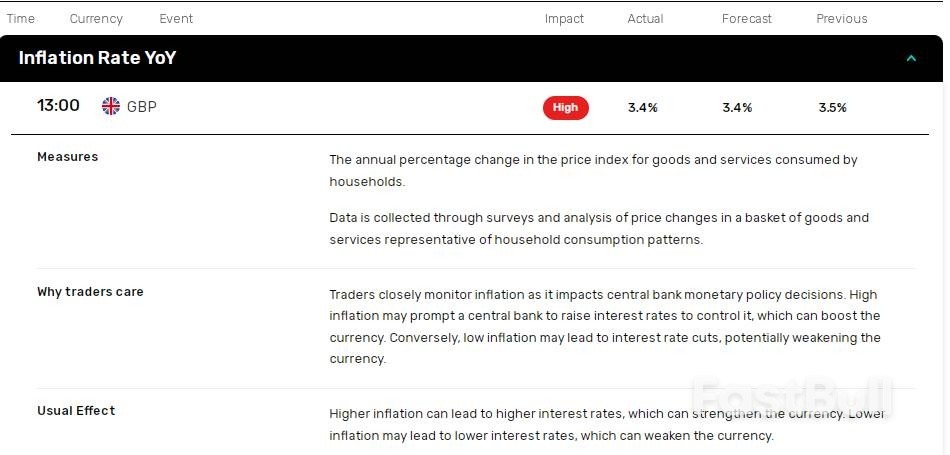
          The UK’s annual inflation rate (headline) cooled from 3.5% in April to 3.4% in May, aligned with a consensus of 3.4%. Core inflation dropped from 3.8% to 3.5% in May, below a consensus of 3.6%.

          Key price trends from the Office for National Statistics included:

          • The Consumer Prices Index, including owner-occupier housing costs (CPIH), rose 4.0% in the 12 months to May after rising 4.1% in April.
          • The largest downward contribution came from transport, offsetting upward contributions from food, and furniture and household goods.
          • The Core CPIH (excluding energy, food, alcohol, and tobacco) increased by 4.2% in the 12 months to May, compared with 4.5% in April.
          • Core CPI (excluding energy, food, alcohol, and tobacco) eased from 3.8% in the 12 months to April to 3.5% in the 12 months to May.
          • The CPI services annual rate slowed from 5.4% in April to 4.7% in May.

          Despite the softer inflation readings, a spike in WTI crude oil prices in response to the Iran-Israel conflict may cloud the inflation outlook. Uncertainty about CPI trends may leave the BoE in a policy-holding pattern despite a faltering UK economy.

          BoE to Hold Rates in June

          Economists expect the BoE to keep interest rates at 4.25% on Thursday, June 19, despite the UK economy losing momentum in April. The UK GDP fell 0.3% month-on-month as services output dropped for the first time since October 2024.

          However, sticky inflation and potentially higher oil prices could raise stagflation risks. Monetary policy uncertainty and a worsening economic outlook may pressure GBP/USD.

          Ahead of May’s inflation report, ING Economics commented on the BoE’s potential rate path, stating:

          “We expect the Bank of England to keep rates at 4.25% on 19 June, but some disappointing job numbers, lower wage growth, and a more optimistic outlook for services inflation mean we expect cuts in August and November.”

          May’s services inflation numbers supported ING Economics’ outlook. However, the Iran-Israel conflict remains a curveball for economists and central bankers.

          Friday’s upcoming retail sales figures could give a better gauge of momentum in the UK economy and the BoE’s path forward.

          GBP/USD Volatility Post-Inflation Data

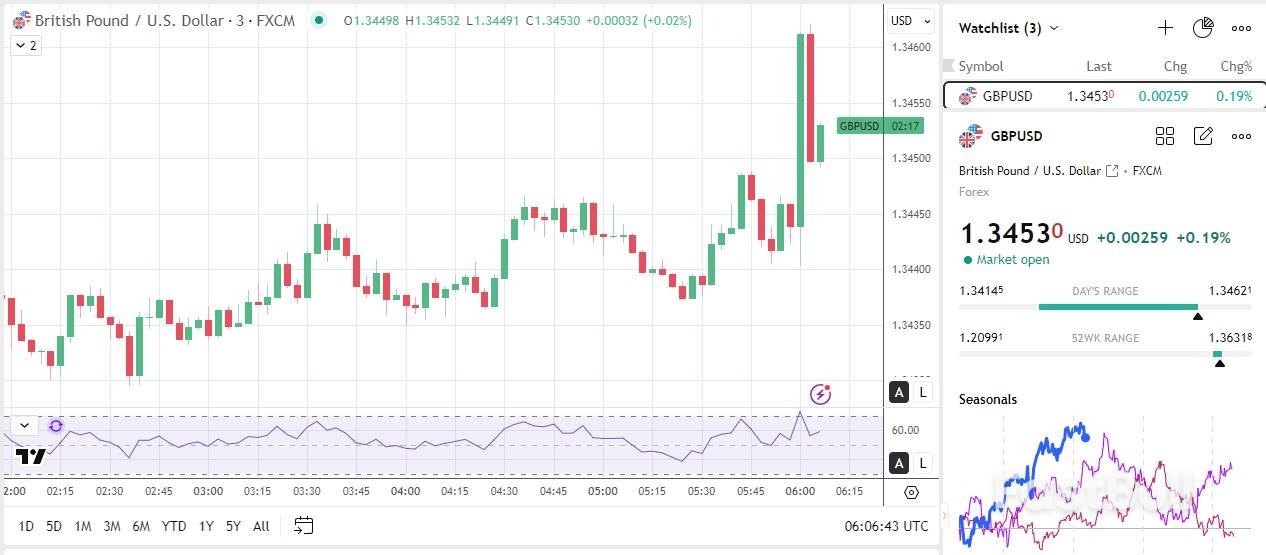
          Ahead of the inflation report, the GBP/USD dipped to a low of $1.34145 before climbing to a high of $1.34489. Following the report, the pair fell to a low of $1.34403 before surging to a high of $1.34621.

          On Wednesday, June 18, the GBP/USD was up 0.19% to $1.34530. The upswing likely signaled the potential impact of sticky inflation on the BoE’s policy outlook.

          GBPUSD – 3 Minute Chart – 180625

          Looking Ahead

          Traders must now turn to the BoE’s interest rate decision on June 19 and Friday’s UK retail sales. Consumer spending data may offer further insights into consumer sentiment and potential GDP and inflation trends.

          A drop in retail sales could signal further economic weakness and softer inflation, supporting multiple BoE rate cuts. However, strong retail sales could dampen BoE rate cut bets, sending GBP/USD higher.

          In parallel, trade developments and the Iran-Israel conflict will remain key drivers of risk sentiment and GBP/USD price action.

          Source: FX Empire

          To stay updated on all economic events of today, please check out our Economic calendar
          Risk Warnings and Disclaimers
          You understand and acknowledge that there is a high degree of risk involved in trading. Following any strategies or investment methods may lead to potential losses. The content on the site is provided by our contributors and analysts for information purposes only. You are solely responsible for determining whether any trading assets, securities, strategy, or any other product is suitable for investing based on your own investment objectives and financial situation.
          Add to Favorites
          Share

          Japan’s Export Engine Falters as U.S. Tariffs Bite and Trade Talks Stall

          Gerik

          Economic

          U.S. Tariffs Deal a Heavy Blow to Japan’s Export Sector

          Japan, the world’s fourth-largest economy, is showing growing signs of strain as its export-driven growth model faces intensified pressure from new U.S. trade barriers. According to data released by Japan’s Ministry of Finance on June 18, total exports in May fell by 1.7% year-over-year, marking the first contraction in eight months. This decline was driven primarily by an 11.1% plunge in exports to the United States, Japan’s largest export market.
          The impact of trade policy shifts under President Donald Trump is becoming increasingly visible. Since April 5, Japanese exports to the U.S. have been subject to a 10% general tariff, with an additional 14% retaliatory duty set to take effect on July 9 unless a deal is reached. Moreover, a separate 25% levy already applies to steel, automobiles, and auto parts. Earlier this month, Trump’s administration escalated tensions further by doubling tariffs on imported steel and aluminum to 50%.

          Auto and Steel Exports Lead Declines

          The latest data reveals sector-specific damage: exports of complete automobiles to the U.S. in May plummeted 24.7%, while auto parts fell by 19%, and steel shipments dipped by 1.5%. These declines point to targeted vulnerabilities in Japan’s industrial economy, particularly in industries most exposed to U.S. protectionism.
          With automotive exports making up nearly one-third of Japan’s U.S.-bound shipments, the sharp contraction in this category signals not only immediate pain but longer-term structural risks, especially as electric vehicle adoption and regional trade realignments threaten traditional Japanese export advantages.

          Diplomatic Stalemate After Six Rounds of Negotiations

          Despite six rounds of high-level trade talks between Japanese and American officials, progress has stalled. Prime Minister Shigeru Ishiba met President Trump on June 16 during the G7 summit in Alberta, but discussions failed to yield a breakthrough. Trump has reportedly accused Japan of being "tough" in negotiations, further dampening optimism for a near-term resolution.
          This prolonged impasse comes at a time when Japan is urgently seeking relief for its embattled exporters. With the July 9 tariff hike deadline approaching, companies face growing uncertainty about market access, pricing power, and long-term competitiveness in the U.S. market.

          Asia’s Broader Trade Landscape Also Struggles

          Japan is not alone in feeling the effects of U.S. trade policy. South Korea’s exports have also fallen for the first time in four months, and China’s trade with the U.S. has declined by double-digit percentages for two consecutive months. These regional signals suggest that the fallout from U.S. tariff actions is not isolated but systemic, rippling across Asia’s tightly interlinked supply chains.
          Within Japan’s broader trade performance, results were mixed. While exports to China fell 8.8%—marking the third straight monthly decline—exports to the European Union rose by 4.9%. Shipments to Southeast Asia edged up by a marginal 0.1%, indicating stagnation in a traditionally high-growth corridor.

          Imports Fall, Trade Surplus Widens—But Not for the Right Reasons

          On the import side, Japan recorded a 7.7% decline year-over-year, sharper than expected. While this helped produce a trade surplus of 637.61 billion yen (approximately $4.4 billion), the contraction in imports may reflect weakening domestic demand rather than a healthy rebalancing of trade. With household consumption and industrial investment both under pressure, Japan’s trade surplus could signal economic fragility rather than strength.
          Japan’s export-driven economy is facing a pivotal moment. The sharp drop in shipments to the U.S.—its top trading partner—comes amid a breakdown in diplomacy and escalating tariff pressures. As global supply chains remain fragile and geopolitical tensions intensify, Japan must grapple with both external headwinds and internal structural challenges.
          Without a swift resolution to its trade standoff with Washington, Tokyo risks deeper industrial contraction and a prolonged drag on GDP growth. The coming weeks may prove critical not just for Japan’s economic outlook, but for the broader stability of trade flows in the Asia-Pacific region.

          Source: Nikkei Asia

          To stay updated on all economic events of today, please check out our Economic calendar
          Risk Warnings and Disclaimers
          You understand and acknowledge that there is a high degree of risk involved in trading. Following any strategies or investment methods may lead to potential losses. The content on the site is provided by our contributors and analysts for information purposes only. You are solely responsible for determining whether any trading assets, securities, strategy, or any other product is suitable for investing based on your own investment objectives and financial situation.
          Add to Favorites
          Share

          U.S. Treasury Yields Fall Sharply as Weak Retail Sales and Geopolitical Tensions Raise Recession Alarm

          Gerik

          Economic

          Retail Sales Slump Triggers Bond Market Rally

          Treasury yields fell notably on Tuesday as May retail sales came in significantly below expectations, signaling a sharper-than-anticipated consumer pullback and intensifying concerns over the U.S. economic outlook. The Census Bureau reported a 0.9% monthly decline in retail sales, compared to a projected 0.6% drop. Excluding automobiles, sales fell 0.3%—worse than the 0.1% increase economists expected. The data indicates not just temporary consumer fatigue but potentially deeper cracks in demand fundamentals.
          The response from fixed-income markets was swift. The benchmark 10-year Treasury yield slid over 6 basis points to 4.387%, while the 2-year Treasury note declined by more than 2 basis points to 3.946%. These moves reflect both an adjustment in growth expectations and growing demand for the perceived safety of government debt. Because bond yields move inversely to prices, the drop in yields reflects a surge in buying activity, driven by both economic and geopolitical risk.

          Consumer Weakness Reinforces Downside Growth Risk

          Retail sales are a leading indicator of domestic economic momentum. The broad-based softness—particularly the 2% decline in gasoline sales—suggests more than price effects; it may reflect a contraction in consumer mobility and overall spending. With personal consumption comprising nearly 70% of U.S. GDP, such a decline poses a direct risk to second-quarter growth forecasts.
          While lower energy prices can, in theory, support household spending, the simultaneous drop in retail volumes hints at a more systemic demand weakness. The retail slump, especially in discretionary segments, reinforces concerns that inflation-fatigued consumers may be pulling back in response to cost pressures and economic uncertainty.

          Geopolitical Turbulence Amplifies Market Caution

          Adding to the bearish economic signals is the mounting uncertainty surrounding the escalating conflict between Israel and Iran. President Trump’s abrupt departure from the G7 summit in Alberta, citing “much bigger” events in the Middle East, heightened market sensitivity to geopolitical risks. His call for Iranians to evacuate Tehran, alongside continued missile exchanges and reports of explosions in the Iranian capital, contributed to the safe-haven flows into U.S. Treasurys.
          This conflict introduces potential global economic spillovers, particularly via oil markets, supply chain disruptions, and risk sentiment contagion. Historically, heightened geopolitical uncertainty has driven investors toward low-risk assets such as U.S. bonds and gold, and current price action aligns with that pattern.
          Deutsche Bank echoed this sentiment in a note on Tuesday, highlighting the sustained aerial conflict and ambiguity over Israel’s willingness to consider a ceasefire. These developments suggest that financial markets are pricing in not just regional instability, but the likelihood of broader economic dislocation.

          Policy Implications: Fed Caught Between Growth and Inflation Risks

          The Federal Reserve’s upcoming decision now takes center stage, with markets recalibrating expectations in light of weak economic data and persistent inflationary risks linked to oil prices. While the Fed is widely expected to keep rates unchanged, the outlook for future rate cuts has become increasingly nuanced. On one hand, softening consumer data supports an easing bias; on the other, geopolitical-driven commodity shocks may sustain inflationary pressures, complicating the Fed’s dual mandate.
          The bond market is signaling skepticism that the U.S. economy can maintain growth under current rate conditions, especially if global energy and trade dynamics worsen. The steepening in the Treasury curve—where long-term yields fall more than short-term ones—also points toward recession expectations, with investors anticipating slower growth and eventual rate cuts.
          Tuesday’s bond market reaction reflects a confluence of deteriorating retail activity and intensifying geopolitical stress, both of which have triggered a reassessment of economic resilience. The fall in Treasury yields signals growing investor concern that the U.S. is approaching an inflection point where stagnant consumer demand and rising global risk may tip the economy into a downturn. As the Federal Reserve prepares to issue its latest policy guidance, financial markets will be looking for clarity on whether policymakers are prepared to pivot in the face of deepening uncertainty.

          Source: CNBC

          To stay updated on all economic events of today, please check out our Economic calendar
          Risk Warnings and Disclaimers
          You understand and acknowledge that there is a high degree of risk involved in trading. Following any strategies or investment methods may lead to potential losses. The content on the site is provided by our contributors and analysts for information purposes only. You are solely responsible for determining whether any trading assets, securities, strategy, or any other product is suitable for investing based on your own investment objectives and financial situation.
          Add to Favorites
          Share

          Japan's Exports Suffer Sharpest Decline in Eight Months Amid Auto Tariff Fallout and Trade Gridlock

          Gerik

          Economic

          Auto Tariffs Drive Sharp Contraction in Japan’s Export Performance

          Japan’s export sector contracted significantly in May, as new trade data revealed a 1.7% year-over-year decline—the most pronounced fall in eight months. Although the downturn was less severe than the 3.8% drop forecasted by economists, it marked a clear reversal from the 2% growth posted in April and highlights the intensifying impact of US trade measures, especially on Japan’s critical automobile industry.
          The drop was driven by a 24.7% plunge in car exports to the U.S., a sector that constituted 28.3% of Japan’s exports to the American market in 2024. Overall automobile shipments declined 6.9% globally, suggesting that while US policy is the immediate pressure point, broader global demand softness may be emerging. The numbers reflect not only the impact of the existing 25% tariff on Japanese auto and steel exports, but also anxiety over the upcoming 24% “reciprocal” tariff due to be implemented on July 9.

          Trade Imbalance Shrinks, But Underlying Risks Mount

          Despite the export shock, Japan’s trade deficit in May was smaller than anticipated, totaling 637.6 billion yen (approximately $4.39 billion), better than the 892.9 billion yen shortfall expected by analysts. Imports also contracted more than expected, falling 7.7% year-on-year compared to the consensus forecast of a 6.7% decline.
          While this appears positive on the surface, the narrower deficit is largely a byproduct of weakened domestic demand rather than trade resilience. Import contraction, particularly in raw materials and capital goods, reflects cooling private sector confidence and subdued household consumption—further symptoms of macroeconomic fragility.

          Geopolitical and Structural Pressures Converge

          The sharp fall in exports coincides with a lack of progress in trade negotiations between Japan and the United States. After six rounds of high-level discussions between Japanese negotiator Ryosei Akazawa and U.S. officials Howard Lutnick and Scott Bessent, a resolution remains elusive. President Trump recently criticized Japan’s stance as “tough,” suggesting a hardening U.S. approach that leaves little room for swift compromise.
          The timing is particularly detrimental, as the Bank of Japan’s recent policy statement already warned of a moderation in growth due to weakening trade and corporate profitability. The BOJ acknowledged that global policy uncertainty could derail overseas demand, further complicating the already precarious recovery trajectory. With Japan’s GDP having contracted by 0.2% in the first quarter, any prolonged drag from trade could push the country toward a technical recession.

          Sectoral Concentration Heightens Exposure to Trade Shocks

          Japan’s economic model, heavily dependent on industrial exports—particularly automobiles and electronics—amplifies its vulnerability to targeted tariffs. While Japan has pursued diversification through multilateral agreements like the CPTPP and RCEP, these have yet to offset the dominance of the U.S. as a trade partner. Despite past exemptions such as the 2018 steel tariff waiver, the current landscape suggests a diminished likelihood of similar relief, especially under the renewed tariff regime.
          Moody’s Analytics economist Stefan Angrick emphasized that tariffs now represent the single largest threat to Japan’s near-term outlook. Even if a partial deal is reached, he argues, a full return to pre-Trump trade conditions is unlikely, suggesting a structurally altered environment that could hinder export recovery for months to come.

          Policy Response and Political Stakes

          Prime Minister Shigeru Ishiba has reiterated the strategic importance of Japan’s automobile sector, reportedly labeling it a "major national interest." As negotiations stall, Japan’s strategy appears to prioritize preserving market access for auto manufacturers over broader concessions. This sectoral focus may help insulate key firms but risks alienating other industries and complicating broader trade diversification.
          Simultaneously, fiscal and monetary tools to cushion the impact are becoming less effective. With the BOJ maintaining ultra-low rates and signaling caution on bond tapering, Japan’s policy space remains narrow. Any aggressive fiscal support to offset the export slump may further inflate the government’s already elevated debt burden.
          The sharp drop in Japan’s exports—particularly its auto shipments to the U.S.—underscores the fragility of its recovery and the high exposure to geopolitical risk. With negotiations stalled and new tariffs imminent, the outlook for Japan’s external sector remains deeply uncertain. Unless a breakthrough is achieved in the coming weeks, export-driven growth will continue to face headwinds, putting additional pressure on policymakers to craft a multi-front response that balances diplomacy, domestic stimulus, and structural trade diversification.

          Source: Reuters

          To stay updated on all economic events of today, please check out our Economic calendar
          Risk Warnings and Disclaimers
          You understand and acknowledge that there is a high degree of risk involved in trading. Following any strategies or investment methods may lead to potential losses. The content on the site is provided by our contributors and analysts for information purposes only. You are solely responsible for determining whether any trading assets, securities, strategy, or any other product is suitable for investing based on your own investment objectives and financial situation.
          Add to Favorites
          Share
          FastBull
          Copyright © 2025 FastBull Ltd

          728 RM B 7/F GEE LOK IND BLDG NO 34 HUNG TO RD KWUN TONG KLN HONG KONG

          TelegramInstagramTwitterfacebooklinkedin
          App Store Google Play Google Play
          Products
          Charts

          Chats

          Q&A with Experts
          Screeners
          Economic Calendar
          Data
          Tools
          Membership
          Features
          Function
          Markets
          Copy Trading
          Latest Signals
          Contests
          News
          Analysis
          24/7
          Columns
          Education
          Company
          Careers
          About Us
          Contact Us
          Advertising
          Help Center
          Feedback
          User Agreement
          Privacy Policy
          Business

          White Label

          Data API

          Web Plug-ins

          Poster Maker

          Affiliate Program

          Risk Disclosure

          The risk of loss in trading financial instruments such as stocks, FX, commodities, futures, bonds, ETFs and crypto can be substantial. You may sustain a total loss of the funds that you deposit with your broker. Therefore, you should carefully consider whether such trading is suitable for you in light of your circumstances and financial resources.

          No decision to invest should be made without thoroughly conducting due diligence by yourself or consulting with your financial advisors. Our web content might not suit you since we don't know your financial conditions and investment needs. Our financial information might have latency or contain inaccuracy, so you should be fully responsible for any of your trading and investment decisions. The company will not be responsible for your capital loss.

          Without getting permission from the website, you are not allowed to copy the website's graphics, texts, or trademarks. Intellectual property rights in the content or data incorporated into this website belong to its providers and exchange merchants.

          Not Logged In

          Log in to access more features

          FastBull Membership

          Not yet

          Purchase

          Become a signal provider
          Help Center
          Customer Service
          Dark Mode
          Price Up/Down Colors

          Log In

          Sign Up

          Position
          Layout
          Fullscreen
          Default to Chart
          The chart page opens by default when you visit fastbull.com