• Trade
  • Markets
  • Copy
  • Contests
  • News
  • 24/7
  • Calendar
  • Q&A
  • Chats
Trending
Screeners
SYMBOL
LAST
BID
ASK
HIGH
LOW
NET CHG.
%CHG.
SPREAD
SPX
S&P 500 Index
6857.13
6857.13
6857.13
6865.94
6827.13
+7.41
+ 0.11%
--
DJI
Dow Jones Industrial Average
47850.93
47850.93
47850.93
48049.72
47692.96
-31.96
-0.07%
--
IXIC
NASDAQ Composite Index
23505.13
23505.13
23505.13
23528.53
23372.33
+51.04
+ 0.22%
--
USDX
US Dollar Index
98.820
98.900
98.820
98.980
98.740
-0.160
-0.16%
--
EURUSD
Euro / US Dollar
1.16627
1.16635
1.16627
1.16715
1.16408
+0.00182
+ 0.16%
--
GBPUSD
Pound Sterling / US Dollar
1.33497
1.33507
1.33497
1.33622
1.33165
+0.00226
+ 0.17%
--
XAUUSD
Gold / US Dollar
4222.93
4223.34
4222.93
4230.62
4194.54
+15.76
+ 0.37%
--
WTI
Light Sweet Crude Oil
59.292
59.322
59.292
59.469
59.187
-0.091
-0.15%
--

Community Accounts

Signal Accounts
--
Profit Accounts
--
Loss Accounts
--
View More

Become a signal provider

Sell trading signals to earn additional income

View More

Guide to Copy Trading

Get started with ease and confidence

View More

Signal Accounts for Members

All Signal Accounts

Best Return
  • Best Return
  • Best P/L
  • Best MDD
Past 1W
  • Past 1W
  • Past 1M
  • Past 1Y

All Contests

  • All
  • Trump Updates
  • Recommend
  • Stocks
  • Cryptocurrencies
  • Central Banks
  • Featured News
Top News Only
Share

Turkey's Main Banking Index Up 2%

Share

French October Trade Balance -3.92 Billion Euros Versus Revised -6.35 Billion Euros In September

Share

Kremlin Aide Says Russia Is Ready To Work Further With Current USA Team

Share

Kremlin Aide Says Russia And USA Are Moving Forward In Ukraine Talks

Share

Shanghai Rubber Warehouse Stocks Up 7336 Tons

Share

Shanghai Tin Warehouse Stocks Up 506 Tons

Share

Reserve Bank Of India Chief Malhotra: Goal Is To Have Inflation Be Around 4%

Share

Ukmto Says Master Has Confirmed That The Small Crafts Have Left The Scene, Vessel Is Proceeding To Its Next Port Of Call

Share

Shanghai Nickel Warehouse Stocks Up 1726 Tons

Share

Shanghai Lead Warehouse Stocks Down 3064 Tons

Share

Shanghai Zinc Warehouse Stocks Down 4000 Tons

Share

Shanghai Aluminium Warehouse Stocks Up 8353 Tons

Share

Shanghai Copper Warehouse Stocks Down 9025 Tons

Share

Equinor: Preliminary Estimates Indicate Reservoirs May Contain Between 5 -18 Million Standard Cubic Meters Of Recoverable Oil Equivalents

Share

Japan Chief Cabinet Secretary Kihara: Government To Take Appropriate Steps On Excessive And Disorderly Moves In Foreign Exchange Market, If Necessary

Share

[Report: Amazon Pays €180 Million To Italy To End Tax And Labor Investigations] Amazon Has Paid A Settlement And Dismantled Its Monitoring System For Delivery Drivers In Italy, Ending An Investigation Into Alleged Tax Fraud And Illegal Labor Practices. In July 2024, The Group's Logistics Services Division Was Accused Of Circumventing Labor And Tax Laws By Relying On Cooperatives Or Limited Liability Companies To Supply Workers, Evading VAT, And Reducing Social Security Payments. Sources Say The Group Has Now Paid Approximately €180 Million To Italian Tax Authorities As Part Of A €1 Billion Settlement Involving 33 Companies

Share

Airbus - Booked 797 Gross Aircraft Orders In January-November

Share

[Market Update] Spot Gold Broke Through $4,230 Per Ounce, Up 0.51% On The Day

Share

Reserve Bank Of India Chief Malhotra: There Will Be Ample Liquidity As Long As We Are In An Easing Cycle

Share

Reserve Bank Of India Chief Malhotra: Quantum Of System Liquidity Will Be Managed To Ensure Monetary Transmission Is Happening

TIME
ACT
FCST
PREV
France 10-Year OAT Auction Avg. Yield

A:--

F: --

P: --

Euro Zone Retail Sales MoM (Oct)

A:--

F: --

P: --

Euro Zone Retail Sales YoY (Oct)

A:--

F: --

P: --

Brazil GDP YoY (Q3)

A:--

F: --

P: --

U.S. Challenger Job Cuts (Nov)

A:--

F: --

P: --

U.S. Challenger Job Cuts MoM (Nov)

A:--

F: --

P: --

U.S. Challenger Job Cuts YoY (Nov)

A:--

F: --

P: --

U.S. Initial Jobless Claims 4-Week Avg. (SA)

A:--

F: --

P: --

U.S. Weekly Initial Jobless Claims (SA)

A:--

F: --

P: --

U.S. Weekly Continued Jobless Claims (SA)

A:--

F: --

P: --

Canada Ivey PMI (SA) (Nov)

A:--

F: --

P: --

Canada Ivey PMI (Not SA) (Nov)

A:--

F: --

P: --

U.S. Non-Defense Capital Durable Goods Orders Revised MoM (Excl. Aircraft) (SA) (Sept)

A:--

F: --

P: --
U.S. Factory Orders MoM (Excl. Transport) (Sept)

A:--

F: --

P: --

U.S. Factory Orders MoM (Sept)

A:--

F: --

P: --

U.S. Factory Orders MoM (Excl. Defense) (Sept)

A:--

F: --

P: --

U.S. EIA Weekly Natural Gas Stocks Change

A:--

F: --

P: --

Saudi Arabia Crude Oil Production

A:--

F: --

P: --

U.S. Weekly Treasuries Held by Foreign Central Banks

A:--

F: --

P: --

Japan Foreign Exchange Reserves (Nov)

A:--

F: --

P: --

India Repo Rate

A:--

F: --

P: --

India Benchmark Interest Rate

A:--

F: --

P: --

India Reverse Repo Rate

A:--

F: --

P: --

India Cash Reserve Ratio

A:--

F: --

P: --

Japan Leading Indicators Prelim (Oct)

A:--

F: --

P: --

U.K. Halifax House Price Index YoY (SA) (Nov)

A:--

F: --

P: --

U.K. Halifax House Price Index MoM (SA) (Nov)

A:--

F: --

P: --

France Current Account (Not SA) (Oct)

--

F: --

P: --

France Trade Balance (SA) (Oct)

A:--

F: --

P: --

France Industrial Output MoM (SA) (Oct)

A:--

F: --

P: --

Italy Retail Sales MoM (SA) (Oct)

--

F: --

P: --

Euro Zone Employment YoY (SA) (Q3)

--

F: --

P: --

Euro Zone GDP Final YoY (Q3)

--

F: --

P: --

Euro Zone GDP Final QoQ (Q3)

--

F: --

P: --

Euro Zone Employment Final QoQ (SA) (Q3)

--

F: --

P: --

Euro Zone Employment Final (SA) (Q3)

--

F: --

P: --
Brazil PPI MoM (Oct)

--

F: --

P: --

Mexico Consumer Confidence Index (Nov)

--

F: --

P: --

Canada Unemployment Rate (SA) (Nov)

--

F: --

P: --

Canada Labor Force Participation Rate (SA) (Nov)

--

F: --

P: --

Canada Employment (SA) (Nov)

--

F: --

P: --

Canada Part-Time Employment (SA) (Nov)

--

F: --

P: --

Canada Full-time Employment (SA) (Nov)

--

F: --

P: --

U.S. Personal Income MoM (Sept)

--

F: --

P: --

U.S. Dallas Fed PCE Price Index YoY (Sept)

--

F: --

P: --

U.S. PCE Price Index YoY (SA) (Sept)

--

F: --

P: --

U.S. PCE Price Index MoM (Sept)

--

F: --

P: --

U.S. Personal Outlays MoM (SA) (Sept)

--

F: --

P: --

U.S. Core PCE Price Index MoM (Sept)

--

F: --

P: --

U.S. UMich 5-Year-Ahead Inflation Expectations Prelim YoY (Dec)

--

F: --

P: --

U.S. Core PCE Price Index YoY (Sept)

--

F: --

P: --

U.S. Real Personal Consumption Expenditures MoM (Sept)

--

F: --

P: --

U.S. 5-10 Year-Ahead Inflation Expectations (Dec)

--

F: --

P: --

U.S. UMich Current Economic Conditions Index Prelim (Dec)

--

F: --

P: --

U.S. UMich Consumer Sentiment Index Prelim (Dec)

--

F: --

P: --

U.S. UMich 1-Year-Ahead Inflation Expectations Prelim (Dec)

--

F: --

P: --

U.S. UMich Consumer Expectations Index Prelim (Dec)

--

F: --

P: --

U.S. Weekly Total Rig Count

--

F: --

P: --

Q&A with Experts
    • All
    • Chatrooms
    • Groups
    • Friends
    Connecting
    .
    .
    .
    Type here...
    Add Symbol or Code

      No matching data

      All
      Trump Updates
      Recommend
      Stocks
      Cryptocurrencies
      Central Banks
      Featured News
      • All
      • Russia-Ukraine Conflict
      • Middle East Flashpoint
      • All
      • Russia-Ukraine Conflict
      • Middle East Flashpoint

      Search
      Products

      Charts Free Forever

      Chats Q&A with Experts
      Screeners Economic Calendar Data Tools
      Membership Features
      Data Warehouse Market Trends Institutional Data Policy Rates Macro

      Market Trends

      Market Sentiment Order Book Forex Correlations

      Top Indicators

      Charts Free Forever
      Markets

      News

      News Analysis 24/7 Columns Education
      From Institutions From Analysts
      Topics Columnists

      Latest Views

      Latest Views

      Trending Topics

      Top Columnists

      Latest Update

      Signals

      Copy Rankings Latest Signals Become a signal provider AI Rating
      Contests
      Brokers

      Overview Brokers Assessment Rankings Regulators News Claims
      Broker listing Forex Brokers Comparison Tool Live Spread Comparison Scam
      Q&A Complaint Scam Alert Videos Tips to Detect Scam
      More

      Business
      Events
      Careers About Us Advertising Help Center

      White Label

      Data API

      Web Plug-ins

      Affiliate Program

      Awards Institution Evaluation IB Seminar Salon Event Exhibition
      Vietnam Thailand Singapore Dubai
      Fans Party Investment Sharing Session
      FastBull Summit BrokersView Expo
      Recent Searches
        Top Searches
          Markets
          News
          Analysis
          User
          24/7
          Economic Calendar
          Education
          Data
          • Names
          • Latest
          • Prev

          View All

          No data

          Scan to Download

          Faster Charts, Chat Faster!

          Download App
          English
          • English
          • Español
          • العربية
          • Bahasa Indonesia
          • Bahasa Melayu
          • Tiếng Việt
          • ภาษาไทย
          • Français
          • Italiano
          • Türkçe
          • Русский язык
          • 简中
          • 繁中
          Open Account
          Search
          Products
          Charts Free Forever
          Markets
          News
          Signals

          Copy Rankings Latest Signals Become a signal provider AI Rating
          Contests
          Brokers

          Overview Brokers Assessment Rankings Regulators News Claims
          Broker listing Forex Brokers Comparison Tool Live Spread Comparison Scam
          Q&A Complaint Scam Alert Videos Tips to Detect Scam
          More

          Business
          Events
          Careers About Us Advertising Help Center

          White Label

          Data API

          Web Plug-ins

          Affiliate Program

          Awards Institution Evaluation IB Seminar Salon Event Exhibition
          Vietnam Thailand Singapore Dubai
          Fans Party Investment Sharing Session
          FastBull Summit BrokersView Expo

          Market Navigator: Week of 21 July 2025

          IG

          Forex

          Economic

          Summary:

          China delivered stronger-than-expected Q2 GDP growth of 5.2% despite structural challenges, while global trade tensions eased with reduced tariffs and cryptocurrency regulation achieved a historic breakthrough. US equities surged to fresh highs driven by strong corporate earnings, while USD/JPY strengthened on Japanese electoral uncertainty and Bitcoin soared above $123,000 on regulatory optimism.Market participants will scrutinise the ECB's interest rate decision and Fed Chair Powell's policy guidance, alongside comprehensive global PMI data and critical technology sector earnings from Tesla and Alphabet.
          What happened last week

          China GDP beats expectations: China's second-quarter gross domestic product (GDP) expanded 5.2% year-on-year (YoY), surpassing consensus forecasts. However, intensifying export dependence, property sector distress, and weak retail consumption highlight the urgent need for policy intervention to achieve Beijing's 5% full-year target. Senior leadership is expected to discuss additional stimulus in early August.Trade tensions ease: Washington reduced Indonesian tariffs from 32% to 19%. The administration made concessions to China, allowing Nvidia H20 chip exports while Treasury Secretary Bessent suggested flexibility on the 12 August deadline. Trump will issue tariff letters to 150+ nations at 10-15% rates.Crypto regulation breakthrough: The GENIUS Act established the first federal stablecoin framework, transforming digital asset regulation. Bank of America and Citigroup signalled plans for proprietary stablecoins. Cryptocurrency investment may soon be made available through 401(k) retirement plans.Global inflation patterns diverge: US core inflation fell to 2.9%, below forecasts, though tariff cost pass-through emerges. Japan's inflation moderated from 3.7% to 3.3% on lower energy price growth, but rice prices doubled YoY suggesting food inflation may not be transitory. UK inflation unexpectedly surged to 3.6%, a 17-month high.

          Markets in focus

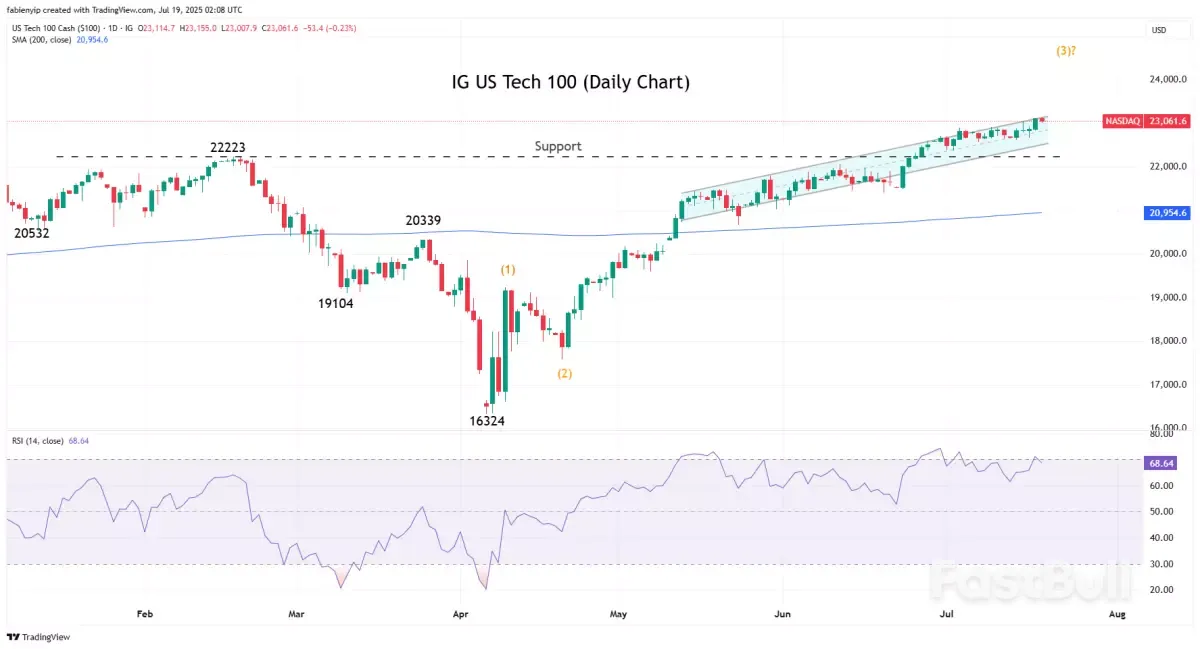
          US equity market rises on positive corporate earnings.US major banks delivered extraordinary second-quarter performance, capitalising on elevated market volatility to generate exceptional trading revenues. Goldman Sachs' equity trading division achieved its strongest quarterly performance in company history, while Citigroup recorded its highest quarterly revenue in over a decade, underlining the sector's operational leverage during volatile market conditions. The S&P 500 Banking Index outperformed broader indices with a 0.9% weekly advance, demonstrating sector-specific strength amid broader market uncertainty.Netflix exceeded all key performance metrics and upgraded full-year guidance, yet shares declined over 4% on Friday as investors crystallised profits following a spectacular 40% year-to-date rally, highlighting the challenge of sustaining momentum after exceptional gains.The US Tech 100 index established three consecutive daily records before retreating 0.1% on Friday, successfully breaching the psychologically significant 23,000 threshold. Technical analysis suggests potential corrective movement toward 22,545 support, though maintenance above this level would preserve the bullish trend established from mid-May lows. Elliott Wave analysis indicates that if current price action follows Wave 3 characteristics from the 21 April base, a 200% Fibonacci extension could potentially drive the index toward 24,718 before Wave 4 correction materialises. February's 22,223 high provides crucial technical support for any pullback scenario.

          Figure 1: US Tech 100 index (daily) price chartMarket Navigator: Week of 21 July 2025_1

          TradingView, as of 19 July 2025. Past performance is not a reliable indicator of future performance.

          USD/JPY benefits from dollar strength and Japanese political uncertainty

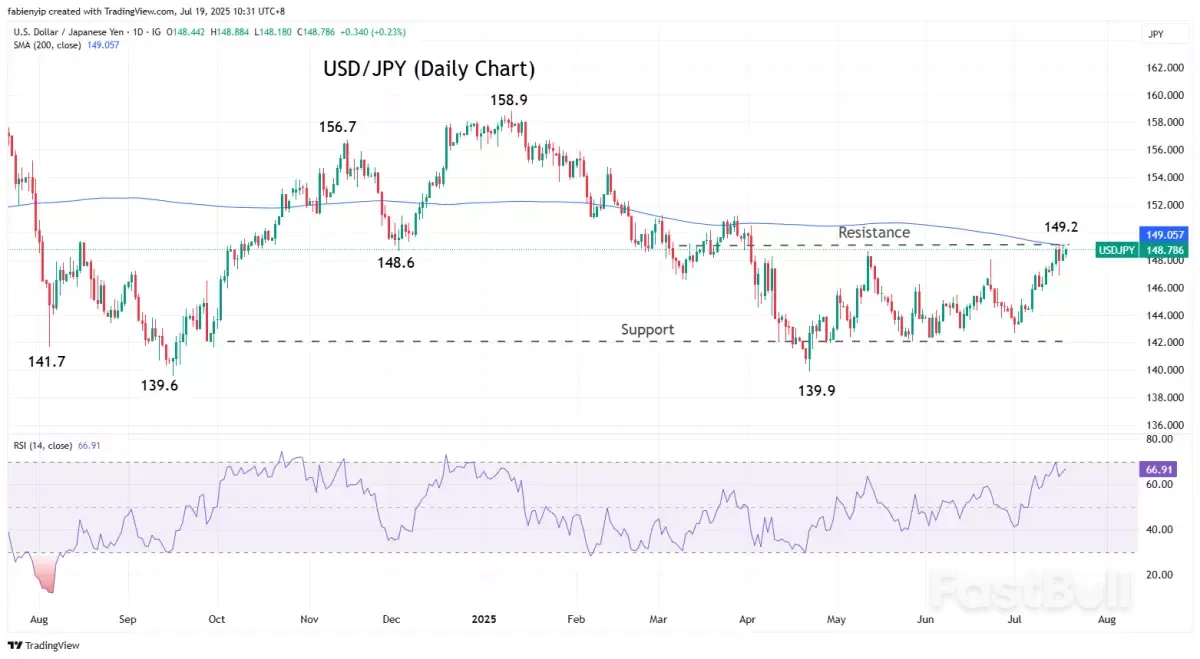
          USD/JPY has surged 3% month-to-date, propelled by US dollar strength and mounting volatility from the Upper House election. The ruling Liberal Democratic Party-Komeito coalition faces probable loss of its chamber majority, with opposition parties advocating more expansionary fiscal policies that could undermine yen stability. Given markets have already partly accounted for ruling party electoral defeat probability, we anticipate USD/JPY momentum will encounter material resistance at the 149 threshold.Escalating speculation surrounding US-Japan trade negotiations, particularly foreign exchange intervention discussions, could materially constrain additional yen weakness. Tokyo may face Washington pressure to strengthen the yen as part of broader trade deficit reduction efforts, creating potential policy conflict between domestic political considerations and international trade obligations.Technical analysis reveals USD/JPY encountered critical resistance at 149.2 following its powerful rebound from 142.7 on 1 July. Sustained resistance at this level suggests probable reversion to the established 142-149 trading range, while a decisive break above 149 could target the 151 level as the next significant resistance zone.

          Figure 2: USD/JPY (daily) price chartMarket Navigator: Week of 21 July 2025_2

          Source: TradingView, as of 19 July 2025. Past performance is not a reliable indicator of future performance.

          Bitcoin surges past $123,000 on regulatory breakthroughs

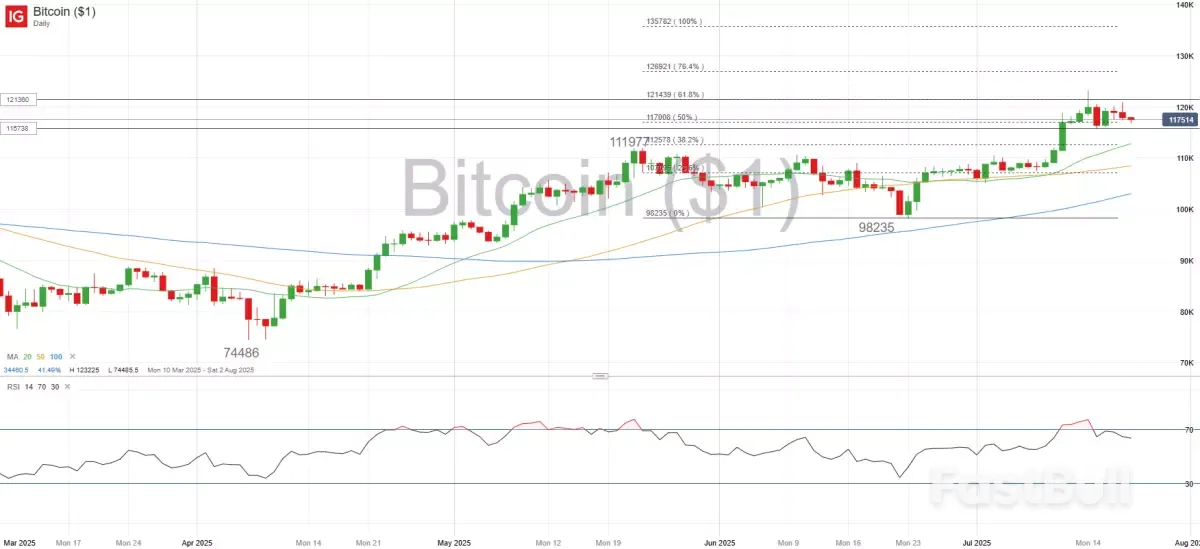
          Digital assets achieved unprecedented regulatory legitimacy as President Trump signed the GENIUS Act following House approval, while the CLARITY Act and anti-central bank digital currency (CBDC) Surveillance State Act advanced through the Congressional and will then be reviewed by the Senate. The CLARITY Act proposes transferring digital asset regulatory authority from the restrictive Securities and Exchange Commission (SEC) to the more accommodating Commodity Futures Trading Commission (CFTC), fundamentally reshaping oversight frameworks. The anti-CBDC legislation prohibits Federal Reserve (Fed) digital currency issuance, preserving consumer financial privacy.These transformative regulatory developments propelled Bitcoin above $123,000 before profit-taking drove prices below $116,000. Sustained exchange-traded fund (ETF) inflows combined with accelerating institutional adoption continue supporting long-term price appreciation. Derivatives market data from Bybit and Deribit reveal overwhelming trader optimism for July price performance, with call options expiring 1 August struck between $130,000-$132,000 exhibiting the highest open interest concentration.Having surpassed last week's $121,439 high, Bitcoin's next technical target aligns with the 76.4% Fibonacci extension of the 7 April to 23 May rally at $126,921. Immediate technical support resides near $115,700.

          Figure 3: Bitcoin (daily) price chart

          Market Navigator: Week of 21 July 2025_3

          Source: IG, 19 July 2025. Past performance is not a reliable indicator of future performance.

          The week ahead

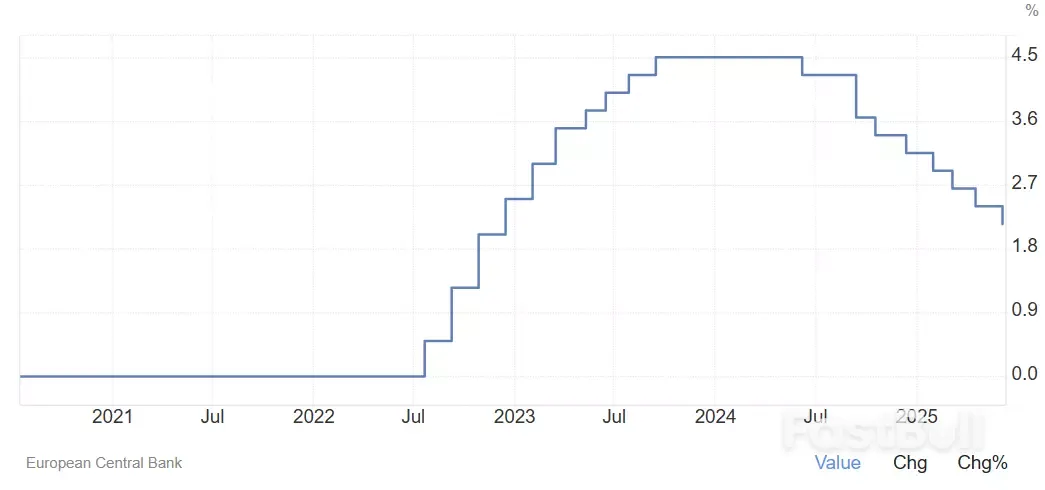
          The week ahead delivers a pivotal convergence of monetary policy, global economic sentiment, and corporate earnings that could reshape market expectations across multiple fronts. The European Central Bank (ECB)'s interest rate decision Thursday takes centre stage, with markets closely watching for signals on the future policy path to maintain inflation at current levels amid the eurozone's evolving economic landscape.ECB President Lagarde's recent comments at the ECB Form indicated the disinflationary project has achieved its objective. Euro Area's headline year-on-year (YoY) inflation rose from 1.9% to 2.0%, matching ECB's target in June. We anticipate policy rates will remain unchanged as policymakers assess the impact of seven consecutive rate cuts while monitoring US-Europe trade relationship developments. Market pricing implies one additional 25 basis point reduction this year, most likely delivered in October.Fed Chair Powell's speech Tuesday will provide crucial insights into US monetary policy thinking, particularly following recent benign inflation prints and robust employment data, while navigating intense political pressure from the Trump administration advocating rate cuts to stimulate economic growth.Flash PMI readings across Australia, Japan, the UK and US on Thursday offer comprehensive insights into global business activities, with particular attention on whether the UK's manufacturing sector can emerge from contractionary territory.On the corporate front, technology giants Tesla and Alphabet reporting earnings, providing key indicators of consumer demand trends, artificial intelligence investment impact, and the broader technology sector's resilience amid economic uncertainties.

          Figure 4: ECB's deposit facility rate

          Market Navigator: Week of 21 July 2025_4

          Source: Trading Economics

          Source:IG

          To stay updated on all economic events of today, please check out our Economic calendar
          Risk Warnings and Disclaimers
          You understand and acknowledge that there is a high degree of risk involved in trading. Following any strategies or investment methods may lead to potential losses. The content on the site is provided by our contributors and analysts for information purposes only. You are solely responsible for determining whether any trading assets, securities, strategy, or any other product is suitable for investing based on your own investment objectives and financial situation.
          Add to Favorites
          Share

          Commerce Secretary Lutnick Says He Is Confident US Will Secure Trade Deal With EU

          James Whitman

          Economic

          US Commerce Secretary Howard Lutnick said on Sunday that he was confident that the United States can secure a trade deal with the European Union (EU), but Aug 1 is a hard deadline for tariffs to kick in.

          Lutnick said he had just got off the phone with European trade negotiators, and there was "plenty of room" for agreement.

          "These are the two biggest trading partners in the world, talking to each other. We'll get a deal done. I am confident [that] we'll get a deal done," Lutnick said in an interview with CBS' "Face the Nation".

          US President Donald Trump threatened on July 12 to impose a 30% tariff on imports from Mexico and the EU starting Aug 1, after weeks of negotiations with major US trading partners failed to reach a comprehensive trade deal.

          Lutnick said that was a hard deadline.

          "Nothing stops countries from talking to us after Aug 1, but they're going to start paying the tariffs on Aug 1," he said on CBS.

          Trump announced the tariffs in a letter to European Commission president Ursula von der Leyen. He sent letters to other trading partners, including Mexico, Canada, Japan and Brazil, setting blanket tariff rates ranging from 20% to 50%, as well as a 50% tariff on copper.

          Lutnick also said that he expects Trump to renegotiate the United States-Mexico-Canada Agreement (USMCA) signed during Trump's first White House term in 2017-2021.

          Barring any major changes, USMCA-compliant goods from Mexico and Canada are exempt from tariffs.

          "I think the president is absolutely going to renegotiate USMCA, but that's a year from today," Lutnick said.

          Source: Reuters

          To stay updated on all economic events of today, please check out our Economic calendar
          Risk Warnings and Disclaimers
          You understand and acknowledge that there is a high degree of risk involved in trading. Following any strategies or investment methods may lead to potential losses. The content on the site is provided by our contributors and analysts for information purposes only. You are solely responsible for determining whether any trading assets, securities, strategy, or any other product is suitable for investing based on your own investment objectives and financial situation.
          Add to Favorites
          Share

          Hedge Funds Retreat from Japan Ahead of Political Shock

          Gerik

          Economic

          Investor Exodus Precedes Political Blow

          Global hedge funds significantly reduced their exposure to Japanese equities between July 11 and 17, marking the sharpest sell-off in nearly two and a half months, according to Goldman Sachs. This wave of selling came just before Sunday’s upper house election, which dealt a severe setback to Prime Minister Shigeru Ishiba and his ruling coalition. Though Ishiba has pledged to remain in power to conclude critical trade negotiations with the United States, his weakened position has sparked broader investor unease.
          The pre-election selloff was driven by a spike in short positions and a milder reduction in long holdings. Despite this, hedge funds still hold an overweight position in Japan relative to its MSCI World Index weight, currently at +0.6%, according to Goldman.

          Markets React Cautiously but Calmly

          Although Japanese equity markets were closed for a national holiday on Monday, early indicators suggest that investors had already priced in the election outcome. Nikkei futures inched upward, and the yen saw modest gains. Nevertheless, both the Nikkei 225 and Topix indexes have underperformed in July, falling 1.7% and 0.6%, respectively, in contrast to rallies seen in other global stock markets.
          The muted market reaction on Monday does not fully reflect deeper concerns. Analysts warn that Ishiba’s political capital is eroding, increasing the risk of “policy paralysis” and delays in fiscal reform. MUFG analysts highlighted that for the first time since 1955, the Liberal Democratic Party (LDP)-led coalition no longer holds a majority in both chambers of Japan’s legislature. This historic shift may deepen policy gridlock and limit Japan's ability to respond to external economic threats, including trade tensions and inflation volatility.

          Risk Premium Rising on Japanese Assets

          The hedge fund exodus underscores growing doubts about Japan's policy trajectory. Political instability could complicate ongoing tariff negotiations with the U.S. and stall key reforms. Fiscal risks are also in focus, as a weakened government may resort to populist spending measures, exacerbating already large deficits.
          While the yen’s safe-haven status provided some cushion, Japanese equities now carry a higher political risk premium. If Ishiba’s leadership remains in limbo, institutional investors may continue to unwind positions despite Japan’s relative macroeconomic stability.
          In the near term, global investors are expected to closely monitor any cabinet reshuffles, stimulus announcements, or signals regarding a potential change in leadership. Unless confidence is restored, Japan’s equities may continue to diverge from broader global market trends.

          Source: Reuters

          To stay updated on all economic events of today, please check out our Economic calendar
          Risk Warnings and Disclaimers
          You understand and acknowledge that there is a high degree of risk involved in trading. Following any strategies or investment methods may lead to potential losses. The content on the site is provided by our contributors and analysts for information purposes only. You are solely responsible for determining whether any trading assets, securities, strategy, or any other product is suitable for investing based on your own investment objectives and financial situation.
          Add to Favorites
          Share

          Strong Corporate Earnings Buoy Markets but Tariff Turmoil Looms Ahead

          Gerik

          Economic

          Markets Steady Amid Tariff Storm Warnings

          U.S. markets have so far shrugged off escalating trade rhetoric, closing last week mostly flat. The S&P 500 and Nasdaq gained 0.6% and 1.5% respectively, while the Dow dipped slightly by 0.32%. The relative calm is surprising given the imminent risk of a trade shock: a “hard deadline” set by President Trump for new tariffs ranging from 15% to potentially 30% on European Union imports, effective Aug. 1.
          Trump's latest stance calls for a minimum 15–20% tariff on EU products, significantly higher than the 10% baseline the bloc hoped to secure, and far lower than the maximum 30% floated in his July 12 letter. Despite the apparent negotiating gap, market reaction was muted, with futures little changed on Sunday.

          Earnings Season Shields Against Trade Anxiety Temporarily

          The current shield against trade-related volatility is corporate earnings. About 83% of S&P 500 companies that have reported so far have beaten expectations, per FactSet. Banks such as JPMorgan and Goldman Sachs posted strong results, reinforcing optimism about U.S. economic resilience. Investor confidence has temporarily decoupled from the geopolitical risk narrative.
          The market’s next test comes from Big Tech. Earnings from Alphabet and Tesla, among others, are expected in the final days leading to the Aug. 1 deadline. Solid beats could provide a further buffer against tariff fears. However, as CNBC's Yeo Boon Ping warns, “Every silver lining has a dark cloud” a subtle reminder that good earnings may distract markets from deeper structural risks.

          Tariffs: A Threat to Transatlantic Trade and Consumer Sentiment

          The looming tariffs have already stirred backlash across Europe. The EU is threatening to retaliate with its own levies on U.S. goods such as bourbon whiskey, motorcycles, jeans, boats, and peanut butter many of which are symbolic American exports. Irish distilleries, like Skellig Six18, worry that U.S. tariffs could derail years of market cultivation. June O’Connell, the founder of Skellig, emphasized how the political tide in Washington now threatens their growing U.S. customer base.
          In contrast to the more targeted trade approach under previous U.S. administrations, Trump’s broader tariff strategy could spark widespread consumer and business uncertainty. While Commerce Secretary Howard Lutnick confirmed the Aug. 1 date, he left open the possibility for post-deadline negotiations, offering a faint ray of hope for de-escalation.

          Political Drama Adds Fuel to Uncertainty

          Another undercurrent is political instability at the Federal Reserve. Reports that Scott Bessent urged Trump not to dismiss Fed Chair Jerome Powell added to policy uncertainty. Although Trump denied plans to fire Powell, even speculation of such action can erode investor trust in institutional independence and monetary continuity.
          For now, solid earnings have insulated markets from geopolitical tremors. But this calm may be fleeting. Should tariffs be imposed as scheduled on Aug. 1, the fallout could be wide-ranging impacting global supply chains, investor confidence, and consumer prices. With both EU and U.S. economies facing fragile post-pandemic recoveries, the stakes are high.
          As Big Tech reports roll in, they may either reinforce market resilience or expose deeper vulnerabilities hidden beneath this earnings-led optimism. Investors would be wise to treat this period not as a plateau, but as the eye of an intensifying storm.

          Source: CNBC

          To stay updated on all economic events of today, please check out our Economic calendar
          Risk Warnings and Disclaimers
          You understand and acknowledge that there is a high degree of risk involved in trading. Following any strategies or investment methods may lead to potential losses. The content on the site is provided by our contributors and analysts for information purposes only. You are solely responsible for determining whether any trading assets, securities, strategy, or any other product is suitable for investing based on your own investment objectives and financial situation.
          Add to Favorites
          Share

          China Holds Key Lending Rates Amid Fading Consumer Confidence and Looming ‘Demand Cliff’

          Gerik

          Economic

          Policy Pause Reflects Cautious Balancing Act

          The People’s Bank of China (PBOC) chose to maintain its benchmark interest rates unchanged on July 21, despite growing signs of economic fatigue. The 1-year Loan Prime Rate (LPR), which impacts corporate and household lending, remains at 3.0%, while the 5-year LPR, a key reference for mortgages, stays at 3.5%. This decision reflects the central bank’s cautious approach in navigating between preserving policy space and addressing deteriorating domestic demand.
          The rate hold follows second-quarter GDP growth of 5.2% year-over-year, slightly down from 5.4% in Q1 but still ahead of consensus expectations (5.1%). However, consumer-facing indicators showed strain: retail sales in June rose only 4.8% annually, decelerating from 6.4% in May and missing the 5.4% Reuters forecast.

          Weak Confidence, Limited Tools

          The decision to pause rate cuts stems partly from limited monetary policy effectiveness in the current context. According to Frederic Neumann of HSBC, although rates are already relatively low, their impact on stimulating demand is diminishing. Structural issues such as disinflation, weak property sentiment, and shrinking external demand are pressuring the economy beyond the reach of standard monetary tools. As a result, the PBOC may prefer to conserve its policy ammunition and deploy it more forcefully when external shocks, such as the full effect of U.S. tariffs, materialize in the coming months.
          Despite holding nominal interest rates, China’s real interest rates remain elevated due to disinflationary trends. This dynamic, where nominal rates remain flat while inflation declines, results in higher real borrowing costs. Such a scenario could discourage credit expansion and investment, reinforcing a negative demand loop.
          The yuan showed minimal response, with the offshore CNY/USD holding steady at around 7.179 after the announcement, suggesting markets had priced in the pause and are awaiting clearer stimulus signals.

          Nomura Warns of Second-Half Weakness

          A growing chorus of analysts anticipates more aggressive policy moves later in the year. In a note dated July 9, Nomura predicted a notable downturn in economic activity during H2 2025. They identified key pressure points: a potential export slump driven by rising U.S. tariffs, a worsening real estate market, and deteriorating fiscal health among local governments. These factors, they argue, point toward a “demand cliff,” where the cumulative loss of consumer, corporate, and government spending could sharply reduce GDP momentum.
          Nomura now expects H2 GDP growth to decelerate to 4.0% year-on-year, down from 5.1% in the first half. If realized, this would mark the weakest second-half performance since the initial pandemic recovery phase, reinforcing the argument for imminent fiscal and monetary interventions.

          Fiscal Measures Likely to Take the Lead

          With interest rates close to their lower bound and private sector confidence still shaky, further monetary easing may offer diminishing returns. Instead, targeted fiscal stimulus especially for households, local infrastructure, and struggling property markets could become the primary tool for Beijing in stabilizing growth.
          Nonetheless, the PBOC’s decision to hold suggests policymakers remain in a wait-and-see mode, possibly coordinating broader macroeconomic interventions in tandem with fiscal authorities and awaiting more clarity on the impact of global headwinds like escalating trade restrictions.
          The coming months will be critical in determining whether Beijing can avert a sharper downturn or if the anticipated “demand cliff” triggers a deeper economic correction.

          Source: CNBC

          To stay updated on all economic events of today, please check out our Economic calendar
          Risk Warnings and Disclaimers
          You understand and acknowledge that there is a high degree of risk involved in trading. Following any strategies or investment methods may lead to potential losses. The content on the site is provided by our contributors and analysts for information purposes only. You are solely responsible for determining whether any trading assets, securities, strategy, or any other product is suitable for investing based on your own investment objectives and financial situation.
          Add to Favorites
          Share

          Eu'S Wave Of Russia Sanctions Three Years Later Doesn'T Signal Urgency

          Samantha Luan

          Political

          Economic

          If the Russia-Ukraine War was the First World War, then by now we would be past the Russian Revolution about three years in. If it were the Second World War, the Germans would be about to surrender at Stalingrad. But in our present, with fighting largely deadlocked, Europe has just begun a cautious offensive on the economic front.

          The latest package of sanctions adopted on Friday takes aim at Russia’s energy earnings. The mostly ineffective cap on the price of Russian oil exports using EU ships or services will now be set at 15 per cent below market prices, instead of $60 per barrel as previously, meaning $47.6 per barrel initially, which will be revised several times per year. Czechia’s exemption from the EU ban on Russian oil imports has ended, closing one small remaining spigot.

          Further ships in Russia’s “shadow fleet” and traders working with Russian oil have been added to the sanctions list, as has “one entity in the Russian LNG [liquefied natural gas] sector”. And transactions with the Nord Stream gas pipelines under the Baltic Sea by any EU operator are banned.

          Perhaps most materially, the EU has also banned the import of refined petroleum products made from Russian crude in third countries, mostly affecting India and Turkey, but potentially GCC countries, too. Indian fuel exports to the EU doubled in 2023 to 200,000 barrels a day, and have remained elevated since. The latest European sanctions have already markedly tightened the diesel market. Indian refiner Nayara, owned 49.13 per cent by Russia’s state Rosneft, is hit with sanctions.

          Previous European sanctions have been notably leaky. The Russian war juggernaut has been slowed but not derailed. Brussels still seems lackadaisical about the urgency of the situation, as missiles and drones pound Ukrainian cities, and thousands of North Korean troops appear on the battlefield. Europe’s own bloody colonial history should tell it the fate of those who allow foreign military adventurers to interfere in their domestic affairs.

          Is it enough?

          Putting sanctions only now on a pipeline that was mostly blown up in September 2022 may not be the height of courage. More aggressive measures have been hamstrung until now by opposition from some EU members, who are either politically friendly to Russia, or who claim that special circumstances should entitle them to exemptions.

          Sanctioned goods, including military components, continue to flood into Russia through backdoors in Central Asian states and through China. The oil price cap has been largely ineffective because it is hard to monitor, and because Greek and other European shipowners have been happy to sell old vessels into the shadow fleet.

          The most effective sanctions on Russian energy were imposed by Moscow itself, and by the still mysterious bombers of the Nord Stream pipeline. Russia started cutting down on gas exports to the EU from September 2021, well before launching its invasion, then imposed payment conditions that most of its buyers rejected.

          The EU did at least move in March to ban the trans-shipment of Russian LNG through European ports. This was an inconvenience, as Russia’s Arctic LNG terminals typically use expensive ice-class tankers, then transfer their cargoes to standard vessels in warmer waters. In May, the European Commission presented a roadmap to phase out remaining imports of Russian LNG and gas by pipeline.

          In 2024, Russia sold about 21 billion cubic metres of LNG and 27 BCM of gas by pipeline to the EU, still almost a fifth of the bloc’s total. The pipeline gas would anyway fall this year, since transit by Ukraine, having remarkably continued through the war, was finally cut off at the end of last year. The LNG will be diverted to other markets, primarily in Asia, but the pipeline gas has no other outlet.

          Russia currently earns roughly $230 billion per year from its exports of oil, gas and coal. This has already fallen from around $400 billion during the invasion year of 2022.

          The new measures on gas would cut its revenues by some $5 billion annually. Effective wielding of the new, lower price cap on oil might chop off $30 billion or so over the course of a year. Enforcement will be crucial, as Russia, like Iran, continues to juggle the shadow fleet, and traders find way to obfuscate oil’s origins.Higher costs for tankers and transactions add a few more billion. But this is nibbling at the edges, not biting into the jugular vein.

          The wildcard is the US. President Donald Trump’s erratic moves on the conflict and his threats of the puzzling “secondary tariffs” on countries buying Russian oil are hard to analyse. New, much more aggressive sanctions proposed in Congress would target Russia’s trade partners, but they have been paused during a 50-day hiatus announced by Mr Trump. It is not clear if the US will join enforcement of the new oil price cap, which will be crucial in its effectiveness.

          Where Russia stands

          Still, the Russian economy is under strain. Budget revenues have been revised down this year because of lower global energy prices. The national wealth fund could be depleted by next year, as the government withdraws from it to cover the deficit. The economy contracted in the first quarter, despite the huge spending on military production, even official figures admit of inflation being about 10 per cent, and central bank interest rates are at 20 per cent.

          The future of the war effort depends crucially on the direction of oil prices, and how far Opec+ is able to keep raising output without seriously denting the market. By October, Russia’s allowable crude production will not be far short of its previous historic high in 2022. It will become apparent how sustainable this level is. Oil prices have shrugged off the impact of the Israel-Iran war. They were not excited either by the news of the latest sanctions.

          As for gas, the expected increasing oversupply from next year onwards may stiffen sinews in European capitals to get off Russian supplies entirely.

          It does not seem likely that this war will end like the Eastern Front in the First World War, with bread riots in Petrograd, nor like the Second World War, with crushing battlefield defeats accompanying economic collapse. But sanctions are putting ever more sand in the gears of a war machine already strained to its limits. The hope in Kyiv must be that the pressure on their weary soldiers and civilians eases, and a combination of military and financial pressure opens a path to genuine peace.

          Source: THENATIONALNEWS

          To stay updated on all economic events of today, please check out our Economic calendar
          Risk Warnings and Disclaimers
          You understand and acknowledge that there is a high degree of risk involved in trading. Following any strategies or investment methods may lead to potential losses. The content on the site is provided by our contributors and analysts for information purposes only. You are solely responsible for determining whether any trading assets, securities, strategy, or any other product is suitable for investing based on your own investment objectives and financial situation.
          Add to Favorites
          Share

          China’s Rare-Earth Magnet Exports Surge 158% After Trade Truce, But Supply Chains Remain Fragile

          Gerik

          Economic

          Commodity

          China–U.S. Trade War

          Export Rebound Follows Easing of Beijing’s Restrictions

          Following months of tightened export controls, China significantly boosted its shipments of rare-earth magnets in June more than doubling total volumes to 3,188 tons from just 1,238 tons in May. Exports to the United States surged over sevenfold to 353 tons from only 46 tons, amid renewed commitments under a June trade agreement that followed intense diplomatic talks in Geneva.
          The dramatic rebound was a direct consequence of Beijing’s decision to ease restrictions on the shipment of key strategic minerals, after global outcry and negotiations led by President Donald Trump. The correlation between the truce and the export surge confirms the material impact of high-level political negotiations on supply availability for critical manufacturing inputs.

          Volumes Recover, But Still Lag Historical Levels

          Despite the surge, total exports in June were only about two-thirds of the monthly average recorded in 2024. Chinese customs data reflects a partial recovery, not full normalization. Western governments and global manufacturers especially in the U.S. and EU continue to view China’s export behavior as volatile and susceptible to political leverage.
          China accounts for around 90% of the world’s rare-earth permanent magnets, used in industries ranging from electric vehicles and smartphones to wind turbines and military jets. Thus, the country’s export policy acts as a global choke point, making any disruption deeply consequential for global supply chains.

          Political Leverage and Trade Negotiation Fallout

          China's decision in April to restrict the export of seven rare earth elements and associated magnets was widely viewed as a strategic response to mounting geopolitical tensions. This triggered fears of production halts at Western factories and prompted rapid diplomatic engagement. Trump’s willingness to reach a truce was largely motivated by concerns over national security and industrial competitiveness, particularly as the U.S. ramps up clean energy and defense investments.
          Yet while the truce unblocked exports, structural risks remain. In Washington, Treasury Secretary Scott Bessent confirmed that shipments have improved but noted persistent delays, indicating that implementation remains inconsistent.

          Broader Global Supply Chain Disruptions

          The export curbs did not only affect the U.S. Europe’s automotive sector, which relies heavily on Chinese magnets, also faced shortages. Although recent talks between EU Trade Commissioner Maros Sefcovic and China’s Commerce Minister Wang Wentao led to modest improvements in licensing, European officials warn of deeper systemic issues. These include bureaucratic bottlenecks and non-transparent allocation mechanisms, which are expected to be on the agenda of the upcoming EU-China summit.
          India, too, has experienced friction. While Chinese shipments to India rose modestly to 172 tons in June, 30 export license applications remain pending. According to Indian automotive officials, China has yet to approve any new licenses for Indian automakers since April, highlighting the selective nature of the export relief and ongoing political complexities.

          Geopolitical Fallout and Strategic Diversification

          The recent export shock has accelerated efforts in the West to diversify away from Chinese rare-earth dominance. Earlier this month, the U.S. Department of Defense agreed to acquire a stake in MP Materials the only significant rare-earth mining company in the U.S. to support the construction of a domestic magnet production facility.
          This investment demonstrates a clear causal response: the more vulnerable Western supply chains appear to Chinese restrictions, the stronger the push for industrial policy and domestic capability building. The EU, Japan, and Australia are also exploring long-term partnerships to create rare-earth corridors independent of Beijing’s control.

          Beijing Maintains a Hard Line on Strategic Minerals

          Despite temporary relief, Chinese authorities continue to assert control. Officials recently pledged “zero tolerance” for the smuggling of strategic minerals and vowed to enhance enforcement on unauthorized technology transfers. This signals Beijing’s intent to retain tight sovereignty over key technologies and materials, even as it cooperates selectively with trade partners.
          Simultaneously, Chinese leaders have attempted to reassure the global market by reiterating that domestic consumption is the primary driver of growth and that China has no interest in dominating global trade. However, the credibility of such statements is undercut by recurring export shocks and rising scrutiny from trading partners.

          Temporary Relief, Persistent Risk

          While the June rebound in China’s rare-earth magnet exports offers short-term relief to manufacturers and policymakers, deeper fragilities remain. The partial recovery demonstrates the geopolitical sensitivity of rare-earth trade and the extent to which China’s decisions can reshape global industrial dynamics.
          Unless long-term diversification strategies bear fruit, the world’s dependence on Chinese rare-earth production will continue to represent a structural vulnerability one that is tightly interwoven with the broader currents of strategic competition and economic security.

          Source: Bloomberg

          To stay updated on all economic events of today, please check out our Economic calendar
          Risk Warnings and Disclaimers
          You understand and acknowledge that there is a high degree of risk involved in trading. Following any strategies or investment methods may lead to potential losses. The content on the site is provided by our contributors and analysts for information purposes only. You are solely responsible for determining whether any trading assets, securities, strategy, or any other product is suitable for investing based on your own investment objectives and financial situation.
          Add to Favorites
          Share
          FastBull
          Copyright © 2025 FastBull Ltd

          728 RM B 7/F GEE LOK IND BLDG NO 34 HUNG TO RD KWUN TONG KLN HONG KONG

          TelegramInstagramTwitterfacebooklinkedin
          App Store Google Play Google Play
          Products
          Charts

          Chats

          Q&A with Experts
          Screeners
          Economic Calendar
          Data
          Tools
          Membership
          Features
          Function
          Markets
          Copy Trading
          Latest Signals
          Contests
          News
          Analysis
          24/7
          Columns
          Education
          Company
          Careers
          About Us
          Contact Us
          Advertising
          Help Center
          Feedback
          User Agreement
          Privacy Policy
          Business

          White Label

          Data API

          Web Plug-ins

          Poster Maker

          Affiliate Program

          Risk Disclosure

          The risk of loss in trading financial instruments such as stocks, FX, commodities, futures, bonds, ETFs and crypto can be substantial. You may sustain a total loss of the funds that you deposit with your broker. Therefore, you should carefully consider whether such trading is suitable for you in light of your circumstances and financial resources.

          No decision to invest should be made without thoroughly conducting due diligence by yourself or consulting with your financial advisors. Our web content might not suit you since we don't know your financial conditions and investment needs. Our financial information might have latency or contain inaccuracy, so you should be fully responsible for any of your trading and investment decisions. The company will not be responsible for your capital loss.

          Without getting permission from the website, you are not allowed to copy the website's graphics, texts, or trademarks. Intellectual property rights in the content or data incorporated into this website belong to its providers and exchange merchants.

          Not Logged In

          Log in to access more features

          FastBull Membership

          Not yet

          Purchase

          Become a signal provider
          Help Center
          Customer Service
          Dark Mode
          Price Up/Down Colors

          Log In

          Sign Up

          Position
          Layout
          Fullscreen
          Default to Chart
          The chart page opens by default when you visit fastbull.com