• Trade
  • Markets
  • Copy
  • Contests
  • News
  • 24/7
  • Calendar
  • Q&A
  • Chats
Trending
Screeners
SYMBOL
LAST
BID
ASK
HIGH
LOW
NET CHG.
%CHG.
SPREAD
SPX
S&P 500 Index
6857.13
6857.13
6857.13
6865.94
6827.13
+7.41
+ 0.11%
--
DJI
Dow Jones Industrial Average
47850.93
47850.93
47850.93
48049.72
47692.96
-31.96
-0.07%
--
IXIC
NASDAQ Composite Index
23505.13
23505.13
23505.13
23528.53
23372.33
+51.04
+ 0.22%
--
USDX
US Dollar Index
98.890
98.970
98.890
98.980
98.740
-0.090
-0.09%
--
EURUSD
Euro / US Dollar
1.16524
1.16531
1.16524
1.16715
1.16408
+0.00079
+ 0.07%
--
GBPUSD
Pound Sterling / US Dollar
1.33467
1.33476
1.33467
1.33622
1.33165
+0.00196
+ 0.15%
--
XAUUSD
Gold / US Dollar
4224.72
4225.06
4224.72
4230.62
4194.54
+17.55
+ 0.42%
--
WTI
Light Sweet Crude Oil
59.483
59.513
59.483
59.543
59.187
+0.100
+ 0.17%
--

Community Accounts

Signal Accounts
--
Profit Accounts
--
Loss Accounts
--
View More

Become a signal provider

Sell trading signals to earn additional income

View More

Guide to Copy Trading

Get started with ease and confidence

View More

Signal Accounts for Members

All Signal Accounts

Best Return
  • Best Return
  • Best P/L
  • Best MDD
Past 1W
  • Past 1W
  • Past 1M
  • Past 1Y

All Contests

  • All
  • Trump Updates
  • Recommend
  • Stocks
  • Cryptocurrencies
  • Central Banks
  • Featured News
Top News Only
Share

Swiss Government: Exemption Is Appropriate Given That Reinsurance Business Is Conducted Between Insurance Companies, Protection Of Clients Not Affected

Share

Morgan Stanley Expects Fed To Cut Rates By 25 Bps Each In January And April 2026 Taking Terminal Target Range To 3.0%-3.25%

Share

Azerbaijan's Socar Says Socar And Ucc Holding Sign Memorandum Of Understanding On Fuel Supply To Damascus International Airport

Share

Fca: Measures Include Review Of Credit Union Regulations & Launch Of Mutual Societies Development Unit By Fca

Share

Morgan Stanley Expects US Fed To Cut Interest Rates By 25 Bps In December 2025 Versus Prior Forecast Of No Rate Cut

Share

Russian Defence Ministry Says Russian Forces Capture Bezimenne In Ukraine's Donetsk Region

Share

Bank Of England: Regulators Announce Plans To Support Growth Of Mutuals Sector

Share

[US Government Concealed Records Of Attacks On Venezuelan Ships? US Watchdog: Lawsuit Filed] On December 4th Local Time, The Organization "US Watch" Announced That It Has Filed A Lawsuit Against The US Department Of Defense And The Department Of Justice, Alleging That The Two Departments "illegally Concealed Records Regarding US Government Attacks On Venezuelan Ships." US Watch Stated That The Lawsuit Targets Four Unanswered Requests. These Requests, Based On The Freedom Of Information Act, Aim To Obtain Records From The US Department Of Defense And The Department Of Justice Regarding The US Military Attacks On Ships On September 2nd And 15th. The US Government Claims These Ships Were "involved In Drug Trafficking" But Has Provided No Evidence. Furthermore, The Lawsuit Documents Released By The Organization Mention That Experts Say That If Survivors Of The Initial Attacks Were Killed As Reported, This Could Constitute A War Crime

Share

Standard Chartered Bought Back Total 573082 Shares On Other Exchanges For Gbp9.5 Million On Dec 4 - HKEX

Share

Russian President Putin: Russia Is Ready To Provide Uninterrupted Fuel Supplies To India

Share

French President Macron: Unity Between Europe And The US On Ukraine Is Essential, There Is No Distrust

Share

Russian President Putin: Numerous Agreements Signed Today Aimed To Strengthening Cooperation With India

Share

Russian President Putin: Talks With Indian Colleagues And Meeting With Prime Minister Modi Were Useful

Share

India Prime Minister Modi: Trying For Early Conclusion Of FTA With Eurasian Economic Union

Share

India Prime Minister Modi: India-Russia Agreed On Economic Cooperation Program To Expand Trade Till 2030

Share

India Government: Indian Firms Sign Deal With Russia's Uralchem To Set Up Urea Plant In Russia

Share

UN FAO Forecasts Global Cereal Production In 2025 At 3.003 Billion Metric Tons Versus 2.990 Billion Tons Estimated Last Month

Share

Cores - Spain October Crude Oil Imports Rise 14.8% Year-On-Year To 5.7 Million Tonnes

Share

USA S&P 500 E-Mini Futures Up 0.18%, NASDAQ 100 Futures Up 0.4%, Dow Futures Flat

Share

London Metal Exchange: Copper Inventories Decreased By 275 Tons, Zinc Inventories Increased By 1,050 Tons, Lead Inventories Decreased By 4,500 Tons, Nickel Inventories Remained Unchanged, Aluminum Inventories Decreased By 2,600 Tons, And Tin Inventories Decreased By 90 Tons

TIME
ACT
FCST
PREV
France 10-Year OAT Auction Avg. Yield

A:--

F: --

P: --

Euro Zone Retail Sales YoY (Oct)

A:--

F: --

P: --

Brazil GDP YoY (Q3)

A:--

F: --

P: --

U.S. Challenger Job Cuts (Nov)

A:--

F: --

P: --

U.S. Challenger Job Cuts MoM (Nov)

A:--

F: --

P: --

U.S. Challenger Job Cuts YoY (Nov)

A:--

F: --

P: --

U.S. Initial Jobless Claims 4-Week Avg. (SA)

A:--

F: --

P: --

U.S. Weekly Initial Jobless Claims (SA)

A:--

F: --

P: --

U.S. Weekly Continued Jobless Claims (SA)

A:--

F: --

P: --

Canada Ivey PMI (SA) (Nov)

A:--

F: --

P: --

Canada Ivey PMI (Not SA) (Nov)

A:--

F: --

P: --

U.S. Non-Defense Capital Durable Goods Orders Revised MoM (Excl. Aircraft) (SA) (Sept)

A:--

F: --

P: --
U.S. Factory Orders MoM (Excl. Transport) (Sept)

A:--

F: --

P: --

U.S. Factory Orders MoM (Sept)

A:--

F: --

P: --

U.S. Factory Orders MoM (Excl. Defense) (Sept)

A:--

F: --

P: --

U.S. EIA Weekly Natural Gas Stocks Change

A:--

F: --

P: --

Saudi Arabia Crude Oil Production

A:--

F: --

P: --

U.S. Weekly Treasuries Held by Foreign Central Banks

A:--

F: --

P: --

Japan Foreign Exchange Reserves (Nov)

A:--

F: --

P: --

India Repo Rate

A:--

F: --

P: --

India Benchmark Interest Rate

A:--

F: --

P: --

India Reverse Repo Rate

A:--

F: --

P: --

India Cash Reserve Ratio

A:--

F: --

P: --

Japan Leading Indicators Prelim (Oct)

A:--

F: --

P: --

U.K. Halifax House Price Index YoY (SA) (Nov)

A:--

F: --

P: --

U.K. Halifax House Price Index MoM (SA) (Nov)

A:--

F: --

P: --

France Current Account (Not SA) (Oct)

A:--

F: --

P: --

France Trade Balance (SA) (Oct)

A:--

F: --

P: --

France Industrial Output MoM (SA) (Oct)

A:--

F: --

P: --

Italy Retail Sales MoM (SA) (Oct)

A:--

F: --

P: --

Euro Zone Employment YoY (SA) (Q3)

--

F: --

P: --

Euro Zone GDP Final YoY (Q3)

--

F: --

P: --

Euro Zone GDP Final QoQ (Q3)

--

F: --

P: --

Euro Zone Employment Final QoQ (SA) (Q3)

--

F: --

P: --

Euro Zone Employment Final (SA) (Q3)

--

F: --

P: --
Brazil PPI MoM (Oct)

--

F: --

P: --

Mexico Consumer Confidence Index (Nov)

--

F: --

P: --

Canada Unemployment Rate (SA) (Nov)

--

F: --

P: --

Canada Labor Force Participation Rate (SA) (Nov)

--

F: --

P: --

Canada Employment (SA) (Nov)

--

F: --

P: --

Canada Part-Time Employment (SA) (Nov)

--

F: --

P: --

Canada Full-time Employment (SA) (Nov)

--

F: --

P: --

U.S. Personal Income MoM (Sept)

--

F: --

P: --

U.S. Dallas Fed PCE Price Index YoY (Sept)

--

F: --

P: --

U.S. PCE Price Index YoY (SA) (Sept)

--

F: --

P: --

U.S. PCE Price Index MoM (Sept)

--

F: --

P: --

U.S. Personal Outlays MoM (SA) (Sept)

--

F: --

P: --

U.S. Core PCE Price Index MoM (Sept)

--

F: --

P: --

U.S. UMich 5-Year-Ahead Inflation Expectations Prelim YoY (Dec)

--

F: --

P: --

U.S. Core PCE Price Index YoY (Sept)

--

F: --

P: --

U.S. Real Personal Consumption Expenditures MoM (Sept)

--

F: --

P: --

U.S. 5-10 Year-Ahead Inflation Expectations (Dec)

--

F: --

P: --

U.S. UMich Current Economic Conditions Index Prelim (Dec)

--

F: --

P: --

U.S. UMich Consumer Sentiment Index Prelim (Dec)

--

F: --

P: --

U.S. UMich 1-Year-Ahead Inflation Expectations Prelim (Dec)

--

F: --

P: --

U.S. UMich Consumer Expectations Index Prelim (Dec)

--

F: --

P: --

U.S. Weekly Total Rig Count

--

F: --

P: --

U.S. Weekly Total Oil Rig Count

--

F: --

P: --

U.S. Consumer Credit (SA) (Oct)

--

F: --

P: --

China, Mainland Foreign Exchange Reserves (Nov)

--

F: --

P: --

Q&A with Experts
    • All
    • Chatrooms
    • Groups
    • Friends
    Connecting
    .
    .
    .
    Type here...
    Add Symbol or Code

      No matching data

      All
      Trump Updates
      Recommend
      Stocks
      Cryptocurrencies
      Central Banks
      Featured News
      • All
      • Russia-Ukraine Conflict
      • Middle East Flashpoint
      • All
      • Russia-Ukraine Conflict
      • Middle East Flashpoint

      Search
      Products

      Charts Free Forever

      Chats Q&A with Experts
      Screeners Economic Calendar Data Tools
      Membership Features
      Data Warehouse Market Trends Institutional Data Policy Rates Macro

      Market Trends

      Market Sentiment Order Book Forex Correlations

      Top Indicators

      Charts Free Forever
      Markets

      News

      News Analysis 24/7 Columns Education
      From Institutions From Analysts
      Topics Columnists

      Latest Views

      Latest Views

      Trending Topics

      Top Columnists

      Latest Update

      Signals

      Copy Rankings Latest Signals Become a signal provider AI Rating
      Contests
      Brokers

      Overview Brokers Assessment Rankings Regulators News Claims
      Broker listing Forex Brokers Comparison Tool Live Spread Comparison Scam
      Q&A Complaint Scam Alert Videos Tips to Detect Scam
      More

      Business
      Events
      Careers About Us Advertising Help Center

      White Label

      Data API

      Web Plug-ins

      Affiliate Program

      Awards Institution Evaluation IB Seminar Salon Event Exhibition
      Vietnam Thailand Singapore Dubai
      Fans Party Investment Sharing Session
      FastBull Summit BrokersView Expo
      Recent Searches
        Top Searches
          Markets
          News
          Analysis
          User
          24/7
          Economic Calendar
          Education
          Data
          • Names
          • Latest
          • Prev

          View All

          No data

          Scan to Download

          Faster Charts, Chat Faster!

          Download App
          English
          • English
          • Español
          • العربية
          • Bahasa Indonesia
          • Bahasa Melayu
          • Tiếng Việt
          • ภาษาไทย
          • Français
          • Italiano
          • Türkçe
          • Русский язык
          • 简中
          • 繁中
          Open Account
          Search
          Products
          Charts Free Forever
          Markets
          News
          Signals

          Copy Rankings Latest Signals Become a signal provider AI Rating
          Contests
          Brokers

          Overview Brokers Assessment Rankings Regulators News Claims
          Broker listing Forex Brokers Comparison Tool Live Spread Comparison Scam
          Q&A Complaint Scam Alert Videos Tips to Detect Scam
          More

          Business
          Events
          Careers About Us Advertising Help Center

          White Label

          Data API

          Web Plug-ins

          Affiliate Program

          Awards Institution Evaluation IB Seminar Salon Event Exhibition
          Vietnam Thailand Singapore Dubai
          Fans Party Investment Sharing Session
          FastBull Summit BrokersView Expo

          Few Signs of Foreign Exporters Absorbing U.S. Tariff Hikes

          WELLS FARGO

          Economic

          Summary:

          If foreign exporters were absorbing the cost of tariffs, U.S. import prices would be declining in proportion to the rise in the tariff rate. Yet, nonfuel import prices, which exclude the cost of tariffs, rose 1.2% year-over-year in June. The dollar's slide has likely incentivized foreign suppliers to bump up or hold the line on their invoice prices. With little relief on import prices, domestic firms are stomaching the cost of higher tariffs and starting to pass it on to consumers. We suspect import price growth has room to weaken in the coming months amid weaker demand but do not look for a plunge
          Resisting Tariff Pressures

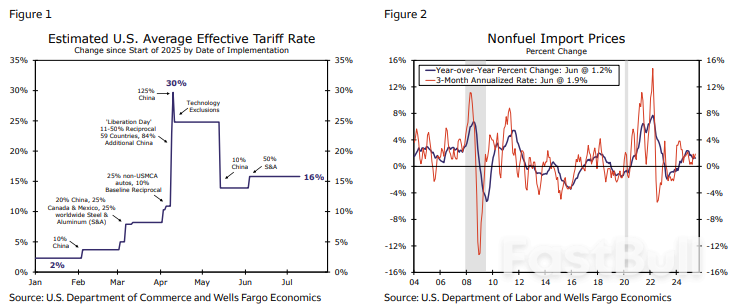
          Higher tariffs have had a modest effect on overall inflation thus far. The Consumer Price Index wasup 2.7% on a year-ago basis in June—a softer pace than at the start of the year. The limited change inthe inflation picture comes despite the Trump administration having started to roll out higher tariffsin February. After several escalations, delays and negotiations, we estimate the effective tariff rate isroughly 16% today, up from 2% in 2024 (Figure 1).As a reminder, tariffs are a tax on goods paid by U.S. importers. There are a few ways the cost can bedistributed, as we discussed in a report earlier this year. Domestic firms can pass it along via higherselling prices, absorb it via profit margin compression or a combination of the two. Yet, even beforeproducts arrive at U.S. docks, foreign suppliers can also indirectly shoulder higher tariffs by loweringtheir list prices to ameliorate the total cost burden faced by domestic firms. Exporters may provide such relief to maintain market share.
          Few Signs of Foreign Exporters Absorbing U.S. Tariff Hikes_1
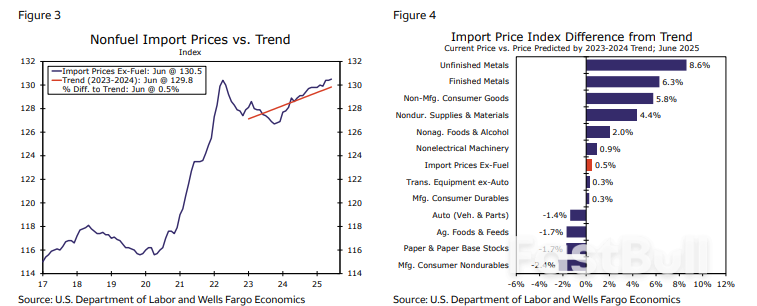
          In June, import prices excluding fuels were up 1.2% year-over-year and running at an annualized rateof 1.9% over the past three months (Figure 2). The lift has not been driven by tariffs themselves. Sincethe Import Price Index is primarily used to calculate the inflation-adjusted value of imports in GDP,it excludes tariffs from the prices paid by importers because the income generated from tariffs istransferred to the federal government, not the importing firm.If foreign exporters were absorbing the cost of tariffs, import prices would be declining in proportionto the rise in the tariff rate. A look at import prices through June, however, shows prices excluding fuelmarginally higher, rather than lower, where they would have been had they continued to rise in line withtheir recent trend (Figure 3). Thus, the recent rise in import prices points to foreign suppliers generallyresisting price cuts.
          Few Signs of Foreign Exporters Absorbing U.S. Tariff Hikes_2
          Underneath the surface, some of the recent strength in import prices has been driven by skyrocketingprecious metal prices, especially for gold and silver, as elevated uncertainty has supported demandfor safe-haven assets. Beyond metals, import prices for food, non-durable supplies & materials anda selection of consumer goods are also running ahead of their recent trends, suggesting foreignexporters are not shouldering the cost of higher tariffs on these products (Figure 4). Weaker autoprices relative to trend, on the other hand, likely reflect some foreign exporters discounting prices in aneffort to move inventory in the face of sluggish domestic sales recently.Across categories of import prices, roughly half are running below their pre-tariff trends, while theother half are in line with or above those levels. The mix is reflective of variations in product-specificand country-level factors, with half of all import price categories having risen in price since the start ofthe year.
          Few Signs of Foreign Exporters Absorbing U.S. Tariff Hikes_3
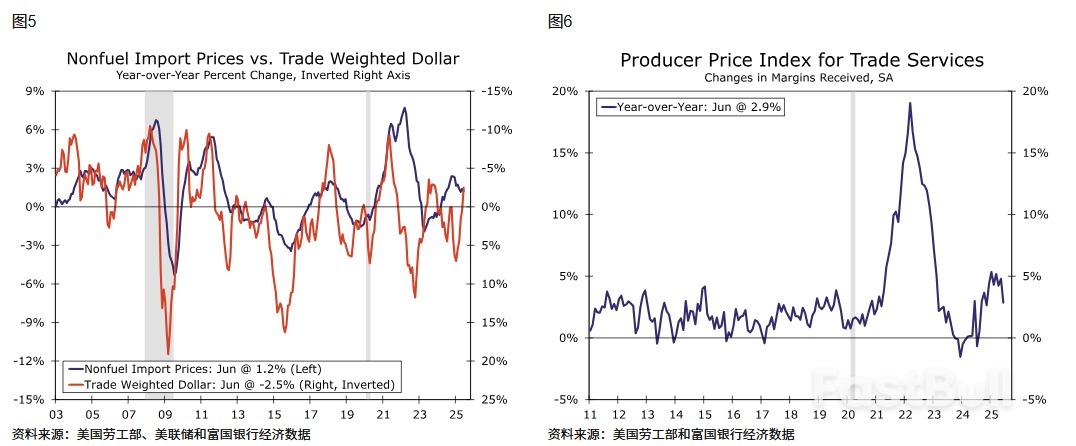
          So why is overall import price inflation holding up? For one, the scramble for imports ahead of newtariffs strained global supply chains and led to a pickup in shipping costs that foreign exporters couldhave baked into their prices depending on the nature of their trade contracts. The dollar's slide has alsoplayed a major role. Approximately 95% of the nation's imports are denominated in U.S. dollars, and the Federal Reserve's trade-weighted dollar index is down 6.3% since the start of the year and 2.5%from a year ago (Figure 5). The broad depreciation has likely incentivized foreign suppliers to bump uptheir invoice prices, as dollar-denominated revenues are not stretching as far when translated to theirhome currencies.With little relief from import prices, domestic firms are stomaching the cost of higher tariffs andstarting to pass it on to consumers. Excluding vehicles, the core goods CPI posted its strongestmonthly increase since February 2022 in June, with widespread gains across furniture, apparel, motorvehicle parts and recreational items. U.S. firms also appear to be absorbing some of the additionalproduct cost brought on by tariffs. The trade services component of the Producer Price Index, whichis a measure of product margins for wholesalers and retailers, has slowed sharply in recent months,illustrative of margin compression (Figure 6).Looking ahead, import price growth has room to weaken but is unlikely to plunge. Foreign purchasingmanager surveys indicate weaker manufacturing activity in Canada and China since the beginning ofthe year, but stronger activity across the Eurozone and Mexico. The mix suggests some exporters maybe amenable to cut prices while others may be inclined to hold the line. Although softer consumerspending in the United States could weigh on foreign production and encourage more exporters to cuttheir prices in the second half of the year, our expectation for the dollar to continue weakening overthe same time frame will likely counteract the deflationary impulse from weaker demand. In short,import prices are unlikely to be a relief valve for consumer price inflation in the months ahead.

          来源:WELLS FARGO

          To stay updated on all economic events of today, please check out our Economic calendar
          Risk Warnings and Disclaimers
          You understand and acknowledge that there is a high degree of risk involved in trading. Following any strategies or investment methods may lead to potential losses. The content on the site is provided by our contributors and analysts for information purposes only. You are solely responsible for determining whether any trading assets, securities, strategy, or any other product is suitable for investing based on your own investment objectives and financial situation.
          Add to Favorites
          Share

          Bipartisan Crypto Bill CLARITY Act Passed By US Congress

          Oliver Scott

          Key Points:

          ● Main event: Bipartisan legislation passed, impacting crypto markets.
          ● CLARITY Act aims at consumer protection, developer support.
          ● Transforms regulatory landscape and increases U.S. market transparency.
          Passage of the Bipartisan CLARITY Act Marks a New Era in U.S. Crypto Regulation

          The passage of the CLARITY Act is an important step for the U.S. digital asset market, with potential to simplify and solidify its regulatory framework.

          Rep. Dusty Johnson, a key architect of the CLARITY Act, led the effort for regulatory clarity, aiming to bolster the U.S. as a leader in digital assets. The Act provides specific jurisdictional boundaries between the SEC and the CFTC for major cryptocurrencies. Co-sponsors include leaders from both parties, underscoring the broad political support for the Act. It also impacts stablecoins with national reserve requirements, supporting the U.S. dollar's dominance.

          "The regulatory certainty provided by CLARITY will launch a golden age of digital assets, transforming every industry like the internet did. Today is a watershed victory for America." — Dusty Johnson, Representative, United States House of Representatives

          The immediate effects of the Act include increased confidence among institutional investors and developers, as regulatory risks are mitigated. It is expected to encourage new investments in U.S. crypto markets as jurisdictions become clearly defined. Regulatory implications affect consumer protection and market structures, aiming to strengthen the industry and promote innovation within the United States. Key cryptocurrencies such as BTC, ETH, and stablecoins will see clear regulatory paths, influencing compliance interest among blockchain projects.

          The House Financial Services Committee document on digital assets highlights insights suggesting potential outcomes from clarified regulations include enhanced market growth and cross-border collaboration due to lowered compliance barriers. Historical trends in crypto regulation highlight the challenge of aligning legal frameworks with market dynamics, a balance this Act strives to achieve by accommodating both traditional and digital financial markets.

          Source: CryptoSlate

          Risk Warnings and Disclaimers
          You understand and acknowledge that there is a high degree of risk involved in trading. Following any strategies or investment methods may lead to potential losses. The content on the site is provided by our contributors and analysts for information purposes only. You are solely responsible for determining whether any trading assets, securities, strategy, or any other product is suitable for investing based on your own investment objectives and financial situation.
          Add to Favorites
          Share

          Fed Should Cut Rates By 25 Bps In July, Governor Waller Says

          Henry Thompson

          Federal Reserve Governor Christopher Waller said on Thursday that he continued to call for the central bank to cut interest rates by end-July, citing growing risks to the economy and limited inflationary risks from trade tariffs.

          Waller made the comments in remarks prepared for a gathering of Money Marketeers of New York University, stating that the Fed needed to bring its policy into neutral territory, instead of keeping it restrictive.

          Waller also warned that he saw signs of strain in the labor market, furthering the case for lower interest rates.

          “It makes sense to cut the FOMC’s policy rate by 25 basis points two weeks from now,” Waller said.

          “I see the hard and soft data on economic activity and the labor market as consistent: The economy is still growing, but its momentum has slowed significantly, and the risks to the FOMC’s employment mandate have increased.”

          Waller said that the inflationary effects of President Donald Trump’s trade tariffs were likely to be a one-time event that policymakers could look through.

          “Tariff increases are a one-time boost to prices that do not sustainably increase inflation… central bankers should—and, in fact, do—look through price-level shocks to avoid needlessly tightening policy in times like these and damaging the economy.”Waller’s comments come just before Fed officials enter a two-week media blackout period before the central bank’s upcoming meeting. The Fed governor is an outlier among members of the central bank, most of which have expressed caution over cutting interest rates.

          Fed Chair Jerome Powell said that rates will not fall until the inflation effect of Trump’s tariffs becomes clear.

          But Trump has repeatedly called on Powell to cut rates, even engaging in personal attacks against the Fed chair.

          Speculation over Trump prematurely firing Powell grew drastically this week, although Trump denied that he intended to do so.

          Source: Yahoo Finance

          Risk Warnings and Disclaimers
          You understand and acknowledge that there is a high degree of risk involved in trading. Following any strategies or investment methods may lead to potential losses. The content on the site is provided by our contributors and analysts for information purposes only. You are solely responsible for determining whether any trading assets, securities, strategy, or any other product is suitable for investing based on your own investment objectives and financial situation.
          Add to Favorites
          Share

          Trump Has Already Crossed Fed Independence Rubicon

          Liam Peterson

          Whether Federal Reserve Chair Jerome Powell is fired next week, forced to resign in six months or allowed to muddle through to the end of his term next May, the supposedly sacrosanct notion of Fed independence has already been shattered.

          Yet what's nearly as remarkable as President Donald Trump's attacks on Powell for not cutting interest rates is financial markets' resilience in the face of this extraordinary degree of political interference in monetary policy, unprecedented in recent decades.

          Equity investors are known for being optimists, but today's Wall Street is veritably Teflon-coated.

          Of course, Trump's attacks on Powell have not been without consequence. The dollar has clocked its worst start to a year since the United States dropped the gold standard in the early 1970s. Long-dated Treasury yields are the highest in 20 years, and the "term premium" on U.S. debt is the highest in over a decade.

          Consumers' inflation expectations, by some measures, are also the highest in decades. Inflation has been above the Fed's 2% target for over four years, and the prospect of a dovish Fed under the stewardship of a new Trump-friendly Chair could keep it that way.

          But that's not solely down to Fed policy and credibility risks. The Trump administration's fiscal and trade policies, and unilateralist position on the world political stage, have also tempted some investors to trim their exposure to U.S. debt and the dollar.

          Still, Wall Street seems immune to all that, and it closed in the green on Wednesday after Trump played down a Bloomberg report that he will soon fire Powell, a step he says is "highly unlikely". Even at the point of maximum selling before that rebuttal, the big U.S. equity indices were down less than 1%.

          Given the magnitude of the news investors were reacting to, that's barely a ripple, especially when you remember that the S&P 500 and Nasdaq hit record highs only 24 hours earlier.

          Indeed, the S&P 500 is enjoying its third-fastest rebound from a 20% drawdown in history, according to Fidelity's Jurrien Timmer. Goldman Sachs analysts also note that the index's price-to-earnings ratio of 22 times forward earnings is in the 97th percentile since 1980. And the Nasdaq is up 40% in barely three months.

          Taking all this into account, there's plenty of space for a correction. What's needed is a catalyst. Threatening the foundation of the financial system would seem to qualify, but will it?

          Thomson ReutersPolymarket betting probability of Fed's Powell out this year

          BECOMING IMMUNE

          One might argue that investors are simply skeptical that Trump really will oust Powell, even were it "for cause", ostensibly the Trump administration's ire over the $2.4 billion cost of renovating the Fed's building in Washington.

          But Trump has made it clear for months that he wants Powell replaced by someone more malleable, so whether it happens in the coming weeks, months, or May next year, the new Fed Chair will almost certainly be someone strongly influenced by the president.

          Of course, the Fed Chair is only one of 19 members of the Federal Open Market Committee and just one of 12 voting members at any given rate-setting meeting. He or she does not decide policy unilaterally. Still, the negative reaction to Powell leaving before his term is up could be powerful, even though you would expect it to be priced in to some extent by now.

          All else being equal, a more dovish-leaning Fed will reasonably be expected to weigh on short-dated yields, steepen the yield curve, and weaken the dollar as bond investors price in more rate cuts, and keep inflation closer to 3% than 2%. In the short term, stocks could benefit from expectations of a lower policy rate, although higher long-dated yields would increase the discount rate, which could be particularly negative for Big Tech and other growth stocks.

          JP Morgan CEO Jamie Dimon on Tuesday warned of the dangers of political interference in Fed policymaking, telling reporters on a conference call: "The independence of the Fed is absolutely critical. Playing around with the Fed can often have adverse consequences, absolutely opposite of what you might be hoping for."

          That Rubicon has already been crossed, and for now at least, markets appear to have accepted that.

          Source: Reuters

          Risk Warnings and Disclaimers
          You understand and acknowledge that there is a high degree of risk involved in trading. Following any strategies or investment methods may lead to potential losses. The content on the site is provided by our contributors and analysts for information purposes only. You are solely responsible for determining whether any trading assets, securities, strategy, or any other product is suitable for investing based on your own investment objectives and financial situation.
          Add to Favorites
          Share

          Japan's Core Inflation Slows In June But Stays Above Central Bank Target

          Daniel Carter

          Economic

          Japan's core inflation slowed in June due to temporary cuts in utility bills but stayed above the central bank's 2% target, highlighting lingering price pressures that will keep alive market expectations for further interest rate rises.
          The data will be among factors the Bank of Japan (BOJ) will scrutinise at its next policy meeting on July 30-31, when the board is expected to revise up its inflation forecast in a quarterly review of its projections.
          The nationwide core consumer price index (CPI), which excludes volatile fresh food costs, rose 3.3% in June from a year earlier, government data showed on Friday, matching a median market forecast.
          The rise was smaller than the 3.7% increase in May due largely to the resumption of fuel subsidies aimed at helping households weather the pain from higher living costs.
          A separate index that strips away both fresh food and fuel costs - closely watched by the BOJ as a measure of domestic demand-driven prices - rose 3.4% in June from a year earlier after increasing 3.3% in May.
          The BOJ exited a decade-long, radical stimulus programme last year and raised short-term interest rates to 0.5% in January on the view that Japan was on the cusp of sustainably hitting its 2% inflation target.
          While the central bank has signalled its readiness to raise rates further, the economic impact of higher U.S. tariffs forced it to cut its growth forecasts in May and complicated decisions around the timing of the next rate increase.
          Japan's economy shrank in the first quarter as rising living costs hurt consumption. Exports fell in May for the first time in eight months, stoking recession fears.
          A slight majority of economists in a June Reuters poll expected the BOJ to forgo another rate hike this year.

          Source: Theedgemarkets

          To stay updated on all economic events of today, please check out our Economic calendar
          Risk Warnings and Disclaimers
          You understand and acknowledge that there is a high degree of risk involved in trading. Following any strategies or investment methods may lead to potential losses. The content on the site is provided by our contributors and analysts for information purposes only. You are solely responsible for determining whether any trading assets, securities, strategy, or any other product is suitable for investing based on your own investment objectives and financial situation.
          Add to Favorites
          Share

          Europeans Warn Iran of UN Sanctions Unless Concrete Progress on Nuclear Talks

          Manuel

          Energy

          Middle East Situation

          France, Britain and Germany told Iran on Thursday that they wanted Tehran to resume diplomacy immediately over its nuclear programme and warned if there were no concrete steps by the end of the summer they would restore U.N. sanctions.
          The foreign ministers of the so-called E3, along with the European Union's foreign policy chief, held their first call with Iran's Foreign Minister Abbas Araqchi since Israel and the United States carried out air strikes in mid-June on Iran's nuclear programme.
          Speaking after the call, a French diplomatic source said the ministers had called on Iran to resume diplomatic efforts immediately to reach a "verifiable and lasting" nuclear deal.
          The three countries, along with China and Russia, are the remaining parties to a 2015 deal with Iran that lifted sanctions on the country in return for restrictions on its nuclear programme.
          A U.N. Security Council resolution which enshrines the deal expires on October 18 and under its terms U.N. sanctions can be re-imposed beforehand. The process would take about 30 days.
          The Europeans have repeatedly warned that unless there is a new nuclear accord they will launch the "snapback mechanism", which would restore all previous U.N. sanctions on Iran if it is found to be in violation of the agreement's terms.
          "The ministers also reiterated their determination to use the so-called 'snapback' mechanism in the absence of concrete progress toward such an agreement by the end of the summer," the diplomatic source said.
          The source did not elaborate what concrete progress would entail.
          Since the air strikes, inspectors from the U.N. atomic watchdog have left Iran. While Iran has suggested it is open to diplomacy, there are no indications a sixth round of nuclear talks between Washington and Tehran will resume imminently.
          Diplomats say that even if they were to resume talks, reaching a comprehensive accord before the end of August - the final deadline the Europeans have given - seems unrealistic, especially without inspectors on the ground to assess Iran's remaining nuclear programme.
          Two European diplomats said they hoped to coordinate strategy with the United States in the coming days with a view to possibly holding talks with Iran soon.

          Source: Reuters

          Risk Warnings and Disclaimers
          You understand and acknowledge that there is a high degree of risk involved in trading. Following any strategies or investment methods may lead to potential losses. The content on the site is provided by our contributors and analysts for information purposes only. You are solely responsible for determining whether any trading assets, securities, strategy, or any other product is suitable for investing based on your own investment objectives and financial situation.
          Add to Favorites
          Share

          Waller Says Fed Should Cut Rates Now With Labor Market On Edge

          Daniel Carter

          Central Bank

          Economic

          “With inflation near target and the upside risks to inflation limited, we should not wait until the labor market deteriorates before we cut the policy rate,” he said Thursday in the text of a speech prepared for an event hosted by the Money Marketeers in New York. “I believe it makes sense to cut the FOMC's policy rate by 25 basis points two weeks from now.”
          Fed officials will gather July 29-30 in Washington.
          Waller's remarks set him apart from most of his fellow policymakers, who have characterized the employment landscape as still solid.
          “Looking across the soft and hard data, I get a picture of a labor market on the edge,” he said.
          Waller is one of two Fed officials, alongside Vice Chair for Supervision Michelle Bowman, who had already signaled their openness to cutting rates as early as this month.
          He had previously differentiated himself from other officials by saying he believed the impact of tariffs on inflation would be temporary, and he repeated that view Thursday.
          “Policy should look through tariff effects and focus on underlying inflation, which seems to be close to the FOMC's 2% goal,” he said, referring to the Fed's rate-setting panel, the Federal Open Market Committee.
          Underlying inflation in the US rose by less than expected in June for a fifth straight month, though the latest data also showed an aggressive set of tariffs announced by President Donald Trump in April were beginning to lift prices for some goods.
          Waller said inflation expectations remain anchored and wage growth isn't accelerating, easing concerns of a persistent inflation effect.
          He said the risk of a weaker jobs market is “greater and sufficient” to cut interest rates.
          “The economy is still growing, but its momentum has slowed significantly, and the risks to the FOMC's employment mandate have increased,” he added.
          He said he expects the economy to “remain soft” for the rest of 2025 after growing at about a 1% pace in the first half of the year.
          Several other policymakers, including Governor Adriana Kugler and New York Fed President John Williams, have expressed more concern about the potential impact of tariffs on inflation and have said they'd prefer to wait longer before lowering rates.
          Investors expect the central bank to hold interest rates steady when they gather later this month, and see slightly better than even odds of a rate cut in September, according to futures contracts.
          Waller has been among the names touted to succeed Jerome Powell at the head of the central bank when his term as chair expires in May. Trump, who will nominate Powell's successor, has been demanding lower rates from the Fed.

          Source: Bloomberg Europe

          To stay updated on all economic events of today, please check out our Economic calendar
          Risk Warnings and Disclaimers
          You understand and acknowledge that there is a high degree of risk involved in trading. Following any strategies or investment methods may lead to potential losses. The content on the site is provided by our contributors and analysts for information purposes only. You are solely responsible for determining whether any trading assets, securities, strategy, or any other product is suitable for investing based on your own investment objectives and financial situation.
          Add to Favorites
          Share
          FastBull
          Copyright © 2025 FastBull Ltd

          728 RM B 7/F GEE LOK IND BLDG NO 34 HUNG TO RD KWUN TONG KLN HONG KONG

          TelegramInstagramTwitterfacebooklinkedin
          App Store Google Play Google Play
          Products
          Charts

          Chats

          Q&A with Experts
          Screeners
          Economic Calendar
          Data
          Tools
          Membership
          Features
          Function
          Markets
          Copy Trading
          Latest Signals
          Contests
          News
          Analysis
          24/7
          Columns
          Education
          Company
          Careers
          About Us
          Contact Us
          Advertising
          Help Center
          Feedback
          User Agreement
          Privacy Policy
          Business

          White Label

          Data API

          Web Plug-ins

          Poster Maker

          Affiliate Program

          Risk Disclosure

          The risk of loss in trading financial instruments such as stocks, FX, commodities, futures, bonds, ETFs and crypto can be substantial. You may sustain a total loss of the funds that you deposit with your broker. Therefore, you should carefully consider whether such trading is suitable for you in light of your circumstances and financial resources.

          No decision to invest should be made without thoroughly conducting due diligence by yourself or consulting with your financial advisors. Our web content might not suit you since we don't know your financial conditions and investment needs. Our financial information might have latency or contain inaccuracy, so you should be fully responsible for any of your trading and investment decisions. The company will not be responsible for your capital loss.

          Without getting permission from the website, you are not allowed to copy the website's graphics, texts, or trademarks. Intellectual property rights in the content or data incorporated into this website belong to its providers and exchange merchants.

          Not Logged In

          Log in to access more features

          FastBull Membership

          Not yet

          Purchase

          Become a signal provider
          Help Center
          Customer Service
          Dark Mode
          Price Up/Down Colors

          Log In

          Sign Up

          Position
          Layout
          Fullscreen
          Default to Chart
          The chart page opens by default when you visit fastbull.com