Markets
News
Analysis
User
24/7
Economic Calendar
Education
Data
- Names
- Latest
- Prev


Signal Accounts for Members
All Signal Accounts
All Contests


France 10-Year OAT Auction Avg. YieldA:--
F: --
P: --
Euro Zone Retail Sales YoY (Oct)A:--
F: --
P: --
Brazil GDP YoY (Q3)A:--
F: --
P: --
U.S. Challenger Job Cuts (Nov)A:--
F: --
P: --
U.S. Challenger Job Cuts MoM (Nov)A:--
F: --
P: --
U.S. Challenger Job Cuts YoY (Nov)A:--
F: --
P: --
U.S. Initial Jobless Claims 4-Week Avg. (SA)A:--
F: --
P: --
U.S. Weekly Initial Jobless Claims (SA)A:--
F: --
P: --
U.S. Weekly Continued Jobless Claims (SA)A:--
F: --
P: --
Canada Ivey PMI (SA) (Nov)A:--
F: --
P: --
Canada Ivey PMI (Not SA) (Nov)A:--
F: --
P: --
U.S. Non-Defense Capital Durable Goods Orders Revised MoM (Excl. Aircraft) (SA) (Sept)A:--
F: --
U.S. Factory Orders MoM (Excl. Transport) (Sept)A:--
F: --
P: --
U.S. Factory Orders MoM (Sept)A:--
F: --
P: --
U.S. Factory Orders MoM (Excl. Defense) (Sept)A:--
F: --
P: --
U.S. EIA Weekly Natural Gas Stocks ChangeA:--
F: --
P: --
Saudi Arabia Crude Oil ProductionA:--
F: --
P: --
U.S. Weekly Treasuries Held by Foreign Central BanksA:--
F: --
P: --
Japan Foreign Exchange Reserves (Nov)A:--
F: --
P: --
India Repo RateA:--
F: --
P: --
India Benchmark Interest RateA:--
F: --
P: --
India Reverse Repo RateA:--
F: --
P: --
India Cash Reserve RatioA:--
F: --
P: --
Japan Leading Indicators Prelim (Oct)A:--
F: --
P: --
U.K. Halifax House Price Index YoY (SA) (Nov)A:--
F: --
P: --
U.K. Halifax House Price Index MoM (SA) (Nov)A:--
F: --
P: --
France Current Account (Not SA) (Oct)A:--
F: --
P: --
France Trade Balance (SA) (Oct)A:--
F: --
P: --
France Industrial Output MoM (SA) (Oct)A:--
F: --
P: --
Italy Retail Sales MoM (SA) (Oct)A:--
F: --
P: --
Euro Zone Employment YoY (SA) (Q3)--
F: --
P: --
Euro Zone GDP Final YoY (Q3)--
F: --
P: --
Euro Zone GDP Final QoQ (Q3)--
F: --
P: --
Euro Zone Employment Final QoQ (SA) (Q3)--
F: --
P: --
Euro Zone Employment Final (SA) (Q3)--
F: --
Brazil PPI MoM (Oct)--
F: --
P: --
Mexico Consumer Confidence Index (Nov)--
F: --
P: --
Canada Unemployment Rate (SA) (Nov)--
F: --
P: --
Canada Labor Force Participation Rate (SA) (Nov)--
F: --
P: --
Canada Employment (SA) (Nov)--
F: --
P: --
Canada Part-Time Employment (SA) (Nov)--
F: --
P: --
Canada Full-time Employment (SA) (Nov)--
F: --
P: --
U.S. Personal Income MoM (Sept)--
F: --
P: --
U.S. Dallas Fed PCE Price Index YoY (Sept)--
F: --
P: --
U.S. PCE Price Index YoY (SA) (Sept)--
F: --
P: --
U.S. PCE Price Index MoM (Sept)--
F: --
P: --
U.S. Personal Outlays MoM (SA) (Sept)--
F: --
P: --
U.S. Core PCE Price Index MoM (Sept)--
F: --
P: --
U.S. UMich 5-Year-Ahead Inflation Expectations Prelim YoY (Dec)--
F: --
P: --
U.S. Core PCE Price Index YoY (Sept)--
F: --
P: --
U.S. Real Personal Consumption Expenditures MoM (Sept)--
F: --
P: --
U.S. 5-10 Year-Ahead Inflation Expectations (Dec)--
F: --
P: --
U.S. UMich Current Economic Conditions Index Prelim (Dec)--
F: --
P: --
U.S. UMich Consumer Sentiment Index Prelim (Dec)--
F: --
P: --
U.S. UMich 1-Year-Ahead Inflation Expectations Prelim (Dec)--
F: --
P: --
U.S. UMich Consumer Expectations Index Prelim (Dec)--
F: --
P: --
U.S. Weekly Total Rig Count--
F: --
P: --
U.S. Weekly Total Oil Rig Count--
F: --
P: --
U.S. Consumer Credit (SA) (Oct)--
F: --
P: --
China, Mainland Foreign Exchange Reserves (Nov)--
F: --
P: --


No matching data
Latest Views
Latest Views
Trending Topics
Top Columnists
Latest Update
White Label
Data API
Web Plug-ins
Affiliate Program
View All

No data
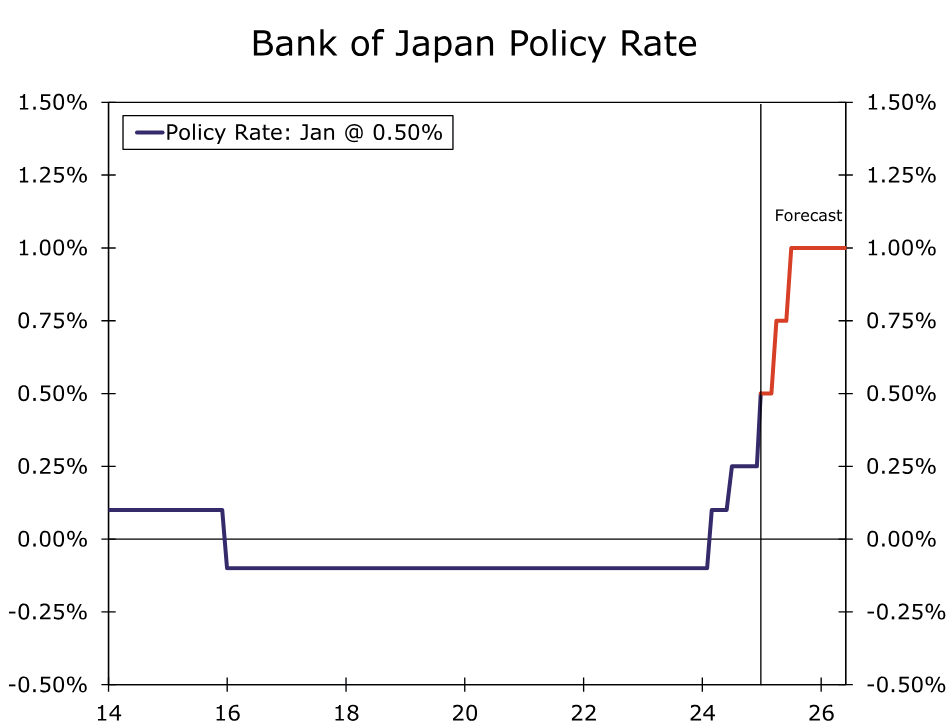
In a widely expected decision, the Bank of Japan (BoJ) took another step along its monetary policy normalization path at this week’s meeting, raising its policy rate by 25 bps to 0.50%.
The BoJ also forecast underlying inflation to remain at or above its 2% inflation target over the medium term, in our opinion a strong signal of further tightening to come. Comments from Governor Ueda also leaned hawkish, as he said the current policy rate is still far from its “neutral” level, and that he was not considering some specific rate level as a barrier.
Against this backdrop, we continue to forecast a 25 bps rate hike to 0.75% at the BoJ’s April announcement. We now also forecast a final 25 bps rate increase to 1.00% in July, while acknowledging that the timing of that final rate hike could get pushed back depending on how local and global economic conditions evolve. Overall, we think the outlook for Bank of Japan tightening and eventual Fed easing could lead to a reasonably resilient yen through 2025, with more sustained and substantial yen weakness perhaps more likely in 2026 as the U.S. economy recovers.
In a widely expected decision, the Bank of Japan (BoJ) took another step along its monetary policy normalization path at this week’s meeting, raising its policy rate by 25 bps to 0.50%. In raising interest rates, the BoJ said growth and inflation have been developing generally in line with its forecasts, and also cited reasons for a firming in wage and price trends. The BoJ said:
There have been many views expressed by firms stating that they will continue to raise wages steadily in this year’s annual spring labor-management wage negotiations; and
With wages continuing to rise, there has been an increase in moves to reflect higher costs, such as increased personnel expenses and distribution costs, in selling prices.
The Bank of Japan also noted relative stability in global financial markets, saying “while attention has been drawn to various uncertainties, global financial and capital markets have been stable on the whole, as overseas economies have followed a moderate growth path.”
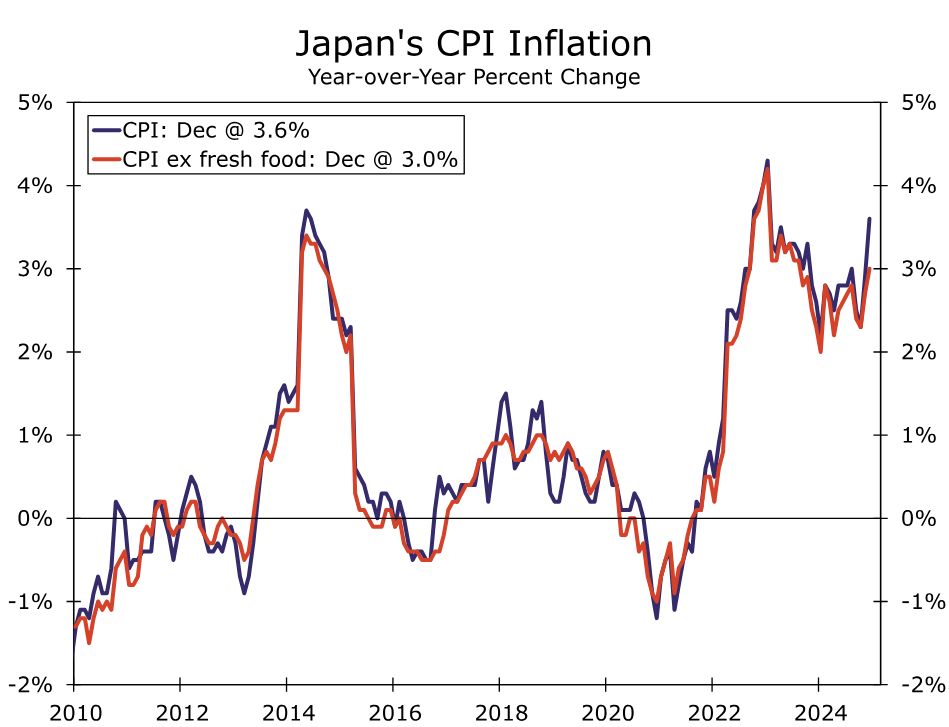
The Bank of Japan’s encouraging assessment of recent economic trends was also reinforced by upward revisions to its economic outlook. While the forecasts for GDP growth were little changed, there were some notable upward revisions to the central bank’s inflation forecasts. CPI ex-fresh food inflation is forecast at 2.7% for FY2024 (previously 2.5%), 2.4% for FY2025 (previously 1.9%) and 2.0% for FY2026 (previously 1.9%). In a similar vein, the outlook for CPI ex-fresh food and energy inflation was revised higher to 2.2% for FY 2024 (previously 2.0%), 2.1% for FY2025 (previously 1.9%) and 2.1% for FY2026 (unchanged). The forecast for Japan’s underlying inflation to remain at or above the central bank’s 2% inflation target over the medium term is, in our opinion, a strong signal of further tightening to come. The Bank of Japan indicated as much in its monetary policy announcement, saying that:
Given that real interest rates are at significantly low levels, if the outlook for economic activity and prices presented in the January Outlook Report will be realized, the Bank will accordingly continue to raise the policy interest rate and adjust the degree of monetary accommodation.
In addition to the Bank of Japan’s announcement, in our view, comments from Governor Ueda also point to multiple further rate hikes from the Bank of Japan over the balance of 2025. Ueda said he expected solid results from this year’s spring wage negotiations, a development we think would be supportive of another rate increase in April. Ueda also suggested global markets have been relatively calm in the initial days of President Trump’s administration. Interestingly, Ueda also said that even after this week’s rate increase, the current policy rate is still far from its “neutral” level, and that he was not considering some specific rate level as a barrier. He indicated that one BoJ analysis suggested the neutral rate could be somewhere between 1.00% and 2.50%. So long as overall economic trends remain encouraging, we view those comments as consistent with the BoJ eventually raising its policy rate to 1.00%, perhaps by its July announcement.
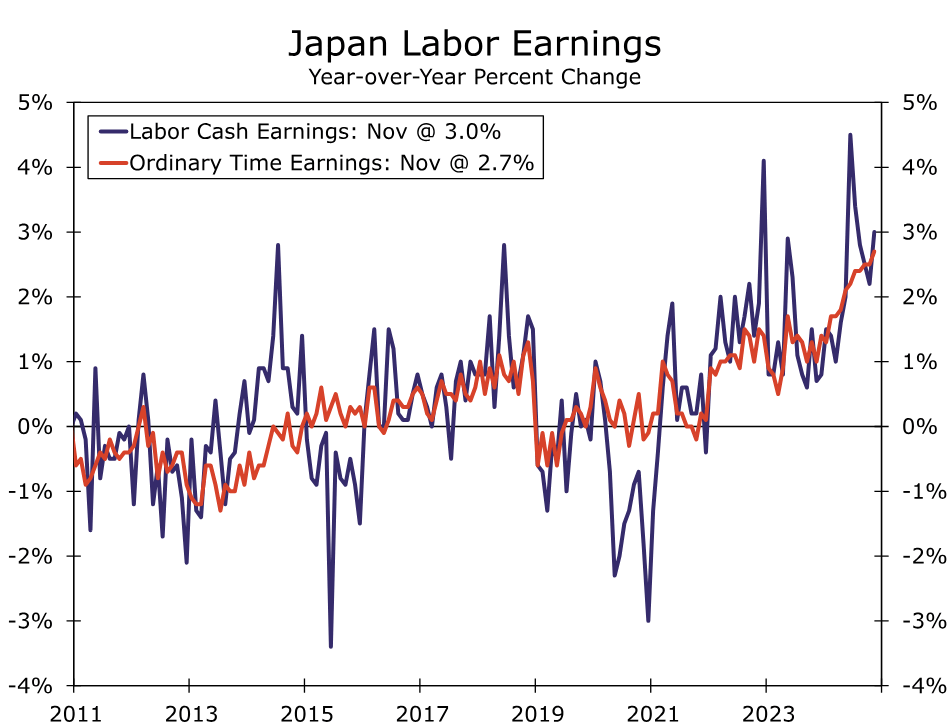
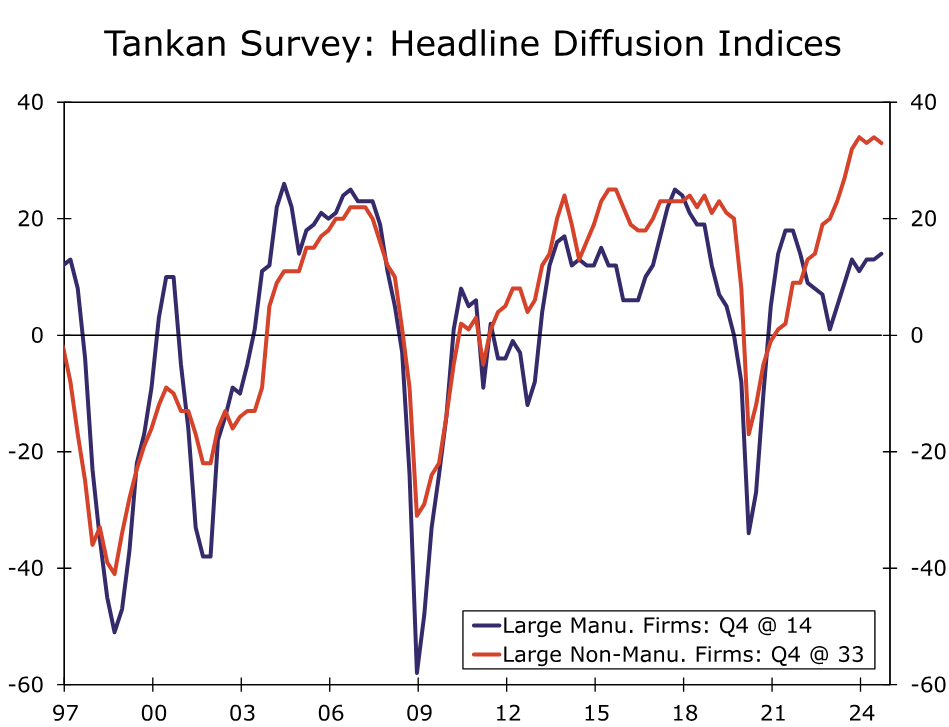
Regarding recent economic trends, labor cash earnings rose 3.0% year-over-year in November and expectations for this year’s spring wage talks are upbeat. Inflation also remains elevated, with CPI ex-fresh food inflation at 3.0% year-over-year in December. Sentiment surveys, most notably the Tankan survey, have generally improved in recent quarters, consistent with steadier economic growth ahead. While these encouraging economic trends remain in place, and with global economic conditions perhaps more benign during the early part of this year as the U.S. economy advances at a steady pace and with Fed policy on hold, we view these conditions as most conducive for further Bank of Japan rate hikes. Against this backdrop, we continue to forecast a 25 bps rate hike to 0.75% at the BoJ’s April announcement. We now also forecast a final 25 bps rate increase to 1.00% in July, while acknowledging that the timing of that final rate hike could get pushed back depending on how local and global economic conditions evolve. Overall, we think the outlook for Bank of Japan tightening and eventual Fed easing could lead to a reasonably resilient yen through 2025, with more sustained and substantial yen weakness perhaps more likely in 2026 as the U.S. economy recovers.
Sales of previously owned homes in the US rose for the third straight month in December, entering 2025 with some momentum after the worst year in nearly three decades.
Contract closings of existing homes last month increased 2.2% to an annualised rate of 4.24 million, the most since February, according to National Association of Realtors data released on Friday. That was in line with the estimate of economists surveyed by Bloomberg.
The third straight pickup in monthly sales — the longest streak since late 2021, when mortgage rates were less than half of where they are now — signals that homeowners and buyers alike have come to terms with borrowing costs around 7%. The new-home market also appears to be stabilising, providing some early signs of optimism for the new year.
“Home sales in the final months of the year showed solid recovery despite elevated mortgage rates,” NAR chief economist Lawrence Yun said in a prepared statement.
However, for all of 2024, sales reached the lowest since 1995, when the US had about 70 million fewer people. It marked the third straight annual decline, stretches only ever seen in the 2006 housing crisis as well as the recessions around the early 1980s and 1990s.
“The prospects for this year look better, but not by much as the triple threat of high mortgage rates, high home prices and low supply will continue,” Robert Frick, corporate economist at Navy Federal Credit Union, said by email.
The median sale price, meantime, climbed 6% over the past 12 months to US$404,400 (RM1.8 million), reflecting more sales activity in the upper end of the market. That helped propel prices for the entire year to a record.
After slowly creeping up for months, inventory dropped 13.5% in December from the prior month — which is typical at the end of the year. It’s still up 16.2% from December 2023.
There was hope that 2024 could be a turning point for the housing market as the Federal Reserve started cutting interest rates. But mortgage rates track government bond yields, which rose nearly a full percentage point towards the end of the year after inflation proved stubborn, fueling concerns that officials eased policy too soon. They’re expected to keep rates steady at next week’s meeting.
Treasury yields are still elevated as investors brace for the cost of President Donald Trump’s policies and price pressures are cooling only somewhat. That’s projected to keep mortgage rates on average above 6% through at least 2027, according to some estimates.
In December, 53% of homes sold were on the market for less than a month, unchanged from November, while 16% sold for above the list price. Properties stayed on the market for 35 days on average, compared with 32 days in the previous month.
Existing-home sales account for the majority of the US total and are calculated when a contract closes. The government will release figures on new-home sales on Monday.
Separate data on Friday showed US business activity cooled this month on a slowdown in services, while consumer sentiment declined due to concerns about unemployment and potential tariffs’ impact on inflation.


Bitcoin hodlers continuing to accumulate during price declines, along with short-term holders buying more during price surges driven by FOMO (fear of missing out), sets a “bullish tone” for 2025, according to a crypto analyst.
Long-term Bitcoin (BTC) hodlers (LTH) — those who have held their Bitcoin for more than 155 days — dominance “remains high, signaling strong long-term conviction,” CryptoQuant contributor IT Tech said in a Jan. 24 analyst note. He said:
“They continue to accumulate during price declines and strategically take profits during upward trends.”
Meanwhile, IT Tech said that Bitcoin short-term holders — those who have held their Bitcoin for less than 155 days — seem more confident about buying into the market’s upside momentum, making him more optimistic about Bitcoin’s price over the next 12 months.

He said that short-term holders jumping in most when Bitcoin’s price is on the rise signals they’re “FOMO-driven entries.”
“Short-term holders acting on speculation, sets a bullish tone for 2025,” he said.
Throughout January, Bitcoin has hovered around the psychological $100,000 price level, dipping below it a few times while briefly reaching a new all-time high above $109,000 on Jan. 20, just ahead of Donald Trump’s inauguration as US president.
At the time of publication, the average long-term holder's cost is $24,639 per Bitcoin, which represents the average hodler is in profit of more than four times that amount, as per Bitbo data.
Bitcoin’s current price is $104,390, as per CoinMarketCap data.

The short-term realized price is $90,541. Data from Checkonchain, a Bitcoin onchain analysis program, indicated that 80% of short-term holders were back in the profit bracket after BTC’s recovery above $100,000. Earlier this month, the STH supply in loss dropped to 65% before Bitcoin rebounded.
Meanwhile, IT Tech explained that occasional sell-offs by long-term holders shouldn’t be a cause for concern, as they can “create healthy pullbacks, offering opportunities for new accumulation,” he said.
According to a separate Jan. 24 analysis by CryptoQuant contributor “Crazzyblockk,” long-term holders are “largely avoiding significant selling, reinforcing a strong HODLing sentiment despite current market fluctuations.”
The analyst said that recent on-chain data revealed that only 18% of Bitcoin deposits into crypto exchange Binance come from long-term holders.
White Label
Data API
Web Plug-ins
Poster Maker
Affiliate Program
The risk of loss in trading financial instruments such as stocks, FX, commodities, futures, bonds, ETFs and crypto can be substantial. You may sustain a total loss of the funds that you deposit with your broker. Therefore, you should carefully consider whether such trading is suitable for you in light of your circumstances and financial resources.
No decision to invest should be made without thoroughly conducting due diligence by yourself or consulting with your financial advisors. Our web content might not suit you since we don't know your financial conditions and investment needs. Our financial information might have latency or contain inaccuracy, so you should be fully responsible for any of your trading and investment decisions. The company will not be responsible for your capital loss.
Without getting permission from the website, you are not allowed to copy the website's graphics, texts, or trademarks. Intellectual property rights in the content or data incorporated into this website belong to its providers and exchange merchants.
Not Logged In
Log in to access more features

FastBull Membership
Not yet
Purchase
Log In
Sign Up