• Trade
  • Markets
  • Copy
  • Contests
  • News
  • 24/7
  • Calendar
  • Q&A
  • Chats
Trending
Screeners
SYMBOL
LAST
BID
ASK
HIGH
LOW
NET CHG.
%CHG.
SPREAD
SPX
S&P 500 Index
6929.95
6929.95
6929.95
6945.76
6921.61
-2.10
-0.03%
--
DJI
Dow Jones Industrial Average
48710.96
48710.96
48710.96
48782.00
48589.07
-20.21
-0.04%
--
IXIC
NASDAQ Composite Index
23593.09
23593.09
23593.09
23665.15
23567.85
-20.22
-0.09%
--
USDX
US Dollar Index
97.690
97.770
97.690
97.770
97.500
+0.080
+ 0.08%
--
EURUSD
Euro / US Dollar
1.17707
1.17734
1.17707
1.17965
1.17613
-0.00054
-0.05%
--
GBPUSD
Pound Sterling / US Dollar
1.34976
1.35015
1.34976
1.35267
1.34768
-0.00021
-0.02%
--
XAUUSD
Gold / US Dollar
4533.34
4533.34
4533.34
4549.79
4502.79
+53.36
+ 1.19%
--
WTI
Light Sweet Crude Oil
56.739
56.991
56.739
58.765
56.571
-1.479
-2.54%
--

Community Accounts

Signal Accounts
--
Profit Accounts
--
Loss Accounts
--
View More

Become a signal provider

Sell trading signals to earn additional income

View More

Guide to Copy Trading

Get started with ease and confidence

View More

Signal Accounts for Members

All Signal Accounts

Best Return
  • Best Return
  • Best P/L
  • Best MDD
Past 1W
  • Past 1W
  • Past 1M
  • Past 1Y

All Contests

  • All
  • Trump Updates
  • Recommend
  • Stocks
  • Cryptocurrencies
  • Central Banks
  • Featured News
Top News Only
Share

Argentina's Congress Approves Budget For 2026, The First Under The Milei Administration

Share

Russia Says It Captures Village In Zaporizhzhia, Ukraine Defending Major Town

Share

[Russia Says Ukraine To Recruit 2 Million More] The Russian Foreign Ministry Stated On The 25th That Ukrainian Authorities Plan To Recruit 2 Million People Into The Military By Early 2026. According To Sputnik News Agency, Russian Foreign Ministry Spokesperson Maria Zakharova Stated At A Press Conference On The 25th That Ukraine May Soon Launch A Full-scale Mobilization, And The Recruitment Department Has Received Orders To Issue 2 Million Recruitment Notices By Early 2026

Share

[Analysts Question Nvidia-Groq Deal's Regulatory Circumvention; Details Awaiting Disclosure] This Week, Nvidia And Groq Announced A $20 Billion Deal Described As A "non-exclusive Licensing Agreement." Analysts Point Out That Such Non-exclusive Licensing Agreements Have Been Widely Used By Tech Giants In Recent Years, Partly To Circumvent Regulatory Scrutiny. Bernstein Analyst Stacy Rasgon Stated, "Antitrust Risk Appears To Be The Main Concern, But Structuring The Deal As A Non-exclusive License Helps Maintain The Illusion Of Competition." Cantor Analysts Stated That This Move Is Both Offensive And Defensive, Helping Nvidia Expand Its Complete System Technology Stack And Solidify Its Leadership In The AI ​​market. Bank Of America Securities Also Called The Deal "surprising, Expensive, But Strategic," Highlighting Nvidia's Focus On The Future Growth Of AI Inference Chips

Share

[Putin: Russia Will Use Artificial Intelligence To Strengthen Weaponry Advantage] Russian President Vladimir Putin Stated On The 26th That Russia Has Included Measures In Its New National Armament Plan To Ensure The Expansion Of High-tech Production And Will Apply Artificial Intelligence (AI) Technology To Strengthen Its Weaponry Advantage. According To A Statement Released On The Russian Presidential Website, Putin Chaired A Meeting That Day To Approve Key Indicators And Funding Parameters, Including The Budget, In The Draft National Armament Plan For 2027-2036

Share

[New York State: Record High In Weekly Flu Cases] (December 16) Data From The New York State Department Of Health Shows That 71,123 Positive Flu Cases Were Reported In The Week Ending December 20, A 38% Increase From The Previous Week. This Is The Highest Weekly Record Since Case Surveillance Began In 2004. The New York State Department Of Health Did Not Specify Whether The Surge In Cases Is Related To A New Variant Called "Subclade K". Data Shows That Only 24% Of New Yorkers Will Be Vaccinated Against The Flu In The 2025-26 Flu Season

Share

Brendan McKenna, An Emerging Markets Economist And Foreign Exchange Strategist At Wells Fargo Securities, Noted That Latin American Currencies Performed "quite Robustly" Due To Lower Volatility During The Christmas Holiday Season And Investors Seeking To Earn Carry Trades

Share

Ning Sun, Senior Emerging Markets Strategist At State Street Global Markets In Boston, Said: “This Week, Strong U.S. Data Supported Risk Sentiment (for Emerging Market Assets) Amid Low Liquidity. Looking Ahead To Next Year, I Believe Emerging Markets Have The Potential To Perform Well Again, But Their Performance Will Depend More On The Continued Weakness Of The Dollar As Interest Rate Differentials Narrow.”

Share

On Friday (December 26), In Late New York Trading, S&P 500 Futures Ultimately Fell 0.02%, Dow Jones Futures Fell 0.11%, And NASDAQ 100 Futures Rose Slightly By Less Than 0.01%. Russell 2000 Futures Fell 0.48%

Share

SPDR Gold Trust Reports Holdings Up 0.27%, Or 2.86 Tonnes, To 1071.13 Tonnes By Dec 26

Share

Usps: Winter Weather In Great Lakes & Northeastern USA May Impact Processing, Transportation, & Delivery Of Mail & Packages

Share

On Friday (December 26), At The Close Of Trading In New York (05:59 Beijing Time On Saturday), The Offshore Yuan (CNH) Was Quoted At 7.0045 Against The US Dollar, Down 28 Points From The Close Of Trading In New York On Thursday. The Yuan Traded Within A Range Of 6.9997-7.0085 During The Day. This Week, The Offshore Yuan Rose A Cumulative 297 Points, An Increase Of 0.42%, Rising Continuously From Monday To Thursday, And Fluctuating At High Levels On Friday

Share

(US Stocks) The Philadelphia Gold And Silver Index Closed Up 1.45% At 363.21 Points, Setting A New Closing Record High After A One-day Hiatus, And Rising 4.43% For The Week. (Global Session) The NYSE Arca Gold Miners Index Closed Up 1.04% At 2572.35 Points, Also Setting A New Closing Record High After A One-day Hiatus, And Rising 4.53% For The Week. US Stocks Opened Sharply Higher On Monday And Then Continued To Fluctuate At High Levels

Share

KCNA: North Korea's Supreme Leader Kim Jong UN Sends New Year's Greeting To Putin

Share

Spot Palladium Extends Gains, Last Up 15% To $1937.64/Oz

Share

New York Governor Hochul Declared A State Of Emergency In Several Counties Affected By The Blizzard

Share

Brazil: Japan Schedules Sanitary Audit On Brazilian Beef For March 2026

Share

Among The S&P 500 Components, 15 Stocks, Including Crh, Newmont Corp., And Fox Corp., Hit Record Closing Highs

Share

Ukraine President Zelenskiy: Russia Using Belarus Territory To Circumvent Ukrainian Defences

Share

California Dmv: "We Are Currently Developing Regulations That Require Manufacturers To Ensure Remote Drivers And Remote Assistants Meet High Standards For Safety, Accountability, And Responsiveness"

TIME
ACT
FCST
PREV
U.S. API Weekly Cushing Crude Oil Stocks

A:--

F: --

P: --

U.S. API Weekly Refined Oil Stocks

A:--

F: --

P: --

U.S. API Weekly Gasoline Stocks

A:--

F: --

P: --

Mexico Unemployment Rate (Not SA) (Nov)

A:--

F: --

P: --

U.S. MBA Mortgage Application Activity Index WoW

A:--

F: --

P: --

U.S. Weekly Continued Jobless Claims (SA)

A:--

F: --

P: --
U.S. Weekly Initial Jobless Claims (SA)

A:--

F: --

P: --

U.S. Initial Jobless Claims 4-Week Avg. (SA)

A:--

F: --

P: --

Japan Construction Orders YoY (Nov)

A:--

F: --

P: --

Japan New Housing Starts YoY (Nov)

A:--

F: --

P: --

Turkey Capacity Utilization (Dec)

A:--

F: --

P: --

Japan Tokyo CPI YoY (Excl. Food & Energy) (Dec)

A:--

F: --

P: --

Japan Unemployment Rate (Nov)

A:--

F: --

P: --

Japan Tokyo Core CPI YoY (Dec)

A:--

F: --

P: --

Japan Tokyo CPI YoY (Dec)

A:--

F: --

P: --

Japan Jobs to Applicants Ratio (Nov)

A:--

F: --

P: --

Japan Tokyo CPI MoM (Dec)

A:--

F: --

P: --

Japan Tokyo CPI MoM (Excl. Food & Energy) (Dec)

A:--

F: --

P: --

Japan Industrial Inventory MoM (Nov)

A:--

F: --

P: --

Japan Retail Sales (Nov)

A:--

F: --

P: --

Japan Industrial Output Prelim MoM (Nov)

A:--

F: --

P: --

Japan Large-Scale Retail Sales YoY (Nov)

A:--

F: --

P: --

Japan Industrial Output Prelim YoY (Nov)

A:--

F: --

P: --

Japan Retail Sales MoM (SA) (Nov)

A:--

F: --

P: --

Japan Retail Sales YoY (Nov)

A:--

F: --

P: --

Russia Retail Sales YoY (Nov)

A:--

F: --

P: --

Russia Unemployment Rate (Nov)

A:--

F: --

P: --

Argentina Retail Sales YoY (Oct)

A:--

F: --

P: --

U.S. Weekly Treasuries Held by Foreign Central Banks

--

F: --

P: --

China, Mainland Industrial Profit YoY (YTD) (Nov)

A:--

F: --

P: --

Russia IHS Markit Manufacturing PMI (Dec)

--

F: --

P: --

India Manufacturing Output MoM (Nov)

--

F: --

P: --

India Industrial Production Index YoY (Nov)

--

F: --

P: --

France Unemployment Class-A (Nov)

--

F: --

P: --

Euro Zone Total Reserve Assets (Nov)

--

F: --

P: --

Canada National Economic Confidence Index

--

F: --

P: --

U.S. Pending Home Sales Index (Nov)

--

F: --

P: --

U.S. Pending Home Sales Index MoM (SA) (Nov)

--

F: --

P: --

U.S. Pending Home Sales Index YoY (Nov)

--

F: --

P: --

U.S. EIA Weekly Crude Oil Imports Changes

--

F: --

P: --

U.S. EIA Weekly Cushing, Oklahoma Crude Oil Stocks Change

--

F: --

P: --

U.S. EIA Weekly Crude Demand Projected by Production

--

F: --

P: --

U.S. EIA Weekly Gasoline Stocks Change

--

F: --

P: --

U.S. Dallas Fed General Business Activity Index (Dec)

--

F: --

P: --

U.S. EIA Weekly Heating Oil Stock Changes

--

F: --

P: --

U.S. EIA Weekly Crude Stocks Change

--

F: --

P: --

U.S. Dallas Fed New Orders Index (Dec)

--

F: --

P: --

Russia CPI YoY (Dec)

--

F: --

P: --

U.S. EIA Weekly Natural Gas Stocks Change

--

F: --

P: --

Brazil CAGED Net Payroll Jobs (Nov)

--

F: --

P: --

South Korea Industrial Output MoM (SA) (Nov)

--

F: --

P: --

South Korea Retail Sales MoM (Nov)

--

F: --

P: --

South Korea Services Output MoM (Nov)

--

F: --

P: --

Russia IHS Markit Services PMI (Dec)

--

F: --

P: --

Turkey Economic Sentiment Indicator (Dec)

--

F: --

P: --

Brazil Unemployment Rate (Nov)

--

F: --

P: --

U.S. Weekly Redbook Index YoY

--

F: --

P: --

U.S. S&P/CS 20-City Home Price Index YoY (Not SA) (Oct)

--

F: --

P: --

U.S. S&P/CS 20-City Home Price Index MoM (SA) (Oct)

--

F: --

P: --

U.S. FHFA House Price Index MoM (Oct)

--

F: --

P: --

Q&A with Experts
    • All
    • Chatrooms
    • Groups
    • Friends
    Zena flag
    versuta
    So, how's it going, guys?
    and u? @versuta
    3173441 flag
    lost
    3173441 flag
    me
    versuta flag
    3173441
    lost
    @3173441what's acid?
    versuta flag
    Zena
    @Zenaim good
    3173441 flag
    lost forex me
    versuta flag
    Zena
    @ZenaJust transferred 1 ETH to Qukеx and about to sell it for $3,130... that's around $160 profit per trade for me
    Zena flag
    versuta
    @versutaI'm getting in with 1 ETH too.
    3173441 flag
    sell me
    versuta flag
    3173441
    lost forex me
    @3173441I feel you... I lost $11k on futures yesterday.
    Zena flag
    SanJi
    Nobody knows.
    @SanJiWhere's the best place to buy? Or how are you trading?
    SanJi flag
    SanJi flag
    I buy on binаnce at $2,927 and sell on Qukеx for $3,130.
    Zena flag
    I use Bybit to buy
    SanJi flag
    its okay
    sosovalue flag
    I've already made about $800 on this.
    versuta flag
    sosovalue
    I've already made about $800 on this.
    @sosovalueLol, we're going step for step bro
    Zena flag
    I just started, but I already managed to make my first trade.
    SanJi flag
    SanJi
    its okay
    And how much have you made?
    Zena flag
    only $350
    Type here...
    Add Symbol or Code

      No matching data

      All
      Trump Updates
      Recommend
      Stocks
      Cryptocurrencies
      Central Banks
      Featured News
      • All
      • Russia-Ukraine Conflict
      • Middle East Flashpoint
      • All
      • Russia-Ukraine Conflict
      • Middle East Flashpoint

      Search
      Products

      Charts Free Forever

      Chats Q&A with Experts
      Screeners Economic Calendar Data Tools
      Membership Features
      Data Warehouse Market Trends Institutional Data Policy Rates Macro

      Market Trends

      Market Sentiment Order Book Forex Correlations

      Top Indicators

      Charts Free Forever
      Markets

      News

      News Analysis 24/7 Columns Education
      From Institutions From Analysts
      Topics Columnists

      Latest Views

      Latest Views

      Trending Topics

      Top Columnists

      Latest Update

      Signals

      Copy Rankings Latest Signals Become a signal provider AI Rating
      Contests
      Brokers

      Overview Brokers Assessment Rankings Regulators News Claims
      Broker listing Forex Brokers Comparison Tool Live Spread Comparison Scam
      Q&A Complaint Scam Alert Videos Tips to Detect Scam
      More

      Business
      Events
      Careers About Us Advertising Help Center

      White Label

      Data API

      Web Plug-ins

      Affiliate Program

      Awards Institution Evaluation IB Seminar Salon Event Exhibition
      Vietnam Thailand Singapore Dubai
      Fans Party Investment Sharing Session
      FastBull Summit BrokersView Expo
      Recent Searches
        Top Searches
          Markets
          News
          Analysis
          User
          24/7
          Economic Calendar
          Education
          Data
          • Names
          • Latest
          • Prev

          View All

          No data

          Scan to Download

          Faster Charts, Chat Faster!

          Download App
          English
          • English
          • Español
          • العربية
          • Bahasa Indonesia
          • Bahasa Melayu
          • Tiếng Việt
          • ภาษาไทย
          • Français
          • Italiano
          • Türkçe
          • Русский язык
          • 简中
          • 繁中
          Open Account
          Search
          Products
          Charts Free Forever
          Markets
          News
          Signals

          Copy Rankings Latest Signals Become a signal provider AI Rating
          Contests
          Brokers

          Overview Brokers Assessment Rankings Regulators News Claims
          Broker listing Forex Brokers Comparison Tool Live Spread Comparison Scam
          Q&A Complaint Scam Alert Videos Tips to Detect Scam
          More

          Business
          Events
          Careers About Us Advertising Help Center

          White Label

          Data API

          Web Plug-ins

          Affiliate Program

          Awards Institution Evaluation IB Seminar Salon Event Exhibition
          Vietnam Thailand Singapore Dubai
          Fans Party Investment Sharing Session
          FastBull Summit BrokersView Expo

          A Look at Previous Fed Rate Cuts and What It Means for Equities

          SAXO

          Central Bank

          Economic

          Summary:

          The market is increasing its confidence that the Fed will cut its policy rate at the March meeting starting a rate cut cycle. We take a look at previous initial rate cut cycles and how the US equity market responded to in the first 90 trading days to such a rate cut.
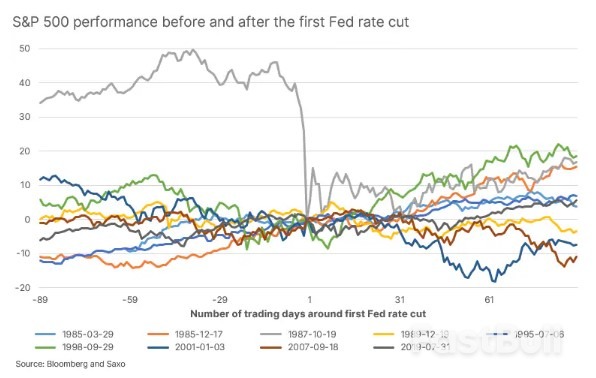
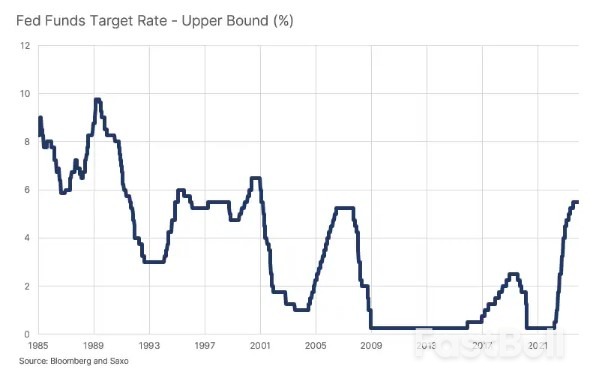
          Initial rate cuts are rarely seen as negative
          Since 19 October the market has drastically altered its view on inflation and more importantly policy rates set by the Fed and ECB. As the US SOFR (Secured Overnight Financing Rate) Dec 2024 contract is showing the market has moved the 2024 terminal Fed Funds rate lower by almost 100 bps. This repricing has fuelled sentiment in equities delivering one of the strongest months in 20 years in equities. The SOFR futures forward curve is now pricing in 5 rate cuts by December 2024 with the Fed rate cut coming at the Fed meeting on 20 March.
          There have been 9 initial Fed rate cuts starting a rate cut cycle (shorter or longer) since 1 January 1985 and if we look at the S&P 500 performance during these periods then the US equity market tends to rise in the subsequent 3 months after a rate cut cycle has begun. Remember that with only 9 rate cut cycles the statistics here come with small confidence and investors should take note of the current situation instead of blindly trust history. The average S&P 500 gain during the 90 trading days after an initial Fed rate cut is 5.1% which is significantly above the normal 3-month S&P 500 return which is in the 2-2.5% range.
          History gives us the clue that an initial rate cut by the Fed is often interpreted by the market as a natural initial adjustment of policy rates to changing circumstances. But the market is rarely coupling the initial rate hike with an incoming recession. If that was the case history would a more clear downward direction in equities post an initial rate hike. This is also likely the reason why equities have rallied since mid-October. The equity market sees the current priced in rate cuts as a natural adjustment to lower inflation and not a sign of a recession. Should SOFR futures suddenly rally a lot higher from here then it would be a sign that rates traders are seeing a recession coming and then the interpretation by equities will flip on dime.
          Another striking difference in the market is the median recession probability by economists tracking the US economy. The probability is at 50% which is a huge divergence from equity markets which are closer to all-time highs and thus signalling less than a 10% probability of a recession.A Look at Previous Fed Rate Cuts and What It Means for Equities_1
          Financial conditions vs inflation
          The prevailing narrative driving the repricing in policy rates is that central banks won over inflation. Although premature and we have little data to base our understanding of the new structural inflation level in the economy, that is nevertheless what the market is running with. Now, one thing is inflation coming down, another is financial conditions which the Fed is also paying close attention to. If look at the Fed's own adjusted financial conditions index then it now the loosest since the rate hike cycle began back in early 2022 and financial conditions have ease substantially in the past two months.
          Looser financial conditions will help underpin financial markets and more importantly the economy. There are no signs that financial conditions are getting too tight and thus if the Fed followed their own methodology they would sit tight for longer avoiding a repeat of the 1970s where they cut the interest rate too quickly.
          There is final unknown in all of this and that is China. The false starts in 2023 and the widening cracks in the economy is forcing the Chinese leadership to act in their own self-interest. The CCP's Politburo is about to set the date for the third plenum which will gather extra attention this time around because China's economy is seen as weakening. If China goes bold regardless of the obvious weakened fiscal transmission due to the old economic model is currently broken (real estate and infrastructure spending) then that could be a surprise factor for the global economy and inflation. The Fed and ECB are well aware of this. So 2024 will start with a high stake poker game in world of policy rates.A Look at Previous Fed Rate Cuts and What It Means for Equities_2
          To stay updated on all economic events of today, please check out our Economic calendar
          Risk Warnings and Disclaimers
          You understand and acknowledge that there is a high degree of risk involved in trading. Following any strategies or investment methods may lead to potential losses. The content on the site is provided by our contributors and analysts for information purposes only. You are solely responsible for determining whether any trading assets, securities, strategy, or any other product is suitable for investing based on your own investment objectives and financial situation.
          Comments
          Add to Favorites
          Share

          U.S. Payrolls Rose 199,000 in November, Unemployment Rate Falls to 3.7%

          Justin

          Economic

          Job creation showed little signs of a let-up in November, as payrolls grew even faster than expected and the unemployment rate fell despite signs of a weakening economy.
          Nonfarm payrolls rose by a seasonally adjusted 199,000 for the month, slightly better than the 190,000 Dow Jones estimate and ahead of the unrevised October gain of 150,000, the Labor Department reported Friday.
          The unemployment rate declined to 3.7%, compared to the forecast for 3.9%, as the labor force participation rate edged higher to 62.8%. A more encompassing unemployment rate that includes discouraged workers and those holding part-time positions for economic reasons fell to 7%, a decline of 0.2 percentage point.
          U.S. Payrolls Rose 199,000 in November, Unemployment Rate Falls to 3.7%_1
          The department’s survey of households, used to calculate the unemployment rate, showed much more robust job growth of 747,000 and an addition of 532,000 workers to the labor force.
          Average hourly earnings, a key inflation indicator, increased by 0.4% for the month and 4% from a year ago. The monthly increase was slightly ahead of the 0.3% estimate, but the yearly rate was in line.
          Markets showed mixed reaction to the report, with stock market futures modestly negative while Treasury yields surged.
          “What we wanted was a strong but moderating labor market, and that’s what we saw in the November report,” said Robert Frick, corporate economist with Navy Federal Credit Union, noting “healthy job growth, lower unemployment, and decent wage increases. All this points to the labor market reaching a natural equilibrium around 150,000 jobs next year, which is plenty to continue the expansion, and not enough to trigger a Fed rate hike.”
          U.S. Payrolls Rose 199,000 in November, Unemployment Rate Falls to 3.7%_2
          Health care was the biggest growth industry, adding 77,000. Other big gainers included government (49,000), manufacturing (28,000) and leisure and hospitality (40,000).
          Heading into the holiday season, retail lost 38,000 jobs, half of which came from department stores. Transportation and warehousing also showed a decline of 5,000.
          Duration of unemployment fell sharply, dropping to an average 19.4 weeks, the lowest level since February.
          The report comes at a critical time for the U.S. economy.
          Though growth defied widespread expectations for a recession this year, most economists expect a sharp slowdown in the fourth quarter and tepid gains in 2024.
          Federal Reserve officials are watching the jobs numbers closely as they continue to try to bring down inflation that had been running at a four-decade high but has shown signs lately of easing.
          Futures markets pricing strongly points to the Fed halting its rate-hiking campaign and beginning to cut next year, though central bank officials have been more circumspect about what lies ahead. Pricing had been pointing to the first cut happening in March, though that swung following the jobs report, pushing a higher probability for the first expected cut now to May.
          The Fed will hold its two-day policy meeting next week, and investors will be looking for clues about how officials view the economy.
          Policymakers have been looking to bring the economy in for a soft landing that likely would feature modest growth, a sustainable pace of wage increases and inflation at least progressing back to the Fed's 2% inflation target.
          Consumers hold the key to the U.S. economy, and by most measures they've held up fairly well.
          Retail sales fell 0.1% in October but were still up 2.5% from the previous year. The numbers are not adjusted for inflation, so they indicate that consumers at least have nearly kept pace with higher prices. A gauge the Fed uses showed inflation running at a 3.5% annual rate in October, excluding food and energy prices.
          However, there is some worry that the Covid-era stimulus payments and the continued pressure from higher interest rates could eat into spending.
          Net household wealth fell by about $1.3 trillion in the third quarter to about $151 trillion, owing largely to declines in the stock market, according to Fed data released this week. Household debt rose 2.5%, close to the pace where it has been for the past several quarters.
          Fed officials have been watching wage data closely. Rising prices tend to feed into wages, potentially creating a spiral that can be difficult to control.

          Source: CNBC

          To stay updated on all economic events of today, please check out our Economic calendar
          Risk Warnings and Disclaimers
          You understand and acknowledge that there is a high degree of risk involved in trading. Following any strategies or investment methods may lead to potential losses. The content on the site is provided by our contributors and analysts for information purposes only. You are solely responsible for determining whether any trading assets, securities, strategy, or any other product is suitable for investing based on your own investment objectives and financial situation.
          Comments
          Add to Favorites
          Share

          Yen Springs Higher, Nonfarm Payrolls Coming Up

          XM

          Economic

          Yen takes the elevator up

          The Japanese yen blasted higher on Thursday, gaining 2% against the US dollar after the Governor of the Bank of Japan provided the clearest indications yet that the era of negative interest rates is about to end.
          Speaking before parliament, Governor Ueda said that calibrating monetary policy will become "more challenging" heading into next year, adding that his central bank has several options about which policy rates to target once it exits negative interest rates.
          His comments lit a fire under the Japanese yen, as traders ramped up bets that the Bank of Japan will be the sole central bank to raise rates next year, flying against a global rate cutting cycle. Market pricing suggests the BoJ will exit negative rates by April, after it evaluates the outcome of the spring wage negotiations.
          Beyond FX markets, options traders have also joined the bandwagon of betting on a stronger yen, something reflected in the sharp spike in implied volatility of USD/JPY options. The yen was up almost 4% against the dollar at one point yesterday, but the advance was halted near the 200-day moving average and the currency ultimately trimmed its gains in half.
          All told, the stage seems set for the yen to shine in 2024 as the forces that devastated the currency over the last couple of years go into reverse, with interest rate differentials narrowing once again and lower energy prices supporting the yen through the trade channel. The latest surge may have been the opening act of the yen's long-awaited trend reversal.

          Nonfarm payrolls - disappointment on the cards?

          As for today, all eyes will fall on the latest US employment report. Nonfarm payrolls are projected to have risen by 180k in November, more than the 150k last month, while the unemployment rate is seen steady at 3.9%. Meanwhile, wage growth is expected to have lost some steam in annual terms.
          In terms of any potential surprises, the tea leaves point to a disappointment in this employment report, following a streak of underwhelming labor market indicators. Business surveys such as the S&P Global composite PMI signaled the weakest increase in employment since mid-2020, as firms cut back on hiring in an attempt to control costs. Similarly, the ADP report was softer than expected.
          That said, the fact that jobless claims remain historically low suggests there were no signs of mass layoffs in the US economy either, limiting the scope for disappointment today. Therefore, the early evidence is consistent with a labor market that is cooling off, although employers are not firing people yet, they are simply hiring less.
          An employment report that falls short of forecasts today could reinforce bets for heavy rate cuts by the Fed next year, and by extension inflict some damage on the dollar. Nonetheless, the dollar's broader trajectory will likely be decided by next week's events, which include an inflation report and a Fed policy decision.

          Stocks jump, Google leads the way

          Shares on Wall Street resumed their AI-powered rally on Thursday, with the tech generals leading the charge after Google unveiled its latest artificial intelligence model, propelling its stock price more than 5% higher.
          In general, stock markets are currently priced for perfection. Valuations are stretched and earnings assumptions seem overly optimistic heading into a global economic slowdown next year and a US presidential election that historically dampens market performance in the lead-up. The risk/reward profile for equities does not seem very attractive here. Yen Springs Higher, Nonfarm Payrolls Coming Up_1
          To stay updated on all economic events of today, please check out our Economic calendar
          Risk Warnings and Disclaimers
          You understand and acknowledge that there is a high degree of risk involved in trading. Following any strategies or investment methods may lead to potential losses. The content on the site is provided by our contributors and analysts for information purposes only. You are solely responsible for determining whether any trading assets, securities, strategy, or any other product is suitable for investing based on your own investment objectives and financial situation.
          Comments
          Add to Favorites
          Share

          Putin's Economic Challenges Are Numerous but Surmountable as Election Looms

          Devin

          Economic

          Russia's success in evading a Western oil price cap is helping drive a recovery in economic growth as President Vladimir Putin prepares to run for re-election, despite the problems caused by labour shortages, inflation and high interest rates.
          Russia's parliament has formally set next year's presidential election date for March 17. Putin, who on Thursday said the economy was set to grow 3.5% this year, is widely expected to run for a new six-year term.
          Russia's export-focused, $2.2-trillion economy has ridden the sanctions wave better than either Moscow or the West anticipated when those opposed to the February 2022 invasion of Ukraine sought to punish and isolate Putin's Russia.
          Crucially, the West has been unable to effectively curb Russia's oil revenues. Russia has redirected exports to destinations such as China and India and used the opaque ownership of so-called shadow fleets of ships to circumvent the West's oil price cap.
          In November, energy revenues contributed 961.7 billion roubles ($10.41 billion) to Russia's budget, compared with just 425.5 billion in January.
          With oil revenues recovering, Putin's key domestic challenge will be grappling with a stark labour shortage, aggravated by last year's military mobilisation and the emigration of hundreds of thousands of people since Russia invaded Ukraine.
          Other economic issues, such as the weak rouble, high inflation and interest rates risk squeezing households' purchasing power, a particularly sensitive topic as the country goes to the polls.
          Skilled Worker Shortage
          With unemployment at a record low 2.9% and Moscow throwing fiscal resources at the defence sector through increased military production, other sectors like IT are short on staff, hampering productivity.
          Russia needs more skilled workers, managers and high-quality engineers to reach the desired level of technological sovereignty in manufacturing industries, Putin's economic adviser Maxim Oreshkin said in November.
          "For people to come here more willingly, we need attractive salaries," Oreshkin said.
          Short-term sanctions shocks have been overcome, Oreshkin said, but pressure from the West will only increase and the whole economy must work on transitioning to Russian technology platforms.
          Workforce capacity has reached historically high levels, said Dmitry Kulikov, director at the ACRA ratings agency.
          "This means that economic growth will be constrained on the supply side, as a result of which annual GDP growth rates will fall from around 3% in 2023 to closer to the potential 1-2%," Kulikov said.
          Significant wage jumps in manufacturing and the military, as well as fiscal support for families affected by the war and mobilisation, are driving an increase in salaries.
          After a contraction in 2022, real incomes are set to recover sharply this year, but unevenly across sectors and regions, forcing many families to cut back, especially on imported goods.
          As Russia's economy rebounds from a 2.1% contraction in 2022, the key question will be how the economy copes with overheating, with supply-side constraints likely to curb growth, said Liam Peach, senior emerging markets economist at Capital Economics.
          "Households have experienced a big rise in their incomes, but I don't think it's sustainable," said Peach. "Higher inflation means a bigger squeeze on household incomes ahead of the election."
          Inflation pressure?
          Keeping a lid on inflation is the central bank's job. Already forced into 750 basis points of monetary tightening since July, the bank is widely expected to hike again, to 16%, on Dec. 15. Following double-digit inflation in 2022, inflation this year is seen at around 7.5%, still well above the bank's 4% target.
          "It's plausible that inflation gets as high as 10% next year because the economy is growing quickly," said Peach, pointing to wage pressure and unanchored household inflation expectations.
          But ultimately, the inflation situation is manageable for now, especially with a population that has become accustomed to regular price rises, however painful.
          The central bank will of course talk cautiously about inflation, said Elina Ribakova, senior fellow at the Peterson Institute for International Economics and the Kyiv School of Economics (KSE).
          But the development of a serious inflation spiral would require greater fiscal pressure, uncontrolled rouble depreciation and the central bank being behind the curve, she added.
          "They are nowhere near that, they are just not feeling the pressure," Ribakova said.
          Authorities responded with rate hikes and capital controls to the rouble's tumble past 100 to the dollar this year and sharp volatility is always a risk. It traded at 92.76 on Thursday.
          While a relatively weak rouble is factored into Russia's budget plans and boosts state coffers through foreign currency export revenues, it pushes up import costs, fans inflation and risks capital flight.
          Oil Price Comfort
          Oil prices, the lifeblood of Russia's economy, are currently well above what Russia needs for fiscal security, even if they slid to five-month lows this week.
          A series of output cuts by OPEC+ countries and the widespread circumvention of the West's price cap are combining to boost Russia's energy revenues.
          "Fundamentally, the price cap's leverage is increasingly under threat," KSE Institute said in its November review, referring to the West's $60 a barrel cap. "In October, more than 99% of seaborne exports of Russian crude oil appear to have been sold above $60/barrel."
          The West's sanctions, designed to cut Moscow's key source of financing, put immense strain on Russia's budget deficit early this year, but Moscow now expects a deficit of around just 1% of GDP.
          "If the oil price stays at the current level, it is extraordinarily comfortable for Russia," said Ribakova.
          ($1 = 92.3955 roubles)

          Source: WTVB

          To stay updated on all economic events of today, please check out our Economic calendar
          Risk Warnings and Disclaimers
          You understand and acknowledge that there is a high degree of risk involved in trading. Following any strategies or investment methods may lead to potential losses. The content on the site is provided by our contributors and analysts for information purposes only. You are solely responsible for determining whether any trading assets, securities, strategy, or any other product is suitable for investing based on your own investment objectives and financial situation.
          Comments
          Add to Favorites
          Share

          NIKKEI Analysis: Japanese Stock Market Outlook

          FXOpen

          Stocks

          In the first half of 2023, the Japanese stock market was dominated by bullish sentiment due to (still) negative interest rates — while the rest of the G7 countries raised their rates to combat inflation.
          The NIKKEI-225 index grew by 30% in the first half of the year. But then the balance of supply and demand was achieved, judging by the daily chart, where a range was formed (shown in blue), framing the index’s fluctuations in the second half of the year. Judging by the change in the slope of the bullish trend lines, demand was sufficient to maintain the price at the lower limit of the range, but not enough to go beyond the upper limit.
          The situation is fundamentally reversed. While interest rates in the US, Europe and elsewhere are thought to be near the top, there is growing talk in Japan that the central bank will begin raising them after years of being stuck in negative territory:
          → Bloomberg: The next meeting of the Bank of Japan will be held on December 19 – speculation is growing that the Bank will move away from negative interest rates as early as this month.
          → Reuters: 22 of 26 economists (85%) surveyed in November believe the Bank of Japan will abandon its negative interest rate policy by the end of next year.
          The winding down of ultra-loose monetary policy could have a negative impact on the growth of Japanese companies – accordingly, the growing bearish sentiment is reflected in the index quote. Since the end of November, the NIKKEI 225 has dropped almost 5%.
          NIKKEI Analysis: Japanese Stock Market Outlook_1The chart shows that the November top:
          → did not exceed the annual maximum set in June;
          → only slightly exceeded the September high – in fact, a false breakout;
          → the price forms a rounding (shown by an arrow) – a sign of gradual depletion of demand, which is replaced by the dominance of supply.
          It is possible that the bears, which are gaining power, will be able to form a breakdown of the median line of the blue channel as early as December.
          This article represents the opinion of the Companies operating under the FXOpen brand only. It is not to be construed as an offer, solicitation, or recommendation with respect to products and services provided by the Companies operating under the FXOpen brand, nor is it to be considered financial advice.
          Risk Warnings and Disclaimers
          You understand and acknowledge that there is a high degree of risk involved in trading. Following any strategies or investment methods may lead to potential losses. The content on the site is provided by our contributors and analysts for information purposes only. You are solely responsible for determining whether any trading assets, securities, strategy, or any other product is suitable for investing based on your own investment objectives and financial situation.
          Comments
          Add to Favorites
          Share

          Yen Bulls Turn to US Payrolls

          ING

          Forex

          USD: Payrolls may ruin the party for the yen
          The exceptional rally in the yen remains the biggest story in FX at the moment. The size of the drop in USD/JPY and the volatile intraday price-action are a clear consequence of the heavy short positioning on the yen into this round of hawkish speculation on Japanese rates. USD/JPY net longs amounted to 42% of open interest on 28 November, as per the latest CFTC data.
          Despite technical factors such as positioning having exacerbated the yen moves, we’d be careful to call for a peak in the JPY rally just yet. First, because there is likely a lot more bearish JPY positioning to be scaled back by speculators, second – and most importantly – because markets may not have many incentives to unwind bets on a December BoJ hike unless Japanese or central bank officials step in to tame the speculation before the meeting.
          Our view remains that the BoJ would prefer to exit negative rates policy at either the January or April meeting, when the Outlook Report accompanies the policy decision and Governor Kazuo Ueda can use an upside revision in inflation to justify a rate hike. Incidentally, the final release of 3Q GDP in Japan signalled a worse economic contraction (-0.7% QoQ) than previously estimated.
          We’ll be looking at USD/JPY closely today not only to gauge how much markets continue to speculate on BoJ tightening but also in relation to US risk events. The US jobs figures for November are a key turning point for markets' ongoing speculation on Federal Reserve easing in 2024. The payrolls’ consensus number is 183k, but soft JOLTS job openings and ADP payrolls (despite the latter having no predictive power for official figures) suggest markets may be positioned for a weaker reading. Our economics team forecasts 180k, and we suspect the US jobs market may still prove a bit more resilient than expected – triggering some unwinding of dovish Fed bets and supporting the dollar. The US calendar also includes the December University of Michigan surveys; markets will mostly be moved by the inflation expectations numbers, which are expected to have declined.
          All in all, we see some upside risks for the dollar today. The high sensitivity of USD/JPY to US rates means that US payrolls could trigger a rebound in the pair. That said, the ongoing bullish momentum in the yen on the back of hawkish domestic bets means sellers of USD/JPY may re-emerge around the 145.0 area.
          EUR: New leg lower?
          EUR/USD rebounded yesterday afternoon thanks to a broad-based dollar decline but remains a laggard in the G10 space. This morning, the pair is again under pressure and back below the 1.0800 gauge, despite some pro-cyclical currencies advancing.
          There are two points to make about the current EUR bearish momentum. First, the key driver – the dovish European Central Bank rate repricing – may have run most of its course. Markets are currently pricing in a 75% probability of a rate cut in March, and around 135bp of total easing in the next 12 months, and given no strong dovish shift in the ECB’s stance just yet, investors may feel uncomfortable with more dovish expectations than this.
          The second point is that – while rate expectations might have bottomed – the short-term EUR-USD rate differential argues for a lower exchange rate. What has likely prevented a further EUR/USD drop has been resilient risk sentiment. Today’s US payrolls are a key event for the pair, as they might weigh on risk assets and favour a EUR/USD downward convergence to its depressed rate spreads.
          With the eurozone calendar offering no catalysts and the ECB in a quiet period ahead of next week’s meeting, EUR/USD could eye the 1.070 support in the coming days if US payrolls don’t disappoint.
          GBP: EUR/GBP to stay capped
          The only event to monitor in the UK today is the release of the Bank of England inflation attitudes survey. As discussed by our economics team in the BoE preview, we expect Governor Andrew Bailey to push back against rate cut expectations at next week’s policy meeting, which should favour sterling’s performance in the crosses.
          There is still limited scope for an immediate rebound in EUR/GBP, given the euro’s bearish momentum may linger into the ECB announcement. In line with our dollar view, we see downside risks for cable, which may ease back below the 1.2500 gravity line in the coming days.
          CEE: Another inflation drop in Hungary
          Consumer inflation in Hungary for November was published this morning. The fresh numbers showed a drop from 9.9% to 7.9 % year-on-year, slightly lower than the market expected. The National Bank of Hungary had expected 8.9% in its last forecast in September, so the deviation from the forecast has widened further. The inflation path looks good for the NBH but for now, it seems insufficient to accelerate the pace of rate cuts from the current 75bp per month, in our view.
          Otherwise, today's calendar is essentially empty in the CEE region. Later today, we will see the state budget result for November. And after trading, S&P will publish a rating review of Hungary. We do not expect any changes. But S&P has the lowest rating for Hungary among the three major agencies so it will be interesting to see some signs of improvement in the commentary given the economic and inflation developments in recent months.
          EUR/HUF has been gradually moving up over the last few days and touched 382 yesterday, following a strong decline in market rates. The IRS market has seen a massive rally in recent weeks. In the last two weeks alone, the 2y rate has fallen by roughly 80bp. So the terminal rate for this cutting cycle has quickly moved to roughly 5.25%, which should already be an indicator for the market to stop the next rally. We think these are the conditions for EUR/HUF to stabilise and we could also see some upward correction in rates given the length and one-sidedness of the current rally, which would support the forint.
          Risk Warnings and Disclaimers
          You understand and acknowledge that there is a high degree of risk involved in trading. Following any strategies or investment methods may lead to potential losses. The content on the site is provided by our contributors and analysts for information purposes only. You are solely responsible for determining whether any trading assets, securities, strategy, or any other product is suitable for investing based on your own investment objectives and financial situation.
          Comments
          Add to Favorites
          Share

          Exploring the Impact of US NFP on Different Asset Classes, BOJ Will Stick with Gradualism

          SAXO

          Forex

          JPY: Risk of waves of further appreciation

          Yen rallied sharply yesterday on traders increasing their bets of a BOJ exit. Bank of Japan governor Ueda's comments yesterday still emphasized that BOJ will continue patient monetary easing, but there were elements of hawkishness such as a comment that it will become even more challenging to maintain easy policy towards the end of this year and into early 2024. He also said that BOJ has not decided whether to keep interest rate at zero or move it up to 0.1%, and at what pace short-term rates will be hiked after ending negative rate policy. This pushed the markets to price in odds of a tweak at the BOJ's December 19 meeting.
          The November global bond rally also suggests that the situation could be favorable for BOJ to tweak earlier than previously expected. Lastly, BOJ's timeframe to exit negative rates is tight now, they need to get there before other central banks start cutting rates. From a macro lens as well, inflation could ease significantly as supply chains normalize and energy prices cool, closing the potential window to tighten policy. This could mean a tweak in January or even December, but we continue to think that the BOJ tweak will be moderate.
          There is significant room for yen to rally both on a positioning and valuation basis. However, there is still scope for the ride to be bumpy as dollar finds support if US data stays resilient and Fed pushes back on rate cut expectations. But a top for USDJPY in this cycle is likely behind us, and as the yen appreciates, investors need to watch for any short yen squeeze or forced unwinding of carry trades. Volatility in yen is likely to pick up as traders assess the path of Fed rate cuts while speculations of a BOJ exit continue to build. Today's NFP could be key, followed by CPI and the Fed's dot plot next week.
          Market Takeaway: A turn in Fed policy and speculation for a BOJ exit could continue to fuel waves of yen rallies on US data disappointment or dovish Fed commentaries. Key level in USDJPY could be the 200DMA and yesterday's low at 141.71. EURJPY's support at 200DMA and yesterday's low of 153.23, and the 153 handle.Exploring the Impact of US NFP on Different Asset Classes, BOJ Will Stick with Gradualism_1

          NFP Preview: Risks skewed towards an upside surprise

          Big focus today is the US jobs data which could be a test of whether the pace of Fed easing priced in by the markets is justified or not. Market is expecting a strong headline jobs number as the resolution of the UAW strikes could mean that a lot of workers came back to the labor market. Unemployment rate may therefore be a bigger focus today, and any rise towards the 4% mark can spook concerns that the labor market is cooling. Labor data so far this week has been mixed, with JOLTS and ADP conveying a weakening labor market, but jobless claims last night still holding up possibly due to Thanksgiving and holiday-related hiring.
          Consensus expects headline jobs to be up 183k in November from 150k previously. Unemployment rate is seen to remain unchanged at 3.9% and wage growth is likely to soften to 4.0% YoY from 4.1% previously.
          If we get a beat on the headline expectations, that could push back on the rate cuts priced in for next year. This could see yields rising and pressure on equities, particularly the tech sector. USD could reverse higher, with the DXY index likely to be back above 104. The currencies that stand to lose the most on dollar strength include EUR (with EZ inflation easing suggesting more room for ECB dovish repricing) and AUD (after a dovish hold last week). Gold could also test the $2,009 support again.
          If the headline is weaker than expected, but unemployment rate is steady, that could potentially fuel a continuation of the current goldilocks that market is pricing in. This means that equities can continue to run higher as yields plunge again, but FX may be a better play here. USD could extend its bearish momentum, with Gold and yen standing the most chances to gain. NZD and GBP could also hold up as further Fed dovish re-pricing takes place.
          Biggest risk comes from a scenario where we get a headline miss, along with higher unemployment number. This could shift the market sentiment away from goldilocks to start to price in a recession, and equities stand to lose the most in that case despite the lower yields. USD could be sideways as a safety bid comes through, but Gold and yen still stand to gain.
          Risk Warnings and Disclaimers
          You understand and acknowledge that there is a high degree of risk involved in trading. Following any strategies or investment methods may lead to potential losses. The content on the site is provided by our contributors and analysts for information purposes only. You are solely responsible for determining whether any trading assets, securities, strategy, or any other product is suitable for investing based on your own investment objectives and financial situation.
          Comments
          Add to Favorites
          Share
          FastBull
          Copyright © 2025 FastBull Ltd

          728 RM B 7/F GEE LOK IND BLDG NO 34 HUNG TO RD KWUN TONG KLN HONG KONG

          TelegramInstagramTwitterfacebooklinkedin
          App Store Google Play Google Play
          Products
          Charts

          Chats

          Q&A with Experts
          Screeners
          Economic Calendar
          Data
          Tools
          Membership
          Features
          Function
          Markets
          Copy Trading
          Latest Signals
          Contests
          News
          Analysis
          24/7
          Columns
          Education
          Company
          Careers
          About Us
          Contact Us
          Advertising
          Help Center
          Feedback
          User Agreement
          Privacy Policy
          Personal Information Protection Statement
          Business

          White Label

          Data API

          Web Plug-ins

          Poster Maker

          Affiliate Program

          Risk Disclosure

          The risk of loss in trading financial instruments such as stocks, FX, commodities, futures, bonds, ETFs and crypto can be substantial. You may sustain a total loss of the funds that you deposit with your broker. Therefore, you should carefully consider whether such trading is suitable for you in light of your circumstances and financial resources.

          No decision to invest should be made without thoroughly conducting due diligence by yourself or consulting with your financial advisors. Our web content might not suit you since we don't know your financial conditions and investment needs. Our financial information might have latency or contain inaccuracy, so you should be fully responsible for any of your trading and investment decisions. The company will not be responsible for your capital loss.

          Without getting permission from the website, you are not allowed to copy the website's graphics, texts, or trademarks. Intellectual property rights in the content or data incorporated into this website belong to its providers and exchange merchants.

          Not Logged In

          Log in to access more features

          FastBull Membership

          Not yet

          Purchase

          Become a signal provider
          Help Center
          Customer Service
          Dark Mode
          Price Up/Down Colors

          Log In

          Sign Up

          Position
          Layout
          Fullscreen
          Default to Chart
          The chart page opens by default when you visit fastbull.com