


- WTI
- XAUUSD
- XAGUSD
- USDX


Markets
Analysis
User
24/7
Economic Calendar
Education
Data
- Names
- Latest
- Prev














A Treasury FRN coupon is a sum of daily accruals, not the latest bill rate multiplied by a quarter. A $100,000 example separates rate conversion, reset timing, the payment lockout and interest paid when buying between coupon dates.
The latest 13-week Treasury bill auction rate does not, on its own, tell you what a Treasury floating-rate note will pay this quarter. There are two separate calculations: convert the bill's discount-rate quote into the FRN's index rate, then apply the rate belonging to each day of the interest period. Looking up the final rate and multiplying it by three months can get both steps wrong.
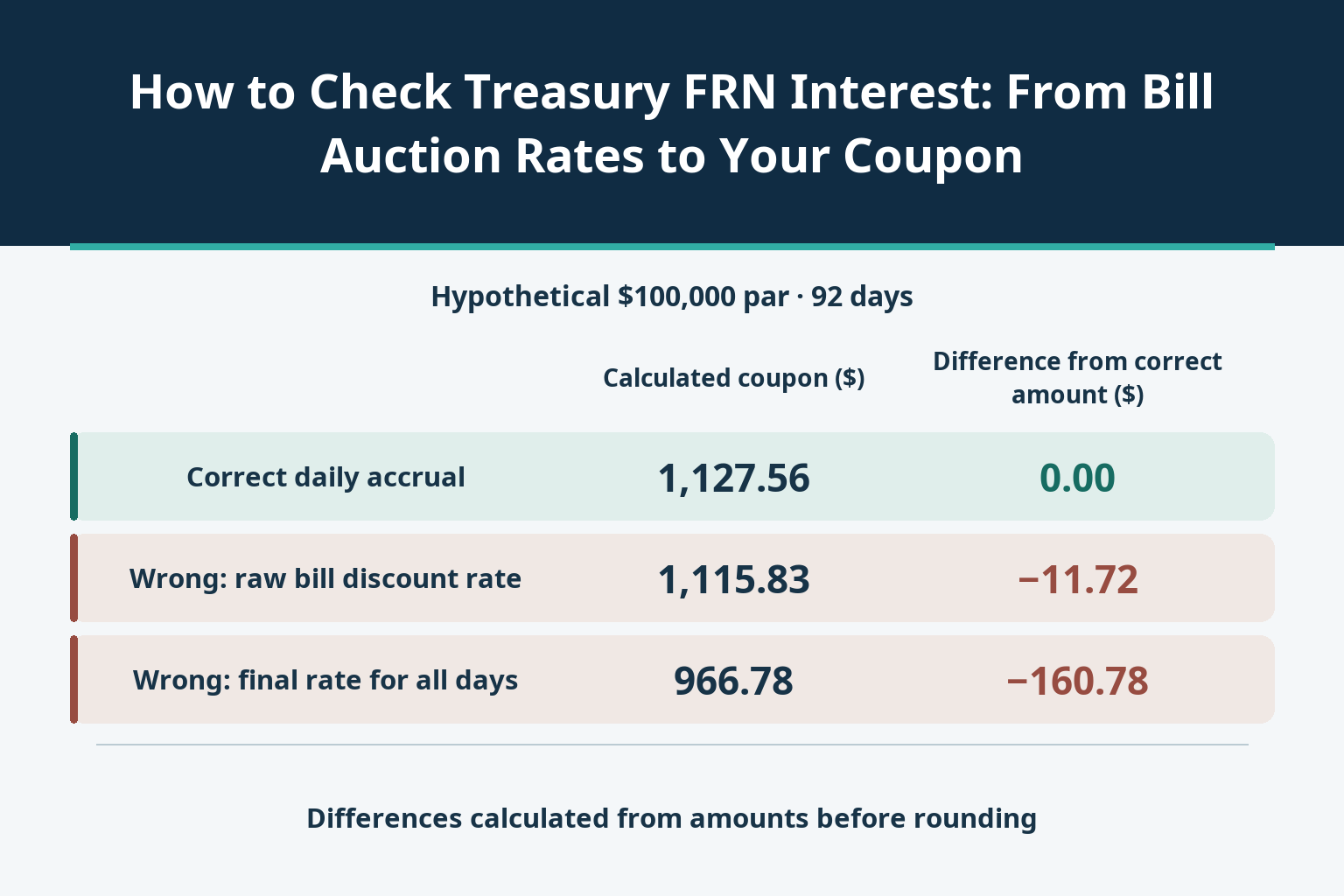
For the hypothetical $100,000 position below, the correct 92-day coupon is $1,127.56. Using unconverted bill discount rates produces $1,115.83. Applying the final coupon rate to the entire period produces only $966.78. Neither discrepancy is evidence of a missing payment: each comes from a specific mistake in the interest ledger.
This discussion concerns the U.S. Treasury FRN indexed to 13-week bill auctions, not a corporate note tied to an overnight benchmark. Treasury FRNs mature in two years and pay quarterly. Weekly bill auctions usually provide the new reference information, but interest is assigned to calendar days. Quarterly payment does not mean the rate is fixed for three months.
The auction's High Rate is a discount rate: the bill's discount is measured against its redemption value. The FRN index converts that quotation into a simple money-market yield on an actual/360 basis. A fixed spread, set when the FRN is first auctioned, is then added. The spread is not reset every time a new bill auction takes place.
These distinctions matter when reading a screen. A bill High Rate, a bill Investment Rate and an FRN's current interest rate are not three interchangeable labels for the same number. The bill Investment Rate uses a different annualization convention. Equally, a reopening's discount margin is a pricing input, not permission to overwrite the existing note's fixed spread.
Let d be the bill's annual discount rate expressed as a decimal, and n its actual number of days to maturity. Its price per $100 is P = 100 × (1 − d × n / 360). Measuring the discount against that purchase price, rather than $100, gives the actual/360 simple yield:
r = (100 − P) / P × 360 / n = d / (1 − d × n / 360).
Assume n = 91 and d = 0.045. The bill price is 98.862500, and the converted index is 4.551776457% after rounding the percentage to nine decimal places. Add a hypothetical fixed spread of 0.150%, or 15 basis points, and the FRN accrues at 4.701776457% a year. These are invented inputs for reconciliation, not reported auction results.
| Rate case | Bill High Rate (%) | Bill price per $100 | FRN index (%) | Index + spread (%) | Daily interest ($) |
|---|---|---|---|---|---|
| A: first rate block | 4.500 | 98.862500 | 4.551776457 | 4.701776457 | 13.060490 |
| B: second rate block | 3.600 | 99.090000 | 3.633060854 | 3.783060854 | 10.508502 |
| C: lockout test only | 5.400 | 98.635000 | 5.474730065 | 5.624730065 | 15.624250 |
Row C is reserved for a separate lockout test below; it is not a third rate used in the main coupon. All three bill prices in this example terminate within six decimal places, avoiding an intermediate price-rounding complication. For an actual holding, use the published index and the bill's actual term: “13 weeks” is not a reason to hard-code 91 for every auction.
Keep percentage units explicit. An index displayed as 4.551776457% enters the dollar formula as 0.04551776457. Rounding a decimal rate to nine places is not the same operation as rounding a percentage to nine places. Small unit mistakes repeated across a large position can obscure a genuine timing discrepancy.
Assume a full interest period containing 92 calendar days and constant par of $100,000. Its applicable-rate ledger assigns A to the first 63 days and B to the final 29. These are assumed stretches of unchanged effective rates; they do not imply that only two bill auctions occurred. Successive weekly auctions can produce the same High Rate.
For each day, interest equals par × max(index + spread, 0) / 360. Add those dollar accruals. Do not increase tomorrow's interest-bearing principal by today's accrued amount. This is daily accumulation, not daily compounding. Include the period's first accrual day and exclude its next interest-payment or maturity date; weekends inside the period still count.
| Accrual block | Calendar days | Applicable annual rate (%) | Interest ($) |
|---|---|---|---|
| Days 1–63 | 63 | 4.701776457 | 822.810880 |
| Days 64–92 | 29 | 3.783060854 | 304.746569 |
| Full period | 92 | — | 1,127.557449 |
The first block contributes $822.810879975 and the second $304.746568794, giving $1,127.557448769 before display rounding. Multiplying the last annual rate, 3.783060854%, by $100,000 × 92/360 instead gives $966.782218244. That erases the earlier, higher-rate days and understates the result by about $160.78.
A different shortcut preserves the 63/29 split but adds the spread directly to the unconverted bill High Rates. It gives $1,115.833333333, about $11.72 too little. The first error assigns the wrong rate to time; the second uses the wrong yield denominator. Fixing one does not fix the other. Dollar amounts shown to cents here are explanatory displays; a statement reconciliation must also respect the paying agent's actual rounding sequence.
Under Treasury's offering rules, the normal rate change follows the bill auction on the next calendar day. A two-business-day lockout before Treasury's issue settlement, including a reopening, or an interest payment creates an exception: a bill auction within that window is excluded from the calculation of that issuance settlement amount or coupon. This is not a new lockout created by every secondary-market purchase. Check the applicable index for the particular CUSIP rather than assuming every newly announced rate immediately enters every note's payment.
Take a separate timing test. Suppose auction C occurs inside the coupon's lockout and, without that restriction, its rate would affect exactly the final accrual day. That day still uses B for this payment. Replacing it prematurely with C adds $15.624250181 − $10.508502372, about $5.12, producing an incorrect $1,132.67 coupon.
The difference is for one explicitly assumed accrual day, not a universal two-day adjustment. Two business days are not always two calendar days, and auction schedules, holidays and the payment calendar matter. The deferred change must be applied according to the published daily record after the lockout; it does not rewrite interest already assigned to earlier days. No assumed calendar date in this model replaces that check.
Now suppose the investor buys at the start of day 64. The preceding 63 days' accrued interest is $822.81. Paying that amount at settlement and later receiving the full $1,127.56 coupon leaves approximately $304.75 attributable to the buyer's 29 days, before costs and taxes. The full coupon is a cash receipt; it is not all income newly earned since purchase.
Add an independent assumption that the clean price is 100.20 per $100 par. The price component is $100,200, and the interest component is about $822.81, so the cash settlement is $101,022.81. The $200 premium and the accrued interest have different meanings. The former is part of the price paid for the security; the latter compensates for interest already accumulated before the buyer's settlement.
Neither $1,127.56 divided by par nor by that cash settlement is automatically an annual investment return. A holding-period calculation also needs the eventual sale or redemption proceeds, other cash payments, costs and the actual period held. Treasury's reopening guidance makes the same operational distinction: an unchanged maturity and spread do not require an unchanged price. The separate explanation of why floating-rate bonds can fall despite coupon resets addresses that pricing risk.
The zero floor applies to the daily sum of index and spread. For a different hypothetical note, an index of 0.100% with a fixed spread of −0.200% gives zero daily interest, not a negative amount to offset another day's positive accrual. That is a separate contract example, not a change to the main note's +0.150% spread.
A floor on interest is not a floor on the purchase or resale price. Nor should today's index be projected through every unknown future day and presented as an already earned coupon. A partial-period ledger can contain verified past accruals and a forecast of remaining accruals, but the two must remain identifiable. Changing a future-rate assumption changes the forecast, not the past ledger.
Finally, do not transfer this method unchanged to a corporate FRN, a fund distribution or a product using compounded overnight rates. Different observation windows, principal changes and payment conventions can change the calculation. Start with the actual instrument, not merely the words “floating rate.”
The useful question is not whether the latest rate looks plausible. It is whether the correct rate, in the correct units, has been assigned to the correct days and to the correct owner's period. Once those three checks are explicit, a Treasury FRN coupon becomes a reproducible cash-flow calculation.

728 RM B 7/F GEE LOK IND BLDG NO 34 HUNG TO RD KWUN TONG KLN HONG KONG





The risk of loss in trading financial instruments such as stocks, FX, commodities, futures, bonds, ETFs and crypto can be substantial. You may sustain a total loss of the funds that you deposit with your broker. Therefore, you should carefully consider whether such trading is suitable for you in light of your circumstances and financial resources.
No decision to invest should be made without thoroughly conducting due diligence by yourself or consulting with your financial advisors. Our web content might not suit you since we don't know your financial conditions and investment needs. Our financial information might have latency or contain inaccuracy, so you should be fully responsible for any of your trading and investment decisions. The company will not be responsible for your capital loss.
Without getting permission from the website, you are not allowed to copy the website's graphics, texts, or trademarks. Intellectual property rights in the content or data incorporated into this website belong to its providers and exchange merchants.
Not Logged In
Log in to access more features


Log In
Sign Up