


- USDX
- XAUUSD
- XAGUSD
- WTI


Markets
Analysis
User
24/7
Economic Calendar
Education
Data
- Names
- Latest
- Prev

















A floating coupon reduces one source of price risk, not every source. Separate the contractual spread, discount margin and reset date, then calculate how an interest-paying bond can still deliver a negative holding-period return.
A bond’s coupon can rise while its market price falls. For a floating-rate bond, those outcomes are perfectly compatible: the benchmark used to calculate interest and the extra compensation investors demand for holding the bond are different variables. Resetting one does not automatically reset the other.
The practical question is not whether a security is labelled “floating”. It is which cash flows adjust, when they adjust, and whether the adjustment compensates for the risks that are moving. A note with modest sensitivity to benchmark rates may still have meaningful exposure to credit spreads, liquidity, currencies and embedded options.
Start with the contractual coupon formula: reference rate plus a fixed quoted margin. If the reference rate is 4% and the margin is 1 percentage point, the annualized coupon rate is 5%. That 1% is part of the contract. The required margin, often called the discount margin, is the extra return used in pricing under specified assumptions. It can move after issuance without changing the contractual addition to the coupon.
Next distinguish the rate observation or reset date, the payment date and maturity. A quarterly payment schedule does not prove that the rate changes quarterly. U.S. Treasury floating-rate notes, for example, mature in two years and pay quarterly, but their reference index resets weekly using the relevant 13-week Treasury-bill auction discount rate. Their fixed spread stays constant. A corporate note can use a different benchmark and a different timetable.
Some coupons are determined in advance. Others compound overnight rates in arrears, with observation shifts, lookbacks or payment delays. The ARRC’s published SOFR work illustrates why those conventions matter. “Three-month coupon” is not enough information to reproduce the next payment. Read the actual terms before assigning the bond the risk of a three-month deposit.
Consider a hypothetical corporate note with face value 100, two years remaining and eight quarterly payments. Interest is set at the start of each 90-day period on a 360-day basis. The reference rate is 4%, the contractual margin is 1%, and the next coupon has just been locked at 1.25. The valuation point is immediately after a payment, so accrued interest is zero.
Assume a flat future reference rate and a flat required margin, with nominal annual rates compounded quarterly. The example excludes calls, caps, floors, amortization, taxes, fees, currency movements and a jump into default. These are controlled valuation scenarios, not market quotations or forecasts. A change in required compensation can occur without an immediate default.
Price equals the sum of each projected coupon divided by [1 + (reference rate + required margin)/4] raised to its payment number, plus the similarly discounted 100 principal. With both the contractual and required margins at 1%, each coupon is 1.25 and the price is 100. The par result relies on the aligned assumptions; it is not a guarantee for every floater.
Keep the reference rate at 4%, but raise the required margin from 1% to 3%. The issuer still owes the contractual 5% annualized coupon, or 1.25 each quarter. Investors now discount at 7% annually, equivalent to 1.75% per quarter. The eight payments and principal are worth 96.2975, a 3.70% decline from par.
Nothing in the coupon formula promises to add those extra two percentage points. A reset based on the same reference rate will therefore not restore the price to 100. Treating the required margin as though it were newly added to the coupon would remove the very risk being measured.
Required compensation may reflect changing issuer risk, trading liquidity and market conditions. The same distinction is important when separating a bond’s benchmark yield from its credit spread. A quoted spread is not, by itself, a statistical probability of default. Comparing two margins also requires compatible currencies, seniority, options and valuation conventions.
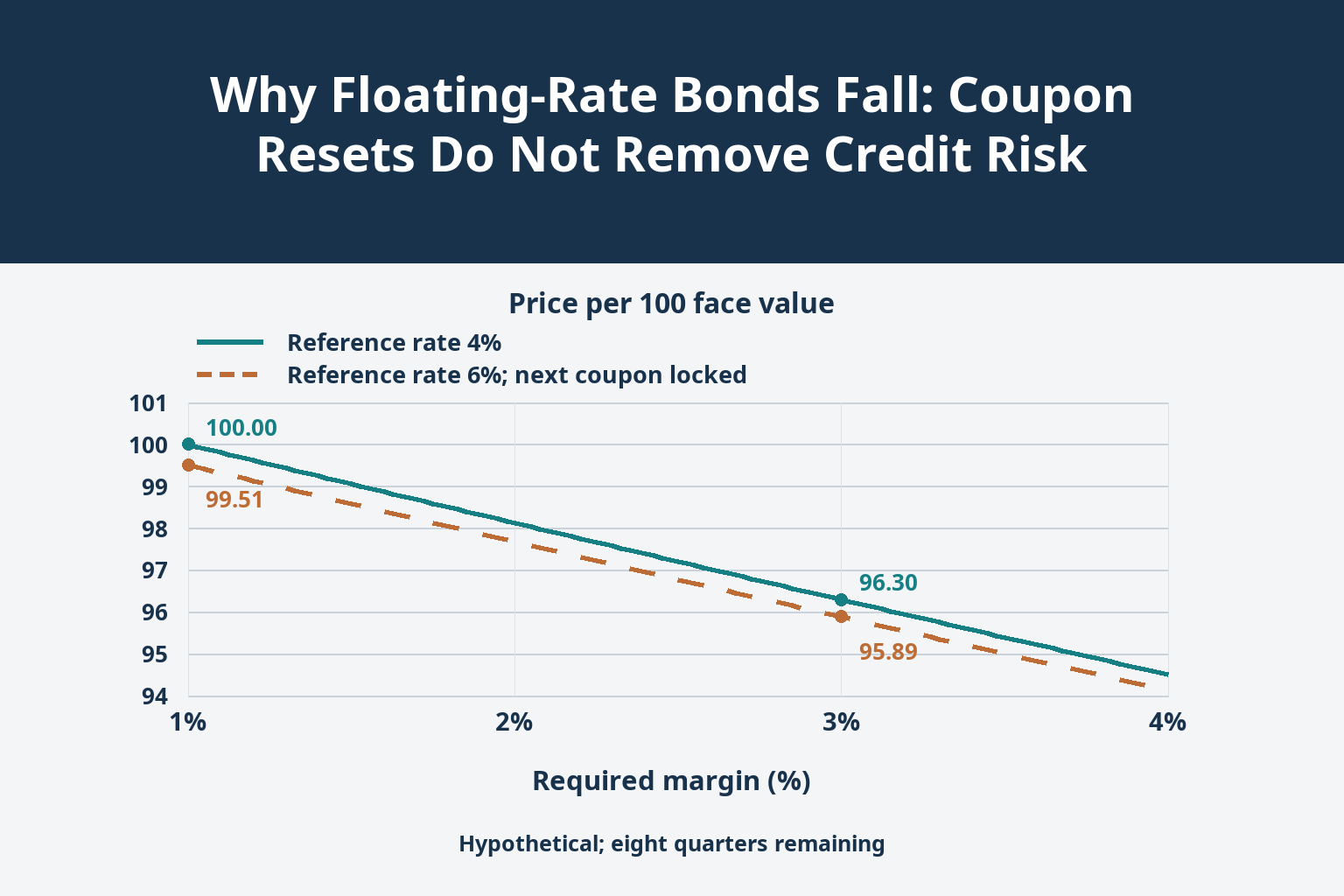
Now return the required margin to 1% and raise only the reference rate from 4% to 6%, immediately after the next coupon was fixed. That first payment remains 1.25; projected payments two through eight rise to 1.75. At a 7% discount rate the price is 99.5086, not exactly 100. The small loss is the present value of waiting for the higher coupon.
Under these assumptions the note is worth 100 immediately after the next payment and reset. Discounting that future 100 plus the already fixed 1.25 for one quarter gives 101.25/1.0175 = 99.5086. This shortcut works because the margins match and the remaining reset terms are idealized—not because the issuer must repurchase at par next quarter.
| Hypothetical shock | Reference rate | Required margin | Next coupon | Later quarterly coupons | Price per 100 |
|---|---|---|---|---|---|
| No change | 4% | 1% | 1.25 | 1.25 | 100.0000 |
| Margin widens | 4% | 3% | 1.25 | 1.25 | 96.2975 |
| Reference rate rises | 6% | 1% | 1.25 | 1.75 | 99.5086 |
| Both change | 6% | 3% | 1.25 | 1.75 | 95.8874 |
If both shocks occur—reference rate 6% and required margin 3%—the price is 95.8874. The first coupon is still 1.25 and the later coupons are 1.75, but discounting is at 9% annually. Incorrectly increasing the first coupon as well produces 96.3764 and overvalues the note by about 0.489 per 100.
The chart changes the required margin while holding the two reference-rate scenarios explicit. It is not a historical price series. In a real valuation, forward curves, distinct projection and discount curves, actual day counts and settlement dates replace the flat-rate simplification.
Take a separate path through time. Buy the original note at 100. The reference rate stays at 4%. After receiving the first quarterly coupon of 1.25, sell when the required margin has widened to 3%. Seven quarters now remain, so the exit price is 96.7327—not the eight-quarter price in the table.
The return is (96.7327 + 1.25 − 100)/100, approximately −2.02% for the quarter before costs and taxes. Using the 5% annualized coupon as the investment return misses both the holding period and the capital loss. Between payment dates, use consistent full prices including accrued interest, and add only cash coupons actually received.
Holding a single note to maturity changes the exit question but does not remove issuer nonpayment risk or make an above-par purchase harmless. Currency movements can also dominate returns in the investor’s home currency. A fund that continually replaces bonds is not a single note with a promised portfolio redemption at 100 on a specified date.
A cap limits coupon increases as reference rates rise. A floor changes behavior when rates fall. A call can shorten the period of attractive income, while subordination or capital-instrument terms change the claim itself. Securities that switch from fixed to floating must be read as two contractual phases. None should be forced into the plain-note model above.
The benign case is supported when reset mechanics are understood, required margins remain stable, actual trading liquidity is adequate and the investor’s currency exposure is controlled. It weakens when spreads widen, a cap binds, a large premium is paid, quotes become stale or cash is needed before a workable exit. Falling policy rates may stabilize price while reducing future income; price stability and income stability are different objectives.
Floating-rate bonds can reduce exposure to a changing benchmark. They do not make every risk float away. The decisive distinction is between a coupon that adjusts under a contract and a price that must clear a market.

728 RM B 7/F GEE LOK IND BLDG NO 34 HUNG TO RD KWUN TONG KLN HONG KONG





The risk of loss in trading financial instruments such as stocks, FX, commodities, futures, bonds, ETFs and crypto can be substantial. You may sustain a total loss of the funds that you deposit with your broker. Therefore, you should carefully consider whether such trading is suitable for you in light of your circumstances and financial resources.
No decision to invest should be made without thoroughly conducting due diligence by yourself or consulting with your financial advisors. Our web content might not suit you since we don't know your financial conditions and investment needs. Our financial information might have latency or contain inaccuracy, so you should be fully responsible for any of your trading and investment decisions. The company will not be responsible for your capital loss.
Without getting permission from the website, you are not allowed to copy the website's graphics, texts, or trademarks. Intellectual property rights in the content or data incorporated into this website belong to its providers and exchange merchants.
Not Logged In
Log in to access more features


Log In
Sign Up