


- USDX
- XAUUSD
- XAGUSD
- WTI


Markets
Analysis
User
24/7
Economic Calendar
Education
Data
- Names
- Latest
- Prev


















A 5% bill discount quote can beat a 5.1% investment-yield quote. Rebuild both prices on the same dates, calculate the cost that reverses the ranking, and distinguish maturity return from an early sale.
A Treasury bill quoted at 5.00% can offer a higher return than another quoted at 5.10%. That is possible when the first number is a discount rate and the second is an investment yield. They use different denominators and annualization conventions. Comparing the two percentages directly can reverse the purchase decision.
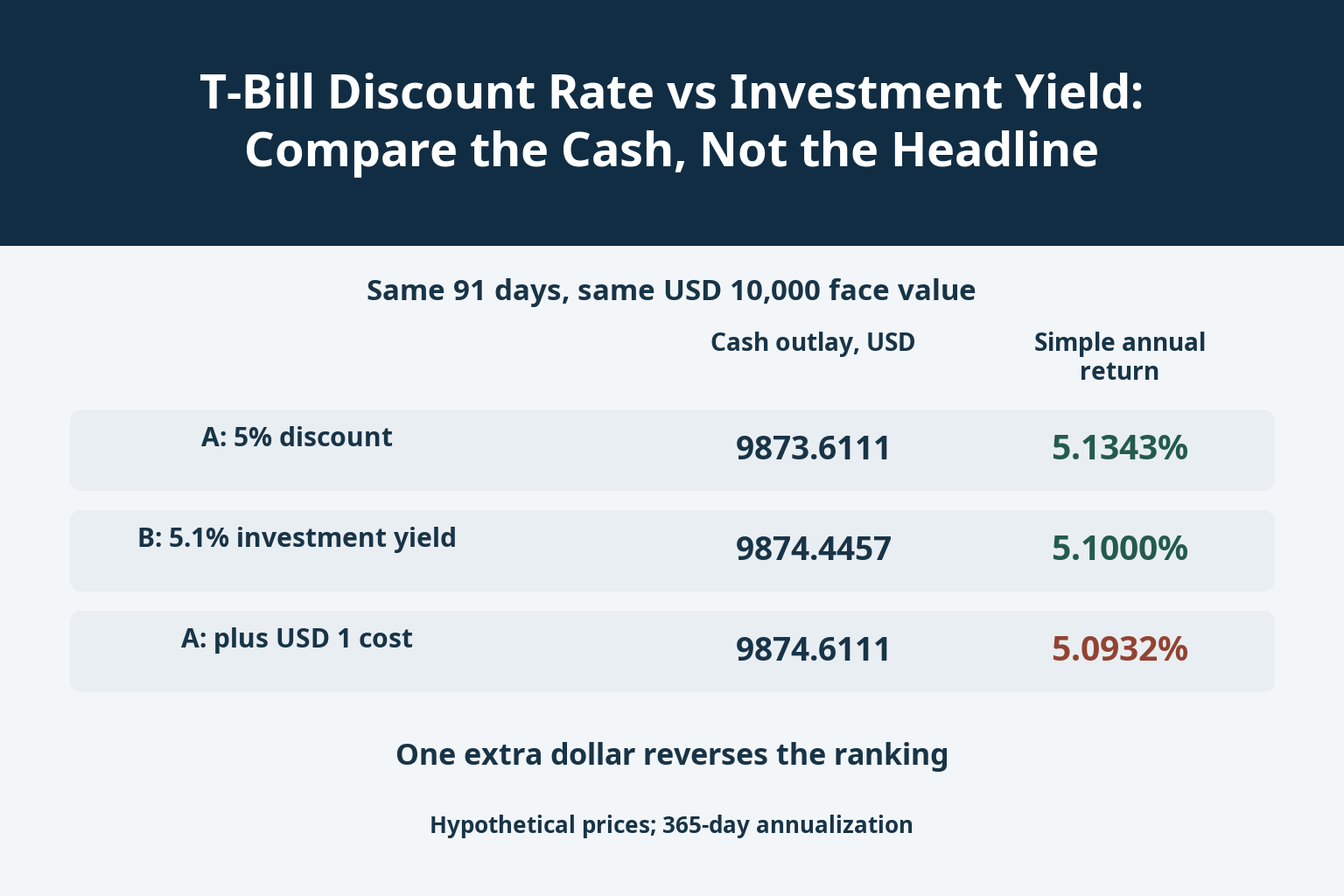
The useful comparison starts with cash paid and cash received on matching dates. In the hypothetical 91-day example below, the 5% discount quote becomes a 5.1343% simple annual return on the purchase price, slightly above 5.10%. Yet an extra dollar of purchase cost on USD 10,000 face value reverses that result. The difference is small enough that execution details matter more than the headline.
A US Treasury bill has no periodic coupon. In the held-to-maturity calculation used here, the investor pays a price below face value and receives face value at maturity. A bank-discount quote annualizes the discount relative to face value using a 360-day basis. The short-bill investment rate instead relates that gain to the purchase price, using the applicable 365- or 366-day year.
Neither label is a promise that the displayed quote is available for your order. Record the security, settlement date, maturity date, price side, quotation time and available quantity. For a purchase, use the executable offer price, not a dealer's purchase bid. If the screen instead displays a fund yield, a deposit APY or a different bond-yield convention, do not silently insert it into a bill formula.
Define face value F, purchase price P, days to maturity t, discount rate d and investment rate i. Rates enter the equations as decimals. The discount-price equation is P = F × (1 − d × t/360). For the short-bill investment convention, i = (F/P − 1) × y/t, so P = F/(1 + i × t/y). The annualization basis y is 365 or 366 as applicable.
Our two fictional bills have the same settlement and maturity, t = 91 days, F = USD 10,000, and y = 365. This is an issue-to-maturity example whose following one-year period does not include February 29. It excludes taxes, FX, funding costs, interim cash flows and trading costs initially. Both prices are assumed executable for that face amount. No current auction or dealer quotation is being reported.
Bill A has d = 0.05: P = 10,000 × (1 − 0.05 × 91/360) = 9,873.6111. Bill B has i = 0.051: P = 10,000/(1 + 0.051 × 91/365) = 9,874.4457. Both pay 10,000 on the same date if held to maturity with payment made as assumed. A buys that cash flow for slightly less.
| Hypothetical purchase | Cash outlay, USD | Maturity profit, USD | 91-day return | Simple annual return |
|---|---|---|---|---|
| A: discount quote 5.00% | 9873.6111 | 126.3889 | 1.2801% | 5.1343% |
| B: investment quote 5.10% | 9874.4457 | 125.5543 | 1.2715% | 5.1000% |
| A with an additional USD 1 cost | 9874.6111 | 125.3889 | 1.2698% | 5.0932% |
For A, the gain is 126.3889, but the denominator for the holding return is 9,873.6111, not 10,000. Its 91-day return is 1.2801%, and multiplying the unrounded result by 365/91 gives 5.1343%. B's corresponding numbers are 1.2715% and 5.1000%. These are simple annualized returns, not a forecast of a full year's compound earnings.
The table rounds money to four decimal places to make the model traceable; calculations retain full precision. A real order must use its actual rounded settlement amount. The comparison fixes face value, not invested capital. Someone investing a fixed cash budget must also account for permitted denominations and residual cash rather than treating these two outlays as identical.
With equal maturity proceeds and dates, A and B break even when their all-in outlays match. If B has no extra cost, A's maximum additional cost is 9,874.4457 − 9,873.6111, approximately USD 0.8346 before settlement rounding. That is the economic size of the initial advantage, not the 0.10 percentage-point gap between the two incompatible headline rates.
Charge A an additional USD 1 at purchase and leave B unchanged. A's outlay becomes 9,874.6111 and its maturity gain 125.3889. The simple annual return falls to 5.0932%, below B's 5.1000%. This is an invented fee, not a claim about a broker's tariff. Include actual fees in the initial outlay and any maturity deductions in final cash. Do not count a spread twice if the executable offer already includes it.
The maturity return assumes the bill is held until the stated payment. Suppose instead that A, without the extra dollar cost, is sold 30 days after settlement, leaving 61 days. Use three separate hypothetical executable bid discount rates to reconstruct sale proceeds with the same discount-price equation. There are no sale costs in this comparison.
| Exit bid discount rate | Sale proceeds, USD | Profit over 30 days, USD | 30-day return |
|---|---|---|---|
| 5.0000% | 9915.2778 | 41.6667 | 0.4220% |
| 6.0000% | 9898.3333 | 24.7222 | 0.2504% |
| 8.0000% | 9864.4444 | -9.1667 | −0.0928% |
At an unchanged 5% discount rate, less time to maturity raises the price and produces a 41.6667 gain. At 6%, the gain is only 24.7222. At 8%, the investor loses 9.1667 despite having bought a bill below par. The no-cost break-even exit discount rate is 5% × 91/61, approximately 7.4590%. An exit rate above that threshold produces a loss in this particular model.
These are 30-day holding returns, not maturity yields or price forecasts. Actual bid size, spreads and fees change the boundary. A money need before maturity therefore cannot be assessed solely from the initial held-to-maturity yield.
The US Treasury investment-rate formula for bills longer than one half-year is different; the short formula is not a universal shortcut for every maturity. Its year basis is also not simply “366 whenever the issue year is a leap year.” The relevant official definition examines the year following the issue date and whether that interval contains February 29. For secondary-market quotations, check the provider's convention and actual settlement dates rather than assuming the auction label fixes your purchase return.
Annualizing a 91-day return does not lock the reinvestment rate for the remaining year. Nor does a USD return establish the outcome in another currency. Taxes, currency conversion and liquidity needs require separate cash flows. For coupon-paying instruments, the additional payment dates raise the distinct issues covered in yield to maturity and reinvestment assumptions.
The result is dependable only within those matching conditions. A different payment date, a non-executable quote or an omitted cost invalidates the simple ranking. A rate becomes useful when it can be reconciled to the money leaving and returning to the account.

728 RM B 7/F GEE LOK IND BLDG NO 34 HUNG TO RD KWUN TONG KLN HONG KONG





The risk of loss in trading financial instruments such as stocks, FX, commodities, futures, bonds, ETFs and crypto can be substantial. You may sustain a total loss of the funds that you deposit with your broker. Therefore, you should carefully consider whether such trading is suitable for you in light of your circumstances and financial resources.
No decision to invest should be made without thoroughly conducting due diligence by yourself or consulting with your financial advisors. Our web content might not suit you since we don't know your financial conditions and investment needs. Our financial information might have latency or contain inaccuracy, so you should be fully responsible for any of your trading and investment decisions. The company will not be responsible for your capital loss.
Without getting permission from the website, you are not allowed to copy the website's graphics, texts, or trademarks. Intellectual property rights in the content or data incorporated into this website belong to its providers and exchange merchants.
Not Logged In
Log in to access more features


Log In
Sign Up