


- WTI
- XAUUSD
- XAGUSD
- USDX


Markets
Analysis
User
24/7
Economic Calendar
Education
Data
- Names
- Latest
- Prev






Follow a hypothetical USD 10 million purchase and a matching domestic securities sale. Reconcile bank reserves, partial offsets and settlement dates before interpreting the exchange rate or calling an operation monetary easing.
A central bank can buy foreign currency without leaving the banking system with more reserve balances. It can offset the reserve credit from the currency purchase through a separate domestic operation. That is the core of sterilised foreign-exchange intervention. The FX transaction still happened; the offset changes what remains in domestic settlement liquidity.
In the hypothetical case below, buying USD 10 million adds H 70 million to bank reserves. Selling existing domestic securities for the same settlement amount removes H 70 million. Net reserves are unchanged, while the central bank holds more foreign assets and fewer domestic securities. Neither “no effect on anything” nor “automatic monetary easing” follows from that result.
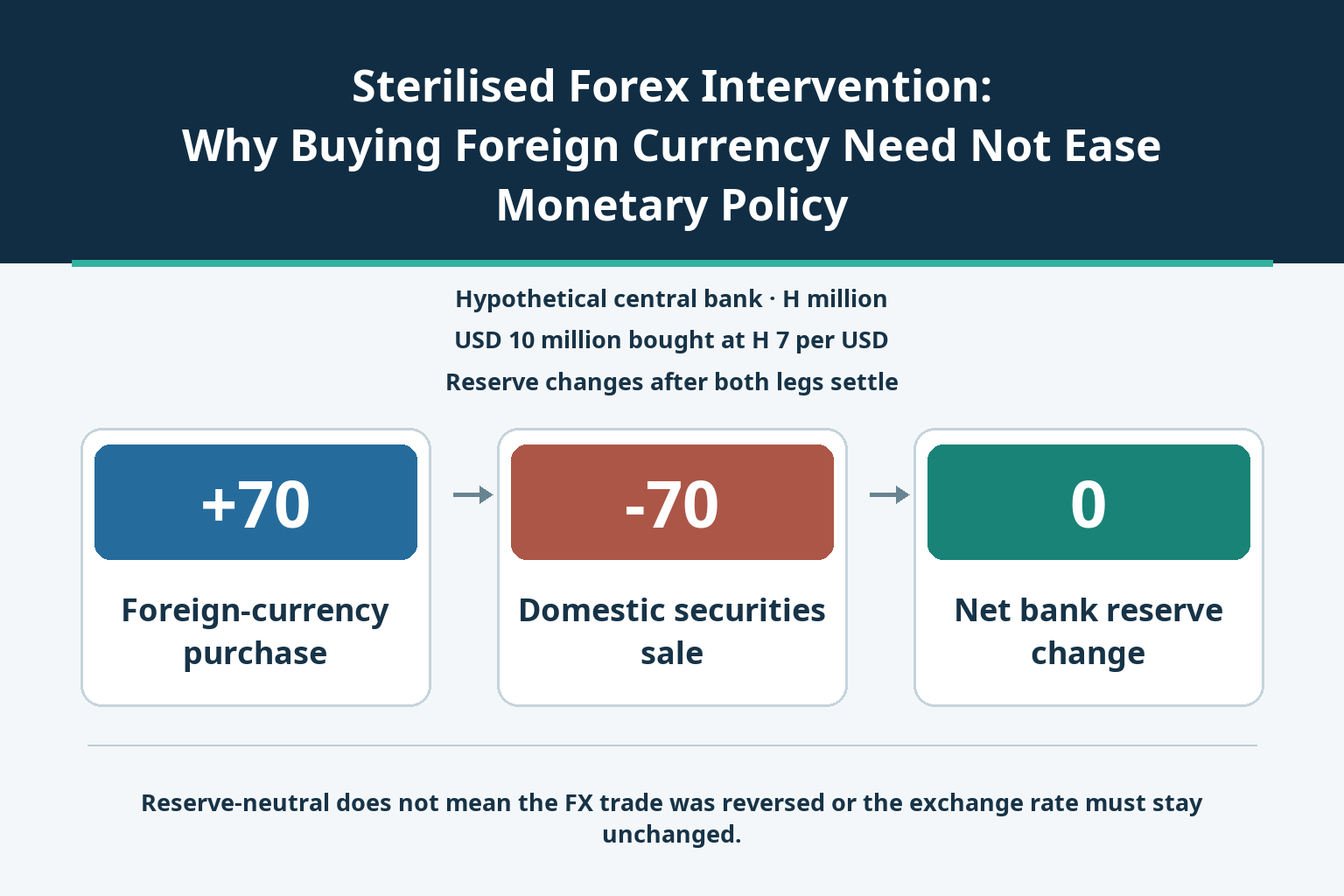
Let H denote a fictional home currency. A USD/H quote of 7 means H 7 per US dollar; a rise in this quote means a weaker H. The central bank buys dollars and pays H. For this model, payment settles by crediting banks’ reserve accounts at the central bank, rather than by printing and handing out physical notes.
Those bank reserve balances are the central bank’s liabilities. They are not its foreign-currency assets, household deposits or an individual trader’s account equity. Calling all of these “reserves” obscures opposite sides of the operation. The identity below describes central-bank settlement balances, not a multiplier for broad money.
Assume the central bank already owns enough domestic securities to sell outright to banks. Use actual settlement cash, with no fees, interest, valuation changes or other flows. This is an invented mechanism example, not the operating rule, balance sheet or intervention announcement of a particular country.
Buying USD 10 million at H 7 per dollar creates a foreign asset worth H 70 million and credits H 70 million of bank reserves. An outright domestic securities sale for H 70 million then reduces the central bank’s domestic assets and debits the banks’ reserve accounts by that amount. All table entries are changes in H millions.
| Settled leg | Foreign assets | Domestic securities | Bank reserves |
|---|---|---|---|
| USD purchase | +70 | 0 | +70 |
| Domestic securities sale | 0 | −70 | −70 |
| Combined change | +70 | −70 | 0 |
After both legs, foreign assets have risen by 70 and domestic securities have fallen by 70. Total central-bank assets and bank reserves are unchanged in this deliberately closed model. The asset composition has changed. “Sterilised” refers to the offset of the intervention’s domestic liquidity effect; it does not mean the foreign asset was sold back.
The offset amount is the securities’ settlement price, not their face value. Selling a bond with a face value of 70 does not establish a 70 reserve debit if the cash proceeds differ. A temporary liquidity operation would also require its maturity and reversal to be tracked; this example uses an outright sale to keep that distinction explicit.
Start each independent scenario with bank reserves of H 200 million. The first three use the identical USD purchase above. The fourth instead sells USD 10 million and buys domestic securities for H 70 million. Do not add the rows together.
| Independent case | FX reserve flow | Domestic offset flow | Closing reserves |
|---|---|---|---|
| No offset | +70 | 0 | 270 |
| Partial offset | +70 | −50 | 220 |
| Full offset | +70 | −70 | 200 |
| USD sale plus full offset | −70 | +70 | 200 |
In the partial case, 50/70=71.4286% of the initial reserve credit is absorbed. Reserves still rise by 20 to 220. Describing that as fully sterilised would erase the residual. With no offset they reach 270; with the full offset they return to 200.
The reverse-direction example drains 70 through the dollar sale and restores 70 through the securities purchase. It also ends at 200 but involves the opposite FX transaction. An unchanged reserve total therefore cannot reveal whether dollars were bought or sold.
A currency board can deliberately allow currency transactions to change settlement liquidity as part of its adjustment mechanism. See USD/HKD’s currency-board liquidity adjustment. Its institutional design must be read on its own terms; the optional offset assumed here must not be imported into every exchange-rate regime.
Suppose the FX purchase settles on day 1 but the securities sale settles on day 2. With no other flows, reserves are 270 after day 1 and 200 after day 2. A plan to absorb liquidity tomorrow is not evidence that today’s reserve credit has already been neutralised. Trade dates, announcements and settlement dates answer different questions.
Now take a separate same-day case: the intervention’s two legs net to zero, but an unrelated government payment flow drains H 15 million from bank reserves. Observed reserves end at 185 rather than 200. That fall does not prove a dollar sale; the FX contribution was zero after its offset.
Reconcile opening reserves plus the FX settlement flow, the offsetting settlement flow and all other flows to closing reserves. If one term is unknown, label the reconciliation incomplete. Do not force the residual into an inferred intervention amount or silently mix USD transaction sizes with H settlement balances.
The FX purchase changes currency demand and supply. The domestic securities sale offsets a reserve balance; it does not reverse the original currency purchase. Changes in the assets held by the private sector and information about future policy can still matter. Their importance depends on market conditions and the credibility and scale of the operation.
Portfolio composition is a conditional channel, not a guaranteed price effect. In a counterfactual where the exchanged assets are perfect substitutes and policy expectations do not change, those portfolio and signalling channels supply no reason for repricing. When substitutability or expectations differ, the effect need not be zero, but the accounting table cannot quantify it.
Nor does a reserve increase alone identify a policy-rate cut. The interest paid on reserves, the monetary operating framework and other policy decisions matter. The model gives no numerical link from H 20 million of residual liquidity to basis points or to an exchange-rate target. Offset capacity, eligible assets, costs and legal authority also have to be established for a real institution.
A currency falling after an official purchase is not by itself a clean measure of success. Other orders, information and changing risk appetite affect the same price; the unobserved path without the operation is missing. Equally, a routine official FX transaction for government services should not automatically be labelled an exchange-rate intervention.
First confirm the institution, stated purpose, currency direction, quotation unit and transaction size. Then obtain settlement dates and the domestic liquidity operation’s instrument, cash amount and maturity. Distinguish an announced intention from settled balances and a routine currency service from a policy intervention.
Next reproduce the reserve reconciliation in one home-currency unit and on a common time window. Check other reserve flows and whether the offset is full, partial or merely delayed. Match any claim about bank deposits or interest rates to separate evidence; neither is established by a central-bank reserve identity alone.
Finally separate three conclusions: what currencies actually changed hands, what net reserve liquidity remained, and what market or policy effect is supported. A verified zero in the second calculation does not settle the third. If the cash legs, dates or policy framework are unavailable, the defensible conclusion is narrower than a directional forex trade.

728 RM B 7/F GEE LOK IND BLDG NO 34 HUNG TO RD KWUN TONG KLN HONG KONG


The risk of loss in trading financial instruments such as stocks, FX, commodities, futures, bonds, ETFs and crypto can be substantial. You may sustain a total loss of the funds that you deposit with your broker. Therefore, you should carefully consider whether such trading is suitable for you in light of your circumstances and financial resources.
No decision to invest should be made without thoroughly conducting due diligence by yourself or consulting with your financial advisors. Our web content might not suit you since we don't know your financial conditions and investment needs. Our financial information might have latency or contain inaccuracy, so you should be fully responsible for any of your trading and investment decisions. The company will not be responsible for your capital loss.
Without getting permission from the website, you are not allowed to copy the website's graphics, texts, or trademarks. Intellectual property rights in the content or data incorporated into this website belong to its providers and exchange merchants.
Not Logged In
Log in to access more features


Log In
Sign Up


