


- USDX
- XAUUSD
- XAGUSD
- WTI


 -- On monday the forcing of trades is huge among traders
 . While on the road you have to build something that pushes you to achieve consistency in an acceptable period.

Markets
Analysis
User
24/7
Economic Calendar
Education
Data
- Names
- Latest
- Prev






A 10% stock decline need not produce a short-selling profit. Rebuild daily borrow charges, dividend payments and margin capacity, then test whether the position can survive until the thesis plays out.
A stock falls from 50 to 45. The short seller called the direction correctly, yet the trade can still lose money. At a 60% annual stock-borrow fee, a 60-day holding period can consume more than the entire price gain once a dividend payment and execution costs are included. The relevant question is not merely how far the stock might fall, but how much of that fall remains after the cost of keeping the short position alive.
For an unchanged number of shares, net profit equals the sale proceeds minus the cost of buying back the shares, minus stock-borrow charges, dividend compensation and execution costs, plus any cash interest actually credited. If there is a separate cash loan, its financing charge also belongs in the ledger. A stock loan and a cash loan are different liabilities; do not automatically charge the same interest expense twice.
Borrow charges are usually quoted annually but accrue over the holding period under the contract. The calculation base may be a daily reference value or collateral amount, with specific rounding and day-count rules. Neither the opening price nor a 360-day denominator is universal. Similarly, a quoted net rebate can already incorporate part of the lending economics. Reconcile the quote with the statement before adding another fee.
The short-sale cash is not earned income: the account still owes shares. Nor is posted margin itself an expense. It is capital tied up to support a liability whose market value changes. This distinction matters in pairs trading, where a quiet net market exposure can conceal an expensive or fragile short leg.
Consider a hypothetical 1,000-share short opened at 50 and covered at 45 after 60 charged days. All amounts use one currency. Assume a 360-day fee basis, no cash interest, no cash-loan financing, no tax or currency effect, and constant share quantity. For the first 20 days, the fee reference price is 50 and the annual rate 10%; for the remaining 40 days, the reference is 48 and the rate 60%.
The two charges are 1,000 × 50 × 10% × 20 / 360 = 277.78 and 1,000 × 48 × 60% × 40 / 360 = 3,200. Total borrow cost is 3,477.78. Add a single dividend compensation payment of 0.60 per share and total execution costs of 100. The 5,000 gross price gain becomes only 822.22 net.
Using those already specified costs, the break-even cover price is 50 − (3,477.78 + 600 + 100) / 1,000 = 45.82222. This is a conditional accounting threshold, not a price target. Before exit, the future fee rate, reference value and holding period remain unknown. The threshold must therefore be recalculated as the position evolves.
The table keeps the opening price at 50, final cover price at 45, one dividend payment of 600 and execution costs of 100. The constant-rate scenarios use a fixed fee reference of 48; the mixed-rate row uses the two-stage calculation above. The 120-day scenario still assumes only one dividend payment.
| Borrow assumption | Charged days | Borrow cost | Net profit at 45 | Break-even cover price |
|---|---|---|---|---|
| 10% throughout | 60 | 800.00 | 3500.00 | 48.50 |
| 10% then 60% | 60 | 3477.78 | 822.22 | 45.82 |
| 60% throughout | 60 | 4800.00 | -500.00 | 44.50 |
| 60%, longer wait | 120 | 9600.00 | -5300.00 | 39.70 |
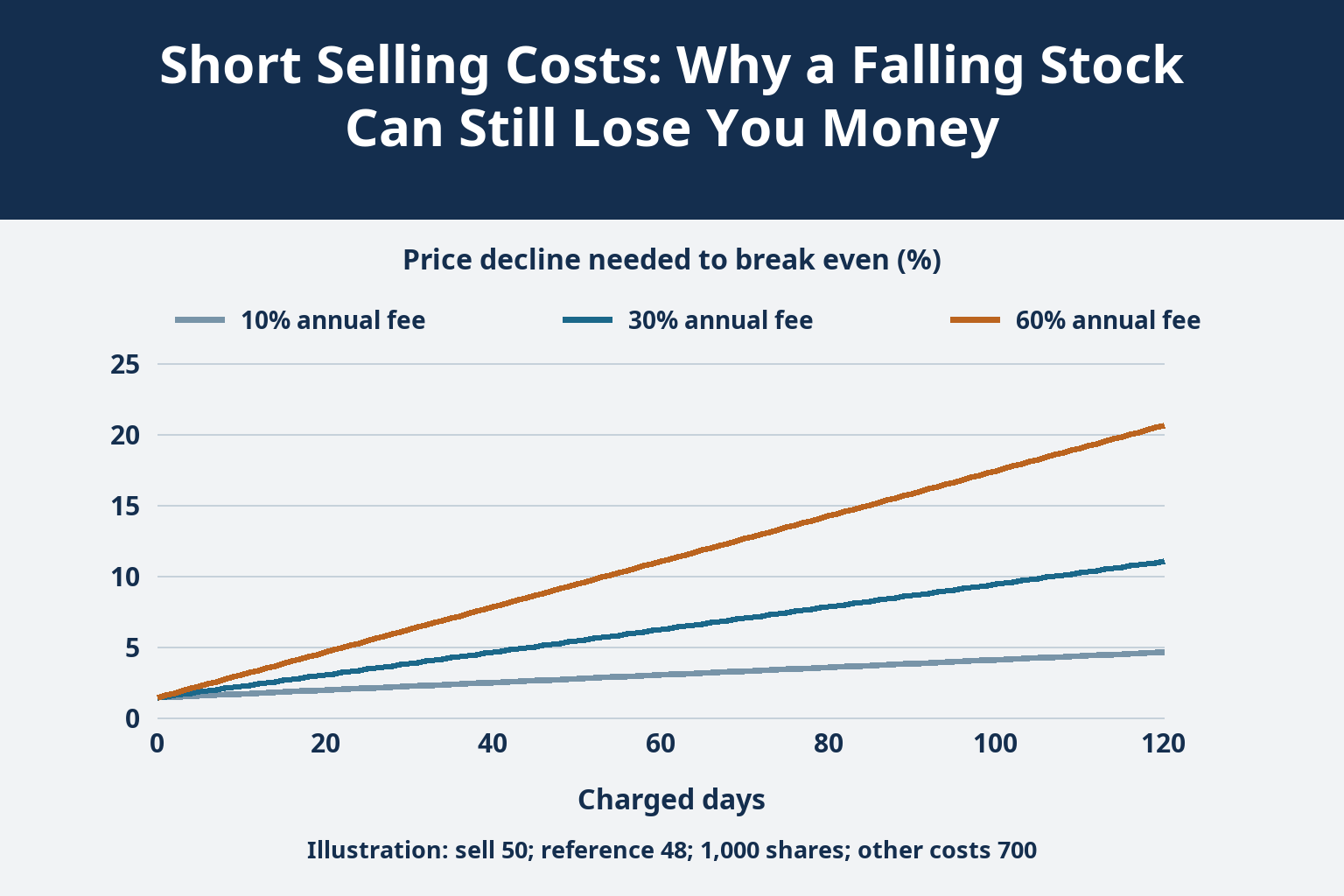
At 60% for 60 days, borrow cost is 4,800 and the trade loses 500 despite the 10% share-price decline. Extend the same assumptions to 120 days and the loss becomes 5,300. The chart shows how the required price decline rises with charged days under constant reference values and rates; it is a cost map, not a forecast of share prices or lending rates.
A dividend is not a free short-selling catalyst. If a share mechanically goes ex-dividend by 0.60, the resulting 0.60 gross short gain is offset by the corresponding compensation payment, before taxes and other effects. A backtest built from adjusted prices must be reconciled with its cash-flow treatment; mixing a dividend-adjusted series with a second, inconsistent dividend deduction can distort the result.
A bearish valuation thesis does not grant control over the loan's life. If the stock lender recalls shares and replacement borrowing is unavailable, the position may have to be covered under the applicable agreement. A fee increase and a recall are different events: one changes the cost of waiting, the other can remove the ability to wait.
Suppose the illustrative short is instead closed on day 20 at 55, before the dividend obligation arises. With 277.78 of accrued borrow charges and 100 execution costs, the realized loss is 5,377.78. A later fall to 45 does not convert that closed trade into a winner. A chart showing only entry and a convenient eventual low omits the decisive constraint.
Borrow availability, termination provisions and realistic replacement capacity are therefore part of the trade thesis. A displayed availability figure is not a promise of uninterrupted financing. A stop order also cannot guarantee its trigger price through a gap or illiquid auction.
Take a separate, simplified account illustration: 25,000 of initial equity plus 50,000 of short-sale proceeds gives 75,000 cash, against a liability of 1,000 shares. Ignore fees and interest here. Account equity at stock price S is 75,000 − 1,000S. Assume, purely for this example, a maintenance requirement equal to 30% of the current short market value.
The equality 75,000 − 1,000S = 0.30 × 1,000S gives S = 57.6923. At 60, equity is 15,000 while the assumed requirement is 18,000: the shortfall is 3,000. Accrued costs lower the boundary further. Other positions, collateral haircuts and changing house requirements alter the calculation; 30% is not a universal regulatory or broker rule.
Price appreciation simultaneously increases the share liability and the required support. That double effect explains why eventual correctness is insufficient. The short's potential price gain is bounded by a fall to zero, while the stock price has no comparable fixed upper bound. Margin analysis is a survival calculation, not an estimate of maximum loss.
A strong short thesis needs three things to coincide: the price view, a net economic advantage after carrying costs, and the ability to maintain the position long enough to realize it. Remove any one of them and a persuasive valuation argument can still produce a losing trade.

728 RM B 7/F GEE LOK IND BLDG NO 34 HUNG TO RD KWUN TONG KLN HONG KONG





The risk of loss in trading financial instruments such as stocks, FX, commodities, futures, bonds, ETFs and crypto can be substantial. You may sustain a total loss of the funds that you deposit with your broker. Therefore, you should carefully consider whether such trading is suitable for you in light of your circumstances and financial resources.
No decision to invest should be made without thoroughly conducting due diligence by yourself or consulting with your financial advisors. Our web content might not suit you since we don't know your financial conditions and investment needs. Our financial information might have latency or contain inaccuracy, so you should be fully responsible for any of your trading and investment decisions. The company will not be responsible for your capital loss.
Without getting permission from the website, you are not allowed to copy the website's graphics, texts, or trademarks. Intellectual property rights in the content or data incorporated into this website belong to its providers and exchange merchants.
Not Logged In
Log in to access more features


Log In
Sign Up