


- WTI
- XAUUSD
- XAGUSD
- USDX


Markets
Analysis
User
24/7
Economic Calendar
Education
Data
- Names
- Latest
- Prev















A higher haircut on a new repo can force a funding adjustment even when bond values are unchanged. An exact rollover ledger separates the cash injection, required asset sale, remaining equity and settlement constraints.
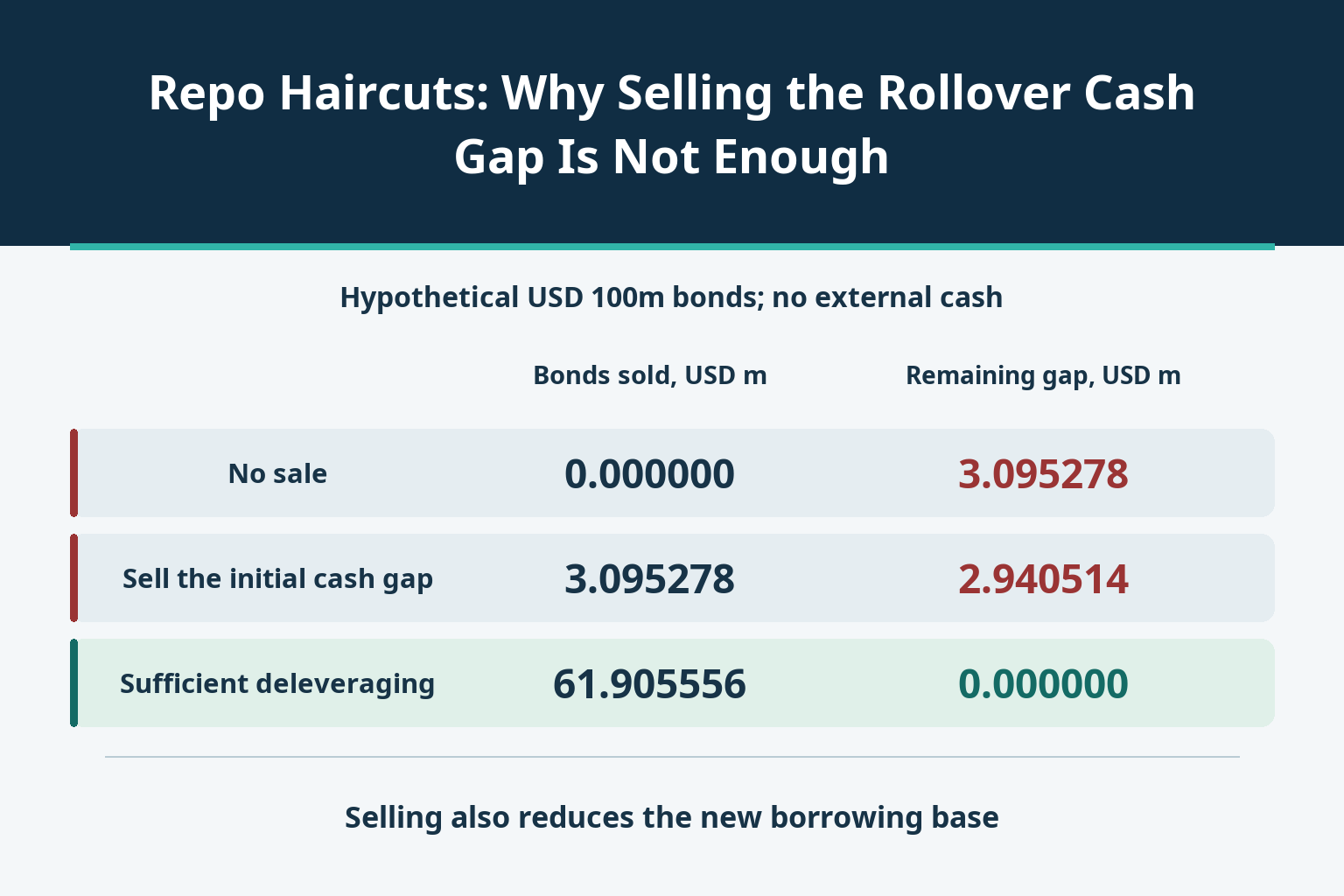
A repo borrower facing a USD 3.10 million rollover gap cannot necessarily close it by selling USD 3.10 million of the financed bonds. The sale supplies cash, but it also removes securities that would have supported the new borrowing. In the hypothetical case below, retaining all the bonds requires about USD 3.10 million of outside cash; reaching a balanced end position without that cash requires selling about USD 61.91 million. Neither amount is itself the portfolio’s investment loss.
The event is a fixed-term repo reaching maturity, followed by a separately negotiated new repo. It is not a lender unilaterally changing a fixed haircut halfway through an existing contract. Repo is structured as a securities sale with an agreed repurchase and serves an economic financing purpose; describing the borrower’s bond exposure does not mean the securities remain freely deliverable to anyone.
Assume the bonds initially have a USD 100 million full, or dirty, market value, including accrued interest. A 2% haircut supplies USD 98 million of cash and leaves USD 2 million of economic equity. The old repo lasts seven actual days at an assumed 5% annual simple rate on an ACT/360 basis. Interest is charged on the USD 98 million cash principal, not on the USD 100 million bond value.
Interest = 98,000,000 × 0.05 × 7/360 = USD 95,277.78.
Old maturity payment = USD 98,095,277.78.
Calculations retain unrounded values internally. There are no coupon cash payments, other assets, taxes, fees, collateral transfers or netting arrangements in this example. The full bond value is still USD 100 million at rollover; merely assuming an unchanged clean price would not establish that. The ACT/360 basis is chosen for this model, not imposed on every repo market.
Fix the definition before comparing percentages: h = (V − C)/V, where V is the full securities value and C the cash advanced. A 5% haircut therefore finances 95% of the retained eligible securities. The collateral-to-cash ratio is instead V/C = 1/(1 − h), or 105.2632%.
If a contract actually specifies a 105% collateral-to-cash ratio, its corresponding haircut is 4.7619%, not 5%. USD 100 million of securities would support USD 95,238,095.24 under that ratio, versus USD 95 million under a 5% haircut. The USD 238,095.24 difference is large enough to matter in a funding ledger. Check the contractual denominator rather than relying on a label such as initial margin.
In our new repo the haircut is 5%, up three percentage points from 2%. Retaining every bond therefore provides USD 95 million, leaving USD 3,095,277.78 to pay from outside resources. That is USD 3 million of reduced financing capacity plus the old USD 95,277.78 interest bill. The new repo’s future interest is a later financing expense, not another item to add to this old maturity payment. The 5% interest rate and 5% haircut happen to share a number but describe different things.
Let x be the market value of bonds sold. Only V − x remains eligible for the new repo, so total funding without outside cash is:
x + 0.95(V − x) = 0.95V + 0.05x.
Each dollar sold generates one dollar of sale proceeds but removes 95 cents of new borrowing capacity. It improves the original gap by only five cents. This is not a 95% transaction fee; it prevents the same securities from being counted simultaneously as sold assets and unchanged collateral.
| Plan | External cash, USD | Bonds sold, USD | Bonds retained, USD | New repo cash, USD | Remaining gap, USD |
|---|---|---|---|---|---|
| Retain all; inject cash | 3,095,277.78 | 0.00 | 100,000,000.00 | 95,000,000.00 | 0.00 |
| Sell only the initial gap; no injection | 0.00 | 3,095,277.78 | 96,904,722.22 | 92,059,486.11 | 2,940,513.89 |
| Sufficient deleveraging; no injection | 0.00 | 61,905,555.56 | 38,094,444.44 | 36,189,722.22 | 0.00 |
Selling only USD 3,095,277.78 leaves new repo funding of USD 92,059,486.11 and an unpaid gap of USD 2,940,513.89. To close the gap without external cash, solve 0.95V + 0.05x = 98,095,277.777… . The required sale is x = 3,095,277.777…/0.05 = USD 61,905,555.56.
The retained USD 38,094,444.44 supports USD 36,189,722.22 of new repo cash. Sale proceeds and new cash together meet the old obligation. Independently rounded table cells can differ by a cent when added; the identity uses unrounded values. A separate zero-interest check gives a USD 3 million gap and a USD 60 million sale, not a USD 3 million sale.
After the sufficient-sale plan, economic equity is retained assets minus new financing: 38,094,444.444… − 36,189,722.222… = USD 1,904,722.22. That is exactly the original USD 2 million less the old repo interest. Selling USD 61.91 million is a balance-sheet contraction, not an invented USD 61.91 million loss.
Under the retain-all plan, equity instead becomes USD 5 million: the original USD 2 million, less interest, plus USD 3,095,277.78 of outside cash. The injection is not trading profit. In both plans the tighter funding condition changes how much capital supports the remaining bond exposure.
The haircut itself is neither an annual financing charge nor a mark-to-market loss. It restricts the cash raised against a given asset value. In a real portfolio, selling costs, lower prices, coupons, other assets or additional borrowing would change the ledger; they cannot be silently added to a model that excludes them.
With outside cash E ≥ 0, full bond value V, new haircut h and old payment D, the minimum algebraic sale is x = max(0, [D − (1 − h)V − E]/h), for 0 < h < 1. The next check is indispensable: x cannot exceed the available securities. An equation can produce a number that no portfolio can sell.
Keep the old payment fixed and the new haircut at 5%, but test three different rollover values:
| Full bond value, USD | Cash to retain all, USD | Required sale without injection, USD | Arithmetic feasibility | Gap after selling all, USD |
|---|---|---|---|---|
| 100,000,000.00 | 3,095,277.78 | 61,905,555.56 | Within existing assets | 0.00 |
| 99,000,000.00 | 4,045,277.78 | 80,905,555.56 | Within existing assets | 0.00 |
| 96,000,000.00 | 6,895,277.78 | 137,905,555.56 | Exceeds existing assets | 2,095,277.78 |
At USD 99 million, the required sale rises to about USD 80.91 million and remains within the assumed assets. At USD 96 million, the formula asks for USD 137.91 million, which is impossible from that holding. Selling every bond would still leave USD 2,095,277.78 of the old payment unfunded without another cash source.
This last result is a shortfall within the defined asset-and-liability set, not a legal insolvency finding about a real institution. It does, however, invalidate a claim that selling enough of the existing position must always solve the rollover problem. Other available resources would have to be identified, not assumed into existence.
The arithmetic assumes eligible new financing and sales at the stated full market value, without spread, impact or minimum-size constraints. It does not establish that those trades are available. More fundamentally, the old repo’s securities must be returned or released under an agreed process before the borrower can rely on delivering them into a sale or new financing.
Security return, old-repo repayment, sale settlement and receipt of new cash may require coordinated settlement or a committed bridge. “No external cash” in the sale plan means no net external capital injection into the final structure. It does not mean zero intraday liquidity or no temporary credit requirement. None of those facilities is promised by the equation.
Keep price-return analysis separate too. The implied repo rate and the actual cost of financing bonds answer different questions. A potentially attractive asset trade cannot settle an old payment merely because its expected return exceeds a financing rate. Funding amount, payment time and access to the securities each need their own evidence.
The decisive distinction is between a cash gap and the asset sale needed to fund it. When the sold asset also supports the replacement loan, the borrowing base must shrink in the same calculation. Leaving out that second effect can turn a seemingly small rollover adjustment into an unworkable plan.

728 RM B 7/F GEE LOK IND BLDG NO 34 HUNG TO RD KWUN TONG KLN HONG KONG





The risk of loss in trading financial instruments such as stocks, FX, commodities, futures, bonds, ETFs and crypto can be substantial. You may sustain a total loss of the funds that you deposit with your broker. Therefore, you should carefully consider whether such trading is suitable for you in light of your circumstances and financial resources.
No decision to invest should be made without thoroughly conducting due diligence by yourself or consulting with your financial advisors. Our web content might not suit you since we don't know your financial conditions and investment needs. Our financial information might have latency or contain inaccuracy, so you should be fully responsible for any of your trading and investment decisions. The company will not be responsible for your capital loss.
Without getting permission from the website, you are not allowed to copy the website's graphics, texts, or trademarks. Intellectual property rights in the content or data incorporated into this website belong to its providers and exchange merchants.
Not Logged In
Log in to access more features


Log In
Sign Up