


- WTI
- XAUUSD
- XAGUSD
- USDX


Markets
Analysis
User
24/7
Economic Calendar
Education
Data
- Names
- Latest
- Prev






A non-deliverable forward can offset the dollar cost of a won invoice without delivering a single won. Reconcile the settlement formula with the actual currency purchase, then test the fixing, executable rate and timing of available cash to see what the hedge really covers.
A company can receive a substantial dollar payment from a non-deliverable forward and still be unable to pay its Korean supplier. The apparent contradiction disappears once the hedge and the invoice are kept separate: the NDF settles a currency difference in dollars, while the supplier requires won. A useful settlement analysis therefore follows both cash flows, the rate at which won can actually be bought and the time at which the dollars become available.
Consider a company that funds itself in dollars and owes a fixed invoice of 1.3 billion Korean won. It has lawful access to the conversion and payment channels needed to pay that invoice. To hedge the currency exposure, it buys won and sells dollars through a dollar-settled NDF at an agreed rate K of 1,300 won per dollar. The dollar notional N is USD1 million, and the corresponding won amount Q is N×K, or KRW1.3 billion.
These are invented contract inputs, not current market quotations. The example assumes the invoice remains unchanged, both counterparties perform and there is no initial cash payment. Fees, taxes, interim collateral cash flows and financing charges are outside the calculation. Excluding them is a modelling choice, not a claim that an NDF never requires cash before maturity.
The NDF does not exchange those two notionals at maturity. It settles the agreed difference in dollars; the company must obtain the won separately. The BIS makes this distinction in its explanation of non-deliverable hedging. Dollar settlement is the convention selected for this example, not a universal rule for every NDF contract or market.
Let R be the contract's fixing rate, also expressed as won per dollar. Define P as dollars received by the company that owes won: a positive P is a receipt, and a negative P is a payment. Its settlement is:
P = Q/R − N = N(K/R − 1) = N(K−R)/R.
Q/R is the dollar equivalent of the fixed won amount at the fixing. Subtracting the contracted dollar amount produces the difference. When won strengthens, R falls: each dollar buys fewer won, the invoice becomes more expensive in dollar terms, and this company's NDF produces a positive receipt. The dollar buyer on the other side has the opposite sign, N(1−K/R). Saying only “long the NDF” leaves the economic direction ambiguous.
Units provide a quick error check. Multiplying the dollar notional by K−R produces a won amount, not a dollar amount. Dividing by R converts that difference into dollars. Omitting the denominator can turn a modest cash adjustment into a wildly incorrect number. If the quotation is inverted, with s=1/R and k=1/K in dollars per won, the same receipt is Q(s−k). That version uses the won notional Q, not the dollar notional N.
Now define X as the executable rate for buying the full invoice amount for its payment value date. X has the same units as R. The company sells dollars to the dealer, so the relevant quote is the dealer's dollar-buying side, not a displayed midpoint. The gross dollar conversion cost is C=Q/X.
The first table assumes X equals R in each of three independent hypothetical outcomes. The rows are not a sequence of market observations. Dollars are shown to cents, while the underlying calculation retains the unrounded values.
| Fixing R = execution X: KRW per USD | NDF receipt P: USD | Gross conversion cost C: USD | Combined outflow C−P: USD |
|---|---|---|---|
| 1,200 | +83,333.33 | 1,083,333.33 | 1,000,000.00 |
| 1,300 | 0.00 | 1,000,000.00 | 1,000,000.00 |
| 1,400 | −71,428.57 | 928,571.43 | 1,000,000.00 |
At 1,200, buying KRW1.3 billion requires USD1,083,333.33, and the NDF pays USD83,333.33. Together they leave a USD1 million outflow. The receipt is not an additional trading windfall: it offsets the greater dollar cost of the invoice.
At 1,400, the won purchase costs only USD928,571.43, but the company pays USD71,428.57 under the NDF. The combined amount is again USD1 million. Calling that derivative payment a failed hedge ignores the invoice's offsetting improvement. At 1,300 the derivative payment is zero; the obligation to buy and deliver the won does not disappear.
The neat offset depends on an assumption that can be missed in a settlement spreadsheet: the actual purchase must be made at the fixing rate. Combining the two cash flows exposes what happens when it is not:
C−P = N + Q(1/X−1/R).
The second term is the residual against the contracted dollar budget. Keep R at 1,200, so the NDF receipt remains USD83,333.333… in every row below, and change only the executable conversion rate X.
| Execution X: KRW per USD | Gross conversion cost: USD | Combined outflow: USD | Amount above USD budget N |
|---|---|---|---|
| 1,200 | 1,083,333.33 | 1,000,000.00 | 0.00 |
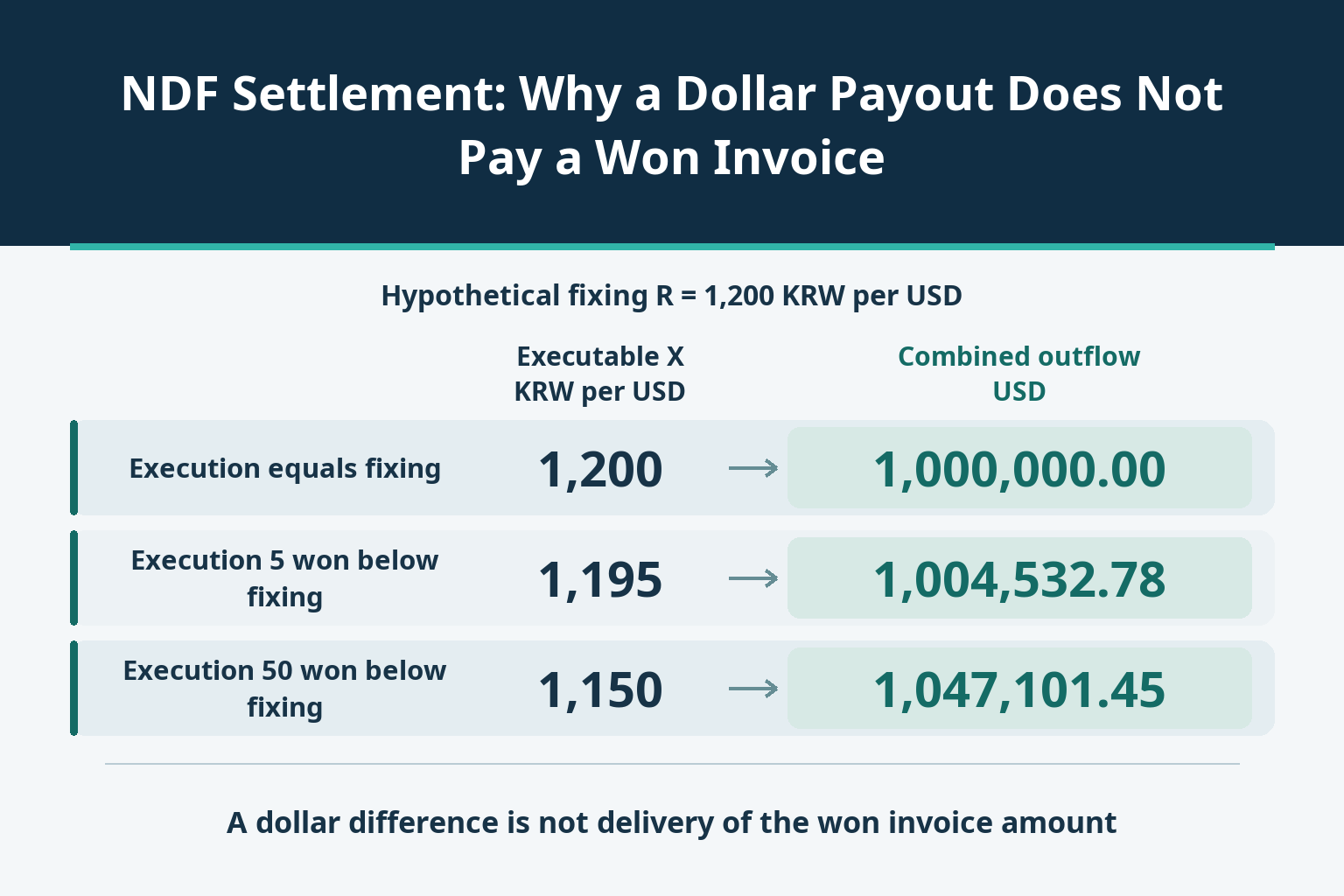
| 1,195 | 1,087,866.11 | 1,004,532.78 | 4,532.78 |
| 1,150 | 1,130,434.78 | 1,047,101.45 | 47,101.45 |
At X=1,195, the combined dollar cost is USD1,004,532.78, exceeding the budget by USD4,532.78. At X=1,150 it rises to USD1,047,101.45. The NDF has not changed its fixing or stopped working; another transaction is being completed at a different rate.
Such a gap might reflect execution timing, quote side or the market actually accessible to the company. These figures do not identify its cause, and the whole difference should not automatically be labelled a fee. Nor must the residual be adverse: with X above R, dollars buy more won and the residual is negative. The table illustrates sensitivity, not a probable outcome or a maximum loss.
Even the matched-rate case does not settle the funding question. Return to R=X=1,200 and assume the company has USD1 million available. It must fund the currency purchase before the USD83,333.33 NDF receipt becomes usable. The immediate requirement is the gross USD1,083,333.33, leaving a temporary shortfall of USD83,333.33.
The later receipt can repay that bridge. The eventual combined outflow is still USD1 million before financing charges, but the company needed more than that amount at an earlier moment. An expected receipt and an available balance are not interchangeable. If bridge funding carries a cost, that cost must be added; it does not vanish because the ultimate currency arithmetic balances.
This is an assumed order of payments, not a claim that every NDF pays late or settles two business days after fixing. The fixing timestamp, NDF settlement date and availability time, conversion value date and supplier's payment cutoff are separate fields. Calendars and time zones can matter even where two instructions appear to carry the same date.
A contract needs a defined fixing source and observation time, not whichever closing rate is easiest to find. The actual confirmation also determines the settlement currency, calculation agent and fallback when the normal fixing is unavailable. Historical exchange rules and industry templates help explain the mechanics; they do not establish identical terms for every bilateral OTC agreement today.
The commercial exposure can change independently of those terms. If the invoice is cancelled or reduced, the NDF does not automatically cancel or shrink with it. Part of the hedge may then become an unmatched currency position. A postponed invoice can also create a timing mismatch even when its amount is unchanged.
Calculating an FX forward's value before maturity and the cost of an early unwind is a different problem from the maturity cash flows shown here. A terminal settlement formula is not an early-closeout quote. Equally, an NDF provides neither the legal right nor the operational channel to buy or remit won. Those arrangements must exist separately.
The decisive question is not merely whether the NDF pays. It is whether the currency purchase, contract terms and available cash combine to meet the actual invoice at the intended cost and time.

728 RM B 7/F GEE LOK IND BLDG NO 34 HUNG TO RD KWUN TONG KLN HONG KONG





The risk of loss in trading financial instruments such as stocks, FX, commodities, futures, bonds, ETFs and crypto can be substantial. You may sustain a total loss of the funds that you deposit with your broker. Therefore, you should carefully consider whether such trading is suitable for you in light of your circumstances and financial resources.
No decision to invest should be made without thoroughly conducting due diligence by yourself or consulting with your financial advisors. Our web content might not suit you since we don't know your financial conditions and investment needs. Our financial information might have latency or contain inaccuracy, so you should be fully responsible for any of your trading and investment decisions. The company will not be responsible for your capital loss.
Without getting permission from the website, you are not allowed to copy the website's graphics, texts, or trademarks. Intellectual property rights in the content or data incorporated into this website belong to its providers and exchange merchants.
Not Logged In
Log in to access more features


Log In
Sign Up