


- USDX
- XAUUSD
- XAGUSD
- WTI


 -- On monday the forcing of trades is huge among traders
 . While on the road you have to build something that pushes you to achieve consistency in an acceptable period.

Markets
Analysis
User
24/7
Economic Calendar
Education
Data
- Names
- Latest
- Prev






A five-point takeover discount can hide a much larger downside. Recalculate the cash comparison, failure price and closing delay before treating a deal spread as an opportunity.
A company agrees to pay 100 for a stock that still trades at 95. The tempting interpretation is that five points are waiting to be collected. The more useful question is what must happen before the investor receives 100—and what the shares could be worth if it does not happen.
A takeover spread prices a conditional payment, a waiting period and a downside scenario together. It is neither a deposit yield nor a direct reading of the chance of completion. Even a correct view that the deal will probably close can produce an unattractive investment at the current price.
Separate a rumour, an announced proposal and a signed agreement. Then identify the consideration: a fixed cash amount, a fixed number of acquirer shares, a mixed payment or a formula with adjustment bands. A headline transaction value is not necessarily the amount payable for each share bought on the market. Dividends, elections, different share classes and amended terms can change the cash-flow calculation.
The signed document and subsequent company filings are the starting point, not a broker screen showing an attractive percentage. Read the remaining conditions, approval timetable, financing commitments and termination provisions. A termination fee may be payable to a company under specified circumstances; do not treat it as an automatic payment protecting every shareholder. A deadline may create a termination right rather than guarantee settlement on that date.
Use a wholly hypothetical cash offer of 100 and an executable purchase price of 95. Assume no dividends, currency changes, tax or dealing costs initially. Successful completion gives a holding-period return of 100/95−1 = 5.2632%. If cash arrives in exactly six months, the compound annualised equivalent is (100/95)²−1 = 10.8033%. If it takes twelve months, it is only 5.2632%.
Annualisation changes the unit of measurement; it does not create a second successful deal into which the proceeds can be reinvested. Nor does it account for failure. Suppose the failure value is 70: the loss is 25 per share, or 26.3158% of the purchase price. One such loss offsets five successful five-point gains before costs, assuming equal share counts. A high win rate can coexist with a poor result.
In the simplest two-outcome model, both outcomes occur at the same time. Let P be the price paid, C the completion payment, B the share value on failure, T the years to that common outcome date, and r an effective annual cash comparison rate. The probability threshold q that makes the expected terminal value equal to cash is:
q = [P × (1+r)^T − B] / (C−B).
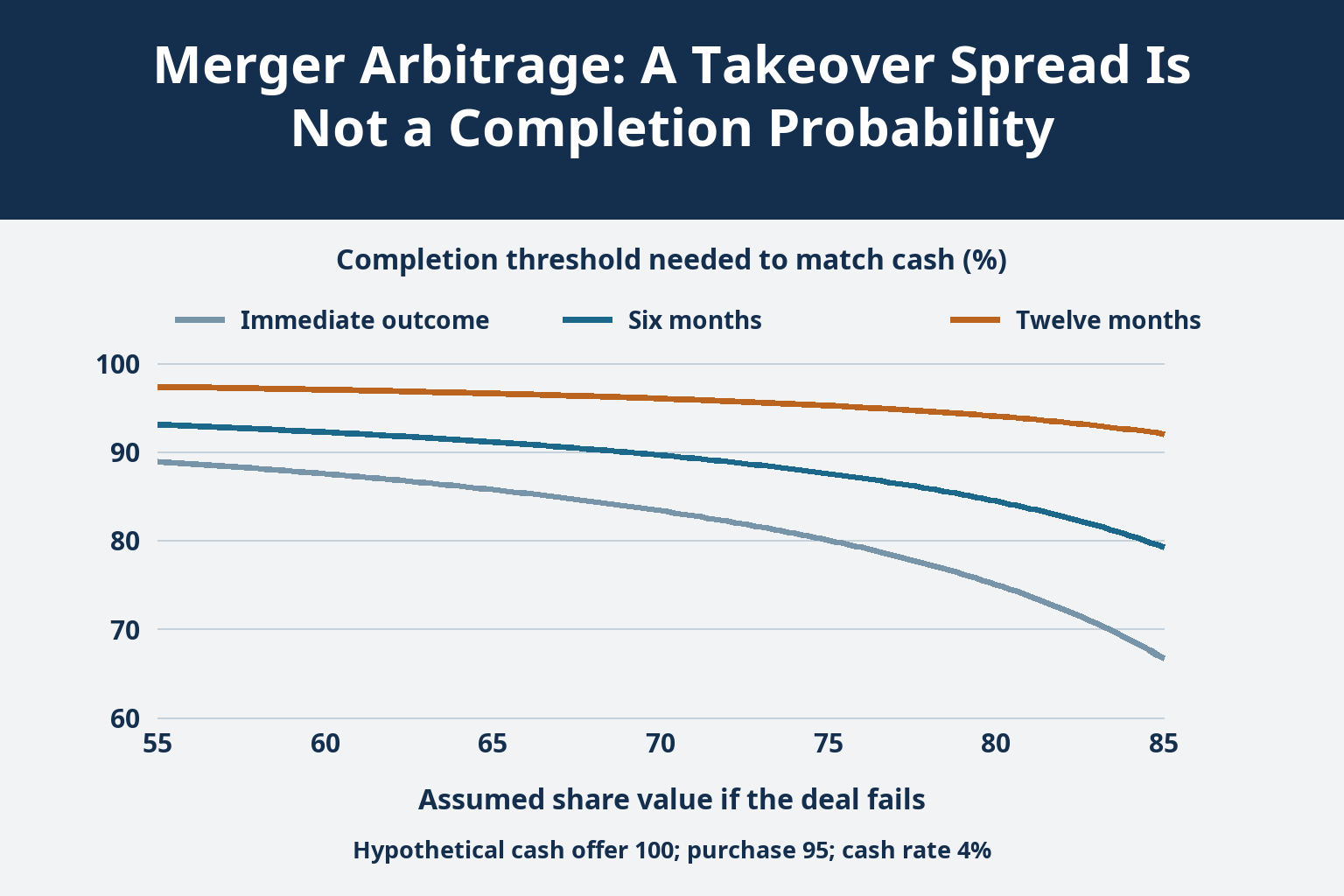
With P=95, C=100 and B=70, ignoring time gives 83.33%. At a 4% cash rate and a six-month horizon, the threshold rises to 89.60%. Cash turns 95 into 96.8814 during the wait, so an expected outcome merely equal to 95 is not enough. The table changes only the assumed failure value and horizon; the offer and purchase price stay fixed.
| Failure value | Months to outcome | Zero-rate threshold % | 4% cash hurdle % |
|---|---|---|---|
| 60.00 | 6 | 87.50 | 92.20 |
| 60.00 | 12 | 87.50 | 97.00 |
| 70.00 | 6 | 83.33 | 89.60 |
| 70.00 | 12 | 83.33 | 96.00 |
| 80.00 | 6 | 75.00 | 84.41 |
| 80.00 | 12 | 75.00 | 94.00 |
This is a model hurdle, not an observed physical probability. Reverse-engineering a market price cannot identify completion probability independently of risk premiums, liquidity, funding constraints and investors’ different failure-price estimates. Using a cash rate does not remove the risk of the equity position. If a calculation gives more than 100%, the assumed deal cannot match that cash hurdle even with certain completion under those inputs; do not clip the result and call it “100% likely”.
Suppose an analyst independently assigns a 90% completion probability to the six-month, 70-failure scenario. Expected proceeds are 0.90×100+0.10×70 = 97. Discounting at 4% gives 95.1163: an apparent advantage of only 0.1163 over the purchase price, before any extra compensation for risk. An all-in cost equivalent to 0.40 paid today eliminates it. Replacing P with 95.40 raises the cash-matching threshold to 90.96%.
The pre-announcement share price is a reference, not a floor. Since the announcement, sector valuations, earnings, debt and the value of assets may have changed. A failed process may also leave new costs or strategic damage. Build a stand-alone valuation range using updated fundamentals and comparable market moves; do not simply freeze the last unaffected quote.
The sensitivity table contains a useful warning: a lower failure value raises the completion threshold even though the quoted five-point spread has not changed. A wider spread after bad news can mean a better entry price, worse deal prospects, a longer wait, a lower failure value—or several at once. The chart alone cannot choose among these explanations.
If success occurs in six months but failure could emerge in one month or two years, the common-date shortcut no longer applies. Value each outcome’s cash flows at its own time, and state what happens to proceeds after an early failure if comparing terminal wealth. A third outcome such as a higher bid needs its own probability and payoff. Probabilities must sum to one, and mutually inconsistent events must not be double counted.
In a fixed-exchange-ratio stock deal, a long target position may be paired with a short position in the acquirer based on the contractual shares to be received. This can offset part of the acquirer-price exposure on successful delivery. It does not hedge away rejection, changed terms, stock-borrow costs, recalls or the unwind after failure. Cash offers do not automatically call for the same short leg.
A contractual exchange ratio is also not the regression coefficient used in statistical pairs trading and cointegration analysis. One rests on enforceable transaction terms if conditions are met; the other estimates a historical relationship. Confusing them can leave the wrong number of shares to deliver. Mixed consideration, collars and elections require their actual payoff rules, not a fixed-ratio shortcut.
The relevant confirmation is progress toward actual payment on the stated terms. The thesis fails when new evidence makes those terms, timing or downside assumptions untenable—not only when the share price crosses an arbitrary chart line. A spread becomes analytically useful only after the investor can explain which uncertainty it compensates for and how that conclusion would be disproved.

728 RM B 7/F GEE LOK IND BLDG NO 34 HUNG TO RD KWUN TONG KLN HONG KONG





The risk of loss in trading financial instruments such as stocks, FX, commodities, futures, bonds, ETFs and crypto can be substantial. You may sustain a total loss of the funds that you deposit with your broker. Therefore, you should carefully consider whether such trading is suitable for you in light of your circumstances and financial resources.
No decision to invest should be made without thoroughly conducting due diligence by yourself or consulting with your financial advisors. Our web content might not suit you since we don't know your financial conditions and investment needs. Our financial information might have latency or contain inaccuracy, so you should be fully responsible for any of your trading and investment decisions. The company will not be responsible for your capital loss.
Without getting permission from the website, you are not allowed to copy the website's graphics, texts, or trademarks. Intellectual property rights in the content or data incorporated into this website belong to its providers and exchange merchants.
Not Logged In
Log in to access more features


Log In
Sign Up