


- EURUSD
- XAUUSD
- XAGUSD
- WTI
- USDX


Markets
Analysis
User
24/7
Economic Calendar
Education
Data
- Names
- Latest
- Prev










A monthly implied rate is not a meeting outcome. Rebuild the day weights, test the assumed outcomes and separate a policy surprise from a currency forecast.
A quoted 60% chance of a rate cut can help an FX trader describe what is already priced. Its meaning depends on the rate instrument, the effective date of the decision and the outcomes allowed in the calculation. A rate expected on average across an entire month must first be separated into days before and after the policy change.
The calculation below turns a hypothetical monthly price into a meeting probability and then deliberately breaks the assumptions. It produces 60%, while dividing the monthly rate change by a 25 basis point cut produces 24%. Neither percentage measures the probability that the dollar will fall.
Consider a 30-day federal funds futures contract quoted as 100 minus the arithmetic monthly average effective federal funds rate, or EFFR. EFFR is an observed overnight transaction rate, distinct from the target range announced by the Federal Reserve. For days with no published rate, the contract carries forward the latest preceding published observation. Count calendar days using that rule, including weekends and holidays, rather than just trading sessions.
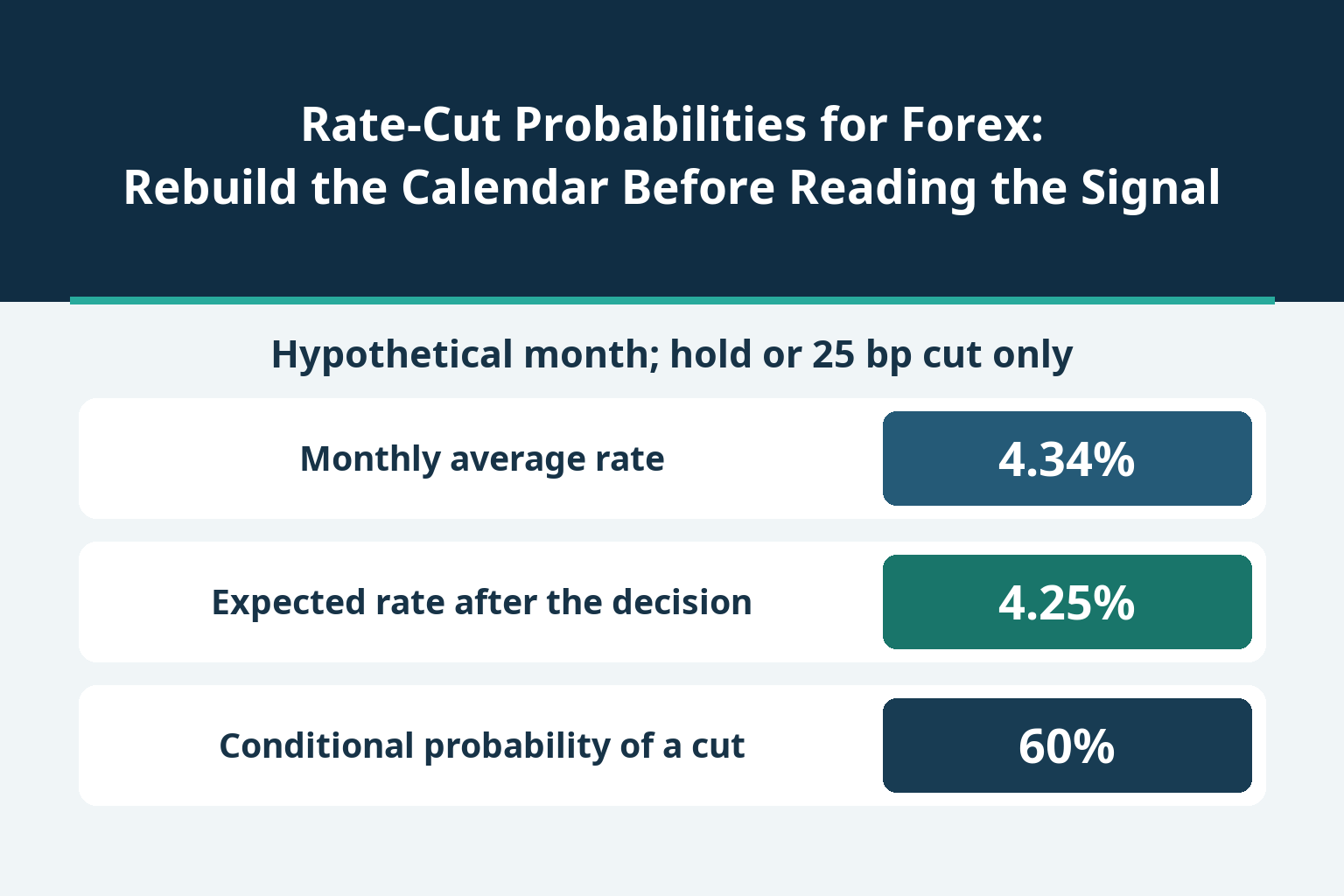
For an illustrative 30-day month, assume an EFFR of 4.40% applies to the first 18 days. The new setting applies for the remaining 12 days. A hypothetical futures price of 95.660 implies a monthly average of 4.340%. All these inputs are invented for the example. They are not a live quote or a forecast for a named meeting.
Let D be total calendar days, N the days assigned to the old rate, M the days assigned to the new rate, r₀ the old EFFR and r̄ the monthly implied average. With D=N+M and only one change in the month, the expected post-decision rate r₁ follows from the weighted average.
r₁ = (D × r̄ − N × r₀) ÷ M
Substitution gives (30×4.340−18×4.400)÷12=4.250%. Use percentage points consistently in that calculation. The expected fall after the decision is 0.150 percentage point, or 15 basis points. Under a two-outcome assumption of no change at 4.40% or a 25 bp cut to 4.15%, the cut probability is (4.40−4.25)÷0.25=60%. The other outcome receives 40%.
Using the upper end of the target range in place of EFFR changes the model. The starting observation and both assumed outcomes must refer to the same underlying rate. A forecast of the target range also requires an assumption about the EFFR-to-target relationship.
The monthly average is only 6 bp below 4.40%. Dividing 6 by 25 gives 24%, but the lower rate would apply for only 12 of the month’s 30 days. Weighting the 25 bp move by 12/30 gives a 10 bp monthly effect if the cut is certain. The observed 6 bp effect is therefore 60% of that full effect.
A seemingly minor timing error can invalidate the estimate. If only six days belonged to the new rate, the same price and starting rate would imply r₁=4.10%, a 30 bp expected fall. Dividing by 25 gives 120%. This is evidence that the selected hold-or-25-bp-cut model cannot fit the inputs. Clipping it to 100% conceals the inconsistency.
Small price differences also matter more when few days remain. With 12 post-change days, a 0.005 price difference means 0.5 bp in the monthly rate, 1.25 bp in the inferred post-decision rate and 5 percentage points in the binary probability. The following prices are a hypothetical sensitivity range, not a claim about the current minimum tick or an executable bid–ask spread.
| Hypothetical price | Monthly rate | Post-decision rate | 25 bp cut probability |
|---|---|---|---|
| 95.655 | 4.345% | 4.2625% | 55% |
| 95.660 | 4.340% | 4.2500% | 60% |
| 95.665 | 4.335% | 4.2375% | 65% |
Use the effective date in the policy implementation notice. A meeting date, an announcement timestamp and the date from which the new rate applies serve different roles. If the month is already in progress, separate the published daily fixings from the still-uncertain days. A one-day error in the calendar can overwhelm the apparent precision of a displayed probability.
Even a correct r₁ of 4.25% does not identify a unique outcome distribution. The table compares two hypothetical distributions that share the same expected rate. Each row sums to 100%; each uses the same starting EFFR and assumes proportional changes in EFFR.
| Assumed distribution | Hold at 4.40% | Cut to 4.15% | Cut to 3.90% | Expected rate |
|---|---|---|---|---|
| Hold or 25 bp cut | 40% | 60% | 0% | 4.25% |
| Hold or 50 bp cut | 70% | 0% | 30% | 4.25% |
The first distribution has a 60% chance of any cut, while the second has a 30% chance of any cut. Both imply a 15 bp expected reduction. A monthly mean supplies one constraint; allowing more outcome sizes introduces more unknowns. Additional contracts, options or explicitly stated modelling restrictions are needed to distinguish them. Simply adding another meeting to the same month creates further timing and path ambiguity.
Pricing can also reflect risk compensation, liquidity and the difference between the reference rate and the target. A market-implied probability is conditional on how those effects are treated. It is not automatically a survey frequency or a statistically calibrated real-world probability. A one-basis-point change in the expected post-decision rate alone shifts this binary estimate by four percentage points.
For a currency pair, compare changes in the expected paths of both currencies at matching horizons. In the binary example, a realised 25 bp cut is 10 bp more easing than the 15 bp expected reduction. Reporting the entire 25 bp as a surprise ignores the component already priced.
Suppose, in a separate hypothetical comparison, the expected US post-meeting rate falls by 10 bp during an observation window while the comparable expected euro-area rate falls by 12 bp. The US-minus-euro expected differential increases by 2 bp. Looking only at the US rate would describe that relative repricing incorrectly. Use instruments with compatible tenors and document any reference-rate basis adjustment before subtracting them.
That arithmetic still provides no fixed pip target. Guidance can move later meetings even when today’s decision is expected. Changes in risk appetite, economic information and positioning can accompany the announcement. The link between a rate surprise and an exchange-rate response must be assessed in the relevant event window. Keep nominal exchange-rate changes separate from inflation-adjusted comparisons.
Record the contract month, quote time and time zone, price type, reference rate and the latest published observation available at that time. Reconstruct every calendar-day weight, including carry-forward days, and check the policy’s effective date. If the month has realised days, retain their actual observations instead of replacing the whole pre-meeting block with today’s rate.
Reproduce the monthly average from the inferred path before calculating probabilities. State the allowed outcomes, their rate levels and any basis or pricing-premium assumption. Reject probabilities outside 0–100%, negative weights and results that change materially under a plausible timing or quote adjustment. Treat them as model failures to investigate.
For an FX interpretation, preserve before-and-after snapshots of both currency paths and the currency quote. Distinguish the decision, statement and press conference windows, and inspect spreads and actual fills separately from indicative chart prices. A calculation that reconciles the rate contract has passed a pricing check. Establishing a tradable FX effect requires its own evidence.

728 RM B 7/F GEE LOK IND BLDG NO 34 HUNG TO RD KWUN TONG KLN HONG KONG


The risk of loss in trading financial instruments such as stocks, FX, commodities, futures, bonds, ETFs and crypto can be substantial. You may sustain a total loss of the funds that you deposit with your broker. Therefore, you should carefully consider whether such trading is suitable for you in light of your circumstances and financial resources.
No decision to invest should be made without thoroughly conducting due diligence by yourself or consulting with your financial advisors. Our web content might not suit you since we don't know your financial conditions and investment needs. Our financial information might have latency or contain inaccuracy, so you should be fully responsible for any of your trading and investment decisions. The company will not be responsible for your capital loss.
Without getting permission from the website, you are not allowed to copy the website's graphics, texts, or trademarks. Intellectual property rights in the content or data incorporated into this website belong to its providers and exchange merchants.
Not Logged In
Log in to access more features


Log In
Sign Up


