


- XAUUSD
- XAGUSD
- WTI
- USDX


Markets
Analysis
User
24/7
Economic Calendar
Education
Data
- Names
- Latest
- Prev










A zero fixed fee can beat a better exchange rate for a small conversion and lose for a larger one. Calculate net receipts on the same total budget, locate the crossover, and test what happens when a deduction or quote changes.
A zero fixed fee does not guarantee the largest amount of foreign currency. Nor does a better displayed exchange rate guarantee it. The useful comparison is how much of the destination currency reaches the account after the same total amount leaves the source account.
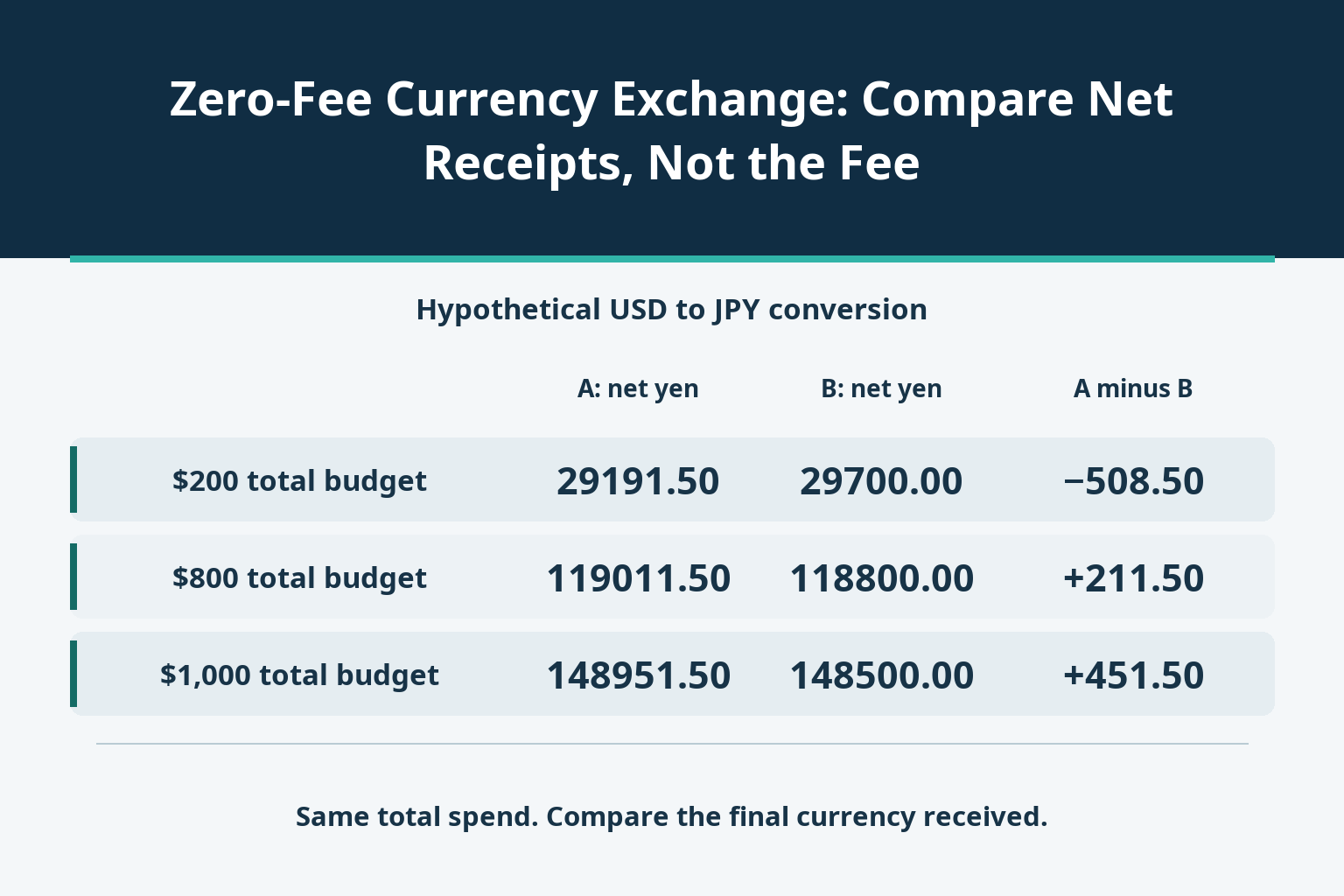
In the hypothetical dollar-to-yen conversion below, the zero-fee choice wins with a $200 budget, but the choice charging $5 wins with $1,000. The crossover is $623.75—not a universal threshold, but the result of two specific executable rates and a fully specified fee structure.
Let M be the total dollar budget, f a fixed dollar fee taken from that budget, q the number of yen actually received per dollar converted, and g a separate yen deduction after conversion. Net yen received are R = (M−f)q−g. The rate q must be positive, the budget must exceed the dollar fee, and the net receipt must be positive and meet any applicable minimum amount.
A quote that says “convert $1,000, plus a $5 fee” spends $1,005. It is not comparable with another quote spending $1,000 in total. For a fixed $1,000 budget under the first structure, only $995 is converted. If a fee is charged as a percentage or has a minimum, its actual calculation basis must replace the fixed f in this model.
The direction also matters: q here means yen per dollar sold by the customer. Do not substitute dollars per yen or the other side of a two-way quote. For a worked account of this distinction, see checking inverse exchange rates and the correct side of a cash conversion. A quote shown on a chart is not automatically the rate available for this conversion.
Assume two quotes available at the same time for the same conversion and delivery conditions. Choice A deducts $5 and converts the remainder at 149.70 yen per dollar. Choice B charges no fixed dollar fee and converts at 148.50. Neither has a separate yen deduction or other charge in this example. All rates and amounts are invented for the calculation, not market quotes.
| Total budget, USD | A: net JPY | B: net JPY | A minus B, JPY |
|---|---|---|---|
| 200.00 | 29,191.50 | 29,700.00 | −508.50 |
| 800.00 | 119,011.50 | 118,800.00 | +211.50 |
| 1,000.00 | 148,951.50 | 148,500.00 | +451.50 |
The difference is R_A−R_B = 149.70(M−5)−148.50M = 1.20M−748.50 yen. Each additional dollar of budget adds 1.20 yen to A’s relative result, while A starts with the yen equivalent of its $5 fee to overcome. Setting the difference to zero gives M = 748.50/1.20 = $623.75.
Below that amount B delivers more yen; above it A does, while these parameters remain unchanged. At the exact crossover both deliver 92,626.875 yen before rounding. Fractional yen are retained here to make the arithmetic reproducible, not to claim that a service pays fractional yen. Actual credited amounts follow its stated currency-unit and rounding rules.
For comparison only, suppose a same-time reference rate S is 150 yen per dollar. A’s rate is 0.2% below that reference and B’s is 1% below it, calculated as m = 1−q/S. The reference is a measuring stick, not a promise of an executable conversion. The gap also does not, by itself, establish a provider’s profit margin.
A useful normalized comparison is C = 1−R/(MS): how far the final yen amount falls short of converting the entire budget at the reference. With q = S(1−m), this becomes C = m+(f/M)(1−m)+g/(MS). It describes an all-in shortfall against the chosen benchmark; it is not a new bill to subtract from R.
For A at a $200 budget, the shortfall is 2.695%. Simply adding the 0.2% rate gap to the $5 fee as 2.5% of the budget gives 2.7%, slightly overstating it: the $5 already removed is not also converted at the less favorable rate. At $1,000, A’s shortfall is 0.699%, versus B’s 1%. Once the actual rate is in the cash calculation, subtracting its embedded rate gap again would double-count it.
Use a benchmark with a matched timestamp and quotation direction. A previous-day fixing or the opposite side of a bid/ask quote can make the measured gap misleading. Comparing the two actual net receipts does not require assuming that the benchmark itself was tradable.
Keep the total budget at $800 and leave B unchanged. In each row below, change only the stated feature of A relative to the base case. A receiving-side deduction of 300 yen reverses its initial 211.50-yen advantage. A separately considered fall in its unlocked rate to 149.40 also makes B deliver more.
| $800 budget; B unchanged | A rate, JPY per USD | A yen deduction | A: net JPY | B: net JPY | A minus B |
|---|---|---|---|---|---|
| Original terms | 149.70 | 0 | 119,011.50 | 118,800.00 | +211.50 |
| A deducts 300 yen after conversion | 149.70 | 300 | 118,711.50 | 118,800.00 | −88.50 |
| A’s unlocked rate changes | 149.40 | 0 | 118,773.00 | 118,800.00 | −27.00 |
For fixed fees and rates, the general difference is M(q_A−q_B)−q_Af_A+q_Bf_B−g_A+g_B. When q_A differs from q_B, the crossover is (q_Af_A−q_Bf_B+g_A−g_B)/(q_A−q_B). The 300-yen deduction moves this example’s crossover to $873.75; the rate change alone moves it to $830. The original $623.75 figure no longer applies.
A mathematical crossing is usable only if it is positive and lies in the amount range for which both offers and fee rules apply. If the rates are equal, there is no rate difference by which to divide; compare the constant charges instead. Tiered rates, minimum fees, caps and proportional charges require the appropriate formula for each band. An unknown receiving deduction means the net comparison is not yet complete.
A fixed source budget and a fixed destination requirement are different questions. To deliver N yen under the fixed-fee model, the dollar outlay is M = f+(N+g)/q. Add any yen deduction before dividing by the rate, then add the dollar fee. Subtracting a yen fee from a dollar amount would mix units.
To deliver 150,000 yen with the original terms, A requires about $1,007.0040 before payment-unit rounding; B requires about $1,010.1010. Rounding A’s required debit down to $1,007.00 leaves only $1,002 to convert and produces 149,999.40 yen—0.60 yen short before any credit rounding. If payment is restricted to whole cents and these are the only charges, the next cent up, $1,007.01, produces 150,000.897 yen before credit rounding. This is a model calculation, not a claim about any service’s debit or delivery policy: the permitted payment increment and final credit-rounding rule still need to be checked.
Do not infer an exact delivery commitment from a rounded calculator result. Confirm whether the quoted destination amount is guaranteed, whether the rate is locked for the intended amount and time, and whether a later deduction can reduce it. A later delivery time or a different funding method is also a changed comparison, even when the fee headline is identical.
Record the total debit in the source currency, the amount actually converted, the executable rate with its units, each separately charged fee and its currency, and the final net credit. The arithmetic should connect the total debit to the converted amount and then to the destination amount without counting an embedded rate difference twice.
Keep the quote time, expiry, delivery conditions and rounding rule beside those figures. If a fee or rate changes, recalculate both the net amount and the crossover rather than reusing an earlier result. If the statement later differs, trace the difference to the conversion amount, rate, explicit deduction or rounding; a low advertised fee cannot identify which step changed.
The final decision is narrow and testable: for the same spend and equivalent delivery terms, which confirmed quote leaves more of the required currency? That avoids treating “zero fee,” a favorable reference rate, or a threshold from an old quote as a substitute for the actual amount received.

728 RM B 7/F GEE LOK IND BLDG NO 34 HUNG TO RD KWUN TONG KLN HONG KONG


The risk of loss in trading financial instruments such as stocks, FX, commodities, futures, bonds, ETFs and crypto can be substantial. You may sustain a total loss of the funds that you deposit with your broker. Therefore, you should carefully consider whether such trading is suitable for you in light of your circumstances and financial resources.
No decision to invest should be made without thoroughly conducting due diligence by yourself or consulting with your financial advisors. Our web content might not suit you since we don't know your financial conditions and investment needs. Our financial information might have latency or contain inaccuracy, so you should be fully responsible for any of your trading and investment decisions. The company will not be responsible for your capital loss.
Without getting permission from the website, you are not allowed to copy the website's graphics, texts, or trademarks. Intellectual property rights in the content or data incorporated into this website belong to its providers and exchange merchants.
Not Logged In
Log in to access more features


Log In
Sign Up


