


- XAUUSD
- XAGUSD
- WTI
- USDX


Markets
Analysis
User
24/7
Economic Calendar
Education
Data
- Names
- Latest
- Prev










A worked callable-bond model explains capped upside, early repayment and reinvestment risk. Check the call schedule before treating a high coupon as a locked return.
A bond yielding more than a comparable non-callable issue may be paying you for an unattractive bargain: the issuer can return your money just when keeping the coupon would be most valuable. Falling rates can therefore shorten the investment and limit its price gain, while rising rates leave you holding the longer-lived bond.
The practical question is not simply whether a bond is callable. It is who can end the cash flows, on which dates, at what price, and after which coupon. Those details determine both the yield calculation and whether the bond can fund a planned stream of payments.
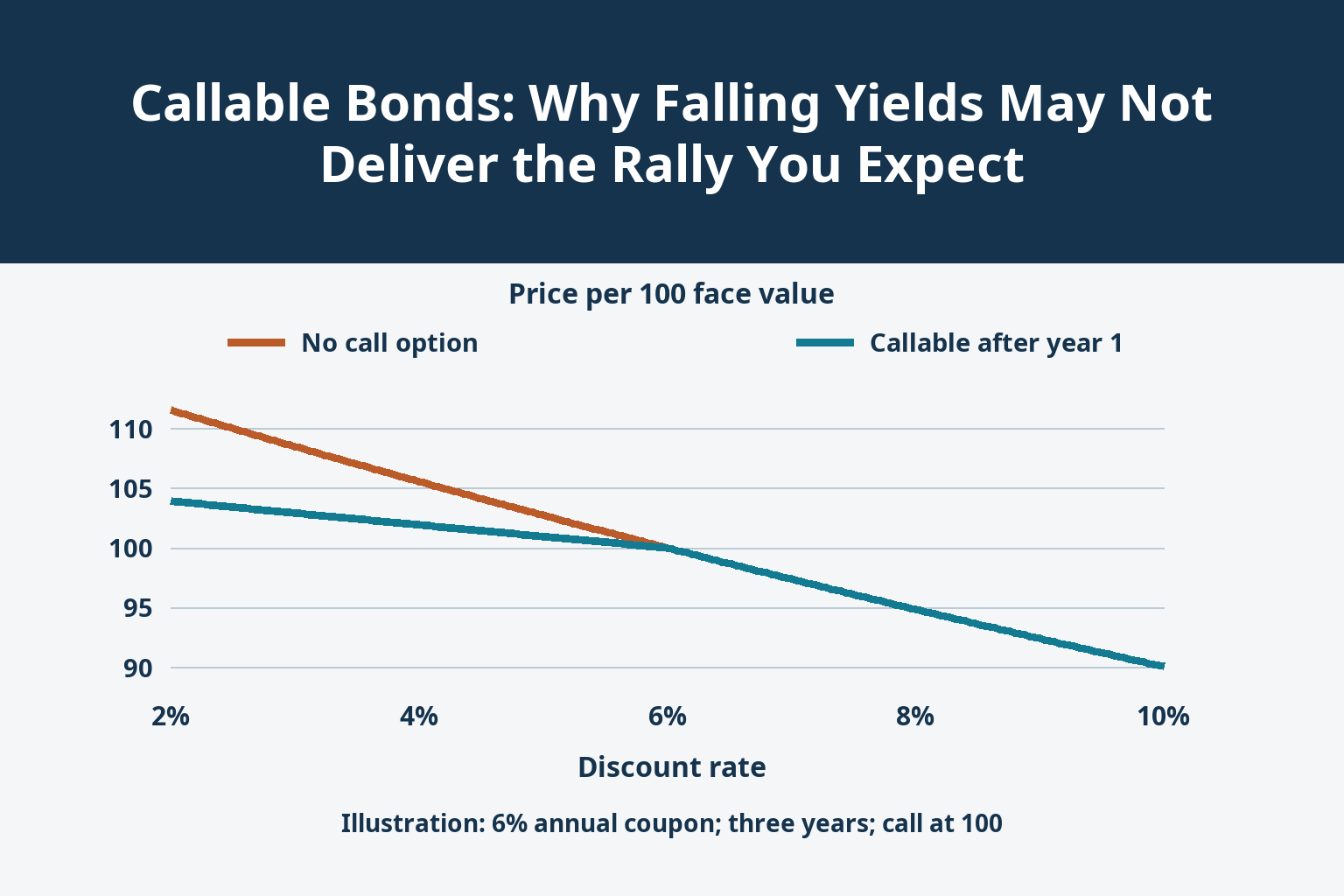
A call belongs to the issuer, not the investor. A maturity date of three years does not guarantee three more coupons if the issuer has a right to redeem sooner. Conversely, a call date is an opportunity, not a promise that repayment will occur. Notice requirements, call protection, redemption premiums and the distinction between fixed-price and make-whole provisions all matter.
Keep the purchase price and redemption price separate. Buying at 105 and being repaid 100 returns the bond's face amount, but not everything you paid. Accrued interest is another separate cash flow. A quote based on a clean price needs the settlement accrued interest added to establish the actual initial outlay.
Consider an original illustration: face value 100, an annual coupon of 6, and three years remaining. The issuer has just one call opportunity, immediately after paying the first year's coupon, at a redemption price of 100. If it does not call, the investor receives 6 in year two and 106 in year three. We value the bond immediately after a coupon payment, so starting accrued interest is zero.
To isolate the option, assume a flat annual-compounding discount rate r that is known and remains constant. Ignore default, taxes, trading costs and refinancing frictions. This deliberately zero-volatility experiment is not a market valuation model or a forecast of call probability.
At the call date, after that year's coupon, the value of leaving the debt outstanding is:
B1 = 6 / (1 + r) + 106 / (1 + r)²
If B1 exceeds 100, the issuer pays 100 rather than retaining a more valuable liability. Otherwise it leaves the bond outstanding. The investor still receives the first coupon in either case:
Callable price = [6 + min(100, B1)] / (1 + r)
Without the call, discount all three promised payments: 6, 6 and 106. Subtracting the callable value from that straight-bond value identifies the value of the issuer's option in this experiment.
| Rate | Straight bond | Callable bond | Issuer option |
|---|---|---|---|
| 2% | 111.5355 | 103.9216 | 7.6140 |
| 4% | 105.5502 | 101.9231 | 3.6271 |
| 6% | 100.0000 | 100.0000 | 0.0000 |
| 8% | 94.8458 | 94.8458 | 0.0000 |
| 10% | 90.0526 | 90.0526 | 0.0000 |
At 4%, leaving the debt outstanding is worth 103.7722 at the call date. Redemption at 100 is cheaper, so the investor receives 106 in one year: principal plus the coupon. Its value today is 106/1.04 = 101.9231. A future redemption price of 100 therefore does not impose a universal 100 ceiling on today's price. Time to redemption and intervening coupons cannot be omitted.
From the common price of 100 at a 6% rate, a decline to 4% raises the straight bond to 105.5502 but the callable bond only to 101.9231. A rise to 8% reduces both to 94.8458. The investor gives up much of the rally without obtaining equivalent protection against the sell-off. These are alternative rate scenarios for the same hypothetical contract, not historical returns.
The simplified graph has a kink at the exercise boundary. In a model with uncertain future rates, the transition is smoother and a callable bond can show negative convexity near the exercise region. That does not mean every callable bond has negative convexity at every price or yield. Deeply out-of-the-money call rights may have little immediate effect on its rate sensitivity.
Now use a separate hypothetical market offer of 105 for the same terms; this is a purchase quote, not a claim that 105 is the fair value from the table. Redemption in one year produces 106, making yield to call 106/105 − 1 = 0.9524%. If the issuer never calls and all scheduled payments are made, the three-year yield to maturity is about 4.1917%. Neither the 6% coupon rate nor the 5.7143% current yield measures the one-year redemption outcome.
For this single-call example, the lower of those contractual cash-flow yields is 0.9524%. A real call schedule can require more dates and prices. Yield to worst is not a default-loss floor, a guaranteed realized return or a probability-weighted expected return. It also does not fix the rate available after early repayment. The distinction between quoted bond yield and actual investment return becomes important when the investment horizon outlasts the bond.
If a separate purchase fee is 0.50 per 100 face value, initial spending rises to 105.50. The same one-year receipt then produces only 0.4739%. A dealer comparison that uses one all-in price and another price before fees is not a like-for-like yield comparison.
A central-bank cut is not a call notice. The issuer's actual refinancing cost includes its credit spread, transaction costs and access to funding. A wider credit spread can offset lower benchmark rates. A protected period may prohibit a call, while a make-whole formula can make the redemption amount very different from a fixed 100. Use the governing terms rather than importing the illustration's exercise rule.
Market analysis also needs uncertain future rates. Effective duration revalues the bond after rate shifts and allows the expected cash flows to change; fixed-cash-flow modified duration can miss that change. Option-adjusted spread comparisons require compatible benchmark curves, volatility assumptions and exercise models. A larger model spread is not automatically an investable excess return, and the deterministic table above does not estimate a market OAS.
For an investor needing income over three years, a first-year call creates a replacement decision for both principal and future coupons. Do not book the remaining two coupons as assured income. Equally, do not assume the issuer will rescue a falling bond price by calling it: leaving expensive debt outstanding can be the cheaper option when new financing costs more.
A high coupon is only the starting observation. The more useful decision is whether the compensation is sufficient for the issuer's right to change the life of the investment—and whether the resulting cash-flow uncertainty fits the purpose of holding it.

728 RM B 7/F GEE LOK IND BLDG NO 34 HUNG TO RD KWUN TONG KLN HONG KONG





The risk of loss in trading financial instruments such as stocks, FX, commodities, futures, bonds, ETFs and crypto can be substantial. You may sustain a total loss of the funds that you deposit with your broker. Therefore, you should carefully consider whether such trading is suitable for you in light of your circumstances and financial resources.
No decision to invest should be made without thoroughly conducting due diligence by yourself or consulting with your financial advisors. Our web content might not suit you since we don't know your financial conditions and investment needs. Our financial information might have latency or contain inaccuracy, so you should be fully responsible for any of your trading and investment decisions. The company will not be responsible for your capital loss.
Without getting permission from the website, you are not allowed to copy the website's graphics, texts, or trademarks. Intellectual property rights in the content or data incorporated into this website belong to its providers and exchange merchants.
Not Logged In
Log in to access more features


Log In
Sign Up