- AUDUSD
- XAUUSD
- XAGUSD
- WTI
- USDX


Markets
Analysis
User
24/7
Economic Calendar
Education
Data
- Names
- Latest
- Prev













A bullish option spread is not a bet on direction alone. Reconcile the entry debit, executable exit price and expiry payoff, then check what exercise could leave in the account.
A stock rises, yet the bullish option position loses money. That is not necessarily a pricing error. A bull call spread buys a defined slice of the stock’s upside over a defined period; it does not buy every dollar of the rally. The entry price, remaining option value and eventual settlement all matter.
Keep three numbers separate: the debit paid to enter, the cash obtainable by closing now, and the payoff at expiry. Most misleading spread comparisons quietly substitute one for another. The practical question is not simply whether the stock can rise, but whether the expected move is large enough, arrives before expiry and can be monetised without an unwanted share position.
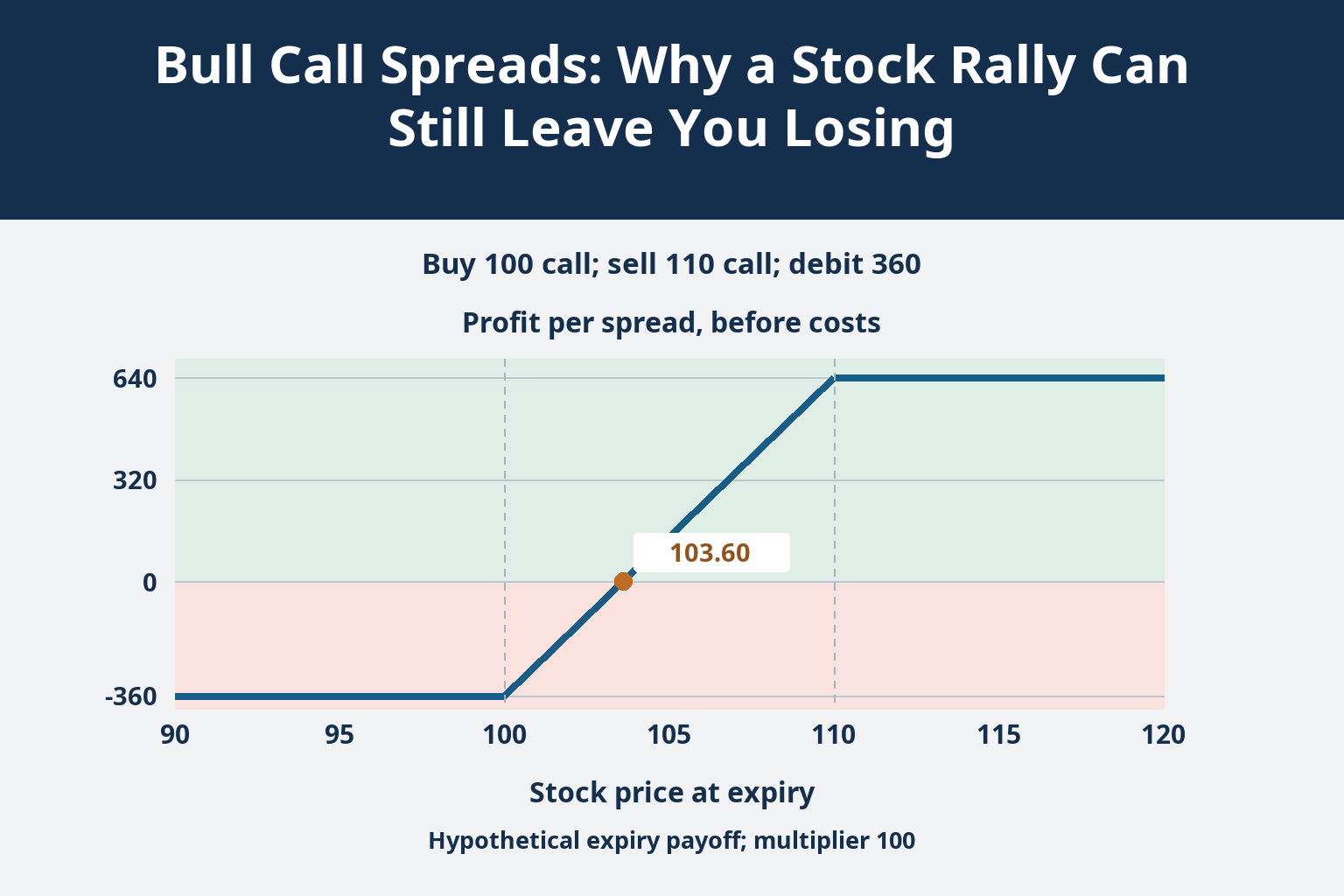
Consider an entirely hypothetical stock at 100. Buy one call with a 100 strike for 5.80 per share and sell one call with a 110 strike for 2.20. Both reference the same stock, expiry and delivery terms. Assume each contract represents 100 shares and the quoted premiums are actual fills. The net debit is (5.80−2.20) × 100 = 360. The ten-point strike width represents a maximum combined intrinsic value of 1,000, not a maximum profit of 1,000.
The short call finances part of the purchase by giving away gains above 110. Buying only the lower-strike call would cost 580 and retain further upside. The spread costs 220 less but has a different exposure, not the same exposure at a discount. Changing the upper strike changes both the price and the part of the rally retained.
Let S be the stock price used for the terminal calculation. Before costs, one spread’s profit is 100 × [max(S−100, 0) − max(S−110, 0) − 3.60]. The following values assume both legs are settled consistently and no residual stock is carried beyond the calculation point. Currency units are the same for premiums, strikes and profit.
| Stock at expiry | Long call value | Short call liability | Spread value | Profit before costs |
|---|---|---|---|---|
| 95.00 | 0.00 | 0.00 | 0.00 | -360.00 |
| 100.00 | 0.00 | 0.00 | 0.00 | -360.00 |
| 103.60 | 360.00 | 0.00 | 360.00 | 0.00 |
| 106.00 | 600.00 | 0.00 | 600.00 | 240.00 |
| 110.00 | 1000.00 | 0.00 | 1000.00 | 640.00 |
| 120.00 | 2000.00 | 1000.00 | 1000.00 | 640.00 |
The maximum profit is 640, the maximum option-payoff loss is 360 and the expiry breakeven is 103.60. A stock that rises from 100 to 102 still leaves a 160 loss. A rise to 120 produces the same terminal profit as a rise to 110. The capped upside is the price of the lower entry debit.
If total transaction charges for this assumed completed lifecycle are 12, subtract 12 from every profit result: maximum gain 628, maximum loss 372 and breakeven 103.72. These figures omit tax and financing. Different exercise, assignment or closing charges require a new cost total; “commission free” does not remove bid–ask costs.
Suppose the stock subsequently reaches 106 while time remains. Assume an executable bid of 6.40 for the long call and an executable ask of 3.10 to buy back the short call. Closing both legs brings in 330. Against the initial 360 debit and 12 total charges, realised profit is 330−360−12 = −42. At expiry, the table’s result at 106 would instead be +240 before costs.
The two outcomes are not contradictory: they use different times. Before expiry the short call still has value, and closing requires paying to remove it. A midpoint portfolio mark is not proof that the entire position can be closed there at the required size. Check a live combination quote, depth and the complete fill report. Executing the legs separately may create temporary directional exposure; an unfilled limit order is not an exit.
If the long call has delta 0.70 and the short call’s quoted delta is 0.42, the net position delta is (0.70−0.42) × 100 = 28 shares. Locally, a one-unit stock rise suggests approximately 28 of option-value improvement with other inputs fixed. It does not imply 100, and it is not a reliable forecast for a large move.
Gamma, time decay and volatility exposure also combine as long-leg sensitivity minus short-leg sensitivity. Their net signs and magnitudes depend on where the stock sits relative to both strikes, time remaining and the volatility surface. Do not assume that time always helps, or that selling one option cancels all volatility risk. A uniform volatility shift and a change in the relative implied volatilities of the two strikes are different shocks.
Expiry selection also sets which events the position spans. For the distinction between the quoted volatility of an expiry and risk concentrated inside part of that horizon, see how forward volatility separates two option horizons. That term-structure calculation does not by itself determine this spread’s fair price.
The bounded diagram describes the matched option payoff. It is not a promise that an unattended account cannot lose more after its composition changes. With physically settled American-style contracts, the short leg may be assigned before expiry, and holding the long leg does not mean the broker automatically uses it to complete a paired transaction. Funding, stock delivery and the treatment of remaining option value need explicit planning.
Consider a separate expiry path using the same 360 debit. The stock is 109.95; assume the long call is exercised and the short call is not assigned. The account buys 100 shares at 100, requiring 10,000 of purchase funding. At 109.95 the stock gain less the debit is 635 before costs. If those shares are still held when the stock later opens at 95, the combined result becomes (95−100) × 100−360 = −860. The additional loss arises from the unhedged stock held after expiry, not from the original matched terminal payoff exceeding its formula.
Near the short strike, do not infer assignment with certainty from the closing print. Know the broker’s exercise instructions, cut-off times and handling of after-hours moves. Cash-settled European-style products avoid this particular share-delivery path, but their settlement reference and last trading time still require checking. Do not import one product’s rules into another.
A forecast that the stock will recover “eventually” is incomplete for a dated spread. Set a price range and a date, then inspect the loss if the move is smaller or later. The ratio 640/360 describes the best payoff relative to the debit, not a success probability or expected return. A credible expectation requires a distribution of outcomes and realistic exit costs.
The thesis is weakened if the catalyst moves beyond expiry, the target price remains below the cost-adjusted breakeven, or liquidity makes the planned close uneconomic. If the stock has already moved far above 110, further upside has little terminal benefit: reassess the small remaining reward against the remaining settlement and execution work rather than treating the original maximum profit as still available.
A sound spread analysis therefore ends with an account-state reconciliation, not just a neat payoff chart. Direction can be right while timing, price paid or settlement handling still makes the result wrong.

728 RM B 7/F GEE LOK IND BLDG NO 34 HUNG TO RD KWUN TONG KLN HONG KONG





The risk of loss in trading financial instruments such as stocks, FX, commodities, futures, bonds, ETFs and crypto can be substantial. You may sustain a total loss of the funds that you deposit with your broker. Therefore, you should carefully consider whether such trading is suitable for you in light of your circumstances and financial resources.
No decision to invest should be made without thoroughly conducting due diligence by yourself or consulting with your financial advisors. Our web content might not suit you since we don't know your financial conditions and investment needs. Our financial information might have latency or contain inaccuracy, so you should be fully responsible for any of your trading and investment decisions. The company will not be responsible for your capital loss.
Without getting permission from the website, you are not allowed to copy the website's graphics, texts, or trademarks. Intellectual property rights in the content or data incorporated into this website belong to its providers and exchange merchants.
Not Logged In
Log in to access more features


Log In
Sign Up