- AUDUSD
- XAUUSD
- XAGUSD
- WTI
- USDX


Markets
Analysis
User
24/7
Economic Calendar
Education
Data
- Names
- Latest
- Prev











An unchanged yield curve is not an unchanged bond yield. Reprice a five-year zero-coupon bond after one year, separate carry from roll-down, and calculate the exit yield that beats cash.
A bond can make money while its yield rises—and still be a poor result relative to cash. These are different tests. Confusing them is one reason a chart showing an attractive slope can make a roll-down trade look safer than it is.
Roll-down is a conditional repricing exercise, not interest that the issuer has promised to pay. Start with a holding period and the bond's remaining cash flows at its end. Then ask what exit yield would preserve capital, what yield would beat the alternative, and whether either threshold survives costs and financing. A worked example puts those questions on the same scale.
A five-year bond becomes a four-year bond after one year. If the yield curve slopes upward and remains unchanged at each remaining maturity, that bond may be valued at a lower yield when sold. The curve can stay still while the yield on the individual security falls. Keeping the security's own yield constant is a different scenario.
Do not confuse this with rolling a futures contract: there is no sale of one expiry and purchase of another in the example. Nor does an issuer pay a separate roll-down coupon. The effect appears in the hypothetical sale price. The shape of today's curve alone cannot establish tomorrow's price.
Consider an invented zero-coupon bond paying 100 exactly five years from purchase. Its initial annual-compounded yield is 4.5%. Assume no default, taxes or transaction costs, and sell after exactly one year. Zero-coupon structures isolate the calculation because there is no interim coupon to reinvest; they are not a claim that a particular government bond currently offers these rates.
P₀ = 100 / 1.045⁵ = 80.2451
P₁ = 100 / (1 + y₄)⁴
R = P₁ / P₀ − 1
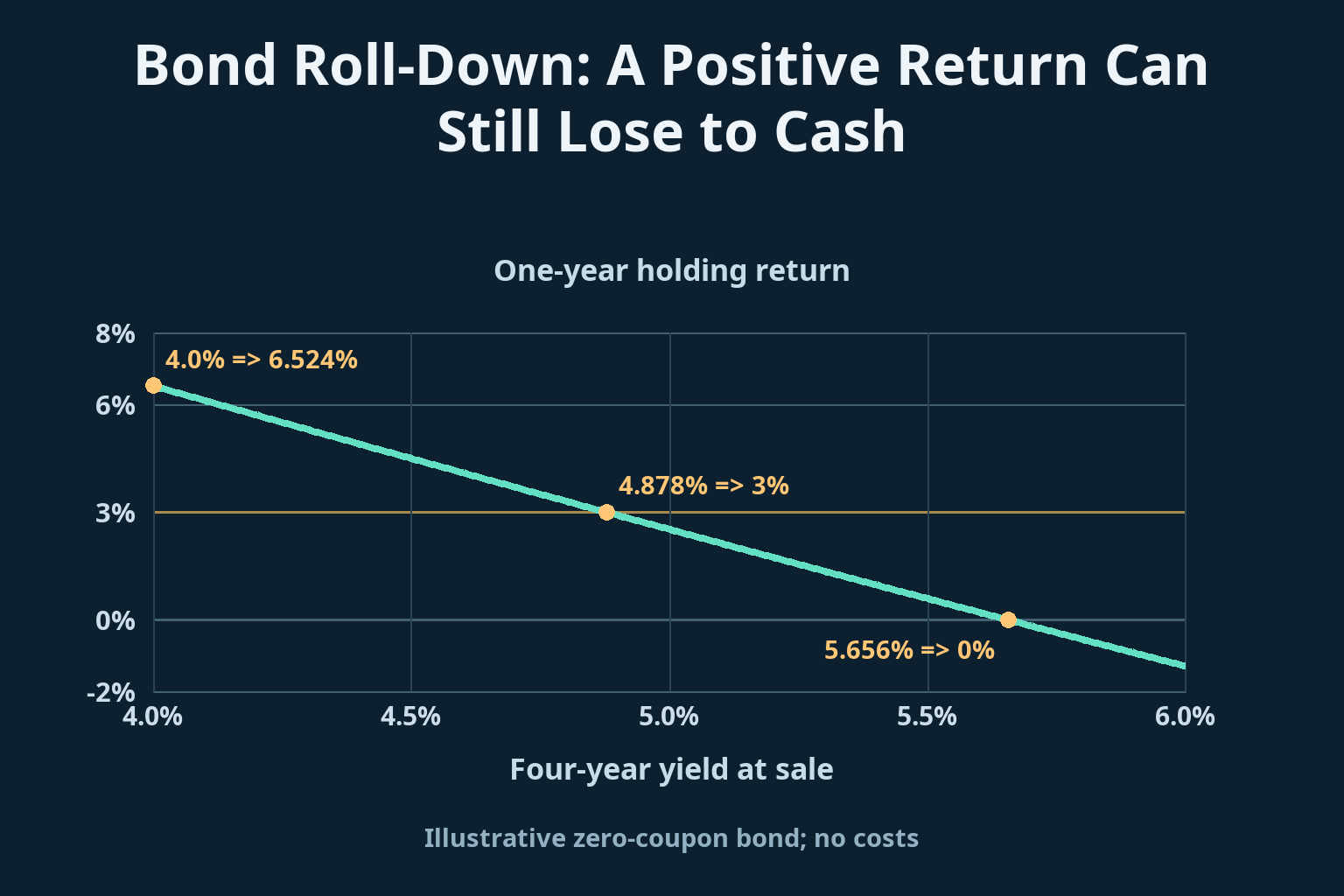
Suppose today's four-year zero rate is 4%. If that point on the curve is still 4% next year, the sale price is 85.4804 and the one-year return is 6.524%. The same security has one fewer year of discounting and a lower valuation yield.
| Yield at sale | Sale price | Holding return |
|---|---|---|
| 4.0% | 85.4804 | +6.524% |
| 4.5% | 83.8561 | +4.500% |
| 5.0% | 82.2702 | +2.524% |
| 5.5% | 80.7217 | +0.594% |
| 6.0% | 79.2094 | -1.291% |
The 5% exit case is particularly useful. The yield is higher than the original 4.5%, yet the return remains positive at 2.524% because the passage of time offsets the adverse yield move. At 6%, it does not: the one-year return is −1.291%. None of these rows has an assigned probability.
First hold the security's yield at 4.5%. Four years of discounting give 83.8561 and a 4.5% return. Next change only the exit yield to the unchanged curve's four-year point, 4%. The extra 1.6243 of price, divided by the original 80.2451 investment, contributes 2.024 percentage points. The total is 4.5% + 2.024% = 6.524%.
This is an explicitly defined attribution, not a universal naming convention. Some reports use carry to include roll-down; others show it separately. Never add the initial yield to the full 6.524% price return: that counts the ageing contribution twice. For a zero-coupon security, having no cash coupon does not mean having no holding return.
A coupon bond needs a fuller ledger: dirty sale price plus the horizon value of coupons received, minus dirty purchase price and costs. Clean prices alone omit accrued interest. Reinvestment assumptions, day counts and coupon timing must agree; replacing the zero rate in this example with a quoted par yield is not a harmless shortcut.
Setting P₁ equal to P₀ produces a nominal capital-preservation hurdle of 1.0455/4 − 1, or 5.656%. Below that exit yield this cost-free example has a positive return; above it, a loss. This says nothing about whether holding the bond was the best use of capital.
If a same-currency, comparable-credit one-year zero-coupon alternative locks in 3%, the relevant target becomes P₀ × 1.03. Solving for the four-year yield gives:
y₄* = [1.045⁵ / 1.03]1/4 − 1 = 4.8784%
At this yield, the bond matches the 3% alternative. At a 5% exit it earns money but loses that comparison. The lower 4.8784% hurdle is also the four-year forward zero rate starting in one year implied by the assumed one- and five-year spot rates. That is a price-consistent break-even calculation, not a forecast of the central bank or future bond market. The distinction between an implied forward rate and a realized reinvestment rate is essential here.
The unchanged-curve outcome of 6.524% is therefore not a free extra yield. It is a different future-curve scenario from the one that makes the two investments tie. A probability-weighted expected return requires more than declaring today's curve unchanged.
The useful output of a roll-down analysis is an exit-price map with an explicit benchmark. “The curve is steep” is only the starting observation; the investment case depends on which part of that map the future can realistically occupy.

728 RM B 7/F GEE LOK IND BLDG NO 34 HUNG TO RD KWUN TONG KLN HONG KONG





The risk of loss in trading financial instruments such as stocks, FX, commodities, futures, bonds, ETFs and crypto can be substantial. You may sustain a total loss of the funds that you deposit with your broker. Therefore, you should carefully consider whether such trading is suitable for you in light of your circumstances and financial resources.
No decision to invest should be made without thoroughly conducting due diligence by yourself or consulting with your financial advisors. Our web content might not suit you since we don't know your financial conditions and investment needs. Our financial information might have latency or contain inaccuracy, so you should be fully responsible for any of your trading and investment decisions. The company will not be responsible for your capital loss.
Without getting permission from the website, you are not allowed to copy the website's graphics, texts, or trademarks. Intellectual property rights in the content or data incorporated into this website belong to its providers and exchange merchants.
Not Logged In
Log in to access more features


Log In
Sign Up