Markets
News
Analysis
User
24/7
Economic Calendar
Education
Data
- Names
- Latest
- Prev


Signal Accounts for Members
All Signal Accounts
All Contests


Japan Tankan Small Manufacturing Outlook Index (Q4)A:--
F: --
P: --
Japan Tankan Large Non-Manufacturing Outlook Index (Q4)A:--
F: --
P: --
Japan Tankan Large Manufacturing Outlook Index (Q4)A:--
F: --
P: --
Japan Tankan Small Manufacturing Diffusion Index (Q4)A:--
F: --
P: --
Japan Tankan Large Manufacturing Diffusion Index (Q4)A:--
F: --
P: --
Japan Tankan Large-Enterprise Capital Expenditure YoY (Q4)A:--
F: --
P: --
U.K. Rightmove House Price Index YoY (Dec)A:--
F: --
P: --
China, Mainland Industrial Output YoY (YTD) (Nov)A:--
F: --
P: --
China, Mainland Urban Area Unemployment Rate (Nov)A:--
F: --
P: --
Saudi Arabia CPI YoY (Nov)A:--
F: --
P: --
Euro Zone Industrial Output YoY (Oct)A:--
F: --
P: --
Euro Zone Industrial Output MoM (Oct)A:--
F: --
P: --
Canada Existing Home Sales MoM (Nov)A:--
F: --
P: --
Canada National Economic Confidence IndexA:--
F: --
P: --
Canada New Housing Starts (Nov)A:--
F: --
U.S. NY Fed Manufacturing Employment Index (Dec)A:--
F: --
P: --
U.S. NY Fed Manufacturing Index (Dec)A:--
F: --
P: --
Canada Core CPI YoY (Nov)A:--
F: --
P: --
Canada Manufacturing Unfilled Orders MoM (Oct)A:--
F: --
P: --
U.S. NY Fed Manufacturing Prices Received Index (Dec)A:--
F: --
P: --
U.S. NY Fed Manufacturing New Orders Index (Dec)A:--
F: --
P: --
Canada Manufacturing New Orders MoM (Oct)A:--
F: --
P: --
Canada Core CPI MoM (Nov)A:--
F: --
P: --
Canada Trimmed CPI YoY (SA) (Nov)A:--
F: --
P: --
Canada Manufacturing Inventory MoM (Oct)A:--
F: --
P: --
Canada CPI YoY (Nov)A:--
F: --
P: --
Canada CPI MoM (Nov)A:--
F: --
P: --
Canada CPI YoY (SA) (Nov)A:--
F: --
P: --
Canada Core CPI MoM (SA) (Nov)A:--
F: --
P: --
Canada CPI MoM (SA) (Nov)A:--
F: --
P: --
Federal Reserve Board Governor Milan delivered a speech
U.S. NAHB Housing Market Index (Dec)--
F: --
P: --
Australia Composite PMI Prelim (Dec)--
F: --
P: --
Australia Services PMI Prelim (Dec)--
F: --
P: --
Australia Manufacturing PMI Prelim (Dec)--
F: --
P: --
Japan Manufacturing PMI Prelim (SA) (Dec)--
F: --
P: --
U.K. 3-Month ILO Employment Change (Oct)--
F: --
P: --
U.K. Unemployment Claimant Count (Nov)--
F: --
P: --
U.K. Unemployment Rate (Nov)--
F: --
P: --
U.K. 3-Month ILO Unemployment Rate (Oct)--
F: --
P: --
U.K. Average Weekly Earnings (3-Month Average, Including Bonuses) YoY (Oct)--
F: --
P: --
U.K. Average Weekly Earnings (3-Month Average, Excluding Bonuses) YoY (Oct)--
F: --
P: --
France Services PMI Prelim (Dec)--
F: --
P: --
France Composite PMI Prelim (SA) (Dec)--
F: --
P: --
France Manufacturing PMI Prelim (Dec)--
F: --
P: --
Germany Services PMI Prelim (SA) (Dec)--
F: --
P: --
Germany Manufacturing PMI Prelim (SA) (Dec)--
F: --
P: --
Germany Composite PMI Prelim (SA) (Dec)--
F: --
P: --
Euro Zone Composite PMI Prelim (SA) (Dec)--
F: --
P: --
Euro Zone Services PMI Prelim (SA) (Dec)--
F: --
P: --
Euro Zone Manufacturing PMI Prelim (SA) (Dec)--
F: --
P: --
U.K. Services PMI Prelim (Dec)--
F: --
P: --
U.K. Manufacturing PMI Prelim (Dec)--
F: --
P: --
U.K. Composite PMI Prelim (Dec)--
F: --
P: --
Euro Zone ZEW Economic Sentiment Index (Dec)--
F: --
P: --
Germany ZEW Current Conditions Index (Dec)--
F: --
P: --
Germany ZEW Economic Sentiment Index (Dec)--
F: --
P: --
Euro Zone Trade Balance (Not SA) (Oct)--
F: --
P: --
Euro Zone ZEW Current Conditions Index (Dec)--
F: --
P: --
Euro Zone Trade Balance (SA) (Oct)--
F: --
P: --
U.S. Retail Sales MoM (Excl. Automobile) (SA) (Oct)--
F: --
P: --


No matching data
Latest Views
Latest Views
Trending Topics
Top Columnists
Latest Update
White Label
Data API
Web Plug-ins
Affiliate Program
View All

No data
Zodia Custody, the digital asset custody firm backed by Standard Chartered, has dissolved its joint venture with Japan’s SBI Holdings two years after launching the initiative.
The venture, known as SBI Zodia Custody, was 51% owned by SBI and 49% by Zodia Custody. According to its website, the project aimed to replicate institutional-grade custodial services in the digital asset space.
“This is a strategic alignment between SBI and ourselves as a mutual decision that we have other priorities and they have other priorities,” Julian Sawyer, CEO at Zodia Custody, reportedly told Bloomberg.
Sawyer revealed that the venture had been in discussions with Japan’s Financial Services Agency (FSA) regarding local registration but had not submitted a formal application. They were “working and preparing for an application,” he said, noting the decision to dissolve came before any regulatory filing was made.

SBI says Zodia exit not a retreat
SBI Holdings spokesperson Kosuke Kitamura told Bloomberg that the exit should not be seen as a step back. “This dissolution does not represent a retreat,” he said. “[It’s a] proactive decision aimed at pursuing group-wide synergies with greater speed under our digital ecosystem.”
Last month, it was reported that SBI Holdings plans to launch Japan’s first dual-asset cryptocurrency exchange-traded fund (ETF), offering exposure to both Bitcoin (BTC) and XRP (XRP). However, the firm later denied those reports.
Zodia Custody, meanwhile, continues expanding in other markets. The firm recently acquired Tungsten Custody Solutions in the UAE amid a shift in focus to more favorable regulatory environments.
Japan remains a tough market for crypto
Japan remains a tough market for foreign crypto firms due to its cautious regulatory approach.
In July, Maksym Sakharov, co-founder and CEO of decentralized onchain bank WeFi, told Cointelegraph that Japan’s regulatory bottlenecks, not taxes, are the real reason crypto innovation is leaving the country.
Sakharov said that even if the proposed 20% flat tax on crypto gains is implemented, Japan’s “slow, prescriptive, and risk‑averse” approval culture will continue to push startups and liquidity offshore.
“The 55% progressive tax is painful and very visible, but it’s not the core blocker anymore,” he said. “The FSA/JVCEA pre‑approval model and the absence of a truly dynamic sandbox are what keep builders and liquidity offshore,” he added.
Blockchain-native lending firm Figure Technology Solutions, led by SoFi co-founder Mike Cagney, announced the pricing of its initial public offering of 31,500,000 shares of its Class A common stock late Wednesday.
The firm set a price of $25 per share — an increase from its estimated IPO range of between $20 and $22 per share, stated in an S-1 filing with the Securities and Exchange Commission earlier in the day.
At the announced price, Figure's IPO targets a raise of $787.5 million (up from $693 million), and values the company at roughly $5.3 billion (up from $4.7 billion). Approximately 211.7 million total Class A and Class B shares will be outstanding immediately after the offering, excluding the underwriters' overallotment option.
The offering comprises 23,506,605 shares of Class A common stock from Figure, along with 7,993,395 shares of Class A common stock being offered by certain existing stockholders. That represents a change from the 26,645,296 and 4,854,704 respective figures in the prior filing, shifting the composition of the total share offering. Figure will not receive any proceeds from the shares sold by existing stockholders.
In addition, Figure has provided the underwriters with a 30-day option to purchase up to 4,725,000 additional shares of its Class A common stock at the initial public offering price, minus underwriting discounts and commissions.
Figure's shares are expected to start trading on the Nasdaq Global Select Market under the ticker "FIGR" on Thursday. The offering is scheduled to close on Sept. 12, subject to customary closing conditions, the firm said. The SEC declared the registration statement for the securities effective on Sept. 10.
Goldman Sachs, Jefferies, and BofA are joint lead bookrunners for the offering, with Societe Generale, KBW, and Mizuho as bookrunners. Texas Capital Securities, Needham & Company, Piper Sandler, FT Partners, KKR, and Roberts & Ryan are acting as co-managers.
Figure joins a growing list of crypto-related companies that have gone public, including Coinbase, Circle, and Bullish. BitGo, Gemini, Grayscale, and Kraken are also eyeing public listings.
Disclaimer: The Block is an independent media outlet that delivers news, research, and data. As of November 2023, Foresight Ventures is a majority investor of The Block. Foresight Ventures invests in other companies in the crypto space. Crypto exchange Bitget is an anchor LP for Foresight Ventures. The Block continues to operate independently to deliver objective, impactful, and timely information about the crypto industry. Here are our current financial disclosures.
© 2025 The Block. All Rights Reserved. This article is provided for informational purposes only. It is not offered or intended to be used as legal, tax, investment, financial, or other advice.
Arai’s token (AA) will be listed on the Gate exchange. When a coin is listed on a big exchange like Gate, new users can buy and sell much more easily. This usually pulls more attention and can make the price go up, especially if the project is unknown or has strong news. Traders may quickly join in, hoping for a good short-term gain. Sometimes, prices can be extra volatile as new people buy in and early holders sell. If hype drops after launch, there could be a fast sell-off. Still, listings often push prices higher at first. source
Gate@GateSep 10, 2025Gate Initial Listing: $AA @ARAI_Systems
Trading Starts: 13:00, September 12th (UTC)
Trade: https://t.co/iI2OTnDmvY
More details: https://t.co/jwmJoYqdbO pic.twitter.com/lpY2xTYCjm
Victoria VR will soon open a land reveal event. Land owners will see what is hidden in their virtual land, like traits and power. This may make some lands seem more valuable. If many users get excited, they may try to buy land or the VR token, hoping for rare features. This can push prices up. But if traits seem weak, prices could drop instead. The event is important because it creates new information and possible surprises for the market. Watch for big moves as details about the lands become public. source
Victoria VR@VictoriaVRcomAug 04, 2025Victoria VR | Land Reveal
The wait is almost over.
The reveal sequence begins soon — unveiling what’s hidden beneath your lands: traits, power, and potential.
Everything changes on:
September 21, 2025
Be ready. pic.twitter.com/9T1F3UTysY
SwissBorg is starting the HUB Alpha Deal for BORG holders. HUB is a new network that uses extra internet bandwidth for AI tasks. The deal lets top BORG holders access vaults with the lowest valuations. This can attract more users to buy and hold BORG, pushing the price up. Large supporters want early entry to good projects, so demand increases. If users think HUB will succeed, BORG could see a strong positive move. However, if interest is low or the deal is too small, the price may not rise much. Still, this deal could be a strong short-term catalyst. source
SwissBorg@swissborgSep 10, 2025New Alpha Early Deal: HUB - Unlocking the Internet’s Wasted Value
Hub @hubdotxyz is a decentralised network that transforms idle internet bandwidth into real-time intelligence for AI. By joining its global mesh, users help process the web in real time - delivering structured… pic.twitter.com/TbTmToShQ0
Sui-based yield trading protocol Nemo lost about $2.59 million due to a known vulnerability introduced by non-audited code being deployed, according to the project.
According to Nemo’s post-mortem analysis of the Sept. 7 hack, a flaw in a function intended to reduce slippage allowed the attacker to change the state of the protocol. This function, named “get_sy_amount_in_for_exact_py_out,” was pushed onchain without being audited by smart contract auditor Asymptotic.
Furthermore, Asymptotic’s team identified the issue in a preliminary report. Still, the Nemo team admits that its “team did not adequately address this security concern in a timely manner.”
Deploying new code only required a signature from a single address, allowing the developer to push unaudited code onchain without disclosing the changes. Furthermore, he did not use the confirmation hash provided in the audit for the deployment, breaking the procedure.
This is not the first time a hack was revealed to have been easily preventable. The report follows NFT trading platform SuperRare suffering a $730,000 exploit in late July due to a basic smart contract bug that experts say could have easily been prevented with standard testing practices.
Security procedures changed too late
The vulnerable code was pushed onchain in early January. The upgrade procedure, which would likely have prevented the unaudited code from being deployed onchain, was implemented in April.
Despite the upgrade, the vulnerability had already made its way into the production environment. Asymptotic warned Nemo of the vulnerability on Aug. 11, but the project said it was focused on other issues and failed to address it before the exploit.
Nemo pauses protocol, prepares patch
According to the analysis, Nemo’s protocol core functions are now paused to prevent further losses. The team is collaborating with multiple security teams and providing all relevant addresses to assist in freezing assets on centralized exchanges.
A patch has now been developed, and Asymptotic is auditing the new code. The project said it removed its flash loan function, fixed the vulnerable code and added a manual-reset feature to restore affected values. Nemo is also designing a compensation plan for users, including debt structuring at the tokenomics level.
Nemo apologized to its users and claims to have learned that “security and risk management demand constant vigilance.” The team also promised to improve its defences and apply stricter protocol control.
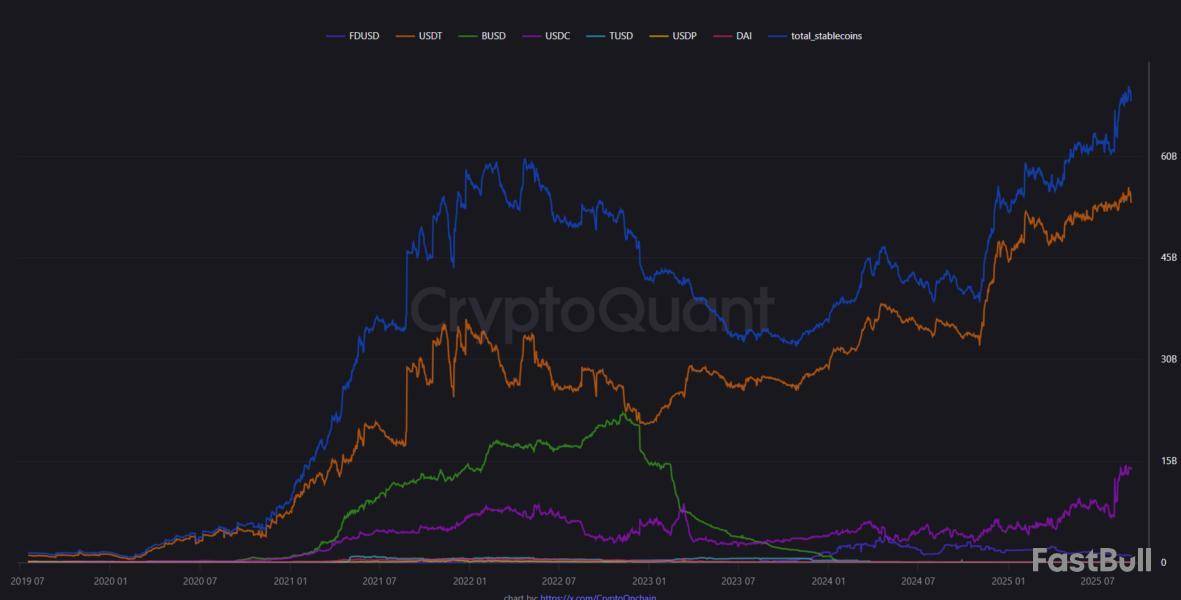
Exchange-based stablecoin holdings on the Ethereum and Tron blockchains recently surpassed $70 billion.
The previous all-time high, set during the 2021 bull market, was approximately $60 billion. After hovering around that level for much of the year, exchange stablecoin holdings began to rise sharply in August.
Stablecoins on Exchanges: A Potential Buying Pressure
According to a report published Thursday by CryptoQuant analyst ‘CryptoOnchain’, this metric represents a massive pool of potential buying pressure on exchanges. This figure briefly surpassed $70 billion on September 2nd and is currently fluctuating around $68.3 billion as of Thursday.
The analyst noted that it has a strong correlation with actual cryptocurrency prices. The holdings hit their most recent low of $32 billion in late October 2023, then more than doubled.
Over that same period, Bitcoin’s price surged by roughly 3.3x from its previous price of around $35,000, while Ethereum’s price jumped 2.5x from its level of $1,890.
USDC’s Role in the Rally
A closer look at the data shows that USDT, the largest stablecoin by market cap, accounts for about $53 billion—or 77%—of these exchange holdings. USDC accounts for about $14 billion, or 20%.
CryptoOnchain pointed to USDC’s explosive growth as a key factor. While USDT maintains its top spot with steady growth, the analyst claims that the USDC deposited on exchanges strongly correlates with major cryptocurrency price increases.
Indeed, with rising expectations for a US interest rate cut, USDC on exchanges soared from just $6.8 billion on August 1 to $14 billion in a single month. In contrast, USDT holdings saw little change, rising from $52.6 billion to $53.1 billion during the same period.
CryptoOnchain describes the current buildup of stablecoins on exchanges as an “extremely strong bullish signal.” He states that this capital is ready to be deployed into assets like Bitcoin and altcoins, signaling a powerful rally may be on the horizon.
White Label
Data API
Web Plug-ins
Poster Maker
Affiliate Program
The risk of loss in trading financial instruments such as stocks, FX, commodities, futures, bonds, ETFs and crypto can be substantial. You may sustain a total loss of the funds that you deposit with your broker. Therefore, you should carefully consider whether such trading is suitable for you in light of your circumstances and financial resources.
No decision to invest should be made without thoroughly conducting due diligence by yourself or consulting with your financial advisors. Our web content might not suit you since we don't know your financial conditions and investment needs. Our financial information might have latency or contain inaccuracy, so you should be fully responsible for any of your trading and investment decisions. The company will not be responsible for your capital loss.
Without getting permission from the website, you are not allowed to copy the website's graphics, texts, or trademarks. Intellectual property rights in the content or data incorporated into this website belong to its providers and exchange merchants.
Not Logged In
Log in to access more features

FastBull Membership
Not yet
Purchase
Log In
Sign Up