





- USDCAD
- XAUUSD
- XAGUSD
- WTI
- USDX








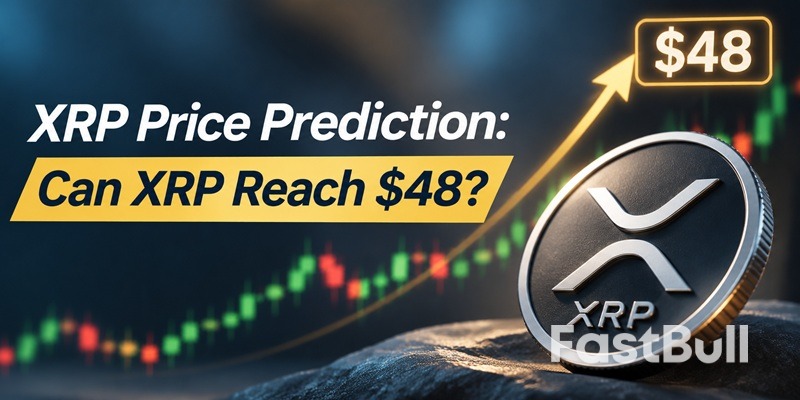
A $48 XRP price target has drawn attention, but reaching it would require an extraordinary revaluation. On November 20, 2026, XRP traded around $0.96, making $48 roughly 50 times the market price. The key question is whether the technical case and market fundamentals can support a move of that scale.
Can XRP Realistically Reach $48?
XRP could theoretically reach $48, but this should be treated as an extremely bullish scenario, not a baseline forecast. At approximately $0.96 on November 20, 2026, XRP would need to rise about 4,900% to reach $48. That would put its price at roughly 50 times its current level.
The comparison with XRP's previous record shows how ambitious the target is. XRP's all-time high was approximately $3.84 on January 4, 2018. A price of $48 would be 12.5 times that peak. XRP would not simply need to recover its previous high; it would need to establish a much higher market valuation.
A move of that size is not mathematically impossible. Crypto assets can be repriced sharply during powerful market cycles. But a $48 outcome would likely require several factors to align: sustained demand for XRP, deeper institutional participation, meaningful use of the XRP Ledger, supportive regulation, and a broad crypto bull market. A bullish chart pattern alone cannot prove that these conditions will occur.
It is important to distinguish possibility from probability. A price target describes a potential outcome under certain assumptions. It does not establish how likely the outcome is, when it might happen, or how much downside could occur along the way.
Where Does the $48 XRP Price Prediction Come From?
Ali Martinez's $48 XRP Price Target
One widely circulated source of the $48 target is crypto analyst Ali Martinez. In a post on March 13, 2026, he said a multi-year triangle pattern on XRP's chart pointed to $48 as a potential target in the next bull run. The forecast was based on a long-term technical setup, not a valuation model tied to XRP payment volume, revenue, or token demand. Read the report on Martinez's prediction.
The wording matters: $48 was described as a potential target for a future bull run, not a guaranteed price or a date-specific forecast. It is also one analyst's view, not a consensus target shared by the entire market. Investors should treat it as a bullish scenario to examine rather than evidence that XRP is on a confirmed path to $48.
What Does the Technical Pattern Actually Suggest?
A multi-year triangle pattern reflects a period in which price swings narrow between converging trendlines. Technical analysts watch these formations because a breakout can signal a change in the balance between buyers and sellers. If price breaks above resistance and holds, chart-based projections may point to a much higher potential target.
However, the pattern does not guarantee the direction or size of the next move. A breakout can fail, price can fall back into the formation, and a projected target can become irrelevant as market conditions change. Trading volume, follow-through, liquidity, and confirmation on longer time frames all matter.
Chart analysis also has limits. It can suggest a possible price path, but it cannot explain whether enough buyers will value XRP at that level. To assess the $48 target more fully, it helps to translate the token price into the market capitalization it would imply.
What Would XRP's Market Cap Be at $48?
Market Cap Based on Circulating Supply
Market capitalization is calculated by multiplying a token's price by its circulating supply. CoinGlass listed XRP's circulating supply at approximately 63.52 billion tokens on November 20, 2026. At $48 per token, that supply would imply a market capitalization of about $3.05 trillion.
For comparison, XRP's market capitalization was about $60.8 billion at a price near $0.96. A $48 price would therefore imply a market value roughly 50 times larger, assuming the circulating supply stayed around 63.52 billion. This is a more useful way to judge the scale of the prediction than looking at the token price alone. View XRP price and supply data.
Market capitalization is not the same as the amount of cash that must flow into an asset. It is the token's market price multiplied by the number of tokens in circulation. Even so, a valuation near $3 trillion would put XRP among the world's largest financial assets and would require demand far beyond its current scale.
Fully Diluted Valuation at Maximum Supply
XRP has a maximum supply of 100 billion tokens. If all 100 billion were valued at $48 each, its fully diluted valuation would be $4.8 trillion. This is higher than the circulating-supply market capitalization because it counts the entire maximum supply, including tokens that are not currently circulating.
The distinction matters because XRP's circulating supply can change over time. Ripple reports that a large portion of its XRP holdings is subject to on-ledger escrow lockups, and releases do not necessarily mean that every token enters the market. Still, any serious assessment of a $48 target must account for both the price and the supply used in the valuation. See Ripple's XRP overview and supply information.
What Could Drive XRP Toward $48?
Institutional Demand and Investment Products
Institutional participation could support XRP if it creates sustained demand rather than short-lived speculation. Regulated investment products can make it easier for asset managers and other investors to gain exposure without holding tokens directly. For a $48 target to become more plausible, however, the important evidence would be persistent capital inflows, deeper liquidity, and investors maintaining exposure through market pullbacks.
The availability of investment products alone does not guarantee price appreciation. Net inflows and actual demand matter more than product launches or headlines.
XRP Ledger Adoption and Real-World Utility
Greater use of the XRP Ledger for payments, asset transfers, and tokenization could strengthen XRP's long-term case. Ripple reports that the network has processed more than 4 billion transactions and moved over $1.7 trillion in value since 2012. These figures indicate substantial network activity, but they do not directly show how much XRP is bought or held to support that activity.
XRP can serve as a bridge asset in the network, helping move value between currencies. Wider use could support demand if transactions and financial applications actually require XRP. However, growth in Ripple's payment business should not be treated as equivalent to growth in XRP demand. Not every service or transaction connected with Ripple necessarily uses XRP.
Regulatory Clarity and a Strong Crypto Bull Market
Clearer regulation could reduce uncertainty for exchanges, financial institutions, and investors. More predictable rules may encourage broader participation and make it easier for financial companies to develop products involving XRP.
Broader market conditions also matter. A strong Bitcoin-led bull market can increase liquidity and risk appetite across major altcoins. But even supportive regulation and rising crypto prices would not guarantee a $48 valuation. XRP would still need enough independent demand to support a market capitalization measured in trillions of dollars.
What Could Prevent XRP From Reaching $48?
High Valuation and Supply Pressure
The biggest obstacle is the valuation required. At the current circulating supply, $48 implies a market capitalization of about $3.05 trillion. Using the maximum supply, the fully diluted valuation would be $4.8 trillion. Those figures require an extraordinary expansion in demand and investor confidence.
Supply is another consideration. XRP has a maximum supply of 100 billion tokens, and changes in circulating supply can affect the market capitalization implied by a given price. Escrow releases do not automatically create selling pressure, but tokens entering circulation could weigh on price if demand does not keep pace.
Competition and Limited Real-World Demand
XRP competes in a payments and digital-asset market that includes stablecoins, other blockchain networks, and traditional payment systems. If competing solutions gain adoption, XRP may struggle to capture enough activity to support an extremely high valuation.
Network growth alone is not enough. Investors need evidence that greater use translates into meaningful demand for XRP itself. Regulatory setbacks, weaker institutional interest, or a prolonged crypto downturn could also delay or prevent the $48 target from becoming achievable.
XRP Price Prediction: Bullish, Base, and Bearish Scenarios
XRP's future price will depend on adoption, capital flows, regulation, and overall market conditions. Rather than treating $48 as the expected outcome, it is more useful to consider three scenarios.
Bullish Scenario: XRP Moves Toward $48
In an extremely bullish scenario, XRP attracts sustained institutional investment, the XRP Ledger gains meaningful adoption, and demand for the token increases. Favorable regulation and a prolonged crypto bull market provide additional support. Even then, reaching $48 would require the market to sustain a valuation of several trillion dollars, making it an ambitious upside target rather than a typical bull-market assumption.
Base Scenario: Moderate Long-Term Growth
In the base scenario, XRP's ecosystem continues to develop and investor participation improves, but adoption and demand grow at a more measured pace. The crypto market experiences periods of expansion and correction rather than uninterrupted gains. XRP could appreciate under these conditions without approaching $48.
Bearish Scenario: XRP Faces Further Downside
In a bearish scenario, crypto liquidity weakens, institutional demand slows, or real-world usage fails to generate meaningful token demand. Regulatory uncertainty or stronger competition could further reduce investor confidence. XRP could lose value even while the XRP Ledger continues operating and developing.
Ultimately, $48 remains an exceptionally ambitious XRP price target. Reaching it would require more than a favorable chart pattern: sustained token demand, major market expansion, and stronger real-world utility would all need to support the valuation.


