• Trade
  • Markets
  • Copy
  • Contests
  • News
  • 24/7
  • Calendar
  • Q&A
  • Chats
Trending
Screeners
SYMBOL
LAST
BID
ASK
HIGH
LOW
NET CHG.
%CHG.
SPREAD
SPX
S&P 500 Index
6870.39
6870.39
6870.39
6895.79
6858.28
+13.27
+ 0.19%
--
DJI
Dow Jones Industrial Average
47954.98
47954.98
47954.98
48133.54
47871.51
+104.05
+ 0.22%
--
IXIC
NASDAQ Composite Index
23578.12
23578.12
23578.12
23680.03
23506.00
+72.99
+ 0.31%
--
USDX
US Dollar Index
98.880
98.960
98.880
98.960
98.730
-0.070
-0.07%
--
EURUSD
Euro / US Dollar
1.16522
1.16529
1.16522
1.16717
1.16341
+0.00096
+ 0.08%
--
GBPUSD
Pound Sterling / US Dollar
1.33263
1.33272
1.33263
1.33462
1.33136
-0.00049
-0.04%
--
XAUUSD
Gold / US Dollar
4206.08
4206.49
4206.08
4218.85
4190.61
+8.17
+ 0.19%
--
WTI
Light Sweet Crude Oil
59.272
59.302
59.272
60.084
59.265
-0.537
-0.90%
--

Community Accounts

Signal Accounts
--
Profit Accounts
--
Loss Accounts
--
View More

Become a signal provider

Sell trading signals to earn additional income

View More

Guide to Copy Trading

Get started with ease and confidence

View More

Signal Accounts for Members

All Signal Accounts

Best Return
  • Best Return
  • Best P/L
  • Best MDD
Past 1W
  • Past 1W
  • Past 1M
  • Past 1Y

All Contests

  • All
  • Trump Updates
  • Recommend
  • Stocks
  • Cryptocurrencies
  • Central Banks
  • Featured News
Top News Only
Share

German Government Spokesperson: We Reject Criticism Of Europe In New US National Security Strategy

Share

Ivory Coast 2025/26 Cocoa Arrivals Reached 803000 T By December 7 Versus 820000 T A Year Ago - Exporters' Estimate

Share

EU To Delay Proposals For Automotive Sector, Including Co2 Emissions, To Dec 16, Draft EU Commission Document Shows

Share

Kremlin: India Buys Energy Where It Is Profitable To And As Far As We Understand They Will Continue To Do That

Share

Turkey's Main Banking Index Up 2.5%

Share

Turkey's Main BIST-100 Index Up 1.9%

Share

Hungary's Preliminary November Budget Balance Huf -403 Billion

Share

Indian Rupee Down 0.1% At 90.07 Per USA Dollar As Of 3:30 P.M. Ist, Previous Close 89.98

Share

India's Nifty 50 Index Provisionally Ends 0.96% Lower

Share

[JPMorgan: US Stock Rally May Stagnate Following Fed Rate Cut] JPMorgan Strategists Say The Recent Rally In US Stocks May Stall As Investors Take Profits Following The Anticipated Fed Rate Cut. The Market Currently Predicts A 92% Probability Of The Fed Lowering Borrowing Costs On Wednesday. Expectations Of A Rate Cut Have Continued To Rise, Fueled By Positive Signals From Policymakers In Recent Weeks. "Investors May Be More Inclined To Lock In Gains At The End Of The Year Rather Than Increase Directional Exposure," Mislav Matejka's Team Wrote In A Report

Share

Russian Defence Ministry: Russian Forces Take Control Of Novodanylivka In Ukraine's Zaporizhzhia Region

Share

Russian Defence Ministry: Russian Forces Take Control Of Chervone In Ukraine's Donetsk Region

Share

French Finance Ministry: Government Started Process To Block Temporarily Shein Platform

Share

Finance Minister: Indonesia To Impose Coal Export Tax Of Up To 5% Next Year

Share

[Trump Considering Fired Homeland Security Secretary Noem? White House Denies] According To Reports From US Media Outlets Such As The Daily Beast And The UK's Independent, The White House Has Denied Reports That US President Trump Is Considering Firing Homeland Security Secretary Noem. White House Spokesperson Abigail Jackson Posted On Social Media On The 7th Local Time, Calling The Claims "fake News" And Stating That "Secretary Noem Has Done An Excellent Job Implementing The President's Agenda And 'making America Safe Again'."

Share

HKEX: Standard Chartered Bought Back 571604 Total Shares On Other Exchanges For Gbp9.5 Million On Dec 5

Share

Morgan Stanley Reiterates Bullish Outlook On US Stocks Due To Fed Rate Cut Expectations. Morgan Stanley Strategists Believe That The US Stock Market Faces A "bullish Outlook" Given Improved Earnings Expectations And Anticipated Fed Rate Cuts. They Expect Strong Corporate Earnings By 2026, And Anticipate The Fed Will Cut Rates Based On Lagging Or Mildly Weak Labor Markets. They Expect The US Consumer Discretionary Sector And Small-cap Stocks To Continue To Outperform

Share

China's National Development And Reform Commission Announced That Starting From 24:00 On December 8, The Retail Price Limit For Gasoline And Diesel In China Will Be Reduced By 55 Yuan Per Ton, Which Translates To A Reduction Of 0.04 Yuan Per Liter For 92-octane Gasoline, 0.05 Yuan Per Liter For 95-octane Gasoline, And 0.05 Yuan Per Liter For 0# Diesel

Share

Tkms CEO: US Security Strategy Highlights Need For Europe To Take Care Of Its Own Defences

Share

USA S&P 500 E-Mini Futures Up 0.1%, NASDAQ 100 Futures Up 0.18%, Dow Futures Down 0.02%

TIME
ACT
FCST
PREV
France Industrial Output MoM (SA) (Oct)

A:--

F: --

P: --
France Trade Balance (SA) (Oct)

A:--

F: --

P: --
Euro Zone Employment YoY (SA) (Q3)

A:--

F: --

P: --
Canada Part-Time Employment (SA) (Nov)

A:--

F: --

P: --

Canada Unemployment Rate (SA) (Nov)

A:--

F: --

P: --

Canada Full-time Employment (SA) (Nov)

A:--

F: --

P: --

Canada Labor Force Participation Rate (SA) (Nov)

A:--

F: --

P: --

Canada Employment (SA) (Nov)

A:--

F: --

P: --

U.S. PCE Price Index MoM (Sept)

A:--

F: --

P: --

U.S. Personal Income MoM (Sept)

A:--

F: --

P: --

U.S. Core PCE Price Index MoM (Sept)

A:--

F: --

P: --

U.S. PCE Price Index YoY (SA) (Sept)

A:--

F: --

P: --

U.S. Core PCE Price Index YoY (Sept)

A:--

F: --

P: --

U.S. Personal Outlays MoM (SA) (Sept)

A:--

F: --

P: --
U.S. 5-10 Year-Ahead Inflation Expectations (Dec)

A:--

F: --

P: --

U.S. Real Personal Consumption Expenditures MoM (Sept)

A:--

F: --

P: --
U.S. Weekly Total Rig Count

A:--

F: --

P: --

U.S. Weekly Total Oil Rig Count

A:--

F: --

P: --

U.S. Consumer Credit (SA) (Oct)

A:--

F: --

P: --
China, Mainland Foreign Exchange Reserves (Nov)

A:--

F: --

P: --

Japan Trade Balance (Oct)

A:--

F: --

P: --

Japan Nominal GDP Revised QoQ (Q3)

A:--

F: --

P: --

China, Mainland Imports YoY (CNH) (Nov)

A:--

F: --

P: --

China, Mainland Exports (Nov)

A:--

F: --

P: --

China, Mainland Imports (CNH) (Nov)

A:--

F: --

P: --

China, Mainland Trade Balance (CNH) (Nov)

A:--

F: --

P: --

China, Mainland Exports YoY (USD) (Nov)

A:--

F: --

P: --

China, Mainland Imports YoY (USD) (Nov)

A:--

F: --

P: --

Germany Industrial Output MoM (SA) (Oct)

A:--

F: --

P: --
Euro Zone Sentix Investor Confidence Index (Dec)

A:--

F: --

P: --

Canada National Economic Confidence Index

--

F: --

P: --

U.K. BRC Like-For-Like Retail Sales YoY (Nov)

--

F: --

P: --

U.K. BRC Overall Retail Sales YoY (Nov)

--

F: --

P: --

Australia Overnight (Borrowing) Key Rate

--

F: --

P: --

RBA Rate Statement
RBA Press Conference
Germany Exports MoM (SA) (Oct)

--

F: --

P: --

U.S. NFIB Small Business Optimism Index (SA) (Nov)

--

F: --

P: --

Mexico 12-Month Inflation (CPI) (Nov)

--

F: --

P: --

Mexico Core CPI YoY (Nov)

--

F: --

P: --

Mexico PPI YoY (Nov)

--

F: --

P: --

U.S. Weekly Redbook Index YoY

--

F: --

P: --

U.S. JOLTS Job Openings (SA) (Oct)

--

F: --

P: --

China, Mainland M1 Money Supply YoY (Nov)

--

F: --

P: --

China, Mainland M0 Money Supply YoY (Nov)

--

F: --

P: --

China, Mainland M2 Money Supply YoY (Nov)

--

F: --

P: --

U.S. EIA Short-Term Crude Production Forecast For The Year (Dec)

--

F: --

P: --

U.S. EIA Natural Gas Production Forecast For The Next Year (Dec)

--

F: --

P: --

U.S. EIA Short-Term Crude Production Forecast For The Next Year (Dec)

--

F: --

P: --

EIA Monthly Short-Term Energy Outlook
U.S. API Weekly Gasoline Stocks

--

F: --

P: --

U.S. API Weekly Cushing Crude Oil Stocks

--

F: --

P: --

U.S. API Weekly Crude Oil Stocks

--

F: --

P: --

U.S. API Weekly Refined Oil Stocks

--

F: --

P: --

South Korea Unemployment Rate (SA) (Nov)

--

F: --

P: --

Japan Reuters Tankan Non-Manufacturers Index (Dec)

--

F: --

P: --

Japan Reuters Tankan Manufacturers Index (Dec)

--

F: --

P: --

Japan Domestic Enterprise Commodity Price Index MoM (Nov)

--

F: --

P: --

Japan Domestic Enterprise Commodity Price Index YoY (Nov)

--

F: --

P: --

China, Mainland PPI YoY (Nov)

--

F: --

P: --

Q&A with Experts
    • All
    • Chatrooms
    • Groups
    • Friends
    Connecting
    .
    .
    .
    Type here...
    Add Symbol or Code

      No matching data

      All
      Trump Updates
      Recommend
      Stocks
      Cryptocurrencies
      Central Banks
      Featured News
      • All
      • Russia-Ukraine Conflict
      • Middle East Flashpoint
      • All
      • Russia-Ukraine Conflict
      • Middle East Flashpoint
      Search
      Products

      Charts Free Forever

      Chats Q&A with Experts
      Screeners Economic Calendar Data Tools
      Membership Features
      Data Warehouse Market Trends Institutional Data Policy Rates Macro

      Market Trends

      Market Sentiment Order Book Forex Correlations

      Top Indicators

      Charts Free Forever
      Markets

      News

      News Analysis 24/7 Columns Education
      From Institutions From Analysts
      Topics Columnists

      Latest Views

      Latest Views

      Trending Topics

      Top Columnists

      Latest Update

      Signals

      Copy Rankings Latest Signals Become a signal provider AI Rating
      Contests
      Brokers

      Overview Brokers Assessment Rankings Regulators News Claims
      Broker listing Forex Brokers Comparison Tool Live Spread Comparison Scam
      Q&A Complaint Scam Alert Videos Tips to Detect Scam
      More

      Business
      Events
      Careers About Us Advertising Help Center

      White Label

      Data API

      Web Plug-ins

      Affiliate Program

      Awards Institution Evaluation IB Seminar Salon Event Exhibition
      Vietnam Thailand Singapore Dubai
      Fans Party Investment Sharing Session
      FastBull Summit BrokersView Expo
      Recent Searches
        Top Searches
          Markets
          News
          Analysis
          User
          24/7
          Economic Calendar
          Education
          Data
          • Names
          • Latest
          • Prev

          View All

          No data

          Scan to Download

          Faster Charts, Chat Faster!

          Download App
          English
          • English
          • Español
          • العربية
          • Bahasa Indonesia
          • Bahasa Melayu
          • Tiếng Việt
          • ภาษาไทย
          • Français
          • Italiano
          • Türkçe
          • Русский язык
          • 简中
          • 繁中
          Open Account
          Search
          Products
          Charts Free Forever
          Markets
          News
          Signals

          Copy Rankings Latest Signals Become a signal provider AI Rating
          Contests
          Brokers

          Overview Brokers Assessment Rankings Regulators News Claims
          Broker listing Forex Brokers Comparison Tool Live Spread Comparison Scam
          Q&A Complaint Scam Alert Videos Tips to Detect Scam
          More

          Business
          Events
          Careers About Us Advertising Help Center

          White Label

          Data API

          Web Plug-ins

          Affiliate Program

          Awards Institution Evaluation IB Seminar Salon Event Exhibition
          Vietnam Thailand Singapore Dubai
          Fans Party Investment Sharing Session
          FastBull Summit BrokersView Expo

          Visualizing The World's Largest Oil Producers

          Damon
          Summary:

          The world is in the middle of the first energy crisis of the 21st century.
          Visualizing The World's Largest Oil Producers_1The World's Largest Oil Producers

          The world is in the middle of the first energy crisis of the 21st century.
          High energy prices, especially for oil, gas, and coal, are driving decades-high inflation in various countries, some of which are also experiencing energy shortages. Russia's recent invasion of Ukraine has exacerbated the crisis, given that the country is both a major producer and exporter of oil and natural gas.
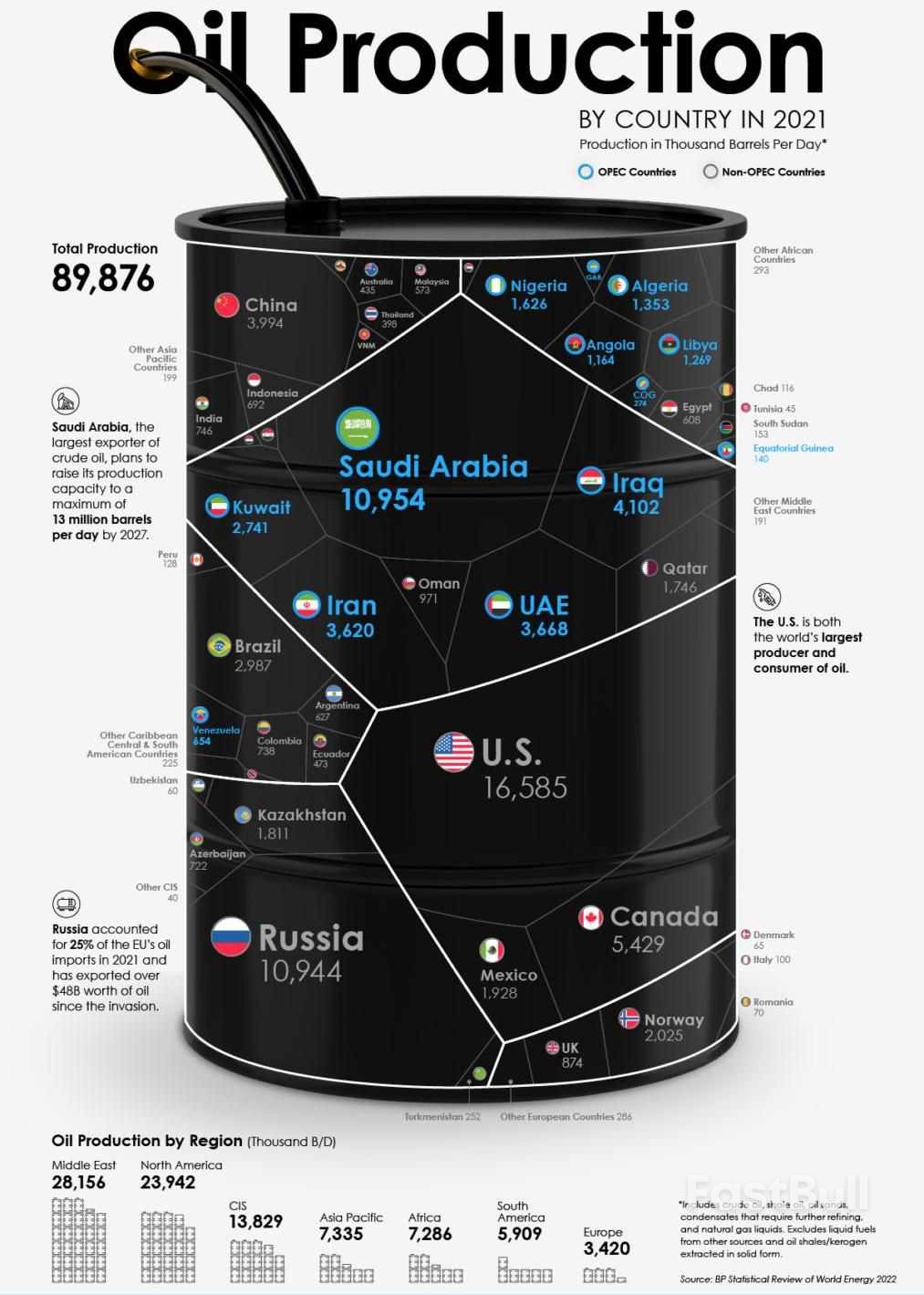
          Using data from BP's Statistical Review of World Energy, the above infographic provides further context on the crisis by visualizing the world's largest oil producers in 2021.

          Oil Production: OPEC Countries vs. Rest of the World

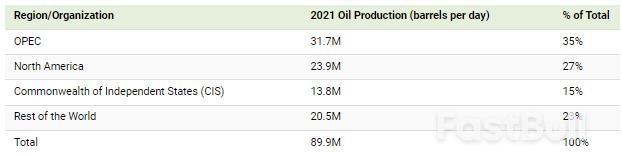
          Before looking at country-level data, it's worth seeing the amount of oil the Organization of Petroleum Exporting Countries (OPEC) produces compared to other organizations and regions.Visualizing The World's Largest Oil Producers_2
          The OPEC countries are the largest oil producers collectively, with Saudi Arabia alone making up one-third of OPEC production. It's also important to note that OPEC production remains below pre-pandemic levels after the organization reduced its output by an unprecedented 10 million barrels per day (B/D) in 2020.
          Following the OPEC countries, the U.S., Canada, and Mexico accounted for just over a quarter of global oil production in 2021. Nearly 70% of North American oil production came from the U.S., the world's largest oil producer.
          Similarly, within the CIS—an organization of post-Soviet Union countries—Russia was by far the largest producer, accounting for 80% of total CIS production.

          The Largest Oil Producers in 2021

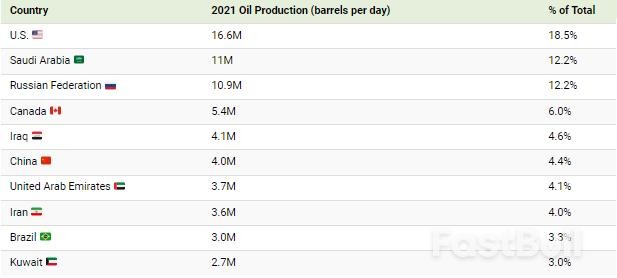
          Roughly 43% of the world's oil production came from just three countries in 2021—the U.S., Saudi Arabia, and Russia. Together, these three countries produced more oil than the rest of the top 10 combined.Visualizing The World's Largest Oil Producers_3
          Over the last few decades, U.S. oil production has been on a rollercoaster of troughs and peaks. After falling from its 1970 peak of 11.3 million B/D, it reached a historic low of 6.8 million B/D in 2008. However, following a turnaround in the 2010s, the country has since surpassed Saudi Arabia as the largest oil producer. As of 2021, though, the U.S. remained a net importer of crude oil while exporting refined petroleum products.
          Saudi Arabia and Russia each produced roughly 11 million B/D in 2021 and were the two largest oil exporters globally. In both countries, state-owned oil firms (Saudi Aramco and Gazprom, respectively) were the most valuable oil and gas producing companies.
          From Europe (excluding Russia), only Norway made the top 15 oil producers, accounting for 2.3% of global production. The lack of regional output partly explains the European Union's dependence on Russian oil and gas, worsening the region's energy crisis.

          How the Energy Crisis is Affecting Oil Production

          After a deep dive in 2020, oil demand is resurfacing and is now above pre-pandemic levels. Furthermore, supply constraints due to sanctions on Russian oil and gas tighten the market and support high oil prices.
          While the impact has been felt globally, European countries have been hit hard due to their reliance on Russia's fossil fuel exports, with some getting almost all of their energy fuels from Russia.
          To combat the oil crunch, the rest of the world is ramping up oil supply through increased production or releasing strategic petroleum reserves (SPRs). U.S. oil production is expected to rise by 1 million B/D in 2022 to a record-high. Simultaneously, Western nations are calling on OPEC members to increase their output to ease prices. However, OPEC nations are sticking to their planned production hikes, with output still below early 2020 levels.
          The U.S. is releasing 180 million barrels of oil from its SPR, of which 60 million barrels will contribute to the IEA's collective release of 120 million barrels. But with oil demand expected to reach a new all-time high in 2023, it remains to be seen whether these efforts to increase supply will be enough to curb the crunch.

          Source: Visualcapitalist

          Risk Warnings and Disclaimers
          You understand and acknowledge that there is a high degree of risk involved in trading. Following any strategies or investment methods may lead to potential losses. The content on the site is provided by our contributors and analysts for information purposes only. You are solely responsible for determining whether any trading assets, securities, strategy, or any other product is suitable for investing based on your own investment objectives and financial situation.
          Comments
          Add to Favorites
          Share

          Democratic Senators Chide Fidelity Investments for BTC-Exposed Retirement Funds

          Damon
          Three United States senators have written to Fidelity Investments CEO Abigail Johnson demanding an explanation for the financial services company's decision to include Bitcoin-exposed funds in its 401(k) retirement plans. "This decision is immensely troubling," they wrote.
          Democrats Dick Durbin, Elizabeth Warren and Tina Smith sent their letter Tuesday. The letter, which is around a page and a half long, discussed Americans' retirement savings habits in general terms with minimal statistics but numerous rhetorical flourishes and strings of adjectives. The money American consumers may invest in retirement funds is "hard earned," for example, and their exposure to the "cryptocurrency casino" is "a bridge too far." The authors of the letter asked:
          "When saving for retirement is already a challenge for so many Americans, why would Fidelity allow those who can save to be exposed to an untested, highly volatile asset like Bitcoin?"
          There is no call to action in the letter, aside from "We look forward to your response."Democratic Senators Chide Fidelity Investments for BTC-Exposed Retirement Funds_1
          The senators were objecting to funds Fidelity Investments introduced in March. Warren, who represents Massachusetts, the state in which Fidelity Investments is based, teamed up with Smith to write to Johnson at the beginning of May, sending a detailed and copiously footnoted letter objecting to the inclusion of Bitcoin (BTC) in retirement plans. That letter concluded with a list of questions and set a two-week deadline for a response.
          Related: Survey: More than a quarter of U.S. millennials plan to use crypto to fund retirement
          Fidelity Investments' actions were controversial within the government. The Department of Labor released a compliance report ahead of the announcement of Fidelity Investments' embrace of crypto-exposed retirement funds that promised an "investigative program" aimed at retirement plans that included crypto. That report eventually led to a lawsuit against the department.
          Also at the beginning of May, Republican Alabama Senator Tommy Tuberville introduced the Financial Freedom Act to protect investors' right to include crypto in retirement accounts.

          Source: cointelegraph

          Risk Warnings and Disclaimers
          You understand and acknowledge that there is a high degree of risk involved in trading. Following any strategies or investment methods may lead to potential losses. The content on the site is provided by our contributors and analysts for information purposes only. You are solely responsible for determining whether any trading assets, securities, strategy, or any other product is suitable for investing based on your own investment objectives and financial situation.
          Comments
          Add to Favorites
          Share

          China's Health Silk Road in the Middle East

          Devin
          The introduction of the Health Silk Road (HSR) and Digital Silk Road (DSR) in 2015 as part of the Belt and Road Initiative (BRI) shows the expansion of China's diplomacy from infrastructure and construction into the health and technology sectors. Multiple areas of cooperation increase China's leverage and promote the longevity of the BRI framework beyond the COVID-19 pandemic.China's Health Silk Road in the Middle East_1
          The HSR is an extension of China's long history of medical assistance in various regions. Africa–China medical cooperation dates back to 1963, when China was the first country to send a medical team to Algeria.
          The COVID-19 pandemic has seen a new phase of medical cooperation with China investing in health care infrastructure and sending medical equipment, workers and pharmaceutical products overseas. The Chinese government is now focusing on which can benefit both recipient and donor countries. It can improve health care systems in poor regions and will create new opportunities to increase Chinese health care investments in the long term.
          In a speech at the 2021 Global Health Summit, President Xi Jinping expressed the necessity of global cooperation and solidarity to fight the COVID-19 pandemic. China's ability to contain the virus at home has given China the credibility to take an active role in vaccine manufacturing and rollout in Africa and the Middle East.
          The use of digital technology to monitor disease, especially 5G technology, has enabled remote connection between medical workers and patients. China is implementing its domestic experience with rural and remote health care access in its enabling of in poor countries.
          In sub-Saharan Africa, the Middle East and Latin America, the BRI plays an important role in providing access to vaccines and medical supplies earlier than Western countries. Middle Eastern nations, such as the United Arab Emirates and Bahrain, were among the first countries outside China to approve the Sinopharm vaccine, reflecting confidence and trust of Middle Eastern states in modern Chinese medicine.
          Egypt was the first African country to manufacture the Chinese Sinovac vaccine. Under a deal with the Chinese pharmaceutical company, a Cairo factory will produce more than 200 million doses per year and a second factory will produce three million doses per day. This would make Egypt the biggest vaccine producer in Africa and the Middle East.
          In 2021, China said it provided two billion doses of vaccines for 120 countries and international organisations, more than any other nation, including a total of 180 million vaccine doses to Africa. Egypt, Algeria and Morocco are among the largest recipients.
          For Middle Eastern countries looking to transform their economies, the health care sector is an increasing reform priority due to the severe impact of the COVID-19 pandemic on economic growth and health care. Attracting investments in the health care sector is a main concern. A focus on integrating technology and developing health infrastructure will be crucial for this reform.
          In recent decades, Egypt, Jordan and Tunisia have become regional centres due to the perceived high quality of health services offered by their private health sectors. But despite increased investments in health infrastructure by many countries across the Middle East and North Africa region, health expenditure as a share of their GDPs is still very low. Lebanon, Tunisia and Saudi Arabia spend more of their GDPs on health than the rest of the region, but health spending is growing the fastest in the UAE and Qatar.
          According to the Gulf states' new development vision, the health sector will increasingly rely on imported pharmaceuticals and manufactures, while the health care market will play a pivotal role in increasing health care investment. China is a crucial trade and health care investment partner in the realisation of this vision. The Abu Dhabi Vision 2030 considers the pharmaceutical industry to be a primary area of development due to its future growth prospects, export potential and the mid to long-term economic impact.
          At a critical juncture in the COVID-19 pandemic, China took the initiative to offer medical assistance and vaccines to developing countries. This move further increased the between China and the United States. China seized the opportunity to gain more influence in the Middle East and Africa which struggle with low vaccination rates in the absence of greater involvement from the United States and the EU.
          As the COVID-19 pandemic rolls into its third year and new subvariants spread rapidly, China will not be able to single-handedly win the vaccine rollout race and fulfill all the vaccination needs of poor regions. A full global recovery from this health crisis requires the cooperation of all great powers.

          Source: eastasiaforum

          Risk Warnings and Disclaimers
          You understand and acknowledge that there is a high degree of risk involved in trading. Following any strategies or investment methods may lead to potential losses. The content on the site is provided by our contributors and analysts for information purposes only. You are solely responsible for determining whether any trading assets, securities, strategy, or any other product is suitable for investing based on your own investment objectives and financial situation.
          Comments
          Add to Favorites
          Share

          EU Problems: Lack of Crypto Experts Worries the European Union

          Damon
          EU Problems: The European Union has a lack of crypto experts available to help regulate the crypto-assets market.
          The European Banking Authority (EBA) faces difficulty in hiring experts to help determine what rules the cryptocurrency industry needs to follow in the European Union.
          In an interview with the Financial Times, José Manuel Campa said the lack of experts in the crypto sphere in the EU has generated a "major concern" in the body responsible for overseeing the EU banking sector.
          The President of the EBA commented that the lack of experts has hampered the development of the guidelines that need to be implemented by 2025.

          European Union – regulating the crypto market

          Regulating the cryptocurrency market has been among the European Union's priorities. The political-economic union represents 27 countries in the region. It recently finalized the Markets in Crypto Assets (MiCA) legislative package, which aims to institute a series of new standards, especially for the use of stablecoins.
          In addition, the parliament voted on a proposal to ban the use of crypto assets that use the PoW consensus method. It was later rejected, to the happiness of asset enthusiasts.
          In this sense, Campa comments that the "very dynamic" nature of cryptocurrencies has made it difficult for the bloc to reach a consensus, despite advances in recent weeks.
          According to the President of the EBA, regardless of the regulatory structure that is developed and approved, it will already be behind in relation to the market. He adds that when the established guidelines take effect three years from now, there is a high chance that crypto assets will have "other uses that we can't predict."EU Problems: Lack of Crypto Experts Worries the European Union_1

          EU Problems: Lack of professionals?

          Campa commented on the difficulty that the European Union has in hiring individuals specialized in the crypto market. This makes it difficult to supervise the industry. The problem itself would not be the lack of skilled labor, but rather competing against high salaries offered by private companies in the sector.
          Investing heavily in hiring and offering higher salaries "is not within the scope of possible discussions," according to the head of the European Banking Authority. However, mass layoffs by large crypto companies in recent months may change this situation. Some of the dismissed professionals may seek to relocate to regulatory agencies.
          In addition, many large companies and exchanges, such as Binance, seek to collaborate with government agencies to establish guidelines that do not hinder the development of the crypto market.

          Source: beincrypto

          Risk Warnings and Disclaimers
          You understand and acknowledge that there is a high degree of risk involved in trading. Following any strategies or investment methods may lead to potential losses. The content on the site is provided by our contributors and analysts for information purposes only. You are solely responsible for determining whether any trading assets, securities, strategy, or any other product is suitable for investing based on your own investment objectives and financial situation.
          Comments
          Add to Favorites
          Share

          Is The US in a Recession? Well, That Depends on Whom You Ask – And What Measure They Use

          Devin
          The U.S. economy shrank at an annual rate 0.9% from April through June, the Bureau of Economic Analysis estimated on July 28, 2022. It follows a contraction in gross domestic product of 1.6% recorded in the first quarter of the year.
          Some observers suggest the two quarters of contraction constitute a "technical recession" or the "unofficial start" of one, while others suggest it at least raises fears or signals it's on the way. Federal Reserve Chair Jerome Powell apparently thinks otherwise. On July 27, after raising interest rates 0.75 percentage point, Powell told reporters, "it's a strong economy and nothing about it suggests that it's close to or vulnerable to a recession."
          Confused about whether the U.S. is in a recession or how to know when one hits? If you are, join the club.
          So The Conversation U.S. asked Brian Blank, a financial economist at Mississippi State University, to explain what's going on in the economy and what factors determine if it is in recession.

          What did the latest GDP report tell us?

          The economy is really hard to pin down right now.
          First, the question everyone is talking about now is the release of the less-than-impressive gross domestic product report, which showed a contraction after adjusting for inflation.
          Some aspects of the report were positive, such as that consumption – how much people are buying – still rose a little and business fixed investment – how much companies spend on machines and factories – was flat, avoiding the drop previously forecast.
          As for some of the more negative news, investment in residential housing and property declined 14%, which makes sense given how much it had been rising since the pandemic upended the housing market. In addition, a drop in private inventory investment – a measure of how much stuff companies have produced but haven't yet sold – had perhaps the biggest impact on negative second-quarter figures. While inventory reductions can be a sign of strength from selling products, the decline reduced overall GDP by over 2 percentage points.
          And overall it means the U.S. economy technically has shrunk for two consecutive quarters, which is why you're seeing a lot more economists, journalists and others use the dreaded "R" word: recession.Is The US in a Recession? Well, That Depends on Whom You Ask – And What Measure They Use_1

          What is a recession, anyway?

          Two quarters in a row of contraction is the shorthand journalists and many others use to describe a recession.
          In the U.S., however, the economy is deemed to be officially in recession only after the National Bureau of Economic Research, a nonprofit and nonpartisan organization, says it is.
          The bureau defines a recession as a "significant decline in economic activity that is spread across the economy and lasts more than a few months." Its business cycle dating committee, which is composed of eight economics professors, meets to determine when recessions begin and end. It uses three key criteria:
          1) How quickly the economy is contracting. 2) How many aspects of the economy are declining. 3) How long the economy contracts.
          The NBER defines recessions as the time between the point at which the economy stops growing – the peak – and the point at which it starts growing again – the trough.Is The US in a Recession? Well, That Depends on Whom You Ask – And What Measure They Use_2

          So, are we in a recession or not?

          Recessions are complicated to identify, given that the economy is big and has many parts. Currently, some parts of the U.S. economy, like the labor market, are growing quickly, while others, such as housing, are slowing.
          While two quarters of economic contraction typically do coincide with a recession, they also do not typically involve the hot job growth the U.S. economy has seen this year. And recessions rarely happen when unemployment – which is currently at a roughly half-century-low of 3.6% – is falling. The economy is typically not in recession if almost everyone who wants a job has one.
          In addition, recessions usually involve declines in real gross domestic income, which is similar to GDP but instead specifically measures income and costs related to production. In theory, they should move more or less in tandem, but gross domestic income continues to grow.
          Another measure of growth is personal income, which has been climbing for most of the year and rose faster than spending in May. The Fed watches this metric closely because of its predictive ability, as does the National Bureau of Economic Research, in addition to unemployment.
          For my 2 cents, I believe Powell is right. The economy does not appear to be in a recession at the moment, given how strong the labor market is. Since 2.7 million more people have jobs now than they did at the end of last year, a key measure of the economy is still growing.
          "There are too many areas of the economy that are performing too well," Powell told reporters. "It doesn't make sense that the economy would be in a recession with this kind of thing happening."
          That said, Powell and the Fed are trying their level best to curb soaring inflation by slowing the economy – and there are worries that doing so will induce a recession. If you want a strong signal to tell if that might be happening, look at residential investment as a percentage of GDP. Residential investment is how much individuals spend on new homes and home improvement. Right now it's flat, but when it starts to decline, a recession is usually on its heels.
          Keep in mind, 2021 boasted one of its best U.S. economies in decades, so maybe Americans can accept a so-so 2022. In some ways, an economy that is not growing too fast might also mean an economy that is getting inflation under control, which suggests that sometimes not so great news is actually good news.

          Source: theconversation

          Risk Warnings and Disclaimers
          You understand and acknowledge that there is a high degree of risk involved in trading. Following any strategies or investment methods may lead to potential losses. The content on the site is provided by our contributors and analysts for information purposes only. You are solely responsible for determining whether any trading assets, securities, strategy, or any other product is suitable for investing based on your own investment objectives and financial situation.
          Comments
          Add to Favorites
          Share

          Dispirited Homebuyers Show Why Fed's Unprecedented Fight Against Inflation is Beginning to Succeed

          Devin
          I've studied finance and financial markets since the 1970s, and I have never seen the Federal Reserve's monetary policy get such prominent news coverage as it has this past year.
          And with good reason. What the Fed does has profound implications for companies, consumers and the U.S. economy, especially now as the U.S. central bank tries to tame the fastest jump in consumer prices in decades. In short, the Fed is jacking up interest rates in hopes that doing so slows the economy enough to bring down inflation.
          The housing market is the sector most substantially influenced by interest rate changes, and as such, it's a key indicator of whether the Fed's plans are succeeding. To see why, I need only consider the experience of my son – or the many other Americans hunting for a new home at a time of rising interest rates.

          What the Fed is Doing

          First, a little background.
          The Federal Reserve is raising interest rates at the fastest pace in its 108-year history as part of its inflation battle. Today's big policy steps are needed in part because the Fed and many others took a while to understand what was causing the rise in inflation.
          In fall 2021, while the pace of inflation was accelerating past 4% – double the Fed's targeted rate – the prevailing view at the central bank and elsewhere was that it reflected temporary disruptions following two years of COVID-19-related slowdowns. The assumption was that inflation would abate automatically as supply chains worked themselves out.
          Unfortunately, that assumption proved wrong because it did not recognize how much government COVID-19 relief spending had stimulated what economists call “aggregate demand” – in other words, the total demand for goods and services produced in an economy. Put another way, consumer spending spurred by government aid created strong demand across the economy.
          And so consumer prices continued to accelerate. Russia's war in Ukraine made the problem worse, especially by driving up global food and energy prices. As of June 2022, inflation was surging at 9.1%, the fastest pace since 1981.
          While the Fed can't do much about the war or other supply-chain issues, it can address domestic aggregate demand. That's where higher interest rates come in.
          Higher borrowing costs choke off consumer demand for homes, cars and other goods and services that typically require a loan, while companies pare back their investments in factories and hiring, which should ease overall inflation.
          The Fed began its most recent tightening policy in March 2022 with a 0.25 percentage point increase in its target interest rate, which acts as a benchmark for other borrowing costs in the U.S. and around the world. Since then, the central bank has raised its target rate twice more – by 0.5 percentage point in May and 0.75 percentage point in June.
          On July 27, the Fed raised the rate by another 0.75 percentage points.

          Why the Housing Market Matters

          The trick to reducing inflation is to choke off enough aggregate demand to tame inflation without driving the economy into recession. One of the main ways to see whether this is happening is to look at housing, which has always been particularly sensitive to rate changes and constitutes more than one-quarter of total U.S. wealth.
          Because buying a house or apartment is such a large expenditure, nearly all purchasers must borrow a pretty big share of the purchase price. And just as record-low mortgages borrowing costs in 2021 helped fuel a housing market boom by lowering the cost of servicing that debt, higher rates increase the cost, discouraging housing purchases.
          The average rate on a 30-year mortgage hit 5.81% in June, the highest level since 2008 and up from less than 3% throughout most of 2021. The rate currently stands at 5.54%. On a $200,000 mortgage, a 5.54% rate translates into over $400 in extra interest costs every month compared with 3%.
          Confronted with such an increase, some house hunters – like my son – have stepped back and reconsidered whether now is the right time to buy.

          Housing Starting to Stall

          In other words, higher mortgage rates lead individuals to invest less in housing. And the effect of falling demand doesn't stop with the house. When people buy a new house, they also tend to purchase new furniture, lawn equipment, televisions and so on. And buying a used home often requires hiring contractors and others to remodel the kitchen or build a new closet in the kids' room.
          So if people are buying fewer homes, they also are purchasing less furniture, electronics and lawnmowers and have less need for electricians and plumbers.
          The drop in demand for all these goods and services should take a meaningful bite out of inflation. While it's still too early to say if this part of the Fed plan is working, we can already see the effects of rising mortgage rates in recent housing data.
          In recent months, fewer new houses are being built, fewer existing homes are being sold and homebuyers are walking away from signed deals at the highest rate since the start of the COVID-19 pandemic.
          At the same time, consumers and investors are beginning to anticipate less inflationary pressure in the next year or so.

          What it Means for Homebuyers

          So as the Fed prepares to hike benchmark rates again, what does all this mean for U.S. consumers, and especially my son and other people looking for a new home?
          For one thing, don't expect long-term interest rates, including for mortgages, to rise much, and certainly not by the same amount of the Fed's interest rate hike.
          Investors tend to factor expected Fed policy changes into its market rates. So unless there is a surprise from the Fed, like a full 1-point hike, long-term rates are unlikely to change much. And they may even begin to fall soon, either because inflation is subdued or the U.S. slips into recession.
          And while it would be nice to know how tighter monetary policy – that is, higher interest rates – will affect today's stratospheric house prices, this is hard to predict. The withdrawal of some buyers from the market should depress house prices by reducing demand, but sellers may also simply decide to delay selling rather than accept a lower price.
          The challenge for would-be homebuyers like my son and his family is to find a seller who cannot hold their house off the market and to offer a lower price than the house would have attracted a few months ago to offset its higher financing cost. The more that happens, the more the Fed will know its rate hikes are working.

          Source: channelchek

          Risk Warnings and Disclaimers
          You understand and acknowledge that there is a high degree of risk involved in trading. Following any strategies or investment methods may lead to potential losses. The content on the site is provided by our contributors and analysts for information purposes only. You are solely responsible for determining whether any trading assets, securities, strategy, or any other product is suitable for investing based on your own investment objectives and financial situation.
          Comments
          Add to Favorites
          Share

          North Korea May Delay Nuclear Test Until End of China's Party Congress

          Damon
          North Korea may postpone its next nuclear weapons test for several months until the end of the National Congress of the Communist Party of China, the country's most important event in years, according to experts Friday
          The North has completed preparations for its seventh nuclear test, intelligence reports show. But it has not taken action for months. Experts say China is most likely the reason behind the delay as Pyongyang's test will certainly take away the world's attention from the crucial political event and might lead to the worst-case scenario for Chinese leaders, especially President Xi Jinping, who seeks to secure a precedent-defying third term in power there.
          In Wednesday's speech on the 69th anniversary of the end of the Korean War (1950-53), North Korean leader Kim Jong-un honored the Chinese soldiers who "shed their blood with our military" in the conflict against South Korea and United Nations Command.
          "All of North Korea's nuclear weapons tests in the past were conducted when either it was isolated, including from its allies such as China, or there were technical and political needs," Hong Min, a senior researcher at the Korea Institute for National Unification, told The Korea Times. "After mentioning the Chinese military's contribution to the war, Kim paid his respects to the Chinese soldiers the next day at a monument symbolizing the alliance of the two nations. The North must be thinking how its nuclear test would affect the relations, especially ahead of the critical event for Xi."North Korea May Delay Nuclear Test Until End of China's Party Congress_1
          In that speech, Kim said his armed forces were completely prepared to respond to any crisis, threatening to "annihilate" the Yoon Suk-yeol administration and South Korea's military. But there was no suggestion that he is about to order a nuclear weapons test, Hong noted.
          "Throughout his message, Kim takes on a passive and defensive posture … It is possible that the North would respond militarily when South Korea and the U.S. conduct their joint drills in August. But it will most like be launching short-range missiles, not another nuclear test," he added.
          The worst-case scenario for Beijing, especially before the party congress expected to be held in September or October, is giving Seoul a reason to justify its move to install additional U.S. anti-ballistic missile defense systems, simply known as THAAD, on its soil, said Cheong Seong-chang, director at the Center for North Korean Studies at the Sejong Institute, a think tank. It was one of Yoon's key campaign pledges.North Korea May Delay Nuclear Test Until End of China's Party Congress_2
          "In the past, China stopped the operation of its oil pipeline to North Korea (saying 'it needs to be repaired') as a means of pressuring Pyongyang. Today, Beijing has one more effective measure: their cross-border freight train services, which have been suspended over COVID-19," he said. "Without resources coming from that line, many of the North's major projects this year, including the construction of apartment buildings, would be disrupted … Beijing would not think it can completely stop the North's nuclear test plan, but it has many cards to delay it (until after the party congress)."
          Pyongyang-Beijing relations remained at a low point after Kim rose to power in late 2011. Four of North Korea's six total nuclear weapons tests so far were conducted under his watch (2013, twice in 2016, and in 2017). In signs of a rapprochement, Kim and Xi held five summits in 2018 and 2019. The 2017 test was the North's latest.

          Source: TheKoreaTimes

          Risk Warnings and Disclaimers
          You understand and acknowledge that there is a high degree of risk involved in trading. Following any strategies or investment methods may lead to potential losses. The content on the site is provided by our contributors and analysts for information purposes only. You are solely responsible for determining whether any trading assets, securities, strategy, or any other product is suitable for investing based on your own investment objectives and financial situation.
          Comments
          Add to Favorites
          Share
          FastBull
          Copyright © 2025 FastBull Ltd

          728 RM B 7/F GEE LOK IND BLDG NO 34 HUNG TO RD KWUN TONG KLN HONG KONG

          TelegramInstagramTwitterfacebooklinkedin
          App Store Google Play Google Play
          Products
          Charts

          Chats

          Q&A with Experts
          Screeners
          Economic Calendar
          Data
          Tools
          Membership
          Features
          Function
          Markets
          Copy Trading
          Latest Signals
          Contests
          News
          Analysis
          24/7
          Columns
          Education
          Company
          Careers
          About Us
          Contact Us
          Advertising
          Help Center
          Feedback
          User Agreement
          Privacy Policy
          Business

          White Label

          Data API

          Web Plug-ins

          Poster Maker

          Affiliate Program

          Risk Disclosure

          The risk of loss in trading financial instruments such as stocks, FX, commodities, futures, bonds, ETFs and crypto can be substantial. You may sustain a total loss of the funds that you deposit with your broker. Therefore, you should carefully consider whether such trading is suitable for you in light of your circumstances and financial resources.

          No decision to invest should be made without thoroughly conducting due diligence by yourself or consulting with your financial advisors. Our web content might not suit you since we don't know your financial conditions and investment needs. Our financial information might have latency or contain inaccuracy, so you should be fully responsible for any of your trading and investment decisions. The company will not be responsible for your capital loss.

          Without getting permission from the website, you are not allowed to copy the website's graphics, texts, or trademarks. Intellectual property rights in the content or data incorporated into this website belong to its providers and exchange merchants.

          Not Logged In

          Log in to access more features

          FastBull Membership

          Not yet

          Purchase

          Become a signal provider
          Help Center
          Customer Service
          Dark Mode
          Price Up/Down Colors

          Log In

          Sign Up

          Position
          Layout
          Fullscreen
          Default to Chart
          The chart page opens by default when you visit fastbull.com