







• Trade
  • Markets
  • Copy
  • Contests
  • News
  • 24/7
  • Calendar
  • Q&A
  • Chats
Screeners
SYMBOL
LAST
ASK
BID
HIGH
LOW
NET CHG.
%CHG.
SPREAD
SPX
S&P 500 Index
6917.82
6917.82
6917.82
6993.09
6862.05
-58.62
-0.84%
--
DJI
Dow Jones Industrial Average
49240.98
49240.98
49240.98
49653.13
48832.78
-166.67
-0.34%
--
IXIC
NASDAQ Composite Index
23255.18
23255.18
23255.18
23691.60
23027.21
-336.92
-1.43%
--
USDX
US Dollar Index
97.340
97.420
97.340
97.350
97.140
+0.140
+ 0.14%
--
EURUSD
Euro / US Dollar
1.18130
1.18138
1.18130
1.18377
1.18075
-0.00045
-0.04%
--
GBPUSD
Pound Sterling / US Dollar
1.37075
1.37086
1.37075
1.37328
1.36821
+0.00111
+ 0.08%
--
XAUUSD
Gold / US Dollar
5053.46
5053.87
5053.46
5091.84
4910.07
+107.21
+ 2.17%
--
WTI
Light Sweet Crude Oil
63.444
63.474
63.444
63.865
62.685
-0.190
-0.30%
--

Community Accounts

Signal Accounts
--
Profit Accounts
--
Loss Accounts
--
View More

Become a signal provider

Sell trading signals to earn additional income

View More

Guide to Copy Trading

Get started with ease and confidence

View More

Signal Accounts for Members

All Signal Accounts

Best Return
  • Best Return
  • Best P/L
  • Best MDD
Past 1W
  • Past 1W
  • Past 1M
  • Past 1Y

All Contests

  • All
  • Trump Updates
  • Recommend
  • Stocks
  • Cryptocurrencies
  • Central Banks
  • Featured News
Top News Only
Share

Kremlin Says There Are Contacts Between Russia And France At A Working Level But There Are Is No Confirmation Of Plans For High-Level Contacts For Now

Share

Kremlin Says Russia's Military Campaign In Ukraine Will Continue Until Kyiv Takes Some Decisions

Share

Kremlin, Asked About India's Plans To Diversify Its Oil Supplies, Says Moscow Is Aware That Russia Is Not The Only Supplier

Share

Kremlin Says It Has Not Seen Any New Developments When It Comes To India And Russian Oil

Share

Euro Zone December PPI Falls 0.3% Month-On-Month

Share

ISTAT - Italy January Preliminary CPI (Nic Index) 0.4% Month-On-Month, 1.0% Year-On-Year

Share

Indian Rupee Ends Down 0.2% At 90.4350 Per USA Dollar, Previous Close 90.2650

Share

India's Nifty 50 Index Provisionally Ends 0.04% Higher

Share

Eurostat - Euro Zone Jan Inflation Excluding Unprocessed Food And Energy Estimated At 2.2% Year-On-Year (Consensus 2.3%) Versus 2.3% Year-On-Year In Dec

Share

Eurostat - Euro Zone Jan Inflation Estimated At 1.7% Year-On-Year (Consensus 1.7%) Versus 2.0% Year-On-Year In Dec

Share

Trump's India Pact To Make Big Dent In Russian Oil Revenue

Share

Morgan Stanley Raises Near-Term Brent Forecasts As The Geopolitical Risk Premium Likely Persists For A Period, But Expects Prices Below $60/ Bbl Later This Year

Share

UBS CEO Ermotti: Some Clarifaction Needed On Use Of AT1 Debt But Credit Suisse Showed They Play A "Critical" Role In Financial Stability

Share

Europe's Telecom Stocks Surge To 8-Year High, Up 2.4%

Share

Ukrainian Peace Negotiators Arrived In Abu Dhabi, Started First Meetings -Interfax-Ukraine

Share

Ukraine's Naftogaz Says Ukraine Has Received Delivery Of 100 Mcm Batch Of USA LNG, First Delivery In 2026

Share

Putin Tells Xi: Moscow-Beijing Tie Is Stabilising Factor During Current Global Turbulence

Share

Santander Brasil Q4 Loan-Loss Provision Expenses 6.77 Billion Reais

Share

Putin Tells Xi: Our Partnership In Energy Is Mutually Beneficial And Strategic

Share

UBS CFO Tuckner: Reasonable To Expect A Phase-In For Capital Ordinance Measure, But Needs Confirmation By Swiss Government

TIME
ACT
FCST
PREV
Mexico Manufacturing PMI (Jan)

A:--

F: --

P: --

U.S. API Weekly Refined Oil Stocks

A:--

F: --

P: --

U.S. API Weekly Gasoline Stocks

A:--

F: --

P: --

U.S. API Weekly Cushing Crude Oil Stocks

A:--

F: --

P: --

U.S. API Weekly Crude Oil Stocks

A:--

F: --

P: --

Japan IHS Markit Services PMI (Jan)

A:--

F: --

P: --

Japan IHS Markit Composite PMI (Jan)

A:--

F: --

P: --

China, Mainland Caixin Services PMI (Jan)

A:--

F: --

P: --

China, Mainland Caixin Composite PMI (Jan)

A:--

F: --

P: --

India HSBC Services PMI Final (Jan)

A:--

F: --

P: --

India IHS Markit Composite PMI (Jan)

A:--

F: --

P: --

Russia IHS Markit Services PMI (Jan)

A:--

F: --

P: --

South Africa IHS Markit Composite PMI (SA) (Jan)

A:--

F: --

P: --

Italy Services PMI (SA) (Jan)

A:--

F: --

P: --

Italy Composite PMI (Jan)

A:--

F: --

P: --

Germany Composite PMI Final (SA) (Jan)

A:--

F: --

P: --

Euro Zone Composite PMI Final (Jan)

A:--

F: --

P: --

Euro Zone Services PMI Final (Jan)

A:--

F: --

P: --

U.K. Composite PMI Final (Jan)

A:--

F: --

P: --

U.K. Total Reserve Assets (Jan)

A:--

F: --

P: --

U.K. Services PMI Final (Jan)

A:--

F: --

P: --

U.K. Official Reserves Changes (Jan)

A:--

F: --

P: --

Euro Zone Core CPI Prelim YoY (Jan)

A:--

F: --

P: --

Euro Zone Core HICP Prelim YoY (Jan)

A:--

F: --

P: --

Euro Zone HICP Prelim YoY (Jan)

A:--

F: --

P: --

Euro Zone PPI MoM (Dec)

A:--

F: --

P: --
Euro Zone Core HICP Prelim MoM (Jan)

--

F: --

P: --

Italy HICP Prelim YoY (Jan)

A:--

F: --

P: --

Euro Zone Core CPI Prelim MoM (Jan)

A:--

F: --

P: --

Euro Zone PPI YoY (Dec)

A:--

F: --

P: --
U.S. MBA Mortgage Application Activity Index WoW

--

F: --

P: --

Brazil IHS Markit Composite PMI (Jan)

--

F: --

P: --

Brazil IHS Markit Services PMI (Jan)

--

F: --

P: --

U.S. ADP Employment (Jan)

--

F: --

P: --

The U.S. Treasury Department released its quarterly refinancing statement.
U.S. IHS Markit Composite PMI Final (Jan)

--

F: --

P: --

U.S. IHS Markit Services PMI Final (Jan)

--

F: --

P: --

U.S. ISM Non-Manufacturing Price Index (Jan)

--

F: --

P: --

U.S. ISM Non-Manufacturing Employment Index (Jan)

--

F: --

P: --

U.S. ISM Non-Manufacturing New Orders Index (Jan)

--

F: --

P: --

U.S. ISM Non-Manufacturing PMI (Jan)

--

F: --

P: --

U.S. ISM Non-Manufacturing Inventories Index (Jan)

--

F: --

P: --

U.S. EIA Weekly Crude Oil Imports Changes

--

F: --

P: --

U.S. EIA Weekly Crude Demand Projected by Production

--

F: --

P: --

U.S. EIA Weekly Heating Oil Stock Changes

--

F: --

P: --

U.S. EIA Weekly Gasoline Stocks Change

--

F: --

P: --

U.S. EIA Weekly Crude Stocks Change

--

F: --

P: --

U.S. EIA Weekly Cushing, Oklahoma Crude Oil Stocks Change

--

F: --

P: --

Australia Trade Balance (SA) (Dec)

--

F: --

P: --

Australia Exports MoM (SA) (Dec)

--

F: --

P: --

Japan 30-Year JGB Auction Yield

--

F: --

P: --

Indonesia Annual GDP Growth

--

F: --

P: --

Indonesia GDP YoY (Q4)

--

F: --

P: --

Q&A with Experts
    • All
    • Chatrooms
    • Groups
    • Friends
    SlowBear ⛅ flag
    Nawhdir Øt
    @Nawhdir ØtOh ots two for two alroght lets keep that going then
    Size flag
    Sometimes the market just shakes everyone out before the real moves start.@Nawhdir Øt
    Nawhdir Øt flag
    SlowBear ⛅
    @SlowBear ⛅no, I mean I cancelled both sell limits
    SlowBear ⛅ flag
    Nawhdir Øt
    @Nawhdir Øt I think that is a good possibility we should remai calm and watch out
    SlowBear ⛅ flag
    Nawhdir Øt
    @Nawhdir ØtI do hope you will share your entry when you get it on Gold
    Nawhdir Øt flag
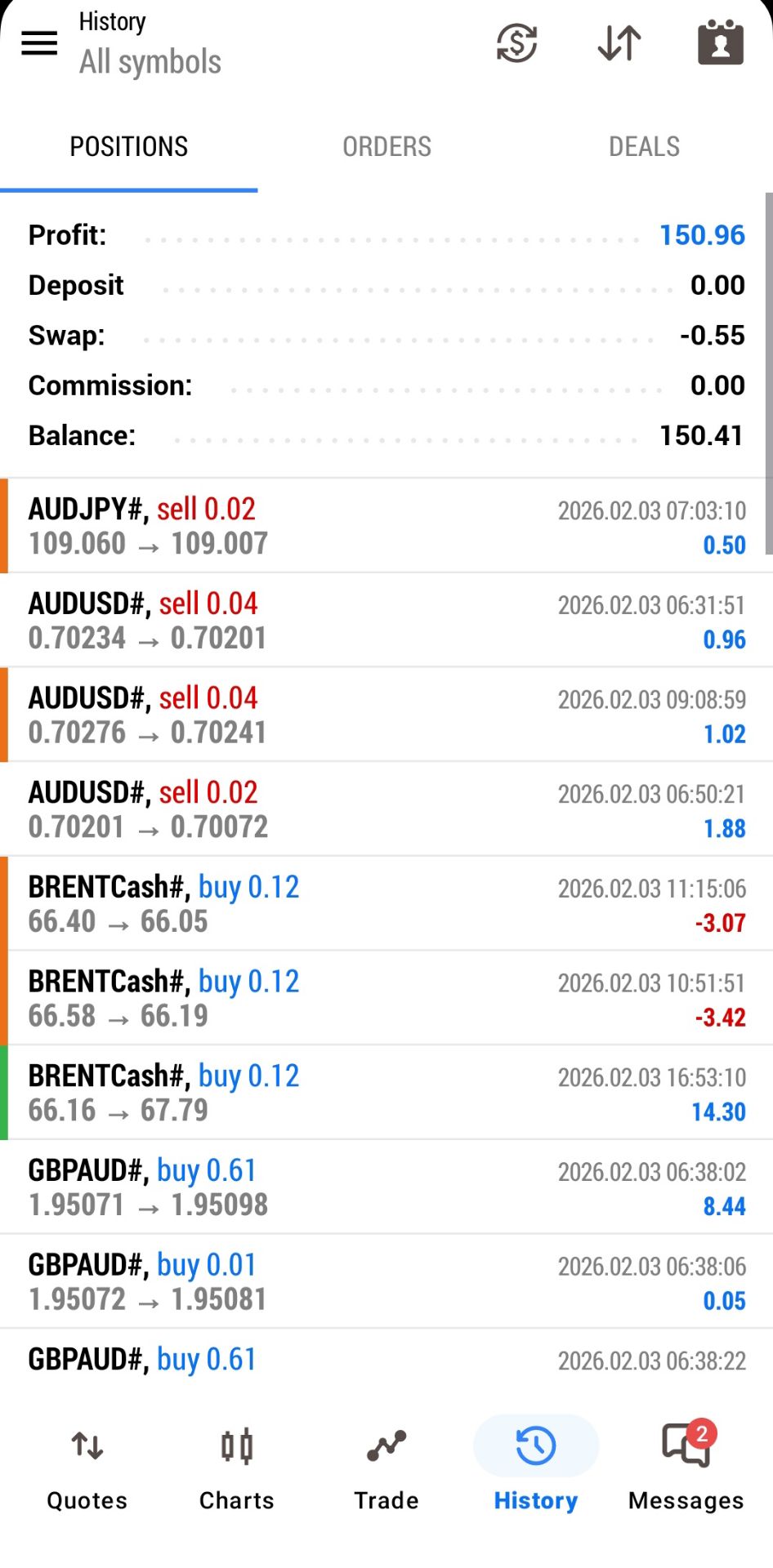
    yesterday £150
    Nawhdir Øt flag
    Visxa Benfica flag
    Nawhdir Øt
    @Nawhdir ØtWhere are you placing the limit order?
    Visxa Benfica flag
    I see the overall trend as still downward, but there might be a short-term rebound
    SlowBear ⛅ flag
    Nawhdir Øt
    @Nawhdir ØtOh okay so you are not in any Gold yet you are still watching?
    Nawhdir Øt flag
    Nawhdir Øt flag
    now, I haven't achieved anything, neither profit nor loss 🤣🤣
    SlowBear ⛅ flag
    Nawhdir Øt
    @Nawhdir ØtWow, yesterday was a blessing and it all started with £9 i believe
    Size flag
    Nawhdir Øt
    now, I haven't achieved anything, neither profit nor loss 🤣🤣
    @Nawhdir Øtsometimes that’s actually a win in itself!
    SlowBear ⛅ flag
    Nawhdir Øt
    @Nawhdir Øt So how much have you made today?
    Size flag
    No loss means your capital is safe, and you’re still in the game for the setups that really matter@Nawhdir Øt
    SlowBear ⛅ flag
    Nawhdir Øt
    now, I haven't achieved anything, neither profit nor loss 🤣🤣
    @Nawhdir Øtoh today has been flat, i thought you closed the brent trade today?
    Size flag
    Patience pays, sometimes doing nothing is the most profitable move..
    "JOSHUA" recalled a message
    JOSHUA flag
    Buy AU right now, it's preparing to break through 5100
    Type here...
    Add Symbol or Code

      No matching data

      All
      Trump Updates
      Recommend
      Stocks
      Cryptocurrencies
      Central Banks
      Featured News
      • All
      • Russia-Ukraine Conflict
      • Middle East Flashpoint
      • All
      • Russia-Ukraine Conflict
      • Middle East Flashpoint
      Search
      Products

      Charts Free Forever

      Chats Q&A with Experts
      Screeners Economic Calendar Data Tools
      Membership Features
      Data Warehouse Market Trends Institutional Data Policy Rates Macro

      Market Trends

      Market Sentiment Order Book Forex Correlations

      Top Indicators

      Charts Free Forever
      Markets

      News

      News Analysis 24/7 Columns Education
      From Institutions From Analysts
      Topics Columnists

      Latest Views

      Latest Views

      Trending Topics

      Top Columnists

      Latest Update

      Signals

      Copy Rankings Latest Signals Become a signal provider AI Rating
      Contests
      Brokers

      Overview Brokers Assessment Rankings Regulators News Claims
      Broker listing Forex Brokers Comparison Tool Live Spread Comparison Scam
      Q&A Complaint Scam Alert Videos Tips to Detect Scam
      More

      Business
      Events
      Careers About Us Advertising Help Center

      White Label

      Broker API

      Data API

      Web Plug-ins

      Affiliate Program

      Awards Institution Evaluation IB Seminar Salon Event Exhibition
      Vietnam Thailand Singapore Dubai
      Fans Party Investment Sharing Session
      FastBull Summit BrokersView Expo
      Recent Searches
        Top Searches
          Markets
          News
          Analysis
          User
          24/7
          Economic Calendar
          Education
          Data
          • Names
          • Latest
          • Prev

          View All

          No data

          Scan to Download

          Faster Charts, Chat Faster!

          Download App
          English
          • English
          • Español
          • العربية
          • Bahasa Indonesia
          • Bahasa Melayu
          • Tiếng Việt
          • ภาษาไทย
          • Français
          • Italiano
          • Türkçe
          • Русский язык
          • 简中
          • 繁中
          Open Account
          Search
          Products
          Charts Free Forever
          Markets
          News
          Signals

          Copy Rankings Latest Signals Become a signal provider AI Rating
          Contests
          Brokers

          Overview Brokers Assessment Rankings Regulators News Claims
          Broker listing Forex Brokers Comparison Tool Live Spread Comparison Scam
          Q&A Complaint Scam Alert Videos Tips to Detect Scam
          More

          Business
          Events
          Careers About Us Advertising Help Center

          White Label

          Broker API

          Data API

          Web Plug-ins

          Affiliate Program

          Awards Institution Evaluation IB Seminar Salon Event Exhibition
          Vietnam Thailand Singapore Dubai
          Fans Party Investment Sharing Session
          FastBull Summit BrokersView Expo

          US REITs set for rebound in 2026 as rate cuts and valuation gap drive 17% return

          Investing.com
          BRIXMOR PROPERTY GROUP INC.
          +0.60%
          Alphabet-A
          -1.16%
          Equinix, Inc. Common Stock REIT
          -1.06%
          Amazon
          -1.79%
          Netflix
          -3.41%
          Summary:

          Investing.com -- U.S. REITs are positioned for a rebound in 2026 after several years out of favor, as lower interest rates,...

          Investing.com -- U.S. REITs are positioned for a rebound in 2026 after several years out of favor, as lower interest rates, improving earnings growth and discounted valuations set up a recovery.

          BMO Capital Markets forecasts a 17% total return for the sector next year, driven by a roughly 4% dividend yield, mid-single-digit growth in funds from operations and modest multiple expansion.

          .


          REITs are trading at about a 15% discount to net asset value, a gap BMO expects to narrow as transaction activity picks up through mergers, asset sales and share repurchases.

          BMO sees slowing job growth continuing into 2026, but expects consumer spending to remain resilient, supported by steady wage growth and larger income tax refunds.

          That backdrop, combined with easing financial conditions, underpins its more constructive view on REIT earnings after four weak years.

          BMO favors affordable residential exposure in Sunbelt markets, data centers, full-service lodging, senior housing and select office markets in New York City and the Sunbelt.

          It is Neutral on industrial, net lease, retail, single-family rentals and storage, and less constructive on cell towers, coastal apartments, medical office buildings and West Coast office.

          Data center REITs are expected to rebound after underperforming in 2025, with BMO highlighting Digital Realty and Equinix as beneficiaries.

          Sunbelt-focused residential names are also preferred as affordability becomes a key policy focus ahead of U.S. midterm elections.

          BMO’s top REIT picks for 2026 are Broadstone Net Lease Inc (NYSE:BNL),  Brixmor Property (NYSE:BRX), CareTrust REIT, Equinix Inc (NASDAQ:EQIX), Independence Realty Trust, Vornado Realty Trust and Welltower.

          The firm also sees select lodging and observatory owners benefiting from large global events scheduled for 2026, which could lift travel and tourism demand.

          Risk Warnings and Disclaimers
          You understand and acknowledge that there is a high degree of risk involved in trading. Following any strategies or investment methods may lead to potential losses. The content on the site is provided by our contributors and analysts for information purposes only. You are solely responsible for determining whether any trading assets, securities, strategy, or any other product is suitable for investing based on your own investment objectives and financial situation.
          Add to Favorites
          Share

          Goldman downgrades Mattel as tariff pressures and valuation limit upside in 2026

          Investing.com
          Amazon
          -1.79%
          Advanced Micro Devices
          -1.69%
          Mattel
          -0.24%
          Apple
          -0.20%
          Netflix
          -3.41%

          Investing.com -- Goldman Sachs downgraded Mattel Inc (NASDAQ:MAT) to Neutral from Buy, citing the stock’s recent outperformance and growing caution around the consumer and macro backdrop for toys in 2026.

          Stock has gained roughly 9% vs a 2% rise in S&P500.  

          At roughly 12 times expected 2026 earnings, Goldman said the stock has moved back toward the middle of its recent trading range, leaving less scope for further multiple expansion.

          Goldman kept its $21 price target and raised its 2026 revenue and adjusted EPS estimates modestly, driven by a slightly improved outlook for Hot Wheels and third-party intellectual property.

          The bank said tariff-related price increases remain an overhang on demand, with the risk that higher prices are increasingly borne by consumers as promotions fade.

          Goldman also flagged pressure on lower-income shoppers, which it expects to weigh disproportionately on toy demand next year. It said sales trends in the first half of 2026 will be key to gauging how much pricing elasticity is starting to bite.

          Goldman is also more cautious on the contribution from Mattel’s newer growth initiatives. It said recent film releases tied to Mattel’s intellectual property have not yet delivered a material lift to revenue, leading the bank to temper expectations for a stronger film slate in 2026 without clearer data points from the company.

          Mattel’s self-published video game strategy remains relatively small in the context of group financials, limiting near-term upside, while the benefits from product innovation across core brands such as Barbie and Fisher-Price are still unproven.


          Risk Warnings and Disclaimers
          You understand and acknowledge that there is a high degree of risk involved in trading. Following any strategies or investment methods may lead to potential losses. The content on the site is provided by our contributors and analysts for information purposes only. You are solely responsible for determining whether any trading assets, securities, strategy, or any other product is suitable for investing based on your own investment objectives and financial situation.
          Add to Favorites
          Share

          S&P 500 hits record high after mixed December payrolls release

          Investing.com
          Apple
          -0.20%
          Advanced Micro Devices
          -1.69%
          NVIDIA
          -2.84%
          Amazon
          -1.79%
          Tesla
          +0.04%

          Investing.com-- U.S. stocks traded higher, as investors digested a highly-anticipated monthly jobs report and noted that the Supreme Court will not deliver a ruling on the legality of the Trump administration’s global tariffs policy on Friday.

          At 10:32 ET (15:32 GMT), the blue-chip Dow Jones Industrial Average had gained 189 points, or 0.4%, the benchmark S&P 500 index advanced 35 points, or 0.5%, and the tech-heavy NASDAQ Composite rose 160 points, or 0.7%.

          The indices are on track for a winning week, with the S&P 500 up about 0.9% week to date, while the Dow and Nasdaq have gained 1.8% and 1.1%, respectively, before today’s movements..

          Get premium stock market updates, analyst recommendations on InvestingPro

          Mixed December jobs reading

          The U.S. economy added 50,000 jobs in December, down from 56,000 in November, according to Labor Department data on Friday. Economists had anticipated a reading of 66,000.

          November’s total was also revised lower from 64,000 initially. The Labor Department’s Bureau of Labor Statistics flagged that October’s decline in payrolls was revised lower by 68,000 to a loss of 173,000.

          With the revisions, employment in October and November combined is 76,000 lower than previously reported, a trend that the BLS said resulted from additional information received from businesses and government agencies since the last published estimates and from the recalculation of seasonal factors.

          However, the unemployment rate edged down to 4.4%, compared to forecasts that it would match November’s revised level of 4.5%.

          "Overall, these numbers are consistent with the current narrative of improving economic momentum, but not so robust that the Fed will be forced to pivot aggressively in a hawkish direction," said analysts at Vital Knowledge, in a note.

          Investors have been closely monitoring job market data, as the figures may hold sway over the future trajectory of Fed interest rate policy. The central bank slashed rates multiple times last year in a bid to bolster a weakening labor market, even as inflation showed signs of stickiness.

          Markets are currently pricing in two more 25-basis-point rate cuts in 2026.

          No Supreme Court tariffs ruling issued

          Elsewhere, the U.S. Supreme Court did not unveil a decision on President Donald Trump’s tariffs, despite expectations that one could have come today.

          At issue is Trump’s use of emergency economic powers enshrined in a 1977 law to impose the levies. Speaking at hearings in November, justices from both conservative and liberal justices voiced some skepticism around Trump’s claims.

          Should the tariffs be reversed, the U.S. government could be forced to issue an estimated $150 billion in refunds for duties already paid by importers.

          Crude set for weekly gains

          Oil prices rose Friday, on course for another weekly gain, as developments in Venezuela and Iran threatened to disrupt global supplies.

          Brent futures gained 2.2% to $63.36 a barrel and U.S. West Texas Intermediate crude futures rose 2.6% to $59.25 a barrel.

          Both benchmark prices climbed more than 3% on Thursday, following two straight days of declines, putting the contracts on course for weekly gains of around 2%, the third in a row.

          Civil unrest in major Middle Eastern producer Iran has added to concerns about global supply following the Trump administration’s seizure of Venezuela President Nicolas Maduro last week and his claims the U.S. will control the South American country’s oil sector.

          President Trump said he will meet with executives from a host of large oil companies on Friday to discuss the fate of Venezuela’s vast oil reserves.

          Ayushman Ojha and Scott Kanowsky contributed to this article.

          Risk Warnings and Disclaimers
          You understand and acknowledge that there is a high degree of risk involved in trading. Following any strategies or investment methods may lead to potential losses. The content on the site is provided by our contributors and analysts for information purposes only. You are solely responsible for determining whether any trading assets, securities, strategy, or any other product is suitable for investing based on your own investment objectives and financial situation.
          Add to Favorites
          Share

          Top Supermarket Stocks to Watch in 2026: Kroger Leads Value Plays

          Investing.com
          Albertsons Companies
          +3.50%
          Apple
          -0.20%
          Advanced Micro Devices
          -1.69%
          Public Service Enterprise Group
          +1.56%
          NVIDIA
          -2.84%

          Investing.com -- The supermarket sector presents compelling investment opportunities for 2026, with several chains offering attractive valuations despite ongoing industry challenges. According to WarrenAI’s analysis using Investing Pro metrics, these grocery retailers stand out for their combination of value, growth potential, and stability.

          Kroger leads the pack as the top supermarket stock for defensive investors in 2026. Despite a modest 3.6% one-year return, the company trades below both its fair value of $63.58 and analyst target of $73.86, offering 6.5% upside according to InvestingPro. With a solid 2.0% dividend yield and a forward P/E of 12.0x, Kroger presents quality at a discount.

          Examine more top stocks in different sectors using WarrenAI by upgrading to InvestingPro -

          1. Kroger (NYSE:KR): Trading at $59.68, Kroger offers value and stability with a 2.0% dividend yield and a Pro Score of 2.17. The company’s forward PEG ratio of 0.62 indicates significant growth potential relative to its current valuation. The company’s EPS growth is forecast above 35%, with a low forward PEG ratio of 0.62 signaling undervaluation. Recent asset sales and a renewed focus on core grocery operations suggest a leaner, more focused business moving forward. While technicals appear bearish short-term, the fundamentals look strong for a potential rebound.

          2. Albertsons Companies (NYSE:ACI): At $16.81, Albertsons represents a deep value play with considerable risk. Despite a -13.8% one-year return, it trades at an attractive forward P/E of 7.5x and PEG of 0.32. Analysts see substantial upside to $22.35 (32.9% above current price), though InvestingPro’s fair value of $15.60 suggests caution. The company offers a 2.9% dividend yield and has appeared on JPMorgan’s list of top consumer stocks for 2026, despite ongoing concerns about its high debt levels.

          3. Sprouts Farmers Market (NASDAQ:SFM): Priced at $77.59, Sprouts emerges as the sector’s growth leader with the highest Pro Score (3.06) and impressive revenue growth forecast (14.1%). After suffering a steep -45% one-year decline, the stock now trades at a forward P/E of 14.4x and PEG of 0.39, potentially offering growth at a bargain. The company boasts the sector’s top ROIC at 13.0%, though analyst sentiment remains mixed with Deutsche Bank recently initiating coverage with a Hold rating and $88 target.

          4. Weis Markets (NYSE:WMK): At $65.23, Weis Markets offers defensive characteristics with the lowest debt ratio (12% D/E) and a consistent 2.0% dividend yield. Trading below its fair value of $77.34 with 18.6% potential upside, the company provides stability but limited growth prospects, as reflected in its 0% growth forecast and higher PEG ratio of 2.04. For risk-averse investors, it represents a safe option without significant upside potential.

          These supermarket stocks present varied investment profiles for 2026, from value plays to growth opportunities, allowing investors to select based on their risk tolerance and investment goals.

          This article was generated with the support of AI and reviewed by an editor. For more information see our T&C.

          Risk Warnings and Disclaimers
          You understand and acknowledge that there is a high degree of risk involved in trading. Following any strategies or investment methods may lead to potential losses. The content on the site is provided by our contributors and analysts for information purposes only. You are solely responsible for determining whether any trading assets, securities, strategy, or any other product is suitable for investing based on your own investment objectives and financial situation.
          Add to Favorites
          Share

          BMO upgrades Marriott on steadier 2026 lodging outlook and credit card upside

          Investing.com
          Amazon
          -1.79%
          NVIDIA
          -2.84%
          Apple
          -0.20%
          Advanced Micro Devices
          -1.69%
          Tesla
          +0.04%

          Investing.com -- BMO Capital Markets upgraded Marriott International Inc (NASDAQ:MAR) to Outperform, saying the hotel operator is well placed to benefit from a steadier lodging backdrop in 2026 and potential upside from its credit card partnerships.

          BMO set a $370 price target and said it has become more constructive on the sector for 2026, with Marriott standing out because of its high-end brand mix and asset-light business model.


          The firm said Marriott’s fee-based structure delivers durable growth with low capital needs, limited fixed costs and strong cash generation, supporting more than $3 billion a year in share repurchases.

          The analysts said they have previously underestimated the durability of Marriott’s growth and focused too heavily on valuation. In their view, the company’s ability to keep growing through a mixed macro backdrop supports the case for continued earnings growth and possibly further multiple expansion.

          BMO expects Marriott to outperform peers on revenue per available room growth in 2026. It views the stock as a more offensive way to play the cycle than Hilton, citing Marriott’s higher exposure to incentive management fees, luxury and full-service hotels, and international markets. Marriott has outgrown Hilton Worldwide Holdings Inc (NYSE:HLT) on RevPAR by an average of about 180 basis points between 2023 and 2025, and BMO expects that trend to continue next year.

          A key source of upside is Marriott’s credit card program. Credit card fees account for about 21% of Marriott’s franchise fees and have consistently grown faster than the company’s underlying earnings model. Since the last renewal in 2017, Marriott’s loyalty membership has more than doubled, room count has risen about 40%, and global card spending is up roughly 80%.


          BMO said this sets the stage for a favorable renewal in 2026. A conservative 10% uplift would add about 120 basis points to EBITDA growth, which the firm believes is not fully reflected in current forecasts.

          BMO flagged risks, including a muted RevPAR environment and slower unit growth compared with some peers. Still, it said the quality of Marriott’s growth and its brand mix support the upgrade despite those headwinds.


          Risk Warnings and Disclaimers
          You understand and acknowledge that there is a high degree of risk involved in trading. Following any strategies or investment methods may lead to potential losses. The content on the site is provided by our contributors and analysts for information purposes only. You are solely responsible for determining whether any trading assets, securities, strategy, or any other product is suitable for investing based on your own investment objectives and financial situation.
          Add to Favorites
          Share

          Our Roundtable Pros See More Gains for Stocks, Especially Those Left Behind Until Now — Barrons.com

          Dow Jones Newswires
          NVIDIA
          -2.84%

          By Lauren R. Rublin

          If the stock market climbs a wall of worry, that wall is getting higher by the day. Take your pick: Pricey valuations, index concentration, circular finance, sticky inflation, and government debt are just a few of investors' many concerns. Then there is geopolitics, which took a shocking turn on Jan. 3 with the capture of Venezuela's president, Nicolás Maduro, and his wife by U.S. troops.

          Yet, for all the worries, old and new, most of the investors on the Barron's Roundtable were in a chipper mood this year at our annual gathering, which took place Jan. 5 in New York. Most expect the U.S. stock market's growth streak to continue in 2026, fueled by rising earnings, falling interest rates, government stimulus, and consumer spending. What's more, they see many thriving companies whose stocks have yet to join the multiyear party on Wall Street — but soon will.

          No surprise, the future of artificial intelligence was an overarching Roundtable theme. Whether it lowers "the marginal cost of human intelligence to zero," as one panelist declared, or falls short of its promise, as another suggested, it is driving massive corporate spending and economic growth right now. Just for fun, we asked these 11 seers to identify other megatrends that will capture investors' attention in coming years. Their answers were varied and illuminating.

          This week's edited Roundtable installment features the panelists' macro forecasts, including those of our newest Roundtable member, Christopher Rossbach, chief investment officer of J. Stern, a London-based investment firm, and manager of its World Stars Global Equity strategy. Chris is well versed in global investing and a die-hard fan of quality stocks, wherever they are traded.

          We also include here the 2026 investment picks of John W. Rogers Jr., the founder, chairman, co-CEO, and chief investment officer of Ariel Investments, and Sonal Desai, chief investment officer and portfolio manager at Franklin Templeton Fixed Income. John continues to hold out hope for a long-overdue rally in small and mid-cap stocks, five of which he explores in detail. Sonal likes the prospects for seven fixed-income-oriented funds, and sees even more gains for gold.

          We'll roll out the rest of the panelists' picks in the next two weeks. Read on for the first Roundtable update.

          Barron's : This year began with a bang — in Caracas. Where to from here for the markets, if not the world? Rajiv, kick things off.

          Rajiv Jain: Our market view has shifted in the past 12 to 15 months. We believe the economy is softening across the board. We are seeing one- to three-year highs in the unemployment rate across almost all major nations. Inflation is unchanged, or higher. Interest rates are higher almost everywhere, except in China. Deficits are at a record percentage of GDP [gross domestic product]. There is still stimulus in the system.

          The biggest driver of the economy seems to be the frothy stock market, which has seen a capex [capital expenditure] cycle, driven by AI. We are seeing signs of extreme late-cycle behavior, for example, in the debt financing of data centers. More than 60% of data centers are being built outside of hyperscalers [massive cloud computing companies] with heavy debt usage, far greater than in the dot-com era. Equity valuations are extremely high. In our view, you aren't getting paid to take risks. And that is without discussing geopolitics.

          Where will the S&P 500 end the year?

          Jain: We see significant downside to the market. A significant portion of earnings revisions are coming from capex. If Microsoft spends $100, it can write off that expense over a six- to 10-year period. But it shows up in revenue and earnings almost immediately at Nvidia or Broadcom or Amphenol. We believe earnings growth is going to slow down meaningfully for the biggest technology companies, not to mention semiconductor companies. We see the rate of change in capex peaking in 2025.

          The biggest tech stocks driving the market are the companies ramping up capex. Amazon.com's capital spending is on track to be higher than its AWS [Amazon Web Services cloud computing] revenue. Google's capex is much higher than its cloud revenue. The company's margins went from 5% in 2023 to 22% last year as depreciation was extended to six years from three years. Go back four years, and the business was losing money on a net basis. We believe the true economic life of GPUs [graphics processing units] or TPUs [tensor processing units] is closer to three years.

          The market for public cloud appears to be 90%-plus penetrated. The market leaders' growth has slowed. Public cloud and advertising are two key drivers for hyperscalers, but digital advertising penetration is also reaching 75% globally. The Magnificent Seven [ Alphabet, Amazon.com, Apple, Meta Platforms, Microsoft, Nvidia, and Tesla] are mature, with slowing revenue growth and declining free cash flow. That should have a negative impact on the market — and that assumes no blowup in the bond market or anything like that.

          Can you estimate per-share depreciation costs across the Mag Seven?

          Jain: It is hard to specify on a per-share basis, but in Alphabet's case, there could be a six to seven percentage-point hit to earnings in 2026.

          Also, we believe that stock-based compensation is becoming an issue. At Meta Platforms, SBC was 10% of revenue for the four quarters ended September 2025. Amazon's cumulative free cash flow in the past five years was lower than that of Philip Morris International. Free cash flow is meaningfully deteriorating across almost all of the large tech companies. Google hasn't seen any growth in free cash flow since 2021 once you adjust for SBC-related flows, even as its market capitalization has doubled. If the biggest tech stocks and semiconductor names fall, that will take down the broader market.

          Who wants to take the other side of this trade?

          Todd Ahlsten: I can. We remain positive on the market. We have a year-end target for the S&P 500 of 7500 to 7800. That presumes a price/earnings multiple of 22 to 23 times earnings, on $340 in 2027 earnings. We consider four factors: What does the S&P 500 look like as an asset class? Is the AI buildout a generational theme? How does the U.S. economy look? Our fourth consideration is global liquidity.

          To break them down, the S&P 500 is an incredible collection of companies, unmatched globally, that are investing in leading-edge technologies. The reinvestment rate in the U.S., or capex plus research-and-development spending divided by operating cash flow, is about 50% higher than in the rest of the world. U.S. companies continue to innovate, generate higher returns on capital, and widen their moats. They are in the catbird seat to monetize AI.

          Rajiv mentioned potential cracks in the AI story, but we think this is a generational investment theme. Companies will invest multiple hundreds of billions of dollars annually for many years to come. There will be some rugged terrain, and perhaps supply-chain and power shortages and drawdowns in certain stocks. But AI will lead to a massive wave of productivity, and be a moat-widening event for U.S. companies.

          Third, the U.S. economy looks pretty good in 2026. We expect growth of 2% to 2.5%. The economy has been incredibly resilient no matter geopolitics, policy variability, or the level of interest rates. With the midterm elections approaching, we are going to get fiscal and monetary support. Ultimately, we will have to pay for it, but it could be supportive of markets this year.

          Likewise, global liquidity will be a tailwind for asset prices in 2026. U.S. regulators are lowering banks' SLR [supplementary leverage ratios], which will free up capital. The Federal Reserve will probably cut interest rates a couple of times, and $10 trillion of U.S. debt will mature.

          This could be a topping year for the market given all the fiscal and monetary stimulus, and the AI-buildout narrative could top for a bit. But we see upside to double-digit market returns in 2026. There are a lot of good places to invest.

          Christopher Rossbach: As Charlie Munger, Warren Buffett's late business partner, said, "Micro is what we do, macro is what we put up with." We have had to put up with a lot of macro. I agree with Todd on the macro. The economy still looks robust. AI is a transformational technology, given the opportunity it affords to achieve productivity gains, and we think we are at the beginning of that process. We don't yet have the computing capacity, infrastructure, or applications to fully realize its potential.

          Turning to the markets, however, valuations are much fuller than they had been. We have had 10 to 15 years of solid index returns. A lot of companies aren't just fully valued, but overvalued. Stock-picking is going to matter much more than it did. The index era is basically over. There are some great companies with good growth prospects selling at reasonable valuations, and other companies, particularly in the consumer space, that could turn around. These consumer companies are the cheapest part of the market, and could offer great opportunities this year.

          Every year, it seems, this group declares it a stockpicker's market. Yet stock market indexes such as the S&P 500 and Nasdaq Composite gain even more altitude and prove difficult to beat. Why will 2026 be any different?

          John W. Rogers Jr.: There is more pressure to own the leading stocks in the indexes than I have ever seen. When people buy the same stocks just because they dominate the indexes, it is a sign of a market top. The Mag Seven account for 50% of the returns of the S&P 500. In the 12 months ended Sept. 30, if mid-cap growth managers didn't match the Russell Midcap Growth Index exposure to Palantir Technologies and AppLovin, it resulted in a 9% lag to the index.

          I come from Chicago. The University of Chicago helped to make indexing popular. I have a lot of respect for the great thinkers such as [Vanguard founder] Jack Bogle and [economist] Burton Malkiel, who argued that indexing is the smartest investment strategy. But capitalization-weighted indexes have become concentrated today in so few stocks and industries that benchmarking investments to an index could lead to massive underperformance in the next five to 10 years. We expect that to open the door to a new period of stock-picking.

          Ahlsten: S&P 500 companies, ex-the Mag Seven, are in an unbelievable position to monetize the massive investment wave in AI, widen their moats, and drive higher margins and earnings growth. They account for more than 70% of the index's expected 2026 net income, and they are undervalued. Some people think an AI selloff could lead to a market crash. I look at it another way: These companies have a massive opportunity.

          Rogers: I'll add one other thing. Warren Buffett bought stocks in the Dow Jones Industrial Average when he started out in the 1960s. The Dow 30 reflected domestic industries. It was considered a great index. The S&P 500, with 500 names, was later thought to be even better. I haven't read any academic research about this, but maybe today's index isn't what it was supposed to be. Maybe it has morphed into something different than what its creators had thought. Everyone drinks the Kool-Aid and wants to own the index. But no one is doing the research to see whether equity indexes are as well constructed and relevant today as they were in the past.

          Abby Cohen: I want to talk about valuations. If stocks are inexpensive, investors can deal with unpleasant news. But if they are fully priced, or pricing in a scenario that is wonderful, that is a risky situation with little margin for error.

          The S&P 500, which is market-cap weighted, is trading for about 23 times forward earnings. On an equal-weight basis, it is trading for 17 times earnings. The gap is extraordinary, and speaks to the point others have raised: The opportunities from a valuation perspective aren't in the large-cap names any longer. They are in smaller-cap names.

          If you take a more rigorous valuation approach based on discounted cash flow, the S&P 500 is in challenging territory. Thus, I find myself looking not only at the pleasant consensus economic and earnings forecasts, but also at what could go wrong. There is a long list in 2026.

          What are your biggest concerns?

          Cohen: AI-related capex has pushed up not only S&P 500 earnings but also U.S. GDP in the past couple of years. We should think about what will happen in the likely event this spending slows.

          Another area of concern is private credit. A lot of money is going into this area, which has allowed companies to stay private for longer. But there is a lack of transparency regarding the quality and value of these investments.

          I worry about crypto. Only a fraction of crypto-related transactions are for economic purposes. As crypto has become more widely used in the U.S., often through stablecoins, the use of margin debt has increased. Stablecoins can be backed by U.S. Treasuries but also by uninsured deposits at the issuing institution. There has also been a weakening of regulatory oversight and little international coordination.

          We haven't talked about the U.S. debt situation. The federal debt has been growing, which is unusual when the economy is doing well. The Congressional Budget Office estimates that the 2025 omnibus spending bill will add $3.5 trillion to the debt over the next decade, and it isn't assuming a recession. An increase of this magnitude is disturbing.

          Another potential risk relates to threats to Federal Reserve independence, which has been critical to our success as a nation and the dollar's status as a reserve currency. Lastly, for now, if the U.S. feels comfortable going into Venezuela, the Chinese may feel more comfortable going into Taiwan, which is vulnerable to naval blockades. There is also a global reliance on Taiwan's tech sector, which supplies 25% of memory chips and 45% of logic chips. Any destabilization there is a potential problem.

          Most of these concerns pertained to last year, too, yet the market rose. Where do you expect stocks to end this year?

          Cohen: My earnings outlook isn't as robust as Todd's, so I see a valuation for the S&P 500 in a range of 6700 to 7000. I don't see large gains for the index, but I see a rotation into stocks that haven't been winners, as Chris discussed. Some parts of the U.S. market offer good value. The U.S. consumer looks pretty solid. There are opportunities in healthcare, and diversification into international stocks makes sense. Last year I spoke about opportunities in some of the markets in East Asia. They did well because they were inexpensive and had good earnings growth. I would expect a rotation into some other markets this year. Later I will talk about India.

          Sonal, what is the outlook for fixed income?

          Sonal Desai: First, I want to talk about Venezuela. What happened wasn't unprecedented. The U.S. has a history of intervening in Latin America. We did it in Panama in 1989. What happens next is unclear.

          Medium term, U.S. involvement should send oil prices lower. Venezuela was supplying around 800,000 barrels a day in the recent past, down from well over three million in the 1990s. I keep reading about the U.S. robbing Venezuela, but American oil companies had their Venezuela facilities expropriated in 2007. If U.S. and international companies can begin producing oil again in Venezuela, the price of crude will eventually come down. That could be negative for Canada, the other supplier of heavy crude, and the Canadian dollar. From the bond market's perspective, one implication would be the possible restructuring of PDVSA's [Petróleos de Venezuela's] debt, and Venezuela's sovereign debt.

          The first several people who spoke today had little to say about Venezuela, which gets to the broader impact, or lack thereof, on markets. This particular geopolitical development is unlikely to have a substantial or lasting impact on markets.

          Regarding the economy, my GDP forecast tops Todd's. I expect the U.S. economy to grow by 2.75% to 3% this year.

          Ahlsten: I like that.

          Desai: Consumption will be strong owing to fiscal tailwinds. Whether the deficit should have been expanded in the way it was expanded is a separate matter from the growth impact. Then, if the government sends out $2,000 tariff-rebate checks, as has been discussed, that will be substantially more even than the $1,400 helicopter drop in the first quarter of the Biden administration. The overall fiscal impulse will have a significant impact on consumption and inflation.

          Second, the hyperscalers will have spent close to a trillion dollars from 2025 to 2026. That adds to the supportive growth backdrop. Third, the changing regulatory regime is important to the extent that it gets banks back into the business of lending.

          Banks make money when there is an upward-sloping [Treasury] yield curve, and I expect the yield curve to steepen significantly this year. I would expect inflation to remain at the current 2.75% to 3% annual rate. The Fed shouldn't have cut rates by 25 basis points in December. [A basis point is a hundredth of a percentage point.] I don't think two more rate cuts are warranted this year. We might get one cut, but even that isn't currently called for.

          I tend to be less alarmed than others about the issue of Fed independence, largely because we already have a dovish Fed. We haven't had a hawkish Fed chair since Paul Volcker. That said, further loosening [of monetary policy] would be a mistake at this point. I have said for a while that I think the neutral federal-funds rate [the rate that neither stimulates nor restricts growth] is closer to 4% than 3%. If additional rate cuts take the fed-funds rate down to 3.00% to 3.25%, we will essentially be looking at zero real rates.

          That isn't a good place for an economy with productivity growth of 2.25% to 2.50% and inflation running close to 3%. The 10-year Treasury yield is higher today than it was before 1.75 percentage points of rate cuts. Clearly, the market is paying attention to inflation and the fiscal outlook. The 10-year Treasury yield could scale 4.50% this year, and approach 5% with significant further fiscal expansion.

          Against this backdrop, I wouldn't be looking for major spread compression in fixed income. Emerging markets look attractive. The dollar came into last year overvalued against other currencies, and is now close to fair value against the euro. It is massively overvalued against the yen.

          Scott Black: The accumulated national debt is $38.6 trillion, or 1.22 times nominal GDP. Money supply has been growing, and the Fed is no longer winding down its balance sheet. To the contrary, balance-sheet assets have been creeping up a bit. We have a $1.7 trillion fiscal deficit. The Fed is buying short-term paper. Who is going to fund long-term bonds? If the 10-year yield goes up to 4.5% to 5%, does that change the ballgame for the equity market?

          Scott, you may have answered your own question.

          Henry Ellenbogen: Every year there are reasons to be concerned, and this year is no different. I recently reread last year's Roundtable. Only two panelists thought the market would go up in 2025: Todd and me. I have the same concerns as the rest of you, and if the 10-year Treasury yield breaks 5%, the stock market will struggle.

          We should also be concerned about the U.S. relationship with China. The issue isn't Venezuela. But if you believe the bond market and our relationship with China are under control, there are reasons to be positive about stocks.

          Risk Warnings and Disclaimers
          You understand and acknowledge that there is a high degree of risk involved in trading. Following any strategies or investment methods may lead to potential losses. The content on the site is provided by our contributors and analysts for information purposes only. You are solely responsible for determining whether any trading assets, securities, strategy, or any other product is suitable for investing based on your own investment objectives and financial situation.
          Add to Favorites
          Share

          iHeartMedia stock falls after Goldman Sachs downgrade to Sell

          Investing.com
          Amazon
          -1.79%
          NVIDIA
          -2.84%
          Advanced Micro Devices
          -1.69%
          Tesla
          +0.04%
          iHeartMedia
          -3.02%

          Investing.com -- iHeartMedia Inc Class A (NASDAQ:IHRT) stock fell 4.2% on Friday after Goldman Sachs downgraded the audio entertainment company from Neutral to Sell, citing concerns about changing consumption and advertising trends.

          Goldman Sachs analyst Stephen Laszczyk lowered his price target on iHeartMedia to $3.50 from $4.00, representing a potential 16% downside from current levels. The downgrade follows a significant rally in the stock, which has gained 123% in 2025.

          Laszczyk expressed growing concerns about the company’s ability to "sustain top-line multi-platform audio trends" amid evolving audio consumption and advertising patterns. The analyst also highlighted concerns about iHeartMedia’s free cash flow generation, which has underperformed Goldman’s expectations this year.

          The media company faces significant debt obligations, with $5.1 billion coming due through 2031, adding pressure to its financial outlook. This debt burden makes the company’s ability to generate free cash flow particularly critical.

          iHeartMedia operates across multiple audio platforms including broadcast radio stations, digital streaming services, and podcasts. The company has been working to transform its business model to adapt to the digital audio landscape, but faces intense competition from streaming services and changing listener habits.

          This article was generated with the support of AI and reviewed by an editor. For more information see our T&C.

          Risk Warnings and Disclaimers
          You understand and acknowledge that there is a high degree of risk involved in trading. Following any strategies or investment methods may lead to potential losses. The content on the site is provided by our contributors and analysts for information purposes only. You are solely responsible for determining whether any trading assets, securities, strategy, or any other product is suitable for investing based on your own investment objectives and financial situation.
          Add to Favorites
          Share
          FastBull
          Copyright © 2026 FastBull Ltd

          728 RM B 7/F GEE LOK IND BLDG NO 34 HUNG TO RD KWUN TONG KLN HONG KONG

          TelegramInstagramTwitterfacebooklinkedin
          App Store Google Play Google Play
          Products
          Charts

          Chats

          Q&A with Experts
          Screeners
          Economic Calendar
          Data
          Tools
          Membership
          Features
          Function
          Markets
          Copy Trading
          Latest Signals
          Contests
          News
          Analysis
          24/7
          Columns
          Education
          Company
          Careers
          About Us
          Contact Us
          Advertising
          Help Center
          Feedback
          User Agreement
          Privacy Policy
          Personal Information Protection Statement
          Business

          White Label

          Broker API

          Data API

          Web Plug-ins

          Poster Maker

          Affiliate Program

          Risk Disclosure

          The risk of loss in trading financial instruments such as stocks, FX, commodities, futures, bonds, ETFs and crypto can be substantial. You may sustain a total loss of the funds that you deposit with your broker. Therefore, you should carefully consider whether such trading is suitable for you in light of your circumstances and financial resources.

          No decision to invest should be made without thoroughly conducting due diligence by yourself or consulting with your financial advisors. Our web content might not suit you since we don't know your financial conditions and investment needs. Our financial information might have latency or contain inaccuracy, so you should be fully responsible for any of your trading and investment decisions. The company will not be responsible for your capital loss.

          Without getting permission from the website, you are not allowed to copy the website's graphics, texts, or trademarks. Intellectual property rights in the content or data incorporated into this website belong to its providers and exchange merchants.

          Not Logged In

          Log in to access more features

          Connect Broker
          Become a signal provider
          Help Center
          Customer Service
          Dark Mode
          Price Up/Down Colors

          Log In

          Sign Up

          Position
          Layout
          Fullscreen
          Default to Chart
          The chart page opens by default when you visit fastbull.com