


- XAUUSD
- XAGUSD
- WTI
- USDX



Markets
Analysis
User
24/7
Economic Calendar
Education
Data
- Names
- Latest
- Prev












Key takeaways AMD beats on the quarter, led by data-centre strength, but investors focus on what comes next.
· AMD beats on the quarter, led by data-centre strength, but investors focus on what comes next.
· China-related AI chip shipments lift revenue, yet they also muddy margins and visibility.
· The key 2026 question is repeatability: more named deals, more volume, and clearer timing.
Late on 3 February 2026 in the US, and early 4 February 2026 in Europe, Advanced Micro Devices (AMD) reports a strong quarter. Then the share price falls in after-hours trading. That sounds contradictory, but it is actually very normal in the artificial intelligence era.
AMD's numbers say "we are executing". The market's reaction says "show me the next step". In plain terms: this is not a test of whether demand exists. It is a test of whether amd can turn demand into a predictable, repeatable business that investors can model with confidence.
That is the hook. Amd is trying to move from "credible challenger" to "credible alternative". The difference is not marketing. It is a steady flow of shipments, margins, and customer wins that do not require a footnote.
Start with what works. AMD reports fourth-quarter revenue of 10.3 billion USD and adjusted earnings per share (earnings per share is profit per share) of 1.53 USD. Data-centre revenue, the part most linked to artificial intelligence spending, rises 39% year on year to about 5.4 billion USD.
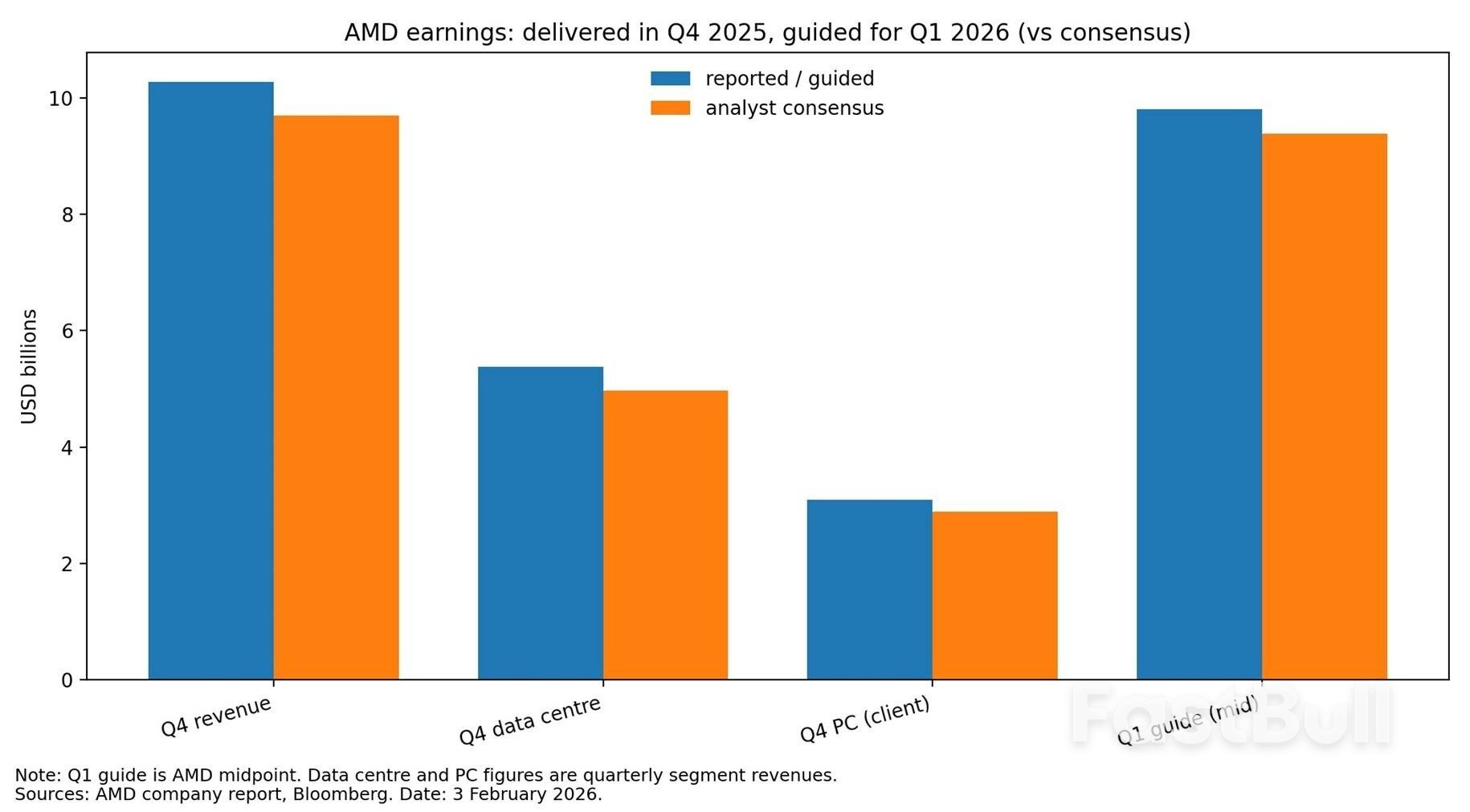
Data centres are the factories of modern software, and AMD is selling more machines into those factories. That matters because data-centre chips tend to be higher value than many consumer chips. It is also where long-term growth lives, because cloud companies and large enterprises keep building computing capacity.
The client side also improves. Pc-related revenue rises, helped by demand for newer pc chips and market share gains. This is not as fashionable as artificial intelligence, but it matters because it keeps the business balanced. AMD is at its best when it grows in data centres without needing the pc market to be perfect.
So why does the share price fall? Because earnings are not a history exam. They are a confidence exam.
AMD's quarter includes a material contribution from shipping older-generation Instinct MI308 data-centre graphics processing units (graphics processing units are specialised chips for heavy computing) to China. That adds revenue, and it shows AMD can operate inside export rules.
But it also creates two problems for the story investors want.
First, it can pressure margins. AMD itself points out that if you strip out both the inventory reserve reversal and the China MI308 shipments, adjusted gross margin would look lower than the headline suggests. In other words, some of the profit quality is not as clean as it appears at first glance.
Second, it reduces visibility. Those China sales are not guaranteed, and licensing for newer products remains uncertain. Management signals that China MI308 revenue falls sharply in the next quarter, which makes the near-term path bumpier.
This is not a "China is good" or "China is bad" issue. It is a "China is harder to forecast" issue. Markets dislike fog. They can handle rain.
For the first quarter of 2026, AMD guides to revenue of about 9.8 billion USD, plus or minus 0.3 billion USD. That is above the average Bloomberg analyst estimate. Yet the market reaction is negative.
The reason sits in expectations, not arithmetic.
AMD is in the shadow of a dominant rival in artificial intelligence chips. Investors are not only asking, "are you growing?". They are asking, "are you closing the gap fast enough to justify the valuation and the excitement?". Some investors were looking for a clearer acceleration, especially in the parts of the business tied to data-centre accelerators.
Management keeps a bullish long-term tone, including the idea that artificial intelligence revenue can reach the tens of billions of dollars in 2027. That might be true. The market simply wants a tighter bridge between today's shipments and that future claim.
Think of it like a new restaurant that promises it will be fully booked next year. Great. But investors still want to see the reservations for next week.
The first risk is an expectations gap. Artificial intelligence stocks can fall even on good results if the outlook does not match the market's imagination. The early warning sign is guidance that beats consensus but still fails to explain "why growth accelerates from here".
The second risk is margin noise. China mix, inventory adjustments, and product transitions can all move gross margin in ways that confuse investors. The early warning sign is a strong revenue print paired with cautious margin commentary.
The third risk is concentration. Big artificial intelligence deals often involve a small number of very large customers. That can produce lumpy quarters. The early warning sign is when growth depends on a few one-off shipments rather than a broad ramp across many customers.
· Watch data-centre revenue growth and margin commentary together. Growth without stable margins often triggers scepticism.
· Track product and platform milestones. Look for clear timelines on next-generation accelerators and systems, not only ambition.
· Listen for customer breadth. More named wins across cloud, enterprise, and public sector lowers "one big deal" risk.
· Separate "quarter quality" from "story quality". One can be strong while the other still needs proof.
AMD delivers a quarter that looks genuinely solid. Data-centre momentum improves, pcs rebound, and management sounds confident about demand. On paper, this is a company moving in the right direction.
But the share price reaction is a reminder of what artificial intelligence investing looks like in 2026. It is not enough to say the opportunity is huge. The market wants a clean chain from orders to shipments to margins, repeated quarter after quarter, with fewer special items and fewer "this part is complicated" footnotes.
AMD's challenge is simple to state and hard to execute: turn promise into a habit. When the receipts become boringly consistent, the stock reaction usually becomes boring too. That is often a compliment.

728 RM B 7/F GEE LOK IND BLDG NO 34 HUNG TO RD KWUN TONG KLN HONG KONG





The risk of loss in trading financial instruments such as stocks, FX, commodities, futures, bonds, ETFs and crypto can be substantial. You may sustain a total loss of the funds that you deposit with your broker. Therefore, you should carefully consider whether such trading is suitable for you in light of your circumstances and financial resources.
No decision to invest should be made without thoroughly conducting due diligence by yourself or consulting with your financial advisors. Our web content might not suit you since we don't know your financial conditions and investment needs. Our financial information might have latency or contain inaccuracy, so you should be fully responsible for any of your trading and investment decisions. The company will not be responsible for your capital loss.
Without getting permission from the website, you are not allowed to copy the website's graphics, texts, or trademarks. Intellectual property rights in the content or data incorporated into this website belong to its providers and exchange merchants.
Not Logged In
Log in to access more features


Log In
Sign Up


