• Trade
  • Markets
  • Copy
  • Contests
  • News
  • 24/7
  • Calendar
  • Q&A
  • Chats
Trending
Screeners
SYMBOL
LAST
BID
ASK
HIGH
LOW
NET CHG.
%CHG.
SPREAD
SPX
S&P 500 Index
6827.42
6827.42
6827.42
6899.86
6801.80
-73.58
-1.07%
--
DJI
Dow Jones Industrial Average
48458.04
48458.04
48458.04
48886.86
48334.10
-245.98
-0.51%
--
IXIC
NASDAQ Composite Index
23195.16
23195.16
23195.16
23554.89
23094.51
-398.69
-1.69%
--
USDX
US Dollar Index
97.830
97.910
97.830
98.070
97.810
-0.120
-0.12%
--
EURUSD
Euro / US Dollar
1.17566
1.17573
1.17566
1.17596
1.17262
+0.00172
+ 0.15%
--
GBPUSD
Pound Sterling / US Dollar
1.33924
1.33934
1.33924
1.33940
1.33546
+0.00217
+ 0.16%
--
XAUUSD
Gold / US Dollar
4341.43
4341.86
4341.43
4350.16
4294.68
+42.04
+ 0.98%
--
WTI
Light Sweet Crude Oil
56.993
57.023
56.993
57.601
56.878
-0.240
-0.42%
--

Community Accounts

Signal Accounts
--
Profit Accounts
--
Loss Accounts
--
View More

Become a signal provider

Sell trading signals to earn additional income

View More

Guide to Copy Trading

Get started with ease and confidence

View More

Signal Accounts for Members

All Signal Accounts

Best Return
  • Best Return
  • Best P/L
  • Best MDD
Past 1W
  • Past 1W
  • Past 1M
  • Past 1Y

All Contests

  • All
  • Trump Updates
  • Recommend
  • Stocks
  • Cryptocurrencies
  • Central Banks
  • Featured News
Top News Only
Share

Security Source: Ukrainian Drones Hits Russian Oil Infrastructure In Caspian Sea For Third Time

Share

Spot Palladium Extends Gains, Last Up 5% To $1562.7/Oz

Share

Mexico's Economy Ministry Announces Start Of Anti-Dumping Investigation And Anti-Subsidy Investigations Into USA Pork Imports

Share

Canada Nov CPI Common +2.8%, CPI Median +2.8%, CPI Trim +2.8% On Year

Share

NY Fed's Empire State Prices Paid Index +37.6 In December Versus+49.0 In November

Share

Canada Nov Consumer Prices +0.1% On Month, +2.2% On Year

Share

Canada Nov CPI Core -0.1% On Month, +2.9% On Year

Share

Canada Nov Core CPI, Seasonally Adjusted +0.2% On Month, Oct +0.3% (Unrevised)

Share

UK Health Minister Streeting On Doctors' Strike: Vote To Go Ahead Reveals The Bma's Shocking Disregard For Patient Safety

Share

Venezuelan State Oil Company Pdvsa Says Was Subject To Cyber Attack But Operations Unaffected

Share

Russia Central Bank Says January-October Current Account Surplus At $37.1 Billion

Share

Polish Current Account Balance At +1924 Million Euros In October Versus+130 Million Euros Seen In Reuters Poll

Share

Statement: Germany, Ukraine Propose 10-Point Plan To Strengthen Armament Cooperation

Share

London Metal Exchange Three Month Copper Falls More Than 3% To $11541.50 A Metric Ton

Share

[Market Update] Spot Silver Surged $2.00 During The Day, Returning To $64/ounce, A Gain Of 3.23%

Share

European Central Bank: Italy's Recurrent Ad Hoc Tax Provisions Cause Uncertainty, Damage Investor Confidence, And May Affect Banks' Funding Costs

Share

Stats Office: Nigeria Consumer Inflation At 14.45% Year-On-Year In November

Share

European Central Bank: Italy's Budget Measures Weighing On Domestic Banks Could Have "Negative Implications" On Their Credit Liquidity

Share

Azerbaijan's January-November Oil Exports Via Btc Pipeline Down 7.1% Year-On-Year Data Shows

Share

Azerbaijan's Aliyev Plans A Large-Scale Prisoner Amnesty, Azertac Reports

TIME
ACT
FCST
PREV
Japan Tankan Small Manufacturing Outlook Index (Q4)

A:--

F: --

P: --

Japan Tankan Large Non-Manufacturing Outlook Index (Q4)

A:--

F: --

P: --

Japan Tankan Large Manufacturing Outlook Index (Q4)

A:--

F: --

P: --

Japan Tankan Small Manufacturing Diffusion Index (Q4)

A:--

F: --

P: --

Japan Tankan Large Manufacturing Diffusion Index (Q4)

A:--

F: --

P: --

Japan Tankan Large-Enterprise Capital Expenditure YoY (Q4)

A:--

F: --

P: --

U.K. Rightmove House Price Index YoY (Dec)

A:--

F: --

P: --

China, Mainland Industrial Output YoY (YTD) (Nov)

A:--

F: --

P: --

China, Mainland Urban Area Unemployment Rate (Nov)

A:--

F: --

P: --

Saudi Arabia CPI YoY (Nov)

A:--

F: --

P: --

Euro Zone Industrial Output YoY (Oct)

A:--

F: --

P: --

Euro Zone Industrial Output MoM (Oct)

A:--

F: --

P: --

Canada Existing Home Sales MoM (Nov)

A:--

F: --

P: --

Canada National Economic Confidence Index

A:--

F: --

P: --

Canada New Housing Starts (Nov)

A:--

F: --

P: --
U.S. NY Fed Manufacturing Employment Index (Dec)

A:--

F: --

P: --

U.S. NY Fed Manufacturing Index (Dec)

A:--

F: --

P: --

Canada Core CPI YoY (Nov)

A:--

F: --

P: --

Canada Manufacturing Unfilled Orders MoM (Oct)

A:--

F: --

P: --

U.S. NY Fed Manufacturing Prices Received Index (Dec)

A:--

F: --

P: --

U.S. NY Fed Manufacturing New Orders Index (Dec)

A:--

F: --

P: --

Canada Manufacturing New Orders MoM (Oct)

A:--

F: --

P: --

Canada Core CPI MoM (Nov)

A:--

F: --

P: --

Canada Trimmed CPI YoY (SA) (Nov)

A:--

F: --

P: --

Canada Manufacturing Inventory MoM (Oct)

A:--

F: --

P: --

Canada CPI YoY (Nov)

A:--

F: --

P: --

Canada CPI MoM (Nov)

A:--

F: --

P: --

Canada CPI YoY (SA) (Nov)

A:--

F: --

P: --

Canada Core CPI MoM (SA) (Nov)

A:--

F: --

P: --

Canada CPI MoM (SA) (Nov)

A:--

F: --

P: --

Federal Reserve Board Governor Milan delivered a speech
U.S. NAHB Housing Market Index (Dec)

--

F: --

P: --

Australia Composite PMI Prelim (Dec)

--

F: --

P: --

Australia Services PMI Prelim (Dec)

--

F: --

P: --

Australia Manufacturing PMI Prelim (Dec)

--

F: --

P: --

Japan Manufacturing PMI Prelim (SA) (Dec)

--

F: --

P: --

U.K. 3-Month ILO Employment Change (Oct)

--

F: --

P: --

U.K. Unemployment Claimant Count (Nov)

--

F: --

P: --

U.K. Unemployment Rate (Nov)

--

F: --

P: --

U.K. 3-Month ILO Unemployment Rate (Oct)

--

F: --

P: --

U.K. Average Weekly Earnings (3-Month Average, Including Bonuses) YoY (Oct)

--

F: --

P: --

U.K. Average Weekly Earnings (3-Month Average, Excluding Bonuses) YoY (Oct)

--

F: --

P: --

France Services PMI Prelim (Dec)

--

F: --

P: --

France Composite PMI Prelim (SA) (Dec)

--

F: --

P: --

France Manufacturing PMI Prelim (Dec)

--

F: --

P: --

Germany Services PMI Prelim (SA) (Dec)

--

F: --

P: --

Q&A with Experts
    • All
    • Chatrooms
    • Groups
    • Friends
    Connecting
    .
    .
    .
    Type here...
    Add Symbol or Code

      No matching data

      All
      Trump Updates
      Recommend
      Stocks
      Cryptocurrencies
      Central Banks
      Featured News
      • All
      • Russia-Ukraine Conflict
      • Middle East Flashpoint
      • All
      • Russia-Ukraine Conflict
      • Middle East Flashpoint
      Search
      Products

      Charts Free Forever

      Chats Q&A with Experts
      Screeners Economic Calendar Data Tools
      Membership Features
      Data Warehouse Market Trends Institutional Data Policy Rates Macro

      Market Trends

      Market Sentiment Order Book Forex Correlations

      Top Indicators

      Charts Free Forever
      Markets

      News

      News Analysis 24/7 Columns Education
      From Institutions From Analysts
      Topics Columnists

      Latest Views

      Latest Views

      Trending Topics

      Top Columnists

      Latest Update

      Signals

      Copy Rankings Latest Signals Become a signal provider AI Rating
      Contests
      Brokers

      Overview Brokers Assessment Rankings Regulators News Claims
      Broker listing Forex Brokers Comparison Tool Live Spread Comparison Scam
      Q&A Complaint Scam Alert Videos Tips to Detect Scam
      More

      Business
      Events
      Careers About Us Advertising Help Center

      White Label

      Data API

      Web Plug-ins

      Affiliate Program

      Awards Institution Evaluation IB Seminar Salon Event Exhibition
      Vietnam Thailand Singapore Dubai
      Fans Party Investment Sharing Session
      FastBull Summit BrokersView Expo
      Recent Searches
        Top Searches
          Markets
          News
          Analysis
          User
          24/7
          Economic Calendar
          Education
          Data
          • Names
          • Latest
          • Prev

          View All

          No data

          Scan to Download

          Faster Charts, Chat Faster!

          Download App
          English
          • English
          • Español
          • العربية
          • Bahasa Indonesia
          • Bahasa Melayu
          • Tiếng Việt
          • ภาษาไทย
          • Français
          • Italiano
          • Türkçe
          • Русский язык
          • 简中
          • 繁中
          Open Account
          Search
          Products
          Charts Free Forever
          Markets
          News
          Signals

          Copy Rankings Latest Signals Become a signal provider AI Rating
          Contests
          Brokers

          Overview Brokers Assessment Rankings Regulators News Claims
          Broker listing Forex Brokers Comparison Tool Live Spread Comparison Scam
          Q&A Complaint Scam Alert Videos Tips to Detect Scam
          More

          Business
          Events
          Careers About Us Advertising Help Center

          White Label

          Data API

          Web Plug-ins

          Affiliate Program

          Awards Institution Evaluation IB Seminar Salon Event Exhibition
          Vietnam Thailand Singapore Dubai
          Fans Party Investment Sharing Session
          FastBull Summit BrokersView Expo

          The Crypto Market Continues to Send Alarming Signals

          Adam

          Cryptocurrency

          Summary:

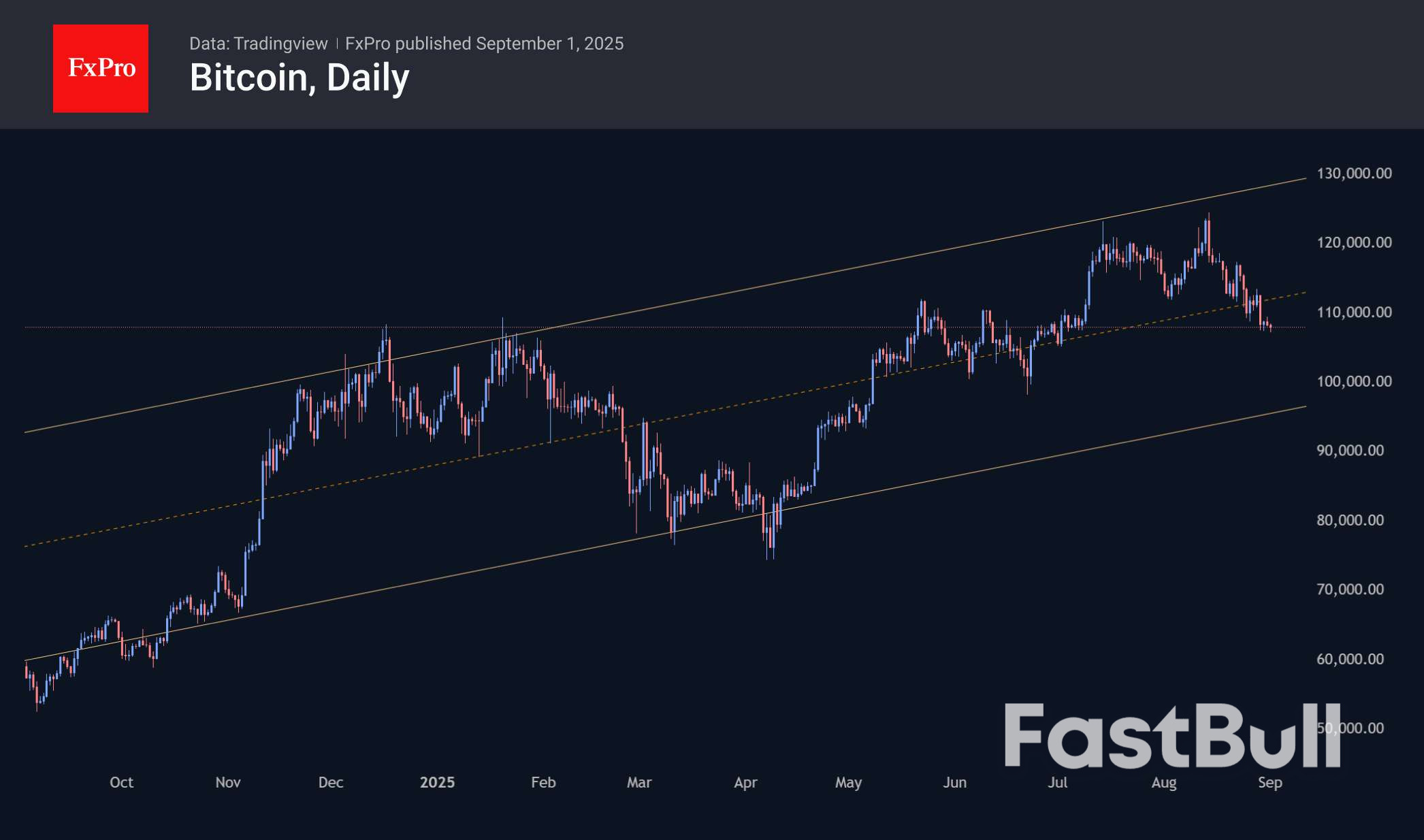
          Bitcoin briefly dipped below \$107K before rebounding, as crypto market cap slid 3.4% to \$3.74T, signaling a bearish trend. ETF inflows resumed, but sentiment nears fear amid seasonal weakness.
          Bitcoin Tests $107K Support, Before Recovery

          The Crypto Market Continues to Send Alarming Signals_1
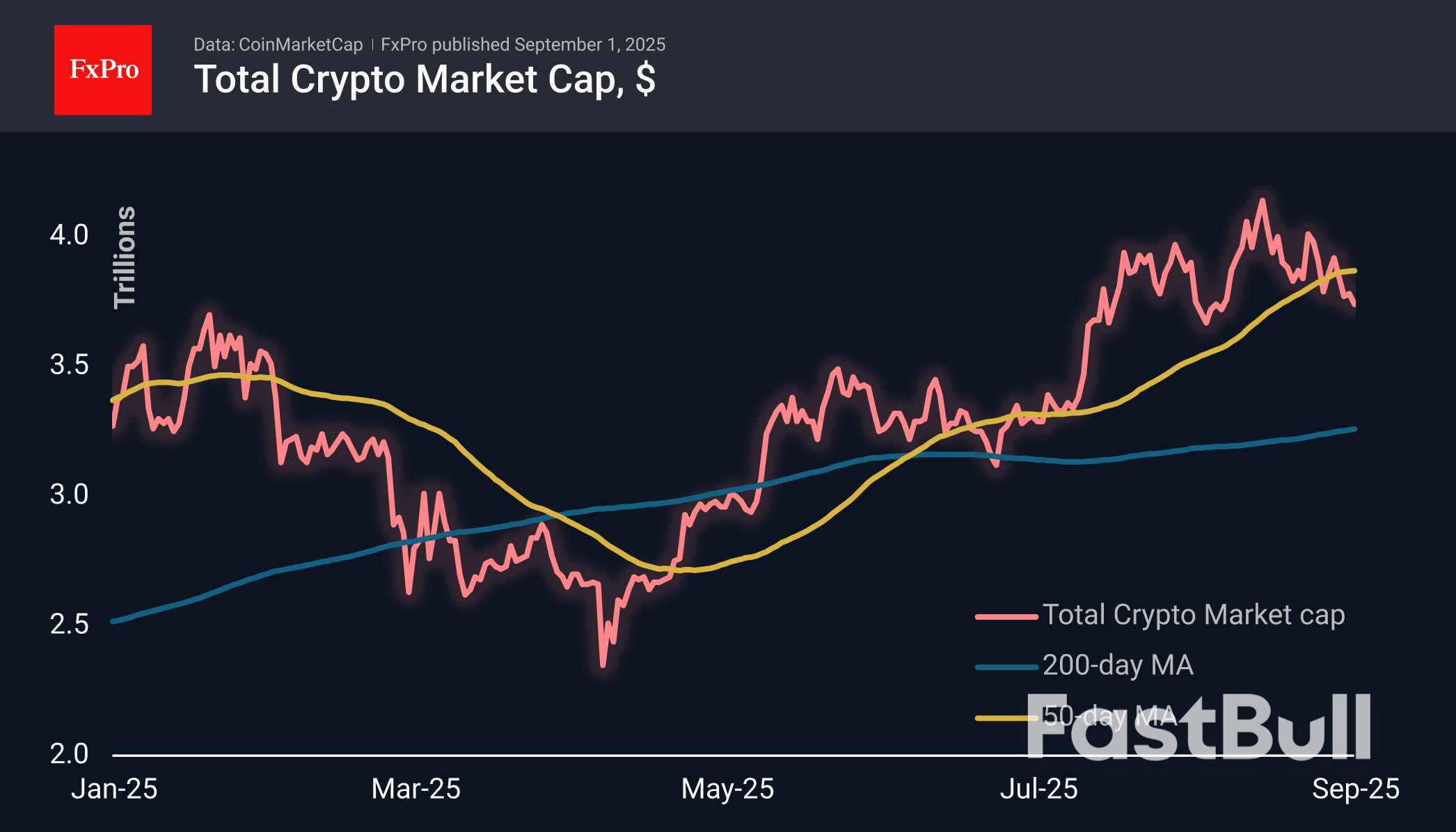
          The cryptocurrency market capitalisation has fallen by 3.4% over the past seven days to $3.74 trillion, its lowest level in three and a half weeks. The total capitalisation chart continues to record a series of lower lows, signalling a downward trend. A break below the 50-day moving average reinforces this signal, confirming the medium-term downward trend.
          The Crypto Market Continues to Send Alarming Signals_2
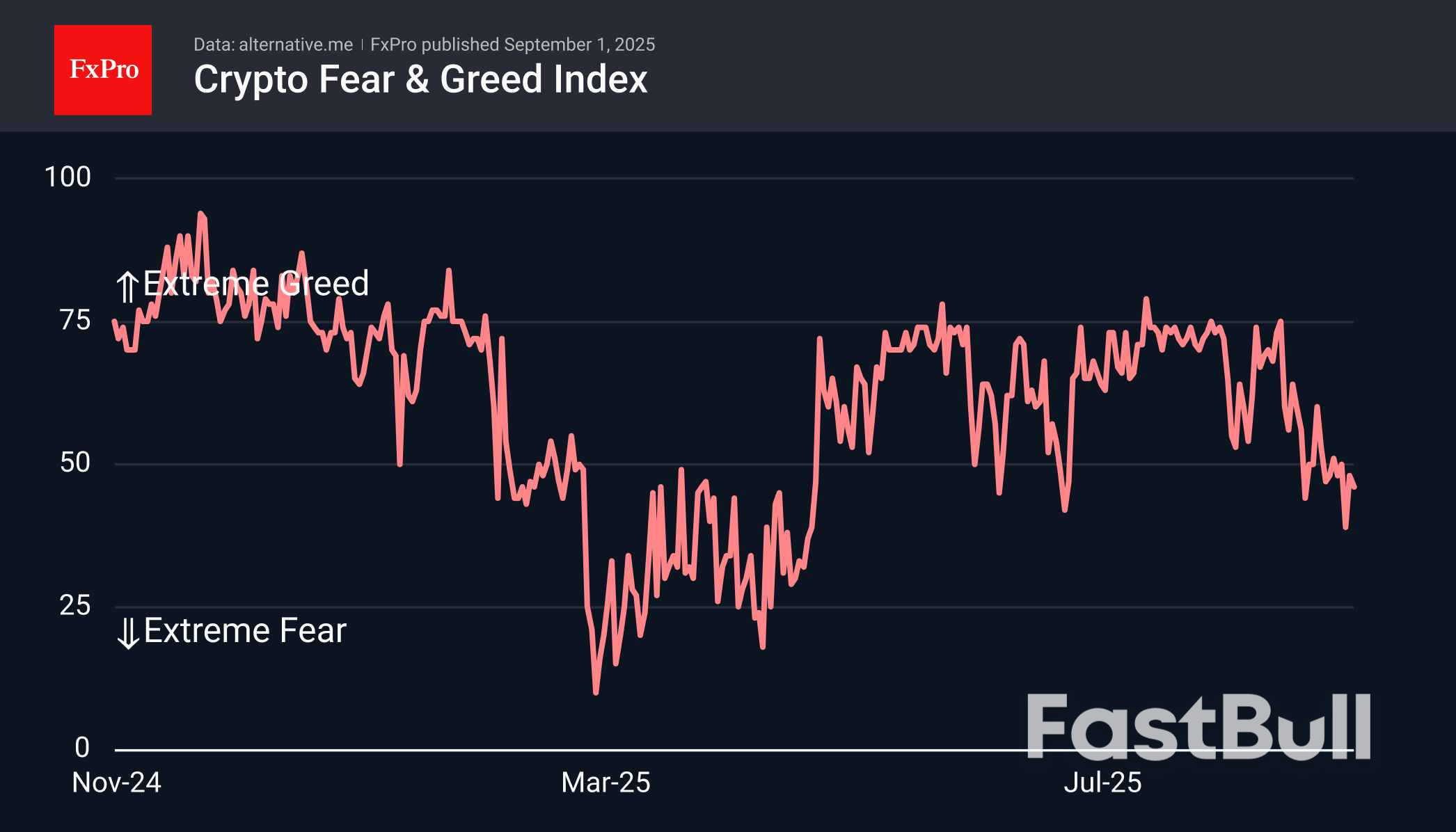
          The sentiment index, at 46, is easily touching fear territory. It fell to 39 at the start of the day on Saturday, the lowest level since the end of April. Given how often cryptocurrencies are the first to react to changes in investor sentiment, such a dip looks like a harbinger of difficult weeks ahead for stocks.
          The Crypto Market Continues to Send Alarming Signals_3
          On Monday morning, Bitcoin briefly fell below $107K, its lowest level since early July, but then bounced to $109K. On daily timeframes, BTC is approaching but has not yet entered oversold territory, retaining the potential for further decline. Some support from bulls can be expected around the $105K price point, as this has been a resistance level for many months. This area also appears to be the last line of defence before the psychologically important $100K level, the breach of which could trigger panic selling.

          Crypto News

          September, along with August, is considered one of the two most unfavourable months for BTC. It has declined nine times in the last 14 years, with an average decline of 12.7% and an average growth of 9.2%. Meanwhile, the last two years have been successful for Bitcoin.
          Weekly inflows into spot Bitcoin ETFs in the US resumed, amounting to $440.7 million last week. Total inflows since the approval of Bitcoin ETFs in January 2024 have increased to $54.24 billion.
          Weekly inflows into spot Ethereum ETFs in the US also resumed after a noticeable outflow a week earlier, amounting to $1.08 billion. Total net inflows since the launch of ETFs in July 2024 have grown to $13.51 billion.
          Spot Bitcoin ETFs in the US have almost caught up with the largest exchanges in terms of trading volume, becoming one of the main ways for investors to buy BTC, according to CryptoQuant.
          According to Bloomberg, companies have filed 92 applications with the SEC to launch crypto ETFs in the US. Three exchange-traded funds based on Bitcoin and Ethereum, as well as numerous proposals for altcoins, are among those awaiting approval. Solana and XRP are the most popular.
          Voting has ended on a proposal to reduce fees on the TRON network by 60%. According to blockchain founder Justin Sun, the majority of community members approved the initiative.
          According to DeFiLlama, the dominance of the stablecoin Tether (USDT) in the stablecoin market has fallen below 60% for the first time since March 2023. The decline could be due to increased competition within the industry and tighter regulatory standards.

          Source: fxempire

          Risk Warnings and Disclaimers
          You understand and acknowledge that there is a high degree of risk involved in trading. Following any strategies or investment methods may lead to potential losses. The content on the site is provided by our contributors and analysts for information purposes only. You are solely responsible for determining whether any trading assets, securities, strategy, or any other product is suitable for investing based on your own investment objectives and financial situation.
          Add to Favorites
          Share

          Bitcoin is getting boring. That could open more doors for the crypto asset on Wall Street.

          Adam

          Cryptocurrency

          Bitcoin's (BTC-USD) range of wild price swings has come down this year. The key reason? It may have to do with companies rapidly stockpiling the asset, according to JPMorgan strategists.
          The largest cryptocurrency's three- and six-month rolling volatility, meaning the speed and extent of its price changes over those time periods, has fallen to a historically low level. This trend has continued even as bitcoin's price set new record highs in May, July, and August.
          Bitcoin fell to $108,000 as of Friday afternoon, but jumped to over $109,000 on Monday. It's up over over 17% year to date.
          "Corporate treasuries now hold over 6% of bitcoin's total supply and act as a form of private sector quantitative easing for crypto markets," JPMorgan global market strategist Nikolaos Panigirtzoglou wrote in a client note on Thursday.
          "We believe a factor behind the collapse in bitcoin volatility has been the acceleration of bitcoin purchases by corporate treasuries," Panigirtzoglou added.
          Over the roughly 16 years that bitcoin has been around, its market price has seen wild swings, often at magnitudes far greater than more widely held assets like bonds, gold, and many stocks and its still widely perceived as more volatile than those assets.
          However, the range of its swings has been narrowing and a key factor has been the launch of new bitcoin-related financial products like futures contracts and exchange-traded funds that have brought in more investor groups.
          This year, the biggest new wave has been public and private corporations seeking to put the crypto asset on their balance sheet in a play pioneered years ago by Michael Saylor's Strategy (MSTR) (formerly MicroStrategy).
          Since the Tysons Corner, Va.-based enterprise software company started purchasing the digital asset in 2020, it has become a bitcoin juggernaut. And founder Saylor has made a name for himself as the evangelist of bitcoin adoption for corporates.
          For example, from the president's own namesake, Trump Media & Technology Group (DJT), to video game retailer GameStop (GME), a Japanese hotel operator called Metaplanet (MTPLF), and others, these companies have picked up tens of billions of dollars' worth of bitcoin since the beginning of January, according to data aggregator Bitcoin Treasuries.
          In July alone, public companies snapped up "nearly two-thirds” of total bitcoin purchases among the biggest buyers: exchange-traded products, governments, and public and private companies, according to a recent Bitcoin Treasuries report.
          Such a development may have wide implications for how much bitcoin other kinds of investors could own, according to JPMorgan's Panigirtzoglou.
          By lowering bitcoin's volatility, these new buyers could make bitcoin "more attractive from a valuation point of view," Panigirtzoglou said, adding that as its volatility drops, bitcoin could become a more competitive alternative to gold. While volatility doesn't equal outright investment risk, it represents a key component.
          Between Washington, D.C., and Wall Street, the crypto world has already seen some major wins this year.
          Earlier in August, crypto rallied after Trump signed an executive order that directs federal agencies to remove regulatory barriers blocking access to alternative assets and crypto from being offered in 401(K) other defined-contribution retirement plans.
          Weeks before, Trump signed a bill that will allow US banks to issue their own dollar-pegged stablecoin. A week before big bank executives, including Citigroup's Jane Fraser and JPMorgan Chase's Jamie Dimon, have said they are exploring that business.
          And in late May, Federal Housing Finance Agency Director William Pulte ordered Fannie Mae and Freddie Mac to come up with a way for the government-sponsored mortgage companies to count crypto holdings as assets on mortgage applications.
          While Michael Saylor's Strategy pioneered the gambit of rapidly acquiring crypto assets by issuing a mix of debt and equity years ago, more companies have joined the party this year.
          That's due in part to a combination of less burdensome accounting rules and more favorable treatment of crypto by the Trump administration and the simple fact that Saylor's Strategy play has proven successful. Strategy's stock trades at a significant premium to the underlying bitcoin it holds.
          Though the length of time that such a phenomenon can last remains a hotly debated topic, approximately 180 other companies have imitated the play.
          Of that group, roughly a quarter had stocks trading below the value of the bitcoin they held as of August 22, according to Capriole Investments.
          And it's not just bitcoin either.
          Corporate treasuries have been loading up on cryptocurrencies such as ether and others in addition to bitcoin. And for those smaller tokens, the reaction so far hasn't been boring.
          Trump's namesake media group announced plans to roll out another crypto treasury company just this past week through a partnership with crypto exchange Crypto.com.
          Called Trump Media Group CRO Strategy, this company will hold Crypto.com's lesser-known trading platform and blockchain token Cronos (CRO-USD). The token's market capitalization has almost doubled to $9 billion since the Tuesday announcement.
          Also known by critics as "money printing," quantitative easing is a less conventional monetary policy tool that the US Federal Reserve used to support the economy during two of the country's most recent financial emergencies, the COVID-19 pandemic and the 2008 financial crisis.
          The measure is known to have significant repercussions, such as fueling riskier behavior that can lead to asset bubbles and even future inflation.

          Source: finance.yahoo

          Risk Warnings and Disclaimers
          You understand and acknowledge that there is a high degree of risk involved in trading. Following any strategies or investment methods may lead to potential losses. The content on the site is provided by our contributors and analysts for information purposes only. You are solely responsible for determining whether any trading assets, securities, strategy, or any other product is suitable for investing based on your own investment objectives and financial situation.
          Add to Favorites
          Share

          Stock Market’s Fate Comes Down to Next 14 Trading Sessions

          Adam

          Stocks

          The next few weeks will give Wall Street a clear reading on whether this latest stock market rally will continue — or if it’s doomed to get derailed.
          Jobs reports, a key inflation reading and the Federal Reserve’s interest rate decision all hit over the next 14 trading sessions, setting the tone for investors as they return from summer vacations. The events arrive with the stock market seemingly at a crossroads after the S&P 500 Index posted its smallest monthly gain since July 2024 and heads into September, historically its worst month of the year.
          At the same time, volatility has vanished, with the Cboe Volatility Index, or VIX, trading above the key 20 level just once since the end of June. The S&P 500 hasn’t suffered a 2% selloff in 91 sessions, its longest stretch since July 2024. It touched another all-time high at 6,501.58 on Aug. 28, and is up 9.8% for the year after soaring 30% since its April 8 low.
          “Investors are assuming correctly to be cautious in September,” said Thomas Lee, head of research at Fundstrat Global Advisors. “The Fed is re-embarking on a dovish cutting cycle after a long pause. This makes it tricky for traders to position.”
          The long-time stock-market bull sees the S&P 500 losing 5% to 10% in the fall before rebounding to between 6,800 to 7,000 by year-end.
          Eerie Calm
          Lee isn’t alone in his near-term skepticism. Some of Wall Street’s biggest optimists are growing concerned that the eerie calm is sending a contrarian signal in the face of seasonal weakness. The S&P 500 has lost 0.7% on average in September over the past three decades, and it has posted a monthly decline in four of the last five years, according to data compiled by Bloomberg.
          The major market catalysts begin to hit on Friday with the monthly jobs report. Economists project about 75,000 jobs were added, based on the median of a Bloomberg survey. This data ended up in the spotlight at the beginning of August, when the Bureau of Labor Statistics marked down nonfarm payrolls for May and June by nearly 260,000. The adjustment set off a tirade by President Donald Trump, who fired the head of the agency and accused her of manipulating the data for political purposes.
          Stock Market’s Fate Comes Down to Next 14 Trading Sessions_1
          After that, the BLS will announce its projected revision to the Current Employment Statistics establishment survey on Sept. 9, which may result in further adjustments to expectations for jobs growth.
          Then inflation takes the stage with the consumer price index report arriving on Sept. 11. And on Sept. 17, the Fed will give its policy decision and quarterly interest-rate projections, after which Chair Jerome Powell will hold his press conference. Investors will be looking for any roadmap Powell provides for the trajectory of interest rates. Swaps markets are pricing in roughly 90% odds that the Fed will cut them at this meeting.
          Two days later comes “triple witching,” when a large swath of equity-tied options expire, which should amplify volatility.
          That’s a lot of uncertainty to process. But traders seem oddly unconcerned about this crucial stretch of data and decisions. Hedge funds and large speculators are shorting the Cboe Volatility Index, or VIX, at rates not seen in three years in a bet the calm will last. And jobs day has a forward implied volatility reading of just 85 basis points, indicating the market is underpricing that risk, according to Stuart Kaiser, Citigroup’s head of US equity trading strategy.
          Turbulence Risk
          The problem is, this kind of tranquility and extreme positioning has historically foreshadowed a spike in turbulence. That’s what happened in February, when the S&P 500 peaked and volatility jumped on worries about the Trump administration’s tariff plans, which caught pro traders off-sides after coming into 2025 betting that volatility would stay low. Traders also shorted the VIX at extreme levels in July 2024, before the unwinding of the yen carry trade upended global markets that August.
          The VIX climbed toward 16 on Friday after touching its lowest levels of 2025, but Wall Street’s chief fear gauge still remains 19% below its one-year average.
          Of course, there are fundamental reasons for the S&P 500’s rally. The economy has stayed relatively resilient in the face of Trump’s tariffs, while Corporate America’s profit growth remains strong. That’s left investors the most bullish on US stocks since they peaked in February, with cash levels historically low at 3.9%, according to Bank of America’s latest global fund manager survey.
          But here’s the circular problem: As the S&P 500 climbs higher, investors become increasingly concerned that it is overvalued. The index trades at 22 times analysts’ average earnings forecast for the next 12 months. Since 1990, the market was only more expensive at the height of dot-com bubble and the technology euphoria coming out of the depths of the Covid pandemic in 2020.
          “We’re buyers of big tech,” said Tatyana Bunich, president and founder of Financial 1 Tax. “But those shares are very pricey right now, so we’re holding some cash on the sidelines and waiting for any decent pullback before we add more to that position.”
          Stock Market’s Fate Comes Down to Next 14 Trading Sessions_2
          Another well-known bull, Ed Yardeni of eponymous firm Yardeni Research, is questioning whether the Fed will even cut rates in September, which would hit the stock market hard, at least temporarily. His reason? Inflation remains a persistent risk.
          “I expect this stock rally to stall soon,” Yardeni said. “The market is discounting a lot of happy news, so if CPI is hot and there’s a strong jobs report, traders suddenly may conclude rate cuts aren’t necessarily a done deal, which may lead to a brief selloff. But stocks will recover once traders realize the Fed can’t cut rates by much because of a good reason: The economy is still strong.”

          Source: Bloomberg

          Risk Warnings and Disclaimers
          You understand and acknowledge that there is a high degree of risk involved in trading. Following any strategies or investment methods may lead to potential losses. The content on the site is provided by our contributors and analysts for information purposes only. You are solely responsible for determining whether any trading assets, securities, strategy, or any other product is suitable for investing based on your own investment objectives and financial situation.
          Add to Favorites
          Share

          Asia Factory Activity Shrinks As US Tariffs Bite, China Bucks Trend

          Winkelmann

          Economic

          Political

          Forex

          China–U.S. Trade War

          U.S. tariffs took a toll on factory activity across Asia, overshadowing a surprisingly upbeat performance in China, private surveys showed on Monday, keeping pressure on policymakers to underpin the region's fragile economic recovery.The outcome reinforces concerns that manufacturers in Asia, which have been frontloading shipments to beat higher U.S. levies, will face pressure on profits as exports weaken in the months ahead, analysts say.

          Export powerhouse Japan, South Korea and Taiwan all saw manufacturing activity shrink in August, the surveys showed, underscoring the challenge Asia faces in weathering the hit from President Donald Trump's tariffs."It's a double-whammy for Asian economies, as they face higher U.S. tariffs and competition from cheap Chinese exports," said Toru Nishihama, chief emerging market economist at Dai-ichi Life Research Institute.

          "We'll likely see the hit from U.S. tariffs intensify going forward, with countries reliant on U.S.-bound shipments like Thailand and South Korea particularly vulnerable," he said.The RatingDog China General Manufacturing PMI, compiled by S&P Global, rose to 50.5 in August from 49.5 in July, beating market forecasts and exceeding the 50-mark that separates growth from contraction.

          The reading confounds an official survey on Sunday that showed China's manufacturing activity shrank for a fifth straight month in August on weak domestic demand and uncertainty over the outcome of Beijing's trade deal with the U.S.Taken together, the surveys suggest the world's second-biggest economy is still under significant strain."Notably, the manufacturing sector is helping the recovery, but this rebound is patchy," said Yao Yu, founder of RatingDog.

          "With weak domestic demand, potentially overstretched external orders, and slow profit recovery, the durability of the improvement depends on whether exports truly stabilise and whether domestic demand can pick up pace."The S&P Global Japan Manufacturing Purchasing Managers' Index (PMI) stood at 49.7 in August, improving from 48.9 in July but staying below the 50 threshold for two straight months.

          New orders from overseas fell at the fastest pace since March 2024 as companies battled weak demand from key markets like China, Europe and the U.S., the Japan PMI survey showed.South Korea's factory activity also shrank with the S&P Global PMI standing at 48.3 in August, up from 48.0 in July but contracting for the seventh straight month.

          Source: Yahoo Finance

          To stay updated on all economic events of today, please check out our Economic calendar
          Risk Warnings and Disclaimers
          You understand and acknowledge that there is a high degree of risk involved in trading. Following any strategies or investment methods may lead to potential losses. The content on the site is provided by our contributors and analysts for information purposes only. You are solely responsible for determining whether any trading assets, securities, strategy, or any other product is suitable for investing based on your own investment objectives and financial situation.
          Add to Favorites
          Share

          What does September normally have in store for markets?

          Adam

          Economic

          Don't you just love when the first day of the new month is a Monday? It somehow makes for a fresh, clean start for markets. Or at least it gives me that sort of feeling. As we embark on September trading and the final month of Q3, let's take a look at some seasonal patterns that have typically shaped how the month has gone in years prior.
          For one, we usually see stocks face one of their worst months of the year. That means investors will be familiar with the tune Wake Me Up When September Ends. This year though, everything will ride on Fed expectations and the upcoming FOMC meeting decision on 17 September.
          What does September normally have in store for markets?_1

          S&P 500 index seasonal pattern (monthly % change)

          In the past 20 years, September has in fact been the worst month for the S&P 500. But as mentioned, the drivers this time around might make for a different pathway. After four years of bad Septembers from 2020 to 2023, we also saw the seasonal streak snap last year with the index posting roughly 2% gains.
          Circling back to this year, everything will ride on expectations going into the Fed decision first and foremost. And that begins with the US labour market report this Friday, as well as Fedspeak during the week before the FOMC blackout period starts this weekend.
          After that, we'll move on to focusing on the US CPI report on 11 September before the Fed meets on 17 September. As things stand, traders are pricing in ~90% odds of a 25 bps rate cut for this month with ~54 bps of rate cuts by year-end.
          A key consideration will be the inflation numbers to see if there is any further evidence of tariffs passthrough on prices. So, keep an eye out for that.
          Besides that, September also marks the worst month in the past 20 years for the Nasdaq as well as the MSCI World Index. As such, it typically isn't a great month for stocks in general if you go by the standard playbook that is.

          What does September normally have in store for markets?_2

          Nasdaq Composite index seasonal pattern (monthly % change)

          What does September normally have in store for markets?_3

          MSCI World Index seasonal pattern (monthly % change)

          Besides that, September also isn't really a good month for gold historically. The precious metal might be off to a hot start today but has typically run into trouble over the past two decades in the final month of Q3 trading.
          It is the second worst month in terms of performance for gold in the past 20 years with prices having fallen in 8 of the past 10 September months.
          What does September normally have in store for markets?_4

          Gold (XAU/USD) seasonal pattern (monthly % change)

          The same drivers impacting stocks above will also be key for gold alongside the recent dispute on the legality of Trump's tariffs. The precious metal had a funny 2024 where it bucked the September seasonal trend amid a hot streak that started since February, before also bucking the trend in December where it stopped seven straight years of gains in the final month of the year.
          With gold being up in seven of the last eight months, are we also due a similar story in 2025?
          Lastly, let's take a look at oil to see how the September month typically shapes up for the commodity.
          What does September normally have in store for markets?_5

          WTI crude oil seasonal pattern (monthly % change)

          During most years, the tail end of summer and the start of fall hasn't been too kind for oil prices. And that was the case last year as well. September is usually the middle of a bad stretch of months for oil that typically spans from August to October/November.
          So, that will be something to keep in the back pocket just in case when taking any views on the oil market in the month ahead.

          Source: investinglive

          To stay updated on all economic events of today, please check out our Economic calendar
          Risk Warnings and Disclaimers
          You understand and acknowledge that there is a high degree of risk involved in trading. Following any strategies or investment methods may lead to potential losses. The content on the site is provided by our contributors and analysts for information purposes only. You are solely responsible for determining whether any trading assets, securities, strategy, or any other product is suitable for investing based on your own investment objectives and financial situation.
          Add to Favorites
          Share

          US Dollar: Bearish Momentum Continues as Key Support Faces Pressure

          Adam

          Forex

          The US Dollar Index (DXY) is trading at 97.70, after an intraday high of 97.74 and a low of 97.70. The index remains under pressure, failing to reclaim its short-term moving averages, with the 15-day moving average at 98.08 and the 20-day moving average at 98.16, both trending lower.

          Key Technical Observations

          Downtrend Intact: Price action continues to post lower highs and lower lows since the late 2024 peak, showing sustained bearish momentum.
          Moving Averages as Resistance: The 15- and 20-day moving averages are closely aligned above price and acting as dynamic resistance.
          RSI at 44.31: Momentum remains weak, with RSI hovering below 50, confirming sellers retain control without being oversold.
          Sideways Base Attempt: The index is trying to form a short-term base between 97.50 – 98.50, but lacks bullish follow-through.

          Macro & Market Context

          Fed Policy Outlook: Softer US economic data and dovish tones from the Federal Reserve have limited upside for the US dollar.
          Global Risk Sentiment: Risk-on sentiment has supported other majors (EUR, GBP, EM currencies), putting pressure on the US dollar index.
          Yields & Inflation: Declining US yields continue to weigh on the US dollar’s relative attractiveness.

          Key Levels to Watch

          Immediate Resistance: 98.20 – 98.50 (moving averages & recent supply zone)
          Next Resistance: 99.50 – 100.00 (psychological barrier & prior breakdown point)
          Immediate Support: 97.50 (range floor)
          Breakdown Support: 96.50 (key swing low, major downside risk)
          Bias: Bearish to Neutral
          The US dollar remains in a bearish trend as long as it trades below 98.50. A decisive close under 97.50 could accelerate losses toward 96.50. Only a sustained recovery above the moving averages would shift momentum toward neutral.
          The index remains weak, with downside risk outweighing upside potential. Traders should be cautious of false rebounds near the 98.00 zone, as rallies are likely to face heavy resistance. A clean breakdown below 97.50 would strengthen the bearish case, while a recovery above 98.50 is needed to confirm stabilization.
          US Dollar: Bearish Momentum Continues as Key Support Faces Pressure_1

          Source: investing

          Risk Warnings and Disclaimers
          You understand and acknowledge that there is a high degree of risk involved in trading. Following any strategies or investment methods may lead to potential losses. The content on the site is provided by our contributors and analysts for information purposes only. You are solely responsible for determining whether any trading assets, securities, strategy, or any other product is suitable for investing based on your own investment objectives and financial situation.
          Add to Favorites
          Share

          The Harsh Truth About Life In Canada Today

          Winkelmann

          Economic

          Forex

          Political

          Canada is often portrayed as a land of freedom, opportunity, and prosperity. Reality, however, tells a different story...

          Statist policies, crushing taxes, bloated bureaucracy, and a society overtaken by woke ideology have shattered Canada. This is a cautionary tale for those looking at Canada as an ideal living space. If you are asking yourself what living in Canada is like, let me explain: Canada is not a land of fulfilled dreams but of enduring harsh conditions and barely getting by.

          As if economic hardships aren’t enough, Canadians are also oppressed by the Orwellian newspeak that woke culture is creating. If you speak your mind, you’re labeled a fascist. If you question social policies, you’re accused of microaggressions.There are no best places to live in Canada anymore. As a Canadian, I see little chance of Canada becoming livable again. Since I founded Expat Money in 2017, I have been helping expats build their Plan-Bs to protect their wealth and freedom and leave countries like this one.

          Let’s look at the unfortunate condition that Canada has fallen into.

          The Restrictions Imposed During Covid

          The strict quarantine measures and harsh government interventions implemented in Canada during the COVID-19 hysteria were shameful. The government expanded police and administrative powers to smash public backlash against its COVID policies.A significant protest movement called The Freedom Convoy began in early 2022. Truckers and citizens held large demonstrations in Ottawa against vaccination mandates, harsh pandemic restrictions, and the government’s authoritarian tendencies.

          Former Prime Minister Trudeau used extraordinary powers to freeze the bank accounts of protesters and crack down on activists. Individual and property rights were arbitrarily violated.The Canadian government imposed mandatory vaccinations on federal employees, healthcare workers, and those in the transportation sector, turning personal health decisions into state mandates. Those who were not vaccinated were suspended from their jobs, their travel rights were restricted, and they were ostracized from society. Even the private sector was coerced to impose vaccinations under government pressure.

          Moreover, harsh lockdowns and restricted entry into the country forced businesses into bankruptcy. Massive numbers of people lost their jobs, and the government’s financial structure was severely damaged.

          Woke Culture And The End Of Free Speech

          The problems aren’t limited to elections. In recent years, woke ideology has overtaken Canada’s politics, education system, and workplace. This “progressive” ideology has replaced individual freedoms and meritocracy with the so-called principle of inclusivity and equity. As a result, freedom of speech has been destroyed, social engineering has increased, and social polarization has deepened.In Canada, laws enacted under the guise of “combatting hate speech” have imposed mandatory language use by the government, determining how individuals should speak.

          Now, we have another Bill C-11 to update the Broadcasting Act. The government’s media watchdog, the CRTC, will now be able to monitor online platforms such as YouTube, TikTok, and Spotify. Bill C-11 is a censorship tool to kill free speech in Canada. The government may have sugar-coated the law by saying, “We support Canadian content,” but at its core, it’s an attempt to take control of the internet. The government deciding what content is “sufficiently Canadian” will soon become a matter of deciding what content is appropriate, approved, and safe.

          What about Bill C-18? This is another example of an intervention that legislates internet censorship under the pretext of “protecting the independent press.” Bill C-18 requires internet platforms (especially companies like Google and Meta) to pay media outlets for news content. The government is turning content sharing into an economic penalty to extract money from big tech companies.Because of this law, platforms like Google and Meta have decided to remove news content completely. In other words, the government’s move to “access information” has actually restricted access to information.

          Similarly, due to cancel culture, academics, business people, and members of the media are censored, fired, and subject to social lynching when they voice different views. Diversity, equity, and inclusion (DEI) policies, especially in business and academic institutions, cause decisions to be made based on identity rather than merit. Canadian universities have been degraded from institutions that encourage intellectual freedom into ideological centres where a singular type of thinking is imposed. Companies must prioritize political correctness over efficiency and productivity in business life. Canada has shifted from a society based on individual freedom and voluntary cooperation to a system governed by the ideological impositions of the government.

          Assisted Suicide And Moral Decline

          Indicators of Canada’s political and economic collapse can also be traced to the individual level. The rapid increase in Medical Assistance in Dying (MAiD) applications in Canada has led to deep debate on personal freedoms, ethical values, ​​and the role of the state in the country.

          Canada has the fastest-growing assisted suicide program in the world. When MAiD was legalized in 2016, it only included individuals with terminal illnesses. However, over time, the criteria were relaxed and expanded to include psychological disorders or illnesses that do not have a natural death period. In 2021, approximately 10,000 people ended their lives under MAiD. This number constitutes 3.3% of all deaths. Even people who were experiencing financial difficulties or housing problems resorted to euthanasia, causing heated arguments in the public domain.

          In the face of all the challenges, assuming Canada has a functioning social welfare state would be unwise. Canada’s health system is seriously unreliable because of long waiting times, overburdened hospitals, and staff shortages.Before moving to Canada, be mindful that you can wait months to years for doctor’s appointments and surgeries. The shortage of doctors and nurses severely disrupts health services. Excessive bureaucracy and limited private health services make the health system even more inefficient.

          Federal Government Overreach

          The federal government’s drama is not Canada’s only political issue. The political conflict between the federal and provincial governments is becoming a serious problem.

          There are several main disagreements between the federal and provincial governments:

          ● First, the federal government’s carbon tax has drawn fierce criticism from energy-independent provinces such as Alberta, Saskatchewan, and Ontario.

          ● Second, the federal government demands that the provinces spend more on healthcare financing, while the provinces say they are underfunded and subject to excessive federal intervention.

          ● Third, immigration has exacerbated the housing crisis and the burden on public services in large provinces such as Ontario, Quebec, and British Columbia. The provinces demand more funding, saying they shoulder much of the cost burden, but funding is unavailable.

          ● Fourth, the federal government’s policies restricting fossil fuel use continue to economically harm provinces such as Alberta and Saskatchewan, which depend on oil and gas.

          It’s no surprise that many people in Alberta and the Prairie provinces responded positively to Trump’s annexation proposal. It reflects a deep and long-standing frustration with federal control over energy policy. At the same time, a grassroots “Make Alberta Great Again” movement is gaining real traction. Pro-separation initiatives are picking up momentum, with growing calls for a referendum on Alberta’s independence.

          Even Bill 54, passed in May 2025, lowered the threshold required to trigger a referendum on the province’s sovereignty. Now it’s easier for separatist groups to push for a vote.I was in Alberta last year and met with several people involved in the movement in person. We spoke at length about the political landscape, their frustrations, and their hopes for Alberta’s future. Many of them told me that, while they believe strongly in the cause, they also know how easily their involvement could make them political targets. That’s why they’re working on their Plan-B strategies to protect themselves and their families if things take a turn for the worse.

          Over-Regulation And High Taxes

          Strict government regulations and high tax rates in Canada negatively impact economic growth and entrepreneurship by increasing the financial burden on individuals and businesses.Let me give you an example. Ontario’s total income tax payment can be as high as 53.5%. These high tax rates reduce the disposable income of individuals and businesses and restrict economic mobility. Under the guise of “Tax the rich” and “Pay your fair share,” the Canadian government began taxing capital gains over $250,000 CAD at up to 66.6% starting in 2024. Being an entrepreneur or creating economic productivity in Canada is one of the government’s favourite activities to punish.

          High Cost Of Living

          Rising real estate prices, the cost of essential consumer goods, and transportation have greatly increased the economic burden on individuals. Real estate prices have reached astronomical levels in cities like Vancouver and Toronto. This fact makes home ownership nearly impossible for the middle class. The lack of affordable housing options is threatening life in Canada.

          With average home prices pushing $730,000 CAD ($536,000 USD), double-digit inflation on food and energy, and yet another round of carbon taxes, everyday life in Canada has become flat-out unaffordable. More and more people are waking up to the reality that they can live better, in places like Latin America, for a fraction of the cost and without being punished for simply trying to get ahead.

          Most people seeking to migrate to Canada think about living in Toronto. The average rent for a one-bedroom apartment in Toronto is around $ 2,500 CAD ($1,700 USD). If your job is in Vancouver, the average rent for a one-bedroom apartment is around $2,700 CAD ($1,900 USD).Living expenses in Toronto and Vancouver are sky-high, and if you’re hoping Montreal offers a more affordable alternative, you’ll be disappointed—it’s just as costly. Factor in additional expenses for your family, and Canada quickly becomes an impractical place to invest in or build your future. It is difficult to see the benefits of living there.

          The rapid growth of Canada’s immigrant population has also become another socio-economic issue. Canada does not have a dynamic market economy that can absorb all immigrants without lowering the standard of living of other citizens. Therefore, economic difficulties have not only caused immigrants to become targets but also a threat to social peace.

          Elections In Canada

          Do you recall the political debate that flared up after Trudeau’s resignation, revealing Canada’s polarized politics? Canadian politics was left in confusion about which way to turn after U.S. President Donald Trump hinted at annexing Canada as the 51st state.What an absolutely painful circus to watch unfold. After being thoroughly humiliated by Trump and losing whatever political capital he had left, Trudeau stepped down, hoping to give the Liberals one last shot at survival in the next election.

          The Liberals wasted no time in installing Mark Carney, a globalist even more elitist than Trudeau, as Prime Minister. As a career technocrat, Carney’s credentials read like a who’s who of globalist power centres—Goldman Sachs, the Bank of Canada, the Bank of England, and the World Economic Forum.When I saw that the so-called conservative Pierre Poilievre was positioned to run against Carney in the snap elections on April 28, 2025, it became obvious that the entire contest was pure theatre. Poilievre played his part well, talking tough, staying on script, and never crossing the lines he wasn’t supposed to. In an election where the outcome was never in doubt, Carney picked up where Trudeau left off.

          What’s truly hilarious is that Canadians rallied behind Carney, thinking he was the tough guy who could stand up to Trump, as if a globalist banker could salvage national pride. They saw him as the unifier for the challenges ahead, not realizing he was just the next polished face of the same worn-out agenda. They did not hesitate to choose a copy of the same man as their hope, as if they had forgotten why they had withdrawn their support for Trudeau.

          Watching these painful realities from a distance, I feel compelled to speak the truth. Liberals and conservatives are inflicting irreparable wounds on social cohesion without knowing that the system itself is rigged. Political scandals, unfulfilled campaign promises, and a lack of transparency continue to fuel growing skepticism toward Canadian leaders. My only hope is that more people begin to realize there are far better places to live and truly thrive outside of Canada.

          Canada is no longer worth the debate. Broken systems, high taxes, lost freedoms, there’s nothing left to fix. The smart ones aren’t waiting. They’re departing.

          Conclusion

          It’s time to stop calculating the pros and cons of living in Canada. There are no advantages at all. Canada is a country stuck under high taxes, failing public services, ideological impositions, and an increasingly authoritarian government. Buying a house has become a dream, healthcare a lottery, and freedom of expression a luxury.Even worse, despite all these problems, there is no will to fix Canada’s future. Canada has become divided by ideological wars between ever-growing state control and failed economic policies. Simply put, the best place to live in Canada doesn’t exist.

          The answer for those looking to secure their future is to look beyond Canada. If you don’t want to be penalized for your success, crushed by high taxes, and deprived of your fundamental rights, now is the time to explore alternative countries that genuinely value freedom and opportunity.

          The truth is, Canada’s decline is just one piece of a much bigger global pattern. The warning signs are everywhere: collapsing economies, overreaching governments, and shrinking personal freedoms. You don’t have to wait until it’s too late—or stay trapped in a system that’s stacked against you. There’s a better way forward, and the time to act is now. That’s why we’re urging you to join Doug Casey’s urgent online video event, where he’ll reveal his proven strategy to survive and thrive during the coming collapse. You’ll learn exactly how to secure a real Plan B with second passports, offshore banking, and the kind of freedom insurance that governments can’t take away from you. Reserve your spot here before it’s too late.

          Source: Zero Hedge

          To stay updated on all economic events of today, please check out our Economic calendar
          Risk Warnings and Disclaimers
          You understand and acknowledge that there is a high degree of risk involved in trading. Following any strategies or investment methods may lead to potential losses. The content on the site is provided by our contributors and analysts for information purposes only. You are solely responsible for determining whether any trading assets, securities, strategy, or any other product is suitable for investing based on your own investment objectives and financial situation.
          Add to Favorites
          Share
          FastBull
          Copyright © 2025 FastBull Ltd

          728 RM B 7/F GEE LOK IND BLDG NO 34 HUNG TO RD KWUN TONG KLN HONG KONG

          TelegramInstagramTwitterfacebooklinkedin
          App Store Google Play Google Play
          Products
          Charts

          Chats

          Q&A with Experts
          Screeners
          Economic Calendar
          Data
          Tools
          Membership
          Features
          Function
          Markets
          Copy Trading
          Latest Signals
          Contests
          News
          Analysis
          24/7
          Columns
          Education
          Company
          Careers
          About Us
          Contact Us
          Advertising
          Help Center
          Feedback
          User Agreement
          Privacy Policy
          Business

          White Label

          Data API

          Web Plug-ins

          Poster Maker

          Affiliate Program

          Risk Disclosure

          The risk of loss in trading financial instruments such as stocks, FX, commodities, futures, bonds, ETFs and crypto can be substantial. You may sustain a total loss of the funds that you deposit with your broker. Therefore, you should carefully consider whether such trading is suitable for you in light of your circumstances and financial resources.

          No decision to invest should be made without thoroughly conducting due diligence by yourself or consulting with your financial advisors. Our web content might not suit you since we don't know your financial conditions and investment needs. Our financial information might have latency or contain inaccuracy, so you should be fully responsible for any of your trading and investment decisions. The company will not be responsible for your capital loss.

          Without getting permission from the website, you are not allowed to copy the website's graphics, texts, or trademarks. Intellectual property rights in the content or data incorporated into this website belong to its providers and exchange merchants.

          Not Logged In

          Log in to access more features

          FastBull Membership

          Not yet

          Purchase

          Become a signal provider
          Help Center
          Customer Service
          Dark Mode
          Price Up/Down Colors

          Log In

          Sign Up

          Position
          Layout
          Fullscreen
          Default to Chart
          The chart page opens by default when you visit fastbull.com