Markets
News
Analysis
User
24/7
Economic Calendar
Education
Data
- Names
- Latest
- Prev



Signal Accounts for Members
All Signal Accounts
All Contests


South African Stocks Fell 3.9%, Marking Their Worst Intraday Performance Since US President Trump Announced Tariffs In April 2025. Of The 92 Major Indices Tracked By Bloomberg, The South African Stock Index Is Currently The Worst Performer On January 30th. Precious Metals And Mining Stocks Led The Decline
Fed Governor Waller: Inflation Excluding Tariffs Is Near Fed's 2% Goal And On Path To Reach It
Fed Governor Waller: Heard Of Multiple Layoffs Planned For 2026 With Considerable Doubt About Job Growth And Significant Risk Of A Substantial Deterioration
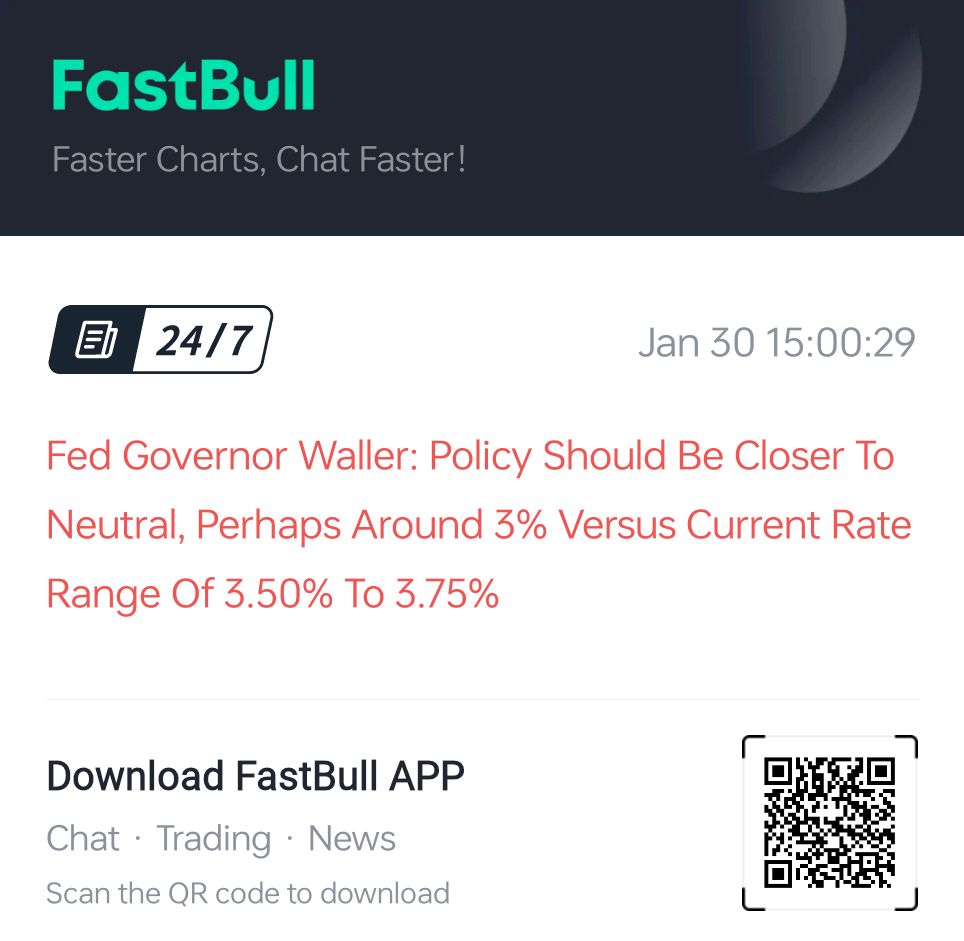
Fed Governor Waller: Policy Should Be Closer To Neutral, Perhaps Around 3% Versus Current Rate Range Of 3.50% To 3.75%
Fed Governor Waller: Inflation Is Elevated From Tariffs But Monetary Policy Should Look Through Those Effects Given Anchored Expectations
Fed Governor Waller: Expects Weak Job Numbers From Last Year To Be Revised Lower To Reflect Virtually No Growth In Payroll Employment In 2025
Fed Governor Waller: Dissented In Favor Of 25-Basis Point Cut At Last Meeting Because Policy Is Still Restricting Activity Too Much
Fed Data - USA Effective Federal Funds Rate At 3.64 Percent On 29 January On $104 Billion In Trades Versus 3.64 Percent On $89 Billion On 28 January
Argentina Government Says Beef Exports Totaled Record $3.7 Billion In 2025, Up 22.3% From Previous Year
Atlanta Fed President Bostic: Every Chair Comes With A View About The World, But Rate Decisions Involve 12 People
Atlanta Fed President Bostic: Would Be Best To Hold Only Treasury Securities That Match The Market
Atlanta Fed President Bostic: The Current Size Of The Balance Sheet Is About Right, Needs To Grow With The Economy
Atlanta Fed President Bostic: Balance Sheet Grew In Response To Crisis, But Should Back Out Of Mbs

Germany GDP Prelim YoY (Not SA) (Q4)A:--
F: --
P: --
Germany GDP Prelim QoQ (SA) (Q4)A:--
F: --
P: --
Germany GDP Prelim YoY (Working-day Adjusted) (Q4)A:--
F: --
P: --
Italy GDP Prelim YoY (SA) (Q4)A:--
F: --
P: --
U.K. M4 Money Supply (SA) (Dec)A:--
F: --
U.K. M4 Money Supply YoY (Dec)A:--
F: --
P: --
U.K. M4 Money Supply MoM (Dec)A:--
F: --
P: --
U.K. Mortgage Lending (Dec)A:--
F: --
U.K. Mortgage Approvals (Dec)A:--
F: --
Italy Unemployment Rate (SA) (Dec)A:--
F: --
P: --
Euro Zone Unemployment Rate (Dec)A:--
F: --
P: --
Euro Zone GDP Prelim QoQ (SA) (Q4)A:--
F: --
P: --
Euro Zone GDP Prelim YoY (SA) (Q4)A:--
F: --
P: --
Italy PPI YoY (Dec)A:--
F: --
P: --
Mexico GDP Prelim YoY (Q4)A:--
F: --
P: --
Brazil Unemployment Rate (Dec)A:--
F: --
P: --
South Africa Trade Balance (Dec)A:--
F: --
P: --
India Deposit Gowth YoYA:--
F: --
P: --
Germany CPI Prelim YoY (Jan)A:--
F: --
P: --
Germany CPI Prelim MoM (Jan)A:--
F: --
P: --
Germany HICP Prelim YoY (Jan)A:--
F: --
P: --
Germany HICP Prelim MoM (Jan)A:--
F: --
P: --
U.S. Core PPI YoY (Dec)A:--
F: --
U.S. Core PPI MoM (SA) (Dec)A:--
F: --
P: --
U.S. PPI YoY (Dec)A:--
F: --
P: --
U.S. PPI MoM (SA) (Dec)A:--
F: --
P: --
Canada GDP MoM (SA) (Nov)A:--
F: --
P: --
Canada GDP YoY (Nov)A:--
F: --
P: --
U.S. PPI MoM Final (Excl. Food, Energy and Trade) (SA) (Dec)A:--
F: --
P: --
U.S. PPI YoY (Excl. Food, Energy & Trade) (Dec)A:--
F: --
P: --
U.S. Chicago PMI (Jan)--
F: --
Canada Federal Government Budget Balance (Nov)--
F: --
P: --
Brazil CAGED Net Payroll Jobs (Dec)--
F: --
P: --
U.S. Weekly Total Oil Rig Count--
F: --
P: --
U.S. Weekly Total Rig Count--
F: --
P: --
China, Mainland NBS Manufacturing PMI (Jan)--
F: --
P: --
China, Mainland NBS Non-manufacturing PMI (Jan)--
F: --
P: --
China, Mainland Composite PMI (Jan)--
F: --
P: --
South Korea Trade Balance Prelim (Jan)--
F: --
Japan Manufacturing PMI Final (Jan)--
F: --
P: --
South Korea IHS Markit Manufacturing PMI (SA) (Jan)--
F: --
P: --
Indonesia IHS Markit Manufacturing PMI (Jan)--
F: --
P: --
China, Mainland Caixin Manufacturing PMI (SA) (Jan)--
F: --
P: --
Indonesia Trade Balance (Dec)--
F: --
P: --
Indonesia Inflation Rate YoY (Jan)--
F: --
P: --
Indonesia Core Inflation YoY (Jan)--
F: --
P: --
India HSBC Manufacturing PMI Final (Jan)--
F: --
P: --
Australia Commodity Price YoY (Jan)--
F: --
P: --
Russia IHS Markit Manufacturing PMI (Jan)--
F: --
P: --
Turkey Manufacturing PMI (Jan)--
F: --
P: --
Italy Manufacturing PMI (SA) (Jan)--
F: --
P: --
South Africa Manufacturing PMI (Jan)--
F: --
P: --
Euro Zone Manufacturing PMI Final (Jan)--
F: --
P: --
U.K. Manufacturing PMI Final (Jan)--
F: --
P: --
Brazil IHS Markit Manufacturing PMI (Jan)--
F: --
P: --
Canada National Economic Confidence Index--
F: --
P: --
Canada Manufacturing PMI (SA) (Jan)--
F: --
P: --
U.S. IHS Markit Manufacturing PMI Final (Jan)--
F: --
P: --
U.S. ISM Manufacturing Employment Index (Jan)--
F: --
P: --
U.S. ISM Manufacturing PMI (Jan)--
F: --
P: --


No matching data
Latest Views
Latest Views
Trending Topics
Top Columnists
Latest Update
White Label
Data API
Web Plug-ins
Affiliate Program
View All

No data
The Swiss franc appreciated past the 0.77 per USD mark in late January, the strongest in over one decade, as a global pivot toward safe assets in combination with aversion toward other currencies that are commonly seen as safe drove markets to pile on the franc as a reliable haven.
A combination of economic policy uncertainty in the US and their Treasury's signal that it will purposefully target a weaker dollar drove the greenback to weaken against G10 currencies, while pledges of expansionary fiscal policy by Japanese officials limited foreign demand for the yen.
Despite its negative impact on an already muted inflation backdrop in Switzerland, bets of a rate cut by the SNB were limited, and the central bank had already pledged to limit intervention to weaken the franc.
The SNB's policy rate has remained at 0% for six months, and central bankers previously expressed reservations in returning to a negative interest rate policy.
The Swiss Franc touched 0.78 against the USD, the highest since January 2015.
Over the past 4 weeks, US Dollar Swiss Franc lost 0.78%, and in the last 12 months, it decreased 13.71%.
The Swiss franc hovered near 0.79 per USD, approaching its strongest level since 2011, as persistent but subdued safe-haven flows lifted the currency.
Despite easing US–Europe geopolitical tensions, risks remain.
Trump withdrew threatened tariffs on European countries after meeting NATO Secretary General Mark Rutte, agreeing on a framework for a future Greenland deal.
This ended weeks of rhetoric that unsettled Europe and raised fears of a renewed global trade war.
However, details of the framework remain unclear, with Denmark ruling out any negotiations over ceding territory, while Trump has not ruled out possible military action in Iran.
Meanwhile, SNB President Martin Schlegel noted that negative inflation readings are possible this year but are not worrisome, as the central bank prioritizes medium-term inflation.
With rates held at 0% for two meetings, officials signal that cuts below this level carry substantial risks.
Neither rate cuts or hikes are expected in the near-term.
The Swiss franc was little changed around 0.792 per USD, holding close to 2011-highs, buoyed by safe-haven flows following tariff threats from US President Donald Trump toward several European nations over the Greenland issue.
European leaders’ readiness to retaliate has revived fears of a wider trade conflict.
Meanwhile, market participants continued to assess the interest rate outlook.
Swiss National Bank President Martin Schlegel, speaking on the sidelines of the World Economic Forum in Davos, said that negative inflation prints are possible this year but stressed that they wouldn't be a problem because the central bank's target is medium-term inflation.
The central bank has held its rate at zero for two meetings, indicating that the risks of cutting below this level remain substantial.
The Swiss franc strengthened 0.5% to just below 0.80 per USD, holding close 2011-highs, as US President Donald Trump's latest tariff threats against Europe over Greenland drove demand for the safe-haven currency.
Over the weekend, Trump announced plans to impose an additional 10% import tariff from February 1 on goods from eight European nations, to remain in place until the US is allowed to purchase Greenland from Denmark.
Major EU states reacted sharply to the threats, with France and others calling them blackmail and considering a range of unprecedented economic countermeasures.
The Swiss franc traded around 0.80 per USD, remaining close to its highest level since 2011, largely supported by safe-haven demand against ongoing geopolitical concerns.
Meanwhile, the latest inflation data alleviated pressure on the Swiss National Bank (SNB) to cut rates below zero.
Swiss consumer inflation held steady in December, defying expectations of a 0.1% decline and following a 0.2% drop in November.
On a year-on-year basis, the CPI rose 0.1%, in line with forecasts, after November’s flat reading.
The Swiss franc eased to around 0.795 per USD but remained close to levels not seen since 2011, as traders reacted to renewed geopolitical tensions following the United States’ capture of Venezuelan President Nicolas Maduro in a weekend raid.
Global economic uncertainty tied to Trump-era trade policies, along with expectations of further rate cuts, also supported safe-haven demand.
Investors are now focused on the domestic January 8’s inflation report for clues on SNB policy, with the CPI expected to decline 0.1% month-on-month and rise just 0.1% year-on-year.
The Swiss National Bank kept rates at 0% in December, as it battles deflationary pressures, and analysts largely anticipate no changes in 2026.
Meanwhile, a fresh PMI survey showed Swiss manufacturing activity contracted more than expected, falling to a seven-month low in December.
White Label
Data API
Web Plug-ins
Poster Maker
Affiliate Program
The risk of loss in trading financial instruments such as stocks, FX, commodities, futures, bonds, ETFs and crypto can be substantial. You may sustain a total loss of the funds that you deposit with your broker. Therefore, you should carefully consider whether such trading is suitable for you in light of your circumstances and financial resources.
No decision to invest should be made without thoroughly conducting due diligence by yourself or consulting with your financial advisors. Our web content might not suit you since we don't know your financial conditions and investment needs. Our financial information might have latency or contain inaccuracy, so you should be fully responsible for any of your trading and investment decisions. The company will not be responsible for your capital loss.
Without getting permission from the website, you are not allowed to copy the website's graphics, texts, or trademarks. Intellectual property rights in the content or data incorporated into this website belong to its providers and exchange merchants.
Not Logged In
Log in to access more features
Log In
Sign Up