Markets
News
Analysis
User
24/7
Economic Calendar
Education
Data
- Names
- Latest
- Prev


Signal Accounts for Members
All Signal Accounts
All Contests


U.K. Trade Balance Non-EU (SA) (Oct)A:--
F: --
P: --
U.K. Trade Balance (Oct)A:--
F: --
P: --
U.K. Services Index MoMA:--
F: --
P: --
U.K. Construction Output MoM (SA) (Oct)A:--
F: --
P: --
U.K. Industrial Output YoY (Oct)A:--
F: --
P: --
U.K. Trade Balance (SA) (Oct)A:--
F: --
P: --
U.K. Trade Balance EU (SA) (Oct)A:--
F: --
P: --
U.K. Manufacturing Output YoY (Oct)A:--
F: --
P: --
U.K. GDP MoM (Oct)A:--
F: --
P: --
U.K. GDP YoY (SA) (Oct)A:--
F: --
P: --
U.K. Industrial Output MoM (Oct)A:--
F: --
P: --
U.K. Construction Output YoY (Oct)A:--
F: --
P: --
France HICP Final MoM (Nov)A:--
F: --
P: --
China, Mainland Outstanding Loans Growth YoY (Nov)A:--
F: --
P: --
China, Mainland M2 Money Supply YoY (Nov)A:--
F: --
P: --
China, Mainland M0 Money Supply YoY (Nov)A:--
F: --
P: --
China, Mainland M1 Money Supply YoY (Nov)A:--
F: --
P: --
India CPI YoY (Nov)A:--
F: --
P: --
India Deposit Gowth YoYA:--
F: --
P: --
Brazil Services Growth YoY (Oct)A:--
F: --
P: --
Mexico Industrial Output YoY (Oct)A:--
F: --
P: --
Russia Trade Balance (Oct)A:--
F: --
P: --
Philadelphia Fed President Henry Paulson delivers a speech
Canada Building Permits MoM (SA) (Oct)A:--
F: --
P: --
Canada Wholesale Sales YoY (Oct)A:--
F: --
P: --
Canada Wholesale Inventory MoM (Oct)A:--
F: --
P: --
Canada Wholesale Inventory YoY (Oct)A:--
F: --
P: --
Canada Wholesale Sales MoM (SA) (Oct)A:--
F: --
P: --
Germany Current Account (Not SA) (Oct)A:--
F: --
P: --
U.S. Weekly Total Rig CountA:--
F: --
P: --
U.S. Weekly Total Oil Rig CountA:--
F: --
P: --
Japan Tankan Large Non-Manufacturing Diffusion Index (Q4)--
F: --
P: --
Japan Tankan Small Manufacturing Outlook Index (Q4)--
F: --
P: --
Japan Tankan Large Non-Manufacturing Outlook Index (Q4)--
F: --
P: --
Japan Tankan Large Manufacturing Outlook Index (Q4)--
F: --
P: --
Japan Tankan Small Manufacturing Diffusion Index (Q4)--
F: --
P: --
Japan Tankan Large Manufacturing Diffusion Index (Q4)--
F: --
P: --
Japan Tankan Large-Enterprise Capital Expenditure YoY (Q4)--
F: --
P: --
U.K. Rightmove House Price Index YoY (Dec)--
F: --
P: --
China, Mainland Industrial Output YoY (YTD) (Nov)--
F: --
P: --
China, Mainland Urban Area Unemployment Rate (Nov)--
F: --
P: --
Saudi Arabia CPI YoY (Nov)--
F: --
P: --
Euro Zone Industrial Output YoY (Oct)--
F: --
P: --
Euro Zone Industrial Output MoM (Oct)--
F: --
P: --
Canada Existing Home Sales MoM (Nov)--
F: --
P: --
Euro Zone Total Reserve Assets (Nov)--
F: --
P: --
U.K. Inflation Rate Expectations--
F: --
P: --
Canada National Economic Confidence Index--
F: --
P: --
Canada New Housing Starts (Nov)--
F: --
P: --
U.S. NY Fed Manufacturing Employment Index (Dec)--
F: --
P: --
U.S. NY Fed Manufacturing Index (Dec)--
F: --
P: --
Canada Core CPI YoY (Nov)--
F: --
P: --
Canada Manufacturing Unfilled Orders MoM (Oct)--
F: --
P: --
Canada Manufacturing New Orders MoM (Oct)--
F: --
P: --
Canada Core CPI MoM (Nov)--
F: --
P: --
Canada Manufacturing Inventory MoM (Oct)--
F: --
P: --
Canada CPI YoY (Nov)--
F: --
P: --
Canada CPI MoM (Nov)--
F: --
P: --
Canada CPI YoY (SA) (Nov)--
F: --
P: --
Canada Core CPI MoM (SA) (Nov)--
F: --
P: --


No matching data
Latest Views
Latest Views
Trending Topics
Top Columnists
Latest Update
White Label
Data API
Web Plug-ins
Affiliate Program
View All

No data
The decentralized governance organization behind cross-chain bridge Stargate has voted to approve an acquisition offer from the LayerZero Foundation, which stewards the interoperability protocol of the same name.
The offer was approved with nearly 95% of votes in favor after LayerZero modified the terms of its offer to appease holders of Stargate's native STG tokens. Under the terms of the proposal, the Stargate DAO will be dissolved and STG holders will be able to swap their holdings for LayerZero's native ZRO tokens at a ratio of 1 STG : 0.08634 ZRO. At current token prices, the deal is valued around $120 million.
Though STG holders who locked their tokens to receive veSTG and a portion of Stargate's bridge fee revenues were originally going to lose their yield income under the terms of the original deal, LayerZero Foundation modified the offer before the vote began, offering veSTG holders 50% of Stargate's top-line revenue for six months following the vote's passage. The remaining 50%, and later all Stargate "excess revenue," will be used to buy and burn ZRO tokens under the terms of the proposal.
The final days of the vote were complicated by a rival $120 million cash offer from the Wormhole Foundation, a LayerZero rival, which requested that the vote be paused for five days so that the Stargate DAO can evaluate the competing offer. Wormhole said it secured financing for $120 million in USDC stablecoins and moved the funds into a segregated wallet.
Following Wormhole's counter-offer, cross-chain protocols Axelar and Across also expressed interest in bidding for Stargate, though they acknowledged that the ongoing vote would need to be slowed down in order to make a proper bid.
"I have no interest in rushing an 11th hour proposal, however if this process is slowed down and other bids are properly considered, Across will participate," Across co-founder Hart Lambur wrote on the proposal's discussion page. "I do honestly believe it would be in the best interests of Stargate holders to run a proper process with other bidders."
The Axelar Foundation echoed the sentiment in its own post. "If a competitive process is initiated for the Stargate acquisition, we would be very interested in preparing a comprehensive proposal and encourage Stargate to collect all options before making a decision," the firm wrote. The Block was unable to reach Lambur or the Axelar Foundation for additional comment.
Despite some chatter around pausing the LayerZero acquisition vote, the vote was finalized on Saturday night. “LayerZero has spent the last four years laying the infrastructure that enables the most efficient form of money transfer ever,” said Bryan Pellegrino, CEO of LayerZero Labs, in a statement. “Stargate’s return gives the LayerZero ecosystem a clear access point to the end-consumer, an immediate revenue-generating asset, and a clear focus on accelerating the velocity of value transfer.”
LayerZero also framed the acquisition as a win for mergers and acquisitions in crypto, calling the deal "one of – if not – the first private acquisitions of a DAO over $100M."
Stargate, which LayerZero calls the most widely used bridge in crypto, was originally launched by LayerZero in 2022. Its native STG token has struggled compared to the native tokens of other popular bridges, its market cap currently sitting below Wormhole and Axelar. LayerZero currently trades at $2.13 following a 2.3% rise over the past twenty-four hours, according to The Block's ZRO Price page.
Disclaimer: The Block is an independent media outlet that delivers news, research, and data. As of November 2023, Foresight Ventures is a majority investor of The Block. Foresight Ventures invests in other companies in the crypto space. Crypto exchange Bitget is an anchor LP for Foresight Ventures. The Block continues to operate independently to deliver objective, impactful, and timely information about the crypto industry. Here are our current financial disclosures.
© 2025 The Block. All Rights Reserved. This article is provided for informational purposes only. It is not offered or intended to be used as legal, tax, investment, financial, or other advice.
VanEck’s recent ETF filing has reignited debate over whether staking yields or raw price performance matters more for long-term investors.
The firm, which has been at the forefront of the push for more digital asset exchange-traded funds (ETFs), filed with the SEC for the first spot Solana ETF fully backed by a liquid staking token (LST)—JitoSOL.
Analysts Debate Staking Yield vs Price Action
If approved, the VanEck JitoSOL ETF would become the first 100% LST-backed ETF in the US. This would mark a new stage in the institutionalization of staking-based products.
The announcement immediately fueled discussion among analysts. While community sentiment reflected optimism, one user noted that staked SOL outperformed Ethereum, Solana, Bitcoin, and Staked Ether since Solana launched.
Against this backdrop, researcher Tom Lombardi questioned the relevance of staking yield for JitoSOL. This is in terms of its impact on the Solana price.
More closely, the analyst highlighted the mismatch or potential disconnect between short-term price momentum and long-term staking benefits.
“SOL is up 13.6% in one day. Staking yield is 0.02% in one day. Sooooo why does yield matter again? Lombardi stated.
However, according to Matthew Sigel, VanEck’s Head of Digital Assets Research, investors should focus on the long-term compounding advantage of staking rather than immediate price impact.
“During a 50% drawdown, 6% yield won’t save you. But when SOL returns to ATH, the staker is well above breakeven while the non-staker is not. That’s the quiet power of compounding. Always overlooked. Preps your portfolio for drawdowns and dilution,” Sigel posted.
Meanwhile, the debate suggests a broader divide. On the one hand, short-term traders focus on price swings.
On the other hand, asset managers, among other investors, increasingly focus on compounding yield as a risk buffer during market cycles.
Has the SEC Opened the Door for LST ETFs?
Jito, the Solana-focused staking protocol behind JitoSOL, framed the ETF filing as a milestone after almost a year-long pursuit.
“This filing represents a culmination of 8 months of collaborative work with SEC staff to establish clear regulatory frameworks for Liquid Staking Tokens,” the team announced.
The SEC’s 2025 guidance, recognizing LSTs as technical receipts representing staked assets plus rewards, has effectively cleared the compliance path.
Jito emphasized that ETFs’ advantages include liquidity discipline, investor-friendly economics, clean NAV mechanics, and closer network alignment. Notably, all these are critical elements for winning institutional trust.
“We’ve long said a 100% staked ETF will offer investors the best product, and we’re excited to see VanEck pushing forward here,” wrote Lucas Bruder, co-founder and CEO of Jito Labs.
For VanEck, the JitoSOL ETF is part of a strategy to bring staking economics into regulated wrappers. The financial instrument bridges the gap between emergent blockchain infrastructure and traditional allocators.
With Solana gaining traction as an institutional-grade blockchain, the ETF could offer exposure that blends yield, liquidity, and compliance.
Whether investors ultimately prioritize staking yields or pure price action, the filing signals that staking-based products are moving squarely into the regulated mainstream.
Bitcoin transaction fees have fallen to their lowest point in more than a decade, highlighting a major shift in how the network is being used.
Glassnode data shows that the 14-day simple moving average of daily fees now sits at 3.5 BTC, a level not seen since 2011 when the protocol was still in its early adoption phase.
Why is Bitcoin’s Network Fee Declining?
Weaker demand for blockspace has driven the decline, reflecting Bitcoin’s broader shift in purpose. Investors now hold the asset primarily as a store of value instead of using it as a payment rail.
On-chain data confirms this shift. Public companies such as Strategy have aggressively expanded their Bitcoin holdings in recent months, positioning the asset as digital capital rather than a medium for everyday transactions.
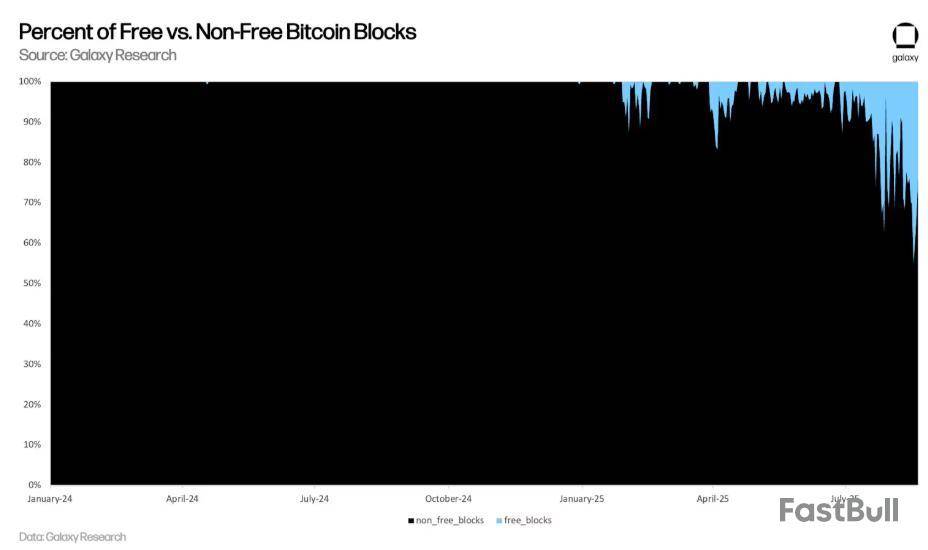
For context, Galaxy Digital noted that Bitcoin’s mempool activity is lacking as the percentage of not-full blocks has spiked to nearly 50% at times in the past few months.
“These blocks fail to reach the maximum weight limit (4,000,000 weight units) despite room to include additional transactions. In short, the mempool, Bitcoin’s waiting room for pending transactions, is frequently empty, and when it isn’t, it’s full of transactions that don’t need to pay high fees to get processed quickly,” Galaxy pointed out.
The firm continued that after the 2024 halving reduced block rewards to 3.125 BTC, miners had expected transaction fees to offset lost revenue. Instead, the opposite has happened.
According to the firm, a subdued fee market makes it harder for smaller operators to remain profitable. This trend raises questions about the long-term economics of Bitcoin’s security model.
Beyond these technical changes, the current market structure also plays a role in the Bitcoin network fees cut.
According to Galaxy, the growth of custodial products such as exchange-traded funds and institutional derivatives has reduced the need for investors to transact directly on-chain.
Moreover, retail traders seeking high-volume activity — particularly in meme coin markets — are moving to cheaper, faster blockchains like Solana. These networks offer smoother execution than Bitcoin’s Runes ecosystem.
“If more BTC volume continues to migrate to ETFs, custodians, and fast alt-L1s, the core network risks becoming a settlement layer without sufficient settlement activity,” Galaxy warned.
Meanwhile, this development arrives at an interesting time when the blockchain network is enjoying significant adoption from institutions and governments globally.
As a result, Bitcoin’s price has climbed to a new all-time high of more than $124,000. There are also now increased projections that its value could reach above $1 million.
Strategy co-founder Michael Saylor signaled an impending Bitcoin purchase, and, if completed, the transaction will mark the company’s third BTC acquisition in August.
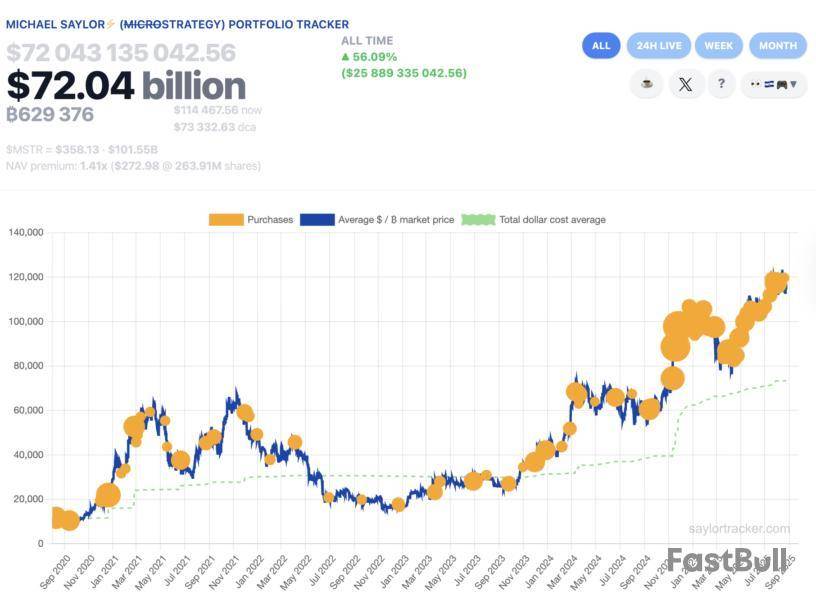
The company’s most recent Bitcoin buy occurred on August 18, when Strategy purchased 430 BTC for $51.4 million, bringing its total holdings to 629,376 BTC, valued at over $72 billion at the time of this writing.
Data from SaylorTracker shows Strategy is up over 56% on its BTC investment, representing over $25.8 billion in unrealized gains at current prices.
The company’s BTC acquisitions in August have been relatively slim. Strategy typically acquires thousands or tens of thousands of BTC in every purchase, yet it has only acquired 585 BTC so far, in two separate transactions, this month.
Strategy leads the charge in corporate BTC acquisition and is the largest BTC treasury company by a wide margin. Saylor continues to advocate for Bitcoin by orange-pilling individual investors and financial institutions, sparking a movement in corporate finance.
Strategy is not directly impacting Bitcoin market prices with its acquisition plan
Shirish Jajodia, the company’s corporate treasurer, recently told podcaster Natalie Brunell that Strategy does not move the BTC market with its purchases.
The company acquires BTC through over-the-counter transactions, private agreements between parties that occur outside of spot exchanges, and other methods that do not impact market price.
Institutional investors hold BTC long-term, which raises the floor price of Bitcoin over time. However, other factors, like price speculation and traders, have a more immediate impact on the short-term market price of BTC, Jajodia said.
“Bitcoin’s trading volume is over $50 billion in any 24 hours — that's huge volume. So, if you are buying $1 billion over a couple of days, it's not actually moving the market that much,” he added.
Strategy continues to accumulate BTC for its corporate treasury, even amid sinking share prices, which have impacted most Bitcoin treasury companies in the second half of 2025.
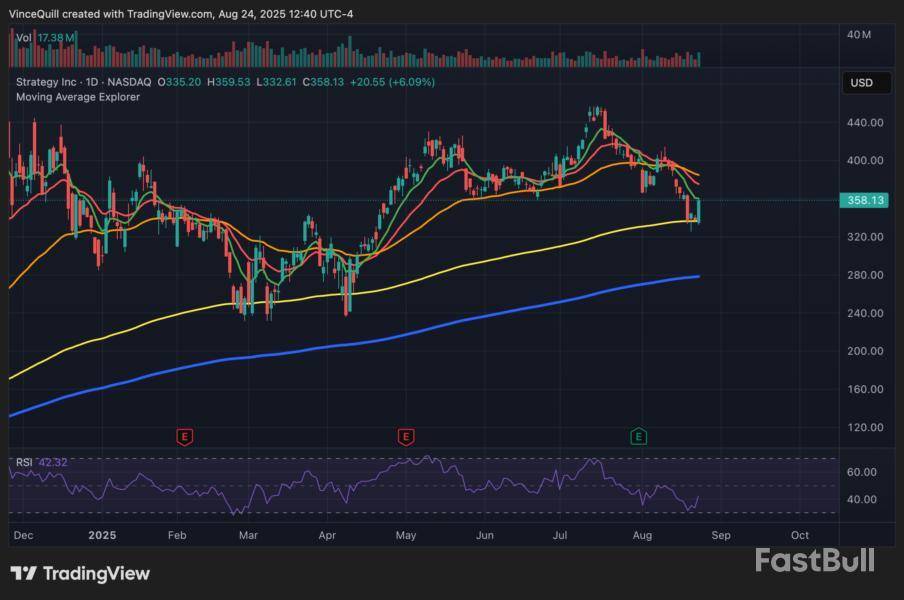
The company’s stock sank to its lowest point in nearly four months on Wednesday, hitting a low of about $325 per share, levels not seen since April. However, the price rebounded to around $358 per share on Friday.
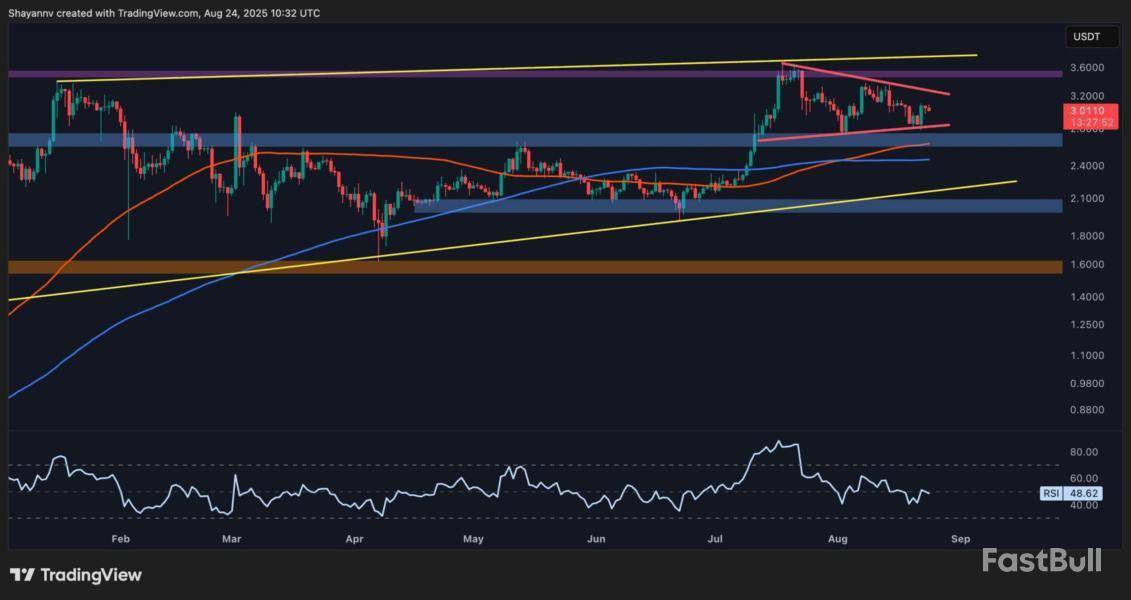
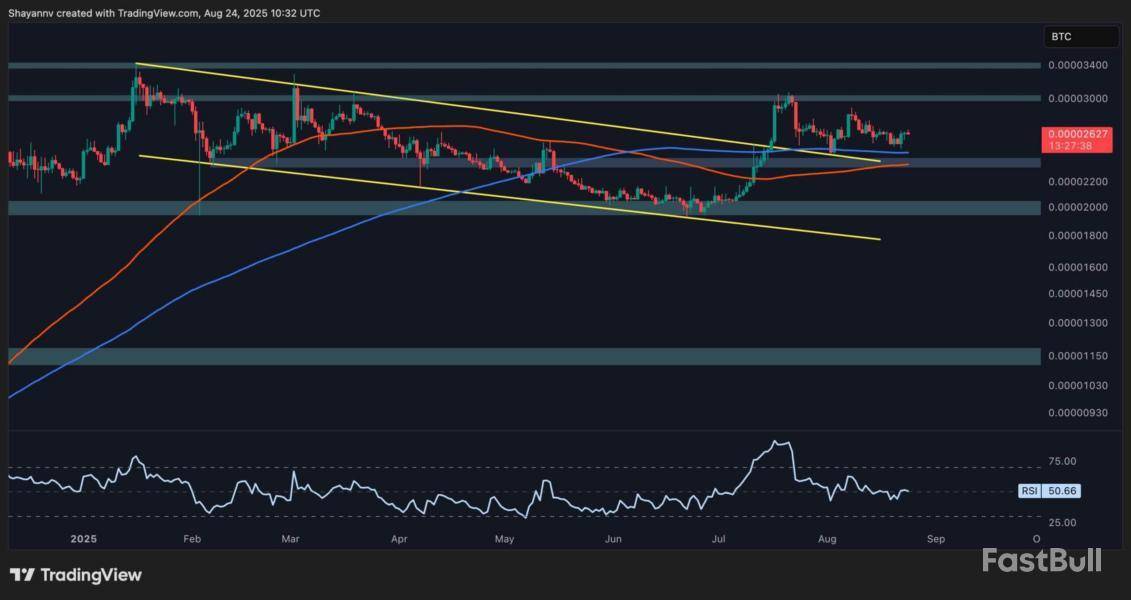
Ripple’s price has been consolidating over the past few weeks following a strong uptrend against both USDT and BTC.
Given its current position, the market still appears poised for at least one more rally before a potential reversal takes shape.Technical Analysis
By ShayanThe USDT Pair
On the USDT chart, Ripple’s token has been consolidating within a symmetrical triangle, positioned just beneath the upper boundary of the broader ascending channel that has guided the price action in recent months. Since symmetrical triangles can resolve in either direction, the next decisive breakout will determine the market’s trajectory.
Currently, XRP is trading above both the 100-day and 200-day moving averages, which have recently shown a bullish crossover. This setup favors a breakout to the upside, potentially carrying the price beyond both the triangle and the larger channel. However, if XRP falls back below these moving averages, the outlook would turn bearish, opening the door for a decline toward the $2.10 support zone.
On the XRP/BTC chart, the price has also been consolidating, mirroring the USDT pair’s behavior after breaking out of a descending channel and moving above both the 100-day and 200-day moving averages. The key difference here is that these moving averages have not yet formed a bullish crossover, suggesting the market may not be ready for a decisive breakout just yet.
Still, with the asset holding above both moving averages and the critical 2,400 SAT support area, the outlook remains constructive. If momentum builds, a rally toward the 3,000 SAT level seems likely, with even a potential retest of the 3,400 SAT resistance zone on the table.
White Label
Data API
Web Plug-ins
Poster Maker
Affiliate Program
The risk of loss in trading financial instruments such as stocks, FX, commodities, futures, bonds, ETFs and crypto can be substantial. You may sustain a total loss of the funds that you deposit with your broker. Therefore, you should carefully consider whether such trading is suitable for you in light of your circumstances and financial resources.
No decision to invest should be made without thoroughly conducting due diligence by yourself or consulting with your financial advisors. Our web content might not suit you since we don't know your financial conditions and investment needs. Our financial information might have latency or contain inaccuracy, so you should be fully responsible for any of your trading and investment decisions. The company will not be responsible for your capital loss.
Without getting permission from the website, you are not allowed to copy the website's graphics, texts, or trademarks. Intellectual property rights in the content or data incorporated into this website belong to its providers and exchange merchants.
Not Logged In
Log in to access more features

FastBull Membership
Not yet
Purchase
Log In
Sign Up