Markets
News
Analysis
User
24/7
Economic Calendar
Education
Data
- Names
- Latest
- Prev




Signal Accounts for Members
All Signal Accounts
All Contests


India Collects 1.93 Trillion Rupees As Goods And Services Tax For Jan 2026 - Government Sources
China's Icbc: Domestic And International Precious Metal Prices Have Been Highly Volatile, With Market Uncertainty Significantly Increasing
India's BSE: Reference Price For Gold, Silver ETFs Traded On Exchange To Be Based On T-1 Net Asset Value
Asked If He Knew About Don Lemon Arrest Beforehand, Trump Says: 'I Didn't Know Anything About It'

U.K. M4 Money Supply (SA) (Dec)A:--
F: --
Italy Unemployment Rate (SA) (Dec)A:--
F: --
P: --
Euro Zone Unemployment Rate (Dec)A:--
F: --
P: --
Euro Zone GDP Prelim QoQ (SA) (Q4)A:--
F: --
P: --
Euro Zone GDP Prelim YoY (SA) (Q4)A:--
F: --
P: --
Italy PPI YoY (Dec)A:--
F: --
P: --
Mexico GDP Prelim YoY (Q4)A:--
F: --
P: --
Brazil Unemployment Rate (Dec)A:--
F: --
P: --
South Africa Trade Balance (Dec)A:--
F: --
P: --
India Deposit Gowth YoYA:--
F: --
P: --
Germany CPI Prelim YoY (Jan)A:--
F: --
P: --
Germany CPI Prelim MoM (Jan)A:--
F: --
P: --
Germany HICP Prelim YoY (Jan)A:--
F: --
P: --
Germany HICP Prelim MoM (Jan)A:--
F: --
P: --
U.S. Core PPI YoY (Dec)A:--
F: --
U.S. Core PPI MoM (SA) (Dec)A:--
F: --
P: --
U.S. PPI YoY (Dec)A:--
F: --
P: --
U.S. PPI MoM (SA) (Dec)A:--
F: --
P: --
Canada GDP MoM (SA) (Nov)A:--
F: --
P: --
Canada GDP YoY (Nov)A:--
F: --
P: --
U.S. PPI MoM Final (Excl. Food, Energy and Trade) (SA) (Dec)A:--
F: --
P: --
U.S. PPI YoY (Excl. Food, Energy & Trade) (Dec)A:--
F: --
P: --
U.S. Chicago PMI (Jan)A:--
F: --
Canada Federal Government Budget Balance (Nov)A:--
F: --
P: --
U.S. Weekly Total Oil Rig CountA:--
F: --
P: --
U.S. Weekly Total Rig CountA:--
F: --
P: --
China, Mainland NBS Manufacturing PMI (Jan)A:--
F: --
P: --
China, Mainland NBS Non-manufacturing PMI (Jan)A:--
F: --
P: --
China, Mainland Composite PMI (Jan)A:--
F: --
P: --
South Korea Trade Balance Prelim (Jan)A:--
F: --
Japan Manufacturing PMI Final (Jan)--
F: --
P: --
South Korea IHS Markit Manufacturing PMI (SA) (Jan)--
F: --
P: --
Indonesia IHS Markit Manufacturing PMI (Jan)--
F: --
P: --
China, Mainland Caixin Manufacturing PMI (SA) (Jan)--
F: --
P: --
Indonesia Trade Balance (Dec)--
F: --
P: --
Indonesia Inflation Rate YoY (Jan)--
F: --
P: --
Indonesia Core Inflation YoY (Jan)--
F: --
P: --
India HSBC Manufacturing PMI Final (Jan)--
F: --
P: --
Australia Commodity Price YoY (Jan)--
F: --
P: --
Russia IHS Markit Manufacturing PMI (Jan)--
F: --
P: --
Turkey Manufacturing PMI (Jan)--
F: --
P: --
U.K. Nationwide House Price Index MoM (Jan)--
F: --
P: --
U.K. Nationwide House Price Index YoY (Jan)--
F: --
P: --
Germany Actual Retail Sales MoM (Dec)--
F: --
Italy Manufacturing PMI (SA) (Jan)--
F: --
P: --
South Africa Manufacturing PMI (Jan)--
F: --
P: --
Euro Zone Manufacturing PMI Final (Jan)--
F: --
P: --
U.K. Manufacturing PMI Final (Jan)--
F: --
P: --
Brazil IHS Markit Manufacturing PMI (Jan)--
F: --
P: --
Canada National Economic Confidence Index--
F: --
P: --
Canada Manufacturing PMI (SA) (Jan)--
F: --
P: --
U.S. IHS Markit Manufacturing PMI Final (Jan)--
F: --
P: --
U.S. ISM Output Index (Jan)--
F: --
P: --
U.S. ISM Inventories Index (Jan)--
F: --
P: --
U.S. ISM Manufacturing Employment Index (Jan)--
F: --
P: --
U.S. ISM Manufacturing New Orders Index (Jan)--
F: --
P: --
U.S. ISM Manufacturing PMI (Jan)--
F: --
P: --
South Korea CPI YoY (Jan)--
F: --
P: --
Japan Monetary Base YoY (SA) (Jan)--
F: --
P: --
Australia Building Permits MoM (SA) (Dec)--
F: --
P: --


No matching data
Latest Views
Latest Views
Trending Topics
Top Columnists
Latest Update
White Label
Data API
Web Plug-ins
Affiliate Program
View All

No data
Key takeaways:
SOL fell to 2026 lows as tech sector layoffs and artificial intelligence revenue concerns hit markets.
Despite the bleak environment, Solana outpaced competitors with network fees jumping 81%, securing its vice-leadership.
Solana’s native token, SOL (SOL), traded down to $100.30 on Saturday, reaching its lowest levels since April 2025. While the 18% price correction over 30 days took traders by surprise, the movement largely mirrored broader altcoin market capitalization trends. A 26% crash in silver prices on Friday further prompted cryptocurrency traders to brace for additional downside.
SOL was able to reclaim the $102 level on Saturday, but sentiment remained weak after $165 million in leveraged bullish positions were forcefully liquidated. Sentiment worsened following escalating tensions in Iran and fears of an economic downturn after Amazon (AMZN US) announced 16,000 white-collar job cuts on Wednesday.
Investors grew more risk-averse upon learning that OpenAI accounted for 45% of Microsoft’s (MSFT US) Azure cloud computing backlog. Additional tension stemmed from a Wall Street Journal report stating Nvidia (NVDA US) would no longer invest $100 billion in OpenAI. The ChatGPT maker is reportedly expected to face $14 billion in net losses in 2026, according to The Information.
Despite the bleak socio-political environment, Solana onchain activity has outpaced its competitors, consolidating its position as the runner-up in network fees and Total Value Locked (TVL). Healthy onchain metrics provide a dual benefit to the native token: they increase staking returns to incentivize long-term holding while creating constant demand for data processing fees.
Solana network fees jumped 81% above the trend over the past 30 days, according to Nansen data. Additionally, active addresses grew by 62%, and transactions soared to 2.29 billion. In comparison, the Ethereum ecosystem—including layer-2 solutions—totaled 623 million transactions, while Ethereum base layer fees grew by only 11%. Solana remained the clear leader in decentralized application (DApp) activity.
Related: Active Solana addresses spike 115%, four in 10 merchants take Bitcoin–Month in Charts
Demand for leveraged bullish positions on SOL vanished as traders sought safety in cash and short-term government bonds. Multi-billion dollar tech companies, including Unity (U US), AppLovin (APP US), Figma, and HubSpot (HUB US), faced price declines of 30% or more within 30 days. Gold, usually perceived as a safe haven, traded down 13% from its $5,600 all-time high reached on Thursday.
The annualized funding rate on SOL perpetual futures plunged to -17%, meaning shorts (sellers) are paying to keep their positions open. This condition is unusual, rarely lasts long, and indicates an extreme lack of leverage appetite from bulls. The move coincided with political disputes regarding United States government funding.
The US Senate approved a funding package on Friday, alongside a two-week stopgap measure to allow more time for government funding disputes over Department of Homeland Security funding following Democratic criticism of immigration enforcement. The US House of Representatives must vote on the final version on Monday.
Solana spot exchange-traded funds (ETFs) saw $11 million in net outflows on Friday, according to CoinGlass. Meanwhile, listed companies using SOL as a corporate reserve strategy are under pressure. Forward Industries (FWDI US), Upexi (UPXI US), and Sharps Technology (STSS US) stocks traded 20% or more below their respective net asset values.
SOL’s path to reclaiming bullish momentum depends largely on renewed confidence in global economic growth and reduced socio-political risks, which may not materialize in the short term.
SUI is approaching a critical smart money zone, with price action signaling that big moves could be on the horizon. Sustained trading above $2 may trigger a breakout, setting the stage for the next significant leg higher.
SUI Reaches Stage For Major Money Entry
Crypto analyst Crypto Patel, in a recent post, highlighted that SUI is at the same stage where big money typically enters the market, urging traders not to miss this opportunity. According to the weekly chart, the long-term ascending channel remains intact, and price is currently trading near a sell-side liquidity grab close to trendline support, signaling potential accumulation.
Related Reading: SUI Reclaims Key Support With Strength — Is $2.35 The Next Target?
The chart also shows strong weekly demand and a bullish order block between $1.15 and $0.80, indicating that the market structure is poised to turn super bullish if SUI clears higher-timeframe resistance. The current compression phase is a classic setup for expansion, meaning the market is preparing for a potential breakout.
Crypto Patel emphasized that smart money tends to buy during compression, while retail often enters after confirmation of the move. If the breakout confirms, projected targets for SUI are $5, $10, and $20, illustrating the potential scale of the next trend. As Crypto Patel puts it, “This is how big trends are built, slowly, then suddenly. Liquidity is cleared, demand is active, and patience gets rewarded.”
Price Trading Around $1.28
Altcoinpedia outlined that SUI is currently trading around $1.28, which serves as the anchor for near-term market analysis. The price structure indicates ongoing consolidation above support near $1.50, while resistance is observed around $2.00. This setup reflects a tightening range as buyers and sellers balance, suggesting that a decisive move could be approaching.
Related Reading: Sui Restores Service After Major 6-Hour Outage Shook Network
Price oscillation within this range highlights that sustained volume expansion above $2.00 could drive the next leg of the trend toward $2.50. Conversely, failure to break this resistance, particularly with shrinking volume, increases the likelihood of a retest of support at $1.50. Should that level fail to hold, price could decline further toward $1.20.
Momentum currently resides in a neutral state, reflecting indecision in the market. In a bullish scenario, a clean break above $2.00, confirmed by momentum indicators, would signal trend continuation. On the downside, a breach of support under heavy volume could accelerate selling pressure and confirm a bearish scenario.
Traders are advised to use key range boundaries for entries and exits, managing risk around both support and resistance levels. For longer-term investors, it is prudent to wait for a decisive breakout from the current consolidation, which would provide a clearer signal for trend direction and reduce the risk of false moves within the neutral range.
After the weekend's crypto market dump, traders are increasingly bearish on Bitcoin, and they're expressing that via Polymarket.
Bitcoin is now more likely to crash below $45,000 than to bounce back to $130,000 this year according to traders on Polymarket.
Shiba Inu has spent recent weeks locked in a downward price action with bullish momentum fading and investor interest thinning without a clear bullish direction. However, holders may finally have something concrete to anticipate. Refreshing activity from Shytoshi Kusama, the Shiba Inu ecosystem’s lead developer, has diverted attention to a key moment expected on Sunday.
Lead Dev Breaks Silence, Teases Sunday
That dynamic began to change when Shytoshi Kusama, the pseudonymous lead developer and co-founder of the Shiba Inu ecosystem, resurfaced on X after a prolonged absence since early December. However, Kusama broke his silence this week with a thread on X explaining the reasons behind his inactivity and has since returned to regular posting and reposting activity.
One post stood out more than the rest, in which Kusama hinted at a revelation scheduled for Sunday. In that message, he spoke about arriving at a discovery by pure chance and referenced what he described as an ancient marker older than time itself. Although the message was a bit cryptic, it immediately generated attention across the SHIB community, which has been hungry for direction and clarity amid recent challenges in Shiba Inu’s price action.
The significance of Sunday became clearer following an interesting exchange between Kusama and a Shiba Inu community member who openly expressed concerns about transparency, reassurance, and leadership presence after recent ecosystem issues.
The community member, known as RuggRat on X, noted how there has been no official statement or simple explanation of what happened from Kusama regarding the Shibarium exploit. This is in reference to the September 2025 Shibarim Bridge exploit, which saw attackers making off with $4.1 million worth of crypto assets.
In response, Kusama acknowledged the concern, stating that silence can sometimes be strategic and framing Sunday as a moment for addressing issues step by step. “This is what Sunday is for. One at a time,” Kusama said.
Shytoshi Kusama™@ShytoshiKusamaJan 29, 2026Fair. But sometimes silence is a weapon for quiet wars. This is what Sunday is for. One bandage. Take off. Fix. Put on. One at a time.
Shiba Inu’s Challenging Phase Has Tested Holder Confidence
Shiba Inu’s price action has struggled to gain any meaningful upside traction since the beginning of 2026, an extension of its late 2025 run. At the time of writing, SHIB is trading around $0.0000071, keeping it pinned down by 1.8% and 10.5% in the past 24 hours and seven days, respectively. Price structure during this period has been marked by a series of lower lows, with persistent selling pressure leaving little room for a meaningful higher high to form.
This prolonged stagnation has been difficult for many Shiba Inu holders, and many of them are increasingly becoming sellers. Furthermore, expectations around ecosystem expansion and utility has yet to reflect positively in the price. That environment is exactly why leadership communication has mattered more than usual.
Featured image from Unsplash, chart from TradingView
A month ago, SLV’s volume was a rounding error compared to the spotlight tech names. A year ago it was around the 170th most traded ETF, living in oblivion. Now it’s swinging like crypto used to: manic inflows, explosive turnover, then a sharp snapback downwards. That’s not normal for a metal ETF tied to a centuries-old industrial commodity.
Silver Volume explodes, source: X
There’s a reason this matters for tech and markets: silver sits at the intersection of industrial demand and macro hedge psychology. It’s used in solar panels, semiconductors, EVs and data centers — the very infrastructure driving AI and green tech. But it’s also a “hard asset” fallback when markets get jittery about debt, monetary policy, and currency stress.
The spike-then-crash pattern here doesn’t look like a simple bet on silver’s fundamentals. It feels like speculative repositioning — a blend of hedge flows, algorithmic rotation, and a dash of fear-driven capital chasing anything with liquid depth. The nearest historical echoes are things like $GME and $MSTR’s erratic runs — not because they’re related assets, but because markets collectively decide to trade something beyond its narrative. Has Silver peaked with a blow off top? Possibly.
If SLV continues to behave like a proxy for macro stress + industrial exposure, its volume swings could be a leading indicator of broader market sentiment — especially in parts of the investor base that don’t show up in the usual tech stock chatter.
Bitcoin has once again fallen below a critical support zone, raising questions about whether the market is gearing up for a deeper sell-off. With selling pressure still intact, traders are now watching key levels closely to see if a final flush toward lower support is imminent.
Price Faces Another Rejection
MakroVision Research shared on X that Bitcoin has once again met strong rejection, resulting in a decisive break below several key support levels. Price has now slipped back into the range of the previous low and continues to trade beneath the critical green resistance zone between $85,200 and $86,200, highlighting that bearish pressure remains in control for now.
On the very short-term timeframe, there are early signs of an attempted rebound, but without a timely and sustainable reclaim of the $85,200–$86,200 zone, this move is best viewed as a technical counter-bounce rather than the start of a meaningful trend reversal. As long as the price remains capped below this area, the broader short-term downtrend remains intact.
From a tactical perspective, the $85,200–$86,200 region has become the key battlefield. A clean reclaim and hold above this zone would be the first clear indication that selling pressure is beginning to fade, potentially allowing for price stabilization and a relief rally.
If this reclaim attempt fails, the risk of continued downside acceleration increases. In that case, focus would turn to the $72,300–$75,300 range, a technically prominent support zone with historical significance. This zone may ultimately serve as a potential support and reversal region should the market experience another phase of capitulation.
CME Gap Opens: What To Expect From Bitcoin This Weekend
Crypto analyst MartyParty, in a recent Bitcoin Wyckoff Accumulation update, highlighted that a CME gap is opening, which is expected to be filled by Sunday evening. This sets the stage for potential short-term volatility, with traders closely watching key technical levels and liquidation activity.
Several scenarios are possible over the coming days. One possibility is the continued liquidation of remaining leveraged longs, with the lowest 25x Binance liquidation currently around $79,350, potentially completing the classic Wyckoff Spring pattern. Another scenario is a retest of secondary support at $81,800, which could act as a temporary floor for Bitcoin’s price action.
If support at $81,800 holds, Bitcoin may trade sideways or attempt to push toward the primary support level, which has now turned into resistance at $84,800. The most probable scenario suggests a move up through $84,500 toward $86,463, followed by a retest of $84,500 on Sunday night as the CME gap is filled, completing the near-term Wyckoff accumulation setup.
By Bill Alpert
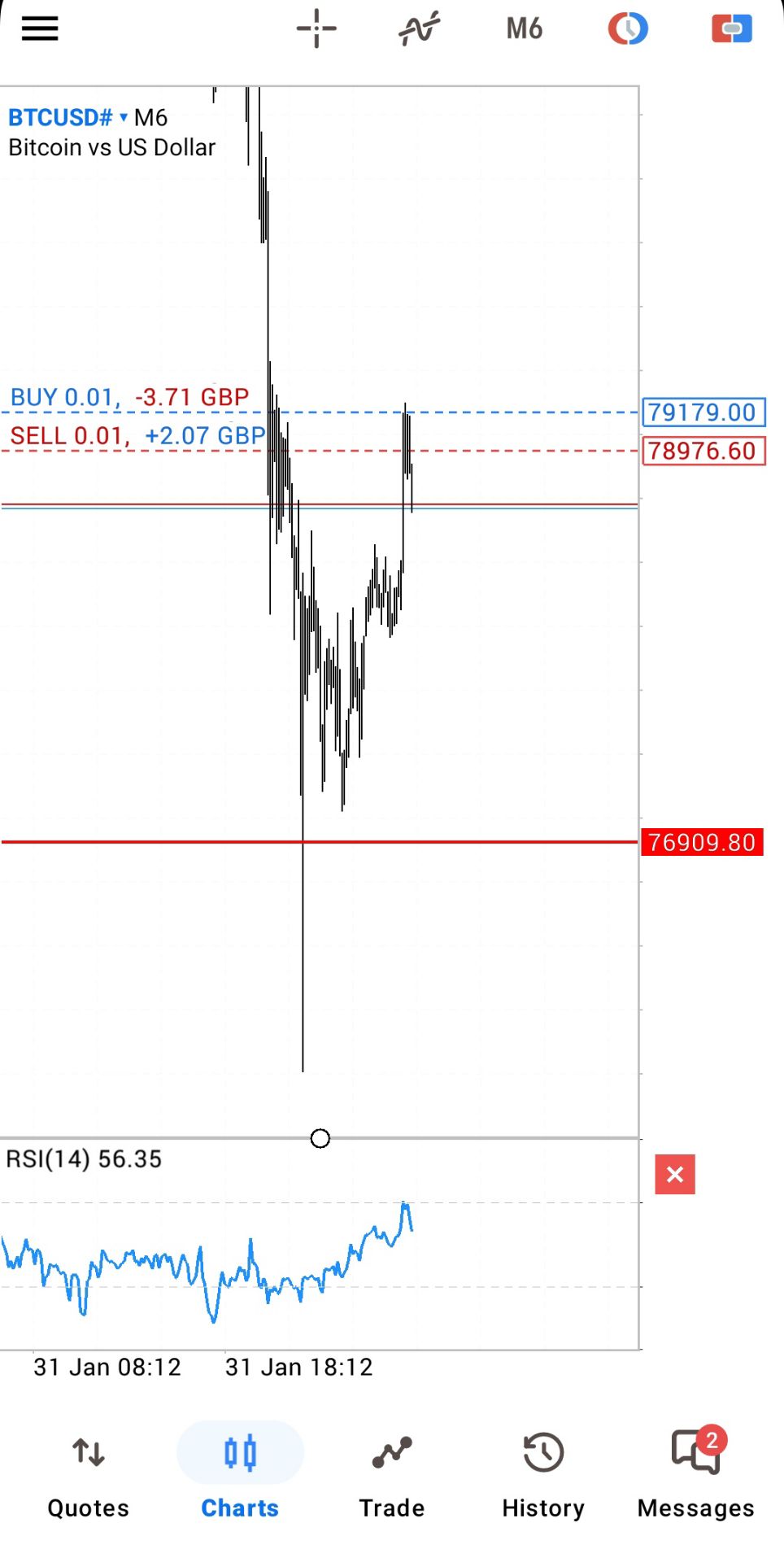
Cryptocurrencies continued to drop on Saturday, extending the week's losses. Bitcoin sank below 80,000.
After ending Friday at $83,817 Bitcoin fell 7% to $78,092 by Saturday evening. Ethereum and XRP fell 10% and 7%, respectively.
The cryptocurrencies have been sliding for a month, but they took a sharp leg down on Friday, when President Donald Trump announced he would nominate Kevin Warsh to serve as the next chairman of the Federal Reserve.
That news also seems to have reversed the powerful rise of gold and silver — which, like cryptocurrencies, are favored by some traders as alternatives to the U.S. dollar.
If some traders see Warsh as bad news for crypto, that thinking is hard to understand. The Fed nominee has called Bitcoin a good asset and said it is a "good policeman for policy."
Write to Bill Alpert at william.alpert@barrons.com
This content was created by Barron's, which is operated by Dow Jones & Co. Barron's is published independently from Dow Jones Newswires and The Wall Street Journal.
White Label
Data API
Web Plug-ins
Poster Maker
Affiliate Program
The risk of loss in trading financial instruments such as stocks, FX, commodities, futures, bonds, ETFs and crypto can be substantial. You may sustain a total loss of the funds that you deposit with your broker. Therefore, you should carefully consider whether such trading is suitable for you in light of your circumstances and financial resources.
No decision to invest should be made without thoroughly conducting due diligence by yourself or consulting with your financial advisors. Our web content might not suit you since we don't know your financial conditions and investment needs. Our financial information might have latency or contain inaccuracy, so you should be fully responsible for any of your trading and investment decisions. The company will not be responsible for your capital loss.
Without getting permission from the website, you are not allowed to copy the website's graphics, texts, or trademarks. Intellectual property rights in the content or data incorporated into this website belong to its providers and exchange merchants.
Not Logged In
Log in to access more features
Log In
Sign Up