Markets
News
Analysis
User
24/7
Economic Calendar
Education
Data
- Names
- Latest
- Prev


Signal Accounts for Members
All Signal Accounts
All Contests


U.K. Trade Balance (Oct)A:--
F: --
P: --
France HICP Final MoM (Nov)A:--
F: --
P: --
China, Mainland Outstanding Loans Growth YoY (Nov)A:--
F: --
P: --
China, Mainland M2 Money Supply YoY (Nov)A:--
F: --
P: --
China, Mainland M0 Money Supply YoY (Nov)A:--
F: --
P: --
China, Mainland M1 Money Supply YoY (Nov)A:--
F: --
P: --
India CPI YoY (Nov)A:--
F: --
P: --
India Deposit Gowth YoYA:--
F: --
P: --
Brazil Services Growth YoY (Oct)A:--
F: --
P: --
Mexico Industrial Output YoY (Oct)A:--
F: --
P: --
Russia Trade Balance (Oct)A:--
F: --
P: --
Philadelphia Fed President Henry Paulson delivers a speech
Canada Building Permits MoM (SA) (Oct)A:--
F: --
P: --
Canada Wholesale Sales YoY (Oct)A:--
F: --
P: --
Canada Wholesale Inventory MoM (Oct)A:--
F: --
P: --
Canada Wholesale Inventory YoY (Oct)A:--
F: --
P: --
Canada Wholesale Sales MoM (SA) (Oct)A:--
F: --
P: --
Germany Current Account (Not SA) (Oct)A:--
F: --
P: --
U.S. Weekly Total Rig CountA:--
F: --
P: --
U.S. Weekly Total Oil Rig CountA:--
F: --
P: --
Japan Tankan Small Manufacturing Outlook Index (Q4)A:--
F: --
P: --
Japan Tankan Large Non-Manufacturing Diffusion Index (Q4)A:--
F: --
P: --
Japan Tankan Large Non-Manufacturing Outlook Index (Q4)A:--
F: --
P: --
Japan Tankan Large Manufacturing Outlook Index (Q4)A:--
F: --
P: --
Japan Tankan Small Manufacturing Diffusion Index (Q4)A:--
F: --
P: --
Japan Tankan Large Manufacturing Diffusion Index (Q4)A:--
F: --
P: --
Japan Tankan Large-Enterprise Capital Expenditure YoY (Q4)A:--
F: --
P: --
U.K. Rightmove House Price Index YoY (Dec)A:--
F: --
P: --
China, Mainland Industrial Output YoY (YTD) (Nov)A:--
F: --
P: --
China, Mainland Urban Area Unemployment Rate (Nov)A:--
F: --
P: --
Saudi Arabia CPI YoY (Nov)--
F: --
P: --
Euro Zone Industrial Output YoY (Oct)--
F: --
P: --
Euro Zone Industrial Output MoM (Oct)--
F: --
P: --
Canada Existing Home Sales MoM (Nov)--
F: --
P: --
Euro Zone Total Reserve Assets (Nov)--
F: --
P: --
U.K. Inflation Rate Expectations--
F: --
P: --
Canada National Economic Confidence Index--
F: --
P: --
Canada New Housing Starts (Nov)--
F: --
P: --
U.S. NY Fed Manufacturing Employment Index (Dec)--
F: --
P: --
U.S. NY Fed Manufacturing Index (Dec)--
F: --
P: --
Canada Core CPI YoY (Nov)--
F: --
P: --
Canada Manufacturing Unfilled Orders MoM (Oct)--
F: --
P: --
U.S. NY Fed Manufacturing Prices Received Index (Dec)--
F: --
P: --
U.S. NY Fed Manufacturing New Orders Index (Dec)--
F: --
P: --
Canada Manufacturing New Orders MoM (Oct)--
F: --
P: --
Canada Core CPI MoM (Nov)--
F: --
P: --
Canada Trimmed CPI YoY (SA) (Nov)--
F: --
P: --
Canada Manufacturing Inventory MoM (Oct)--
F: --
P: --
Canada CPI YoY (Nov)--
F: --
P: --
Canada CPI MoM (Nov)--
F: --
P: --
Canada CPI YoY (SA) (Nov)--
F: --
P: --
Canada Core CPI MoM (SA) (Nov)--
F: --
P: --
Canada CPI MoM (SA) (Nov)--
F: --
P: --
Federal Reserve Board Governor Milan delivered a speech
U.S. NAHB Housing Market Index (Dec)--
F: --
P: --
Australia Composite PMI Prelim (Dec)--
F: --
P: --
Australia Services PMI Prelim (Dec)--
F: --
P: --
Australia Manufacturing PMI Prelim (Dec)--
F: --
P: --
Japan Manufacturing PMI Prelim (SA) (Dec)--
F: --
P: --
U.K. Unemployment Rate (Nov)--
F: --
P: --
U.K. 3-Month ILO Unemployment Rate (Oct)--
F: --
P: --


No matching data
Latest Views
Latest Views
Trending Topics
Top Columnists
Latest Update
White Label
Data API
Web Plug-ins
Affiliate Program
View All

No data
, one of the largest corporate holders of Ethereum, its $1.5 billion share buyback program.
NEW: SharpLink begins utilizing its $1.5B share buyback program, repurchasing ~1M shares of .We believe our stock is significantly undervalued. Buying back stock at NAV < 1 is immediately accretive and compounds long-term stockholder value.Key facts:– $3.6B of on… — SharpLink (SBET) (@SharpLinkGaming)
The company repurchased approximately 939,000 shares of common stock at an average price of $15.98, underscoring its view that the stock is significantly undervalued.
Management says that buybacks represent a compelling investment opportunity, immediately accretive to shareholders, while reinforcing confidence in the company’s long-term growth prospects.Balance Sheet Strength: $3.6B ETH and Zero Debt
At the heart of SharpLink’s strategy is its Ethereum treasury. The company currently holds roughly $3.6 billion in ETH, nearly 100% of which is staked and generating material revenue.
With no outstanding debt and a robust balance sheet, SharpLink says it stands in a position of strength, enabling it to prioritize shareholder returns without compromising future growth.
“With a powerful ETH treasury generating income, we are in a position of strength,” said Joseph Chalom, Co-CEO of SharpLink.Disciplined Capital Allocation and NAV Focus
SharpLink confirmed that it has not tapped into its At-the-Market (ATM) facility while the stock trades below Net Asset Value (NAV), as such activity would dilute ETH per share.
Instead, the company is pursuing a disciplined capital allocation strategy, including buybacks, while reserving the right to utilize its ATM in an accretive way if market conditions improve.
Management highlighted that share repurchases are intended to increase stockholder value while maintaining long-term exposure to Ethereum.Long-Term Ethereum Strategy
As one of the world’s largest publicly traded companies to adopt ETH as its primary treasury reserve asset, SharpLink has positioned itself as a leading advocate for Ethereum adoption.
The company’s ETH dashboard provides transparency, offering investors insights into its holdings, staking income, and market-adjusted NAV.
“Maximizing stockholder value remains our top priority as we execute on our vision of being the most trusted ETH treasury company in the market,” Chalom adds.$SBET Stock Soars, Then Retreats Amid Buyback Momentum
SharpLink Gaming Inc. (Nasdaq: SBET) has experienced dramatic price swings in recent months. Over the past six months, the stock surged 244%, climbing from just above $4 in March to peaks of nearly $80 in June 2025. Volatility Takes Hold
After hitting highs in June, the stock corrected sharply, losing much of its momentum by July. By early August, shares were trading closer to the $20 level, with the price consolidating into September around $15–16.
This volatility reflects the speculative nature of both SharpLink’s ETH-linked strategy and investor sentiment tied to broader crypto markets.Buyback Underpins Stability
The company’s announcement of a $1.5 billion buyback program and its first repurchase of nearly 1 million shares at an average price of $15.98 appears to have provided some price support.
Pre-market trading on September 9 shows shares at $16.20 (+3.38%), suggesting investors see the buyback as a vote of confidence from management.
Acting CFTC Chair Caroline D. Pham said the agency is exploring whether overseas crypto platforms operating under strong, crypto‑specific regimes, such as the EU’s MiCA, could be recognized under existing U.S. cross‑border rules. The aim is to give compliant foreign venues a clearer pathway to serve U.S. participants without waiting for new laws. This move aligns with recent efforts to clarify recognition routes for non‑U.S. exchanges and signals closer coordination on spot crypto oversight between U.S. market regulators.
Key takeaways:
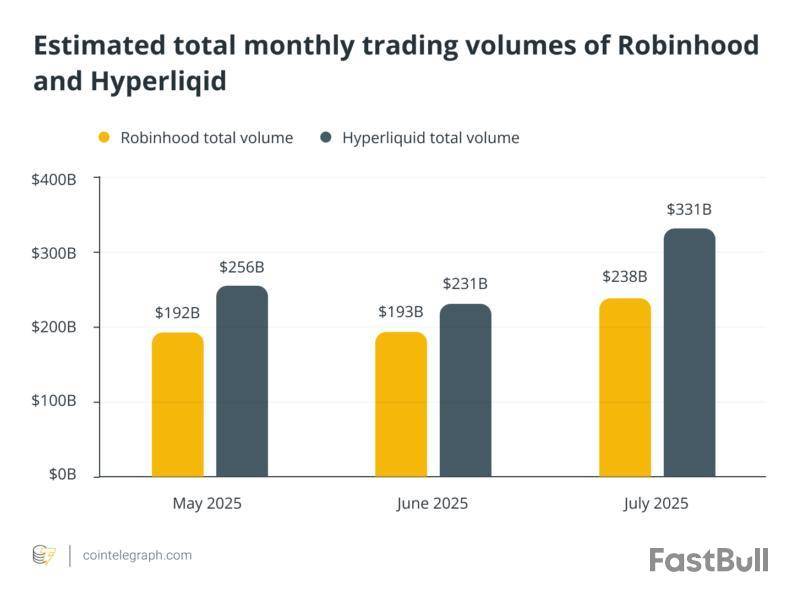
Hyperliquid processed around $330 billion in trading volume in July 2025, briefly surpassing Robinhood.
A split-chain design enabled CEX-like speed while keeping custody and execution onchain.
The HLP vault and Assistance Fund buybacks aligned traders, market makers and token holders in a reinforcing loop.
A large airdrop, Phantom Wallet integration and self-funded operations helped attract users and sustain adoption.
A year after launching its own layer 1 (L1), Hyperliquid has become one of decentralized finance’s (DeFi) top perpetuals venues, logging about $319 billion in trading volume in July 2025. Remarkably, the core team behind it is believed to consist of only 11 people.
This guide looks at the technical design and operational choices that enabled such scale.
What is Hyperliquid?
Hyperliquid is a decentralized perpetuals exchange built on a custom layer 1.
Its chain is divided into two tightly connected components: HyperCore, which manages the onchain order book, margining, liquidations and clearing; and HyperEVM, a general-purpose smart contract layer that interacts directly with exchange state.
Both are secured by HyperBFT, a HotStuff-style proof-of-stake (PoS) consensus that enforces a single transaction order without relying on offchain systems. HyperEVM launched on mainnet on Feb. 18, 2025, adding programmability around the exchange core.
Did you know? Hyperliquid achieves a median trade latency of just 0.2 seconds (with even 99th‑percentile delays under 0.9 seconds) and can handle up to 200,000 transactions per second, rivaling centralized exchanges on speed.
The $330-billion month: What the data shows
July was Hyperliquid’s strongest month yet. Data from DefiLlama shows the platform processed about $319 billion in perpetuals trading volume. That pushed DeFi-wide perpetuals to a record $487 billion — a 34% jump from June.
At the same time, industry trackers highlighted a combined $330.8 billion figure, which included spot trading as well. Headlines noted this meant Hyperliquid briefly surpassed Robinhood.
Robinhood’s July metrics provide the basis for comparison: $209.1 billion in equities notional plus $16.8 billion in crypto trading, along with $11.9 billion at Bitstamp (a Robinhood subsidiary), totaling around $237.8 billion.
Several outlets noted that July marked the third straight month Hyperliquid’s volumes topped Robinhood’s, which is a striking outcome for a team of only 11. And these are monthly figures, not cumulative totals. That means the platform is showing sustained high-frequency activity rather than a one-off spike.
Engineering for throughput
Hyperliquid’s scale comes from a carefully split state machine operating under one consensus.
HyperCore acts as the exchange engine, with central-limit order books, margin accounting, matching and liquidations all kept fully onchain. The documentation stresses that it avoids offchain order books. Each asset’s book exists onchain as part of the chain state, with price-time priority matching.
HyperEVM is an Ethereum Virtual Machine (EVM)-compatible environment on the same blockchain. Because it shares consensus and data availability with HyperCore, applications can build around the exchange without leaving the L1.
Both components rely on HyperBFT, a HotStuff-inspired PoS consensus that delivers a consistent transaction order across the entire system. The design aims for low-latency finality while keeping custody and execution onchain.
This structure differs from typical decentralized exchange (DEX) models: automated market makers (AMMs) that rely on liquidity pools or hybrid order-book DEXs that keep orders onchain but match them offchain.
Hyperliquid instead runs its core exchange logic (order books, matching, margin and liquidations) entirely onchain while still enabling EVM-based apps to integrate natively.
The operating model: How 11 people attained CEX speed
Hyperliquid’s organizational design is deliberately lean.
Founder Jeff Yan has said the core team consists of about 11 people, with hiring intentionally selective to maintain speed and cultural cohesion. The emphasis is on a small, coordinated group rather than rapid headcount expansion.
The project is entirely self-funded and has declined venture capital. Yan frames this as aligning ownership with users and keeping priorities independent of investor timelines. This approach also explains the absence of major centralized-exchange listings — the focus remains on technology and community adoption.
Execution follows a tight feedback loop. When an API outage on July 29 disrupted order execution for 37 minutes, the team reimbursed affected traders $1.99 million the next business day. For a DeFi venue, that speed of response stood out as an example of its “ship, fix, own it” mindset.
“Hiring the wrong person is worse than not hiring at all,” said Yan on staying lean.
Together, selective hiring, independence from venture capital and rapid incident management help explain how a small team can operate at a centralized-exchange cadence while keeping custody and execution fully onchain.
The HLP + Assistance Fund flywheel
Protocol mechanisms align trader activity with liquidity provisioning.
Hyperliquidity Provider (HLP) vault
HLP is a protocol-managed vault that handles market-making and liquidations on HyperCore. Anyone can deposit capital, with contributors sharing in the vault’s profit and loss (PnL) and a portion of trading fees. By making market-making infrastructure open and rules-based, HLP reduces reliance on the bilateral market-maker deals common elsewhere.
Assistance Fund (fee buybacks)
According to DefiLlama dashboards, 93% of protocol fees flow to the Assistance Fund, which buys back and burns HYPE tokens, while 7% go to HLP. This creates a feedback loop: Higher organic volume funds larger buybacks, reducing token supply, while still allocating a portion to support the vault.
Funding mechanics
Perpetual funding on Hyperliquid is purely peer-to-peer, with no protocol take, paid hourly and capped at 4% per hour.
Rates combine a fixed interest (0.01% per eight hours, prorated hourly) with a variable premium derived from an oracle that aggregates centralized exchange spot prices.
This structure helps keep perpetual prices aligned with spot. Payments are made by both sides of the book, reinforcing risk sharing without embedding yield promises.
Distribution and community
Hyperliquid’s token distribution leaned heavily toward users.
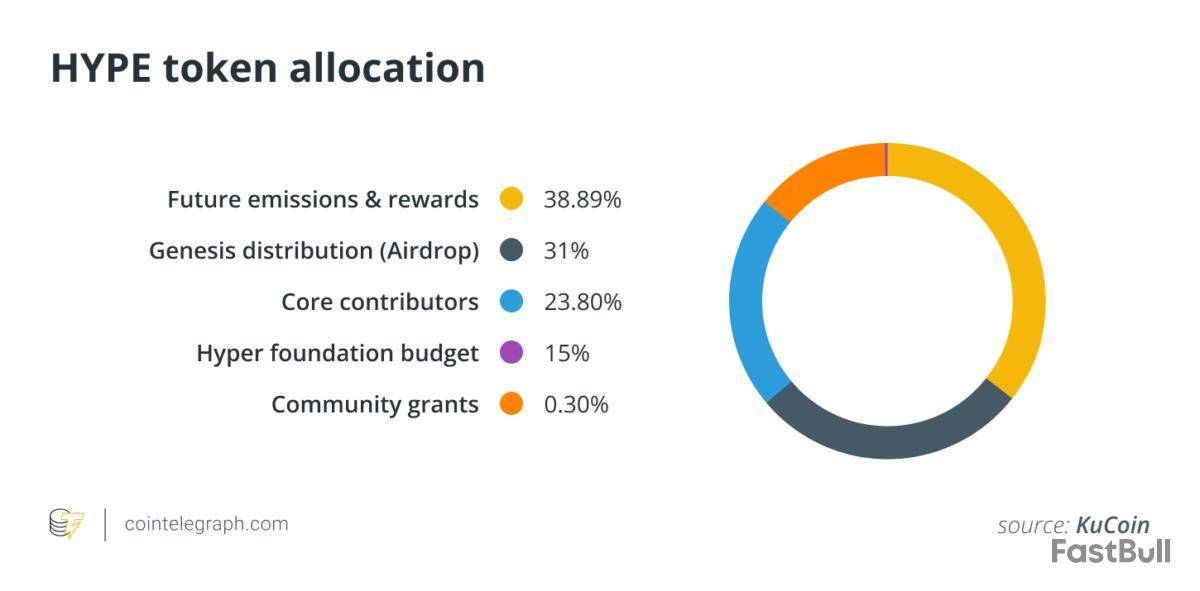
On Nov. 29, 2024, the project launched the HYPE genesis airdrop, distributing about 310 million tokens to early participants. The event coincided with the token’s trading debut, reinforcing a community-first approach. Hyperliquid (HYPE) is used for staking in HyperBFT and for gas payments onchain.
Momentum accelerated in mid-2025 when Phantom Wallet integrated Hyperliquid perpetuals directly in-app. Analysts and media noted a clear boost in flow and adoption.
VanEck’s July report attributed $2.66 billion in trading volume, $1.3 million in fees and roughly 20,900 new users to the Phantom rollout. Separate reporting tracked $1.8 billion in routed volume within the first 16 days.
On the product side, HyperEVM went live on Feb. 18, 2025, enabling general-purpose smart contracts and creating pathways for wallets, vaults and listing processes to integrate around the exchange. That flexibility encouraged outside developers to plug into the ecosystem and supported a steady pipeline of new markets.
Did you know? Hyperliquid’s genesis airdrop distributed around $1.6 billion worth of HYPE across 90,000 users, equal to 31% of the total supply. At peak prices, the average airdrop value exceeded $100,000 per user.
Critiques and risk factors
Decentralization and validator set
In early 2025, researchers and validators raised concerns over validator transparency and centralization. The team acknowledged the issue and said it would make the code open-source after strengthening its security. The team also outlined plans to expand validator participation.
Concentration risk
Hyperliquid’s market share (often estimated at 75%-80% of decentralized perpetuals trading) poses concentration challenges. Commentators highlighted the benefits of network effects but also noted the systemic risks if liquidity shifts or shocks occur at a single venue.
Operational incidents
A 37-minute API outage on July 29 temporarily halted trading. Hyperliquid reimbursed roughly $2 million to users the next day. While the swift refund reinforced its reputation for responsiveness, the event also highlighted the exposure leveraged traders face during outages.
Governance and treasury execution
Observers sometimes scrutinize how protocol-managed vaults allocate capital offchain or across chains, as well as the design of buyback mechanisms. These remain areas of operational risk to watch as Hyperliquid scales.
Did you know? Hyperliquid depends on validator-maintained price oracles. If these oracles are manipulated, it may trigger premature or inaccurate liquidations. To counter this, Hyperliquid limits open interest levels and blocks orders more than 1% away from the oracle price, though the HLP vault is exempt from those restrictions.
Final thoughts: Why Hyperliquid scaled when others stalled
Four factors help explain Hyperliquid’s outsized growth.
First, its execution-first chain design: HyperCore handles onchain matching and margin, while HyperEVM provides composability, both ordered under HyperBFT. Together, this setup delivers near CEX-level latency while keeping custody and state fully onchain.
Second, incentive alignment through fee-funded buybacks (via the Assistance Fund) and the open HLP vault created a reflexive liquidity loop as trading volumes expanded.
Third, maintaining a lean core team of about 11 contributors minimized managerial overhead and kept product cycles fast.
Fourth, distribution advantages (most notably Phantom Wallet’s integration) reduced onboarding friction and expanded reach during a favorable cycle for onchain derivatives.
For those evaluating long-term durability, several watchpoints stand out:
Whether validator decentralization and code open-sourcing progress as promised
How quickly spot markets, central limit order book activity and third-party apps build around HyperEVM
Whether revenue and volume remain resilient as competitors begin adopting similar models.
This article does not contain investment advice or recommendations. Every investment and trading move involves risk, and readers should conduct their own research when making a decision.
The trend of exposure reduction by major Bitcoin network players continues to deepen even as Bitcoin awaits its next major move.
According to Capriole Investments founder Charles Edwards, Bitcoin miners are "puking" Bitcoin at a rate not seen since the cryptocurrency traded at $19,000. This trend of Bitcoin liquidation typically happens for one of two reasons, which include a margin squeeze whenever they need cash, but this might not be the case at present. The second reason stated by Edwards could be that they are bearish despite being in profit.
Charles Edwards@caprioleioSep 09, 2025Bitcoin miners are puking Bitcoin, at a rate not seen since $19K.
This typically happens for 1 of 2 reasons:
1) Margin squeeze, they need cash (not so today)
2) They are in profit and bearish
In all cases, price was higher a month later. pic.twitter.com/6fNvINpPNJ
Bitcoin’s mining difficulty, a measure of how difficult it is for miners to solve cryptographic puzzles in Bitcoin mining, has recently hit a new all-time high, coinciding with an increase in the hash rate.
This strength alleviates fears about miners’ net outflows or the lack of profitability gains across the sector.
Silver lining
Despite the concerns, there is no evidence that miners are under immediate pressure to liquidate positions.
In his tweet, Capriole Investments Founder Charles Edwards posted a Bitcoin price chart alongside his tweet, which also showed Bitcoin miner inflows.
A trend is deduced when Bitcoin miner netflows dip into the red, and the price reverses direction, often climbing, hinting at a bullish divergence.
Edwards added that in cases where Bitcoin miners' outflows soared, the price was often higher a month later, indicating a hidden bullish signal.
This shows that when Bitcoin flows out from miners, it is being taken up by corporate reserves, which often counter the negative effects. At press time, Bitcoin was up 1% in the last 24 hours to $112,931.
Hyperliquid is shaking up the crypto world with a bold move: it’s launching its own stablecoin, USDH, and letting the community vote on who will issue it. With $5.6 billion in deposits and potential annual revenue of $220 million, the announcement has drawn top stablecoin issuers into a high-stakes scramble.
Things are getting interesting. Not familiar with what’s happening? Here’s the scoop.
$220M on the Table
Hyperliquid currently relies on USDC, but all the interest earned on these deposits goes to the external issuer. By launching USDH, the exchange could capture the returns itself.
At a short-term Treasury yield of around 4%, the $5.6 billion in reserves could generate roughly $220 million a year – almost three times the revenue of Hyperliquid’s HLP vault.
Lower trading fees on spot pairs and improved liquidity are part of the plan. Hyperliquid hopes this will boost its spot trading volume, strengthen order books, and make the platform more competitive.
Who’s in the Race?
Hyperliquid’s public bidding process is unusual. Normally, stablecoin issuers are pre-selected or in-house. Here, Paxos, Frax Finance, Agora, Native Markets, and Sky (formerly MakerDAO) are competing through a validator vote.
Each brings something different to the table:
Rune@RuneKekSep 08, 2025USDH powered by Sky
The best stablecoin offers so much more than just a stable medium of exchange – it should also deliver highly efficient returns, generated by actively developing, building and growing the ecosystem it lives in.
By using Sky to power USDH, the Hyperliquid…
Governance or Preselection?
Not everyone is convinced the vote is fair. Some community members call it “governance theater,” pointing out that Native Markets submitted its proposal within an hour of the announcement, and Frax followed just ten hours later.
The short, five-day review window leaves questions about how detailed the evaluation can be.
What This Means for Hyperliquid
USDH could bring a major revenue boost and strengthen Hyperliquid’s ecosystem. It could reduce reliance on USDC and improve spot market liquidity.
But replacing USDC won’t be easy. Its long track record and deep liquidity make it the stablecoin of choice for many traders. For now, this remains a high-stakes experiment!
Recently, the MYX price has taken the spotlight in the crypto market. After a strong pump in early September, it again recorded a remarkable surge of nearly 190% in a single day and 1700% on the weekly scale.
At the time of writing, it is trading now above $17.38, MYX crypto has rapidly climbed into the top 100 altcoins, which no expert imagined such a parabolic move would be a rare sight. The growth was directly linked with its bullish momentum fueled by listings, demand, and speculation.
MYX Price Today: Rally Extends With Fresh Listings Today
The MYX price today reflects an extraordinary run, amplified by major listings and increased liquidity.
Similarly, this parabolic rally is possible from a series of bullish factors. These includes the early September WLFI token listing on the MYX exchange and debate around the unlocking of nearly 39 million MYX tokens.
However, the earlier sparked debate over a potential correction when the token traded below $10 has now been delayed, with strong demand observed on the daily chart.
Sep 09, 2025Gate繁體華語@Gate_zw
However, the persistent buying momentum and FOMO defied expectations, driving MYX price toward the $20 level, and, most recently, the addition of MYX to the GATE exchange on September 9 elevated the bullish sentiment. These developments have attracted strong speculative inflows, as the MYX price chart continues to trend steeply upward.
Leveraged Traders Amplify MYX Price Momentum
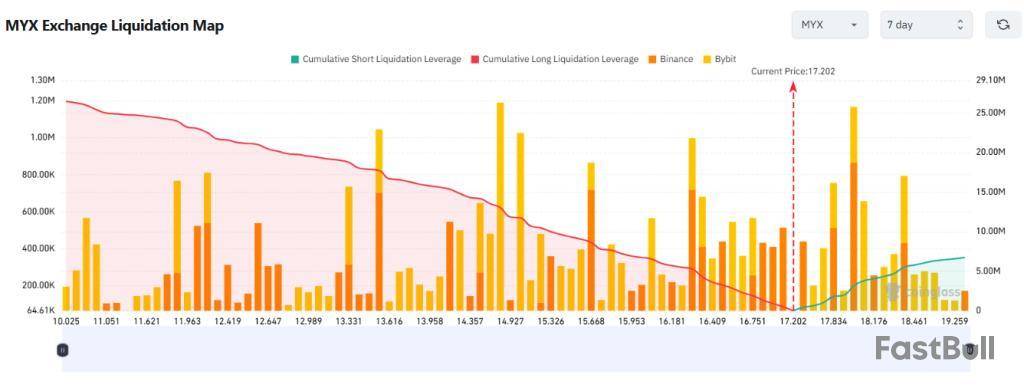
In parallel with its spot gains, the derivatives market for MYX crypto has exploded. Open interest has surged to record highs, and liquidation data reveal that a massive wave of short positions was wiped out, further accelerating the MYX price USD breakout.
Derivatives volumes show aggressive participation from leveraged traders, intensifying the bullish narrative even as technicals signal caution.
While bullish narratives dominate, indicators like the RSI suggest overheated conditions, raising questions about the sustainability of such rapid gains and shaping short-term MYX price forecast discussions.
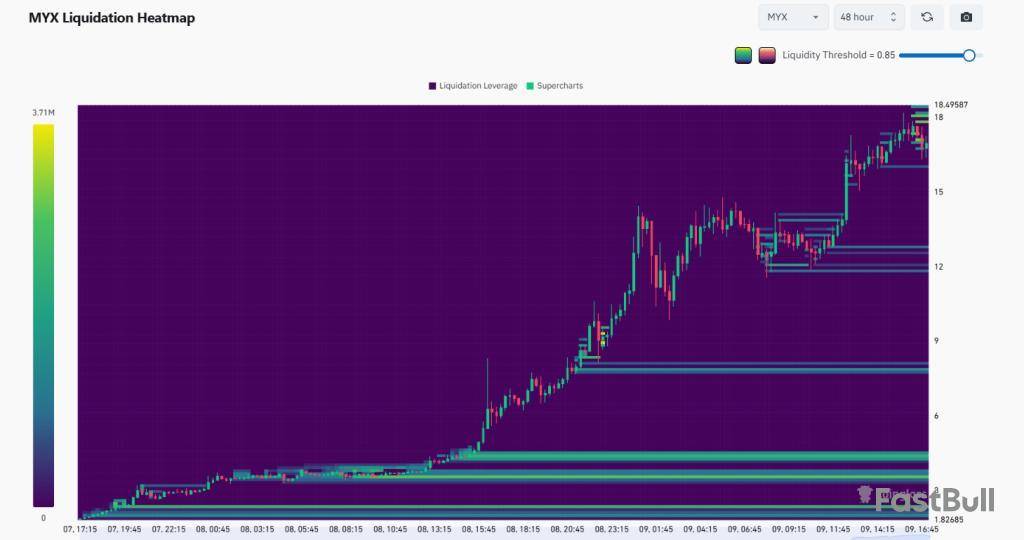
Amid the parabolic advance, MYX crypto has established key technical support zones, which may serve as potential resting points if momentum fades. The liquidation heatmap highlights $7.74, $11.85, $14.14, and $16.08 as crucial levels to watch. These supports could help stabilize the MYX price should speculative demand temporarily cool.
A recent Node Package Manager (NPM) attack stole just $50 worth of crypto, but industry experts say the incident highlights ongoing vulnerabilities for exchanges and software wallets.
Charles Guillemet, the chief technology officer of hardware wallet company Ledger, said in a Tuesday X post that the attempted exploit was a “clear reminder” that software wallets and exchanges remain exposed to risks.
If your funds sit in a software wallet or on an exchange, you’re one code execution away from losing everything,” he said, adding that supply-chain compromises remain a powerful malware delivery vector.
Guillemet took the opportunity to advocate for hardware wallets, saying that features like clear signing and transaction checks would help users withstand such threats. “The immediate danger may have passed, but the threat hasn’t. Stay safe,” he added.
Largest NPM attack stole only $50 in crypto
The attack unfolded after hackers acquired credentials using a phishing email sent from a fake NPM support domain.
Using their newly acquired access to developer accounts, the attackers pushed malicious updates to popular libraries. This included chalk, debug strip-ansi and more.
The code they injected attempted to hijack transactions by intercepting wallet addresses and replacing them in network responses across several blockchains, including Bitcoin, Ethereum, Solana, Tron and Litecoin.
TON CTO breaks down NPM attack
Anatoly Makosov, the chief technology officer of The Open Network (TON), said that only specific versions of 18 packages were compromised and that rollbacks were already published.
Breaking down the mechanics of the attack, Makosov said compromised packages functioned as crypto clippers, which silently spoofed wallet addresses in products that relied on the infected versions.
This means web apps interacting with the aforementioned chains risked having their transactions intercepted and redirected without the knowledge of the users.
He said that developers who pushed their builds within hours of the malicious updates and apps that auto-update their code libraries instead of freezing them to a safe version were the most exposed.
Makosov shared a checklist on how developers can check if their apps were compromised. The main sign is whether the code is using one of 18 versions of popular libraries like ansi-styles, chalk or debug. He said if a project relies on these versions, it’s likely compromised.
He said the fix is to switch back to safe versions, reinstall clean code and rebuild applications. He added that new and updated releases are already available and urged developers to act quickly to clear out the malware before it can affect their users.
White Label
Data API
Web Plug-ins
Poster Maker
Affiliate Program
The risk of loss in trading financial instruments such as stocks, FX, commodities, futures, bonds, ETFs and crypto can be substantial. You may sustain a total loss of the funds that you deposit with your broker. Therefore, you should carefully consider whether such trading is suitable for you in light of your circumstances and financial resources.
No decision to invest should be made without thoroughly conducting due diligence by yourself or consulting with your financial advisors. Our web content might not suit you since we don't know your financial conditions and investment needs. Our financial information might have latency or contain inaccuracy, so you should be fully responsible for any of your trading and investment decisions. The company will not be responsible for your capital loss.
Without getting permission from the website, you are not allowed to copy the website's graphics, texts, or trademarks. Intellectual property rights in the content or data incorporated into this website belong to its providers and exchange merchants.
Not Logged In
Log in to access more features

FastBull Membership
Not yet
Purchase
Log In
Sign Up