Markets
News
Analysis
User
24/7
Economic Calendar
Education
Data
- Names
- Latest
- Prev




Signal Accounts for Members
All Signal Accounts
All Contests


Senior Iranian Official To Reuters: US Insistence On "Discussing Non-Nuclear" Issues Could Jeopardize Talks In Oman
[Sol Dips To $90] February 5Th, According To Htx Market Data, Sol Hit A Low Of $90, With A 24-Hour Decrease Of 8.71%
The S&P 500 Fell 1%, The Technology Sector Fell More Than 3%, And The Telecommunications Sector Fell 2%
When Asked How To Lower The 10-year Treasury Yield, U.S. Treasury Secretary Bessant Said: "It Rose In 2025."
USA Military Says It Conducted Five Strikes Against Multiple Islamic State Targets Across Syria
U.S. Treasury Secretary Bessant: We Will Analyze The Unemployment Issue Among The African American Population, But Cannot Give A Date For This Analysis
USA Told Iran It Will Not Agree To To Change The Location And Format Of Talks Planned For Friday
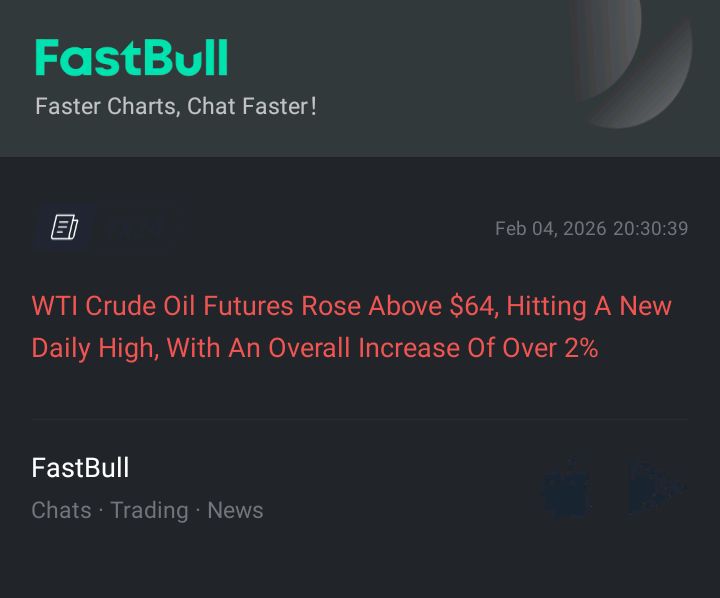
WTI Crude Oil Futures Rose Above $64, Hitting A New Daily High, With An Overall Increase Of Over 2%
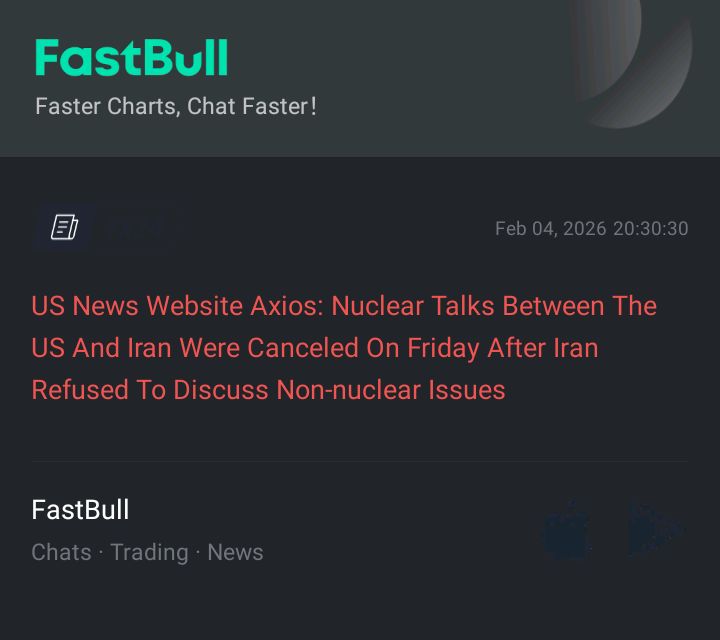
US News Website Axios: Nuclear Talks Between The US And Iran Were Canceled On Friday After Iran Refused To Discuss Non-nuclear Issues
U.S. Treasury Secretary Bessant: President Trump Has Made It Clear That The Digital Dollar Is "abhorrent" To Him
U.S. Treasury Secretary Bessenter Stated That The Spread Between Mortgage Rates And U.S. Treasury Bonds Is At Its Lowest Level In Many Years, Hinting That The Government Will Eventually End Its Administration Of Fannie Mae And Freddie Mac
[Ambassador Xie Feng Meets With Phrma President And CEO Eugene Yoble] According To The Chinese Embassy In The United States, On February 3, Chinese Ambassador To The United States Xie Feng Met With Eugene Yoble, President And CEO Of The Pharmaceutical Research And Manufacturing Enterprises Association (Phrma), At The Latter's Request. The Two Sides Exchanged In-depth Views On Sino-US Biopharmaceutical Industry Policies And Bilateral Pharmaceutical Cooperation
[UK Medium- And Long-Term Government Bond Yields Rise By At Late Wednesday (February 4)] In Late European Trading, The Yield On 10-year UK Government Bonds Rose 2.9 Basis Points To 4.546%, Continuing Its Upward Trend Since 9:00 PM Beijing Time. The Yield On 2-year UK Government Bonds Rose 0.8 Basis Points To 3.715%. The Yield On 30-year UK Government Bonds Rose 4.4 Basis Points, And The Yield On 50-year UK Government Bonds Rose 6.1 Basis Points. The Spread Between 2-year And 10-year UK Government Bond Yields Widened By 2.157 Basis Points To +82.973 Basis Points

Euro Zone Services PMI Final (Jan)A:--
F: --
P: --
U.K. Composite PMI Final (Jan)A:--
F: --
P: --
U.K. Total Reserve Assets (Jan)A:--
F: --
P: --
U.K. Services PMI Final (Jan)A:--
F: --
P: --
U.K. Official Reserves Changes (Jan)A:--
F: --
P: --
Euro Zone Core CPI Prelim YoY (Jan)A:--
F: --
P: --
Euro Zone Core HICP Prelim YoY (Jan)A:--
F: --
P: --
Euro Zone HICP Prelim YoY (Jan)A:--
F: --
P: --
Euro Zone PPI MoM (Dec)A:--
F: --
Euro Zone Core HICP Prelim MoM (Jan)A:--
F: --
P: --
Italy HICP Prelim YoY (Jan)A:--
F: --
P: --
Euro Zone Core CPI Prelim MoM (Jan)A:--
F: --
P: --
Euro Zone PPI YoY (Dec)A:--
F: --
U.S. MBA Mortgage Application Activity Index WoWA:--
F: --
P: --
Brazil IHS Markit Composite PMI (Jan)A:--
F: --
P: --
Brazil IHS Markit Services PMI (Jan)A:--
F: --
P: --
U.S. ADP Employment (Jan)A:--
F: --
The U.S. Treasury Department released its quarterly refinancing statement.
U.S. IHS Markit Composite PMI Final (Jan)A:--
F: --
P: --
U.S. IHS Markit Services PMI Final (Jan)A:--
F: --
P: --
U.S. ISM Non-Manufacturing Price Index (Jan)A:--
F: --
P: --
U.S. ISM Non-Manufacturing Employment Index (Jan)A:--
F: --
P: --
U.S. ISM Non-Manufacturing New Orders Index (Jan)A:--
F: --
P: --
U.S. ISM Non-Manufacturing Inventories Index (Jan)A:--
F: --
P: --
U.S. ISM Non-Manufacturing PMI (Jan)A:--
F: --
P: --
U.S. EIA Weekly Crude Oil Imports ChangesA:--
F: --
P: --
U.S. EIA Weekly Heating Oil Stock ChangesA:--
F: --
P: --
U.S. EIA Weekly Crude Demand Projected by ProductionA:--
F: --
P: --
U.S. EIA Weekly Gasoline Stocks ChangeA:--
F: --
P: --
U.S. EIA Weekly Crude Stocks ChangeA:--
F: --
P: --
U.S. EIA Weekly Cushing, Oklahoma Crude Oil Stocks ChangeA:--
F: --
P: --
Australia Trade Balance (SA) (Dec)--
F: --
P: --
Australia Exports MoM (SA) (Dec)--
F: --
P: --
Japan 30-Year JGB Auction Yield--
F: --
P: --
Indonesia Annual GDP Growth--
F: --
P: --
Indonesia GDP YoY (Q4)--
F: --
P: --
France Industrial Output MoM (SA) (Dec)--
F: --
P: --
Italy IHS Markit Construction PMI (Jan)--
F: --
P: --
Euro Zone IHS Markit Construction PMI (Jan)--
F: --
P: --
Germany Construction PMI (SA) (Jan)--
F: --
P: --
Italy Retail Sales MoM (SA) (Dec)--
F: --
P: --
U.K. Markit/CIPS Construction PMI (Jan)--
F: --
P: --
France 10-Year OAT Auction Avg. Yield--
F: --
P: --
Euro Zone Retail Sales YoY (Dec)--
F: --
P: --
Euro Zone Retail Sales MoM (Dec)--
F: --
P: --
U.K. BOE MPC Vote Cut (Feb)--
F: --
P: --
U.K. BOE MPC Vote Hike (Feb)--
F: --
P: --
U.K. BOE MPC Vote Unchanged (Feb)--
F: --
P: --
U.K. Benchmark Interest Rate--
F: --
P: --
MPC Rate Statement
U.S. Challenger Job Cuts (Jan)--
F: --
P: --
U.S. Challenger Job Cuts MoM (Jan)--
F: --
P: --
U.S. Challenger Job Cuts YoY (Jan)--
F: --
P: --
Bank of England Governor Bailey held a press conference on monetary policy.
Euro Zone ECB Marginal Lending Rate--
F: --
P: --
Euro Zone ECB Deposit Rate--
F: --
P: --


No matching data
View All

No data
Shareholders of Sabre would probably like to forget the past six months even happened. The stock dropped 60.9% and now trades at $1.22. This was partly driven by its softer quarterly results and may have investors wondering how to approach the situation.
Why Do We Think Sabre Will Underperform?
Despite the more favorable entry price, we don't have much confidence in Sabre. Here are three reasons why SABR doesn't excite us and a stock we'd rather own.
1. Weak Growth in Total Bookings Points to Soft Demand
Revenue growth can be broken down into changes in price and volume (for companies like Sabre, our preferred volume metric is total bookings). While both are important, the latter is the most critical to analyze because prices have a ceiling.
Sabre’s total bookings came in at 95.14 million in the latest quarter, and over the last two years, averaged 1.5% year-on-year growth. This performance was underwhelming and suggests it might have to lower prices or invest in product improvements to accelerate growth, factors that can hinder near-term profitability.
2. Cash Burn Ignites Concerns
Free cash flow isn't a prominently featured metric in company financials and earnings releases, but we think it's telling because it accounts for all operating and capital expenses, making it tough to manipulate. Cash is king.
While Sabre posted positive free cash flow this quarter, the broader story hasn’t been so clean. Over the last two years, Sabre’s demanding reinvestments to stay relevant have drained its resources, putting it in a pinch and limiting its ability to return capital to investors. Its free cash flow margin averaged negative 4.7%, meaning it lit $4.72 of cash on fire for every $100 in revenue.
3. High Debt Levels Increase Risk
Debt is a tool that can boost company returns but presents risks if used irresponsibly. As long-term investors, we aim to avoid companies taking excessive advantage of this instrument because it could lead to insolvency.
Sabre’s $4.22 billion of debt exceeds the $682.7 million of cash on its balance sheet. Furthermore, its 7× net-debt-to-EBITDA ratio (based on its EBITDA of $502.2 million over the last 12 months) shows the company is overleveraged.
At this level of debt, incremental borrowing becomes increasingly expensive and credit agencies could downgrade the company’s rating if profitability falls. Sabre could also be backed into a corner if the market turns unexpectedly – a situation we seek to avoid as investors in high-quality companies.
We hope Sabre can improve its balance sheet and remain cautious until it increases its profitability or pays down its debt.
Final Judgment
We see the value of companies helping consumers, but in the case of Sabre, we’re out. Following the recent decline, the stock trades at 11× forward P/E (or $1.22 per share). While this valuation is fair, the upside isn’t great compared to the potential downside. There are superior stocks to buy right now. We’d suggest looking at the most dominant software business in the world.
What Happened?
Shares of travel technology company Sabre fell 8.2% in the afternoon session after the travel industry reacted to a proposal for a one-year cap on credit-card interest rates.
This plan, which would limit rates to 10 percent, triggered a sell-off in shares of major U.S. airlines, including Delta Air Lines and United Airlines. The market anxiety stemmed from concerns about the potential impact on airline revenue streams tied to co-branded credit card partnerships. As a key technology provider for the travel sector, Sabre's stock also felt the pressure from the broader industry downturn.
The shares closed the day at $1.35, down 8.5% from previous close.
What Is The Market Telling Us
Sabre’s shares are extremely volatile and have had 35 moves greater than 5% over the last year. In that context, today’s move indicates the market considers this news meaningful but not something that would fundamentally change its perception of the business.
The previous big move we wrote about was 7 days ago when the stock gained 6.4% on the news that investors wagered geopolitical tension would be contained following the U.S. military's operation in Venezuela, with the Dow hitting a fresh record. Sentiment remained firmly "risk-on" for early 2026, with Wall Street prioritizing domestic economic strength over foreign turbulence. Analysts noted that while the event raises short-term supply questions, the market largely viewed the potential stabilization of Venezuela's vast oil reserves as a long-term economic positive.
Sabre is up 2.9% since the beginning of the year, but at $1.37 per share, it is still trading 69.7% below its 52-week high of $4.52 from February 2025. Investors who bought $1,000 worth of Sabre’s shares 5 years ago would now be looking at an investment worth $109.39.
What Happened?
A number of stocks jumped in the afternoon session after investors wagered geopolitical tension would be contained following the U.S. military's operation in Venezuela, with the Dow hitting a fresh record.
Sentiment remained firmly "risk-on" for early 2026, with Wall Street prioritizing domestic economic strength over foreign turbulence. Analysts noted that while the event raises short-term supply questions, the market largely viewed the potential stabilization of Venezuela's vast oil reserves as a long-term economic positive.
The stock market overreacts to news, and big price drops can present good opportunities to buy high-quality stocks.
Among others, the following stocks were impacted:
Zooming In On Sabre (SABR)
Sabre’s shares are extremely volatile and have had 34 moves greater than 5% over the last year. In that context, today’s move indicates the market considers this news meaningful but not something that would fundamentally change its perception of the business.
The previous big move we wrote about was 28 days ago when the stock dropped 7.6% on the news that the company's recent downward revision of its full-year financial forecast continued to weigh on investor sentiment.
This followed the company's third-quarter report from about a month prior, which presented mixed results. While revenue surpassed estimates, the adjusted loss per share missed expectations. More significantly, Sabre lowered its guidance for the full year 2025. The company revised its revenue projection from a low single-digit percentage increase to flat year-over-year. Additionally, the forecast for pro-forma free cash flow was substantially reduced to approximately $70 million from a previous range of $100-$140 million. These adjustments signaled a weaker financial performance than previously anticipated by the company.
Sabre is up 4.5% since the beginning of the year, but at $1.39 per share, it is still trading 69.2% below its 52-week high of $4.52 from February 2025. Investors who bought $1,000 worth of Sabre’s shares 5 years ago would now be looking at an investment worth $115.93.
As the craze of earnings season draws to a close, here’s a look back at some of the most exciting (and some less so) results from Q3. Today, we are looking at travel and vacation providers stocks, starting with American Airlines .
Airlines, hotels, resorts, and cruise line companies often sell experiences rather than tangible products, and in the last decade-plus, consumers have slowly shifted from buying "things" (wasteful) to buying "experiences" (memorable). In addition, the internet has introduced new ways of approaching leisure and lodging such as booking homes and longer-term accommodations. Traditional airlines, hotel, resorts, and cruise line companies must innovate to stay relevant in a market rife with innovation.
The 17 travel and vacation providers stocks we track reported a mixed Q3. As a group, revenues beat analysts’ consensus estimates by 1.1% while next quarter’s revenue guidance was in line.
Thankfully, share prices of the companies have been resilient as they are up 5% on average since the latest earnings results.
One of the ‘Big Four’ airlines in the US, American Airlines is a major global air carrier that serves both business and leisure travelers through its domestic and international flights.
American Airlines reported revenues of $13.69 billion, flat year on year. This print was in line with analysts’ expectations, and overall, it was a very strong quarter for the company with EPS guidance for next quarter exceeding analysts’ expectations and a beat of analysts’ EPS estimates.
“The American Airlines team is delivering on our commitments,” said American’s CEO Robert Isom.
Interestingly, the stock is up 26.4% since reporting and currently trades at $15.28.
Founded by explorer Sven-Olof Lindblad in 1979, Lindblad Expeditions offers cruising experiences to remote destinations in partnership with National Geographic.
Lindblad Expeditions reported revenues of $240.2 million, up 16.6% year on year, outperforming analysts’ expectations by 4.6%. The business had a very strong quarter with a beat of analysts’ EPS estimates and a solid beat of analysts’ EBITDA estimates.
Lindblad Expeditions pulled off the fastest revenue growth among its peers. The market seems happy with the results as the stock is up 18.2% since reporting. It currently trades at $14.42.
Weakest Q3: Hilton Grand Vacations
Spun off from Hilton Worldwide in 2017, Hilton Grand Vacations is a global timeshare company that provides travel experiences for its customers through its timeshare resorts and club membership programs.
Hilton Grand Vacations reported revenues of $1.3 billion, flat year on year, falling short of analysts’ expectations by 5%. It was a disappointing quarter as it posted a significant miss of analysts’ revenue estimates and a significant miss of analysts’ adjusted operating income estimates.
Hilton Grand Vacations delivered the weakest performance against analyst estimates in the group. Interestingly, the stock is up 1.3% since the results and currently trades at $44.75.
Read our full analysis of Hilton Grand Vacations’s results here.
Originally a division of American Airlines, Sabre is a technology provider for the global travel and tourism industry.
Sabre reported revenues of $715.2 million, up 3.5% year on year. This number beat analysts’ expectations by 1.2%. However, it was a slower quarter as it recorded a miss of analysts’ central reservation system transactions estimates and a significant miss of analysts’ EPS estimates.
The stock is down 30.5% since reporting and currently trades at $1.39.
Read our full, actionable report on Sabre here, it’s free for active Edge members.
Formerly known as Wyndham Destinations, Travel + Leisure is a global vacation company that provides travelers with vacation ownership, exchange, and travel services.
Travel + Leisure reported revenues of $1.04 billion, up 5.1% year on year. This print surpassed analysts’ expectations by 1%. Taking a step back, it was a satisfactory quarter as it also logged a decent beat of analysts’ adjusted operating income estimates but a miss of analysts’ tours conducted estimates.
The stock is up 16.3% since reporting and currently trades at $70.53.
Read our full, actionable report on Travel + Leisure here, it’s free for active Edge members.
Earnings results often indicate what direction a company will take in the months ahead. With Q3 behind us, let’s have a look at Travel + Leisure and its peers.
Airlines, hotels, resorts, and cruise line companies often sell experiences rather than tangible products, and in the last decade-plus, consumers have slowly shifted from buying "things" (wasteful) to buying "experiences" (memorable). In addition, the internet has introduced new ways of approaching leisure and lodging such as booking homes and longer-term accommodations. Traditional airlines, hotel, resorts, and cruise line companies must innovate to stay relevant in a market rife with innovation.
The 17 travel and vacation providers stocks we track reported a mixed Q3. As a group, revenues beat analysts’ consensus estimates by 1.2% while next quarter’s revenue guidance was in line.
In light of this news, share prices of the companies have held steady as they are up 4.8% on average since the latest earnings results.
Formerly known as Wyndham Destinations, Travel + Leisure is a global vacation company that provides travelers with vacation ownership, exchange, and travel services.
Travel + Leisure reported revenues of $1.04 billion, up 5.1% year on year. This print exceeded analysts’ expectations by 1%. Overall, it was a satisfactory quarter for the company with a decent beat of analysts’ adjusted operating income estimates but a miss of analysts’ tours conducted estimates.
Interestingly, the stock is up 16.1% since reporting and currently trades at $70.44.
Founded by explorer Sven-Olof Lindblad in 1979, Lindblad Expeditions offers cruising experiences to remote destinations in partnership with National Geographic.
Lindblad Expeditions reported revenues of $240.2 million, up 16.6% year on year, outperforming analysts’ expectations by 4.6%. The business had a very strong quarter with a beat of analysts’ EPS estimates and an impressive beat of analysts’ EBITDA estimates.
Lindblad Expeditions scored the fastest revenue growth among its peers. The market seems happy with the results as the stock is up 15.9% since reporting. It currently trades at $14.14.
Weakest Q3: Hilton Grand Vacations
Spun off from Hilton Worldwide in 2017, Hilton Grand Vacations is a global timeshare company that provides travel experiences for its customers through its timeshare resorts and club membership programs.
Hilton Grand Vacations reported revenues of $1.3 billion, flat year on year, falling short of analysts’ expectations by 5%. It was a disappointing quarter as it posted a significant miss of analysts’ revenue estimates and a significant miss of analysts’ adjusted operating income estimates.
Hilton Grand Vacations delivered the weakest performance against analyst estimates in the group. Interestingly, the stock is up 1.3% since the results and currently trades at $44.75.
Read our full analysis of Hilton Grand Vacations’s results here.
With amenities like a full go-kart race track built into its ships, Norwegian Cruise Line is a premier global cruise company.
Norwegian Cruise Line reported revenues of $2.94 billion, up 4.7% year on year. This result came in 2.7% below analysts' expectations. It was a slower quarter as it also logged a miss of analysts’ revenue estimates and EBITDA guidance for next quarter missing analysts’ expectations.
The stock is down 2.7% since reporting and currently trades at $21.59.
Read our full, actionable report on Norwegian Cruise Line here, it’s free for active Edge members.
Originally a division of American Airlines, Sabre is a technology provider for the global travel and tourism industry.
Sabre reported revenues of $715.2 million, up 3.5% year on year. This number topped analysts’ expectations by 1.2%. Aside from that, it was a slower quarter as it logged a miss of analysts’ central reservation system transactions estimates and a significant miss of analysts’ EPS estimates.
The stock is down 24.8% since reporting and currently trades at $1.51.
Read our full, actionable report on Sabre here, it’s free for active Edge members.
The end of an earnings season can be a great time to discover new stocks and assess how companies are handling the current business environment. Let’s take a look at how Sabre and the rest of the travel and vacation providers stocks fared in Q3.
Airlines, hotels, resorts, and cruise line companies often sell experiences rather than tangible products, and in the last decade-plus, consumers have slowly shifted from buying "things" (wasteful) to buying "experiences" (memorable). In addition, the internet has introduced new ways of approaching leisure and lodging such as booking homes and longer-term accommodations. Traditional airlines, hotel, resorts, and cruise line companies must innovate to stay relevant in a market rife with innovation.
The 17 travel and vacation providers stocks we track reported a mixed Q3. As a group, revenues beat analysts’ consensus estimates by 1.2% while next quarter’s revenue guidance was in line.
In light of this news, share prices of the companies have held steady as they are up 2.8% on average since the latest earnings results.
Originally a division of American Airlines, Sabre is a technology provider for the global travel and tourism industry.
Sabre reported revenues of $715.2 million, up 3.5% year on year. This print exceeded analysts’ expectations by 1.2%. Despite the top-line beat, it was still a slower quarter for the company with a miss of analysts’ central reservation system transactions estimates and a significant miss of analysts’ EPS estimates.
Unsurprisingly, the stock is down 21.5% since reporting and currently trades at $1.57.
Read our full report on Sabre here, it’s free for active Edge members.
Founded by explorer Sven-Olof Lindblad in 1979, Lindblad Expeditions offers cruising experiences to remote destinations in partnership with National Geographic.
Lindblad Expeditions reported revenues of $240.2 million, up 16.6% year on year, outperforming analysts’ expectations by 4.6%. The business had a very strong quarter with a beat of analysts’ EPS estimates and a solid beat of analysts’ EBITDA estimates.
Lindblad Expeditions scored the fastest revenue growth among its peers. The market seems happy with the results as the stock is up 11.1% since reporting. It currently trades at $13.56.
Is now the time to buy Lindblad Expeditions? Access our full analysis of the earnings results here, it’s free for active Edge members.
Weakest Q3: Hilton Grand Vacations
Spun off from Hilton Worldwide in 2017, Hilton Grand Vacations is a global timeshare company that provides travel experiences for its customers through its timeshare resorts and club membership programs.
Hilton Grand Vacations reported revenues of $1.3 billion, flat year on year, falling short of analysts’ expectations by 5%. It was a disappointing quarter as it posted a significant miss of analysts’ revenue estimates and a significant miss of analysts’ adjusted operating income estimates.
Hilton Grand Vacations delivered the weakest performance against analyst estimates in the group. As expected, the stock is down 2% since the results and currently trades at $43.26.
Read our full analysis of Hilton Grand Vacations’s results here.
Founded in 1926, United Airlines Holdings operates a global airline network, providing passenger and cargo air transportation services across domestic and international routes.
United Airlines reported revenues of $15.23 billion, up 2.6% year on year. This print was in line with analysts’ expectations. It was a strong quarter as it also recorded EPS guidance for next quarter exceeding analysts’ expectations and a decent beat of analysts’ adjusted operating income estimates.
The stock is up 2.7% since reporting and currently trades at $108.32.
Read our full, actionable report on United Airlines here, it’s free for active Edge members.
Established in 1981, Wyndham is a global hotel franchising company with over 9,000 hotels across nearly 95 countries on six continents.
Wyndham reported revenues of $382 million, down 3.5% year on year. This number missed analysts’ expectations by 4.8%. Overall, it was a slower quarter as it also logged a significant miss of analysts’ revenue estimates and full-year EBITDA guidance missing analysts’ expectations.
Wyndham had the slowest revenue growth among its peers. The stock is down 5.8% since reporting and currently trades at $75.69.
Read our full, actionable report on Wyndham here, it’s free for active Edge members.
What Happened?
Shares of travel technology company Sabre fell 7.6% in the afternoon session after the company's recent downward revision of its full-year financial forecast continued to weigh on investor sentiment.
This followed the company's third-quarter report from about a month prior, which presented mixed results. While revenue surpassed estimates, the adjusted loss per share missed expectations. More significantly, Sabre lowered its guidance for the full year 2025. The company revised its revenue projection from a low single-digit percentage increase to flat year-over-year. Additionally, the forecast for pro-forma free cash flow was substantially reduced to approximately $70 million from a previous range of $100-$140 million. These adjustments signaled a weaker financial performance than previously anticipated by the company.
The stock market overreacts to news, and big price drops can present good opportunities to buy high-quality stocks. Is now the time to buy Sabre? Access our full analysis report here.
What Is The Market Telling Us
Sabre’s shares are extremely volatile and have had 34 moves greater than 5% over the last year. In that context, today’s move indicates the market considers this news meaningful but not something that would fundamentally change its perception of the business.
The previous big move we wrote about was 19 days ago when the stock dropped 5.6% on the news that the stock's negative momentum continued as its financial outlook worsened, with a lowered fiscal year 2025 earnings (EBITDA) estimate. Sabre, a technology provider for the global travel and tourism industry, saw its forecast cut due to rising expenses. The increase in selling, general, and administrative costs was aimed at accelerating product development. This spending suggested the company faced ongoing challenges in maintaining its profitability, which appeared to concern investors.
Sabre is down 57.6% since the beginning of the year, and at $1.52 per share, it is trading 66.5% below its 52-week high of $4.52 from February 2025. Investors who bought $1,000 worth of Sabre’s shares 5 years ago would now be looking at an investment worth $125.10.
The risk of loss in trading financial instruments such as stocks, FX, commodities, futures, bonds, ETFs and crypto can be substantial. You may sustain a total loss of the funds that you deposit with your broker. Therefore, you should carefully consider whether such trading is suitable for you in light of your circumstances and financial resources.
No decision to invest should be made without thoroughly conducting due diligence by yourself or consulting with your financial advisors. Our web content might not suit you since we don't know your financial conditions and investment needs. Our financial information might have latency or contain inaccuracy, so you should be fully responsible for any of your trading and investment decisions. The company will not be responsible for your capital loss.
Without getting permission from the website, you are not allowed to copy the website's graphics, texts, or trademarks. Intellectual property rights in the content or data incorporated into this website belong to its providers and exchange merchants.
Not Logged In
Log in to access more features
Log In
Sign Up