• Trade
  • Markets
  • Copy
  • Contests
  • News
  • 24/7
  • Calendar
  • Q&A
  • Chats
Trending
Screeners
SYMBOL
LAST
BID
ASK
HIGH
LOW
NET CHG.
%CHG.
SPREAD
SPX
S&P 500 Index
6827.42
6827.42
6827.42
6899.86
6801.80
-73.58
-1.07%
--
DJI
Dow Jones Industrial Average
48458.04
48458.04
48458.04
48886.86
48334.10
-245.98
-0.51%
--
IXIC
NASDAQ Composite Index
23195.16
23195.16
23195.16
23554.89
23094.51
-398.69
-1.69%
--
USDX
US Dollar Index
97.950
98.030
97.950
98.500
97.950
-0.370
-0.38%
--
EURUSD
Euro / US Dollar
1.17394
1.17409
1.17394
1.17496
1.17192
+0.00011
+ 0.01%
--
GBPUSD
Pound Sterling / US Dollar
1.33707
1.33732
1.33707
1.33997
1.33419
-0.00148
-0.11%
--
XAUUSD
Gold / US Dollar
4299.39
4299.39
4299.39
4353.41
4257.10
+20.10
+ 0.47%
--
WTI
Light Sweet Crude Oil
57.233
57.485
57.233
58.011
56.969
-0.408
-0.71%
--

Community Accounts

Signal Accounts
--
Profit Accounts
--
Loss Accounts
--
View More

Become a signal provider

Sell trading signals to earn additional income

View More

Guide to Copy Trading

Get started with ease and confidence

View More

Signal Accounts for Members

All Signal Accounts

Best Return
  • Best Return
  • Best P/L
  • Best MDD
Past 1W
  • Past 1W
  • Past 1M
  • Past 1Y

All Contests

  • All
  • Trump Updates
  • Recommend
  • Stocks
  • Cryptocurrencies
  • Central Banks
  • Featured News
Top News Only
Share

Ukraine Says It Received 114 Prisoners From Belarus

Share

USA Embassy In Lithuania: Maria Kalesnikava Is Not Going To Vilnius

Share

USA Embassy In Lithuania: Other Prisoners Are Being Sent From Belarus To Ukraine

Share

Ukraine President Zelenskiy: Five Ukrainians Released By Belarus In US-Brokered Deal

Share

USA Vilnius Embassy: USA Stands Ready For "Additional Engagement With Belarus That Advances USA Interests"

Share

USA Vilnius Embassy: Belarus, USA, Other Citizens Among The Prisoners Released Into Lithuania

Share

USA Vilnius Embassy: USA Will Continue Diplomatic Efforts To Free The Remaining Political Prisoners In Belarus

Share

USA Vilnius Embassy: Belarus Releases 123 Prisoners Following Meeting Of President Trump's Envoy Coale And Belarus President Lukashenko

Share

USA Vilnius Embassy: Masatoshi Nakanishi, Aliaksandr Syrytsa Are Among The Prisoners Released By Belarus

Share

USA Vilnius Embassy: Maria Kalesnikava And Viktor Babaryka Are Among The Prisoners Released By Belarus

Share

USA Vilnius Embassy: Nobel Peace Prize Laureate Ales Bialiatski Is Among The Prisoners Released By Belarus

Share

Belarusian Presidential Administration Telegram Channel: Lukashenko Has Pardoned 123 Prisoners As Part Of Deal With US

Share

Two Local Syrian Officials: Joint US-Syrian Military Patrol In Central Syria Came Under Fire From Unknown Assailants

Share

Israeli Military Says It Targeted 'Key Hamas Terrorist' In Gaza City

Share

Rwanda's Actions In Eastern Drc Are A Clear Violation Of Washington Accords Signed By President Trump - Secretary Of State Rubio

Share

Israeli Military Issues Evacuation Warning In Southern Lebanon Village Ahead Of Strike - Spokesperson On X

Share

Belarusian State Media Cites US Envoy Coale As Saying He Discussed Ukraine And Venezuela With Lukashenko

Share

Belarusian State Media Cites US Envoy Coale As Saying That US Removes Sanctions On Belarusian Potassium

Share

Thai Prime Minister: No Ceasefire Agreement With Cambodia

Share

US, Ukraine To Discuss Ceasefire In Berlin Ahead Of European Summit

TIME
ACT
FCST
PREV
U.K. Trade Balance Non-EU (SA) (Oct)

A:--

F: --

P: --

U.K. Trade Balance (Oct)

A:--

F: --

P: --

U.K. Services Index MoM

A:--

F: --

P: --

U.K. Construction Output MoM (SA) (Oct)

A:--

F: --

P: --

U.K. Industrial Output YoY (Oct)

A:--

F: --

P: --

U.K. Trade Balance (SA) (Oct)

A:--

F: --

P: --

U.K. Trade Balance EU (SA) (Oct)

A:--

F: --

P: --

U.K. Manufacturing Output YoY (Oct)

A:--

F: --

P: --

U.K. GDP MoM (Oct)

A:--

F: --

P: --

U.K. GDP YoY (SA) (Oct)

A:--

F: --

P: --

U.K. Industrial Output MoM (Oct)

A:--

F: --

P: --

U.K. Construction Output YoY (Oct)

A:--

F: --

P: --

France HICP Final MoM (Nov)

A:--

F: --

P: --

China, Mainland Outstanding Loans Growth YoY (Nov)

A:--

F: --

P: --

China, Mainland M2 Money Supply YoY (Nov)

A:--

F: --

P: --

China, Mainland M0 Money Supply YoY (Nov)

A:--

F: --

P: --

China, Mainland M1 Money Supply YoY (Nov)

A:--

F: --

P: --

India CPI YoY (Nov)

A:--

F: --

P: --

India Deposit Gowth YoY

A:--

F: --

P: --

Brazil Services Growth YoY (Oct)

A:--

F: --

P: --

Mexico Industrial Output YoY (Oct)

A:--

F: --

P: --

Russia Trade Balance (Oct)

A:--

F: --

P: --

Philadelphia Fed President Henry Paulson delivers a speech
Canada Building Permits MoM (SA) (Oct)

A:--

F: --

P: --

Canada Wholesale Sales YoY (Oct)

A:--

F: --

P: --

Canada Wholesale Inventory MoM (Oct)

A:--

F: --

P: --

Canada Wholesale Inventory YoY (Oct)

A:--

F: --

P: --

Canada Wholesale Sales MoM (SA) (Oct)

A:--

F: --

P: --

Germany Current Account (Not SA) (Oct)

A:--

F: --

P: --

U.S. Weekly Total Rig Count

A:--

F: --

P: --

U.S. Weekly Total Oil Rig Count

A:--

F: --

P: --

Japan Tankan Large Non-Manufacturing Diffusion Index (Q4)

--

F: --

P: --

Japan Tankan Small Manufacturing Outlook Index (Q4)

--

F: --

P: --

Japan Tankan Large Non-Manufacturing Outlook Index (Q4)

--

F: --

P: --

Japan Tankan Large Manufacturing Outlook Index (Q4)

--

F: --

P: --

Japan Tankan Small Manufacturing Diffusion Index (Q4)

--

F: --

P: --

Japan Tankan Large Manufacturing Diffusion Index (Q4)

--

F: --

P: --

Japan Tankan Large-Enterprise Capital Expenditure YoY (Q4)

--

F: --

P: --

U.K. Rightmove House Price Index YoY (Dec)

--

F: --

P: --

China, Mainland Industrial Output YoY (YTD) (Nov)

--

F: --

P: --

China, Mainland Urban Area Unemployment Rate (Nov)

--

F: --

P: --

Saudi Arabia CPI YoY (Nov)

--

F: --

P: --

Euro Zone Industrial Output YoY (Oct)

--

F: --

P: --

Euro Zone Industrial Output MoM (Oct)

--

F: --

P: --

Canada Existing Home Sales MoM (Nov)

--

F: --

P: --

Euro Zone Total Reserve Assets (Nov)

--

F: --

P: --

U.K. Inflation Rate Expectations

--

F: --

P: --

Canada National Economic Confidence Index

--

F: --

P: --

Canada New Housing Starts (Nov)

--

F: --

P: --

U.S. NY Fed Manufacturing Employment Index (Dec)

--

F: --

P: --

U.S. NY Fed Manufacturing Index (Dec)

--

F: --

P: --

Canada Core CPI YoY (Nov)

--

F: --

P: --

Canada Manufacturing Unfilled Orders MoM (Oct)

--

F: --

P: --

Canada Manufacturing New Orders MoM (Oct)

--

F: --

P: --

Canada Core CPI MoM (Nov)

--

F: --

P: --

Canada Manufacturing Inventory MoM (Oct)

--

F: --

P: --

Canada CPI YoY (Nov)

--

F: --

P: --

Canada CPI MoM (Nov)

--

F: --

P: --

Canada CPI YoY (SA) (Nov)

--

F: --

P: --

Canada Core CPI MoM (SA) (Nov)

--

F: --

P: --

Q&A with Experts
    • All
    • Chatrooms
    • Groups
    • Friends
    Connecting
    .
    .
    .
    Type here...
    Add Symbol or Code

      No matching data

      All
      Trump Updates
      Recommend
      Stocks
      Cryptocurrencies
      Central Banks
      Featured News
      • All
      • Russia-Ukraine Conflict
      • Middle East Flashpoint
      • All
      • Russia-Ukraine Conflict
      • Middle East Flashpoint
      Search
      Products

      Charts Free Forever

      Chats Q&A with Experts
      Screeners Economic Calendar Data Tools
      Membership Features
      Data Warehouse Market Trends Institutional Data Policy Rates Macro

      Market Trends

      Market Sentiment Order Book Forex Correlations

      Top Indicators

      Charts Free Forever
      Markets

      News

      News Analysis 24/7 Columns Education
      From Institutions From Analysts
      Topics Columnists

      Latest Views

      Latest Views

      Trending Topics

      Top Columnists

      Latest Update

      Signals

      Copy Rankings Latest Signals Become a signal provider AI Rating
      Contests
      Brokers

      Overview Brokers Assessment Rankings Regulators News Claims
      Broker listing Forex Brokers Comparison Tool Live Spread Comparison Scam
      Q&A Complaint Scam Alert Videos Tips to Detect Scam
      More

      Business
      Events
      Careers About Us Advertising Help Center

      White Label

      Data API

      Web Plug-ins

      Affiliate Program

      Awards Institution Evaluation IB Seminar Salon Event Exhibition
      Vietnam Thailand Singapore Dubai
      Fans Party Investment Sharing Session
      FastBull Summit BrokersView Expo
      Recent Searches
        Top Searches
          Markets
          News
          Analysis
          User
          24/7
          Economic Calendar
          Education
          Data
          • Names
          • Latest
          • Prev

          View All

          No data

          Scan to Download

          Faster Charts, Chat Faster!

          Download App
          English
          • English
          • Español
          • العربية
          • Bahasa Indonesia
          • Bahasa Melayu
          • Tiếng Việt
          • ภาษาไทย
          • Français
          • Italiano
          • Türkçe
          • Русский язык
          • 简中
          • 繁中
          Open Account
          Search
          Products
          Charts Free Forever
          Markets
          News
          Signals

          Copy Rankings Latest Signals Become a signal provider AI Rating
          Contests
          Brokers

          Overview Brokers Assessment Rankings Regulators News Claims
          Broker listing Forex Brokers Comparison Tool Live Spread Comparison Scam
          Q&A Complaint Scam Alert Videos Tips to Detect Scam
          More

          Business
          Events
          Careers About Us Advertising Help Center

          White Label

          Data API

          Web Plug-ins

          Affiliate Program

          Awards Institution Evaluation IB Seminar Salon Event Exhibition
          Vietnam Thailand Singapore Dubai
          Fans Party Investment Sharing Session
          FastBull Summit BrokersView Expo

          Pandemic, Crypto Fuel Increase in Romance Scams

          Summary:

          Scammers have increasingly used cryptocurrency to con victims in romance-related fraud, according to FTC data. The number of romance-related frauds reported to the FTC rose nearly 70% in 2021, and the total amount lost jumped to $547 million, data show.

          Romance scams, such as the one detailed in the recent Netflix Inc. documentary “The Tinder Swindler,” already were gaining in frequency before the coronavirus pandemic began, but their prevalence is now reaching new heights.
          Romance scams—in which fraudsters pretend to be a love interest to bilk unassuming partners—aren’t new, but the rapid growth of the con fueled by the proliferation of online dating apps and social media, as well as tactics being used to target new audiences, including the wider use of cryptocurrency, are gaining renewed attention from law enforcement and compliance departments.
          The number of romance-scam complaints continued to increase through 2021, after setting records in 2020, according to consumer reports to the Federal Trade Commission. The number of romance frauds reported to the FTC reached 56,000 in 2021, a nearly 70% increase over 2020. Victims reported losing about $547 million in such scams, a 78% jump from the prior year, FTC data show.
          “Romance is a powerful hook for scammers,” said Emma Fletcher, a data researcher with the FTC's Bureau of Consumer Protection.
          The pandemic may have fueled the continued growth of romance scams as the coronavirus has provided a convenient excuse for scammers to say they aren’t able to meet in person, Ms. Fletcher said.
          Last year also saw scammers increasingly using romance as a hook to lure people into bogus investments, particularly those involving cryptocurrency, she said. After romancing a potential target, the scammers often make a victim believe they are successful investors and casually offer investment advice for fake opportunities that often involve foreign-exchange trading or cryptocurrency.
          Cryptocurrency was the top method by dollar amount that victims used to make such payments in 2021, at about $139 million. That is nearly five times the cryptocurrency amount reported in 2020 and more than 25 times that in 2019, the FTC said. In comparison, about $121 million was lost through bank transfers or payments and another $93 million through wire transfers in 2021, FTC data shows.
          The FTC saw an increase in the frequency of romance-scam reporting across all age groups in 2021, but the most significant increase was among 18–29-year-olds, Ms. Fletcher said.
          The Global Anti-Scam Organization, a Singapore-based nonprofit formed by victims of online scams that often involve cryptocurrency, said more than 400 of its 1,200 group members are in the U.S. and the majority of its members fell for romance scams. GASO consists of many highly educated professionals in their 20s and 30s, some of whom are attorneys, software developers and physicians, who were looking forward to dating but were instead driven into debt, according to Jan Santiago, deputy director of GASO.
          The group, which was founded in June, said the median loss for its U.S. members as of January was $83,000 each, with some individuals having lost more than $3 million.
          The group has found that no matter how the victims meet the scammers—whether through social media or dating apps, or if the relationship starts romantically—the schemes have some common features. GASO said a scammer typically gains the trust of a target then offers financial advice and opportunities to invest in cryptocurrency and persuades a victim to set up an account on a trading platform such as Coinbase Global Inc., Gemini Trust Co. or Kraken. Within a week or two, the swindler then persuades the victim to transfer the money out of the account to a fake investment site offered by the scammer to trade certain cryptocurrency derivatives, allegedly to get better returns. But the victim isn’t then able to withdraw funds, even after paying hefty fees or so-called taxes.
          “This scam is a hybrid of romance and investment,” Mr. Santiago said. Scammers combine the two to ensnare younger people, he said.
          GASO has been helping its members with transaction tracing and how to report to law enforcement, and it has been working with regulators to raise awareness of the issues victims of these scams may face. The group also has been in contact with Coinbase’s global intelligence investigators to share details about the scams, Mr. Santiago said.
          Representatives for Coinbase didn’t respond to a request for comment. Representatives for Gemini and Kraken didn’t immediately provide a comment.
          Seven federal agencies recently launched a national awareness campaign to alert the public to romance scams that target victims largely through dating apps or social media. The agencies, which include the U.S. Treasury Department’s Financial Crimes Enforcement Network, the Commodity Futures Trading Commission and the Consumer Financial Protection Bureau, said they are reaching out to the public through social media and public-private partnerships to provide information on how to recognize scams and what do if you’re a victim, including how to collect documentation and report the fraud to the appropriate authorities.
          GASO said the CFTC reached out to the group last fall to learn more about romance schemes and to consult on how to educate the public. The group said there should be more consumer and investor protection. A spokeswoman for the CFTC said they connected with GASO for research for one of the regulator’s advisories on romance scams.
          “We make financial innovation so easy, and social engineering has led to less point-of-contact,” Mr. Santiago said. “[Digital financial services] should have the protection afforded as if a person goes into a bank physically and talks to a bank teller.”
          Consumer education is key for financial institutions to be able to prevent and detect these frauds, particularly when payments often aren’t large, according to Alma Angotti, a partner with a focus on risk and regulatory compliance at consulting firm Guidehouse.
          “It’s education, training and awareness,” she said. If someone is volunteering to send money through mobile-payment services or checks, financial institutions are not necessarily able to identify potential fraud because it may look like an unremarkable payment to them, she said.
          But GASO said without more regulation, such as stricter know-your-customer onboarding processes and improved fraud detection at trading platforms and banks, there is little a victim can do to recoup losses.
          “With crypto being such a volatile asset, [the exchanges] should have the same kind of regulations as they would have for margin trading,” Mr. Santiago said. “Many of the victims don’t even grasp how different crypto is,” he said, adding that trading platforms have a responsibility to make sure their users know how crypto works, or “they shouldn’t have let them in at all.”

          Source: The Wall Street Journal.

          Risk Warnings and Disclaimers
          You understand and acknowledge that there is a high degree of risk involved in trading. Following any strategies or investment methods may lead to potential losses. The content on the site is provided by our contributors and analysts for information purposes only. You are solely responsible for determining whether any trading assets, securities, strategy, or any other product is suitable for investing based on your own investment objectives and financial situation.
          Comments
          Add to Favorites
          Share

          Russia Withdraws! Gold & Crude Plummet

          On the morning of February 15th, European time, it was reported that some Russian troops on the Ukrainian border would withdraw, causing collective market turmoil.
          According to INTERFAX: The Russian military says a series of ongoing military exercises have ended and some troops will return to their bases, including from the Ukrainian border. The report also stressed that Russia had never planned to invade Ukraine.
          A spokesman for the Russian Foreign Ministry said that February 15 will go down in history as the day when Western war propaganda failed. Western media had said that Russia would invade Ukraine on February 15.
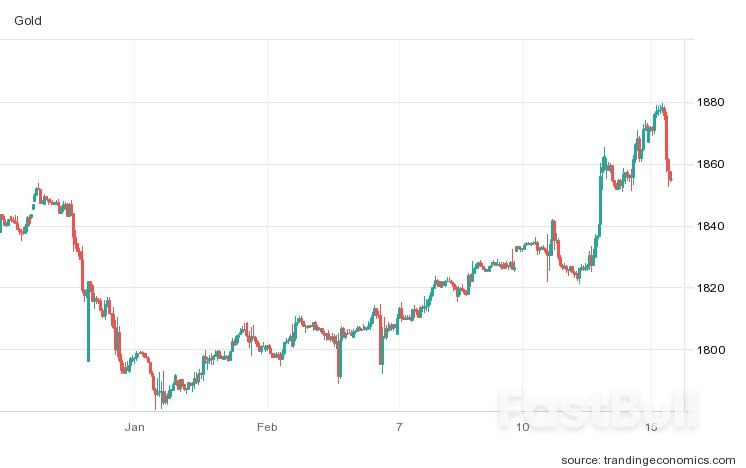
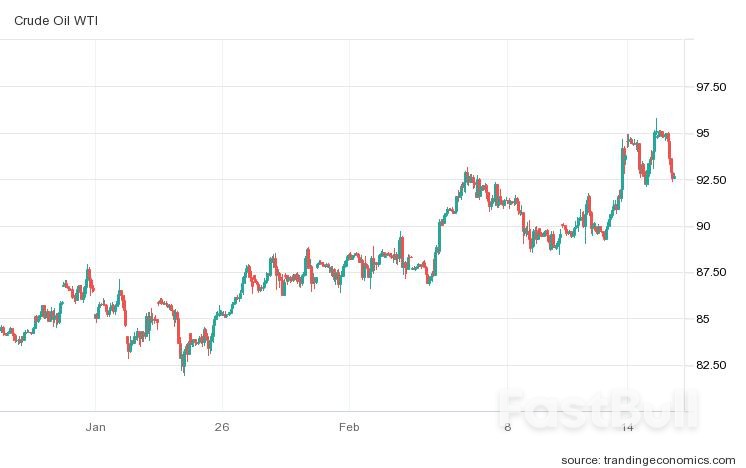
          This news also eased the tense situation in Russia and Ukraine, and the global market changed because of the news. Risky assets in Europe and the United States stock futures index rebounded sharply, safe-haven assets suffered, spot gold plunged more than $20, below the $1,860 mark. Crude oil prices also dropped two dollars in a short period due to the situation in Russia and Ukraine.
          Russia Withdraws! Gold & Crude Plummet_1
          Russia Withdraws! Gold & Crude Plummet_2
          From a technical point of view, the short-term buying of gold and crude was strong before, and there were already signs of overbought. It happened to encounter the news of Russia's withdrawal of troops and there was a correction. At the current stage, gold and crude are more significantly affected by the fundamental news. Has little effect.
          Gold is also affected by the Fed’s interest rate hike and inflation. Expectations of interest rate hikes are digested, while U.S. inflationary pressures are still severe, causing downward pressure on U.S. economic growth. Currently, it is still optimistic. Crude's overall supply shortage is still prominent, and there is still a possibility of breaking through $100.

          Risk Warnings and Disclaimers
          You understand and acknowledge that there is a high degree of risk involved in trading. Following any strategies or investment methods may lead to potential losses. The content on the site is provided by our contributors and analysts for information purposes only. You are solely responsible for determining whether any trading assets, securities, strategy, or any other product is suitable for investing based on your own investment objectives and financial situation.
          Comments
          Add to Favorites
          Share

          Pakistan, Iran to form joint working group on border issues

          Iran and Pakistan will form a joint working group to look after border management, including security, trade and travel issues between the two countries, the Iranian interior minister has said.
          Speaking at the conclusion of a one-day visit to the Pakistani capital, Islamabad, on Monday, Iran’s Interior Minister Ahmad Vahidi told Iranian state-run IRNA that both sides were also seeking to increase engagement on economic relations.
          “Iran-Pakistan relations, especially in the economic field, should be stronger and broader,” Vahidi said.
          During the visit, Vahidi met his Pakistani counterpart Sheikh Rasheed Ahmed, Pakistani Prime Minister Imran Khan and the country’s army chief General Qamar Javed Bajwa.
          The Iranian diplomat was accompanied by Iran’s Ambassador to Pakistan, Mohammad Ali Hosseini, Commander of the Iranian Border Guards, Brigadier General Ahmad Ali Goudarzi, and Iranian military attache Colonel Mostafa Ghanbarpour.
          Pakistan and Iran share a border of roughly 750km (466 miles) located in Pakistan’s southwest and Iran’s southeast. The border has been the site of sporadic skirmishes, with border patrols on both sides targeted.
          In 2018, at least 14 Iranian security personnel, including intelligence officials belonging to Iran’s Islamic Revolutionary Guard Corps, were abducted along the border, increasing tension between the two countries.
          Armed group Jaish al-Adl, affiliated with al-Qaeda, claimed responsibility for those abductions.
          Five of those soldiers were released the same year. Four were rescued by Pakistani security forces in 2019. In 2021, Iran said it had rescued two more of the soldiers.
          According to a statement from the Pakistan prime minister’s office, issues of developing border markets and “a convergence of views” on the situation in Afghanistan were also discussed.
          “[Pakistani PM Khan] stressed early completion and operationalisation of the border sustenance markets, for economic uplift of the people living on both sides of the border,” the statement said.
          It added that PM Khan “expressed satisfaction over convergence of views regarding a peaceful and stable Afghanistan and underscored the importance of close coordination between the two countries”.
          “The prime minister also stressed the need for urgent actions by the international community to prevent humanitarian crisis and economic meltdown in Afghanistan and measures to enhance practical engagement, strengthen stability, and counter terrorism.”
          Vahidi’s talks with Pakistani army chief touched upon similar subjects, according to a Pakistani military statement.
          “[General Bajwa] said that enhanced cooperation between the two brotherly neighbours is vital for peace and stability in the region,” said the statement.
          “Terming Pak-Iran Border as border of peace and friendship, [the army chief] highlighted the need to put in collective efforts to deny any space or liberty of action to be exploited by miscreants along Pak-Iran Border.”

          SOURCE: AL JAZEERA

          Risk Warnings and Disclaimers
          You understand and acknowledge that there is a high degree of risk involved in trading. Following any strategies or investment methods may lead to potential losses. The content on the site is provided by our contributors and analysts for information purposes only. You are solely responsible for determining whether any trading assets, securities, strategy, or any other product is suitable for investing based on your own investment objectives and financial situation.
          Comments
          Add to Favorites
          Share

          The Beginning and End of the Iran Nuclear Deal

          Since the beginning of the year, mainly affected by the shortage of supply, the crude oil market has been very prosperous, all the way up to the possibility of the $100 mark, although the recent Iran nuclear deal is expected to reach the optimistic prospect of limiting some of the gains in oil prices. If the Iran nuclear deal is reached, Iran's oil exports are expected to increase significantly, which will ease the supply tightness in the crude oil market. What is going on with the Iran nuclear deal? What has gone on before and after?

          Iran Nuclear Development

          Iran's nuclear undertaking started in the 1950s. At that time, Iran was in the Pahlavi Dynasty, which implemented a constitutional monarchy, and engaged in a secularized Westernization movement in the country. The relationship with the United States was in the honeymoon period in history. It was also an ally of the United States against Soviet Union expansion in the Middle East. The nuclear undertaking received strong support from the United States in its infancy, including the import of civilian nuclear facilities to Iran.
          However, during the Cold War period when the United States and the Soviet Union were competing for hegemony, especially in the late 1970s when the Soviet Union was at its peak, an Islamic revolution against Westernization and Secularization broke out in Iran, the Pahlavi Dynasty was overthrown, and the then Iranian spiritual leader Khomeinī coming to power, Iran has become an Islamic country with the integration of politics and religion. It has transformed from a Western ally into an anti-American flag bearer. The hostile relationship between Iran and the United States has continued to this day.The Beginning and End of the Iran Nuclear Deal_1
          Although the relationship between the United States and Iran has broken down, nuclear facilities are still reserved. In the 1990s, Iran subcontracted the nuclear power plant to Russia to continue to develop nuclear technology. At the same time, the United States, which has become a rival, has begun to suspect that Iran is going to develop nuclear weapons, and Iran does have a dream of becoming a hegemon in the Middle East. If it is allowed to develop nuclear technology, it will threaten the interests of the United States in the Middle East and the security of Saudi Arabia, Israel, and other Middle East allies, so the United States is also doing everything possible to interfere and impose sanctions. In 2003, the United States launched the blitzkrieg against Iraq, which once forced Iran to sign the " Treaty on the Non-Proliferation of Nuclear Weapons ". At the same time, in 2004, it promised to stop assembling centrifugal aircraft and enrichment of uranium.
          However, after the new Iranian president Mahmūd Ahmadinezhād came to power in 2005, he was extremely tough on the United States. To promote the development of Iran's nuclear industry, he repaired the Bushehr nuclear power plant and prepared it for operation, and launched uranium enrichment activities in a high-profile manner. And developed a new centrifuge to extract 3.5% low-concentration uranium, and nuclear reactions are usually achieved by uranium fission.
          Such high-profile activities of Iran eventually led to 4 sanctions from the United Nations, including that Iran will not be able to obtain loans and aid, the activities of financial institutions will be restricted, overseas accounts will be frozen, some companies will be sanctioned, and oil will not be sold.

          Iran Nuclear Deal Talks Begin

          The United States-led sanctions against Iran have indeed hit Iran's economy severely. The oil export revenue has plummeted, Iran's domestic inflation has risen, and the unemployment rate has remained high, which has also led to many voices of dissatisfaction with Ahmadinezhād.
          It was not until the end of Ahmadinezhād’s term in 2013 that this situation changed. The new President Hassan Rouhani is a typical moderate. After he came to power, he began to actively engage with Western countries to negotiate the nuclear issue and seek ways to lift sanctions on Iran. This negotiation lasted for two full years. By July 2015, Iran and the six countries on the Iranian nuclear issue (the United States, Britain, France, Russia, China, and Germany) reached a comprehensive agreement.
          The preliminary contents of the Iran nuclear deal reached mainly include: Iran shall not engage in the enrichment of uranium with a concentration of more than 5%, and it can only be used for civilian purposes, stop the construction of the Arak heavy water reactor, and allow more inspections by the International Atomic Energy Agency. The six countries will no longer impose additional sanctions on Iran, and at the same time lift some sanctions on Iran.
          On July 20, 2015, the UN Security Council unanimously approved the Iran nuclear deal, and the ten-year-old sanctions against Iran were lifted. The United Nations will reimpose sanctions on Iran if it breaches the deal within a decade.

          The Beginning and End of the Iran Nuclear Deal_2

          Iran Nuclear Deal Interrupted

          However, the good times did not last long. After taking office as the United States president in 2017, Republican Trump has been brooding about the Iran nuclear deal. He has unilaterally imposed several additional sanctions on Iran on the pretext of Iran's missile tests and is eager to wipe out Iran's nuclear industry. On May 8, 2018, Trump announced at the White House that the United States would withdraw from the Iran nuclear deal and would impose the highest level of economic sanctions on Iran.
          In response, Iranian President Hassan Rouhani said in a televised speech that Iran has always abided by the Iran nuclear deal, and despite the withdrawal of the United States, Iran will temporarily stay in the Iran nuclear deal and continue to maintain the framework of the deal. French President Emmanuel Macron, British Prime Minister Theresa May, and German Chancellor Angela Merkel also issued a joint statement expressing regret that the United States had withdrawn from the Iran nuclear deal. The three countries will remain within the Iran nuclear deal and are determined to ensure the implementation.
          The United States unilaterally withdrew from the Iran nuclear agreement, which made Iran quite helpless and annoyed. To ask the signatories to the Iran nuclear deal to resume fulfilling all their commitments, for countermeasure purposes, Iran has begun the process of enriching uranium with advanced centrifuges at its Fordo plant and taken a key step in suspending the implementation of the Iran nuclear agreement. In January 2020, the fifth phase of the suspension of the implementation of the Iran nuclear agreement was announced as the last step, and there is no longer any limit on the number of centrifuges.
          In addition, the withdrawal of the United States from the Iran nuclear deal has brought back the initiative of the Principlists in Iran. In addition, a series of operations such as the beheading of Iran's senior military official Qasem Soleimani has made Iran feel the same hatred against the United States, and the Principlists have swept 2020 parliamentary elections, the political winds in Iran turned to the Principlists. This has also caused serious losses to European companies that have closer economic ties with Iran, made Europe dissatisfied, and the US-Iran relationship has once again become deadlocked. It has also increased the uncertainty of the security situation in the Middle East, which in turn threatens European security.
          However, this seems to play right into the hands of the United States, Europe can not import oil and gas from Iran, can turn to the United States for procurement, the Middle East situation is unstable, increasing the need for the United States presence in the region, after all, Europe, the Middle East, the defense of many countries are to some extent dependent on the United States.

          Iran Nuclear Deal Talks Resume

          The United States unilaterally withdrew from the Iran nuclear deal, which once made the relationship between Europe and the United States somewhat unpleasant, and after Biden came to power, the United States geopolitical global siege "China and Russia" strategic intentions more prominent, to tighten the European allies, to further repair the relationship between Europe and the United States, but also very much hope to negotiate the Iran nuclear deal, to withdraw from the Middle East, more energy to deal with economic and foreign affairs in the Asia-Pacific region.
          On the other hand, Ebrahim Raisi, who became the new Iranian president on August 5, 2021, also expressed support for "any diplomatic plan" that would end sanctions against Iran, and all illegal United States sanctions against Iran must be lifted. The United States also quickly responded to the call, urging the new Iranian president to return to the Iran nuclear negotiations and restart the resumption of the Iran nuclear deal.
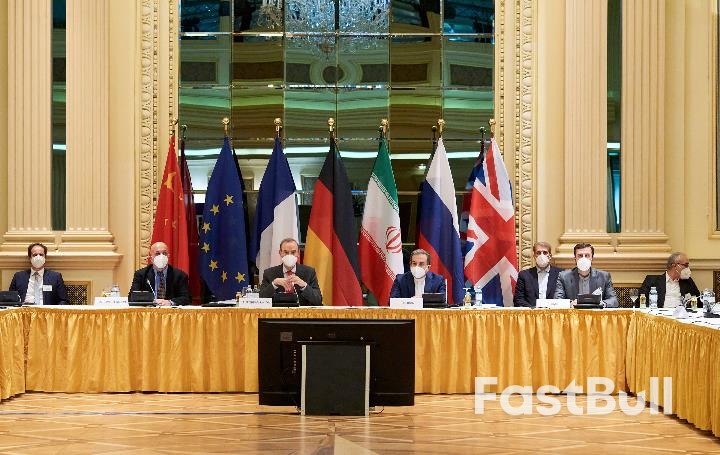
          On November 29, 2021, negotiations on the Iran nuclear deal resumed in Vienna. On February 14, 2022, local time, Iranian Foreign Minister Amirabdollahian said that if the United States, Britain, France, and Germany earnestly fulfill their obligations under the comprehensive agreement on the Iranian nuclear issue, then the Vienna negotiations may reach an agreement within a short period. He also stressed that Iran took part in the Vienna negotiations in a serious manner, made constructive proposals, and Iran was ready to reach a good deal.
          Judging from the current situation, the two important parties in the negotiation, the United States and Iran, will raise the consideration more and give themselves more leeway. It is relatively certain to reach an agreement, and the process may be somewhat tortuous. Of course, political disputes are all about interests.

          Risk Warnings and Disclaimers
          You understand and acknowledge that there is a high degree of risk involved in trading. Following any strategies or investment methods may lead to potential losses. The content on the site is provided by our contributors and analysts for information purposes only. You are solely responsible for determining whether any trading assets, securities, strategy, or any other product is suitable for investing based on your own investment objectives and financial situation.
          Comments
          Add to Favorites
          Share

          New Zealand to lower barriers to Chinese investment under upgraded trade deal

          • The two nations have updated their free-trade agreement, as China seeks more such deals and New Zealand competes for share of Chinese market.
          • It is expected to attract more Chinese investment into New Zealand, while China has pledged to open up several of its sectors.
          China and New Zealand have ratified an upgrade of their long-standing trade deal, as Beijing pushes to expand its global trade network to fortify its economy during prolonged tensions with the US and other countries.
          In a brief statement on Tuesday, the Chinese Ministry of Commerce said the two nations had completed domestic approval procedures and the deal, effective from April, would “further promote trade and investment exchanges” and “jointly promote the development of economic and trade relations to a higher level”.
          The ratification of the new version of a deal first agreed in 2008 comes after five years of negotiation.
          It covers new areas including e-commerce, public procurement and competition policies, as well as measures on environmental protection that are believed to be the strongest China has committed to in any free-trade agreement (FTA).
          Damien O’Connor, New Zealand’s trade and export growth minister, said during a virtual meeting last week with Chinese Commerce Minister Wang Wentao that the upgrade would make it easier to export goods to China.
          “Goods and services exports between China and New Zealand reached NZ$20.1 billion in the year ending June 2021,” he said in a government statement on Tuesday. “New Zealand businesses will benefit from up-to-date rules underpinning our trade.”
          New Zealand is competing with other countries including Australia to supply farm goods to China’s growing middle class. Australia, meanwhile, has a fractious trade relationship with China following a number of disagreements over matters including Canberra’s call to investigate the coronavirus’ origins, the Aukus pact with Britain and the United States, and alleged interference in Australian politics.
          In a move expected to encourage more Chinese companies to invest, New Zealand has agreed to significantly lower barriers to doing so, by making smaller sums no longer subject to government review. There are new thresholds for both private and Chinese government-backed investments.
          This is similar to the treatment allowed to member states of the Comprehensive and Progressive Trans-Pacific Partnership (CPTPP), a high-level FTA that Beijing last year applied to join.
          The agreement with New Zealand also includes a pledge by China to further open up its aviation, construction, shipping and finance sectors.
          The FTA signed with New Zealand in 2008 was the first such agreement between China and a developed country. Negotiations to upgrade it started in 2016.
          China is New Zealand’s biggest trading partner, with two-way trade jumping from US$4.4 billion in 2008 to US$18.1 billion in 2020. New Zealand’s meat and dairy products are increasingly popular among China’s affluent middle class.
          As the world’s manufacturing powerhouse and one of the largest consumer goods markets, China has seen free-trade deals as essential to consolidate its economic integration with the rest of the world.
          It has forged 16 FTAs, including the Regional Comprehensive Economic Partnership (RCEP) between 16 nations in the Asia-Pacific region, which came into effect in January and will connect about 30 per cent of the world’s people and output.
          The CPTPP, which China aspires to join, was a mega-deal scuppered by the Donald Trump administration in 2017 but later revived as an 11-member agreement. It contains some of the world’s most ambitious targets for tariff elimination and the highest standards on trade and investment, which some Chinese observers said could force China to hasten its domestic reform.

          Source: South China Morning Post

          Risk Warnings and Disclaimers
          You understand and acknowledge that there is a high degree of risk involved in trading. Following any strategies or investment methods may lead to potential losses. The content on the site is provided by our contributors and analysts for information purposes only. You are solely responsible for determining whether any trading assets, securities, strategy, or any other product is suitable for investing based on your own investment objectives and financial situation.
          Comments
          Add to Favorites
          Share

          Japan should invest more in renewables and less in 'clean coal'

          Japan's focus on so-called "advanced clean coal technologies" as a means to reach its climate targets is misplaced due to their high cost and low sustainability, according to a climate research report published on Monday (Feb 14).
          The report, titled Coal-de-sac, by London-based climate analytic think-tank TransitionZero, warned that in the worst-case scenario, extensive use of such technology may jeopardise Japan's climate goals.
          In 2020, Japan pledged to cut emissions by at least 46 per cent from 2013 levels by 2030 and to achieve net-zero carbon emissions by 2050.
          The country has long had a bad reputation for its addiction to coal, though Prime Minister Fumio Kishida told the COP26 climate conference last year that Japan will shift towards less polluting "clean coal" technologies.
          But the report urged Japan to instead boost investment in clean renewable technology such as solar and offshore wind. This, it said, is a long-term solution, avoiding the short-term temptation to retrofit existing coal plants with pricey technologies with potentially low returns.
          As it is, the report noted that the carbon intensity of Japan's clean coal technologies is five times higher than what is required for the country to be on track to reach its 2050 target. The cost of these technologies, meanwhile, is up to three times that of solar power.
          "It seems like Japan is pursuing technologies that are the easiest way for it to keep its coal plants operational for longer," TransitionZero co-founder Matt Gray, who co-wrote the report, told a media briefing.
          "If Japan moves ahead with this, they could potentially be locking themselves into high-cost electricity that will not only compromise their economic competitiveness, but also probably do very little to meet their long-term ambitions to be net-zero by 2050."
          The report, which included input by Japanese experts such as Mr Shin Furuno, a senior manager for environmental, social and corporate governance at the Sumitomo Mitsui Trust Bank, compared the cost and environmental impact of renewable energies to that of Japan's three preferred advanced coal technologies.
          One method is ammonia co-firing, by which coal burners are retrofitted to also burn cleaner ammonia to reduce carbon emissions.
          Yet the report noted that the cheapest version of ammonia is four times more pricey than coal, while the cleanest version - produced by renewables - is 15 times more expensive. Japan's goal of building a fully ammonia-fired turbine by 2030, while laudable, is also a highly costly endeavour, it added.
          Another way is coal gasification, by which coal is partially oxidised to produce a less carbon-intensive synthetic gas mixture with a lower proportion of carbon dioxide.
          The third method, carbon capture, utilisation and storage (CCUS), refers to the capture of carbon emissions from fuel combustion, industrial processes or even directly from the atmosphere. This can then be reused as input for manufacturing, or stored underground.
          While CCUS has the potential of reducing emissions by 90 per cent, Japan has limited suitable CCUS sites and may run out of space in 10 years, the report said.
          TransitionZero noted the potential value of these clean coal technologies in so-called "hard-to-abate" sectors such as cement or steel for which transition is not as straightforward.
          Japan currently relies on imports for nearly 90 per cent of its energy needs. It generates about a third of its electricity from coal and 18 per cent from renewable energy.
          It aims to achieve, by 2030, an energy mix of 19 per cent coal and 36 per cent to 38 per cent renewable energy, with the rest made up of nuclear (20 per cent to 22 per cent, up from 6 per cent), liquefied natural gas (20 per cent), oil (2 per cent), and hydrogen or ammonia (1 per cent).
          Some observers, however, believe the nuclear goal is unrealistic amid the politically sensitive restart of power plants due to the Fukushima disaster.

          Source: The Straits Times.

          Risk Warnings and Disclaimers
          You understand and acknowledge that there is a high degree of risk involved in trading. Following any strategies or investment methods may lead to potential losses. The content on the site is provided by our contributors and analysts for information purposes only. You are solely responsible for determining whether any trading assets, securities, strategy, or any other product is suitable for investing based on your own investment objectives and financial situation.
          Comments
          Add to Favorites
          Share

          AUD/USD: Short spike offers shorting opportunities

          Overview

          Intraday trend: up
          Entry levels: short at 0.71676-0.71538 (retracement order), long at 0.71037
          Target: 0.71037 (short), 0.71538, 0.71801 (long)
          Stop loss: 30 points

          Fundamentals

          Although the minutes of the Australian Fed meeting were released today, the AUD/USD reaction to them was muted. Mainly because what was released in the minutes was not too different from what was in the last policy meeting. Remarks such as no interest rate hike until inflation reaches the target level of 2%-3%; recent inflation growth is faster than expected by the Australian Fed, etc., have long been digested by the market.

          Technical Side

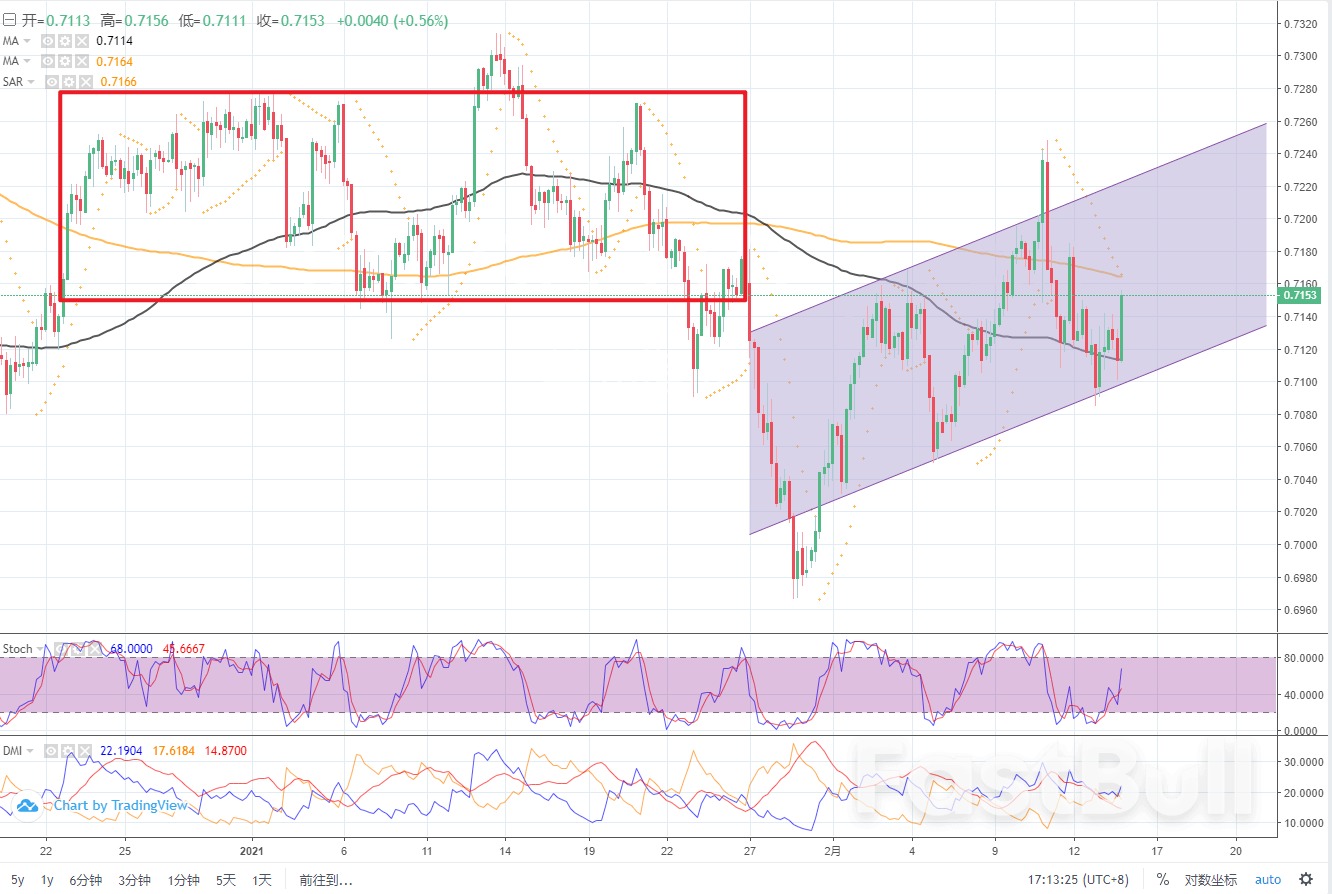
          In the 4-hour chart, The AUD is currently in the rising channel; the recent rise makes the AUD price to the bottom of the historical trend of the shock range (0.7153). At the same time, there is also a 200 MA (orange) pressure above; it is expected that the short-term rise of the AUD will stop here.
          As for the indicators, STS shows an apparent upward movement, while the fast line is accelerating and approaching the overbought zone, indicating that the AUD rally is nearing its end and the market will start to fall in the aftermath.
          In the DMI, the ADX line is moving downward, showing that the AUD's upward momentum is weakening; the -DI is under and performing downward, near the ten range (14.8), indicating that the AUD will also rise slightly and will start to fall afterward.
          AUD/USD: Short spike offers shorting opportunities_1
          Overall, while the AUD is on the rise in the short term as a whole, the recent near-50 point rise in the short term provides the AUD a shorting opportunity.
          Support: 0.71283, 0.71037
          Resistance: 0.71538, 0.71801, 0.7200

          Risk Warnings and Disclaimers
          You understand and acknowledge that there is a high degree of risk involved in trading. Following any strategies or investment methods may lead to potential losses. The content on the site is provided by our contributors and analysts for information purposes only. You are solely responsible for determining whether any trading assets, securities, strategy, or any other product is suitable for investing based on your own investment objectives and financial situation.
          Comments
          Add to Favorites
          Share
          FastBull
          Copyright © 2025 FastBull Ltd

          728 RM B 7/F GEE LOK IND BLDG NO 34 HUNG TO RD KWUN TONG KLN HONG KONG

          TelegramInstagramTwitterfacebooklinkedin
          App Store Google Play Google Play
          Products
          Charts

          Chats

          Q&A with Experts
          Screeners
          Economic Calendar
          Data
          Tools
          Membership
          Features
          Function
          Markets
          Copy Trading
          Latest Signals
          Contests
          News
          Analysis
          24/7
          Columns
          Education
          Company
          Careers
          About Us
          Contact Us
          Advertising
          Help Center
          Feedback
          User Agreement
          Privacy Policy
          Business

          White Label

          Data API

          Web Plug-ins

          Poster Maker

          Affiliate Program

          Risk Disclosure

          The risk of loss in trading financial instruments such as stocks, FX, commodities, futures, bonds, ETFs and crypto can be substantial. You may sustain a total loss of the funds that you deposit with your broker. Therefore, you should carefully consider whether such trading is suitable for you in light of your circumstances and financial resources.

          No decision to invest should be made without thoroughly conducting due diligence by yourself or consulting with your financial advisors. Our web content might not suit you since we don't know your financial conditions and investment needs. Our financial information might have latency or contain inaccuracy, so you should be fully responsible for any of your trading and investment decisions. The company will not be responsible for your capital loss.

          Without getting permission from the website, you are not allowed to copy the website's graphics, texts, or trademarks. Intellectual property rights in the content or data incorporated into this website belong to its providers and exchange merchants.

          Not Logged In

          Log in to access more features

          FastBull Membership

          Not yet

          Purchase

          Become a signal provider
          Help Center
          Customer Service
          Dark Mode
          Price Up/Down Colors

          Log In

          Sign Up

          Position
          Layout
          Fullscreen
          Default to Chart
          The chart page opens by default when you visit fastbull.com