Markets
News
Analysis
User
24/7
Economic Calendar
Education
Data
- Names
- Latest
- Prev


Signal Accounts for Members
All Signal Accounts
All Contests


U.S. Weekly Treasuries Held by Foreign Central BanksA:--
F: --
P: --
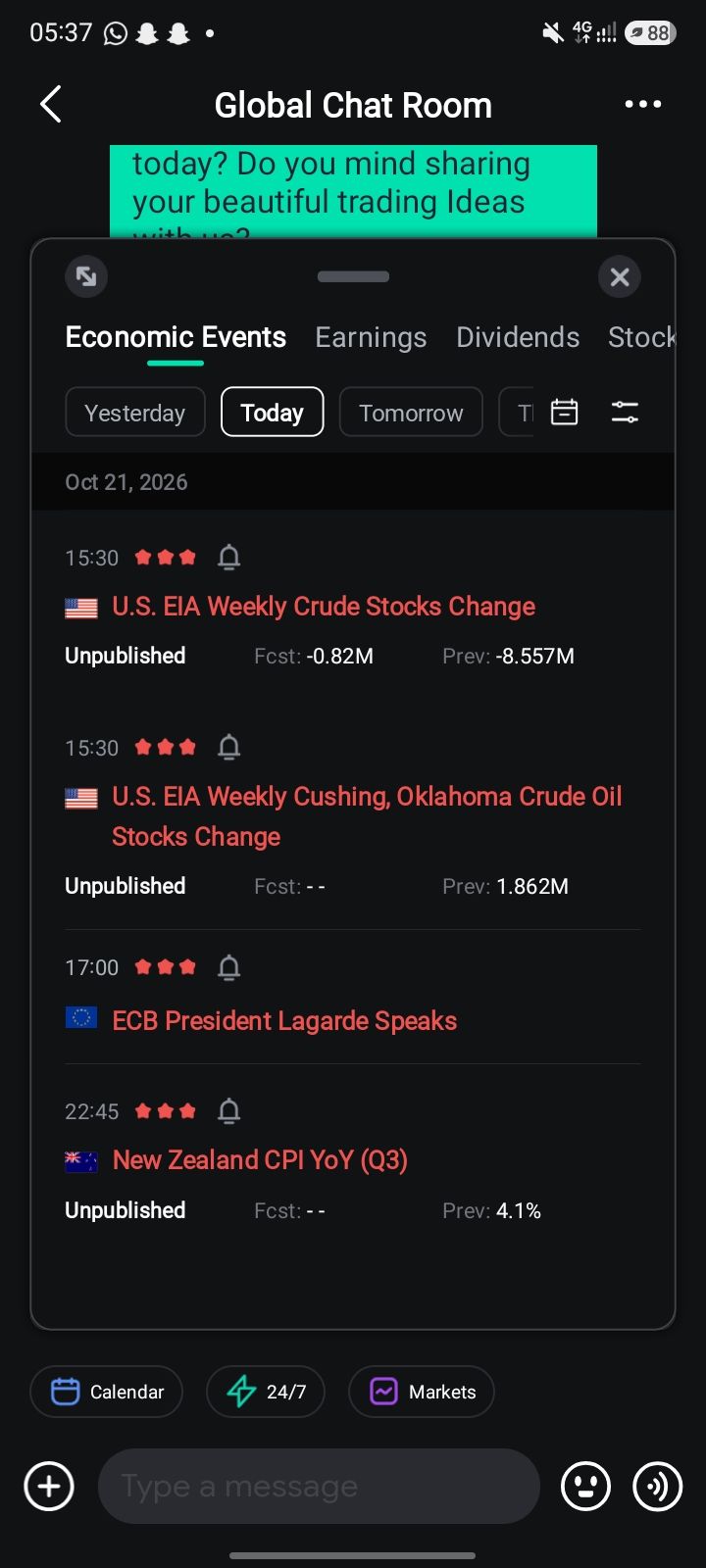
U.S. EIA Weekly Crude Stocks ChangeA:--
F: --
P: --
U.S. EIA Weekly Crude Demand Projected by ProductionA:--
F: --
P: --
U.S. EIA Weekly Cushing, Oklahoma Crude Oil Stocks ChangeA:--
F: --
P: --
U.S. EIA Weekly Gasoline Stocks ChangeA:--
F: --
P: --
South Korea Industrial Output MoM (SA) (Nov)A:--
F: --
South Korea Retail Sales MoM (Nov)A:--
F: --
P: --
South Korea Services Output MoM (Nov)A:--
F: --
P: --
Russia IHS Markit Services PMI (Dec)A:--
F: --
P: --
Turkey Economic Sentiment Indicator (Dec)A:--
F: --
P: --
Brazil Unemployment Rate (Nov)A:--
F: --
P: --
U.S. Weekly Redbook Index YoYA:--
F: --
P: --
U.S. S&P/CS 10-City Home Price Index YoY (Oct)A:--
F: --
P: --
U.S. S&P/CS 10-City Home Price Index MoM (Not SA) (Oct)A:--
F: --
P: --
U.S. S&P/CS 20-City Home Price Index (Not SA) (Oct)A:--
F: --
P: --
U.S. S&P/CS 20-City Home Price Index MoM (Not SA) (Oct)A:--
F: --
P: --
U.S. FHFA House Price Index YoY (Oct)A:--
F: --
U.S. S&P/CS 20-City Home Price Index YoY (Not SA) (Oct)A:--
F: --
P: --
U.S. S&P/CS 20-City Home Price Index MoM (SA) (Oct)A:--
F: --
U.S. FHFA House Price Index (Oct)A:--
F: --
P: --
U.S. FHFA House Price Index MoM (Oct)A:--
F: --
U.S. Chicago PMI (Dec)A:--
F: --
P: --
Brazil CAGED Net Payroll Jobs (Nov)A:--
F: --
P: --
U.S. Weekly Total Oil Rig CountA:--
F: --
P: --
U.S. Weekly Total Rig CountA:--
F: --
P: --
FOMC Meeting Minutes
U.S. API Weekly Refined Oil StocksA:--
F: --
P: --
U.S. API Weekly Crude Oil StocksA:--
F: --
P: --
U.S. API Weekly Cushing Crude Oil StocksA:--
F: --
P: --
U.S. API Weekly Gasoline StocksA:--
F: --
P: --
South Korea CPI YoY (Dec)A:--
F: --
P: --
China, Mainland NBS Manufacturing PMI (Dec)--
F: --
P: --
China, Mainland Composite PMI (Dec)--
F: --
P: --
China, Mainland NBS Non-manufacturing PMI (Dec)--
F: --
P: --
China, Mainland Caixin Manufacturing PMI (SA) (Dec)--
F: --
P: --
Turkey Trade Balance (Nov)--
F: --
P: --
Russia CPI YoY (Dec)--
F: --
P: --
U.S. MBA Mortgage Application Activity Index WoW--
F: --
P: --
South Africa Trade Balance (Nov)--
F: --
P: --
U.S. Initial Jobless Claims 4-Week Avg. (SA)--
F: --
P: --
U.S. Weekly Continued Jobless Claims (SA)--
F: --
P: --
U.S. Weekly Initial Jobless Claims (SA)--
F: --
P: --
U.S. EIA Weekly Cushing, Oklahoma Crude Oil Stocks Change--
F: --
P: --
U.S. EIA Weekly Crude Demand Projected by Production--
F: --
P: --
U.S. EIA Weekly Gasoline Stocks Change--
F: --
P: --
U.S. EIA Weekly Crude Stocks Change--
F: --
P: --
U.S. EIA Weekly Heating Oil Stock Changes--
F: --
P: --
U.S. EIA Weekly Crude Oil Imports Changes--
F: --
P: --
U.S. EIA Weekly Natural Gas Stocks Change--
F: --
P: --
South Korea Trade Balance Prelim (Dec)--
F: --
P: --
Indonesia Core Inflation YoY (Dec)--
F: --
P: --
Indonesia Inflation Rate YoY (Dec)--
F: --
P: --
Turkey Manufacturing PMI (Dec)--
F: --
P: --
Brazil IHS Markit Manufacturing PMI (Dec)--
F: --
P: --
Mexico Manufacturing PMI (Dec)--
F: --
P: --
South Korea IHS Markit Manufacturing PMI (SA) (Dec)--
F: --
P: --
Indonesia IHS Markit Manufacturing PMI (Dec)--
F: --
P: --
India HSBC Manufacturing PMI Final (Dec)--
F: --
P: --
Russia IHS Markit Manufacturing PMI (Dec)--
F: --
P: --
U.K. Nationwide House Price Index MoM (Dec)--
F: --
P: --
U.K. Nationwide House Price Index YoY (Dec)--
F: --
P: --


No matching data
Latest Views
Latest Views
Trending Topics
Top Columnists
Latest Update
White Label
Data API
Web Plug-ins
Affiliate Program
View All

No data
A new report by blockchain analytics firm AMLBot has revealed major differences in how the two largest stablecoin issuers, Tether and Circle, handle the freezing of crypto assets linked to illegal activity.
According to the report, between 2023 and 2025, Tether froze around $3.3 billion worth of USDT, while Circle froze about $109 million in USDC. This means Tether froze nearly 30 times more funds than Circle over the same period.
The report shows that Tether blacklisted 7,268 wallet addresses across multiple blockchains, including Ethereum and Tron. More than 2,800 of these freezes were coordinated with U.S. law enforcement agencies. A large portion of the frozen funds—over 53% of total USDT freezes—was found on the Tron network, which is commonly used for fast and low-cost stablecoin transfers.
One big difference highlighted in the report is Tether’s ability to burn and reissue tokens. In some cases, frozen USDT linked to scams or criminal activity was permanently destroyed, and new tokens were issued to return funds to victims or authorities. AMLBot reported that this process has been used in several large enforcement cases over the past two years.
Circle, which issues the USDC stablecoin, follows a more cautious and legally driven approach. During the same period, Circle blacklisted 372 addresses holding a total of $109 million. Circle only freezes funds when required by court orders, regulatory rules, or sanctions, and it does not burn or reissue tokens. Once frozen, USDC remains locked until legal approval is given to release it.
AMLBot explained that these differences reflect two very different enforcement philosophies. Tether works closely with law enforcement agencies and may freeze funds early in investigations to limit further losses. Circle limits its actions strictly to formal legal instructions.
The report also points out that while Tether’s proactive approach has helped recover funds tied to fraud, trafficking, and scams, it has raised concerns about centralized control and user rights. Circle’s model, while slower, is seen as offering clearer legal safeguards.
Overall, the findings show that stablecoins operate at the intersection of blockchain technology and traditional law enforcement, with each issuer choosing a different balance between speed, control, and legal certainty.
Bitcoin witnessed a sudden flash crash to about $24,111 on the , before quickly rebounding to $87,000 in seconds.
Per the exchange data, the move appeared isolated to USD1, the stablecoin launched by Trump family-backed World Liberty Financial.Source: Binance
This type of “flash wicks” occurs when liquidity thins and order books lose depth. The BTC/USDT trading pair has remained stable after resuming.Bitcoin Flash Wicks and Quick Reversal
During non-peak trading hours, when market makers often pull back, large buy/sell orders could sweep through multiple empty levels. This scenario creates a dramatic spike that looks like a market breakout.
Further, the instant reversal of the wick shows that no broader market move supported the spike.
“Many spot investors find themselves in a similar position to where they were before the flash crash,” Nic Puckrin, crypto analyst and co-founder of The Coin Bureau, told Cryptonews.
“This is certainly an argument against excessive leverage in a market with fluctuating liquidity in such an uncertain geopolitical climate.”
Additionally, temporary pricing issues can also trigger such dislocations. These price fluctuations are often created by faulty quotes or reactions from trading bots.
Experts often emphasize that real rallies require sustained buying pressure and rising volume. In this case, trading volume remained low, and the price quickly returned to its previous level.BTC Price Remains Bearish – What is the Next Directional Move?
Bitcoin rose 0.89% to $87,693.65 over the past 24 hours, outpacing the broader crypto market (+0.83%). The crypto is down sharply from its October peakabove $126,000. The largest digital asset is trading at $87,773 at press time, per .
, Bitcoin is currently consolidating within a descending “triangle pattern,” trading below the 21MA, which serves as a resistance barrier. A definitive breakout or breakdown would confirm the next directional move.
Evernorth, the largest institutional holder of XRP, is sitting on more than $200 million in unrealized losses.
This position highlights the volatility and risks associated with institutional cryptocurrency holdings during a market downturn.
XRP Treasury Firm Evernorth Sees Value of Holdings Drop by Over $200 Million
Evernorth has emerged as a prominent player in the institutional adoption of XRP. In late October, the Nevada-based firm announced plans to raise $1 billion to establish what it described as the “largest public XRP treasury company.”
On November 4, 2025, Evernorth acquired 84.36 million XRP at an average price of $2.54 per token. The transaction pushed the company’s total XRP holdings to more than 473.27 million tokens.
“This continued accumulation reflects Evernorth’s conviction in XRP as the most important asset of the internet, and its mission to build a long-term, institutional-grade XRP treasury with compounding yield,” the firm stated.
However, these purchases have come at a cost. According to data from CryptoQuant, Evernorth’s XRP position is now showing unrealized losses exceeding $200 million.
This mirrors broader weakness across the XRP market. Nearly half of the token’s circulating supply is currently held at a loss. The drawdown stems from XRP’s recent price weakness.
The altcoin has fallen by roughly 25% since Evernorth’s initial treasury announcement. It is now trading below price levels seen at the start of the year, highlighting the challenges facing XRP as momentum continues to fade.
At the time of writing, XRP’s trading price stood at $1.87. The price rose 1.5% over the past day as part of the broader market rally.
Still, BeInCrypto reported that the current market cycle threatens to end XRP’s two-year streak of positive annual returns, with the token likely to close the year down approximately 11%.
Meanwhile, XRP is not the only major crypto asset facing pressure in the fourth quarter of 2025. Other leading cryptocurrencies have also declined, weighing on institutional investors with large on-chain positions.
According to analyst Maartunn, BitMine is currently sitting on an unrealized loss of approximately $3.5 billion on its Ethereum holdings. Despite the drawdown, the firm has continued to accumulate ETH.
Bitcoin-focused treasuries are facing similar challenges. Metaplanet’s Bitcoin holdings are down roughly 18.8%, while several other institutional holders are showing comparable declines as broader market weakness persists.
Bitcoin institutional outflows continued into Christmas as the US gained the title of biggest BTC seller.
Key points:
Bitcoin ETF netflows stay negative for Christmas Eve as the institutional investment vehicles lose another $175 million.
Tax obligations and the quarterly options expiry are blamed for the poor performance.
Hope remains for a broad rebound after the holiday season.
Analysis: Bitcoin institutional bid to return “soon”
Data from UK-based investment company Farside Investors confirms that on Christmas Eve, net outflows from the US spot Bitcoin exchange-traded funds (ETFs) totalled over $175 million.
Bitcoin institutional capital saw no reason to wrap up for the holidays while Wall Street was still open this week.
Farside shows that a lengthy spate of selling continued right up until the last pre-Christmas US trading session ended, with net outflows at $175.3 million.
The tally is similar to that of the past five trading days, which each ended “in the red” for total net outflows of $825.7 million. Since Dec. 15, every trading day has been red except for last Wednesday, which managed to attract net inflows of $457.3 million.
Commenting, market participants attributed the ETFs’ weak performance to seasonality.
“Most of the selling is due to tax loss harvesting, which means it'll be over in a week,” trader Alek wrote in a post on X.
Alek further noted that Friday’s record options expiry event could be impacting risk appetite.
“This is temporary and institutions will back to bidding soon,” he added.
An accompanying chart underscored a recent phenomenon: persistent BTC price downside during US trading sessions.
The Coinbase Premium, which measures the difference in price between Coinbase’s and Binance’s pairs, has spent much of December in negative territory.
“US is now the biggest seller of $BTC. Asia is now the biggest buyer of Bitcoin,” crypto analyst and entrepreneur Ted Pillows summarized.
A negative Premium reflects a lack of buyer demand from the US — something that some believe Bitcoin needs to rediscover to have a chance at holding higher levels.
Bitcoin, Ether ETFs stuck since early November
Offering some hope for 2026, trader BitBull argued that negative ETF netflows, even on a 30-day moving average basis, do not imply “final market tops.”
“Price stabilizes first, flows turn neutral, and only then do inflows return. For now, the data suggests liquidity is inactive, not destroyed,” he told X followers about both Bitcoin and Ether (ETH) ETF habits.
30-day moving average netflows have been consistently negative since the start of November.
This article does not contain investment advice or recommendations. Every investment and trading move involves risk, and readers should conduct their own research when making a decision. While we strive to provide accurate and timely information, Cointelegraph does not guarantee the accuracy, completeness, or reliability of any information in this article. This article may contain forward-looking statements that are subject to risks and uncertainties. Cointelegraph will not be liable for any loss or damage arising from your reliance on this information.
Bitcoin investors are watching macro signals closely after billionaire Elon Musk said the US economy could enter a period of rapid expansion as soon as late 2026, reviving hopes of another leg higher for the cryptocurrency.
Key Takeaways:
In a , Musk predicted “double-digit growth” within the next 12 to 18 months, adding that US GDP could even see “triple-digit” expansion over the next five years if advances in applied artificial intelligence translate into real economic output.
While the comments were not tied directly to crypto, they were quickly picked up by Bitcoin traders searching for signs of improving liquidity and risk appetite.Fed Rate Cuts Put Macro Focus Back on Bitcoin’s Next Move
Macro expectations have long played a role in Bitcoin price action. Investors often track growth forecasts, inflation trends and US Federal Reserve policy to gauge whether conditions favor risk assets.
Rate cuts by the Fed earlier this year have already fueled debate over whether easier financial conditions could support a recovery in Bitcoin after its recent pullback.
Several prominent figures in the crypto space backed Musk’s outlook. Bitcoin entrepreneur Anthony Pompliano noted that the world’s richest man is openly forecasting double-digit GDP growth, framing it as a potentially powerful backdrop for scarce assets like Bitcoin.
Meanwhile, real-world asset yield platform Oryon Finance said Musk’s projections tend to be “not random noise,” even if they are controversial.
Skepticism, however, remains. Some market watchers questioned Musk’s track record on long-term forecasts.
Elon, predictions that come true are not your strongest suit.— Artem Russakovskii (@ArtemR)
Analyst Artem Russakovskii said economic predictions are not Musk’s strongest area, urging caution in extrapolating the comments into market expectations.
Bearish views on Bitcoin’s medium-term outlook also persist. Market commentator Bariksis said that despite Musk’s optimism, he expects a Bitcoin bear market in 2026.
Veteran trader Peter Brandt and Fidelity’s Jurrien Timmer have similarly suggested Bitcoin could revisit the $60,000 range next year.
At the time of publication, Bitcoin was trading at $87,709, down nearly 30% from its Oct. 5 peak of $125,100, according to CoinMarketCap.Bitcoin Remains Tied to Fed Policy as Inflation Eases Slowly, Analyst Says
According to Linh Tran, market analyst at XS.com, Bitcoin’s recent price action underscores the market’s sensitivity to monetary policy expectations rather than headline economic data.
While US inflation has eased from last year’s highs, the latest consumer price index reading of 2.7% suggests that the disinflation process remains slow and uneven, forcing “the Fed to maintain a cautious stance, making it difficult to pivot quickly toward an aggressive easing cycle,” Tran said in a note shared with Cryptonews.com.
Last week, K33 also said Bitcoin’s prolonged sell-side pressure from long-term holders may be approaching its limits after years of steady distribution.
The majority of crypto exploits in the coming year won’t be caused by a zero-day bug in your favorite protocol, say crypto security experts. It’s going to be caused by you.
That’s because 2025 has shown that the majority of hacks don’t start with malicious code; they begin with a conversation, Nick Percoco, chief security officer of crypto exchange Kraken, told Cointelegraph.
From January to early December 2025, data from Chainalysis shows that the crypto industry witnessed over $3.4 billion in theft, with the February compromise of Bybit accounting for nearly half of that total.
During the attack, bad actors gained access through social engineering, injected a malicious JavaScript payload that allowed them to modify transaction details and siphon off funds.
What is social engineering?
Social engineering is a cyberattack method that manipulates people into revealing confidential information or performing actions that compromise security.
Percoco said the battleground for crypto security will be in the mind, not cyberspace.
Tip 1: Use automation where possible
Supply chain compromises have also proven to be a key challenge this year, according to Percoco, as a seemingly minor breach can prove to be devastating later on, because “it’s a digital Jenga tower, and the integrity of every single block matters.”
In the year ahead, Percoco recommends reducing human trust points through actions like automating defenses where possible and verifying every digital interaction through authentication in a “shift from reactive defense to proactive prevention.”
“In crypto especially, the weakest link remains human trust, amplified by greed and FOMO. That’s the crack that attackers exploit every time. But no technology replaces good habits,” he added.
Tip 2: Silo out infrastructure
Lisa, the security operations lead from SlowMist, said bad actors increasingly targeted developer ecosystems this year, which, combined with cloud-credential leaks, created opportunities to inject malicious code, steal secrets, and poison software updates.
“Developers can mitigate these risks by pinning dependency versions, verifying package integrity, isolating build environments, and reviewing updates before deployment,” she said.
Going into 2026, Lisa predicts the most significant threats will likely stem from increasingly sophisticated credential-theft and social-engineering operations.
“Threat actors are already leveraging AI-generated deepfakes, tailored phishing, and even fake developer hiring tests to obtain wallet keys, cloud credentials, and signing tokens. These attacks are becoming more automated and convincing, and we expect this trend to continue,” she said.
To stay safe, Lisa’s advice for organizations is to implement strong access control, key rotation, hardware-backed authentication, infrastructure segmentation, and anomaly detection and monitoring.
Individuals should rely on hardware wallets, avoid interacting with unverified files, cross-check identities across independent channels, and treat unsolicited links or downloads with caution.
Tip 3: Proof of personhood to battle AI deepfakes
Steven Walbroehl, co-founder and chief technology officer of blockchain cybersecurity firm Halborn, predicts AI-enhanced social engineering will play a significant role in the crypto hackers’ playbooks.
In March, at least three crypto founders reported foiling an attempt from alleged North Korean hackers to steal sensitive data through fake Zoom calls that used deepfakes.
Walbroehl warns that hackers are using AI to create highly personalized, context-aware attacks that bypass traditional security awareness training.
To combat this, he suggests implementing cryptographic proof-of-personhood for all critical communications, hardware-based authentication with biometric binding, anomaly detection systems that baseline normal transaction patterns, and establishing verification protocols using pre-shared secrets or phrases.
Tip 4: Keep your crypto to yourself
Wrench attacks, or physical attacks on crypto holders, were also a prominent theme of 2025, with at least 65 recorded instances, according to Bitcoin OG and cypherpunk Jameson Lopps’ GitHub list. The last bull market peak in 2021 was previously the worst year on record, with a total of 36 recorded attacks
An X user under the handle Beau, a former CIA officer, said in an X post on Dec. 2 that wrench attacks are still relatively rare, but he still recommends crypto users take precautions by not talking about wealth or disclosing crypto holdings or extravagant lifestyles online as a start.
He also suggests becoming a “hard target” by using data cleanup tools to hide private personal information, such as home addresses, and investing in home defenses like security cameras and alarms.
Tip 5: Don’t skimp on the tried and true security tips
David Schwed, a security expert who has worked at Robinhood as the chief information security officer, said his top tip is to stick to reputable businesses that demonstrate vigilant security practices, including rigorous and regular third-party security audits of their entire stack, from smart contracts to infrastructure.
However, regardless of the technology, Schwed said users should avoid using the same password for multiple accounts, opt to use a hardware token as a multifactor authentication method and safeguard the seed phrase by securely encrypting it or storing it offline in a secure, physical location.
He also advises using a dedicated hardware wallet for significant holdings and minimizing holdings in exchanges.
Related: Spear phishing is North Korean hackers’ top tactic: How to stay safe
“Security hinges on the interaction layer. Users must remain hyper vigilant when connecting a hardware wallet to a new web application and must thoroughly validate the transaction data displayed on the hardware device’s screen before signing. This prevents ‘blind signing’ of malicious contracts,” Schwed added.
Lisa said her best tips are to only use official software, avoid interaction with unverified URLs, and separate funds across hot, warm, and cold configurations.
To counter the growing sophistication of scams like social engineering and phishing, Kraken’s Percoco recommends “radical skepticism” at all times, by verifying the authenticity and assuming every message is a test of awareness.
“And one universal truth remains: no legitimate company, service, or opportunity will ever ask for your seed phrase or login credentials. The moment they do, you’re talking to a scammer,” Percoco added.
Meanwhile, Walbroehl recommends generating keys using cryptographically secure random number generators, strict segregation between development and production environments, regular security audits and incident response planning with regular drills.
Magazine: When privacy and AML laws conflict: Crypto projects’ impossible choice
In a recent social media post, Ripple CTO David Schwartz clarified that the establishment of the escrow actually prevented Ripple from selling as much XRP as it wanted.
"Before the escrow, Ripple could have sold as much XRP as it wanted every month."
David 'JoelKatz' Schwartz@JoelKatzDec 25, 2025Before the escrow, Ripple could have sold as much XRP as it wanted every month. And I opposed the decision to implement the escrow precisely because I didn't see enough upside to justify giving up that flexibility.
This comes after a user stated that Schwartz established the Ripple Escrow system to systematically dump 1 billion XRP onto the market every month to "fund his career" at the expense of retail investors.
Defending Musk's taxes
The conversation starts with a defense of Elon Musk, pivots to an attack on Ripple's XRP sales, and culminates in a surprising revelation about the history of Ripple's famous Escrow.
The conversation begins with Schwartz correcting a common misconception regarding billionaires and taxes.
The critic argues Musk's tax rate is low (1.43%) because they are comparing his tax bill ($10B) to his total wealth ($700 billion).
However, you are taxed on what you earn or sell, not on what you own. If Musk doesn't sell his stock, he hasn't "earned" that money in a taxable sense yet. Hence, you cannot tax unrealized gains as if they were cash in a bank account.
The surprise
In 2017, Ripple locked 55 billion XRP into a series of escrows to release 1 billion per month. This was marketed as a way to create predictability and certainty for investors.
The escrow was a restriction. Before 2017, Ripple had total access to their holdings and could have sold more than 1 billion a month if it chose.
Schwartz reveals he actually voted against the escrow. Why? He valued operational flexibility. He didn't think the "upside" was worth the "downside" (Ripple losing the ability to access their capital freely). This contradicts the narrative that Ripple execs love the escrow.
Moreover, the Ripple CTO has opined that traders have already adjusted the price of XRP today to account for those future sales.
"And if you think about it, everything people know will happen and expect to happen should already be built into the current price," he said.
White Label
Data API
Web Plug-ins
Poster Maker
Affiliate Program
The risk of loss in trading financial instruments such as stocks, FX, commodities, futures, bonds, ETFs and crypto can be substantial. You may sustain a total loss of the funds that you deposit with your broker. Therefore, you should carefully consider whether such trading is suitable for you in light of your circumstances and financial resources.
No decision to invest should be made without thoroughly conducting due diligence by yourself or consulting with your financial advisors. Our web content might not suit you since we don't know your financial conditions and investment needs. Our financial information might have latency or contain inaccuracy, so you should be fully responsible for any of your trading and investment decisions. The company will not be responsible for your capital loss.
Without getting permission from the website, you are not allowed to copy the website's graphics, texts, or trademarks. Intellectual property rights in the content or data incorporated into this website belong to its providers and exchange merchants.
Not Logged In
Log in to access more features

FastBull Membership
Not yet
Purchase
Log In
Sign Up