Markets
News
Analysis
User
24/7
Economic Calendar
Education
Data
- Names
- Latest
- Prev



Signal Accounts for Members
All Signal Accounts
All Contests


[Israel Raises Three Hardline Demands On US-Iran Talks] It Was Learned On The Evening Of February 2nd Local Time That Israel Will Raise Three Hardline Demands Regarding Iran During Its Meeting With US Presidential Envoy Witkov On February 3rd. These Demands Stipulate That In Any Potential Agreement Between The US And Iran, Iran Must Agree To The Following Three "red Lines": No Nuclear Program; No Ballistic Missile Program; And No Support For Armed "proxies," Including So-called "terrorist Organizations" That Threaten Israel. In Addition To Israeli Prime Minister Netanyahu, Mossad Director Barnea And Chief Of The General Staff Zamir Will Also Attend The Meeting With Witkov. It Is Understood That Israel Still Believes That "overthrowing The Iranian Regime Through Military Action Is 'possible'."
[Britain Imposes New Sanctions On Iran] British Foreign Secretary Yvette Cooper Announced On The 2nd That Britain Is Imposing A New Round Of Sanctions On Iran, Targeting Iranian Law Enforcement And 10 Individuals, Including Home Minister Eskander Mhomeini
On Monday (February 2), At The Close Of Trading In New York (05:59 Beijing Time On Tuesday), The Offshore Yuan (CNH) Was Quoted At 6.9426 Against The US Dollar, Up 158 Points From The Close Of Trading In New York On Friday. The Yuan Traded In The Range Of 6.9630-6.9380 During The Day
The Philadelphia Gold And Silver Index Closed Down 0.40% At 380.81 Points. The NYSE Arca Gold Miners Index Fell 1.62% To 2699.52 Points, After A Sharp Rise Followed By A Fall In Early Trading. The Materials Index Closed Up 0.58%, And The Metals & Mining Index Closed Up 1.44%
On Monday (February 2nd) In Late New York Trading, Spot Silver Fell 6.73% To $79.4438 Per Ounce. Comex Silver Futures Rose 1.56% To $79.760 Per Ounce. Comex Copper Futures Fell 1.49% To $5.8345 Per Pound, Having Fallen As Low As $5.5640 At 14:40 Beijing Time. Spot Platinum Fell 2.93%, While Spot Palladium Rose 0.74%
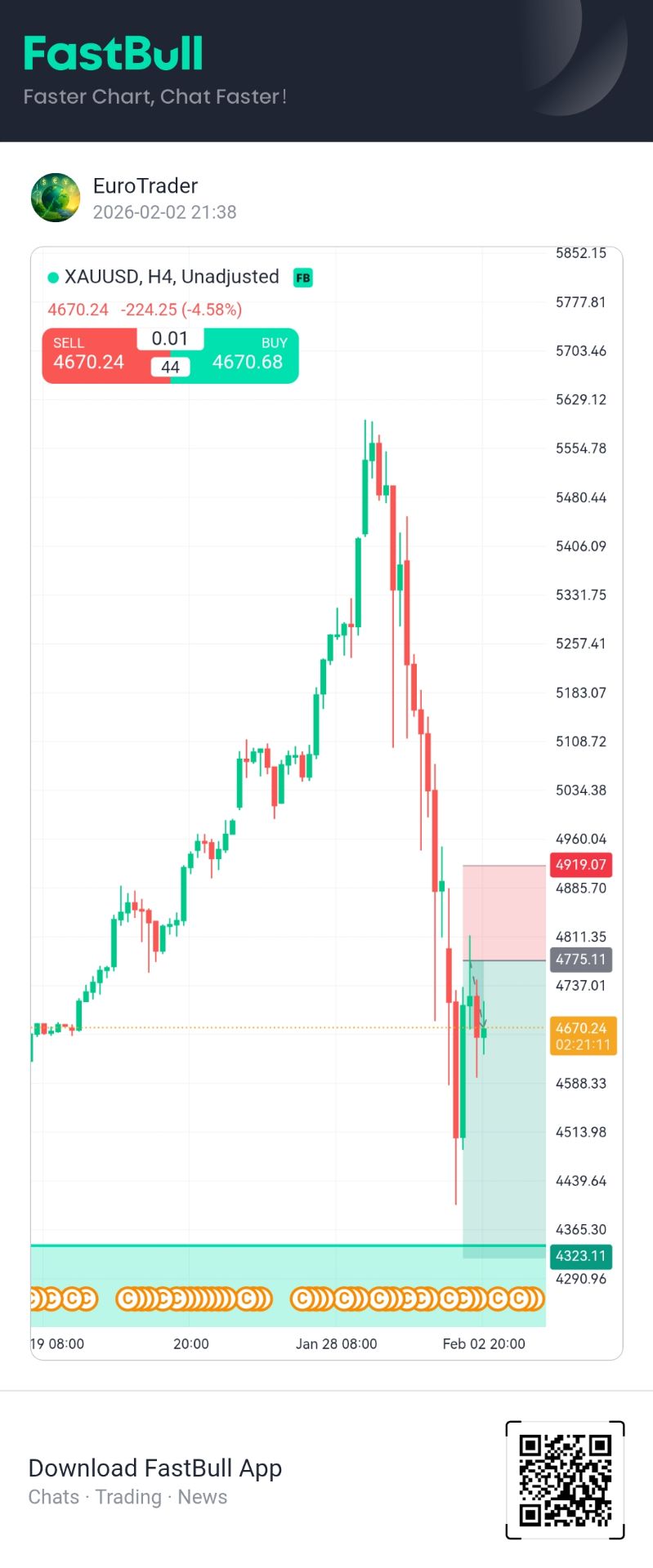
On Monday (February 2nd) In Late New York Trading, Spot Gold Fell 4.54% To $4671.58 Per Ounce, Remaining In A Downward Trend Throughout The Day. At 14:38 Beijing Time, It Had Fallen To $4402.95. On The Daily Chart, Gold Prices Have Fallen For Three Consecutive Trading Days, Approaching The December 31st Low Of $4319.37, And Briefly Breaking Below The 50-day Moving Average And Approaching The 100-day Moving Average (currently At $4483.43 And $4228.16 Respectively). Comex Gold Futures Fell 0.90% To $4702.60 Per Ounce, Also Briefly Falling To $4423.20 At 14:38
US President Trump, Speaking About The Justice Department's Investigation Into The Federal Reserve, Declared: "We'll See How It Goes."
U.S. Treasury Secretary Bessant: Federal Reserve Chairman Nominee Warsh Will Have A Great Start

China, Mainland NBS Non-manufacturing PMI (Jan)A:--
F: --
P: --
South Korea Trade Balance Prelim (Jan)A:--
F: --
Japan Manufacturing PMI Final (Jan)A:--
F: --
P: --
South Korea IHS Markit Manufacturing PMI (SA) (Jan)A:--
F: --
P: --
Indonesia IHS Markit Manufacturing PMI (Jan)A:--
F: --
P: --
China, Mainland Caixin Manufacturing PMI (SA) (Jan)A:--
F: --
P: --
Indonesia Trade Balance (Dec)A:--
F: --
P: --
Indonesia Inflation Rate YoY (Jan)A:--
F: --
P: --
Indonesia Core Inflation YoY (Jan)A:--
F: --
P: --
India HSBC Manufacturing PMI Final (Jan)A:--
F: --
P: --
Australia Commodity Price YoY (Jan)A:--
F: --
P: --
Russia IHS Markit Manufacturing PMI (Jan)A:--
F: --
P: --
Turkey Manufacturing PMI (Jan)A:--
F: --
P: --
U.K. Nationwide House Price Index MoM (Jan)A:--
F: --
P: --
U.K. Nationwide House Price Index YoY (Jan)A:--
F: --
P: --
Germany Actual Retail Sales MoM (Dec)A:--
F: --
Italy Manufacturing PMI (SA) (Jan)A:--
F: --
P: --
South Africa Manufacturing PMI (Jan)A:--
F: --
P: --
Euro Zone Manufacturing PMI Final (Jan)A:--
F: --
P: --
U.K. Manufacturing PMI Final (Jan)A:--
F: --
P: --
Turkey Trade Balance (Jan)A:--
F: --
P: --
Brazil IHS Markit Manufacturing PMI (Jan)A:--
F: --
P: --
Canada National Economic Confidence IndexA:--
F: --
P: --
Canada Manufacturing PMI (SA) (Jan)A:--
F: --
P: --
U.S. IHS Markit Manufacturing PMI Final (Jan)A:--
F: --
P: --
U.S. ISM Output Index (Jan)A:--
F: --
P: --
U.S. ISM Inventories Index (Jan)A:--
F: --
P: --
U.S. ISM Manufacturing Employment Index (Jan)A:--
F: --
P: --
U.S. ISM Manufacturing New Orders Index (Jan)A:--
F: --
P: --
U.S. ISM Manufacturing PMI (Jan)A:--
F: --
P: --
South Korea CPI YoY (Jan)--
F: --
P: --
Japan Monetary Base YoY (SA) (Jan)--
F: --
P: --
Australia Building Approval Total YoY (Dec)--
F: --
P: --
Australia Building Permits MoM (SA) (Dec)--
F: --
P: --
Australia Building Permits YoY (SA) (Dec)--
F: --
P: --
Australia Private Building Permits MoM (SA) (Dec)--
F: --
P: --
Australia Overnight (Borrowing) Key Rate--
F: --
P: --
RBA Rate Statement
Japan 10-Year Note Auction Yield--
F: --
P: --
Saudi Arabia IHS Markit Composite PMI (Jan)--
F: --
P: --
RBA Press Conference
Turkey PPI YoY (Jan)--
F: --
P: --
Turkey CPI YoY (Jan)--
F: --
P: --
Turkey CPI YoY (Excl. Energy, Food, Beverage, Tobacco & Gold) (Jan)--
F: --
P: --
U.S. Weekly Redbook Index YoY--
F: --
P: --
U.S. JOLTS Job Openings (SA) (Dec)--
F: --
P: --
Mexico Manufacturing PMI (Jan)--
F: --
P: --
U.S. API Weekly Refined Oil Stocks--
F: --
P: --
U.S. API Weekly Gasoline Stocks--
F: --
P: --
U.S. API Weekly Cushing Crude Oil Stocks--
F: --
P: --
U.S. API Weekly Crude Oil Stocks--
F: --
P: --
Japan IHS Markit Services PMI (Jan)--
F: --
P: --
Japan IHS Markit Composite PMI (Jan)--
F: --
P: --
China, Mainland Caixin Services PMI (Jan)--
F: --
P: --
China, Mainland Caixin Composite PMI (Jan)--
F: --
P: --
India HSBC Services PMI Final (Jan)--
F: --
P: --
India IHS Markit Composite PMI (Jan)--
F: --
P: --
Russia IHS Markit Services PMI (Jan)--
F: --
P: --
South Africa IHS Markit Composite PMI (SA) (Jan)--
F: --
P: --
Italy Services PMI (SA) (Jan)--
F: --
P: --
Italy Composite PMI (Jan)--
F: --
P: --


No matching data
Latest Views
Latest Views
Trending Topics
Top Columnists
Latest Update
White Label
Data API
Web Plug-ins
Affiliate Program
View All

No data
By Charles Passy
McDonald's is just one of a number of fast-food and fast-casual chains going the plus-size route with their burgers
The McDonald's Big Arch burger comes with two beef patties, three slices of white cheddar, lettuce, pickles, onions and something called Big Arch sauce, all on a poppy-and-sesame-seed bun.
Is the half pounder the new Quarter Pounder?
According to various accounts, McDonald's (MCD) is looking to introduce its meaty Big Arch burger in the U.S. in early March. Already a feature on McDonald's menus in other countries, the plus-size sandwich has two beef patties - reportedly weighing in at 8 ounces combined - along with three slices of white cheddar cheese, lettuce, pickles, onions and something called Big Arch sauce, all on a poppy-and-sesame-seed bun.
It adds up to 1,057 calories of burger feasting, per the British McDonald's website, which is more than three times the calorie count of the standard McDonald's cheeseburger (303 calories) and about double the count of a Big Mac (509 calories).
The bigger-burger story goes beyond McDonald's, with other fast-food and fast-casual chains rolling out their own hefty offerings of late. Carl's Jr., never a chain to shy away from meaty affairs, introduced its Cali XL burger, with two 3.5-ounce beef patties, in November. And Shake Shack (SHAK) rolled out a Big Shack burger, which has two 4-ounce beef patties, as a limited-time item last fall.
And even if Burger King (QSR) hasn't introduced any new supersize burgers recently, it does offer customers the option to up their Whopper game by making the sandwich a Double Whopper or even a Triple Whopper with added patties. The Triple version has a whopping 1,170 calories.
The idea is that even if a bigger burger costs more - the Big Shack, for example, was priced at $9.99 - the customer is getting plenty of bang for their buck. Call it a game of food psychology.
Americans have been obsessed with large portions for a long time, and some say this is even more pronounced when they are feeling the economic pinch: Think the current discussions surrounding affordability, as well as concerns about the high price of dining in restaurants.
"When you see a massive burger that is heavy in your hand, it feels like you are actually winning one over on the system," said Joel Thomas Blackstock, a clinical social worker and therapist who lives in Alabama.
Burger lovers are quick to say that more is, well, more when it comes to the American classic.
"A bigger burger is going to get the job done. It promises fullness," said Paul Whitten, a self-professed burger fanatic who runs a Nashville-based tour company.
From a restaurant's point of view, there's money to be made with these bigger burgers, despite the fact that beef prices have been increasing.
Stephen Zagor, a restaurant-industry consultant who teaches at Columbia University's business school, says that's partly because the fixed costs for a restaurant - everything from labor to the electric bill - are the same no matter how many patties are on a burger. So there's generally good profit in adding extra beef, since the only add-on cost to the restaurant is the patty itself, and that can be passed on to the consumer.
Burgers have never been a huge profit center for fast-food chains in the first place, Zagor noted. "They make their real money on french fries and drinks," he said. Ultimately, if a bigger sandwich gets customers in the door - and those diners complement their purchase with a side of fries and a beverage - then it all works out to a restaurant's advantage, he said.
Those are points echoed by Mark Kalinowski, a veteran fast-food industry analyst. He's especially bullish on the Big Arch's prospects, saying he thinks the burger could become a McDonald's mainstay and one of its billion-dollar-selling menu items. He also doesn't think the Big Arch will significantly cannibalize sales of other popular burgers, such as the Quarter Pounder and Big Mac.
"This should do very well for them," Kalinowski said of the Big Arch, adding that he's heard from sources that it will be available in the U.S. starting March 3.
McDonald's told MarketWatch it didn't have any updates to share about a Big Arch launch in the U.S., but it noted the burger had been introduced in a number of international markets last year, including Germany, Portugal, France, Switzerland and the U.K.
Not that anyone is pretending bigger burgers are exactly healthier burgers. Granted, they do pack more protein - and protein has become a dietary focus of late, as evidenced by new recommendations from the Department of Health and Human Services under Robert F. Kennedy Jr.
Read more: The new food pyramid and brands like Starbucks and Chipotle want us to eat more protein. We're already getting plenty.
But bigger burgers also come with more calories, fat and sodium, dietary experts note. The Big Arch's 1,057 calories, for example, can be close to half, or even more than half, what's often suggested for a total day's caloric intake.
Does that mean you can't ever indulge in a Big Arch or another bigger burger? Not necessarily, says Kezia Joy, a registered dietitian, nutritionist and medical adviser at Welzo, a healthcare platform.
"If you want to fit oversized burgers into your healthy eating plan, enjoy them every now and then, and make sure to pair them with other good choices," she said.
In short, have your bigger burger, but opt for water instead of soda, Joy said. Oh, and skip the fries.
-Charles Passy
This content was created by MarketWatch, which is operated by Dow Jones & Co. MarketWatch is published independently from Dow Jones Newswires and The Wall Street Journal.
White Label
Data API
Web Plug-ins
Poster Maker
Affiliate Program
The risk of loss in trading financial instruments such as stocks, FX, commodities, futures, bonds, ETFs and crypto can be substantial. You may sustain a total loss of the funds that you deposit with your broker. Therefore, you should carefully consider whether such trading is suitable for you in light of your circumstances and financial resources.
No decision to invest should be made without thoroughly conducting due diligence by yourself or consulting with your financial advisors. Our web content might not suit you since we don't know your financial conditions and investment needs. Our financial information might have latency or contain inaccuracy, so you should be fully responsible for any of your trading and investment decisions. The company will not be responsible for your capital loss.
Without getting permission from the website, you are not allowed to copy the website's graphics, texts, or trademarks. Intellectual property rights in the content or data incorporated into this website belong to its providers and exchange merchants.
Not Logged In
Log in to access more features
Log In
Sign Up