


- USDCAD
- XAUUSD
- XAGUSD
- WTI
- USDX


Markets
Analysis
User
24/7
Economic Calendar
Education
Data
- Names
- Latest
- Prev






A practical beginner's overview of day trading, covering how to get started, choose a broker, practice strategies, understand account requirements, and manage risk.
Learning how to start day trading can feel overwhelming if you have never traded before. Break the process into steps: learn how markets work, choose a broker, practice with a simulator, and set rules for entering and exiting trades. Focus on building skills before trying to make quick profits.
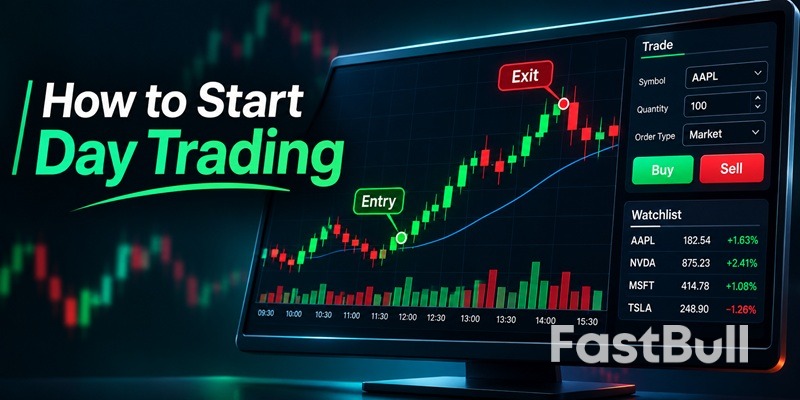
Day trading means buying and selling an asset within the same trading day to profit from short-term price movements. Traders may buy a stock and sell it later, or short-sell it and buy it back after a decline. Most close positions before the market closes.
Day trading focuses on short-term price changes. Prices can move quickly, orders may execute at unexpected prices, and frequent trades add costs. Losses can accumulate quickly, especially with leverage.
Markets include stocks, exchange-traded funds (ETFs), options, futures, forex, and cryptocurrencies. Stocks and ETFs are often more straightforward for beginners; options and futures add contract and leverage risks. Forex and crypto have different hours and regulatory protections. Learn one market first: FINRA's U.S. stock margin rules do not cover every product.
You do not need previous experience to start learning, but placing live trades before understanding the basics can lead to avoidable losses. Use these steps to build a process before committing significant money.
Start with the concepts that affect a trade's price and execution:
Learn basic charts, support, and resistance before adding complex indicators.
Choose the market you want to trade, then compare brokers that offer access to it. For U.S. stocks and ETFs, review:
Look beyond zero commissions or leverage: check minimum deposits, product access, margin terms, and fractional-share rules.
A market order tells the broker to buy or sell at the best available price. It usually prioritizes execution, but the final price is not guaranteed. A limit order sets the worst price you will accept: a buy limit executes only at the limit price or lower, while a sell limit executes only at the limit price or higher. A limit order may not fill.
If a stock is near $50, a market buy may fill above that price. A $50 buy limit will not pay more, but may remain unfilled. Learn how your broker handles partial fills and cancellations.
Pick one setup to study rather than switching strategies after every losing trade. Define the entry signal, the condition that would invalidate the setup, and the maximum loss you will accept. The common beginner approaches are explained below.
Use a paper trading account to place simulated trades without risking real money. Practice reading charts, entering orders, and following your rules in different market conditions. Keep a journal of each trade, including your reason for entering, planned exit, and result.
Paper trading cannot reproduce the emotions or fills of live trading. Treat it as practice, not proof of future profits.
When you can follow your plan consistently in simulation, consider starting with a small live position using money you can afford to lose. Before the session, prepare a watchlist and identify valid setups. During trading, avoid chasing sudden moves. After the session, review your decisions and record what you would repeat or change.
Consistency matters more than trade count. If you cannot explain your entry and exit, wait.
Your starting amount depends on the market, broker minimums, account type, and use of borrowed funds. A small account can limit position size and make fees more significant.
It may be possible to begin with $20 or $100 if your broker supports small or fractional-share orders and permits intraday trading in them. However, a small balance leaves little room for losses and may not meet a broker's account or product requirements. A 2% gain on $100 is just $2 before costs; a 2% loss also removes $2.
Treat a very small account as a way to learn live order execution, not as an income source. Check whether your platform allows fractional shares to be traded intraday.
Calculate costs first; they can turn an apparently profitable strategy into a losing one.
A cash account requires you to pay for securities in full and does not let you borrow from the broker. You must use settled funds and follow cash-account payment rules. Most U.S. stock trades settle on T+1, or one business day after the trade. Selling a position does not make the proceeds settled immediately; using unsettled proceeds improperly can trigger a good-faith or freeriding violation and account restrictions. See the SEC's T+1 settlement explanation.
A margin account lets you borrow from the broker, but leverage can magnify losses and lead to margin calls or forced sales. As of November 2026, FINRA's new intraday margin standards have taken effect, replacing the pattern day trader designation and its $25,000 minimum equity requirement for covered U.S. securities margin accounts. Firms may phase in the new standards through October 20, 2027, so some brokers may still apply the old requirements during the transition.
The new framework removes the $25,000 PDT minimum, but ordinary margin requirements remain. A separate $2,000 minimum equity generally applies to borrowing on margin, and firms may require more. Read FINRA's explanation of the new intraday margin requirements.
These FINRA standards apply to securities margin accounts, not all futures, forex, or crypto products. Ask your broker which rules and minimums currently apply.
No strategy works in every market. Test one setup at a time and learn when it can fail.
Momentum trading focuses on an asset moving strongly in one direction, often with higher-than-usual volume or a market catalyst. The main risk is entering after much of the move has happened, just before a reversal.
Breakout traders watch for a price to move above resistance or below support. Higher volume may add confirmation, but breakouts can fail and return to the previous range. Decide in advance what would invalidate the trade.
Pullback traders look for a temporary move against an established trend, then wait for signs that the original direction is resuming. Entering too early can mean buying into a deeper decline or selling into a continuing rally.
Risk management cannot guarantee profits, but it can limit the impact of mistakes. Set your limits before entering.
A stop-loss order is intended to close a position when the market reaches a chosen price. It helps enforce an exit plan, but does not guarantee the execution price. In a fast market or after a price gap, the fill may be worse than the stop price.
Set the amount you are willing to lose, then calculate position size from the distance between your entry and stop price. If you are willing to risk $5 and your stop is $0.50 below your entry, a 10-share position represents $5 of planned price risk before fees and slippage. If the stop needs to be farther away, reduce the share count rather than increase the planned loss.
Choose a maximum loss for the session. If you reach it, stop trading and review what happened. This can prevent frustration after one loss from turning into a series of impulsive trades.
Borrowed funds increase buying power but also magnify losses. Understand margin requirements before using leverage. Do not chase price spikes, double down to recover losses, or abandon a plan because of fear or excitement.
Day trading requires learning, practice, and risk control. Build a routine, review trades, and increase exposure only when you can follow your rules. Protect capital before pursuing profits.

728 RM B 7/F GEE LOK IND BLDG NO 34 HUNG TO RD KWUN TONG KLN HONG KONG


The risk of loss in trading financial instruments such as stocks, FX, commodities, futures, bonds, ETFs and crypto can be substantial. You may sustain a total loss of the funds that you deposit with your broker. Therefore, you should carefully consider whether such trading is suitable for you in light of your circumstances and financial resources.
No decision to invest should be made without thoroughly conducting due diligence by yourself or consulting with your financial advisors. Our web content might not suit you since we don't know your financial conditions and investment needs. Our financial information might have latency or contain inaccuracy, so you should be fully responsible for any of your trading and investment decisions. The company will not be responsible for your capital loss.
Without getting permission from the website, you are not allowed to copy the website's graphics, texts, or trademarks. Intellectual property rights in the content or data incorporated into this website belong to its providers and exchange merchants.
Not Logged In
Log in to access more features


Log In
Sign Up