Markets
News
Analysis
User
24/7
Economic Calendar
Education
Data
- Names
- Latest
- Prev


Signal Accounts for Members
All Signal Accounts
All Contests


Turkey Retail Sales YoY (Oct)A:--
F: --
P: --
South Africa Mining Output YoY (Oct)A:--
F: --
P: --
South Africa Gold Production YoY (Oct)A:--
F: --
P: --
Italy Quarterly Unemployment Rate (SA) (Q3)A:--
F: --
P: --
IEA Oil Market Report
Turkey 1-Week Repo RateA:--
F: --
P: --
South Africa Refinitiv/Ipsos Primary Consumer Sentiment Index (PCSI) (Dec)A:--
F: --
P: --
Turkey Overnight Lending Rate (O/N) (Dec)A:--
F: --
P: --
Turkey Late Liquidity Window Rate (LON) (Dec)A:--
F: --
P: --
U.K. Refinitiv/Ipsos Primary Consumer Sentiment Index (PCSI) (Dec)A:--
F: --
P: --
Brazil Retail Sales MoM (Oct)A:--
F: --
P: --
U.S. Weekly Continued Jobless Claims (SA)A:--
F: --
U.S. Exports (Sept)A:--
F: --
P: --
U.S. Trade Balance (Sept)A:--
F: --
U.S. Weekly Initial Jobless Claims (SA)A:--
F: --
Canada Imports (SA) (Sept)A:--
F: --
U.S. Initial Jobless Claims 4-Week Avg. (SA)A:--
F: --
P: --
Canada Trade Balance (SA) (Sept)A:--
F: --
Canada Exports (SA) (Sept)A:--
F: --
U.S. Wholesale Sales MoM (SA) (Sept)A:--
F: --
U.S. EIA Weekly Natural Gas Stocks ChangeA:--
F: --
P: --
China, Mainland M1 Money Supply YoY (Nov)--
F: --
P: --
China, Mainland M0 Money Supply YoY (Nov)--
F: --
P: --
China, Mainland M2 Money Supply YoY (Nov)--
F: --
P: --
U.S. 30-Year Bond Auction Avg. YieldA:--
F: --
P: --
Argentina CPI MoM (Nov)A:--
F: --
P: --
Argentina National CPI YoY (Nov)A:--
F: --
P: --
Argentina 12-Month CPI (Nov)A:--
F: --
P: --
U.S. Weekly Treasuries Held by Foreign Central BanksA:--
F: --
P: --
Japan Industrial Output Final MoM (Oct)A:--
F: --
P: --
Japan Industrial Output Final YoY (Oct)A:--
F: --
P: --
U.K. Services Index MoM (SA) (Oct)--
F: --
P: --
U.K. Services Index YoY (Oct)--
F: --
P: --
Germany HICP Final YoY (Nov)--
F: --
P: --
Germany HICP Final MoM (Nov)--
F: --
P: --
U.K. Trade Balance Non-EU (SA) (Oct)--
F: --
P: --
U.K. Trade Balance (Oct)--
F: --
P: --
U.K. Services Index MoM--
F: --
P: --
U.K. Construction Output MoM (SA) (Oct)--
F: --
P: --
U.K. Industrial Output YoY (Oct)--
F: --
P: --
U.K. Trade Balance (SA) (Oct)--
F: --
P: --
U.K. Trade Balance EU (SA) (Oct)--
F: --
P: --
U.K. Manufacturing Output YoY (Oct)--
F: --
P: --
U.K. GDP MoM (Oct)--
F: --
P: --
U.K. GDP YoY (SA) (Oct)--
F: --
P: --
U.K. Industrial Output MoM (Oct)--
F: --
P: --
U.K. Manufacturing Output MoM (Oct)--
F: --
P: --
U.K. Monthly GDP 3M/3M Change (Oct)--
F: --
P: --
Germany CPI Final MoM (Nov)--
F: --
P: --
Germany CPI Final YoY (Nov)--
F: --
P: --
U.K. Construction Output YoY (Oct)--
F: --
P: --
France HICP Final MoM (Nov)--
F: --
P: --
China, Mainland Outstanding Loans Growth YoY (Nov)--
F: --
P: --
U.K. Inflation Rate Expectations--
F: --
P: --
India CPI YoY (Nov)--
F: --
P: --
India Deposit Gowth YoY--
F: --
P: --
Brazil Services Growth YoY (Oct)--
F: --
P: --
Mexico Industrial Output YoY (Oct)--
F: --
P: --
Germany Current Account (Not SA) (Oct)--
F: --
P: --
Russia Trade Balance (Oct)--
F: --
P: --


No matching data
Latest Views
Latest Views
Trending Topics
Top Columnists
Latest Update
White Label
Data API
Web Plug-ins
Affiliate Program
View All

No data
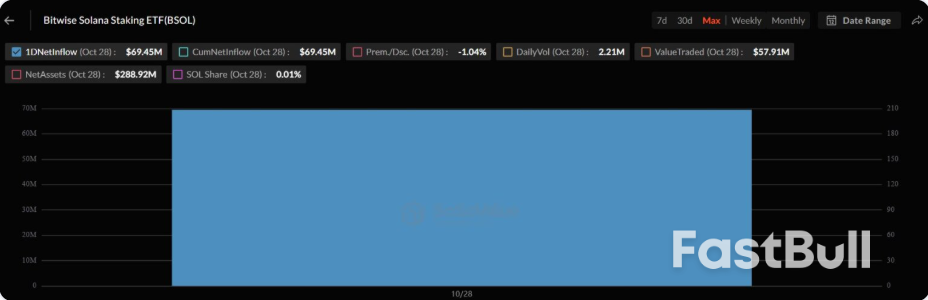
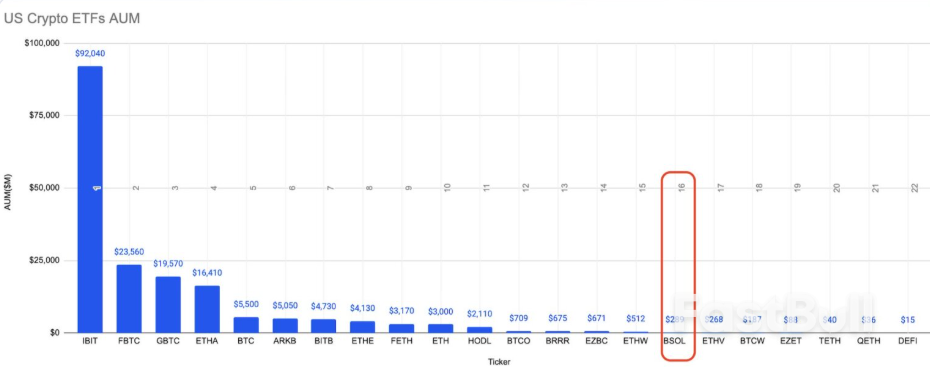
On Oct. 28, Bitwise’s Solana Staking ETF (BSOL) debuted with $69 million in first-day inflows, the strongest launch among roughly 850 ETFs introduced this year, according to SosoValue data.
In our preview we said that the Fed would cut 25bps and end QT... and that's precisely what happened.
First, a quick preview of how we got here:
Since the last FOMC meeting (on Sept 17th), Gold has dramatically outperformed across asset-classes (even with its recent plunge) followed by US equities. Oil prices have tumbled the most while the dollar and bonds have risen in value. Bitcoin is basically unchanged since the last FOMC meeting, having collapsed after reaching record highs intramonth...

The market has grown more dovish since the last Fed meeting, now fully pricing in a 25bps cut today (and is almost certain that December will see another 25bps cut)...

More notably, rate-cut expectations have barely changed since the last FOMC with 46bps of cuts priced in for 2025 and 69bps more priced in for 2026...

Finally, before we get to the meat and potatoes of today's statement, we note that Goldman Sachs models show monetary policy at its most dovish in years...

And bear in mind that financial conditions have never been 'easier'...

So as we detailed in the FOMC preview, the two main questions for traders today is:
1) will the statement/presser provide support for the market's current dovish future take (given the market's anticipation of a 25bps cut, Goldman notes that it would likely be a high bar for the FOMC to change its plan on the basis of alternative data, and in any case the data have not given them any reason to), and,
2) will Powell officially announce the end of QT, as we discussed extensively in recent weeks (here and here), as a result of deteriorating conditions in money markets, the Fed is expected to announce changes to its balance sheet program. Fed Chair Powell suggested that the level of reserves will likely hit an ample level within a couple of months, although as we highlighted, the combination of reserves and reverse repos is now the lowest it has been since 2020 resulting in a creeping increase in the SOFR rate.
Meanwhile, usage of the Fedʼs repo facility has picked up, suggesting that some participants may be growing tighter on cash.

With that in mind, here are the key headlines from the FOMC Statement:

The Federal Reserve is expected to cut interest rates on Wednesday, and wealthy U.S. households may benefit most.
The federal funds rate is the interest rate at which banks borrow and lend to one another overnight. A quarter-point reduction would bring the benchmark rate to a range between 3.75%-4.00%. It could fall to 3.1% by the end of 2027, according to a September forecast from the Federal Open Market Committee.
"That really sets the floor for all other interest rates," said Michael Wagner, co-founder of Omnia Family Wealth in Aventura, Florida. "We ultimately start earning less money on cash, which makes it less attractive versus other investments."
Reductions in the fed funds rate typically set off a chain reaction throughout the economy.
For example, cash held in high-yield savings accounts typically earns less money soon after a reduction in the federal funds rate. The change in short-term interest rates can also potentially lead to cheaper terms on longer-term loans, such as mortgages.
Lower interest rates can speed up economic growth and lead to an increase in hiring, experts say. But they are also associated with rising levels of wealth inequality.
"The Fed's easing cycle could unintentionally widen the generational wealth gap, lifting the net worth of retirees, baby boomers," said Kathryn Rooney Vera, a chief market strategist at StoneX Group.
That's because asset price booms tend to follow Fed rate cuts, and older, wealthier consumers — who own more stocks — disproportionately benefit from those market gains. Meanwhile, younger and less advantaged households with more of their assets in cash may see their returns diminish.
The top 0.1% wealthiest households own over $23 trillion in financial assets as of the second quarter of 2025, according to Federal Reserve data. That's a 91.2% increase from the $12.32 trillion recorded in the first quarter of 2020.
By contrast, the bottom half of the U.S. population holds about $10 trillion in assets. That's a 46.6% increase from the start of 2020, when this segment held just $6.93 trillion in assets.
White Label
Data API
Web Plug-ins
Poster Maker
Affiliate Program
The risk of loss in trading financial instruments such as stocks, FX, commodities, futures, bonds, ETFs and crypto can be substantial. You may sustain a total loss of the funds that you deposit with your broker. Therefore, you should carefully consider whether such trading is suitable for you in light of your circumstances and financial resources.
No decision to invest should be made without thoroughly conducting due diligence by yourself or consulting with your financial advisors. Our web content might not suit you since we don't know your financial conditions and investment needs. Our financial information might have latency or contain inaccuracy, so you should be fully responsible for any of your trading and investment decisions. The company will not be responsible for your capital loss.
Without getting permission from the website, you are not allowed to copy the website's graphics, texts, or trademarks. Intellectual property rights in the content or data incorporated into this website belong to its providers and exchange merchants.
Not Logged In
Log in to access more features

FastBull Membership
Not yet
Purchase
Log In
Sign Up