





- XAUUSD
- XAGUSD
- WTI
- USDX













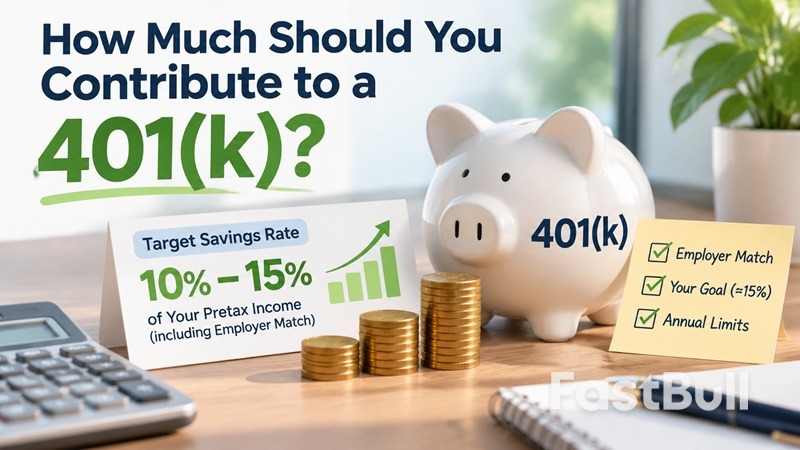
How much should you contribute to a 401(k)? A practical starting point is to contribute enough to receive your full employer match, then work toward saving about 15% of your pretax income for retirement, including employer contributions. Your target depends on your age, current savings, income, and retirement goals.
What Percentage of Your Salary Should You Contribute to a 401(k)?
A common benchmark is to save 15% of your pretax income for retirement each year, counting both your own contributions and any employer match. That does not mean you must put 15% of your salary into your 401(k) yourself. Your personal contribution can be lower if your employer adds money or if you also save in an IRA.
Start by Getting the Full Employer Match
If your employer matches 401(k) contributions, try to contribute enough to receive the full match, provided your budget allows. Otherwise, you may leave part of your compensation benefit unused.
For example, assume you earn $80,000 and your employer matches 50% of your contributions up to 6% of your salary.
| Contribution | Your Annual Contribution | Employer Match |
|---|---|---|
| 3% | $2,400 | $1,200 |
| 6% | $4,800 | $2,400 |
| 8% | $6,400 | $2,400 |
At a 6% contribution rate, you receive the maximum match of $2,400. Raising your contribution to 8% adds another $1,600 of your own money, but does not increase the employer match in this example.
Check your plan's matching formula and vesting schedule. A vesting schedule determines when employer contributions become yours to keep.
Work Toward a 15% Retirement Savings Rate
Fidelity's retirement savings guideline recommends saving at least 15% of pretax income for retirement, including employer contributions. This is a target to work toward, not a rule that fits everyone. The 15% can include money you put into an IRA; it does not all need to go into your 401(k).
For example, if you earn $80,000, 15% equals $12,000 per year. If your employer contributes $2,400 through a match, you would need to save another $9,600 yourself across your retirement accounts to reach that target.
What If You Can't Afford to Contribute That Much?
You do not have to reach 15% immediately. Start with an amount you can maintain, then increase it when your budget improves. If possible, capture the full employer match first. You can also raise your contribution by one percentage point after a pay increase and use automatic payroll deductions to keep saving consistently.
How to Calculate Your 401(k) Contribution
Most 401(k) contributions are calculated as a percentage of eligible pay. To estimate your annual contribution, multiply your salary by your contribution rate.
Annual Employee Contribution = Annual Salary × Contribution Rate
For example, if you earn $80,000 and contribute 8%, you would save $6,400 per year. If you are paid every two weeks, or 26 times a year, that works out to about $246.15 per paycheck.
Calculate Your Contribution Based on Your Salary
The table shows how different contribution rates affect savings on an $80,000 salary. It assumes 26 paychecks per year and does not include employer matching.
| Contribution Rate | Annual Contribution | Biweekly Contribution |
|---|---|---|
| 3% | $2,400 | $92.31 |
| 5% | $4,000 | $153.85 |
| 8% | $6,400 | $246.15 |
| 10% | $8,000 | $307.69 |
| 12% | $9,600 | $369.23 |
| 15% | $12,000 | $461.54 |
Your actual take-home pay will depend on whether you use a traditional or Roth 401(k), your tax situation, and how your plan calculates eligible compensation.
Estimate Your Contribution Per Paycheck
Use the calculator to estimate your employee contribution, amount per paycheck, employer match, and combined annual contributions. It assumes a flat employer match percentage up to the salary percentage you enter. Some plans use tiered formulas, so check your plan documents for an exact match calculation.
401(k) Contribution Calculator
Annual Employee Contribution: $6,400.00
Contribution Per Paycheck: $246.15
Estimated Annual Employer Match: $2,400.00
Total Annual Contributions: $8,800.00
Note: This calculator provides estimates and does not account for IRS contribution limits, vesting schedules, tiered employer matching formulas, or payroll rounding.
How Should Your 401(k) Contribution Change With Age and Income?
The right contribution rate depends partly on how long your savings have to grow and how much you have already accumulated. Someone who starts in their 20s has more time to invest than someone who begins in their 40s or 50s.
Starting Early vs. Catching Up Later
Starting early gives contributions more time to benefit from compounding. If you begin in your 20s or early 30s, working toward a 15% retirement savings rate, including employer contributions, can be a useful benchmark.
If you start later, you may need to save a larger share of your income, work longer, or adjust your retirement spending expectations. Workers aged 50 and older may also be eligible for catch-up contributions, subject to plan rules and annual IRS limits.
Adjusting Contributions Based on Your Retirement Goals
Income affects the dollar amount you save. A 10% contribution from a $60,000 salary is $6,000 a year; the same rate on a $100,000 salary is $10,000. But income alone does not determine whether you are on track. Consider your current retirement balance, planned retirement age, expected expenses, and other income sources such as Social Security, a pension, an IRA, or taxable investments.
What Are the 401(k) Contribution Limits for 2026 and 2027?
The IRS sets annual limits on employee 401(k) contributions and on total additions to a defined contribution plan. The 2027 limits were announced in November 2026.
Employee Contribution Limits and Catch-Up Contributions
For 2026, employees can defer up to $24,500 into traditional and Roth 401(k) accounts combined. For 2027, the limit increases to $25,500. Employees aged 50 or older may be able to contribute an additional catch-up amount if their plan permits it.
| Age Group | 2026 Employee Limit | 2027 Employee Limit |
|---|---|---|
| Under 50 | $24,500 | $25,500 |
| 50–59 and 64+ | $32,500 | $34,000 |
| Ages 60–63 | $35,750 | $37,250 |
The age 60–63 limit includes the higher catch-up amount instead of the standard catch-up; it is not added on top of it. Traditional and Roth 401(k) salary deferrals share the same employee limit. If you participate in more than one 401(k) or 403(b) plan during the year, your employee deferrals generally count toward the same annual limit.
How Employer Contributions Affect the Annual Limit
Employer matching and nonelective contributions do not count toward the regular employee deferral limit, but they do count toward the overall annual additions limit.
For most defined contribution plans, that limit is the lesser of 100% of eligible compensation or:
| Tax Year | Overall Annual Additions Limit |
|---|---|
| 2026 | $72,000 |
| 2027 | $75,000 |
Catch-up contributions that qualify under IRS rules are generally excluded from this overall limit. Check your plan rules before trying to maximize contributions. Your employer may impose plan-specific restrictions, and the plan must permit catch-up contributions.
For the official figures, see the IRS announcement of the 2027 contribution limits and IRS Notice 2026-66.
Should You Increase or Max Out Your 401(k)?
Maxing out your 401(k) can help build retirement savings faster, but it is not automatically the best choice for every household. Consider your income, cash reserves, debt, employer benefits, and other financial goals before increasing contributions.
When It Makes Sense to Increase Your Contributions
Increasing contributions can make sense when your salary rises, essential expenses are covered, and you have enough emergency savings. You may also want to increase your rate if you are behind on your retirement target or want to make full use of the annual limit.
A practical approach is to raise your contribution gradually rather than making a large change that strains your monthly budget. Check how much you have already contributed during the year so you do not accidentally exceed the applicable limit.
When Other Financial Priorities Come First
If you have no emergency savings or carry high-interest credit card debt, putting every available dollar into your 401(k) may not be sensible. Consider keeping cash for unexpected expenses and paying down expensive debt while contributing enough to receive the full employer match when possible.
You do not have to choose one goal exclusively. A balanced plan can maintain retirement contributions while improving your short-term financial stability.
Is a 401(k) Enough for Retirement?
A 401(k) can be a major source of retirement income, but whether it is enough depends on your savings rate, investment performance, retirement age, and spending needs. Many people combine a 401(k) with Social Security, an IRA, a pension, or other investments.
Review your savings and contribution rate regularly, especially after a salary change or major life event. The goal is to build enough resources to support the retirement lifestyle you expect, not simply to hit the maximum contribution limit every year.


