


- XAUUSD
- XAGUSD
- WTI
- USDX



Markets
Analysis
User
24/7
Economic Calendar
Education
Data
- Names
- Latest
- Prev










Find out how inflation affects interest rates, why the Fed raises or cuts rates, and what changing rates mean for savings accounts, mortgages, and loans.
Inflation and interest rates are closely connected, but they do not always move in the same direction. When prices rise persistently, central banks may increase interest rates to slow spending and ease price pressures. These changes affect borrowing costs, savings returns, and the wider economy.
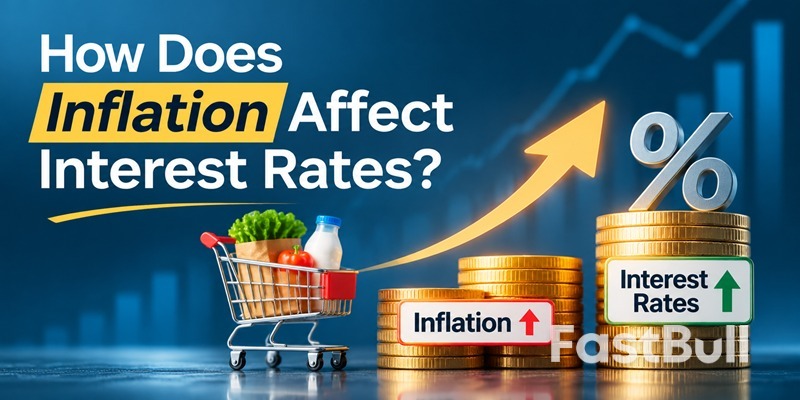
When inflation stays high, the Federal Reserve may raise its benchmark interest rate to slow demand and bring price increases under control. Higher rates make borrowing more expensive, which can reduce consumer spending and business investment. However, the Fed does not raise rates automatically whenever prices rise. It considers the causes of inflation, employment, economic growth, and expectations for future prices.
Persistent inflation reduces the purchasing power of money. To keep price increases from becoming entrenched, the Federal Reserve may raise its target range for the federal funds rate, the rate banks charge one another for overnight borrowing.
Higher policy rates generally pass through to other borrowing rates. Mortgages, auto loans, credit cards, and business financing can become more expensive, although the size and timing of the change vary by product. When households and businesses borrow and spend less, overall demand can cool. Businesses may then have less room to keep raising prices.
The effect depends partly on what is driving inflation. Higher rates can reduce demand-driven price pressure, but they cannot quickly fix supply shortages, an oil-price shock, or disrupted production. That is one reason the Fed looks beyond a single inflation report before changing policy.
When inflation slows, the Fed may eventually cut interest rates, particularly if economic growth and hiring are also weakening. Lower rates can support borrowing, spending, and investment. But falling inflation does not guarantee an immediate rate cut.
Inflation falling from 5% to 3% means prices are still rising, just more slowly. It is not the same as prices falling. The Fed may keep rates high while it checks whether inflation is moving sustainably toward its 2% longer-run goal, measured using the personal consumption expenditures (PCE) price index.
The relationship also works in the opposite direction. While inflation can influence interest rate decisions, interest rates affect future inflation by changing the cost of borrowing and the amount households and businesses are willing to spend.
When the Fed raises rates, borrowing generally becomes more expensive. A household may postpone buying a car or taking out a mortgage, while a business may delay expansion or equipment purchases. Slower spending can reduce demand for goods and services, easing pressure on prices.
Higher rates can also affect hiring and wages as businesses respond to weaker demand. The goal is not necessarily to make prices fall, but to slow the pace at which they rise.
This process takes time. Existing loans, wage agreements, spending plans, and business decisions do not change overnight, so the full effect of monetary policy can take months or longer to appear.
Lower rates make borrowing more affordable. Households may be more willing to finance homes, cars, and other purchases, while businesses may borrow to expand, invest, and hire. If total demand grows faster than the economy's ability to supply goods and services, businesses may raise prices.
However, rate cuts do not automatically cause inflation. If consumers remain cautious, businesses have spare capacity, or the economy is weak, lower rates may support activity without creating excessive price pressure.
Inflation and interest rates often move in the same direction over time, but the relationship is not fixed. The policy rate, market interest rates, and inflation expectations can move at different speeds. This explains why the two sometimes appear to move in opposite directions.
A nominal interest rate is the stated rate on a loan or savings account. A real interest rate adjusts that rate for inflation and gives a better indication of the change in purchasing power.
Approximate real interest rate = Nominal interest rate − Inflation rate
For example, if a savings account pays 5% and inflation is 3%, the real return is about 2% before taxes. The account balance grows by 5%, but its purchasing power increases by less.
Expected inflation matters when lenders and borrowers agree on a rate. Actual inflation can then be used to calculate the realized real return or borrowing cost. The exact calculation also accounts for compounding, so subtracting inflation is an approximation.
Several situations can cause the two to diverge:
Market rates also reflect expected growth, demand for bonds, and risk—not just current inflation. That is why mortgage rates and Treasury yields do not always follow the federal funds rate one-for-one.
A useful U.S. comparison plots the 12-month change in the Consumer Price Index (CPI) against the effective federal funds rate. The two series show how inflation and the Fed's policy stance have changed over time, but their turning points do not always match.
For example, CPI inflation reached 9.1% year over year in June 2022. The Fed had begun raising its target range in March 2022 and lifted it to 5.25%–5.50% in July 2023, after inflation had moved down from its peak. This illustrates why interest rates can continue rising after inflation starts to cool.
Use a chart with both series shown as percentages and check the date range and measurement frequency. The FRED inflation and federal funds rate chart provides a historical comparison. The chart shows correlation and timing, not proof that one line directly causes every movement in the other.
Inflation reduces the purchasing power of money, while interest rate changes affect what savers earn and borrowers pay. The impact depends on the account or loan, whether its rate is fixed or variable, and how quickly banks adjust their rates.
If a savings account pays less than the inflation rate, the money in it loses purchasing power even though the account balance grows. For example, a 2% savings rate with 4% inflation produces an approximate real return of -2% before taxes.
Banks may raise deposit rates when market rates increase, but savings rates do not necessarily move by the same amount or at the same time as the Fed's policy rate. Banks also consider competition for deposits and their own funding needs. Savers should compare the account's APY with inflation and taxes to understand the return in purchasing-power terms.
Inflation can contribute to higher borrowing costs, but different loans respond to interest rate changes in different ways:
An existing fixed-rate mortgage generally keeps the same contractual interest rate and principal-and-interest payment even when inflation or market rates rise. New borrowers, however, may face higher monthly payments if loan rates increase.
Inflation and interest rates influence each other through monetary policy, market expectations, and purchasing power. Knowing the difference between nominal and real rates helps savers assess returns and borrowers understand the cost of debt.

728 RM B 7/F GEE LOK IND BLDG NO 34 HUNG TO RD KWUN TONG KLN HONG KONG


The risk of loss in trading financial instruments such as stocks, FX, commodities, futures, bonds, ETFs and crypto can be substantial. You may sustain a total loss of the funds that you deposit with your broker. Therefore, you should carefully consider whether such trading is suitable for you in light of your circumstances and financial resources.
No decision to invest should be made without thoroughly conducting due diligence by yourself or consulting with your financial advisors. Our web content might not suit you since we don't know your financial conditions and investment needs. Our financial information might have latency or contain inaccuracy, so you should be fully responsible for any of your trading and investment decisions. The company will not be responsible for your capital loss.
Without getting permission from the website, you are not allowed to copy the website's graphics, texts, or trademarks. Intellectual property rights in the content or data incorporated into this website belong to its providers and exchange merchants.
Not Logged In
Log in to access more features


Log In
Sign Up


