


- USDCAD
- XAUUSD
- XAGUSD
- WTI
- USDX



Markets
Analysis
User
24/7
Economic Calendar
Education
Data
- Names
- Latest
- Prev








What is a good faith violation? Learn how unsettled funds trigger GFVs, see stock and options examples, compare broker penalties, and avoid 90-day trading restrictions.
A good faith violation (GFV) occurs when you buy a security in a cash brokerage account using unsettled sale proceeds and sell it before those funds settle. Repeated violations can restrict your trading activity. Understanding settlement dates, cash account rules, and broker-specific policies can help you avoid unnecessary restrictions.
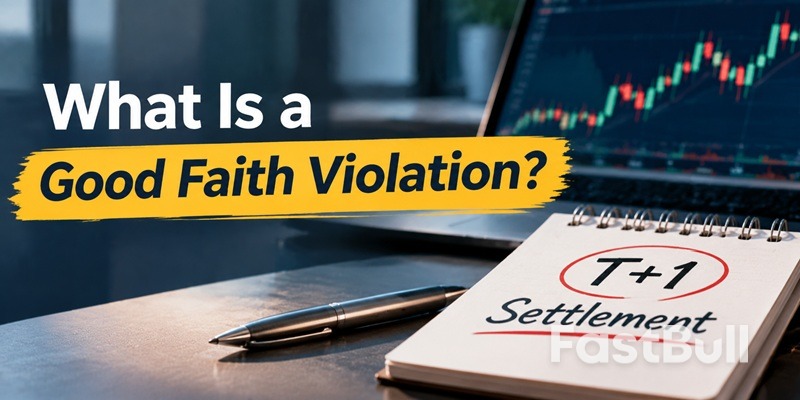
A good faith violation (GFV) happens when you sell a security before paying for its purchase with settled funds. It primarily affects cash brokerage accounts, where investors must pay for securities in full rather than borrow money from their broker.
For example, suppose you sell Stock A and use the proceeds to buy Stock B before the sale of Stock A has settled. If you sell Stock B before the original sale proceeds become settled cash, you may trigger a GFV.
Buying a security with unsettled funds is not automatically a violation. The problem occurs when you sell the newly purchased security before the funds used to pay for it have settled.
Understanding the difference between settled and unsettled funds is essential when trading in a cash account.
Suppose you sell $2,000 worth of shares on Monday. The trade generally settles on Tuesday, so the $2,000 is initially unsettled cash.
Some brokers allow you to use unsettled proceeds to purchase another security before the original sale settles. However, you must wait until those proceeds settle before selling the new position.
Also, Cash Available to Trade and Settled Cash are not necessarily the same balance. Your available buying power may include unsettled proceeds, depending on your broker. Always check the settled cash balance before placing an order.
Since May 28, 2024, most U.S. stock and ETF transactions have followed the T+1 settlement rule. This means a transaction generally settles one business day after the trade date.
For example:
The shorter settlement cycle reduces the time investors must wait for sale proceeds to become settled cash. However, it does not eliminate good faith violations.
The important distinction is that the trade date and settlement date are different. You may see proceeds reflected in your account immediately after selling shares, but that does not necessarily mean the funds are settled.
For more information, see the SEC's explanation of the T+1 settlement cycle.
The easiest way to understand a GFV is to compare trades funded with unsettled proceeds against those paid for with settled cash. The following examples assume a U.S. cash brokerage account with standard T+1 settlement.
Imagine you own Stock A worth $5,000 and have no additional settled cash in your account.
On Monday morning, you sell Stock A for $5,000. You then use the unsettled sale proceeds to purchase Stock B for $5,000.
If you sell Stock B later on Monday, before the proceeds from Stock A settle on Tuesday, you trigger a good faith violation.
Here is how the timing changes the outcome:
| Transaction | Timing | GFV? |
|---|---|---|
| Sell Stock A for $5,000 | Monday morning | No |
| Buy Stock B using Stock A proceeds | Monday afternoon | No, if the broker permits it |
| Sell Stock B before Stock A proceeds settle | Monday afternoon | Yes |
| Sell Stock B after Stock A proceeds settle | Tuesday or later | No |
Key takeaway: The violation depends on whether the funds used to pay for the purchase have settled before you sell the new position, not simply how quickly you buy and sell stocks.
Not every same-day purchase and sale creates a good faith violation.
Suppose your cash account contains $3,000 in settled funds. You use that money to buy Stock A on Monday morning and sell it for $3,100 later that day.
This transaction does not create a GFV because the original purchase was fully covered by settled cash.
However, the $3,100 received from selling Stock A is now unsettled. If you use those proceeds to buy Stock B and sell Stock B before the original proceeds settle, that second sale could trigger a GFV.
The distinction is straightforward: Same-day trading is not inherently a good faith violation. Selling a position before it has been paid for with settled funds is the issue.
Yes. Good faith violations can also occur when trading options in a cash account, provided the account is approved for the relevant options transactions.
For example, suppose you sell shares on Monday and use the unsettled proceeds to buy a call option. If you close that option position later on Monday, before the stock sale proceeds settle, you may trigger a GFV.
Listed options generally follow a T+1 settlement cycle as well. However, cash account options permissions and permitted strategies vary by broker. Some strategies, such as spreads and uncovered option writing, require a margin account.
The same principle applies to stocks and options: Before selling a position purchased with unsettled funds, make sure the funds supporting that purchase have settled.
The consequences of a good faith violation depend on your brokerage firm's policies and the number of violations recorded in your account. A first violation does not automatically result in a 90-day restriction at every broker, but repeated violations can limit your ability to trade with unsettled funds.
Many brokers track GFVs over a rolling 12-month period. A first or second violation may be recorded and accompanied by an account notification or warning, depending on the broker.
For example, Charles Schwab issues two warnings before a third GFV within 12 months triggers a 90-day settled-cash trading restriction.
However, warning systems are not universal. Some brokers use different violation thresholds, so check your account's violation history rather than assuming that every broker follows the same process.
A common consequence of repeated GFVs is a 90-day settled-cash restriction. During this period, you can generally purchase securities only with cash that has already settled in your account.
This means:
Not every 90-day restriction is the same. For example, Webull applies a more restrictive liquidation-only status after a fourth GFV.
It is also important to distinguish a GFV from a freeriding violation. A GFV involves selling a position before the unsettled funds used to pay for it have settled. Freeriding is a separate Regulation T violation that occurs when an investor buys and sells a security before paying for it in full, effectively using the sale proceeds to cover the purchase.
Freeriding can result in a 90-day cash account freeze, even after a single violation. This is different from the repeated-GFV restriction policies used by many brokers. The FINRA explanation of frequent intraday trading provides more detail on the distinction.
You do not need to stop active trading to avoid GFVs. The key is to understand which funds are settled and make sure your purchases are fully paid for before selling the positions.
Before placing an order in a cash account, check your broker's settled cash balance rather than relying only on total cash or buying power.
For example, if your account shows $5,000 in cash buying power but only $2,000 in settled cash, you should treat $2,000 as the amount available for purchases that are fully funded with settled money.
Broker platforms may display several balances:
Always check how your broker calculates these balances before trading.
If you purchase a stock using unsettled proceeds from a previous sale, wait until the original sale has settled before selling the new position.
Under the standard T+1 settlement cycle, proceeds from a Monday stock sale generally settle on Tuesday. If Tuesday is a market settlement holiday, settlement moves to the next business day.
Keeping track of settlement dates is particularly important if you trade multiple securities throughout the day. Record the original sale date, expected settlement date, and positions purchased using those proceeds.
If you frequently trade with unsettled funds, consider keeping some settled cash available for new purchases. This gives you more flexibility without relying on proceeds that have not completed settlement.
Yes. Although the underlying settlement principles are similar, brokerage firms apply different violation thresholds and account restrictions. Here is how several popular U.S. brokers handle cash account trading violations:
| Broker | Violation Threshold | Account Restriction |
|---|---|---|
| Fidelity | 3 GFVs, 3 cash liquidation violations, or 1 freeriding violation within 12 months | 90 days of settled-cash-only trading |
| Webull | 3 GFVs; a fourth triggers an additional restriction | 90 days settled-cash-only after 3; 90 days liquidation-only after 4 |
| Charles Schwab | Third GFV within 12 months, following two warnings | 90 days of settled-cash-only trading |
| IBKR | Free Riding violation; separate from the GFV count system | 90-day Cash Up Front restriction |
| Moomoo | 3 GFVs within 12 months | 90 days of settled-cash-only trading |
There are several important differences worth understanding:
These policies apply to the relevant cash accounts and may change. Always check your broker's latest account notices and trading rules before placing orders. A restriction at one brokerage should not be assumed to apply identically at another.

728 RM B 7/F GEE LOK IND BLDG NO 34 HUNG TO RD KWUN TONG KLN HONG KONG


The risk of loss in trading financial instruments such as stocks, FX, commodities, futures, bonds, ETFs and crypto can be substantial. You may sustain a total loss of the funds that you deposit with your broker. Therefore, you should carefully consider whether such trading is suitable for you in light of your circumstances and financial resources.
No decision to invest should be made without thoroughly conducting due diligence by yourself or consulting with your financial advisors. Our web content might not suit you since we don't know your financial conditions and investment needs. Our financial information might have latency or contain inaccuracy, so you should be fully responsible for any of your trading and investment decisions. The company will not be responsible for your capital loss.
Without getting permission from the website, you are not allowed to copy the website's graphics, texts, or trademarks. Intellectual property rights in the content or data incorporated into this website belong to its providers and exchange merchants.
Not Logged In
Log in to access more features


Log In
Sign Up


