Markets
News
Analysis
User
24/7
Economic Calendar
Education
Data
- Names
- Latest
- Prev


Signal Accounts for Members
All Signal Accounts
All Contests


U.K. Trade Balance Non-EU (SA) (Oct)A:--
F: --
P: --
U.K. Trade Balance (Oct)A:--
F: --
P: --
U.K. Services Index MoMA:--
F: --
P: --
U.K. Construction Output MoM (SA) (Oct)A:--
F: --
P: --
U.K. Industrial Output YoY (Oct)A:--
F: --
P: --
U.K. Trade Balance (SA) (Oct)A:--
F: --
P: --
U.K. Trade Balance EU (SA) (Oct)A:--
F: --
P: --
U.K. Manufacturing Output YoY (Oct)A:--
F: --
P: --
U.K. GDP MoM (Oct)A:--
F: --
P: --
U.K. GDP YoY (SA) (Oct)A:--
F: --
P: --
U.K. Industrial Output MoM (Oct)A:--
F: --
P: --
U.K. Construction Output YoY (Oct)A:--
F: --
P: --
France HICP Final MoM (Nov)A:--
F: --
P: --
China, Mainland Outstanding Loans Growth YoY (Nov)A:--
F: --
P: --
China, Mainland M2 Money Supply YoY (Nov)A:--
F: --
P: --
China, Mainland M0 Money Supply YoY (Nov)A:--
F: --
P: --
China, Mainland M1 Money Supply YoY (Nov)A:--
F: --
P: --
India CPI YoY (Nov)A:--
F: --
P: --
India Deposit Gowth YoYA:--
F: --
P: --
Brazil Services Growth YoY (Oct)A:--
F: --
P: --
Mexico Industrial Output YoY (Oct)A:--
F: --
P: --
Russia Trade Balance (Oct)A:--
F: --
P: --
Philadelphia Fed President Henry Paulson delivers a speech
Canada Building Permits MoM (SA) (Oct)A:--
F: --
P: --
Canada Wholesale Sales YoY (Oct)A:--
F: --
P: --
Canada Wholesale Inventory MoM (Oct)A:--
F: --
P: --
Canada Wholesale Inventory YoY (Oct)A:--
F: --
P: --
Canada Wholesale Sales MoM (SA) (Oct)A:--
F: --
P: --
Germany Current Account (Not SA) (Oct)A:--
F: --
P: --
U.S. Weekly Total Rig CountA:--
F: --
P: --
U.S. Weekly Total Oil Rig CountA:--
F: --
P: --
Japan Tankan Large Non-Manufacturing Diffusion Index (Q4)--
F: --
P: --
Japan Tankan Small Manufacturing Outlook Index (Q4)--
F: --
P: --
Japan Tankan Large Non-Manufacturing Outlook Index (Q4)--
F: --
P: --
Japan Tankan Large Manufacturing Outlook Index (Q4)--
F: --
P: --
Japan Tankan Small Manufacturing Diffusion Index (Q4)--
F: --
P: --
Japan Tankan Large Manufacturing Diffusion Index (Q4)--
F: --
P: --
Japan Tankan Large-Enterprise Capital Expenditure YoY (Q4)--
F: --
P: --
U.K. Rightmove House Price Index YoY (Dec)--
F: --
P: --
China, Mainland Industrial Output YoY (YTD) (Nov)--
F: --
P: --
China, Mainland Urban Area Unemployment Rate (Nov)--
F: --
P: --
Saudi Arabia CPI YoY (Nov)--
F: --
P: --
Euro Zone Industrial Output YoY (Oct)--
F: --
P: --
Euro Zone Industrial Output MoM (Oct)--
F: --
P: --
Canada Existing Home Sales MoM (Nov)--
F: --
P: --
Euro Zone Total Reserve Assets (Nov)--
F: --
P: --
U.K. Inflation Rate Expectations--
F: --
P: --
Canada National Economic Confidence Index--
F: --
P: --
Canada New Housing Starts (Nov)--
F: --
P: --
U.S. NY Fed Manufacturing Employment Index (Dec)--
F: --
P: --
U.S. NY Fed Manufacturing Index (Dec)--
F: --
P: --
Canada Core CPI YoY (Nov)--
F: --
P: --
Canada Manufacturing Unfilled Orders MoM (Oct)--
F: --
P: --
Canada Manufacturing New Orders MoM (Oct)--
F: --
P: --
Canada Core CPI MoM (Nov)--
F: --
P: --
Canada Manufacturing Inventory MoM (Oct)--
F: --
P: --
Canada CPI YoY (Nov)--
F: --
P: --
Canada CPI MoM (Nov)--
F: --
P: --
Canada CPI YoY (SA) (Nov)--
F: --
P: --
Canada Core CPI MoM (SA) (Nov)--
F: --
P: --


No matching data
Latest Views
Latest Views
Trending Topics
Top Columnists
Latest Update
White Label
Data API
Web Plug-ins
Affiliate Program
View All

No data
Galaxy Digital reported the best quarter in its history, with profit surging 1,546% to $505 million as record trading volumes and treasury gains combined with momentum in its artificial-intelligence infrastructure business.
Core earnings nearly tripled to $629 million from $211 million in the previous quarter, with total assets up 27% to $11.5 billion, according to Tuesday’s report.
Founder and CEO Mike Novogratz said the results capped eight years of building across both crypto markets and physical infrastructure.
"We're half a data-center company and half a digital-assets company," he told investors. "Helios is the cornerstone of our future."
Galaxy's 800-megawatt Helios campus in Texas was once among North America’s largest bitcoin mines, and is now in the process of being refitted for artificial-intelligence workloads under a long-term lease with CoreWeave. The firm closed $1.4 billion in project financing to fully fund its first-phase build and, earlier this month, raised another $460 million to accelerate the conversion.
The move came ahead of last week’s $40 billion BlackRock-Nvidia acquisition of Aligned Data Centers, which valued power capacity about 160% higher than comparable bitcoin miners, a deal that effectively validated Galaxy’s pivot from mining to AI infrastructure.
'Breakout quarter'
Galaxy’s digital assets division delivered $318 million in adjusted gross profit, driven by a 140% jump in trading volumes and a single $9 billion bitcoin transaction executed for a client. Asset-management inflows also climbed, adding more than $4.5 billion in digital-asset-treasury mandates and pushing total platform assets to $17 billion.
CFO Chris Ferraro called the period "a breakout quarter for Galaxy," citing record results across the trading and investment business as well as Helios' progress. Galaxy ended the quarter with $1.9 billion in cash and stablecoins and $3.2 billion in total equity. Revenue from the Helios facility is expected to begin contributing in the first half of 2026, as Galaxy continues to bridge digital-finance infrastructure with the growing demand for AI-compute capacity.
Galaxy shares hit a record high of $44.30 following the results, but have since eased to around $42 according to The Block's price data. The stock has remained up more than 330% since early April, when it traded below $10.
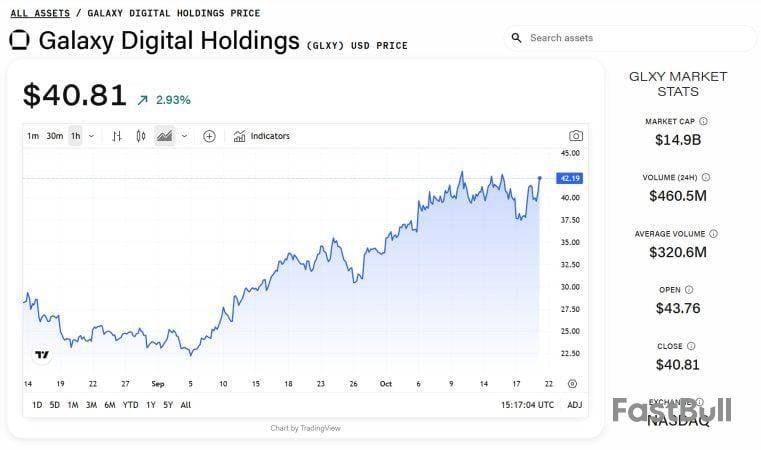
Galaxy Digital stock price. Source: The Block price page
Disclaimer: The Block is an independent media outlet that delivers news, research, and data. As of November 2023, Foresight Ventures is a majority investor of The Block. Foresight Ventures invests in other companies in the crypto space. Crypto exchange Bitget is an anchor LP for Foresight Ventures. The Block continues to operate independently to deliver objective, impactful, and timely information about the crypto industry. Here are our current financial disclosures.
© 2025 The Block. All Rights Reserved. This article is provided for informational purposes only. It is not offered or intended to be used as legal, tax, investment, financial, or other advice.
Former New York Governor Andrew Cuomo lags far behind Democratic frontrunner Zohran Mamdani despite unveiling his proposal to make the city a crypto hub.
Cuomo’s plan, announced on Sunday, would create a new office that would be responsible for attracting emerging tech companies, including cryptocurrencies and blockchain.
The move follows similar initiatives from outgoing Mayor Eric Adams, which have yielded mixed results so far. The mayor’s office reported that many crypto startups have appeared in New York, while existing crypto businesses have not seen much change. Some have noted that the mayor’s office generally has little influence over how or whether the crypto industry develops.
With the mayoral election just two weeks away, a last-ditch effort to appeal to the crypto industry may not be enough to give Cuomo an edge over the frontrunner.
Cuomo’s crypto strategy amid a Mamdani lead
On Sunday, Cuomo’s campaign announced that, if elected, he would create a “chief innovation officer” within his administration to attract business in emerging technologies. He would also create an “Innovation Council” comprising executives from three industries: blockchain, biotech and artificial intelligence.
Cuomo said, “The next mayor must make sure we’re also leading in the technologies that will define the next century — AI, blockchain, and biotech. That’s what this position is about: Keeping New York City not just competitive, but dominant in the global innovation economy.”
The appeal of turning to the crypto lobby is understandable. Crypto lobby groups broke campaign funding records in the 2024 elections and made digital asset regulation a top priority for lawmakers in Washington.
The Winklevoss twins, whose donations to crypto industry lobby groups have reportedly broken $30 million just this year, have also been harshly critical of Cuomo’s main opponent, Democratic candidate Zohran Mamdani.
In a rambling June X post over whether he would “get involved in the NYC mayor race by supporting a candidate that can defeat Zohran Mamdani,” Tyler Winkelvoss condemned Mamdani and Democrats writ large.
He said that Democratic cities were “broken kleptocracies” and that “anarchy and socialism are the next logical steps in this story arc.” He said that financiers and hedge fund managers have failed to “protect the system that allowed them to achieve their success in the first place and allowed New York City to once become the greatest city in the world.”
These hedge fund managers and financiers, including pro-crypto Pershing Square CEO Bill Ackman, have reportedly donated millions to Cuomo’s campaign in recent weeks.
But an appeal to pro-crypto hedge funds may not be enough to move the needle for Cuomo. According to a recent AARP poll, Mamdani enjoys a double-digit lead with 43.2% support, followed by Cuomo at 28.9%, Guardian Angels founder Curtis Sliwa at 19.4% and 8.4% undecided or preferring another candidate.
Crypto didn’t break into the top concerns for respondents. “Cost of living remains the top issue for nearly two-thirds of voters, with public safety and housing affordability also key. Despite concerns about the city’s direction, optimism about future improvement under new leadership has grown modestly since the August poll,” said the AARP.
Wall Street itself isn’t entirely sold on the idea that a Mamdani mayorship would be a disaster for the city. Recent analysis from Business Insider found strong support for Mamdani among more “back office” roles. While wealthier managerial positions were more likely to support Cuomo, their colleagues in tech, HR, operations and intelligence showed a strong bias toward Mamdani.
How can the NYC mayor influence crypto?
Even if Cuomo made a miraculous surge and was able to secure a victory on Nov. 4, the ability of the mayor’s office to influence crypto policy is limited.
Outgoing Mayor Eric Adams attempted to turn the city into a crypto hub. He first demonstrated his belief in crypto by taking his paychecks in Bitcoin (BTC) and opposing crypto mining moratoriums at the state level. In February 2023, the city council’s committee on technology met to discuss blockchain, cryptocurrency and other innovative digital tools.
But as of 2024, few felt that Adams delivered on that promise. Thomas Pacchia, founder of the NYC-based Bitcoin bar PubKey, previously told Cointelegraph that he didn’t notice much of a change in public sentiment.
But this didn’t stop Adams from trying. The mayor continued to make strides to court the crypto industry, announcing a crypto summit earlier this year to meet with top executives. In May, the New York Office of Technology and Innovation (OTI) told Cointelegraph that “crypto and blockchain are our fastest growing tech industries in terms of startups.”
Last week, Adams announced the establishment of the New York City Office of Digital Assets and Blockchain, whose goals include “fostering innovation and development while guiding the responsible development of cryptocurrency and blockchain ecosystems in New York City.”
The OTI said, “Since 2019, crypto startups have increased by 177%, and blockchain startups have increased 143%. NYC has 172 crypto startups compared to 151 in San Francisco. NYC also has 262 blockchain startups compared to 251 in San Francisco.”
How much this is a result of city-level crypto-related initiatives is unclear. The mayor’s office has considerable influence over business-critical issues like municipal taxes, licensing and building permits. But financial policies and regulatory frameworks for the finance industry are largely made at the state and federal levels.
Even if the next mayor, be that Cuomo or Mamdani, wants to influence the crypto industry, they will likely have to go through state regulators first.
Peter Brandt, mostly known in the media as a legendary trader or veteran trader thanks to his 50 years of expertise on the financial market, has just revealed an investment opportunity that may be similar to "buying Bitcoin at $1." Surprisingly, it is not about crypto but about silver.
In his newest X post, Brandt suggested the idea of buying as much metal as possible and, if necessary, even using ultra-leveraged call options, suggesting that taking out loans to capture the trade might be the generational play for Gen Z and Millennials.

Peter Brandt">
To prove his opinion, Brandt points to the silver chart that stretches back to the 1970s. After years of nothing, the market is now pressing toward the $5,036 per contract level, having already cleared the $2,620 pivot that capped prices for much of the last 10 years.
Brandt’s annotated target suggests that this is not just another bounce; it is the kind of move where long-dated resistance gives way and the underlying volatility expands rapidly — something the market saw with gold in the last two years.
"Bitcoin at $1"
Silver’s last explosive runs in 1980 and 2011 both ended in parabolic spikes before crashing back, but the background of 2025 is what makes the current setup different. Monetary tightening has run its course, fiscal imbalances are worsening and ETF flows into precious metals are starting to mirror Bitcoin's 2024 run.
Gold has prospered when a safe-haven hedge was needed, but silver’s thinner liquidity and industrial usage give it more upside potential right now.
When a trader with half a century of experience frames silver as "Bitcoin at $1," it does not mean the chart is destiny, but it does mean the asymmetry is lucrative enough to take a look.
How California’s SB 822 will impact digital assets
California’s Senate Bill 822 (SB 822), signed into law by Governor Gavin Newsom in October 2025, makes California the first US state to protect unclaimed crypto assets from forced liquidation.
Treating digital assets similarly to bank accounts and securities, SB 822 requires unclaimed cryptocurrencies to be transferred in their native form rather than immediately liquidated. This helps prevent forced liquidation of assets like Bitcoin or Ether , which could otherwise trigger taxable events for holders without their consent.
SB 822 has reshaped the legal treatment of digital assets by bringing them under California’s Unclaimed Property Law, the first state framework to clearly include crypto in rules around holding and transferring unclaimed property. Under this law, account holders can reclaim their original digital assets or, if those assets were sold, the net proceeds from the sale by submitting a valid claim to the State Controller.
Authored by Senator Josh Becker, SB 822 updates California’s decades-old Unclaimed Property Law. It passed through both houses in September 2025 before being signed by Governor Gavin Newsom.
Did you know? Self-custodied wallets are generally outside the scope of unclaimed-property laws because no third-party “holder” exists. However, that doesn’t make them risk-free for users. Lost keys, forgotten seed phrases or the death of an owner without an inheritance plan can permanently strand digital assets.
What is unclaimed property, and why does crypto pose a challenge?
Unclaimed property, or escheatment, refers to financial assets that remain inactive or abandoned by their rightful owners for a set period, typically three years. After this period, the state takes over the property. Conventionally, dormant bank accounts, uncashed checks or forgotten securities came under the purview of escheatment.
Applying unclaimed-property laws to cryptocurrency posed significant challenges for regulators. The decentralized nature of crypto raised questions about whether it should be classified as cash, property or a unique asset class. In addition, custodians and exchanges faced operational hurdles in transferring assets to the state without triggering taxable events for users.
Earlier drafts of California’s SB 822 reportedly required custodians to liquidate crypto before remittance. Such a move would have hurt user interests, complicated compliance and weakened digital-asset ownership principles. Joe Ciccolo of the California Blockchain Advocacy Coalition, who previously submitted comments to the Department of Financial Protection and Innovation on digital-asset regulation, stated that the final version avoided those pitfalls and better protected consumers.
How California’s SB 822 operates
California’s SB 822 provides a clear structure for managing unclaimed cryptocurrency under the state’s Unclaimed Property Law. It classifies digital financial assets as intangible property subject to escheatment rules.
The bill considers assets abandoned after three years without any indication of owner interest, such as account activity or communication. It excludes game tokens, loyalty points and non-crypto digital content. Before reporting assets to the state, holders (exchanges or custodians) must notify owners six to 12 months in advance, providing detailed notice content and a form allowing users to reactivate accounts to reset the dormancy period.
Once unclaimed, holders must transfer the same asset type and amount (without liquidation) within 30 days to a state-appointed crypto custodian. The State Controller may decline custody if it’s not in the state’s interest. After about 18-20 months, the state may convert holdings to fiat; claimants can recover either the original crypto (if still held) or its proceeds. Owners or heirs may file claims under the state’s unclaimed property claim procedures.
Did you know? Claims typically have no statute of limitations once holders transfer the assets to the state’s custody. That means you or your heirs can reclaim long-lost crypto years later. The claim requires paperwork and proof of ownership.
How does SB 822 operate in practice?
Understanding how digital assets are treated as unclaimed property in California is crucial for account holders and custodians. Here is a walkthrough of a dormant wallet scenario, following a crypto holder through the mandatory notification and transfer process to a state-appointed custodian.
Dormant wallet scenario: Suppose Allan holds Bitcoin on a California-based exchange but doesn’t log in or show any indication of interest for three years. The exchange must send him a notice six to 12 months before reporting the account as unclaimed. If he doesn’t respond, the exchange reports the holding and transfers the crypto, unchanged and unliquidated, within 30 days to a state-appointed custodian. If Allan returns later, he can file a claim with the State Controller’s Office to recover his original coins.
Edge cases and caveats: If a holder cannot reach the owner because of inactive contact details or a changed address, the asset still qualifies as unclaimed. If the owner files a claim after the crypto has been liquidated by the state, there may be questions about the valuation date and potential capital gains implications under federal tax law.
Exchange compliance: Platforms must maintain contact records and documentation of all owner communications. They also need secure transfer procedures and must use standardized owner-notification forms prescribed by the State Controller. In addition, exchanges are required to coordinate with state-appointed crypto custodians to ensure compliance.
Implications of SB 822: Why it matters
California’s SB 822 represents a significant change in how digital assets are handled under state law. It has streamlined operations and compliance for all stakeholders: users, holders, custodians, tax authorities and regulators.
For crypto users and holders: SB 822 prevents forced liquidation of unclaimed assets and allows owners to reclaim while their crypto is held in state custody. It also promotes a better claiming process, such as keeping contact details updated.
For exchanges and custodians: The law imposes significant compliance obligations, including record-keeping, owner notifications, proof of notice and the transfer of unliquidated crypto to the state.
For tax authorities and regulators: SB 822 may generate potential revenue if assets are sold after a waiting period. It makes California the first state to prohibit forced liquidation of unclaimed crypto, establishing a regulatory precedent other states may adopt.
Did you know? Staking rewards and airdrops can complicate unclaimed crypto. Some jurisdictions expect holders or state custodians to preserve assets as they are, which may include rewards accruing during custody.
How California’s SB 822 is setting the standard for unclaimed crypto
California’s SB 822 aligns with broader efforts globally to integrate cryptocurrency into existing property laws. Several US states, such as Arizona and Texas, have taken steps to include digital assets in unclaimed-property frameworks.
Arizona: In May 2025, Arizona’s HB 2749 placed “digital assets” and “virtual currency” under its unclaimed property law. It considers assets abandoned after three years without any owner activity, with undeliverable electronic notices treated as a relevant indicator of abandonment. Holders need to report and deliver abandoned assets to the Arizona Department of Revenue in their original form. Unclaimed assets may be liquidated by the state through established exchanges or other commercially reasonable methods.
Texas: SB 1244, effective on Sept. 1, 2025, also applies a three-year dormancy period, starting from a failed communication or last owner activity. If a holder has full control of the private keys, they must report and deliver the virtual currency in its native form. However, if a holder only partially holds the private keys, they must still report but are not required to deliver the digital asset. The comptroller may use qualified custodians and liquidate assets not below the current market price.
California also uses a three-year dormancy period but requires holders to transfer the unliquidated crypto to a state-appointed custodian. The law explicitly prohibits forced liquidation at transfer. While Arizona and Texas permit state liquidation, California delays any conversion to fiat, prioritizing consumer protection.
XRP, the native token of Ripple, has been struggling to regain upward momentum after facing sustained selling pressure in recent weeks. Despite broader market volatility and regulatory uncertainties, investors are closely watching whether the token can stage a potential rebound. With on-chain metrics hinting at renewed accumulation and Ripple’s ecosystem expansion continuing, market participants are weighing the possibility of a trend reversal. The coming days could prove pivotal in determining XRP’s next major price direction.
XRP price has been hovering near $2.45 after dropping sharply from its weekly high of around $2.55, reflecting the broader market correction that hit major altcoins. The token lost crucial support at $2.71, turning it into a short-term resistance zone. Technical indicators show declining RSI and weakening momentum, while trading volumes remain subdued. However, on-chain data hints at whale accumulation near current levels, raising the question—could XRP be gearing up for a technical rebound soon?
The XRP/USDT daily chart shows the token consolidating near $2.45 after rebounding from the $2.40 support zone. The MACD remains in bearish territory but is showing early signs of convergence, hinting at a possible momentum shift. Meanwhile, the RSI hovers around 41, indicating XRP is approaching an oversold region. A break above $2.59 could signal a short-term recovery, while failure to hold above $2.40 may expose the price to a deeper correction toward $1.62 support.
In conclusion, XRP’s short-term outlook hinges on reclaiming the $2.60 resistance, which could open the door for a retest of $2.85–$3.00 levels if buying momentum strengthens. On-chain data shows increased whale accumulation near $2.40, suggesting smart money may be positioning for a rebound. However, sustained weakness below $2.40 could invalidate this bullish setup, dragging prices toward $1.80 or even $1.62. For now, XRP’s path forward depends on whether accumulation translates into a confirmed technical breakout.
Batched Threshold Encryption (BTE) builds on foundational concepts such as threshold cryptography, which enable secure collaboration among multiple parties without exposing sensitive data to any single participant. BTE is an evolution of the earliest TE-encrypted mempool schemes, such as Shutter, which we have covered previously. For now, all existing work on BTE remains at the prototype or research stage, but it could shape the future of decentralized ledgers if successful. This creates a clear opportunity for more research and potential adoption, which we will explore in this article.
On most modern blockchains, transaction data is publicly viewable in the mempool before it is sequenced, executed and confirmed in a block. This transparency creates avenues for sophisticated parties to engage in extractive practices known as Maximal Extractable Value (MEV). MEV exploits the block proposer’s ability to reorder, include or omit transactions for financial gain.
Typical forms of MEV exploitation, such as frontrunning and sandwich attacks, remain pervasive, particularly on Ethereum, where, during the flash crash on Oct. 10, an estimated $2.9 million was extracted. Accurately measuring total extractive MEV remains difficult because roughly 32% of these attacks were privately relayed to miners, with some involving over 200 chained subtransactions in a single exploit.
Some researchers have sought to prevent MEV with mempool designs, where pending transactions are held encrypted until block finalization. This prevents other blockchain participants from seeing what trades or actions the transacting users are about to take. Many encrypted mempool proposals use some form of threshold encryption (TE) for this. TE splits a secret key that can unveil the transaction data among several servers. Akin to a multisig, a minimum number of signers must work together to combine their key shares and unlock the data.
Why BTE matters
Standard TE struggles to scale efficiently because every server must decrypt each transaction separately and broadcast a partial decryption share for it. These individual shares are recorded onchain for aggregation and verification. This creates a server communication load that slows the network and increases chain congestion. BTE solves this limitation by allowing each server to release a single constant-sized decryption share that unlocks an entire batch, regardless of size. 
The first functional version of BTE, developed by Arka Rai Choudhuri, Sanjam Garg, Julien Piet and Guru-Vamsi Policharla (2024), used the so-called KZG commitment scheme. It lets the committee of servers lock a polynomial function to a public key while keeping that function initially hidden from both users and committee members.
Decrypting transactions that are encrypted to the public key requires proving that they fit into the polynomial. Because a polynomial of fixed degree can be fully determined from a set number of points, the servers only need to collectively exchange a small amount of data to provide this proof. Once the shared curve is established, they can send out a single compact piece of information derived from it to unlock all transactions in the batch at once.
Importantly, transactions that do not fit within the polynomial remain locked, so the committee can selectively reveal a subset of the encrypted transactions while keeping others hidden. This guarantees that all encrypted transactions outside the selected batch for execution remain encrypted.
Current TE implementations, such as Ferveo and MEVade, could therefore integrate BTE to preserve privacy for non-batch-included transactions. BTE also fits naturally with layer-2 rollups such as Metis, Espresso and Radius, which already pursue fairness and privacy through time-delay encryption or trusted sequencers. By using BTE, these rollups could achieve a trustless ordering process that prevents anyone from exploiting transaction visibility for arbitrage or liquidation gains.
However, this first version of BTE had two major drawbacks: It required a full reinitialization of the system, including a new round of key generation and parameter setup each time a new batch of transactions was encrypted. Decryption consumed significant memory and processing power as nodes worked to combine all partial shares.
Both of these factors limited BTE’s practicality; for instance, the required frequent DKG execution for committee refresh and block processing made the scheme effectively prohibitive for moderately sized permissioned committees, let alone any attempt to scale to a permissionless network.
For cases of selective decryption, where validators only decrypt profitable transactions, BTE makes all decryption shares publicly verifiable. This allows anyone to detect dishonest behavior and penalize offenders via slashing. It keeps the process reliable as long as a threshold of honest servers remains active.
Upgrades to BTE
Choudhuri, Garg, Policharla and Wang (2025) made the first upgrade to BTE to improve server communication through a scheme called the one-time setup BTE. This scheme only required a single initial Distributed Key Generation (DKG) ceremony that runs once across all decryption servers. However, a multiparty computation protocol was still required to set up the commitment for each batch.
The first truly epochless BTE scheme came in August 2025 when Bormet, Faust, Othman and Qu introduced BEAT-MEV as a single, one-time initialization that could support all future batches. It achieved this using two advanced tools, puncturable pseudorandom functions and threshold homomorphic encryption, allowing servers to reuse the same setup parameters indefinitely. Each server only needed to send a small piece of data when decrypting, thus keeping server communication costs low.
Overview of projected performance
Down the line, another paper called BEAST-MEV introduced the concept of Silent Batched Threshold Encryption (SBTE) that removed the need for any interactive setup between servers. It replaced repeated coordination with a non-interactive, universal one-time setup that allows nodes to operate independently.
However, combining all the partial decryptions afterward still required heavy interactive computation. To fix this, BEAST-MEV borrowed BEAT-MEV’s sub-batching technique and used parallel processing to let the system decrypt large batches (up to 512 transactions) in under one second. The following table summarizes how each successive BTE design improves on the original BTE design.
BTE’s potential also holds for protocols such as CoW Swap that already mitigate MEV through batch auctions and intent-based matching, yet still expose parts of the order flow in public mempools. Integrating BTE before solver submission would seal that gap and provide end-to-end transaction privacy. For now, Shutter Network remains the most promising candidate for early adoption, with other protocols likely to follow once implementation frameworks become more mature.
This article does not contain investment advice or recommendations. Every investment and trading move involves risk, and readers should conduct their own research when making a decision.
This article is for general information purposes and is not intended to be and should not be taken as legal or investment advice. The views, thoughts, and opinions expressed here are the author’s alone and do not necessarily reflect or represent the views and opinions of Cointelegraph.
Cointelegraph does not endorse the content of this article nor any product mentioned herein. Readers should do their own research before taking any action related to any product or company mentioned and carry full responsibility for their decisions.
Willemstad, Curacao, October 21st, 2025, Chainwire
Bombastic Casino has launched an updated version of its platform, featuring a redesigned user interface and an expanded set of features. The update introduces daily rewards, social interaction tools, and enhanced transparency measures.
The rebrand is part of Bombastic’s ongoing efforts to develop a more accessible and user-oriented blockchain gaming environment, incorporating a modern design alongside improvements in platform security and community engagement.
What’s New at Bombastic Casino
Fast and Transparent Crypto Gaming
Bombastic accepts leading cryptocurrencies, including BTC, ETH, DOGE, SOL, and ADA, ensuring instant deposits and withdrawals backed by blockchain verification. The casino offers a catalog of thousands of games from more than 65 software providers — from 3D slots and Megaways to live tables and instant-win titles like Crash, Mines, and Plinko.
The Future of Social Gaming
The refreshed Bombastic platform blends entertainment with community, aiming to set new standards in how players interact and win online. With its transparent, fair, and secure ecosystem, Bombastic aims to set new standards in how players interact and win online.
About Bombastic
Launched in 2024 and licensed by the Curaçao Gaming Control Board, Bombastic Casino operates under strict international standards for fairness and player protection. The platform is known for its extensive game selection, blockchain-backed transparency, and player-first approach to crypto entertainment.
Official website: bombastic.com
X (Twitter): x.com/Bombastic_com
Instagram: instagram.com/bombastic_casino
Telegram: t.me/bombastic_com
Contact
Lika Nizharadze
partners@bombastic.com
White Label
Data API
Web Plug-ins
Poster Maker
Affiliate Program
The risk of loss in trading financial instruments such as stocks, FX, commodities, futures, bonds, ETFs and crypto can be substantial. You may sustain a total loss of the funds that you deposit with your broker. Therefore, you should carefully consider whether such trading is suitable for you in light of your circumstances and financial resources.
No decision to invest should be made without thoroughly conducting due diligence by yourself or consulting with your financial advisors. Our web content might not suit you since we don't know your financial conditions and investment needs. Our financial information might have latency or contain inaccuracy, so you should be fully responsible for any of your trading and investment decisions. The company will not be responsible for your capital loss.
Without getting permission from the website, you are not allowed to copy the website's graphics, texts, or trademarks. Intellectual property rights in the content or data incorporated into this website belong to its providers and exchange merchants.
Not Logged In
Log in to access more features

FastBull Membership
Not yet
Purchase
Log In
Sign Up