Markets
News
Analysis
User
24/7
Economic Calendar
Education
Data
- Names
- Latest
- Prev




Signal Accounts for Members
All Signal Accounts
All Contests


Senior Iranian Official To Reuters: US Insistence On "Discussing Non-Nuclear" Issues Could Jeopardize Talks In Oman
[Sol Dips To $90] February 5Th, According To Htx Market Data, Sol Hit A Low Of $90, With A 24-Hour Decrease Of 8.71%
The S&P 500 Fell 1%, The Technology Sector Fell More Than 3%, And The Telecommunications Sector Fell 2%
When Asked How To Lower The 10-year Treasury Yield, U.S. Treasury Secretary Bessant Said: "It Rose In 2025."
USA Military Says It Conducted Five Strikes Against Multiple Islamic State Targets Across Syria
U.S. Treasury Secretary Bessant: We Will Analyze The Unemployment Issue Among The African American Population, But Cannot Give A Date For This Analysis
USA Told Iran It Will Not Agree To To Change The Location And Format Of Talks Planned For Friday
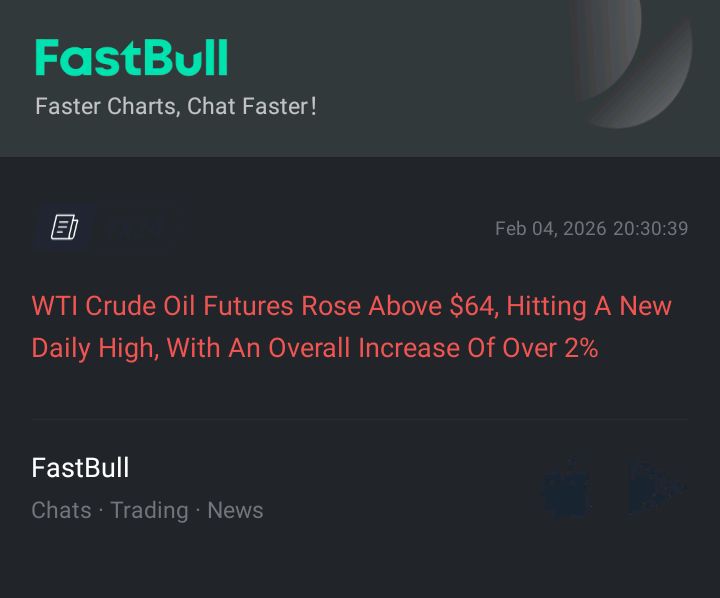
WTI Crude Oil Futures Rose Above $64, Hitting A New Daily High, With An Overall Increase Of Over 2%
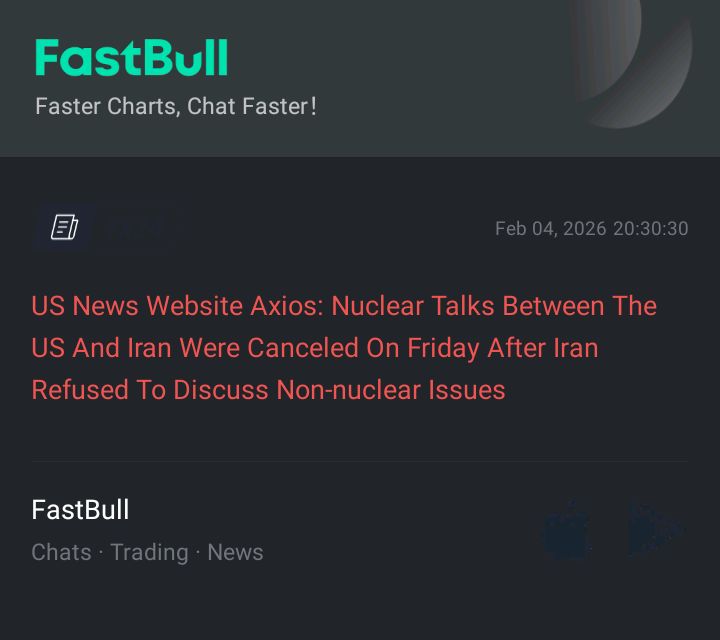
US News Website Axios: Nuclear Talks Between The US And Iran Were Canceled On Friday After Iran Refused To Discuss Non-nuclear Issues
U.S. Treasury Secretary Bessant: President Trump Has Made It Clear That The Digital Dollar Is "abhorrent" To Him
U.S. Treasury Secretary Bessenter Stated That The Spread Between Mortgage Rates And U.S. Treasury Bonds Is At Its Lowest Level In Many Years, Hinting That The Government Will Eventually End Its Administration Of Fannie Mae And Freddie Mac
[Ambassador Xie Feng Meets With Phrma President And CEO Eugene Yoble] According To The Chinese Embassy In The United States, On February 3, Chinese Ambassador To The United States Xie Feng Met With Eugene Yoble, President And CEO Of The Pharmaceutical Research And Manufacturing Enterprises Association (Phrma), At The Latter's Request. The Two Sides Exchanged In-depth Views On Sino-US Biopharmaceutical Industry Policies And Bilateral Pharmaceutical Cooperation
[UK Medium- And Long-Term Government Bond Yields Rise By At Late Wednesday (February 4)] In Late European Trading, The Yield On 10-year UK Government Bonds Rose 2.9 Basis Points To 4.546%, Continuing Its Upward Trend Since 9:00 PM Beijing Time. The Yield On 2-year UK Government Bonds Rose 0.8 Basis Points To 3.715%. The Yield On 30-year UK Government Bonds Rose 4.4 Basis Points, And The Yield On 50-year UK Government Bonds Rose 6.1 Basis Points. The Spread Between 2-year And 10-year UK Government Bond Yields Widened By 2.157 Basis Points To +82.973 Basis Points

Euro Zone Services PMI Final (Jan)A:--
F: --
P: --
U.K. Composite PMI Final (Jan)A:--
F: --
P: --
U.K. Total Reserve Assets (Jan)A:--
F: --
P: --
U.K. Services PMI Final (Jan)A:--
F: --
P: --
U.K. Official Reserves Changes (Jan)A:--
F: --
P: --
Euro Zone Core CPI Prelim YoY (Jan)A:--
F: --
P: --
Euro Zone Core HICP Prelim YoY (Jan)A:--
F: --
P: --
Euro Zone HICP Prelim YoY (Jan)A:--
F: --
P: --
Euro Zone PPI MoM (Dec)A:--
F: --
Euro Zone Core HICP Prelim MoM (Jan)A:--
F: --
P: --
Italy HICP Prelim YoY (Jan)A:--
F: --
P: --
Euro Zone Core CPI Prelim MoM (Jan)A:--
F: --
P: --
Euro Zone PPI YoY (Dec)A:--
F: --
U.S. MBA Mortgage Application Activity Index WoWA:--
F: --
P: --
Brazil IHS Markit Composite PMI (Jan)A:--
F: --
P: --
Brazil IHS Markit Services PMI (Jan)A:--
F: --
P: --
U.S. ADP Employment (Jan)A:--
F: --
The U.S. Treasury Department released its quarterly refinancing statement.
U.S. IHS Markit Composite PMI Final (Jan)A:--
F: --
P: --
U.S. IHS Markit Services PMI Final (Jan)A:--
F: --
P: --
U.S. ISM Non-Manufacturing Price Index (Jan)A:--
F: --
P: --
U.S. ISM Non-Manufacturing Employment Index (Jan)A:--
F: --
P: --
U.S. ISM Non-Manufacturing New Orders Index (Jan)A:--
F: --
P: --
U.S. ISM Non-Manufacturing Inventories Index (Jan)A:--
F: --
P: --
U.S. ISM Non-Manufacturing PMI (Jan)A:--
F: --
P: --
U.S. EIA Weekly Crude Oil Imports ChangesA:--
F: --
P: --
U.S. EIA Weekly Heating Oil Stock ChangesA:--
F: --
P: --
U.S. EIA Weekly Crude Demand Projected by ProductionA:--
F: --
P: --
U.S. EIA Weekly Gasoline Stocks ChangeA:--
F: --
P: --
U.S. EIA Weekly Crude Stocks ChangeA:--
F: --
P: --
U.S. EIA Weekly Cushing, Oklahoma Crude Oil Stocks ChangeA:--
F: --
P: --
Australia Trade Balance (SA) (Dec)--
F: --
P: --
Australia Exports MoM (SA) (Dec)--
F: --
P: --
Japan 30-Year JGB Auction Yield--
F: --
P: --
Indonesia Annual GDP Growth--
F: --
P: --
Indonesia GDP YoY (Q4)--
F: --
P: --
France Industrial Output MoM (SA) (Dec)--
F: --
P: --
Italy IHS Markit Construction PMI (Jan)--
F: --
P: --
Euro Zone IHS Markit Construction PMI (Jan)--
F: --
P: --
Germany Construction PMI (SA) (Jan)--
F: --
P: --
Italy Retail Sales MoM (SA) (Dec)--
F: --
P: --
U.K. Markit/CIPS Construction PMI (Jan)--
F: --
P: --
France 10-Year OAT Auction Avg. Yield--
F: --
P: --
Euro Zone Retail Sales YoY (Dec)--
F: --
P: --
Euro Zone Retail Sales MoM (Dec)--
F: --
P: --
U.K. BOE MPC Vote Cut (Feb)--
F: --
P: --
U.K. BOE MPC Vote Hike (Feb)--
F: --
P: --
U.K. BOE MPC Vote Unchanged (Feb)--
F: --
P: --
U.K. Benchmark Interest Rate--
F: --
P: --
MPC Rate Statement
U.S. Challenger Job Cuts (Jan)--
F: --
P: --
U.S. Challenger Job Cuts MoM (Jan)--
F: --
P: --
U.S. Challenger Job Cuts YoY (Jan)--
F: --
P: --
Bank of England Governor Bailey held a press conference on monetary policy.
Euro Zone ECB Marginal Lending Rate--
F: --
P: --
Euro Zone ECB Deposit Rate--
F: --
P: --


No matching data
View All

No data
LAS VEGAS, Jan. 26, 2026 (GLOBE NEWSWIRE) -- Galaxy Gaming, Inc. , a leading developer and distributor of casino table games and technology, is thrilled to announce the official UK launch of MONOPOLY Table Games Progressive, starting with the installation of MONOPOLY Blackjack Progressive across premier Metropolitan Casinos in London, including Metropolitan Mayfair, Empire Casino, The Sportsman Casino, and Park Lane Club.
This milestone marks the debut of MONOPOLY-branded progressive table games in the UK, bringing one of the world’s most iconic brands to life in the casino pit. Through an exclusive licensing agreement with Hasbro, Inc. , a leading games, IP and toy entertainment company, Galaxy Gaming is the sole table games licensee for MONOPOLY, enabling the company to deliver innovative experiences that combine the thrill of casino gaming with the nostalgia of the legendary board game.
MONOPOLY Blackjack Progressive introduces a dynamic twist to classic blackjack gameplay. At the heart of the excitement is Mr. MONOPOLY, who randomly selects hands and awards multipliers of up to 10x, keeping players engaged and on the edge of their seats. This progressive feature transforms the legendary title into a fresh, immersive experience designed to captivate both seasoned players and newcomers.
“We’re thrilled to see MONOPOLY Blackjack Progressive debut on casino floors in the UK,” said Matt Reback, CEO of Galaxy Gaming. “This launch celebrates our strong partnership with Metropolitan Gaming and their leadership in bringing this exciting new experience to players in the UK market.”
“We’re excited to partner with Galaxy Gaming and introduce MONOPOLY Blackjack Progressive to our UK venues,” said Alex Oswald, Managing Director at Metropolitan Gaming. “MONOPOLY is one of the most recognisable brands in the world, and this launch reflects our commitment to delivering innovative, premium experiences that surprise and delight our players. Working closely with Galaxy Gaming allows us to introduce fresh, engaging gameplay, enhancing the guest experience and reinforcing Metropolitan’s position as a leader in casino entertainment.”
About Galaxy Gaming
Headquartered in Las Vegas, Nevada, Galaxy Gaming (galaxygaming.com) develops and distributes innovative games, bonusing systems, and technology solutions to physical and online casinos worldwide. Galaxy Gaming offers games proven to perform developed by gaming experts and backed by the highest level of customer support. Galaxy Gaming Digital is the world’s leading licensor of proprietary table games to the online gaming industry. Galaxy Gaming has over 130 licenses worldwide, including licenses in 28 U.S. states and more than 30 countries around the world.
About Hasbro
Hasbro is a leading games, IP and toy company whose mission is to create joy and community through the magic of play. With over 164 years of expertise, Hasbro delivers groundbreaking play experiences and reaches over 500 million kids, families and fans around the world, through physical and digital games, video games, toys, licensed consumer products, location-based entertainment, film, TV and more.
Through its franchise-first approach, Hasbro unlocks value from both new and legacy IP, including MAGIC:THE GATHERING, DUNGEONS & DRAGONS, MONOPOLY, HASBRO GAMES, NERF, TRANSFORMERS, PLAY-DOH and PEPPA PIG, as well as premier partner brands. Powered by its portfolio of thousands of iconic marks and a diversified network of partners and subsidiary studios, Hasbro brings fans together wherever they are, from tabletop to screen.
For more than a decade, Hasbro has been consistently recognized for its corporate citizenship, including being named one of the 100 Best Corporate Citizens by 3BL Media, a 2025 JUST Capital Industry Leader, one of the 50 Most Community-Minded Companies in the U.S. by the Civic 50, and a Brand that Matters by Fast Company. For more information, visit https://corporate.hasbro.com or @Hasbro on LinkedIn.
About Metropolitan Gaming
Metropolitan Gaming is a leading international casino and leisure operator, delivering world-class gaming, hospitality and entertainment experiences across a portfolio of iconic venues in the UK and Egypt. The group operates a diverse estate of casinos and entertainment destinations, welcoming millions of guests each year. In London, Metropolitan Gaming’s flagship venues include Metropolitan Mayfair, Empire Casino, The Sportsman Casino and Park Lane Club, each renowned for combining premium gaming with exceptional service, dining and live entertainment.
With a strong focus on player experience, brand partnerships and responsible gaming, Metropolitan Gaming continues to invest in innovative products, technology and collaborations that elevate the casino floor and engage both established and new audiences. The launch of MONOPOLY Blackjack Progressive reflects the group’s commitment to bringing globally recognised brands and compelling new gameplay experiences to its customers.
For more information, visit metropolitangaming.com or @MetropolitanGaming on LinkedIn.
Some of the information contained in this press release includes forward-looking statements. In some cases, you can identify forward-looking statements by terms such as “may,” “will,” “should,” “could,” “might,” “expect,” “intend,” "target," “plan,” “anticipate,” “believe,” “estimate,” “predict,” “potential,” “continue,” or the negative of these terms or other similar expressions. These forward-looking statements are only predictions. We have based these forward-looking statements on our current expectations, assumptions and projections about future events and financial trends that we believe may affect our business, financial condition and results of operations. These forward-looking statements are subject to a number of risks and uncertainties, many of which are beyond the control of the Company, that may cause actual results and future events to differ significantly from those expressed in any forward-looking statement.
These risks and uncertainties include, but are not limited to, the ability to complete the Company’s acquisition by Evolution Malta Holding Limited (“Evolution”), Evolution AB (publ)’s wholly owned subsidiary (the “Merger”) on the proposed terms or on the anticipated timeline, or at all, including risks and uncertainties related to gaming regulatory approvals and satisfaction of other closing conditions to consummate the proposed Merger; the occurrence of any event, change or other circumstance that could give rise to the termination of the Merger Agreement (as defined herein) relating to the proposed Merger; risks that the proposed Merger disrupts the Company’s current plans and operations or diverts the attention of the Company’s management or employees from ongoing business operations; the risk of potential difficulties with the Company’s ability to retain and hire key personnel and maintain relationships with customers and other third parties as a result of the proposed Merger, including during the pendency of the Merger; the risk that the proposed Merger may involve unexpected costs and/or unknown or inestimable liabilities; the risk that the Company’s business may suffer as a result of uncertainty surrounding the proposed Merger; the risk that stockholder litigation in connection with the proposed Merger may affect the timing or occurrence of the proposed Merger or result in significant costs of defense, indemnification and liability; effects relating to the announcement of the Merger or any further announcements or the consummation of the Merger on the market price of the Company’s common stock; the ability of the Company to enter and maintain strategic alliances, product placements or installations in land based casinos or grow its iGaming business, garner new market share, secure licenses in new jurisdictions or maintain existing licenses, successfully develop or acquire and sell proprietary products, comply with regulations, including changes in gaming related and non-gaming related statutes and regulations that affect the revenues of our customers in land-based casino and, online casino markets, have its games approved by relevant jurisdictions, unfavorable economic conditions in the US and worldwide, our level of indebtedness, restrictions and covenants in our loan agreement, dependence on major customers, protection of intellectual property and our ability to license the intellectual property rights of third parties, failure to maintain the integrity of our information technology systems, including without limitation, cyber-attacks or other failures in our telecommunications or information technology systems, or those of our collaborators, third-party logistics providers, distributors or other contractors or consultants, could result in information theft, data corruption and significant disruption of our business, and other factors. Additional information concerning these and other risk factors can be found in the Company’s filings with the Securities and Exchange Commission, including in the most recent Annual Report on Form 10-K, Quarterly Reports on Form 10-Q, Current Reports on Form 8-K and Definitive Proxy Statement.
All forward-looking statements made herein are expressly qualified in their entirety by these cautionary statements. While forward-looking statements reflect the Company’s good faith beliefs, they are not guarantees of future performance or events and there can be no assurance that the actual results, events or developments referenced herein will occur or be realized. Any forward-looking statement speak only as of the date on which it was made. The Company disclaims any obligation to publicly update or revise any forward-looking statement to reflect changes in underlying assumptions or factors, or new information, data or methods, future events or other changes.
Contact:
Media:
Phylicia Middleton (702) 938-1753
Investors:
Steve Kopjo (702) 727-8886
The FTSE 100 was down 0.07% at 10,143.44, while the more domestically-focused FTSE 250 slipped 0.23% to 23,317.53.
As AJ Bell’s Dan Coatsworth put it, “it’s a calmer end to a chaotic week on the markets,” noting that after recent swings “it’s only natural for people to pause and take stock of events.”
The bid for safety remained evident in precious metals, with gold continuing to attract inflows despite easing immediate market stress.
Coatsworth said the metal had “nudged ahead to trade ever closer to $5,000 an ounce as investors were reluctant to let go of their safety blanket, just in case Donald Trump woke up with another controversial idea.”
That caution helped temper equity gains even as broader risk sentiment stabilised.
UK economic data helps underpin sentiment
Sentiment was underpinned by a raft of upbeat UK economic data.
The S&P Global flash UK PMI composite output index rose to 53.9 in January from 51.4 in December, its strongest reading since April 2024 and the ninth consecutive month above the 50 mark that separates expansion from contraction.
Services activity climbed to a 21-month high of 54.3, while manufacturing output also strengthened, with the PMI rising to 51.6.
Chris Williamson at S&P Global said businesses had “kicked up a gear” at the start of the year, pointing to resilient demand and optimism consistent with quarterly GDP growth approaching 0.4%, though he cautioned that job losses persisted as firms grappled with high costs.
PwC economist Jake Finney said the data suggested the economy had begun 2026 on a firmer footing, but warned that persistent cost pressures, particularly in services, could keep the Bank of England on hold in February.
Official figures also showed UK retail sales beat expectations in December, with volumes rising 0.4% against forecasts for a decline.
Patrick Munnelly at TickMill noted that “interpreting signals from this often-volatile series is no straightforward task,” highlighting that while sales volumes rose 2.1% on a three-month annual basis in the fourth quarter, they still fell 0.3% quarter-on-quarter.
“The reality likely lies somewhere in between,” he said, pointing to favourable weather and sporting events supporting food sales earlier in the year, while seasonal shifts such as Black Friday may have distorted more recent data.
The Office for National Statistics said strong demand for precious metals and higher supermarket sales helped offset weakness in non-food stores, with annual sales growth accelerating to 1.3%, though volumes remained below pre-pandemic levels.
ONS statistician Hannah Finselbach highlighted strong online jewellery sales driven by demand for gold and silver, while AJ Bell’s Danni Hewson said the headline increase masked a difficult Christmas for many high-street retailers amid cautious consumer spending.
Consumer confidence, however, remained subdued.
GfK’s long-running index edged up one point to -16 in January, marking a decade in negative territory.
Munnelly observed that while the headline move was modest, “perceptions of personal financial situations improved more significantly than the headline figure suggests,” even as households remained wary about the broader economic outlook.
GfK’s Neil Bellamy said consumers were showing resilience rather than optimism, focusing on what they could control while remaining unconvinced about the wider economy.
Broader global signals were meanwhile mixed.
Asian markets advanced as the dollar continued to weaken, with investors increasingly rotating into non-US assets.
Munnelly said “precious metals also soared to unprecedented levels,” with a weaker dollar helping push gold to an all-time high of over $4,965 an ounce.
In Japan, stocks rose and the yen softened after the Bank of Japan kept its policy rate unchanged at 0.75% while upgrading growth and inflation forecasts, a move that also weighed on bond futures.
Munnelly noted that signs were emerging that “investors are increasingly pulling away from US assets,” with record flows into emerging-market funds adding further pressure to the dollar.
BAE Systems higher, SSP Group reverses gains
On London’s equity markets, defence stocks were in focus, with BAE Systems trading higher as investors continued to favour names that have performed strongly over the past year.
Coatsworth said the FTSE 100 had been supported as investors “loaded up on three names that have served them well over the past year - Rolls-Royce, Endeavour Mining and BAE Systems.”
Shell rallied after a Reuters report said the oil major was considering a sale of its assets in Argentina’s Vaca Muerta shale play.
Watches of Switzerland was higher after it said late on Thursday that it had bought Texas-based Deutsch & Deutsch, a family-owned luxury watch and jewellery retailer that had been operating since the 1920s.
SSP Group reversed earlier gains despite backing full-year guidance and reporting a 5% rise in first-quarter like-for-like sales.
Babcock International edged lower after confirming chief executive David Lockwood will retire at the end of 2026, a move Coatsworth said might allow Lockwood “half a smile” given the shares had risen more than fivefold since he took the role in 2020.
C&C Group tumbled after warning on profits amid weak consumer confidence, with Coatsworth describing it as “a tough time to be running” the drinks group as profit warnings returned, while Rank Group slid after Deutsche Bank downgraded the stock to ‘hold’ and cut its price target sharply.
Reporting by Josh White for Sharecast.com.
Market Movers
FTSE 100 - Risers
BAE Systems (BA.) 2,027.00p 2.12%
BP (BP.) 443.65p 1.57%
Anglo American 3,378.00p 1.08%
FTSE 100 - Fallers
Burberry Group 1,195.50p -6.20%
Admiral Group 2,650.00p -5.76%
Aviva (AV.) 619.40p -5.17%
International Consolidated Airlines Group SA (CDI) 418.30p -2.79%
Flutter Entertainment (DI) 12,990.00p -2.70%
Smurfit Westrock (DI) 3,054.00p -2.65%
JD Sports Fashion (JD.) 82.64p -2.34%
FTSE 250 - Risers
Me Group International 139.40p 4.65%
Hochschild Mining 702.00p 3.69%
Watches of Switzerland Group 534.00p 2.99%
Ceres Power Holdings 347.20p 2.72%
Foresight Environmental Infrastructure Limited 71.90p 2.28%
Endeavour Mining 4,366.00p 2.15%
Oxford Biomedica 871.00p 2.11%
FTSE 250 - Fallers
C&C Group (CDI) 114.40p -11.04%
B&M European Value Retail S.A. (DI) 161.60p -7.18%
Wizz Air Holdings 1,318.00p -4.77%
Close Brothers Group 518.00p -2.91%
By Jonathan I. Shenkman
Most parents want to pass along good money habits to their children. After all, understanding how money works, and how to use it to improve your life, is an essential lifelong skill. The challenge is that most children have little interest in personal finance until they graduate college. When they suddenly need to pay rent, they start to pay attention, but by then they're already playing catch-up.
Parents often ask me for advice on instilling strong financial values and foundational knowledge early so the basics feel familiar when their children eventually take responsibility for their own money. I always say the key is making the lessons accessible and meaningful at each stage of a child's development.
Drawing on nearly two decades of working with families, having my own children, and being a child once myself, I've identified three practical strategies that help children build financial confidence from a young age.
Engage in relevant casual money talk. As a parent, I've long ago realized that the best way to get my children engaged in a topic is to simply introduce an idea and let them develop an interest on their own. Young children are naturally inquisitive. If you bring up an interesting topic, they will follow up with lots of questions.
On a family road trip this past summer, after stopping at both Walmart and Target, I casually mentioned to my 9-year-old that she owns both of those stores. The intrigue generated some questions from her, which sparked conversation, and ultimately led to a discussion about the difference between owning companies by buying stocks and lending a company money with bonds. I used her lemonade stand to further illustrate the concept. If she wanted some money to expand her stand, she could sell me a share of her business, and I can be a part-owner (i.e. stock ownership) or I can lend her the money, and she can pay me back with interest later, which would make me a bondholder. The same concepts are applicable to large companies. While she wasn't inclined to give up any of her lemonade stand profits, she now understood the difference between stocks and bonds.
Sensing I was on a roll, I also showed her on my phone the many companies that make toys or games she is familiar with that she could partially own. I showed her that the maker of Barbie is Mattel and the owner of the game Monopoly is Hasbro, both publicly traded companies. This led to 10 minutes of her searching for a company, looking up what they were trading for, and whether they paid a dividend.
This entire exchange was under 30 minutes, but it had a lasting impact. A few weeks ago, we were waiting at our gate for a flight back to New York, and my daughter asked to use my phone to "look up companies." The key is starting these types of conversations early, not forcing them, and meeting children where they are in life. Discussing toys, lemonade stands, and companies that children are familiar with is a lot more effective than discussing earnings per share, Ebitda, and technical analysis.
Embrace healthy financial habits. Your children are watching. One thing every parent should remember is that your children are watching you. We've all had that moment, when we say or do something we shouldn't, only to hear or see our child repeat it minutes later. Money habits work the same way. Many of the financial behaviors we carry into adulthood, both healthy and unhealthy, come directly from how we were raised.
I work with wealthy clients who will never run out of money in their lifetime yet struggle to spend an extra $20 on a small convenience because they grew up with parents who saved every penny out of fear. Others feel pressure to buy the latest luxury items because that was the norm in their childhood homes. Some adults become stressed, or even physically uncomfortable, at the mention of money because finances were a constant source of tension when they were young.
Of course, many families model the opposite: living within their means, saving consistently, and avoiding unnecessary spending. Plenty of investors recall watching relatives review stock quotes in The Wall Street Journal, collect dividend checks, or use their resources to support loved ones and meaningful causes.
A crucial part of raising children with a healthy relationship with money is embracing healthy financial habits yourself. Treat money as a tool to achieve your goals, not a score card, not a source of anxiety, and that mind-set will naturally pass to the next generation. Act and speak intentionally about money in front of your children. They're paying attention.
Incorporating financial literacy into the school curriculum. There has been a growing push to include personal finance education in school curricula. It's a worthwhile goal, but the challenge lies in making the material digestible for students who aren't naturally thinking about money yet.
A more effective approach is what I call the "slow drip" method, which is introducing financial concepts gradually throughout elementary, middle, and high school rather than relying on a single senior--year course. The lessons that stuck with me as a student were the ones I encountered repeatedly. A one--off personal finance class at the end of high school is easy to forget, but exposure to investing, planning, and financial decision-making over many years helps embed these ideas so they resurface later when students enter the real world.
Practically, this could mean dedicating a few history classes to the evolution of markets, the history of the U.S. stock market, and major investment bubbles. Math classes could incorporate budgeting, the time value of money, compound growth, and basic insurance statistics. Revisiting and building on these real-world concepts throughout a child's academic journey would be invaluable.
Unlike the strategies parents can implement at home, this effort requires collaboration with school boards and educators. However, the long--term payoff of financially confident, better--prepared young adults is well worth the effort.
Keep in mind that you were once a child: It helps to think back to your own childhood and remember what actually captured your attention. When I was growing up, my priorities were simple: playing sports, hanging out with friends, and getting a decent grade to avoid my parents' dismay. Personal finance wasn't even on my radar. Looking back, though, I realize how much I benefited from casual conversations about money and seeing strong financial role models in my parents and grandparents. My father even had me open a Roth IRA at 16 when I had my first summer job. I would have benefited even further by having these concepts woven naturally into my school curriculum.
By meeting children where they are and introducing money lessons in small, meaningful ways, parents can give children a head start toward confidence, competence, and a healthy relationship with money.
Jonathan I. Shenkman, AIF, is the president and chief investment officer of ParkBridge Wealth Management and is based in New York. His practice addresses all aspects of a client's retirement planning, including collaborating with other trusted advisors to help facilitate and manage various tax, estate and financial planning strategies to achieve the client's goals.
Editor's note: Guest commentaries like this one are written by authors outside the Barron's Advisor newsroom. They reflect the perspective and opinions of the authors. Submit feedback and commentary pitches to advisor.editors@barrons.com .
Write to advisor.editors@barrons.com
This content was created by Barron's, which is operated by Dow Jones & Co. Barron's is published independently from Dow Jones Newswires and The Wall Street Journal.
What Happened?
A number of stocks jumped in the afternoon session after investors wagered geopolitical tension would be contained following the U.S. military's operation in Venezuela, with the Dow hitting a fresh record.
Sentiment remained firmly "risk-on" for early 2026, with Wall Street prioritizing domestic economic strength over foreign turbulence. Analysts noted that while the event raises short-term supply questions, the market largely viewed the potential stabilization of Venezuela's vast oil reserves as a long-term economic positive.
The stock market overreacts to news, and big price drops can present good opportunities to buy high-quality stocks.
Among others, the following stocks were impacted:
Zooming In On Grand Canyon Education (LOPE)
Grand Canyon Education’s shares are not very volatile and have only had 4 moves greater than 5% over the last year. In that context, today’s move indicates the market considers this news meaningful, although it might not be something that would fundamentally change its perception of the business.
The previous big move we wrote about was 20 days ago when the stock gained 2.9% on the news that the company announced a $300 million increase to its stock repurchase program and its partner, Grand Canyon University (GCU), received formal recognition of its non-profit status from the U.S. Department of Education.
The expanded buyback program, which brought the total authorization to $2.545 billion, signaled management's confidence in the company's value. Separately, the government's decision on GCU's non-profit status ended a long-running legal dispute. This recognition was expected to allow the university to access more private scholarships, government grants, and relief funds. It also opened the door for more partnerships with school districts and hospitals while significantly cutting down on legal costs previously spent battling for the designation.
Grand Canyon Education is up 3.8% since the beginning of the year, but at $171.68 per share, it is still trading 22.2% below its 52-week high of $220.55 from October 2025. Investors who bought $1,000 worth of Grand Canyon Education’s shares 5 years ago would now be looking at an investment worth $1,871.
By 1200 GMT, the FTSE 100 was up 0.52% at 9,983.34, while the more domestically-focussed FTSE 250 slipped 0.26% to 22,411.54.
The blue-chip index had earlier touched an intraday record of 10,052.
Axel Rudolph, senior technical analyst at IG, said the move above 10,000 was “a powerful signal for UK markets,” reflecting “ongoing confidence in earnings resilience, attractive valuations and the growing appeal of UK equities to international investors at a time when policy headwinds are beginning to ease.”
He added that while performance may be “choppier in 2026,” the index remained “fundamentally supported by globally diversified earnings, strong cash generation and the prospect of a more accommodative Bank of England.”
Trading volumes remained thin as many investors stayed on the sidelines over the New Year holiday, with little in the way of major corporate or macroeconomic catalysts.
Attention was already shifting to next week’s data calendar, where US jobs numbers were expected to set the tone for global markets.
Dan Coatsworth, head of markets at AJ Bell, said the milestone had capped “a tremendous year for UK shares,” adding: “It’s time to break out the champagne as UK stock markets have delivered a New Year’s treat.”
Manufacturing data tentatively positive, house price growth slows
Economic data showed tentative improvement in the UK manufacturing sector at the end of 2025.
The S&P Global UK manufacturing PMI rose to a 15-month high of 50.6 in December from 50.2 in November, remaining above the 50 threshold that separates expansion from contraction, although below the earlier flash estimate of 51.2.
Output increased for a third consecutive month and new orders rose for the first time since September 2024, supported largely by stock building and efforts to clear backlogs.
S&P said manufacturers faced fewer headwinds as uncertainty linked to the Autumn Budget, tariffs and the JLR cyber-attack began to ease, though employment continued to fall for a 14th month and export orders declined for a 47th month, albeit at one of the slowest rates in that sequence.
House price data meanwhile pointed to a cooling housing market.
Nationwide said annual UK house price growth slowed to 0.6% in December, the weakest rate since April 2024, as its index fell 0.4% on the month to 543.0 and average prices eased to £271,068.
The lender’s chief economist Robert Gardner said prices “ended 2025 on a softer note” but described the housing market as resilient overall, with mortgage approvals near pre-pandemic levels despite subdued consumer sentiment and higher borrowing costs.
Elsewhere, eurozone manufacturing remained under pressure, with the HCOB manufacturing PMI falling to a nine-month low of 48.8 in December from 49.6.
Production slipped back into contraction and new orders fell at the fastest pace in almost a year, though business optimism for the year ahead improved.
HCOB chief economist Cyrus de la Rubia said companies continued to cut staff amid weak demand, but noted hopes that German stimulus and higher European defence spending could support the sector in 2026.
In commodities, oil prices were little changed after suffering their biggest annual loss in five years in 2025.
Brent crude was down 0.4% on Friday morning to $60.68 per barrel, while West Texas Intermediate fell 0.4% to $57.24.
Precious metals remained strong, with silver up 4.8% at $74.02 an ounce after a 148% surge last year, gold futures rising 1.4% to $4,402.90 an ounce, copper up 0.9% at $573.45 a pound and platinum jumping 3.1% to $2,126.06 an ounce.
Coatsworth noted that “the sharp rise in the price of gold and silver” has been one of the key tailwinds for the FTSE 100, benefiting miners such as Fresnillo.
Miners and banks among the gainers on a quiet Friday
In equities, miners were among the top performers as metal prices stayed near record highs, with Fresnillo, Glencore and Anglo American all advancing.
Banks also traded higher, led by gains in HSBC, Lloyds Banking Group and NatWest Group.
Coatsworth said the FTSE 100’s strong showing over the past year reflected its “diverse range of industries offering a tonic to investors who started to get the jitters about tech stocks,” adding that overseas investors have increasingly “looked away from the US for opportunities” and towards “cheaper areas of the market, of which the UK is one.”
Corporate news was otherwise limited, though Seeing Machines rose more than 8% after announcing a new Future Mobility Group to support demand from the autonomous driving sector, while Invinity Energy Systems edged higher after securing two new 20MWh battery storage sales in Hungary for delivery in the first half of 2026.
Reporting by Josh White for Sharecast.com.
Market Movers
FTSE 100 - Risers
InterContinental Hotels Group 141.95p 35.71%
Rolls-Royce Holdings (RR.) 1,187.00p 3.22%
Burberry Group 1,301.00p 2.52%
Babcock International Group 1,270.00p 2.17%
BAE Systems (BA.) 1,744.50p 1.78%
Melrose Industries 598.40p 1.70%
International Consolidated Airlines Group SA (CDI) 420.80p 1.57%
FTSE 100 - Fallers
Auto Trader Group 574.00p -2.11%
British Land Company 396.80p -1.73%
Coca-Cola Europacific Partners (DI) 6,750.00p -1.46%
Games Workshop Group 18,650.00p -1.43%
British American Tobacco 4,163.00p -1.21%
Smith & Nephew (SN.) 1,225.00p -1.09%
FTSE 250 - Risers
BlackRock World Mining Trust 832.00p 3.48%
Fidelity China Special Situations 309.00p 2.49%
Pacific Horizon Inv Trust 799.00p 2.44%
Schroder Asia Pacific Fund 673.00p 2.28%
Schroder Asian Total Return Investment Company 572.00p 2.14%
Templeton Emerging Markets Inv Trust 240.00p 2.13%
Bluefield Solar Income Fund Limited 69.90p 2.04%
Harbour Energy H 200.40p 1.93%
FTSE 250 - Fallers
IntegraFin Holding 347.00p -3.61%
Big Yellow Group 1,012.00p -3.25%
B&M European Value Retail S.A. (DI) 164.20p -2.73%
RHI Magnesita N.V. (DI) 2,705.00p -2.70%
By Natasha Khan
PAWTUCKET, R.I. — The maker of Candyland, Monopoly and Scrabble has a new board game on its hands.
But it is only for a select group of Hasbro employees.
"Toy Tycoon" is a role-playing strategy game for up-and-coming leaders. Promising managers inside Hasbro chosen to play the game become CEOs for the day, facing decisions like whether to push into electronic games or go all-in on plush toys.
Is that Marvel or Pokémon license worth it? How about that star hire? How much product should they produce? Did they hit the plan communicated to Wall Street?
"I think the job of a CEO is very similar to a grand strategy game," said Hasbro Chief Executive Chris Cocks.
A Dungeons & Dragons fan, Cocks brought the idea of "Toy Tycoon" to Hasbro from Microsoft, where he played a similar simulation game.
"Moving pieces on a complex game board has a lot of dynamism around it," he said. "I've always thought about business that way, and that's partially why I like it."
Promising managers at Hasbro play at the company's Pawtucket headquarters, after a two-day crash course in business and the toy industry taught by Cocks, Chief Financial Officer Gina Goetter and Chief People Officer Holly Barbacovi.
The game takes a full day. Under the direction of a game master, players confront a series of scenarios testing their managerial mettle. Every round corresponds to a year. The game heats up as each round goes by.
Recently Kate Fakonas, a senior director of product design for Play-Doh and Nerf products, and Stephanie Buscher, vice president of supply planning, took part as co-CEOs competing against other teams.
The two had never met before pairing up. Their assignment: building and dominating toy markets armed with two brands, Super Soaker and My Little Pony. Their rivals were three other pairs of colleagues.
The contestants sat around a table at the "University of Play" conference room at Hasbro's offices in a converted brick mill building.
In the center was a giant board with the categories — toy segments such as dolls and collectibles, plush and interactive, action figures and play sets — while each pair of "CEOs" had in front of them their cards and a phone with only the game loaded so contestants could check their progress.
As soon as Fakonas and Buscher sat down, they had to make a frenzy of decisions, including how much product to order and money to earmark for innovation — as well as profit, dividends and sales to promise investors.
"It struck me immediately how fast it pulls you into a very real-feeling environment," Fakonas said.
Sharp increases in freight costs caused skyrocketing expenses. Then dwindling demand for legacy categories required each player to enter a new category. If a player chooses wrongly, all market share could be lost.
Meanwhile, players also battle each other to secure star talent and license hot brands. Often, they egg each other on, cheer and raise their hands in celebration or disappointment.
The goal of the game is to help the player executives think through how to manage their company's cash, time and other resources — and pivoting when the most thoughtful plans are torpedoed.
Players aim to build a brand, scale a business and smartly apply market research. Milestones include hiring the best talent, controlling inventory and dominating a category.
Over the course of the game, a market leader emerges. Players are rewarded with perks for ascending to "category captain" because their product gains the most share of, say, the plush sector.
Players can lose all their market share in one year, however, though they can claw back if they make a shrewd investment and it pays off.
"It gave me a much broader perspective of what it takes to run a business," Fakonas said.
Also a benefit: Players can observe their own management style. What is their appetite for risk? Should one give a lowball forecast to investors only to over deliver later, or be ambitious and do everything possible to stick to the promised goal?
Fakonas and Buscher ended up winning after five rounds, beating out rival teams by having what the game master calculated was the highest market capitalization.
"We had to balance being responsive to the market without being too reactive to it," Buscher said.
She said she went back to curious colleagues with a broadened view of how the business is run.
But she has tried not to reveal too much about the game to anyone who might play in the future to preserve the element of surprise.
Write to Natasha Khan at natasha.khan@wsj.com
By Andy Serwer
An eclectic group of prominent business leaders left the stage in 2025, reflecting, perhaps, that whom the Pale Horseman chooses makes sense only to him. What follows is a selective and subjective necrology of the deceased.
Fred Smith (June 21, Age 80)
Smith, founder and longstanding CEO of FedEx, was the son of a successful businessman. He grew up in Memphis and went to Yale University, where he was Skull and Bones and befriended George W. Bush. He did two highly decorated tours of duty in Vietnam with the Marine Corps. His Silver Star citation reads, in part: "Unhesitatingly rushing through the intense hostile fire to the position of heaviest contact, Lieutenant Smith fearlessly removed several casualties from the hazardous area and, shouting words of encouragement to his men, directed their fire upon the advancing enemy soldiers...." Back in Memphis after Vietnam, Smith founded FedEx, which now has revenue of some $90 billion and over half a million employees. Smith, who twice declined Bush's offer to make him Defense Secretary, played himself in Tom Hanks' movie Cast Away.
Alan Hassenfeld (July 8, Age 76)
The CEO of Hasbro was born into the family business, which eventually specialized in toys. Hassenfeld became CEO in 1989 after his brother Stephen died, and under his stewardship Hasbro acquired Tonka, Parker Brothers, and Kenner, bringing in brands Play-Doh, Monopoly, and Nerf. Hassenfeld became a benefactor of Brown University's medical center, spearheading the founding of Hasbro Children's Hospital. "He often said his goal was 'to make Rhode Island the healthiest place for children to live,' " says Kris Cambra, assistant dean at Brown's Division of Biology and Medicine.
David Murdock (June 9, Age 102)
Billionaire David Murdock reportedly wanted to live to 125 — and got fairly close. Homeless and destitute as a youth, Murdock became an insatiable entrepreneur and investor. He started in real estate in Phoenix and Los Angeles. He later locked horns with Armand Hammer to invest in Occidental Petroleum. He bought textile maker Cannon Mills in Kannapolis, N.C., and took over Hawaii's Castle & Cook, which owned Dole, making Murdock a pineapple magnate. He owned Lanai, Hawaii's sixth-largest island, which he sold to Larry Ellison in 2012. Back in Kannapolis, he created the North Carolina Research Campus, a scientific center to study a healthy diet, which became his obsession. He would disparage companions' eating habits, according to his physician, who told The Wall Street Journal that "people are afraid to have dinner with him." Murdock collected livestock, orchids, Chippendale mirrors, and Czechoslovakian chandeliers. "In order to do the impossible, you must see the invisible," he told the BBC in 2010.
Leonard Lauder (June 14, Age 92)
Schooled by his mother Estée, Lauder joined the family's cosmetics company at age 24. CEO from 1982 to 1999, he expanded the company to a multiline (Bobbi Brown, Mac, Aveda), publicly traded powerhouse. A major patron of the arts, Lauder donated his $1 billion collection of cubist masterpieces to the Metropolitan Museum in 2013. Raising money for museums was a particular passion of Lauder's. "I first met [Leonard] over 30 years ago at a final interview for me to become a trustee of the Whitney Museum," says Bob Hurst, former vice chairman of Goldman Sachs Group. "I will never forget his parting comment, made with that beautiful, big smile: 'You know, joining this board is going to cost you a lot of money.' "
Giorgio Armani (Sept. 4, Age 91)
Few combined fashion sense and financial acumen like Armani, who built a global empire of clothes, then cosmetics, perfumes, home furnishings, and more — netting him some $10 billion. Armani grew up in Northern Italy; his once-comfortable family ended up impoverished in World War II. Armani dropped out of medical school, did time in the army, and ended up as a window dresser and a salesclerk. In 1975, he founded Armani, with his big break coming in 1980 with the Richard Gere film American Gigolo, in which his brand was splashed all over the screen. "I wrote for Miami Vice, and part of the show's success was the great style Giorgio brought to it," recalls acclaimed editor Terry McDonell. "At the same time, Pat Riley was pacing the L.A. Laker bench in his suits, and suddenly it seemed like the high cool of pop culture — like Eric Clapton — had a new sheen of easy sophistication in his clothes. When I was editing Esquire, I'd have lunch with Armani in his Milan garden with his cat, Hannibal, prowling the flower beds. He would talk about his collections in terms of the simplicity of the lines and the richness of the fabrics. His understatement was symphonic."
Wesley LePatner (July 28, Age 43)
LePatner, CEO of Blackstone Real Estate Income Trust and a rising star at that firm, was among four people shot and killed in Midtown Manhattan when an intruder walked into the office building in which she worked looking for the headquarters of the NFL, allegedly because he was angry about injuries he suffered playing football. LePatner, a wife and mother of two children, was nightmarishly at the wrong place at the wrong time. "Wesley LePatner was simply the best, both personally and professionally, " says Blackstone Chief Operating Officer Jon Gray. "She was an unstoppable force who achieved enormous success but never lost her humility and compassion for others." LePatner, who graduated summa cum laude from Yale University, spent over a decade at Goldman Sachs before joining Blackstone in 2014.
Write to Andy Serwer at andy.serwer@barrons.com
This content was created by Barron's, which is operated by Dow Jones & Co. Barron's is published independently from Dow Jones Newswires and The Wall Street Journal.
The risk of loss in trading financial instruments such as stocks, FX, commodities, futures, bonds, ETFs and crypto can be substantial. You may sustain a total loss of the funds that you deposit with your broker. Therefore, you should carefully consider whether such trading is suitable for you in light of your circumstances and financial resources.
No decision to invest should be made without thoroughly conducting due diligence by yourself or consulting with your financial advisors. Our web content might not suit you since we don't know your financial conditions and investment needs. Our financial information might have latency or contain inaccuracy, so you should be fully responsible for any of your trading and investment decisions. The company will not be responsible for your capital loss.
Without getting permission from the website, you are not allowed to copy the website's graphics, texts, or trademarks. Intellectual property rights in the content or data incorporated into this website belong to its providers and exchange merchants.
Not Logged In
Log in to access more features
Log In
Sign Up