Markets
News
Analysis
User
24/7
Economic Calendar
Education
Data
- Names
- Latest
- Prev


Signal Accounts for Members
All Signal Accounts
All Contests


Japan Tankan Small Manufacturing Outlook Index (Q4)A:--
F: --
P: --
Japan Tankan Large Non-Manufacturing Outlook Index (Q4)A:--
F: --
P: --
Japan Tankan Large Manufacturing Outlook Index (Q4)A:--
F: --
P: --
Japan Tankan Small Manufacturing Diffusion Index (Q4)A:--
F: --
P: --
Japan Tankan Large-Enterprise Capital Expenditure YoY (Q4)A:--
F: --
P: --
U.K. Rightmove House Price Index YoY (Dec)A:--
F: --
P: --
China, Mainland Industrial Output YoY (YTD) (Nov)A:--
F: --
P: --
China, Mainland Urban Area Unemployment Rate (Nov)A:--
F: --
P: --
Saudi Arabia CPI YoY (Nov)A:--
F: --
P: --
Euro Zone Industrial Output YoY (Oct)A:--
F: --
P: --
Euro Zone Industrial Output MoM (Oct)A:--
F: --
P: --
Canada Existing Home Sales MoM (Nov)A:--
F: --
P: --
Canada National Economic Confidence IndexA:--
F: --
P: --
Canada New Housing Starts (Nov)A:--
F: --
U.S. NY Fed Manufacturing Employment Index (Dec)A:--
F: --
P: --
U.S. NY Fed Manufacturing Index (Dec)A:--
F: --
P: --
Canada Core CPI YoY (Nov)A:--
F: --
P: --
Canada Manufacturing Unfilled Orders MoM (Oct)A:--
F: --
P: --
U.S. NY Fed Manufacturing Prices Received Index (Dec)A:--
F: --
P: --
U.S. NY Fed Manufacturing New Orders Index (Dec)A:--
F: --
P: --
Canada Manufacturing New Orders MoM (Oct)A:--
F: --
P: --
Canada Core CPI MoM (Nov)A:--
F: --
P: --
Canada Trimmed CPI YoY (SA) (Nov)A:--
F: --
P: --
Canada Manufacturing Inventory MoM (Oct)A:--
F: --
P: --
Canada CPI YoY (Nov)A:--
F: --
P: --
Canada CPI MoM (Nov)A:--
F: --
P: --
Canada CPI YoY (SA) (Nov)A:--
F: --
P: --
Canada Core CPI MoM (SA) (Nov)A:--
F: --
P: --
Canada CPI MoM (SA) (Nov)A:--
F: --
P: --
Federal Reserve Board Governor Milan delivered a speech
U.S. NAHB Housing Market Index (Dec)A:--
F: --
P: --
Australia Composite PMI Prelim (Dec)--
F: --
P: --
Australia Services PMI Prelim (Dec)--
F: --
P: --
Australia Manufacturing PMI Prelim (Dec)--
F: --
P: --
Japan Manufacturing PMI Prelim (SA) (Dec)--
F: --
P: --
U.K. 3-Month ILO Employment Change (Oct)--
F: --
P: --
U.K. Unemployment Claimant Count (Nov)--
F: --
P: --
U.K. Unemployment Rate (Nov)--
F: --
P: --
U.K. 3-Month ILO Unemployment Rate (Oct)--
F: --
P: --
U.K. Average Weekly Earnings (3-Month Average, Including Bonuses) YoY (Oct)--
F: --
P: --
U.K. Average Weekly Earnings (3-Month Average, Excluding Bonuses) YoY (Oct)--
F: --
P: --
France Services PMI Prelim (Dec)--
F: --
P: --
France Composite PMI Prelim (SA) (Dec)--
F: --
P: --
France Manufacturing PMI Prelim (Dec)--
F: --
P: --
Germany Services PMI Prelim (SA) (Dec)--
F: --
P: --
Germany Manufacturing PMI Prelim (SA) (Dec)--
F: --
P: --
Germany Composite PMI Prelim (SA) (Dec)--
F: --
P: --
Euro Zone Composite PMI Prelim (SA) (Dec)--
F: --
P: --
Euro Zone Services PMI Prelim (SA) (Dec)--
F: --
P: --
Euro Zone Manufacturing PMI Prelim (SA) (Dec)--
F: --
P: --
U.K. Services PMI Prelim (Dec)--
F: --
P: --
U.K. Manufacturing PMI Prelim (Dec)--
F: --
P: --
U.K. Composite PMI Prelim (Dec)--
F: --
P: --
Euro Zone ZEW Economic Sentiment Index (Dec)--
F: --
P: --
Germany ZEW Current Conditions Index (Dec)--
F: --
P: --
Germany ZEW Economic Sentiment Index (Dec)--
F: --
P: --
Euro Zone Trade Balance (Not SA) (Oct)--
F: --
P: --
Euro Zone ZEW Current Conditions Index (Dec)--
F: --
P: --
Euro Zone Trade Balance (SA) (Oct)--
F: --
P: --
Euro Zone Total Reserve Assets (Nov)--
F: --
P: --
U.K. Inflation Rate Expectations--
F: --
P: --


No matching data
Latest Views
Latest Views
Trending Topics
Top Columnists
Latest Update
White Label
Data API
Web Plug-ins
Affiliate Program
View All

No data
The total value locked (TVL) in lending protocols has reached an all-time high of over $55.69 billion, surpassing its previous peaks set in 2021, 2022, and late 2024.
Aave v3, in particular, has been a major contributor to this surge, hitting a new all-time high of $26.09 billion in TVL last week. Just two months earlier, at the start of April, Aave v3’s TVL stood at $16.87 billion, marking a 55% increase in just two months. Compared to the beginning of 2025, when TVL was $19.72 billion, Aave v3 is now up over 32% year-to-date.
For the month of April, Aave averaged roughly $900,000 per day in fees generated. This figure has grown to a daily average of roughly $1.6 million in June, signalling positive growth in terms of protocol fee generation. Over the past three months, the AAVE token has increased by over 65%, significantly outperforming BTC, which has risen by just 26% during the same period.
This growth trend isn't isolated to Aave. Other lending protocols, notably Morpho Blue and Maple Finance, have also recorded strong momentum in recent months:
Maple Finance, in particular, has gained traction due to its expansion into under-collateralised real-world asset (RWA) lending. Its "sovereign pool" framework enables any delegate to originate credit lines provided they can verify borrower underwriting data on-chain. This innovation has enabled Maple to diversify beyond its original clientele in the crypto market-making space.
More broadly, this also aligns with the rise of tokenized finance, where traditional credit desks that can’t hold spot crypto can still participate by purchasing tokenized notes, funneling capital into DeFi rails.
This is an excerpt from The Block's Data & Insights newsletter. Dig into the numbers making up the industry's most thought-provoking trends.
Disclaimer: The Block is an independent media outlet that delivers news, research, and data. As of November 2023, Foresight Ventures is a majority investor of The Block. Foresight Ventures invests in other companies in the crypto space. Crypto exchange Bitget is an anchor LP for Foresight Ventures. The Block continues to operate independently to deliver objective, impactful, and timely information about the crypto industry. Here are our current financial disclosures.
© 2025 The Block. All Rights Reserved. This article is provided for informational purposes only. It is not offered or intended to be used as legal, tax, investment, financial, or other advice.
Ethereum is trading within a tight range that has held for several weeks, forming the kind of compression structure that often leads to a significant breakout. Despite heightened volatility in global markets driven by escalating tensions in the Middle East, ETH has remained resilient, holding strong above key demand zones around the $2,500–$2,600 area. The current environment is marked by uncertainty, with geopolitical conflict and macroeconomic risks weighing on investor sentiment. Yet Ethereum’s price structure suggests that bulls are patiently building momentum.
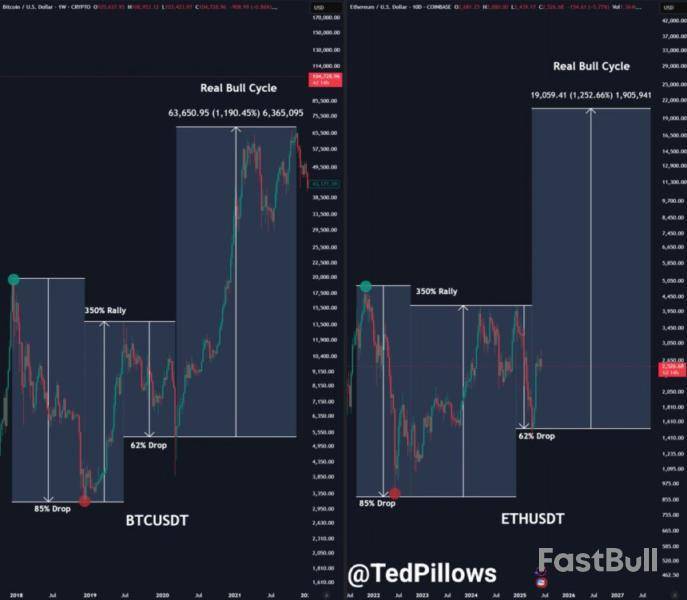
Top analyst Ted Pillows shared a technical outlook, pointing out that Ethereum is mirroring the same consolidation pattern that Bitcoin followed during its 2017–2021 cycle. In that historical setup, BTC compressed into a tight range before entering a parabolic rally once the upper boundary was broken. If Ethereum follows a similar path, the next move could be dramatic, especially if it clears major resistance levels like $2,800.
As long as ETH holds range support and absorbs both upside and downside wicks, this setup remains intact. A breakout above the current range could ignite a fresh leg up for Ethereum—and possibly spark renewed strength across the altcoin market.
Ethereum Builds Momentum As Market Awaits Clarity
Ethereum is currently trading in a tight range, consolidating just above the $2,600 level and holding firm despite macroeconomic and geopolitical headwinds. After rallying nearly 80% from its April lows, ETH appears to be preparing for a decisive move in the coming sessions. However, with escalating tensions between Israel and Iran and uncertainty surrounding possible U.S. involvement, broader markets remain cautious. Until clarity emerges on the geopolitical front, sideways price action may persist.
Still, Ethereum’s price structure remains constructive. Strong consolidation above key demand zones reflects ongoing buyer interest and a lack of heavy selling pressure. This behavior often precedes major moves, as investors accumulate ahead of expected volatility. Some market participants remain cautious, warning of a possible retrace below the $2,400 level if demand falters or broader risk sentiment weakens.
In contrast, bullish analysts like Ted Pillows suggest a more optimistic outlook. According to Pillows, Ethereum is closely following the path Bitcoin took during its 2017–2021 cycle, where tight consolidation ultimately led to a breakout and parabolic rally. In this view, ETH’s real explosive phase won’t begin until it breaks above $4,000. If this scenario plays out, Ethereum could trigger a broader altcoin surge and shift overall crypto market sentiment bullish once again.
ETH Technical Analysis: Consolidation Near Key Levels
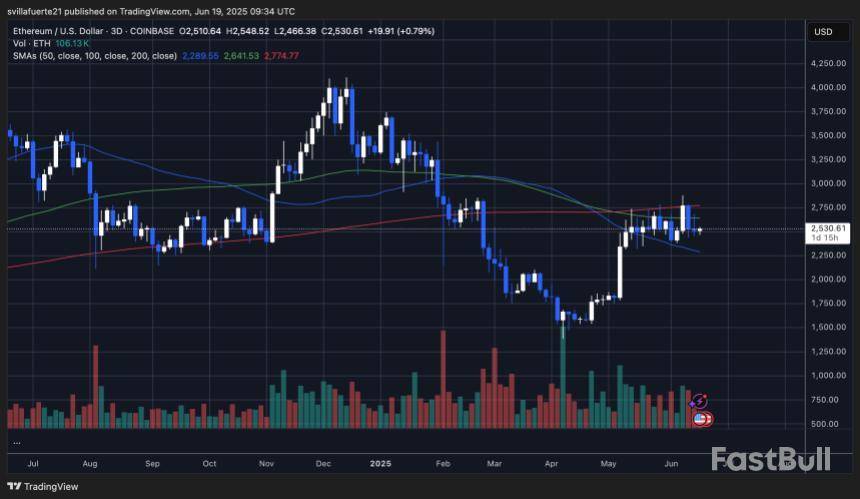
The 3-day Ethereum chart shows a prolonged consolidation phase as ETH trades near the $2,500 mark. Despite geopolitical uncertainty and rising macroeconomic risks, Ethereum has held above the $2,400 support zone, forming a tight range just below the critical resistance at $2,775. This area also coincides with the 200-day SMA (red line), which continues to cap upward momentum.
ETH remains above the 50-day (blue) and 100-day (green) SMAs, suggesting bullish momentum is intact, though lacking follow-through. The recent candle bodies show decreasing volatility, with wicks on both sides being absorbed—a classic sign of compression that often precedes a large move.
Related Reading: Ethereum Golden Cross Approaching – Will History Repeat?
Volume has declined slightly compared to the breakout in early May, indicating a temporary pause in bullish conviction. However, if Ethereum manages a higher close above the $2,775 resistance, it could trigger an impulsive breakout targeting the $3,000 level. On the downside, a break below $2,400 would invalidate the current structure and expose ETH to a deeper correction toward $2,100.
Featured image from Dall-E, chart from TradingView
Bitcoin is showing some early signs of weakness on the daily chart, with a potential death cross formation looming between its 23-day and 50-day moving averages. The pattern with ominous naming could pull the price of the major cryptocurrency toward the 200-day moving average, which is currently stretching at $95,868.
For now, the Bitcoin price is just above the $100,000 psychological threshold, but there is clearly some pressure building up. The 23-day moving average is starting to dip and might cross below the slower 50-day trend line soon, which is a bearish sign historically linked to downward momentum.
As of Thursday, the price was around $104,000, but the chart shows a drop of about -8% from recent levels. If the death cross happens, Bitcoin could test the zone between $95,700 and $96,000, right in line with its 200-day moving average. This average is a longer-term support level and could be a battleground for bulls and bears.TradingView">
The key level to keep an eye on in the short term is around $99,000, which is a line that aligns with short-term support. Should the price of BTC close below this level, a decline could speed up toward the 200-day average.
Sentiment is still linked to macro uncertainty and ETF flows, so any sudden weakness could speed up the technical setup into an actual death cross within days.
While the bulls might still try to defend the six-figure mark, the charts are sending a warning. Bitcoin at $100K is now at risk, and the technical floor is slipping lower.
XRP continues to trade within a tight consolidation range while Bitcoin and Ethereum dominate recent market headlines. Despite lacking strong bullish momentum, XRP’s price action shows resilience, holding key support zones across both USDT and BTC pairs.
However, both charts suggest that the asset is nearing critical inflection points, where a breakdown or breakout could define the next major move.Technical Analysis
By ShayanMarketsThe USDT Pair
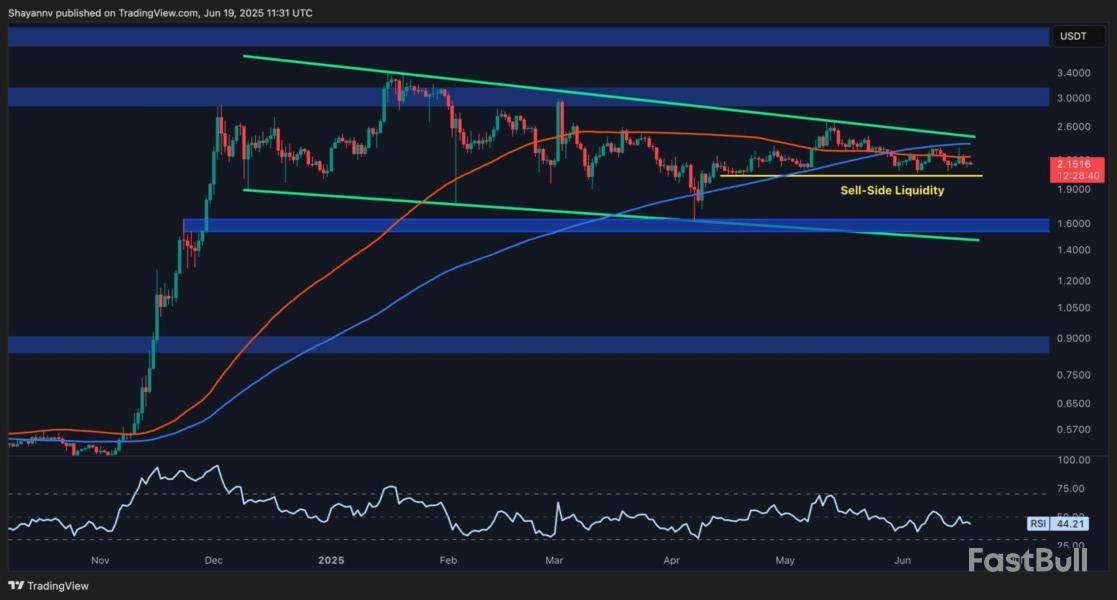
On the daily chart, XRP/USDT remains compressed within a long-term descending channel pattern, bounded by a descending trendline from the yearly highs and a horizontal support near $1.95, with tons of sell-side liquidity resting under it.
The pair is currently trading around $2.15, just under both the 100 and 200 moving averages. The RSI is also hovering near 44, indicating the lack of momentum and confirming the range-bound behavior. The asset is currently coiling just above the highlighted liquidity level, suggesting that if sellers manage to breach $1.95, the next logical demand zone lies around $1.6.
Meanwhile, upside resistance remains at the upper bound of the channel near $2.60, which has rejected multiple attempts in recent weeks. A clean break and daily close above that trendline would potentially confirm a bullish rally, with the target being around $3. Until then, this is still a neutral structure favoring range traders rather than trend-followers.
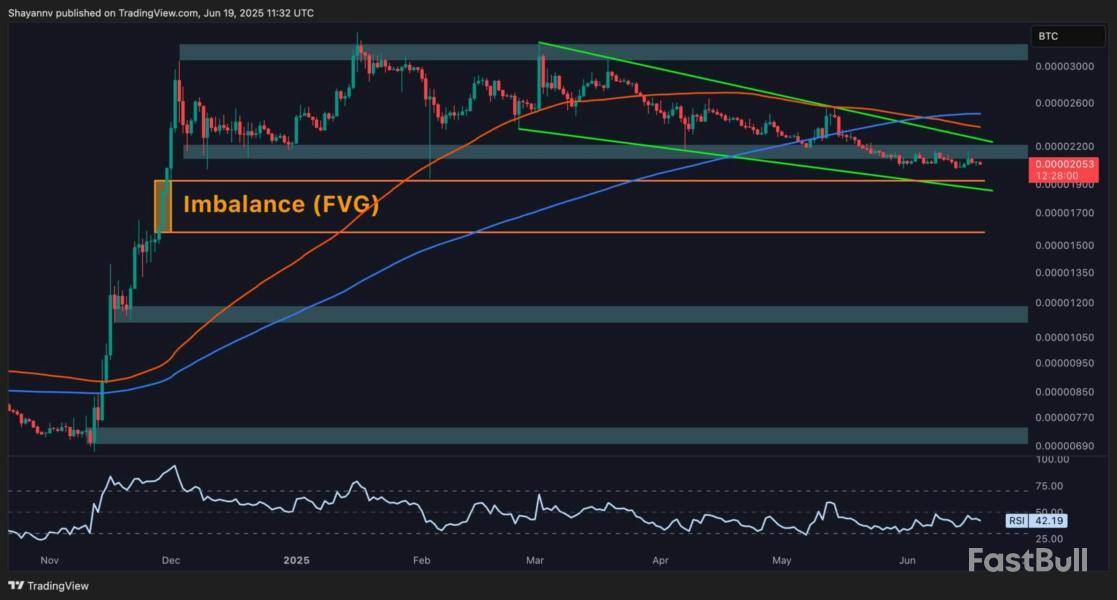
Against Bitcoin, XRP has shown persistent weakness since March, consistently printing lower highs and lower lows. The chart highlights a large descending wedge formation, with price now moving toward the lower boundary of the pattern. Both the 100 and 200 moving averages are angled downward after a bearish crossover, and the RSI is still depressed near 42, reflecting ongoing relative underperformance.
That said, the pair is approaching the imbalance zone (FVG) left from the explosive rally in late 2024. This pocket, located just below 1900 SAT, could act as a magnet for price while also offering potential for a relief bounce. If the buyers step in, the first challenge lies near the higher trendline of the wedge around 2200 SAT, which coincides with a horizontal resistance level.
A decisive move above that level could shift short-term momentum, but unless that happens, the pair remains locked in a clear bearish structure.
Opinion by: Badi Sudhakaran, co-founder, VALR
Finance, as we know it, leaves far too many behind. This exclusion isn’t just about access to banking or financial services — it’s about dignity.
When people can’t preserve their wealth or understand why their money loses value, they lose more than just purchasing power. They lose agency over their lives.
Fortunately, the democratized nature of crypto offers a silver lining and a redemption arc for people. It’s a way of fighting to get back what inflation has stolen.
When “money” means more than just “money”
Crypto offers a path to restore lost dignity through financial education and inclusion, which the current banking system often fails to deliver. While Bitcoin’s price movements may grab headlines, the value lies in something more fundamental: knowledge.
When people engage with cryptocurrency, they begin asking essential questions. Why does money have value? How do financial systems work? What causes inflation?
Knowledge, as the Bahá’í Writings note, becomes “a veritable treasure for man and a source of glory.” We must, however, acknowledge crypto’s challenges. The same technology that promises liberation can become another tool for exclusion.
For many, crypto has devolved into a speculative playground, while complex interfaces and technical jargon create new barriers for those lacking technical competence. Industry participants often prioritize profit over education, exposing new and vulnerable users to risks they don’t fully comprehend.
Learning from the ground up
A more honest path forward for blockchain lies in building systems prioritizing human understanding over transaction speed and community benefit over individual gain. Technology alone cannot deliver dignity. It must be paired with responsible development and meaningful education.
True financial dignity comes from the applied combination of knowledge and agency. It’s visible when a grandmother in rural India uses a crypto wallet over a bank-backed digital payments app because she understands its purpose and message, not because someone told her to. It emerges when a young entrepreneur in Johannesburg can participate in the global economy equally, knowing precisely what they’re doing and why.
What’s particularly striking is how this knowledge spreads through communities. A small study group of crypto users could quickly evolve into a local knowledge hub, where experienced users mentor newcomers, sharing technical skills and financial wisdom passed down through generations. This kind of inclusivity is common throughout blockchain circles.
Recent: A Bitcoiner’s guide to South Africa’s Garden Route
Grassroots and community-led initiatives often prove more effective than formal training programs because they root new technology in a local context and cultural understanding. When it is a community delivering the education to its own people, the knowledge is passed on with greater dignity and respect.
Building human-first systems
The crypto industry’s tendency toward hype and speculation threatens to overshadow these more profound benefits. We need platforms that speak human language, not tech jargon. We need systems that protect as they empower and communities that support as they grow. This means rethinking how we design crypto platforms from the ground up.
Instead of starting with technical capabilities, we should begin by asking human questions. How do people in different communities understand and use money? What are their fears and aspirations? What cultural factors influence their financial decisions?
By embedding these human insights into our technical solutions, we can only create systems that truly serve everyone, not just the technically savvy or financially privileged. If we fail to address valid concerns about accessibility and regulations, the skeptics who dismiss crypto will only be given more fuel.
Wealth isn’t just money; it’s knowledge, dignity and connection. At its best, crypto embodies these values. It’s more than a technology. It’s a tool to empower, educate and unite.
The industry should champion truthfulness and excellence, ensuring crypto serves all, not a privileged few. A future where money, at last, means something more.
Opinion by: Badi Sudhakaran, co-founder, VALR.
This article is for general information purposes and is not intended to be and should not be taken as legal or investment advice. The views, thoughts, and opinions expressed here are the author’s alone and do not necessarily reflect or represent the views and opinions of Cointelegraph.
White Label
Data API
Web Plug-ins
Poster Maker
Affiliate Program
The risk of loss in trading financial instruments such as stocks, FX, commodities, futures, bonds, ETFs and crypto can be substantial. You may sustain a total loss of the funds that you deposit with your broker. Therefore, you should carefully consider whether such trading is suitable for you in light of your circumstances and financial resources.
No decision to invest should be made without thoroughly conducting due diligence by yourself or consulting with your financial advisors. Our web content might not suit you since we don't know your financial conditions and investment needs. Our financial information might have latency or contain inaccuracy, so you should be fully responsible for any of your trading and investment decisions. The company will not be responsible for your capital loss.
Without getting permission from the website, you are not allowed to copy the website's graphics, texts, or trademarks. Intellectual property rights in the content or data incorporated into this website belong to its providers and exchange merchants.
Not Logged In
Log in to access more features

FastBull Membership
Not yet
Purchase
Log In
Sign Up