• Trade
  • Markets
  • Copy
  • Contests
  • News
  • 24/7
  • Calendar
  • Q&A
  • Chats
Trending
Screeners
SYMBOL
LAST
BID
ASK
HIGH
LOW
NET CHG.
%CHG.
SPREAD
SPX
S&P 500 Index
6827.42
6827.42
6827.42
6899.86
6801.80
-73.58
-1.07%
--
DJI
Dow Jones Industrial Average
48458.04
48458.04
48458.04
48886.86
48334.10
-245.98
-0.51%
--
IXIC
NASDAQ Composite Index
23195.16
23195.16
23195.16
23554.89
23094.51
-398.69
-1.69%
--
USDX
US Dollar Index
97.950
98.030
97.950
98.500
97.950
-0.370
-0.38%
--
EURUSD
Euro / US Dollar
1.17394
1.17409
1.17394
1.17496
1.17192
+0.00011
+ 0.01%
--
GBPUSD
Pound Sterling / US Dollar
1.33707
1.33732
1.33707
1.33997
1.33419
-0.00148
-0.11%
--
XAUUSD
Gold / US Dollar
4299.39
4299.39
4299.39
4353.41
4257.10
+20.10
+ 0.47%
--
WTI
Light Sweet Crude Oil
57.233
57.485
57.233
58.011
56.969
-0.408
-0.71%
--

Community Accounts

Signal Accounts
--
Profit Accounts
--
Loss Accounts
--
View More

Become a signal provider

Sell trading signals to earn additional income

View More

Guide to Copy Trading

Get started with ease and confidence

View More

Signal Accounts for Members

All Signal Accounts

Best Return
  • Best Return
  • Best P/L
  • Best MDD
Past 1W
  • Past 1W
  • Past 1M
  • Past 1Y

All Contests

  • All
  • Trump Updates
  • Recommend
  • Stocks
  • Cryptocurrencies
  • Central Banks
  • Featured News
Top News Only
Share

Norwegian Nobel Committee: Calls On The Belarusian Authorities To Release All Political Prisoners

Share

Norwegian Nobel Committee: His Freedom Is A Deeply Welcome And Long-Awaited Moment

Share

Ukraine Says It Received 114 Prisoners From Belarus

Share

USA Embassy In Lithuania: Maria Kalesnikava Is Not Going To Vilnius

Share

USA Embassy In Lithuania: Other Prisoners Are Being Sent From Belarus To Ukraine

Share

Ukraine President Zelenskiy: Five Ukrainians Released By Belarus In US-Brokered Deal

Share

USA Vilnius Embassy: USA Stands Ready For "Additional Engagement With Belarus That Advances USA Interests"

Share

USA Vilnius Embassy: Belarus, USA, Other Citizens Among The Prisoners Released Into Lithuania

Share

USA Vilnius Embassy: USA Will Continue Diplomatic Efforts To Free The Remaining Political Prisoners In Belarus

Share

USA Vilnius Embassy: Belarus Releases 123 Prisoners Following Meeting Of President Trump's Envoy Coale And Belarus President Lukashenko

Share

USA Vilnius Embassy: Masatoshi Nakanishi, Aliaksandr Syrytsa Are Among The Prisoners Released By Belarus

Share

USA Vilnius Embassy: Maria Kalesnikava And Viktor Babaryka Are Among The Prisoners Released By Belarus

Share

USA Vilnius Embassy: Nobel Peace Prize Laureate Ales Bialiatski Is Among The Prisoners Released By Belarus

Share

Belarusian Presidential Administration Telegram Channel: Lukashenko Has Pardoned 123 Prisoners As Part Of Deal With US

Share

Two Local Syrian Officials: Joint US-Syrian Military Patrol In Central Syria Came Under Fire From Unknown Assailants

Share

Israeli Military Says It Targeted 'Key Hamas Terrorist' In Gaza City

Share

Rwanda's Actions In Eastern Drc Are A Clear Violation Of Washington Accords Signed By President Trump - Secretary Of State Rubio

Share

Israeli Military Issues Evacuation Warning In Southern Lebanon Village Ahead Of Strike - Spokesperson On X

Share

Belarusian State Media Cites US Envoy Coale As Saying He Discussed Ukraine And Venezuela With Lukashenko

Share

Belarusian State Media Cites US Envoy Coale As Saying That US Removes Sanctions On Belarusian Potassium

TIME
ACT
FCST
PREV
U.K. Trade Balance Non-EU (SA) (Oct)

A:--

F: --

P: --

U.K. Trade Balance (Oct)

A:--

F: --

P: --

U.K. Services Index MoM

A:--

F: --

P: --

U.K. Construction Output MoM (SA) (Oct)

A:--

F: --

P: --

U.K. Industrial Output YoY (Oct)

A:--

F: --

P: --

U.K. Trade Balance (SA) (Oct)

A:--

F: --

P: --

U.K. Trade Balance EU (SA) (Oct)

A:--

F: --

P: --

U.K. Manufacturing Output YoY (Oct)

A:--

F: --

P: --

U.K. GDP MoM (Oct)

A:--

F: --

P: --

U.K. GDP YoY (SA) (Oct)

A:--

F: --

P: --

U.K. Industrial Output MoM (Oct)

A:--

F: --

P: --

U.K. Construction Output YoY (Oct)

A:--

F: --

P: --

France HICP Final MoM (Nov)

A:--

F: --

P: --

China, Mainland Outstanding Loans Growth YoY (Nov)

A:--

F: --

P: --

China, Mainland M2 Money Supply YoY (Nov)

A:--

F: --

P: --

China, Mainland M0 Money Supply YoY (Nov)

A:--

F: --

P: --

China, Mainland M1 Money Supply YoY (Nov)

A:--

F: --

P: --

India CPI YoY (Nov)

A:--

F: --

P: --

India Deposit Gowth YoY

A:--

F: --

P: --

Brazil Services Growth YoY (Oct)

A:--

F: --

P: --

Mexico Industrial Output YoY (Oct)

A:--

F: --

P: --

Russia Trade Balance (Oct)

A:--

F: --

P: --

Philadelphia Fed President Henry Paulson delivers a speech
Canada Building Permits MoM (SA) (Oct)

A:--

F: --

P: --

Canada Wholesale Sales YoY (Oct)

A:--

F: --

P: --

Canada Wholesale Inventory MoM (Oct)

A:--

F: --

P: --

Canada Wholesale Inventory YoY (Oct)

A:--

F: --

P: --

Canada Wholesale Sales MoM (SA) (Oct)

A:--

F: --

P: --

Germany Current Account (Not SA) (Oct)

A:--

F: --

P: --

U.S. Weekly Total Rig Count

A:--

F: --

P: --

U.S. Weekly Total Oil Rig Count

A:--

F: --

P: --

Japan Tankan Large Non-Manufacturing Diffusion Index (Q4)

--

F: --

P: --

Japan Tankan Small Manufacturing Outlook Index (Q4)

--

F: --

P: --

Japan Tankan Large Non-Manufacturing Outlook Index (Q4)

--

F: --

P: --

Japan Tankan Large Manufacturing Outlook Index (Q4)

--

F: --

P: --

Japan Tankan Small Manufacturing Diffusion Index (Q4)

--

F: --

P: --

Japan Tankan Large Manufacturing Diffusion Index (Q4)

--

F: --

P: --

Japan Tankan Large-Enterprise Capital Expenditure YoY (Q4)

--

F: --

P: --

U.K. Rightmove House Price Index YoY (Dec)

--

F: --

P: --

China, Mainland Industrial Output YoY (YTD) (Nov)

--

F: --

P: --

China, Mainland Urban Area Unemployment Rate (Nov)

--

F: --

P: --

Saudi Arabia CPI YoY (Nov)

--

F: --

P: --

Euro Zone Industrial Output YoY (Oct)

--

F: --

P: --

Euro Zone Industrial Output MoM (Oct)

--

F: --

P: --

Canada Existing Home Sales MoM (Nov)

--

F: --

P: --

Euro Zone Total Reserve Assets (Nov)

--

F: --

P: --

U.K. Inflation Rate Expectations

--

F: --

P: --

Canada National Economic Confidence Index

--

F: --

P: --

Canada New Housing Starts (Nov)

--

F: --

P: --

U.S. NY Fed Manufacturing Employment Index (Dec)

--

F: --

P: --

U.S. NY Fed Manufacturing Index (Dec)

--

F: --

P: --

Canada Core CPI YoY (Nov)

--

F: --

P: --

Canada Manufacturing Unfilled Orders MoM (Oct)

--

F: --

P: --

Canada Manufacturing New Orders MoM (Oct)

--

F: --

P: --

Canada Core CPI MoM (Nov)

--

F: --

P: --

Canada Manufacturing Inventory MoM (Oct)

--

F: --

P: --

Canada CPI YoY (Nov)

--

F: --

P: --

Canada CPI MoM (Nov)

--

F: --

P: --

Canada CPI YoY (SA) (Nov)

--

F: --

P: --

Canada Core CPI MoM (SA) (Nov)

--

F: --

P: --

Q&A with Experts
    • All
    • Chatrooms
    • Groups
    • Friends
    Connecting
    .
    .
    .
    Type here...
    Add Symbol or Code

      No matching data

      All
      Trump Updates
      Recommend
      Stocks
      Cryptocurrencies
      Central Banks
      Featured News
      • All
      • Russia-Ukraine Conflict
      • Middle East Flashpoint
      • All
      • Russia-Ukraine Conflict
      • Middle East Flashpoint
      Search
      Products

      Charts Free Forever

      Chats Q&A with Experts
      Screeners Economic Calendar Data Tools
      Membership Features
      Data Warehouse Market Trends Institutional Data Policy Rates Macro

      Market Trends

      Market Sentiment Order Book Forex Correlations

      Top Indicators

      Charts Free Forever
      Markets

      News

      News Analysis 24/7 Columns Education
      From Institutions From Analysts
      Topics Columnists

      Latest Views

      Latest Views

      Trending Topics

      Top Columnists

      Latest Update

      Signals

      Copy Rankings Latest Signals Become a signal provider AI Rating
      Contests
      Brokers

      Overview Brokers Assessment Rankings Regulators News Claims
      Broker listing Forex Brokers Comparison Tool Live Spread Comparison Scam
      Q&A Complaint Scam Alert Videos Tips to Detect Scam
      More

      Business
      Events
      Careers About Us Advertising Help Center

      White Label

      Data API

      Web Plug-ins

      Affiliate Program

      Awards Institution Evaluation IB Seminar Salon Event Exhibition
      Vietnam Thailand Singapore Dubai
      Fans Party Investment Sharing Session
      FastBull Summit BrokersView Expo
      Recent Searches
        Top Searches
          Markets
          News
          Analysis
          User
          24/7
          Economic Calendar
          Education
          Data
          • Names
          • Latest
          • Prev

          View All

          No data

          Scan to Download

          Faster Charts, Chat Faster!

          Download App
          English
          • English
          • Español
          • العربية
          • Bahasa Indonesia
          • Bahasa Melayu
          • Tiếng Việt
          • ภาษาไทย
          • Français
          • Italiano
          • Türkçe
          • Русский язык
          • 简中
          • 繁中
          Open Account
          Search
          Products
          Charts Free Forever
          Markets
          News
          Signals

          Copy Rankings Latest Signals Become a signal provider AI Rating
          Contests
          Brokers

          Overview Brokers Assessment Rankings Regulators News Claims
          Broker listing Forex Brokers Comparison Tool Live Spread Comparison Scam
          Q&A Complaint Scam Alert Videos Tips to Detect Scam
          More

          Business
          Events
          Careers About Us Advertising Help Center

          White Label

          Data API

          Web Plug-ins

          Affiliate Program

          Awards Institution Evaluation IB Seminar Salon Event Exhibition
          Vietnam Thailand Singapore Dubai
          Fans Party Investment Sharing Session
          FastBull Summit BrokersView Expo

          China Floods the World With Cheap Exports After Trump’s Tariffs

          Adam

          Economic

          Summary:

          China’s exports surged despite U.S. tariffs, pushing a \$1.2T surplus as sales to India, Africa, and Southeast Asia hit records. Most nations avoid retaliation, giving Beijing room to expand.
          President Xi Jinping’s export engine has proved unstoppable during five months of sky-high US tariffs, sending China toward a record $1.2 trillion trade surplus.
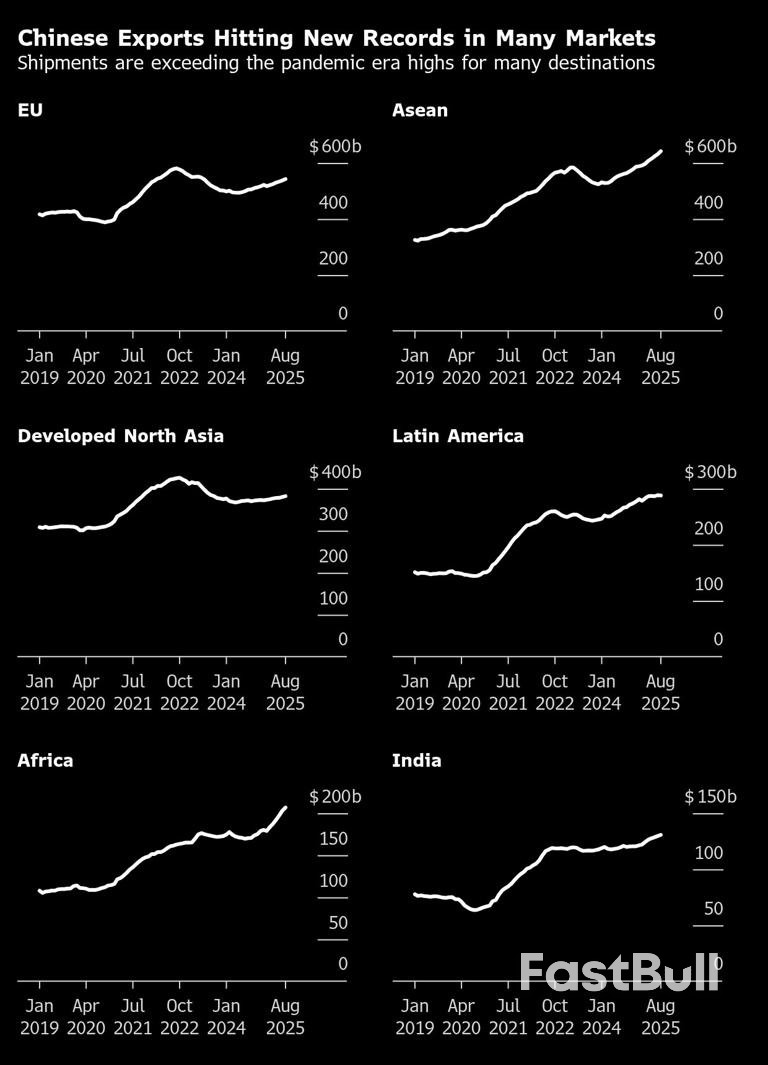
          With access to the US curtailed, Chinese manufacturers have shown they aren't backing down: Indian purchases hit an all-time high in August, shipments to Africa are on track for an annual record and sales to Southeast Asia have exceeded their pandemic-era peak.
          That across-the-board surge is causing alarm abroad, as governments weigh the potential damage to their domestic industries against the risk of antagonizing Beijing — the top trading partner for over half the planet.
          China Floods the World With Cheap Exports After Trump’s Tariffs_1

          Chinese Exports Hitting New Records in Many Markets | Shipments are exceeding the pandemic era highs for many destinations

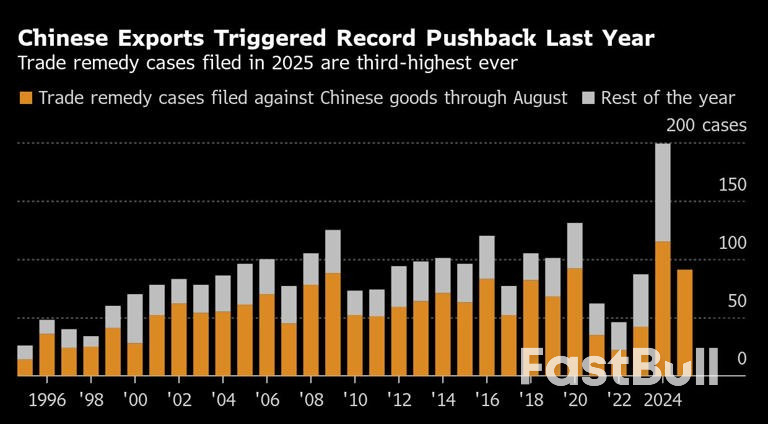
          While so far only Mexico has hit back publicly this year — floating tariffs as high as 50% on Chinese products including cars, auto parts and steel -- other countries are coming under increasing pressure to act. Indian authorities have received 50 applications in recent weeks for investigations into goods dumping from nations including China and Vietnam, according to a person familiar with the matter who asked not to be identified as the information isn’t public. Indonesia’s trade minister pledged to monitor a deluge of goods, after viral videos of Chinese vendors touting plans to export jeans and shirts for as little as 80 US cents to major cities caused an outcry.
          For all the pain, the chances of more meaningful action are limited. Countries already embroiled in tariff negotiations with the Trump administration appear reluctant to take on a separate trade war with the world’s second-largest economy. That’s giving Beijing breathing room from US levies at heights economists previously predicted would halve the nation's annual growth rate.
          “The subdued response is probably informed by ongoing US trade negotiations,” said Christopher Beddor, deputy China research director at Gavekal Dragonomics. “Some countries may not want to be seen as contributing to a breakdown in the global trading system. Some may also be holding back on tariffs against China in order to offer them as concessions to the US during their own trade negotiations.”
          Officials shielding their economies from Beijing are treading carefully. South Africa’s trade minister has advised against punitive tariffs on Chinese car exports — which nearly doubled this year — and is instead seeking more investment. Chile and Ecuador are quietly imposing targeted fees on low-cost imports, after Chinese e-commerce giant Temu’s monthly active users in Latin America soared 143% since January. While Brazil has threatened more aggressive retaliation, this summer it gave China’s biggest electric car maker, BYD Co Ltd, a tariff-free window to ramp up local production.
          Beijing is using both diplomatic charm and economic threats to prevent countries from taking outright retaliation. Earlier this month, China’s president rallied BRICS nations to forge a united voice against protectionism during a leaders’ call of the bloc, while Commerce Ministry officials have warned Mexico to “think twice” before acting, making clear such steps will have recriminations. Adding to the risks, Trump is pressuring NATO nations to impose tariffs up to 100% on China over its support for Russia.
          said in July. The state-run People’s Daily newspaper on its social media account last month hit back against Western criticisms of “dumping,” arguing that China’s exporters don’t sell below cost.
          If Trump does corral other countries to gang up on China, it’ll make dealing with internal challenges such as a prolonged property crash and an aging population harder, according to Chang Shu and David Qu of Bloomberg Economics. “Beijing will likely hit back with reciprocal tariffs immediately, but that risks alienating partners at a time when it critically needs allies,” they said. “Over time, it may also encourage firms to localize production in partner countries.”
          China Floods the World With Cheap Exports After Trump’s Tariffs_2

          Chinese Exports Triggered Record Pushback Last Year | Trade remedy cases filed in 2025 are third-highest ever

          While Chinese exporters are defying the odds, surging trade isn’t making them richer — or helping the nation’s domestic issues. Profits at industrial firms fell 1.7% in the first seven months, as manufacturers trying to reduce overcapacity at home under Xi’s “anti-involution” drive slashed prices to sell more overseas. That’s only worsening China’s sticky deflation, on track for its longest spell since the country began opening up in the late 1970s.
          The export explosion could also undermine Beijing’s efforts to rebalance its economy toward stimulating consumption — defying foreign officials such as US Treasury Secretary Scott Bessent, who has urged Beijing to make boosting the Chinese consumer a pillar of its blueprint for the next half-decade. China’s policy document outlining those plans will be in focus in the coming weeks at a key Communist Party meeting.
          For Xi, the risks might just be worthwhile. Showing the world China doesn’t need the US consumer strengthens his hand going into a high-stakes meeting with Trump at a summit in South Korea. The world’s biggest economies are still hashing out a possible trade deal, with a 90-day pause on tariffs as high as 145% currently keeping the peace.
          China Floods the World With Cheap Exports After Trump’s Tariffs_3

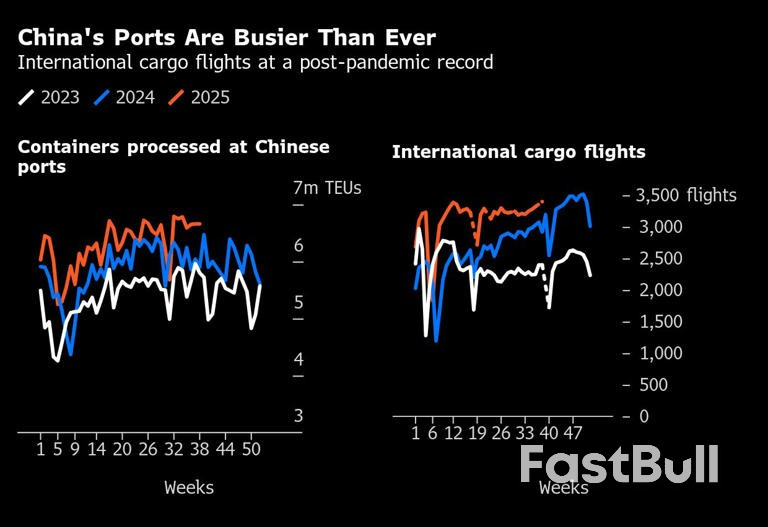
          China's Ports Are Busier Than Ever | International cargo flights at a post-pandemic record

          China Shock 2.0
          Even before Trump stunned the world with America’s steepest tariffs since World War II in April, emerging markets at risk of shedding millions of manufacturing jobs were worried about a glut of Chinese goods. Indonesia’s previous president threatened a 200% tariff to protect local industry, while Brazil has hiked duties on Chinese steel. Even Vietnam took temporary action against Chinese online retail giants that undercut local sellers.
          Ultimately, it’s been hard for foreign leaders to protect their economies from China’s vast fleet of factories.
          “Protectionism from the US and other countries has turned into a paper tiger because Chinese exporters are extremely competitive,” said Arthur Kroeber, head of research at Gavekal Dragonomics. They “can absorb some of the tariff hit and also have plenty of workarounds through transshipment and relocating late-stage production to lower-tariff countries.”
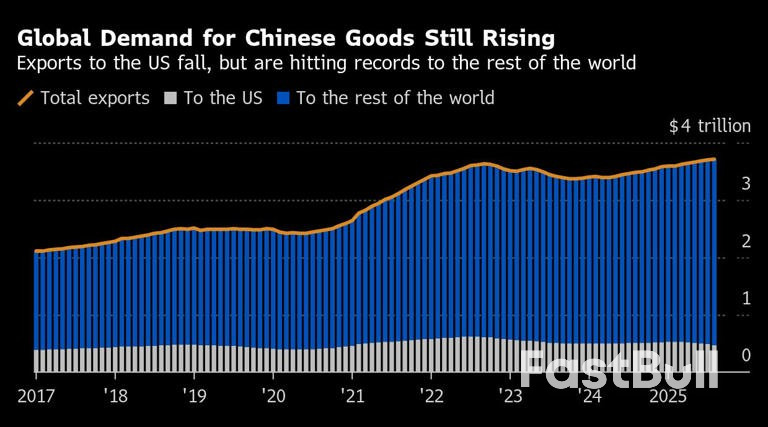
          China’s trade surplus last year was almost $1 trillion and is on track to exceed that in 2025, based on Bloomberg calculations.
          China Floods the World With Cheap Exports After Trump’s Tariffs_4

          Global Demand for Chinese Goods Still Rising | Exports to the US fall, but are hitting records to the rest of the world

          Cambodia’s central bank governor Chea Serey was candid about the balancing act smaller economies reliant on Beijing are having to perform. “We do import a lot from China,” she told Bloomberg Television earlier this month, when asked about Chinese dumping. “We also rely a lot in terms of foreign direct investment from China.”
          While a rise in shipments to Vietnam suggests some goods destined for US shores and other places are being re-routed to bypass Trump’s wall of tariffs, that’s only part of the picture. Demand for China’s world-beating, high-tech innovations helped drive much of the recent traffic. Rising sales to wealthy markets in Europe and Australia also indicate Beijing simply found new buyers for many products.
          India shows how Trump’s redrawing of the global trade map is benefiting Beijing in new ways. Exports to China’s neighbor hit a record $12.5 billion last month, driven largely by Apple Inc.’s suppliers rapidly shifting output of iPhones to India from its Asian neighbor. Those companies, however, still depend on parts and tooling made mostly in China.
          In July, Chinese firms shipped almost $1 billion worth of computer chips to India and billions of dollars more worth of phones and parts, according to data released by Beijing. That puts exports on track to exceed last year’s record, with the value of shipments so far this year almost as large as the whole of 2021.
          “China has performed better than expected in the first half,” JPMorgan Chase & Co.’s chief India economist Sajjid Chinoy told Bloomberg Television. “Some of this is the fact that China has very cleverly found other export markets, including Europe, which has been a key hedge to slowing exports to the US.”

          Source:Bloomberg

          To stay updated on all economic events of today, please check out our Economic calendar
          Risk Warnings and Disclaimers
          You understand and acknowledge that there is a high degree of risk involved in trading. Following any strategies or investment methods may lead to potential losses. The content on the site is provided by our contributors and analysts for information purposes only. You are solely responsible for determining whether any trading assets, securities, strategy, or any other product is suitable for investing based on your own investment objectives and financial situation.
          Add to Favorites
          Share

          Bank of Canada Head: Trump is Raising Questions About Independence of US Monetary Policy

          Manuel

          Central Bank

          Political

          President Donald Trump's actions are raising questions about the continued independence of U.S. monetary policy and have also dented the safe haven appeal of the U.S. dollar, Bank of Canada Governor Tiff Macklem said on Tuesday.
          The observations mark the first time Macklem has commented on Trump's attempts to influence the Federal Reserve.
          In the last few months, Trump has cranked up his demands for a rate cut, tried to remove one of the Fed's governors and repeatedly insisted that chair Jerome Powell resign.
          "President Trump's attempts to influence the Federal Reserve are raising questions about the continued independence of U.S. monetary policy," Macklem told the Saskatoon Chamber of Commerce in the western province of Saskatchewan.
          Macklem said the new global uncertainty, triggered in part by tariffs, underscored the need for Canada to boost productivity and find new foreign markets.
          "The question now is whether U.S. dominance in global financial flows will ebb as the United States pulls back from trade and runs large fiscal deficits. The recent performance of the U.S. dollar may be telling us something," he said.
          The greenback, he noted, was losing its appeal, falling almost 10% since Trump unleashed a barrage of tariffs globally in April. This, Macklem said, had called the dollar's safe haven role into question.
          "For now, the greenback remains dominant, and — without a clear alternative — I suspect it will remain the global reserve currency for the foreseeable future. But for many, its value as a hedge in times of stress has been dented," he said.
          He said the shifting trade equation with the U.S. had immense ramifications for Canada.
          "We can't afford to wait this out," he said, adding that Canadian businesses as well as political and economic leaders would need to chart a new course.
          "We should have been making these changes 15 years ago. But the next best time is now," he said.
          Canada has long suffered from anemic productivity which economists and businesses say is helping fuel inflation.
          "We need to diversify our trade by growing our internal market and finding new overseas markets. And we need to improve our productivity and make ourselves more attractive to investors," Macklem said.
          Canada's economy will work less efficiently, costs will go up and incomes will shrink due to increased trade friction with the U.S., he said, but noted monetary policy would not be able to soften these impacts.
          "Monetary policy cannot undo the efficiency costs of U.S. tariffs ... nor can counter-cyclical fiscal stimulus," he said, adding that only positive structural reform could offset that.

          Source: Reuters

          Risk Warnings and Disclaimers
          You understand and acknowledge that there is a high degree of risk involved in trading. Following any strategies or investment methods may lead to potential losses. The content on the site is provided by our contributors and analysts for information purposes only. You are solely responsible for determining whether any trading assets, securities, strategy, or any other product is suitable for investing based on your own investment objectives and financial situation.
          Add to Favorites
          Share

          Trump's Approval Dips As Americans Worry About Economy, Reuters/Ipsos Poll Finds

          Kevin Du

          Economic

          President Donald Trump's approval ticked slightly lower in recent weeks as Americans worried about the health of the U.S. economy and the Republican's ability to contain rising prices, according to a new Reuters/Ipsos poll.

          The three-day poll, which closed on Sunday, showed 41% of respondents approved of Trump's performance as president, down from 42% in a September 5-9 poll.

          Some 54% of people surveyed said the national economy was on the wrong track, up from 53% in an August poll and 52% in July.

          Only 35% of poll respondents approved of Trump's stewardship over the economy, and 28% gave him a thumbs up on his handling of their cost of living, with both readings slightly lower than in previous polls. Trump returned to the White House this year after promising in his election campaign last year to fix the economy.

          U.S. job growth weakened sharply in August when the unemployment rate rose to a nearly four-year high at 4.3%, while inflation also accelerated last month.

          Public concerns over the economy were higher earlier in the year when Trump was threatening to aggressively impose tariffs on imported goods, sparking sharp declines in stock market values.

          AMERICANS SPLIT ON TACKLING EXTREMISM

          Following this month's assassination of conservative activist Charlie Kirk, Trump has focused much of his rhetoric on the alleged danger his political opponents pose for the nation, telling a Kirk memorial on Sunday that "the violence comes largely from the left."

          Reuters/Ipsos polls this year have persistently shown that Americans view political extremism as the country's biggest problem. Some 28% of respondents in the most recent poll picked it as the top issue, compared to 16% who picked the economy. Asked which party had a better plan for tackling extremism, poll respondents were split almost evenly, with 30% picking Republicans, 26% saying Democrats were better and the rest saying either neither was better or they weren't sure.

          While the economy has weighed on Trump's approval ratings, poll respondents more often picked the Republican Party over the Democratic Party - 34% to 24% - for managing economic policy.

          Trump's approval rating continues to be buoyed by the relative popularity of his immigration policies, which include mass arrests of people suspected of not being in the country legally. Some 42% of poll respondents gave Trump a thumbs up on immigration, unchanged from earlier this month. It was Trump's highest rating on any single issue in the Reuters/Ipsos poll.

          The poll of 1,019 people was conducted online and nationwide. It had a margin of error of 3 percentage points. Beginning this month, Reuters/Ipsos polls have included a slight methodological change, no longer giving respondents the option to say they were “not sure” about whether they approved or disapproved of the president’s overall job performance.

          Source: Reuters

          To stay updated on all economic events of today, please check out our Economic calendar
          Risk Warnings and Disclaimers
          You understand and acknowledge that there is a high degree of risk involved in trading. Following any strategies or investment methods may lead to potential losses. The content on the site is provided by our contributors and analysts for information purposes only. You are solely responsible for determining whether any trading assets, securities, strategy, or any other product is suitable for investing based on your own investment objectives and financial situation.
          Add to Favorites
          Share

          U.S. and global growth forecast lifted by OECD as economies surprise to the upside

          Adam

          Economic

          The Organisation for Economic Co-operation and Development upgraded its global economic growth forecast on Tuesday, with many economies appearing more resilient than expected so far this year.
          The OECD now expects global growth of 3.2% this year, compared to the 2.9% expansion it had forecast in June. Expectations for 2026 were unchanged at 2.9%. This would mark a slowdown from the 3.3% growth seen in 2024.
          Growth expectations for the U.S. were also lifted, to 1.8% for 2025, compared to June’s 1.6% estimate. This still marks a significant fall from 2024′s 2.8% growth, however. The organization forecasts 1.5% growth for the U.S. in 2026.
          “Global growth was more resilient than anticipated in the first half of 2025, especially in many emerging-market economies,” the organisation said in a new report.
          “Industrial production and trade were supported by front-loading ahead of higher tariffs. Strong AI-related investment boosted outcomes in the United States and fiscal support in China outweighed the drag from trade headwinds and property market weakness,” it noted.
          Tariff impact still to come
          The OECD warned, however, that “significant risks to the economic outlook remain,” as investment and trade continue to be hit by high levels of policy uncertainty and elevated tariffs.
          Sweeping duties on goods entering the U.S. came into effect in August after months of policy changes, temporary pauses, and threats from U.S. President Donald Trump.
          Countries and regions around the world now face tariff rates as high as 50% on their exports to the U.S., with some still trying to negotiate trade frameworks.
          “US bilateral tariff rates have increased on almost all countries since May. The overall effective US tariff rate rose to an estimated 19.5% at the end of August, the highest rate since 1933,” the OECD said.
          “The full effects of tariff increases have yet to be felt – with many changes being phased in over time and companies initially absorbing some tariff increases through margins – but are becoming increasingly visible in spending choices, labour markets and consumer prices,” it added.
          Labour markets are showing signs of softening as some countries see higher unemployment and fewer job openings, according to the report, while the disinflation process appears to have flattened.
          The OECD now expects headline inflation to amount to 3.4% across G20 countries in 2025, slightly lower than June’s 3.6% projection. Inflation expectations for the U.S. were revised down more sharply, with the OECD now forecasting price rises of 2.7% in 2025, down from the previous 3.2% forecast.
          Looking ahead, further tariff increases and a return of inflationary pressures were flagged in the organization’s report as two key risks, alongside growing concerns about the fiscal situation and the possibility of repricing in financial markets.
          “High and volatile crypto-asset valuations also raise financial stability risks given growing interconnectedness with the traditional financial system. On the upside, reductions in trade restrictions or faster development and adoption of artificial intelligence technologies could strengthen growth prospects,” the OECD noted.

          Source:cnbc

          To stay updated on all economic events of today, please check out our Economic calendar
          Risk Warnings and Disclaimers
          You understand and acknowledge that there is a high degree of risk involved in trading. Following any strategies or investment methods may lead to potential losses. The content on the site is provided by our contributors and analysts for information purposes only. You are solely responsible for determining whether any trading assets, securities, strategy, or any other product is suitable for investing based on your own investment objectives and financial situation.
          Add to Favorites
          Share

          China Rare Earths Issue Remains Unresolved, US Lawmaker Says

          Adam

          Economic

          Commodity

          The US-China dispute over Beijing’s control of rare earth supplies has yet to be resolved, the head of a visiting US congressional delegation said after meeting Chinese officials, signaling a key irritant persists in bilateral relations.
          Representative Adam Smith described continuing challenges on the matter in a press briefing on Tuesday in the Chinese capital, where he’s leading the first official visit by US House lawmakers since 2019 as relations steady before a potential meeting between the countries’ presidents.
          “I don’t think we resolved the rare earth question,” Smith said, without specifying what the sticking points are. “I think that that still needs to be worked on.”
          China dominates the global supply and processing of the minerals, which are vital for everything from electric vehicles to advanced weaponry. Beijing has used its position as a strategic lever as trade tensions with the Trump administration escalated earlier this year.
          The two governments reached a framework agreement in June that includes a Chinese commitment to review applications for shipping rare earth magnets, although few details of the deal have been disclosed. US Trade Representative Jamieson Greer last week said supplies to his country had “bounced back up significantly,” although European companies have complained about shortages that threaten to halt production.
          Smith also struck a note of caution in response to a reporter’s question about whether Beijing-based ByteDance Ltd. will have any role in maintaining the app’s algorithm in the US. Citing privacy and security concerns, he said the matter has “not been 100% resolved,” while adding that he wasn’t privy to the negotiations.
          The US and China are nearing an agreement to hive off the US operations of social media platform TikTok to a consortium that includes software giant Oracle Corp. Under the spin-off arrangement being discussed, TikTok will be majority-owned and controlled by Americans, according to White House Press Secretary Karoline Leavitt. Many of the finer details of the agreement have yet to be made public.
          Joined by US Ambassador to China David Perdue, the delegation’s visit may build more goodwill ahead of a possible sitdown between US President Donald Trump and Chinese President Xi Jinping next month in South Korea.
          The world’s two largest economies are in the final stages of negotiations for a “huge” Boeing Co. aircraft order, Perdue said at the briefing. Such a deal, which has been years in the making, would be the centerpiece of a trade agreement between the two nations but has been contingent on an easing in tensions.
          On the security front, Smith, the top Democrat on the House Armed Services Committee, urged Beijing to engage in talks over its “rapidly growing nuclear arsenal” to prevent miscalculation.
          “When you’re getting up into the hundreds, close to 1,000 on nuclear weapons, it’s time to start having a conversation about it to make sure that we understand each other,” Smith said. He stressed the need for better military-to-military dialogue, a message he delivered in meetings with Chinese officials including Premier Li Qiang since the delegation arrived on Sunday.
          During the trip, the US delegation has also discussed the flow of fentanyl and called for fair access to China’s market for US firms.
          The group met with National People’s Congress Chairman Zhao Leji and Foreign Minister Wang Yi later on Tuesday.
          Wang praised the exchanges between the two heads of state for steadying relations and called on both sides to uphold them.
          “Their conversations have set the tone and chartered the course for the bilateral relationship. In the recent period, this relationship has stabilized,” Wang said in his opening remarks. “This is not easy. We need to preserve this.”

          Source: Bloomberg

          To stay updated on all economic events of today, please check out our Economic calendar
          Risk Warnings and Disclaimers
          You understand and acknowledge that there is a high degree of risk involved in trading. Following any strategies or investment methods may lead to potential losses. The content on the site is provided by our contributors and analysts for information purposes only. You are solely responsible for determining whether any trading assets, securities, strategy, or any other product is suitable for investing based on your own investment objectives and financial situation.
          Add to Favorites
          Share

          Fed's Powell Sees 'no Risk-free Path' For Interest Rates After Central Bank's Cut Last Week

          Devin

          Central Bank

          Federal Reserve Chairman Jerome Powell said there is “no risk-free path” for the central bank's next policy move as inflation remains elevated but the job market weakens.

          It's "a challenging situation," Powell said during a speech in Rhode Island on Tuesday, reiterating that the Fed must balance its dual goals of maximum employment and price stability.

          "Two-sided risks mean that there is no risk-free path,” he added.

          Powell’s comments repeated many of the same points he made last Wednesday after the central bank voted to cut interest rates 25 basis points and officials penciled in a median estimate of two more 25 basis point cuts by year-end.

          The chairman in in a difficult spot, trying to maintain consensus within the Fed at a time when policymakers are divided about the future path of monetary policy and the White House is applying maximum pressure on the Fed to bring rates down further.

          Stephen Miran, the newest Federal Reserve governor, said Monday in a speech that he believes benchmark interest rates should be around two percentage points lower than their current 4% to 4.25% range. He argued that today’s rates are too restrictive and could lead to more layoffs and worsening unemployment levels.

          Miran, who is on a leave of absence from his White House job while serving as the newest Fed governor, was the lone dissenter last week when the Fed voted to cut rates by a quarter point. He preferred a larger 50 basis point cut.

          The Fed has a dual mandate to keep inflation in check while maximizing employment, and an economic environment where the labor market is weakening but inflation remains elevated leaves the Fed without a clear interest rate policy path.

          Cutting rates can help spur hiring, but may fuel inflation further. Raising rates can help tamp down inflation, but comes with added risks for the job market.

          While signs of a weakening labor market spurred the most recent cut, many Fed officials are urging caution around further rate cuts because inflation remains above the Fed’s 2% target.

          The Personal Consumption Expenditures index, the Fed’s preferred inflation measure, stands at 2.9%. A new reading covering August data will be released on Friday.

          Powell reiterated that weakening employment shifted the balance of risks away from inflation and led to last week’s cut. He said he views the current policy stance as “modestly restrictive” and said Fed policy “is not on a preset course” and the central bank will continue to respond to new economic data, outlook changes, and the balance of risks.

          Some Fed officials this week have reiterated their worries about inflation. St. Louis Fed president Alberto Musalem said Monday he supported cutting interest rates last week as a “precautionary move” to guard against the risk of higher unemployment, but cautioned there is limited room for further rate cuts before risking a boost in inflation.

          Atlanta Fed President Raphael Bostic also told The Wall Street Journal in an interview published Monday that inflation concerns would make him hesitant to support another rate cut in October.

          “I am concerned about the inflation that has been too high for a long time,” Bostic told the Journal. The Fed’s next meeting is Oct. 28-29.

          The Fed needs to be "very cautious" in removing restrictive policy with inflation still above the central bank's 2% target, Cleveland Fed President Beth Hammack added on Monday.

          Source: Yahoo Finance

          Risk Warnings and Disclaimers
          You understand and acknowledge that there is a high degree of risk involved in trading. Following any strategies or investment methods may lead to potential losses. The content on the site is provided by our contributors and analysts for information purposes only. You are solely responsible for determining whether any trading assets, securities, strategy, or any other product is suitable for investing based on your own investment objectives and financial situation.
          Add to Favorites
          Share

          Are capital flows really moving away from the US this year?

          Adam

          Commodity

          The general line of thinking in markets this year has been that with Trump's erratic policies and tariffs, it is all serving to bite at the US economy and the dollar. I admit, even I have been sold on the narrative that a weaker dollar has been in part driven by a shake up in confidence and credibility to the currency in the past few months.
          But besides the evidence we can see in FX flows, there's another story in the background that is worth taking notice of.
          The latest Treasury International Capital (TIC) data for July actually showed that foreign demand for US-denominated assets remain strong. That despite alleged concerns about tariffs and the administration's policy incoherence in handling many things, including the whole Fed ordeal.
          Now, the monthly data hasn't quite yet captured the dovish pivot by the Fed itself but after the rate cut decision last week, it's not to say that the Fed has leaned overly dovish in any case.
          So, let's take a look at what some of the TIC data is saying.
          For one, foreign investors ended up with net purchases of long-term US securities worth $78.8 billion. The year-to-date figure shows net purchases worth $865.1 billion. For some context, the 2024 figure showed net purchases worth $1,180.4 billion. So, it's not to say that there has been a material slowing down in investor appetite for US assets.
          The large chunk of those buying for July were in Treasury bonds/notes and corporate bonds/notes, amounting to $85.4 billion. That is partially offset by equity outflows on the month, which totaled to $16.2 billion. Now, are investors moving away from US stocks? Not quite.
          The net outflow in July comes after record inflows during May and June, which amounted to $115.8 billion and $163.1 billion respectively. And we all know, one month doesn't make a trend.
          Looking into more details, total foreign holdings of Treasuries also moved up to hit a record $9.2 trillion. And of note, EU holdings of US-denominated assets also hit a record of $8.9 trillion in July. (h/t @ Credit Argicole)
          As such, that continues to underscore the strong appetite for US assets even during these supposed testing times for the dollar and the US economy.
          So, what does this all tell us?
          The dollar may be softer this year amid poor market sentiment and a confidence struggle in general. But if and when these headwinds come to pass, the underlying flows suggest that any potential rebound in the dollar is one that is going to carry a large weight supported by the still strong investor appetite for US assets.
          And if anything else, this does shoot down the thinking that foreign investors are moving away from the dollar and the US. In fact, it's far from the reality as seen above.

          Source: investinglive

          Risk Warnings and Disclaimers
          You understand and acknowledge that there is a high degree of risk involved in trading. Following any strategies or investment methods may lead to potential losses. The content on the site is provided by our contributors and analysts for information purposes only. You are solely responsible for determining whether any trading assets, securities, strategy, or any other product is suitable for investing based on your own investment objectives and financial situation.
          Add to Favorites
          Share
          FastBull
          Copyright © 2025 FastBull Ltd

          728 RM B 7/F GEE LOK IND BLDG NO 34 HUNG TO RD KWUN TONG KLN HONG KONG

          TelegramInstagramTwitterfacebooklinkedin
          App Store Google Play Google Play
          Products
          Charts

          Chats

          Q&A with Experts
          Screeners
          Economic Calendar
          Data
          Tools
          Membership
          Features
          Function
          Markets
          Copy Trading
          Latest Signals
          Contests
          News
          Analysis
          24/7
          Columns
          Education
          Company
          Careers
          About Us
          Contact Us
          Advertising
          Help Center
          Feedback
          User Agreement
          Privacy Policy
          Business

          White Label

          Data API

          Web Plug-ins

          Poster Maker

          Affiliate Program

          Risk Disclosure

          The risk of loss in trading financial instruments such as stocks, FX, commodities, futures, bonds, ETFs and crypto can be substantial. You may sustain a total loss of the funds that you deposit with your broker. Therefore, you should carefully consider whether such trading is suitable for you in light of your circumstances and financial resources.

          No decision to invest should be made without thoroughly conducting due diligence by yourself or consulting with your financial advisors. Our web content might not suit you since we don't know your financial conditions and investment needs. Our financial information might have latency or contain inaccuracy, so you should be fully responsible for any of your trading and investment decisions. The company will not be responsible for your capital loss.

          Without getting permission from the website, you are not allowed to copy the website's graphics, texts, or trademarks. Intellectual property rights in the content or data incorporated into this website belong to its providers and exchange merchants.

          Not Logged In

          Log in to access more features

          FastBull Membership

          Not yet

          Purchase

          Become a signal provider
          Help Center
          Customer Service
          Dark Mode
          Price Up/Down Colors

          Log In

          Sign Up

          Position
          Layout
          Fullscreen
          Default to Chart
          The chart page opens by default when you visit fastbull.com