• Trade
  • Markets
  • Copy
  • Contests
  • News
  • 24/7
  • Calendar
  • Q&A
  • Chats
Trending
Screeners
SYMBOL
LAST
BID
ASK
HIGH
LOW
NET CHG.
%CHG.
SPREAD
SPX
S&P 500 Index
6857.13
6857.13
6857.13
6865.94
6827.13
+7.41
+ 0.11%
--
DJI
Dow Jones Industrial Average
47850.93
47850.93
47850.93
48049.72
47692.96
-31.96
-0.07%
--
IXIC
NASDAQ Composite Index
23505.13
23505.13
23505.13
23528.53
23372.33
+51.04
+ 0.22%
--
USDX
US Dollar Index
98.900
98.980
98.900
98.980
98.890
-0.080
-0.08%
--
EURUSD
Euro / US Dollar
1.16536
1.16543
1.16536
1.16555
1.16408
+0.00091
+ 0.08%
--
GBPUSD
Pound Sterling / US Dollar
1.33377
1.33388
1.33377
1.33383
1.33165
+0.00106
+ 0.08%
--
XAUUSD
Gold / US Dollar
4215.10
4215.48
4215.10
4218.25
4194.54
+7.93
+ 0.19%
--
WTI
Light Sweet Crude Oil
59.270
59.307
59.270
59.469
59.187
-0.113
-0.19%
--

Community Accounts

Signal Accounts
--
Profit Accounts
--
Loss Accounts
--
View More

Become a signal provider

Sell trading signals to earn additional income

View More

Guide to Copy Trading

Get started with ease and confidence

View More

Signal Accounts for Members

All Signal Accounts

Best Return
  • Best Return
  • Best P/L
  • Best MDD
Past 1W
  • Past 1W
  • Past 1M
  • Past 1Y

All Contests

  • All
  • Trump Updates
  • Recommend
  • Stocks
  • Cryptocurrencies
  • Central Banks
  • Featured News
Top News Only
Share

India's NIFTY IT Index Last Up 1.3%

Share

India's Nifty 50 Index Rises 0.35%

Share

Israel Sets 2026 Defence Budget At $34 Billion

Share

Russia Says Azov Sea's Port Of Temryuk Damaged In Ukrainian Attack

Share

Israel's Defense Budget For 2026 Will Be 112 Billion Israeli Shekels - Defense Minister Office

Share

One India Rate Panel Member Ram Singh Was Of View That Stance Should Be Changed To 'Accommodative' From 'Neutral' - Monetary Policy Committee Statement

Share

Reserve Bank Of India Chief: Will Continue To Meet Productive Needs Of Economy In Proactive Manner

Share

Reserve Bank Of India Chief: System Level Financial Parameters Of Nbfcs Sound

Share

Reserve Bank Of India Chief: Dollar Rupee Swap To Be For 3 Years, To Be Conducted This Month

Share

India's Nifty Realty Index Extend Gains, Last Up 1.4%

Share

India's Nifty Psu Bank Index Rises 1%

Share

Reserve Bank Of India Chief: Commited To Providing Sufficient Durable Liquidity

Share

Reserve Bank Of India Chief: Transmission Has Been Broad Based Across Sectors, Satisfactory

Share

Reserve Bank Of India Chief: As Of Nov 28, India's Forex Reserves Stood At $686 Billion

Share

Reserve Bank Of India Chief: Healthy Services Exports With Strong Remittances To Keep Cad Modest In This Year

Share

Reserve Bank Of India Chief: CPI Inflation Seen At 0.6% In Q3 Fy26

Share

Reserve Bank Of India Chief: Fy26 CPI Inflation Seen At 2% Versus 2.6% Previously

Share

India's Nifty Realty Index Up 1% After Reserve Bank Of India's Rate Cut

Share

India's Nifty Psu Bank Index Turns Positive, Up 0.43% After Reserve Bank Of India's Rate Cut

Share

Reserve Bank Of India Chief: Merchandise Exports Face Some Headwinds

TIME
ACT
FCST
PREV
Turkey Trade Balance

A:--

F: --

P: --

Germany Construction PMI (SA) (Nov)

A:--

F: --

P: --

Euro Zone IHS Markit Construction PMI (Nov)

A:--

F: --

P: --

Italy IHS Markit Construction PMI (Nov)

A:--

F: --

P: --

U.K. Markit/CIPS Construction PMI (Nov)

A:--

F: --

P: --

France 10-Year OAT Auction Avg. Yield

A:--

F: --

P: --

Euro Zone Retail Sales MoM (Oct)

A:--

F: --

P: --

Euro Zone Retail Sales YoY (Oct)

A:--

F: --

P: --

Brazil GDP YoY (Q3)

A:--

F: --

P: --

U.S. Challenger Job Cuts (Nov)

A:--

F: --

P: --

U.S. Challenger Job Cuts MoM (Nov)

A:--

F: --

P: --

U.S. Challenger Job Cuts YoY (Nov)

A:--

F: --

P: --

U.S. Initial Jobless Claims 4-Week Avg. (SA)

A:--

F: --

P: --

U.S. Weekly Initial Jobless Claims (SA)

A:--

F: --

P: --

U.S. Weekly Continued Jobless Claims (SA)

A:--

F: --

P: --

Canada Ivey PMI (SA) (Nov)

A:--

F: --

P: --

Canada Ivey PMI (Not SA) (Nov)

A:--

F: --

P: --

U.S. Non-Defense Capital Durable Goods Orders Revised MoM (Excl. Aircraft) (SA) (Sept)

A:--

F: --

P: --
U.S. Factory Orders MoM (Excl. Transport) (Sept)

A:--

F: --

P: --

U.S. Factory Orders MoM (Sept)

A:--

F: --

P: --

U.S. Factory Orders MoM (Excl. Defense) (Sept)

A:--

F: --

P: --

U.S. EIA Weekly Natural Gas Stocks Change

A:--

F: --

P: --

Saudi Arabia Crude Oil Production

A:--

F: --

P: --

U.S. Weekly Treasuries Held by Foreign Central Banks

A:--

F: --

P: --

Japan Foreign Exchange Reserves (Nov)

A:--

F: --

P: --

India Repo Rate

A:--

F: --

P: --

India Benchmark Interest Rate

A:--

F: --

P: --

India Reverse Repo Rate

A:--

F: --

P: --

India Cash Reserve Ratio

A:--

F: --

P: --

Japan Leading Indicators Prelim (Oct)

A:--

F: --

P: --

U.K. Halifax House Price Index YoY (SA) (Nov)

--

F: --

P: --

U.K. Halifax House Price Index MoM (SA) (Nov)

--

F: --

P: --

France Current Account (Not SA) (Oct)

--

F: --

P: --

France Trade Balance (SA) (Oct)

--

F: --

P: --

France Industrial Output MoM (SA) (Oct)

--

F: --

P: --

Italy Retail Sales MoM (SA) (Oct)

--

F: --

P: --

Euro Zone Employment YoY (SA) (Q3)

--

F: --

P: --

Euro Zone GDP Final YoY (Q3)

--

F: --

P: --

Euro Zone GDP Final QoQ (Q3)

--

F: --

P: --

Euro Zone Employment Final QoQ (SA) (Q3)

--

F: --

P: --

Euro Zone Employment Final (SA) (Q3)

--

F: --

P: --
Brazil PPI MoM (Oct)

--

F: --

P: --

Mexico Consumer Confidence Index (Nov)

--

F: --

P: --

Canada Unemployment Rate (SA) (Nov)

--

F: --

P: --

Canada Labor Force Participation Rate (SA) (Nov)

--

F: --

P: --

Canada Employment (SA) (Nov)

--

F: --

P: --

Canada Part-Time Employment (SA) (Nov)

--

F: --

P: --

Canada Full-time Employment (SA) (Nov)

--

F: --

P: --

U.S. Dallas Fed PCE Price Index YoY (Sept)

--

F: --

P: --

U.S. PCE Price Index YoY (SA) (Sept)

--

F: --

P: --

U.S. PCE Price Index MoM (Sept)

--

F: --

P: --

U.S. Personal Outlays MoM (SA) (Sept)

--

F: --

P: --

U.S. Core PCE Price Index MoM (Sept)

--

F: --

P: --

U.S. UMich 5-Year-Ahead Inflation Expectations Prelim YoY (Dec)

--

F: --

P: --

U.S. Core PCE Price Index YoY (Sept)

--

F: --

P: --

U.S. 5-10 Year-Ahead Inflation Expectations (Dec)

--

F: --

P: --

U.S. UMich Current Economic Conditions Index Prelim (Dec)

--

F: --

P: --

U.S. UMich Consumer Sentiment Index Prelim (Dec)

--

F: --

P: --

U.S. UMich 1-Year-Ahead Inflation Expectations Prelim (Dec)

--

F: --

P: --

U.S. UMich Consumer Expectations Index Prelim (Dec)

--

F: --

P: --

Q&A with Experts
    • All
    • Chatrooms
    • Groups
    • Friends
    Connecting
    .
    .
    .
    Type here...
    Add Symbol or Code

      No matching data

      All
      Trump Updates
      Recommend
      Stocks
      Cryptocurrencies
      Central Banks
      Featured News
      • All
      • Russia-Ukraine Conflict
      • Middle East Flashpoint
      • All
      • Russia-Ukraine Conflict
      • Middle East Flashpoint
      Search
      Products

      Charts Free Forever

      Chats Q&A with Experts
      Screeners Economic Calendar Data Tools
      Membership Features
      Data Warehouse Market Trends Institutional Data Policy Rates Macro

      Market Trends

      Market Sentiment Order Book Forex Correlations

      Top Indicators

      Charts Free Forever
      Markets

      News

      News Analysis 24/7 Columns Education
      From Institutions From Analysts
      Topics Columnists

      Latest Views

      Latest Views

      Trending Topics

      Top Columnists

      Latest Update

      Signals

      Copy Rankings Latest Signals Become a signal provider AI Rating
      Contests
      Brokers

      Overview Brokers Assessment Rankings Regulators News Claims
      Broker listing Forex Brokers Comparison Tool Live Spread Comparison Scam
      Q&A Complaint Scam Alert Videos Tips to Detect Scam
      More

      Business
      Events
      Careers About Us Advertising Help Center

      White Label

      Data API

      Web Plug-ins

      Affiliate Program

      Awards Institution Evaluation IB Seminar Salon Event Exhibition
      Vietnam Thailand Singapore Dubai
      Fans Party Investment Sharing Session
      FastBull Summit BrokersView Expo
      Recent Searches
        Top Searches
          Markets
          News
          Analysis
          User
          24/7
          Economic Calendar
          Education
          Data
          • Names
          • Latest
          • Prev

          View All

          No data

          Scan to Download

          Faster Charts, Chat Faster!

          Download App
          English
          • English
          • Español
          • العربية
          • Bahasa Indonesia
          • Bahasa Melayu
          • Tiếng Việt
          • ภาษาไทย
          • Français
          • Italiano
          • Türkçe
          • Русский язык
          • 简中
          • 繁中
          Open Account
          Search
          Products
          Charts Free Forever
          Markets
          News
          Signals

          Copy Rankings Latest Signals Become a signal provider AI Rating
          Contests
          Brokers

          Overview Brokers Assessment Rankings Regulators News Claims
          Broker listing Forex Brokers Comparison Tool Live Spread Comparison Scam
          Q&A Complaint Scam Alert Videos Tips to Detect Scam
          More

          Business
          Events
          Careers About Us Advertising Help Center

          White Label

          Data API

          Web Plug-ins

          Affiliate Program

          Awards Institution Evaluation IB Seminar Salon Event Exhibition
          Vietnam Thailand Singapore Dubai
          Fans Party Investment Sharing Session
          FastBull Summit BrokersView Expo

          Can Tencent deliver on Q2 2025 earnings expectations amid hefty AI investment?

          Adam

          Economic

          Summary:

          Tencent reports Q2 earnings on August 13. Analysts expect modest growth amid strong AI investment and gaming expansion. Despite regulatory risks, positive sentiment prevails, driven by innovation, global gaming, and ad revenue gains.
          When is Tencent reporting Q2 2025 earnings?

          Tencent will announce its second-quarter results after Hong Kong markets close on Wednesday, 13 August 2025. The company will hold its earnings conference call at 8.00pm (Hong Kong time) to discuss financial performance.
          The Chinese technology conglomerate has established itself as one of the world's most valuable companies. Its comprehensive ecosystem encompasses gaming, social media, fintech and cloud services across multiple global markets.
          Investors will scrutinise the results for indicators of sustained momentum in gaming revenues. The company's capacity to monetise its extensive user base remains fundamental to long-term growth prospects.
          Market analysts anticipate mixed performance across different business segments this quarter. The focus will centre on how effectively Tencent has navigated regulatory challenges and competitive pressures.

          Key takeaways from Q1 earnings performance

          Tencent delivered revenue above expectations but missed estimates on net profit in its first-quarter results. Key Q1 financial highlights include:
          Revenue: RMB 180.0 billion (+13% YoY) vs estimate of RMB 174.6 billion
          Net profit: RMB 47.8 billion (+14% YoY) vs estimate of RMB 52.2 billion
          Gross margin: Improved to 55.8% from 52.6% a year ago
          Source: Tencent, LSEG
          The robust revenue growth was driven by acceleration in Tencent's Value Added Service segment. Annual growth of 17% was achieved through loyal users of established games 'Honour of Kings' and 'CrossFire Mobile'. The expanding fan base of new game 'Delta Force' also contributed significantly to performance.
          The quarter witnessed Tencent's artificial intelligence investments beginning to generate returns. New AI chatbot and search features were integrated into messaging app Weixin, which maintains over 1.4 billion monthly active users.

          Analyst expectations for Q2 results

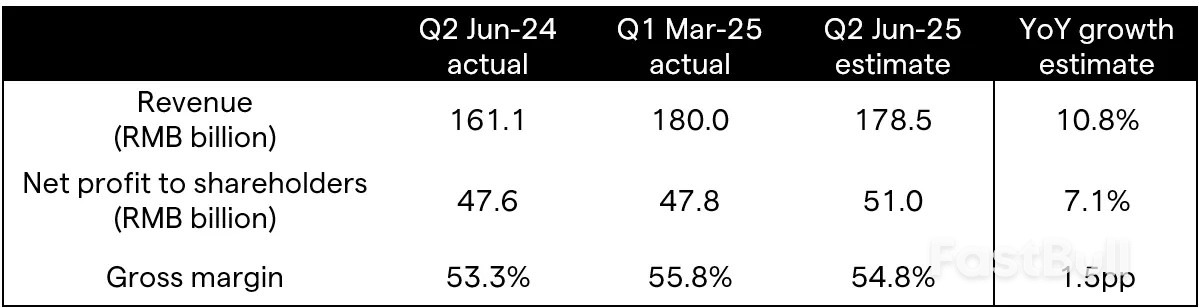
          Analysts expect Tencent to report revenue of RMB 178.5 billion for the second quarter. This would represent year-on-year (YoY) growth of 10.8%, but a marginal decline from the previous quarter's performance.
          Following disappointment in Q1, analysts have moderated their estimations on net profit growth to 7.1%. The gross margin is expected to decline from the previous quarter but still improve on an annualised basis.
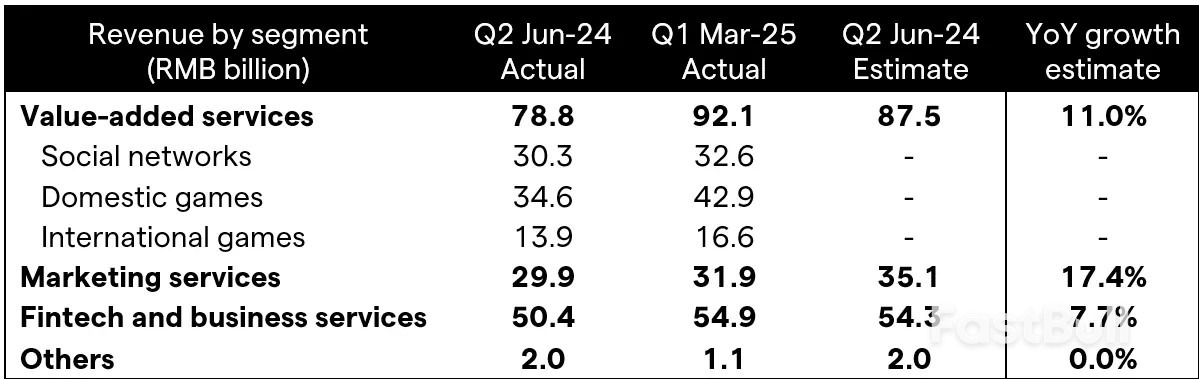
          The company's advertising business, Marketing Services, is anticipated to be the growth engine in the second quarter at 17.4% YoY. Adoption of AI technology helps improve user engagement and sales conversion rates significantly.
          Value-added services, which include gaming and social networks, remain Tencent's core business segment, accounting for 51% of revenue in Q1. Analysts expect this segment to grow at 11% YoY, driven by continued gaming portfolio success.
          Table 1: Financial results expectations

          Can Tencent deliver on Q2 2025 earnings expectations amid hefty AI investment?_1LSEG as of 5 August 2025

          Table 2: Revenue by business segment

          Can Tencent deliver on Q2 2025 earnings expectations amid hefty AI investment?_2 LSEG as of 5 August 2025

          Gaming ambitions drive international expansion

          The gaming business warrants particular attention as Tencent pursues ambitious growth strategies despite ongoing regulatory oversight and consumption cycles. The company is also facing legal challenge as Sony has filed a lawsuit alleging that Tencent's upcoming game 'Light of Motiram' copies elements from Sony's 'Horizon Zero Dawn'. This legal dispute could potentially impact future development plans.
          Tencent's flagship game 'Honor of Kings' is expected to be a significant revenue driver this quarter, but it has ambitions to expand the international games business, which currently accounts for 9% of total revenue. 'Delta Force' has demonstrated its potential to become a new blockbuster domestically following strong initial performance. The global debut of Delta Force's mobile version in April should help gain traction for Tencent's international gaming expansion. This represents a key strategic priority for the company's growth plans.
          Meanwhile, Tencent invested €1.16 billion in March 2025 to acquire a 25% stake in a new Ubisoft subsidiary. This investment focuses on flagship game franchises including 'Assassin's Creed' and makes Tencent Ubisoft's second-largest shareholder.

          AI innovation drives future growth

          Tencent is strategically focused on artificial intelligence initiatives across all business segments. Total capital expenditures surged 91% from the prior year to RMB 27.5 billion in Q1.
          The company recently launched Hunyuan World Model 1.0, which creates immersive 3D virtual scenes from text or image prompts. It also introduced new open-source large language models that can run on consumer devices.
          Tencent upgraded its advertising platform to accelerate content creation and build deeper understanding of merchandise and user interests. This delivers better recommendations and improves advertising effectiveness for clients.
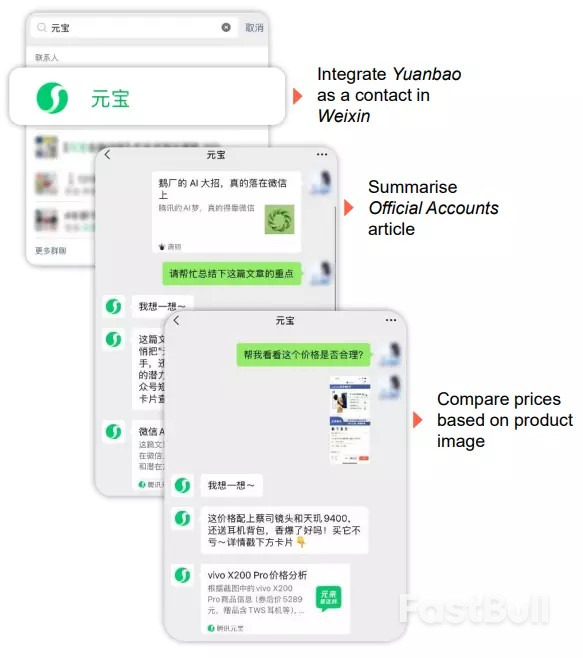
          The company rolled out chatbot Yuanbao as a contact in its messaging app Weixin. This allows users to perform searches through various generative AI models, enhancing user experience and engagement.
          Figure 1: Tencent's AI features in Weixin
          Can Tencent deliver on Q2 2025 earnings expectations amid hefty AI investment?_3

          Analyst sentiment remains positive

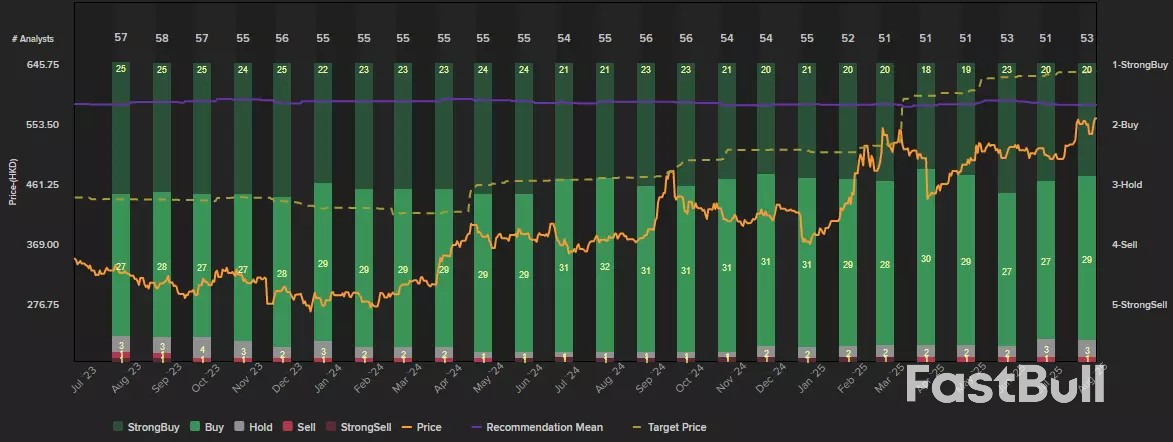
          Wall Street analysts maintain a positive outlook on Tencent. According to LSEG data, 49 out of 53 analysts assign 'buy' or 'strong buy' ratings to the stock. Average price targets increased to HK$631.70 after Q1 results, suggesting approximately 12% upside potential from the closing price on 5 August.

          Figure 2: Wall Street analyst estimates

          Can Tencent deliver on Q2 2025 earnings expectations amid hefty AI investment?_4LSEG, as of 6 August 2025

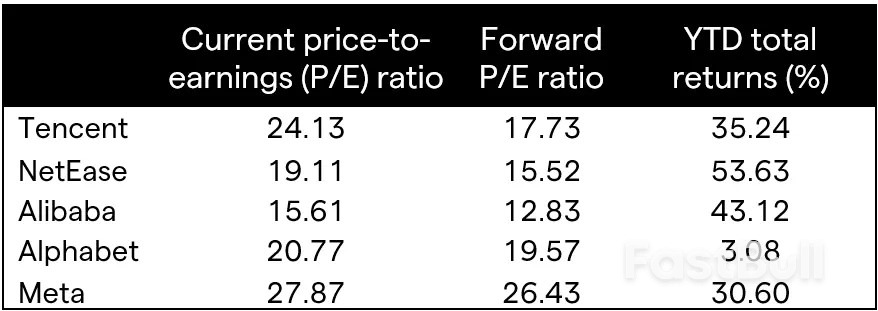
          With a forward price-to-earnings ratio of 18, Tencent's valuation is not cheap compared to Chinese tech conglomerates. However, the company still trades at a slight discount when compared to global peers despite strong fundamentals.
          Table 3: Peer comparison

          Can Tencent deliver on Q2 2025 earnings expectations amid hefty AI investment?_5LSEG, as of market close on 5 August 2025
          Technical analysis suggests upside potential

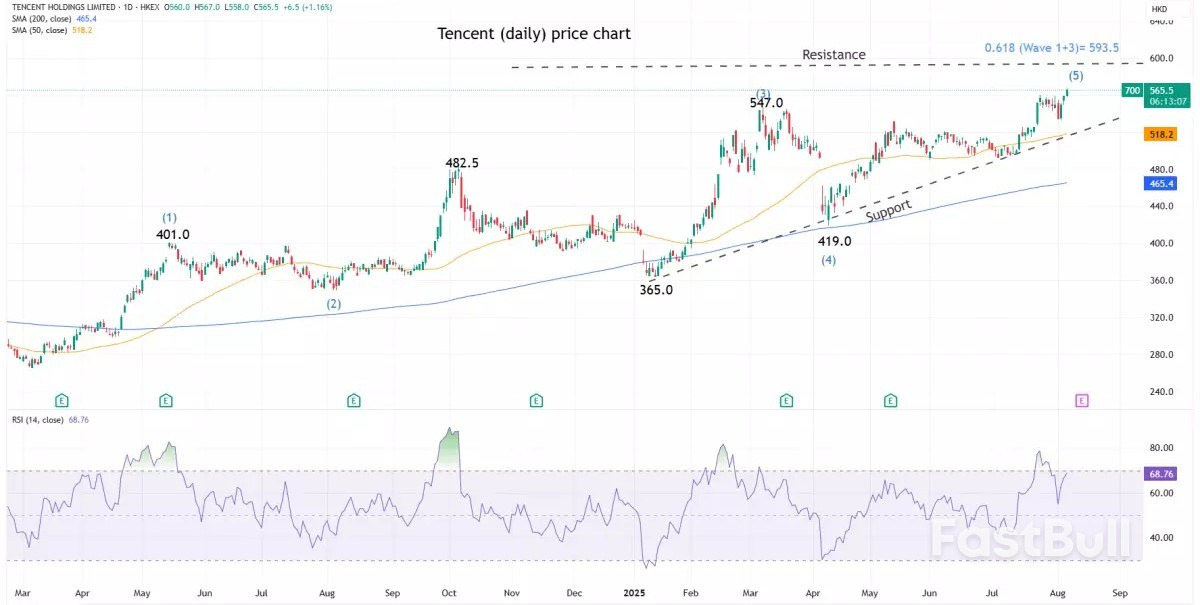
          Despite a 35% return year-to-date, Tencent shares are still trading at a 21% discount to their all-time high of HK$715. This suggests potential room for recovery following strong earnings.
          The technical chart exhibits characteristics of Wave 5 under the Elliott Wave Theory. A 61.8% Fibonacci extension of Wave 1-3 could see share prices rise to the HK$593.5 level on strong earnings before facing key resistance.
          Conversely, disappointing results could see the stock testing support near HK$518. This is where the boundary of the rising channel and 50-day moving average converge on the chart.
          Figure 3: Tencent's daily price chart

          Can Tencent deliver on Q2 2025 earnings expectations amid hefty AI investment?_6as of 6 August 2025. Past performance is not a reliable indicator of future performance

          Looking ahead: strategic priorities

          Tencent's diversified business model provides resilience against sector-specific challenges. The company's investments in AI and international expansion support long-term growth prospects despite near-term headwinds.
          The regulatory environment in China continues to evolve, but Tencent has demonstrated adaptability. It will need to continue innovating across multiple segments to provide competitive advantages and maintain its strong cash flow position to attract investors.
          International diversification efforts may reduce dependence on domestic markets over time. Success in global gaming markets could unlock significant value for shareholders in coming quarters.

          Source: ig

          To stay updated on all economic events of today, please check out our Economic calendar
          Risk Warnings and Disclaimers
          You understand and acknowledge that there is a high degree of risk involved in trading. Following any strategies or investment methods may lead to potential losses. The content on the site is provided by our contributors and analysts for information purposes only. You are solely responsible for determining whether any trading assets, securities, strategy, or any other product is suitable for investing based on your own investment objectives and financial situation.
          Add to Favorites
          Share

          US oil rallies but shows indecision within established range

          Adam

          Commodity

          Oil prices have had volatile swing in the past week, finding strong demand towards the end of July after bouncing at the lows of its $65 to $70 range, even breaking its highs (71.38) before getting hammered from downbeat sentiment post-NFP miss.The commodity is in the Middle of some fundamental headwinds between strong supply (OPEC+ cartel trying to change things up) and Russian oil micmacs.US President Trump is applying strong pressure on countries importing Russian oil to push for a truce in the Eastern European conflicts. India serves as a target for higher tariff menaces as long as they keep buying Russian oil.The action in Oil is still rangebound and despite this morning's rally, the technicals for the black gold are not so hopeful.Let's jump right into a multi-timeframe technical analysis for the commodity.

          US Oil Multi-timeframe Analysis

          US Oil Daily Chart

          US oil rallies but shows indecision within established range_1US Oil Daily Chart, August 6, 2025

          The range established after the Israel-Iran war has held strong between $65 lows and $70 highs, with prices trying to breakout of multiple occasions.But as typical for any range, one may assume it holds until proven the contrary.As mentioned in the introduction, the failed break higher is now met with bearish technical and fundamental catalysts, currently down 6.85% from its past week highs.
          Daily RSI has stopped moving towards bearish territory but such indicators tend to not show much amid rangebound action.
          Levels to keep on your charts:
          Resistance Levels
          Imminent Pivot Zone $67.30 to $68 – Confluence with 50 and 200 Day MAs
          69.5–$70.5 Resistance Zone, range extremes
          71.38 End-July highs
          Support Levels
          $65 to $66 Support Zone
          $64 May Range highs support
          60.5 Low of May Range

          US Oil 4H Chart

          US oil rallies but shows indecision within established range_2US Oil 4H Chart, August 6, 2025

          The Monday weekly open got met with a gap higher from the Trump menaces towards Russian oil buyers which followed by consequent selling.This morning's session did see some decent buying flows but sellers have stepped in at the pivot zone, marking session highs of 67.25.
          Since, the price for the commodity has retracted by about $1 forming a 4H long-tailed indecision Doji candle.A failure to retest the highs of the range may point to more bearish action looking forward, but tracking how countries react to the Trump menaces may provide a fundamental boost (If not buying Russian Oil, supply gets squeezed and may point to higher prices).

          US Oil 1H Chart

          US oil rallies but shows indecision within established range_3US Oil 1H Chart, August 6, 2025

          Despite evolving in a downwards hourly channel, the ongoing price action is very mixed, even looking at shorter timeframes.In these conditions, one of the best ways to get clarity is to look at the ranges of the 4H doji candle for immediate bull/bear strength analysis – Look at reactions above $67.20 or below $65.92.

          Source: marketpulse

          Risk Warnings and Disclaimers
          You understand and acknowledge that there is a high degree of risk involved in trading. Following any strategies or investment methods may lead to potential losses. The content on the site is provided by our contributors and analysts for information purposes only. You are solely responsible for determining whether any trading assets, securities, strategy, or any other product is suitable for investing based on your own investment objectives and financial situation.
          Add to Favorites
          Share

          Kashkari: Fed Needs to Respond to Slowing Economy, Two Cuts This Year Would be Reasonable

          Manuel

          Central Bank

          Economic

          The U.S. Federal Reserve may need to cut interest rates in the near term in response to a slowing U.S. economy, even though it remains unclear whether tariffs will continue to push inflation higher, Minneapolis Fed President Neel Kashkari said on Wednesday.
          "The economy is slowing, and that means in the near term it may become appropriate to start adjusting," Kashkari said in an interview on CNBC's Squawk Box, adding that two quarter-percentage-point rate cuts by the end of the year "seems reasonable to me."
          Kashkari said concerns about rising inflation remain valid, but that it will take time to know whether that poses a problem for the Fed reaching its 2% inflation target or not.
          Meanwhile a weak jobs report and downward revisions to prior months' employment data add to a developing set of statistics that show the economy slowing to a degree the Fed cannot ignore, Kashkari said.
          Recent data "suggests the real underlying economy is slowing. I've got confidence that that is happening," Kashkari said. "How long can we wait until the tariff effects become clear? That's just weighing on me right now."
          Kashkari does not have a vote on interest rate policy this year, but his arguments are similar to those voiced by two Fed governors who dissented at the Fed's decision last week to hold the policy rate steady while awaiting more clarity on how rising import tariffs will feed through to consumer prices.
          A slowdown in job creation and rise in the unemployment rate in July have begun shifting the narrative, however, to put more focus on risks to the Fed's other goal of maintaining maximum employment.

          Source: Reuters

          To stay updated on all economic events of today, please check out our Economic calendar
          Risk Warnings and Disclaimers
          You understand and acknowledge that there is a high degree of risk involved in trading. Following any strategies or investment methods may lead to potential losses. The content on the site is provided by our contributors and analysts for information purposes only. You are solely responsible for determining whether any trading assets, securities, strategy, or any other product is suitable for investing based on your own investment objectives and financial situation.
          Add to Favorites
          Share

          Trump Advised To Nominate Temporary Fed Governor To Fill Open Seat

          Owen Li

          Central Bank

          Bloomberg reports that Trump's advisors are "encouraging" him to nominate a temporary Fed governor to fill Ariana Kugler's soon-to-be vacant seat on the central bank's board. Naming a governor to serve out the term for the seat opening soon, set to expire in January 2026, would give Trump additional time to interview candidates to serve as chair when Powell’s tenure leading the central bank ends in May of next year. Fed Governor Adriana Kugler announced last week that she plans to vacate her role on Aug. 8.

          The two Kevins

          The Fed pick is likely to already work in government, be a short term choice and have been previously vetted by the US Senate for a Federal job. This person would still needs to clear the Senate confirmation process, a vetting process that has traditionally taken months, but could be expedited if Trump pressures lawmakers to quickly fill the seat.

          In this case, neither Kevin Warsh or Kevin Hassett will fill the job. Warsh is not working for the government now and Hassett's current position as the the Director of the National Economic Council does not require Senate confirmation.

          Trump is slated to meet with advisers on Wednesday about the Fed pick, Bloomberg reported.

          Trump on Tuesday said he would make his decision for a replacement for Kugler this week as he looks to make his imprint on the central bank. No decision should be deemed final until announced by Trump, a White House official said.

          Trump also said that he’s weighing whether to fill the seat with a short-term pick or someone he would likely elevate to Fed chair next year: “We’ll either decide on one for permanence or the four-month period — the term. You know, there’s a term of about a number of months,” Trump told reporters at a White House event on Tuesday.

          Kugler’s early departure hands Trump a sooner-than-anticipated opportunity to fill the Fed board with a governor who more closely aligns with his preference for lower interest rates.

          Among the broader group of 19 policymakers who participate in FOMC meetings, a majority signaled in June that they expect two rate cuts this year, a projection that makes a move in September a strong possibility.

          As a reminder, two Fed governors Christopher Waller and Michelle Bowman, both Trump appointees, voted against the July decision to hold rates steady, the first time two members of the board had dissented since 1993.

          “We’re looking at the Fed chair, and that’s down to four people right now,” Trump said Tuesday. “Well, I can tell you because I’ve already said, there’s two Kevins and two other people.”

          Interestingly, shortly after 1130ET, the odds of Kevin Warsh becoming The Fed Chair plunged...

          ...and at the same time, Treasury yioelds spiked across the curve. There was no actual news (headline) catalysts behind either move.

          Source: Zero Hedge

          Risk Warnings and Disclaimers
          You understand and acknowledge that there is a high degree of risk involved in trading. Following any strategies or investment methods may lead to potential losses. The content on the site is provided by our contributors and analysts for information purposes only. You are solely responsible for determining whether any trading assets, securities, strategy, or any other product is suitable for investing based on your own investment objectives and financial situation.
          Add to Favorites
          Share

          ETFs: all that glitters is not gold

          Adam

          Commodity

          In a recent note, Aakash Doshi, head of gold strategy at State Street, tackles this false dilemma between both precious metals. The title is unambiguous: Silver is no substitute for gold. Translation: compare all you want, but don't confuse the real thing with the fake.
          First point: volatility. Over the past 40 years, the price of gold has moved an average of 1.3 points less than US equities, while silver has been 10 points more volatile. Thrill seekers rejoice. Everyone else will sleep soundly.
          Add to that the rare pleasure of recording 18 drops of more than 10% for silver over this period, compared with only four for gold. It's a bit like comparing a yo-yo to a paperweight.
          However, the most interesting conclusion is that despite these ups and downs, the average quarterly returns for both metals are almost identical (1.8% for silver, 1.7% for gold). The same result, with more stress. An excellent case study in behavioral finance.
          Another concern is the correlation with equities. Gold follows its own path, often countercyclically. Silver, meanwhile, follows the market like a diligent student follows the teacher, or like an industrial metal follows the PMI. Because that is the bottom line: silver is used in solar panels, batteries, and printed circuit boards. When industry coughs, silver is supposed to tumble. At this rate, it is not a safe haven, it is a proxy for the manufacturing cycle.
          And then there's the cherry on top: central banks. They are buying gold by the truckload to "de-dollarize," "diversify," or simply sleep a little better at night. As a result, in 2024, gold surpassed the euro as the world's second largest reserve currency. Silver? Not invited to the table - not even a folding chair available at the back of the room.
          What Doshi reminds us is that investing in gold is not about choosing a metal at random. It's about betting on a rare, liquid asset that is integrated into the global monetary system and boosted by strategic demand. Silver, on the other hand, is stuck between the promise of one day shining and the reality of ending up as industrial solder.
          In short, if you're looking for a defensive asset, move on. All that glitters is not gold. Sometimes it's just silver—and that's not a metaphor.
          We appreciate the demonstration, but we would nevertheless point out that State Street is preaching to the choir: it owns the world's largest gold ETF, the SPDR Gold Shares ETF-USD, which is worth close to $100bn. The largest silver ETF is held by rival iShares and is worth $16.8bn. Still, it has risen by 30.5% in 2025, compared to 28.5% for SPDR Gold. Take that.

          Source: marketscreener

          Risk Warnings and Disclaimers
          You understand and acknowledge that there is a high degree of risk involved in trading. Following any strategies or investment methods may lead to potential losses. The content on the site is provided by our contributors and analysts for information purposes only. You are solely responsible for determining whether any trading assets, securities, strategy, or any other product is suitable for investing based on your own investment objectives and financial situation.
          Add to Favorites
          Share

          Why India is in Trump’s crosshairs when crude is not even sanctioned

          Adam

          Economic

          U.S. President Donald Trump added further pressure to India on Wednesday by bumping up tariffs to 50% — but calls for India to immediately stop buying Russian oil could cause global crude prices to spike, industry sources told CNBC.
          Trump has accused India of “fueling” Russia’s war machine and said the country is “directly or indirectly importing Russian Federation oil.” As a result, the U.S. imposed an additional 25% tariff on India, bringing total levies against the major U.S. trading partner to 50%.
          India was once encouraged to buy Russian crude by the United States, and, unlike LNG, Russian crude isn’t sanctioned, but traded under a price cap to limit Moscow’s ability to profit from its sale. India is one of the biggest buyers of Russian oil, according to data from Kpler which shows total Russian crude exports amount to around 3.35 million barrels per day, of which India takes about 1.7 million and China 1.1 million.
          In New Delhi, there must be “confusion,” Bob McNally, president of Rapidan Energy Group and former White House energy advisor to former President George W. Bush, told CNBC.
          “Joe Biden went to India after the invasion of Ukraine and begged them to take Russian oil, the Indians hardly imported any Russian oil, and they begged India, ‘please take the oil,’ so that crude prices would remain low, and they did. Now we’re flipping around and saying, ‘why are you taking all this oil,’” McNally added.
          Industry sources in the Indian petroleum sector told CNBC the country has abided by all international sanctions, and that India is doing the global economy a “favor” by buying Russian oil which in turn, stabilizes prices. The sources did not wish to be identified due to the sensitivity of the matter.
          India has argued that it if it were to stop buying Russian oil, a plan must be put in place to stabilize energy markets, along with a contingency to fill the shortfall in supply if Russian barrels are taken off the market.
          “In case India decides to cut Russian oil imports, the refineries likely would try to find alternative barrels from the Middle East, as they used to rely on those barrels until 2022. Likely other buyers would not step in,” Giovanni Staunovo, a commodity analyst at UBS told CNBC.
          Russia is the third largest global crude producer, after the U.S. and Saudi Arabia. Moscow produces nearly 11 million barrels of oil per day, according to the U.S. Energy Information Administration. India’s Russian crude oil imports was 38% in both 2023 and 2024 and is currently 36% in 2025. Total Indian crude imports are increasing each year with rising demand, and as a result, imports of Russian crude in 2025 are their strongest annual pace yet.
          If this supply was to be removed from the market, prices would skyrocket, according to the industry sources in the Indian petroleum sector. “If India were to stop buying Russian crude oil today, global crude prices could jump to over $200 per barrel for all global consumers,” an industry source told CNBC.
          “Very near term, there is a risk of a pop in brent prices to $80 or above,” McNally told CNBC, signaling that the impact of additional tariffs and a potential cut to Russian oil imports would be significantly less catastrophic.
          U-turn
          “When they didn’t want India to buy something, they told us,” an industry source in the Indian petroleum sector said. This was indeed the case when India was once purchasing Iranian crude, which New Delhi no longer buys and is now sanctioned as Washington doubles down on its maximum pressure campaign against the Islamic Republic.
          Hardeep Singh Puri, India’s petroleum minister, last month told CNBC’s Dan Murphy: “The price of oil would have gone up to 130 dollars a barrel. That was a situation in which we were advised, including by our friends in the United States, to please buy Russian oil, but within the price cap.”
          Sara Vakhshouri, the founder and president of SVB Energy International, told CNBC the hefty duties announced by Trump are a “negotiation tactic,” aimed at “reclaiming lost U.S. oil market share in India and oil export declines since 2022, and securing equivalent export of other commodity to India.”
          “India has always coordinated closely on US oil policy, including sanctions on Iranian oil. At the same time, for the Trump administration, energy security, affordability, and reliability are priorities” Vakhshouri added.
          Russian crude has been placed under a price cap by the European Union since Moscow’s 2022 invasion of Ukraine. That price cap, set at $60 per barrel, allows Russia to export its crude, but at a price lower than the commodity generally trades. The aim is to limit Moscow’s revenue from oil exports, constricting the country’s ability to finance its war in Ukraine. The policy was implemented by G7 nations, hoping to maintain a stable supply of Russian oil on the market.
          Sources within the Indian petroleum sector told CNBC “the price cap is a $1 to $2 difference” and insists New Delhi is not buying Russian crude at a major discount per barrel.
          Even Russian LNG is not “completely under US secondary sanctions, Europe still buys gas from Russia via pipelines and LNG. Only some Russian LNG export terminals (e.g. Artic LNG 2) are under sanctions, but not all LNG exports,” UBS’ Staunovo, told CNBC.
          In 2021, Russia was the largest supplier of petroleum to the European Union. After the bloc’s ban on seaborne imports of Russian crude, the share of imports from Moscow fell from 29% to 2% in the 2025. The EU still imports 19% of its LNG from Russia, according to data from the first quarter of 2025 from Eurostat.
          Russia is a member of OPEC plus, established alongside Saudi Arabia in 2016. The group works to stabilize oil prices, adjusting output based on market fundamentals and trends in supply and demand. A group of eight producers just moved days ago to raise output in September, fully unwinding cuts and helping calm fears of Russian supply concerns.
          “While OPEC+ countries hold spare capacity to tackle supply disruptions, a full drop in Russian crude production/exports would see that spare capacity completely dwindling. The Biden administration was aware of this,” UBS’ Staunovo said.
          The Russian price cap aimed “to reduce the revenues of the Russian government by allowing Russian oil to remain in the markets and to prevent an oil price spike,” Staunovo added, noting that these decisions were made in the run up to a presidential election in the U.S.
          Now, after winning that very election, Trump means business. Before slapping an additional 25% tariff on India on Wednesday, he told CNBC that India “hasn’t been a good trading partner.”
          It means that U.S. ties with New Delhi, a key security and defense partner, could be at risk. India responded sharply to Trump’s criticism on Wednesday, saying it was “unjustified and unreasonable” and that it bought Russian oil with U.S. support.

          Source: cnbc

          To stay updated on all economic events of today, please check out our Economic calendar
          Risk Warnings and Disclaimers
          You understand and acknowledge that there is a high degree of risk involved in trading. Following any strategies or investment methods may lead to potential losses. The content on the site is provided by our contributors and analysts for information purposes only. You are solely responsible for determining whether any trading assets, securities, strategy, or any other product is suitable for investing based on your own investment objectives and financial situation.
          Add to Favorites
          Share

          Saudi Arabia Raises Oil Prices To Asia For Second Month

          Devin

          Economic

          Commodity

          Saudi Arabia, the world's biggest oil exporter, on Wednesday hiked its September crude oil prices for Asian buyers, the second monthly rise in a row, on tight supply and robust demand.

          Saudi Arabia raised the official selling price (OSP) for the flagship Arab light crude it sells to Asia in September to plus $3.20 a barrel above the Oman/Dubai average, state oil company Aramco said in a statement, up $1 from the August premium.

          The increase is within expectations. Refining sources in a Reuters survey had expected the price to rise by 90 cents to $1.05 a barrel from August.

          The September OSPs to Asia for other crude grades - Arab Extra Light, Arab Medium and Arab Heavy - gained 70 cents to $1.20 a barrel from August, the statement showed.

          Saudi Arabia's price hike comes as U.S. President Donald Trump has imposed an additional 25% tariff on Indian goods, citing New Delhi's continued imports of Russian oil, which may boost Indian demand for Saudi and other Middle East crude.

          "In anticipation of higher Indian demand, they have kept the prices very strong," said a source at an Indian refiner.

          The Organization of the Petroleum Exporting Countries and their allies, known as OPEC+, agreed as expected on Sunday to a 547,000 barrels per day output hike in September. Nonetheless, traders say the market is showing signs of tightness.

          Aramco also raised its prices for the United States, and cut them for customers in Europe.

          Saudi crude OSPs are usually released around the fifth of each month, and set the trend for Iranian, Kuwaiti and Iraqi prices, affecting about 9 million bpd of crude bound for Asia.

          State oil giant Saudi Aramco sets its crude prices based on recommendations from customers and after calculating the change in the value of its oil over the past month, based on yields and product prices.

          Below are Saudi prices for September in dollars per barrel.

          Saudi term crude supplies to Asia are priced as a differential to the Oman/Dubai average:


          September

          August

          CHANGE

          EXTRA LIGHT

          $3.50

          $2.30

          +$1.20

          LIGHT

          $3.20

          $2.20

          +$1.00

          MEDIUM

          $2.65

          $1.75

          +$0.90

          HEAVY

          $1.30

          $0.60

          +$0.70

          Prices at Ras Tanura destined for United States are set against ASCI:


          September

          August

          CHANGE

          EXTRA LIGHT

          $6.25

          $5.95

          +$0.30

          LIGHT

          $4.20

          $3.90

          +$0.30

          MEDIUM

          $4.00

          $3.70

          +$0.30

          HEAVY

          $3.35

          $3.05

          +$0.30

          Prices at Ras Tanura destined for Northwest Europe are set against ICE Brent:


          September

          August

          CHANGE

          EXTRA LIGHT

          $4.95

          $6.25

          -$1.30

          LIGHT

          $3.35

          $4.65

          -$1.30

          MEDIUM

          $2.55

          $3.85

          -$1.30

          HEAVY

          $0.15

          $1.45

          -$1.30

          Prices at Ras Tanura for Saudi oil destined for the Mediterranean are set against ICE Brent:


          September

          August

          CHANGE

          EXTRA LIGHT

          $4.85

          $6.15

          -$1.30

          LIGHT

          $3.15

          $4.45

          -$1.30

          MEDIUM

          $2.55

          $3.85

          -$1.30

          HEAVY

          -$0.15

          $1.15

          -$1.30

          Source: TradingView

          To stay updated on all economic events of today, please check out our Economic calendar
          Risk Warnings and Disclaimers
          You understand and acknowledge that there is a high degree of risk involved in trading. Following any strategies or investment methods may lead to potential losses. The content on the site is provided by our contributors and analysts for information purposes only. You are solely responsible for determining whether any trading assets, securities, strategy, or any other product is suitable for investing based on your own investment objectives and financial situation.
          Add to Favorites
          Share
          FastBull
          Copyright © 2025 FastBull Ltd

          728 RM B 7/F GEE LOK IND BLDG NO 34 HUNG TO RD KWUN TONG KLN HONG KONG

          TelegramInstagramTwitterfacebooklinkedin
          App Store Google Play Google Play
          Products
          Charts

          Chats

          Q&A with Experts
          Screeners
          Economic Calendar
          Data
          Tools
          Membership
          Features
          Function
          Markets
          Copy Trading
          Latest Signals
          Contests
          News
          Analysis
          24/7
          Columns
          Education
          Company
          Careers
          About Us
          Contact Us
          Advertising
          Help Center
          Feedback
          User Agreement
          Privacy Policy
          Business

          White Label

          Data API

          Web Plug-ins

          Poster Maker

          Affiliate Program

          Risk Disclosure

          The risk of loss in trading financial instruments such as stocks, FX, commodities, futures, bonds, ETFs and crypto can be substantial. You may sustain a total loss of the funds that you deposit with your broker. Therefore, you should carefully consider whether such trading is suitable for you in light of your circumstances and financial resources.

          No decision to invest should be made without thoroughly conducting due diligence by yourself or consulting with your financial advisors. Our web content might not suit you since we don't know your financial conditions and investment needs. Our financial information might have latency or contain inaccuracy, so you should be fully responsible for any of your trading and investment decisions. The company will not be responsible for your capital loss.

          Without getting permission from the website, you are not allowed to copy the website's graphics, texts, or trademarks. Intellectual property rights in the content or data incorporated into this website belong to its providers and exchange merchants.

          Not Logged In

          Log in to access more features

          FastBull Membership

          Not yet

          Purchase

          Become a signal provider
          Help Center
          Customer Service
          Dark Mode
          Price Up/Down Colors

          Log In

          Sign Up

          Position
          Layout
          Fullscreen
          Default to Chart
          The chart page opens by default when you visit fastbull.com