• Trade
  • Markets
  • Copy
  • Contests
  • News
  • 24/7
  • Calendar
  • Q&A
  • Chats
Trending
Screeners
SYMBOL
LAST
BID
ASK
HIGH
LOW
NET CHG.
%CHG.
SPREAD
SPX
S&P 500 Index
6861.59
6861.59
6861.59
6878.28
6858.25
-8.81
-0.13%
--
DJI
Dow Jones Industrial Average
47874.91
47874.91
47874.91
47971.51
47771.72
-80.07
-0.17%
--
IXIC
NASDAQ Composite Index
23583.34
23583.34
23583.34
23698.93
23579.88
+5.22
+ 0.02%
--
USDX
US Dollar Index
99.080
99.160
99.080
99.110
98.730
+0.130
+ 0.13%
--
EURUSD
Euro / US Dollar
1.16280
1.16288
1.16280
1.16717
1.16245
-0.00146
-0.13%
--
GBPUSD
Pound Sterling / US Dollar
1.33157
1.33166
1.33157
1.33462
1.33087
-0.00155
-0.12%
--
XAUUSD
Gold / US Dollar
4191.34
4191.75
4191.34
4218.85
4175.92
-6.57
-0.16%
--
WTI
Light Sweet Crude Oil
59.033
59.063
59.033
60.084
58.892
-0.776
-1.30%
--

Community Accounts

Signal Accounts
--
Profit Accounts
--
Loss Accounts
--
View More

Become a signal provider

Sell trading signals to earn additional income

View More

Guide to Copy Trading

Get started with ease and confidence

View More

Signal Accounts for Members

All Signal Accounts

Best Return
  • Best Return
  • Best P/L
  • Best MDD
Past 1W
  • Past 1W
  • Past 1M
  • Past 1Y

All Contests

  • All
  • Trump Updates
  • Recommend
  • Stocks
  • Cryptocurrencies
  • Central Banks
  • Featured News
Top News Only
Share

The S&P 500 Opened 4.80 Points Higher, Or 0.07%, At 6875.20; The Dow Jones Industrial Average Opened 16.52 Points Higher, Or 0.03%, At 47971.51; And The Nasdaq Composite Opened 60.09 Points Higher, Or 0.25%, At 23638.22

Share

Reuters Poll - Swiss National Bank Policy Rate To Be 0.00% At End-2026, Said 21 Of 25 Economists, Four Said It Would Be Cut To -0.25%

Share

USGS - Magnitude 7.6 Earthquake Strikes Misawa, Japan

Share

Reuters Poll - Swiss National Bank To Hold Policy Rate At 0.00% On December 11, Said 38 Of 40 Economists, Two Said Cut To -0.25%

Share

Traders Believe There Is A 20% Chance That The European Central Bank Will Raise Interest Rates Before The End Of 2026

Share

Toronto Stock Index .GSPTSE Rises 11.99 Points, Or 0.04 Percent, To 31323.40 At Open

Share

Japan Meteorological Agency: A Tsunami With A Maximum Height Of Three Meters Is Expected Following The Earthquake In Japan

Share

Japan Meteorological Agency: A 7.2-magnitude Earthquake Struck Off The Coast Of Northern Japan, And A Tsunami Warning Has Been Issued

Share

Japan Finance Minister Katayama: G7 Expected To Hold Another Meeting By The End Of This Year

Share

The Japan Meteorological Agency Reported That An Earthquake Occurred In The Sea Near Aomori

Share

Japan Finance Minister Katayama: The G7 Finance Ministers' Meeting Discussed The Critical Mineral Supply Chain And Support For Ukraine

Share

Japan Finance Minister Katayama: Held Onlinemeeting With G7 Finance Ministers

Share

Fed Data - USA Effective Federal Funds Rate At 3.89 Percent On 05 December On $88 Billion In Trades Versus 3.89 Percent On $87 Billion On 04 December

Share

Chinese Foreign Minister Wang Yi: One-China Principle Is An Important Political Foundation For China-Germany Relations, And There Is No Room For Ambiguity

Share

Chinese Foreign Minister Wang Yi: Hopes Germany To Understand, Support China's Position Regarding Japan Prime Minister's Remark On Taiwan

Share

Chinese Foreign Minister Wang Yi: Hopes Germany Will View China More Objectively And Rationally, Adhere To The Positioning Of China-Germany Partnership

Share

China Foreign Ministry: China's Foreign Minister Wang Yi Meets German Counterpart

Share

Israeli Government Spokesperson: Netanyahu Will Meet Trump On December 29

Share

Stc Did Not Ask Internationally-Government To Leave Aden - Senior Stc Official To Reuters

Share

Members Of Internationally-Recognised Government, Opposed To Northern Houthis, Have Left Aden - Senior Stc Official To Reuters

TIME
ACT
FCST
PREV
France Trade Balance (SA) (Oct)

A:--

F: --

P: --
Euro Zone Employment YoY (SA) (Q3)

A:--

F: --

P: --
Canada Part-Time Employment (SA) (Nov)

A:--

F: --

P: --

Canada Unemployment Rate (SA) (Nov)

A:--

F: --

P: --

Canada Full-time Employment (SA) (Nov)

A:--

F: --

P: --

Canada Labor Force Participation Rate (SA) (Nov)

A:--

F: --

P: --

Canada Employment (SA) (Nov)

A:--

F: --

P: --

U.S. PCE Price Index MoM (Sept)

A:--

F: --

P: --

U.S. Personal Income MoM (Sept)

A:--

F: --

P: --

U.S. Core PCE Price Index MoM (Sept)

A:--

F: --

P: --

U.S. PCE Price Index YoY (SA) (Sept)

A:--

F: --

P: --

U.S. Core PCE Price Index YoY (Sept)

A:--

F: --

P: --

U.S. Personal Outlays MoM (SA) (Sept)

A:--

F: --

P: --
U.S. 5-10 Year-Ahead Inflation Expectations (Dec)

A:--

F: --

P: --

U.S. Real Personal Consumption Expenditures MoM (Sept)

A:--

F: --

P: --
U.S. Weekly Total Rig Count

A:--

F: --

P: --

U.S. Weekly Total Oil Rig Count

A:--

F: --

P: --

U.S. Consumer Credit (SA) (Oct)

A:--

F: --

P: --
China, Mainland Foreign Exchange Reserves (Nov)

A:--

F: --

P: --

Japan Trade Balance (Oct)

A:--

F: --

P: --

Japan Nominal GDP Revised QoQ (Q3)

A:--

F: --

P: --

China, Mainland Imports YoY (CNH) (Nov)

A:--

F: --

P: --

China, Mainland Exports (Nov)

A:--

F: --

P: --

China, Mainland Imports (CNH) (Nov)

A:--

F: --

P: --

China, Mainland Trade Balance (CNH) (Nov)

A:--

F: --

P: --

China, Mainland Exports YoY (USD) (Nov)

A:--

F: --

P: --

China, Mainland Imports YoY (USD) (Nov)

A:--

F: --

P: --

Germany Industrial Output MoM (SA) (Oct)

A:--

F: --

P: --
Euro Zone Sentix Investor Confidence Index (Dec)

A:--

F: --

P: --

Canada National Economic Confidence Index

A:--

F: --

P: --

U.K. BRC Like-For-Like Retail Sales YoY (Nov)

--

F: --

P: --

U.K. BRC Overall Retail Sales YoY (Nov)

--

F: --

P: --

Australia Overnight (Borrowing) Key Rate

--

F: --

P: --

RBA Rate Statement
RBA Press Conference
Germany Exports MoM (SA) (Oct)

--

F: --

P: --

U.S. NFIB Small Business Optimism Index (SA) (Nov)

--

F: --

P: --

Mexico 12-Month Inflation (CPI) (Nov)

--

F: --

P: --

Mexico Core CPI YoY (Nov)

--

F: --

P: --

Mexico PPI YoY (Nov)

--

F: --

P: --

U.S. Weekly Redbook Index YoY

--

F: --

P: --

U.S. JOLTS Job Openings (SA) (Oct)

--

F: --

P: --

China, Mainland M1 Money Supply YoY (Nov)

--

F: --

P: --

China, Mainland M0 Money Supply YoY (Nov)

--

F: --

P: --

China, Mainland M2 Money Supply YoY (Nov)

--

F: --

P: --

U.S. EIA Short-Term Crude Production Forecast For The Year (Dec)

--

F: --

P: --

U.S. EIA Natural Gas Production Forecast For The Next Year (Dec)

--

F: --

P: --

U.S. EIA Short-Term Crude Production Forecast For The Next Year (Dec)

--

F: --

P: --

EIA Monthly Short-Term Energy Outlook
U.S. API Weekly Gasoline Stocks

--

F: --

P: --

U.S. API Weekly Cushing Crude Oil Stocks

--

F: --

P: --

U.S. API Weekly Crude Oil Stocks

--

F: --

P: --

U.S. API Weekly Refined Oil Stocks

--

F: --

P: --

South Korea Unemployment Rate (SA) (Nov)

--

F: --

P: --

Japan Reuters Tankan Non-Manufacturers Index (Dec)

--

F: --

P: --

Japan Reuters Tankan Manufacturers Index (Dec)

--

F: --

P: --

Japan Domestic Enterprise Commodity Price Index MoM (Nov)

--

F: --

P: --

Japan Domestic Enterprise Commodity Price Index YoY (Nov)

--

F: --

P: --

China, Mainland PPI YoY (Nov)

--

F: --

P: --

China, Mainland CPI MoM (Nov)

--

F: --

P: --

Q&A with Experts
    • All
    • Chatrooms
    • Groups
    • Friends
    Connecting
    .
    .
    .
    Type here...
    Add Symbol or Code

      No matching data

      All
      Trump Updates
      Recommend
      Stocks
      Cryptocurrencies
      Central Banks
      Featured News
      • All
      • Russia-Ukraine Conflict
      • Middle East Flashpoint
      • All
      • Russia-Ukraine Conflict
      • Middle East Flashpoint
      Search
      Products

      Charts Free Forever

      Chats Q&A with Experts
      Screeners Economic Calendar Data Tools
      Membership Features
      Data Warehouse Market Trends Institutional Data Policy Rates Macro

      Market Trends

      Market Sentiment Order Book Forex Correlations

      Top Indicators

      Charts Free Forever
      Markets

      News

      News Analysis 24/7 Columns Education
      From Institutions From Analysts
      Topics Columnists

      Latest Views

      Latest Views

      Trending Topics

      Top Columnists

      Latest Update

      Signals

      Copy Rankings Latest Signals Become a signal provider AI Rating
      Contests
      Brokers

      Overview Brokers Assessment Rankings Regulators News Claims
      Broker listing Forex Brokers Comparison Tool Live Spread Comparison Scam
      Q&A Complaint Scam Alert Videos Tips to Detect Scam
      More

      Business
      Events
      Careers About Us Advertising Help Center

      White Label

      Data API

      Web Plug-ins

      Affiliate Program

      Awards Institution Evaluation IB Seminar Salon Event Exhibition
      Vietnam Thailand Singapore Dubai
      Fans Party Investment Sharing Session
      FastBull Summit BrokersView Expo
      Recent Searches
        Top Searches
          Markets
          News
          Analysis
          User
          24/7
          Economic Calendar
          Education
          Data
          • Names
          • Latest
          • Prev

          View All

          No data

          Scan to Download

          Faster Charts, Chat Faster!

          Download App
          English
          • English
          • Español
          • العربية
          • Bahasa Indonesia
          • Bahasa Melayu
          • Tiếng Việt
          • ภาษาไทย
          • Français
          • Italiano
          • Türkçe
          • Русский язык
          • 简中
          • 繁中
          Open Account
          Search
          Products
          Charts Free Forever
          Markets
          News
          Signals

          Copy Rankings Latest Signals Become a signal provider AI Rating
          Contests
          Brokers

          Overview Brokers Assessment Rankings Regulators News Claims
          Broker listing Forex Brokers Comparison Tool Live Spread Comparison Scam
          Q&A Complaint Scam Alert Videos Tips to Detect Scam
          More

          Business
          Events
          Careers About Us Advertising Help Center

          White Label

          Data API

          Web Plug-ins

          Affiliate Program

          Awards Institution Evaluation IB Seminar Salon Event Exhibition
          Vietnam Thailand Singapore Dubai
          Fans Party Investment Sharing Session
          FastBull Summit BrokersView Expo

          Can Bitcoin Rebound Sustain in October: These 3 BTC Indicators Have An Answer

          Adam

          Cryptocurrency

          Summary:

          Bitcoin rebounded above $115,000 after a $20 billion sell-off, but signals remain mixed. Bearish divergence and weak taker volume suggest pressure persists, though strong long-term holders support a mid-cycle consolidation.
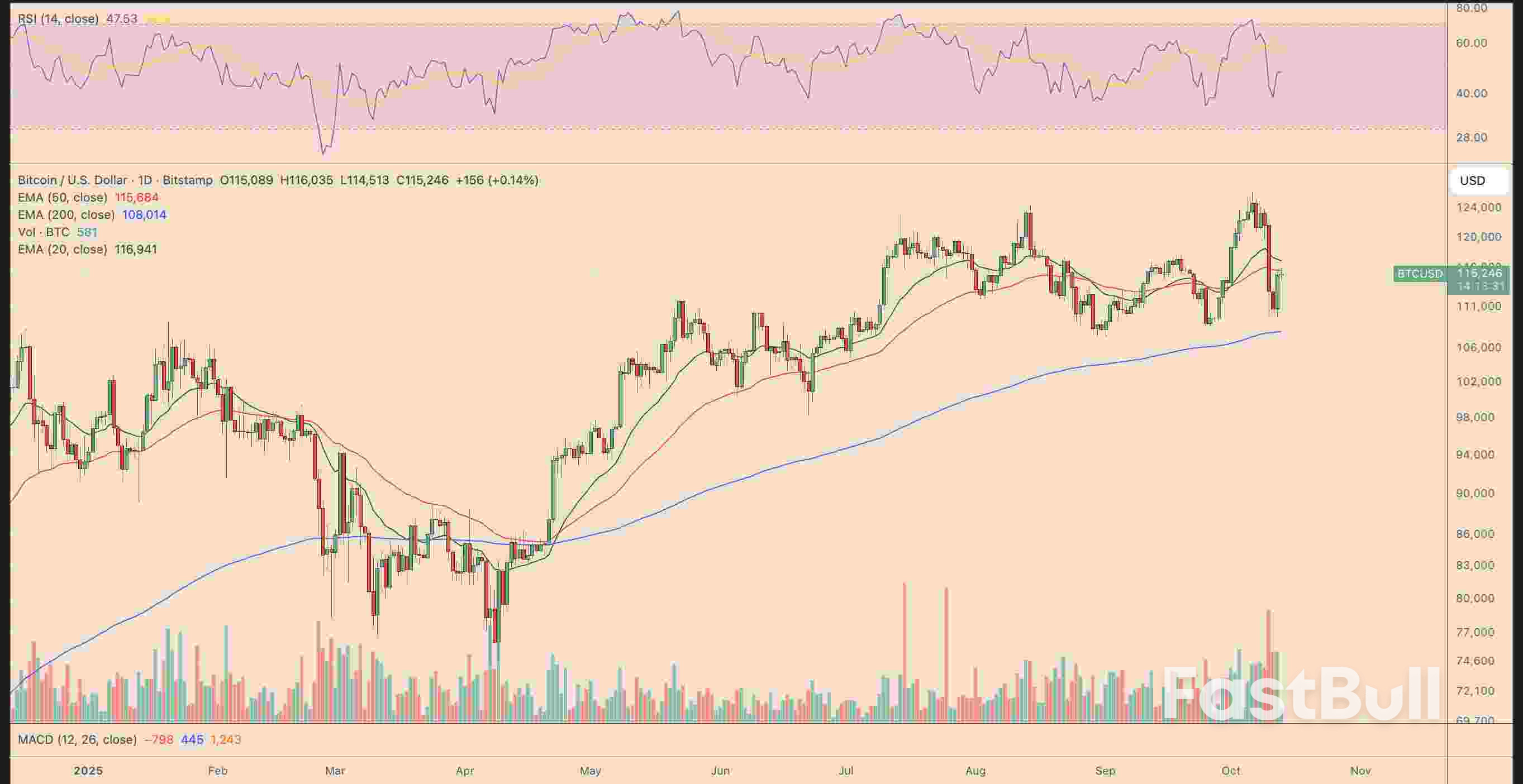
          Bitcoin (BTC) has rebounded above $115,000 after a brutal sell-off triggered by US–China trade tensions and marketwide liquidations exceeding $20 billion over the weekend.
          Can Bitcoin Rebound Sustain in October: These 3 BTC Indicators Have An Answer_1

          BTC/USD daily price chart.

          Yet, beneath the surface, onchain and technical indicators reveal a mixed picture. Some point to waning bullish momentum, others to an underlying base of long-term holder strength.

          BTC’s Net Taker Volume Oscillator Shows Persistent Bearish Pressure

          Bitcoin’s net taker volume oscillator, a key onchain sentiment gauge, has plunged to around -4%, signaling that bearish pressure still dominates the market.
          The metric, which measures whether aggressive buyers (takers) or sellers control futures markets, is now at one of its lowest levels of 2025, suggesting that sell-side momentum remains intense.
          Can Bitcoin Rebound Sustain in October: These 3 BTC Indicators Have An Answer_2

          Bitcoin net taker volume oscillator.

          Historically, such extreme negative readings have preceded short-term market bottoms, but not without a final leg lower as leveraged long positions get flushed out.
          The previous dips to this level, notably in April and July, were followed by sharp volatility before BTC eventually recovered.
          If selling persists, Bitcoin could retest the $105,000–$110,000 range before finding stronger demand. Until the oscillator stabilizes near neutral territory, buyers remain on the defensive.

          BTC Technical Warning: Bearish Divergence Mirrors 2021-2022 Crash Scenario

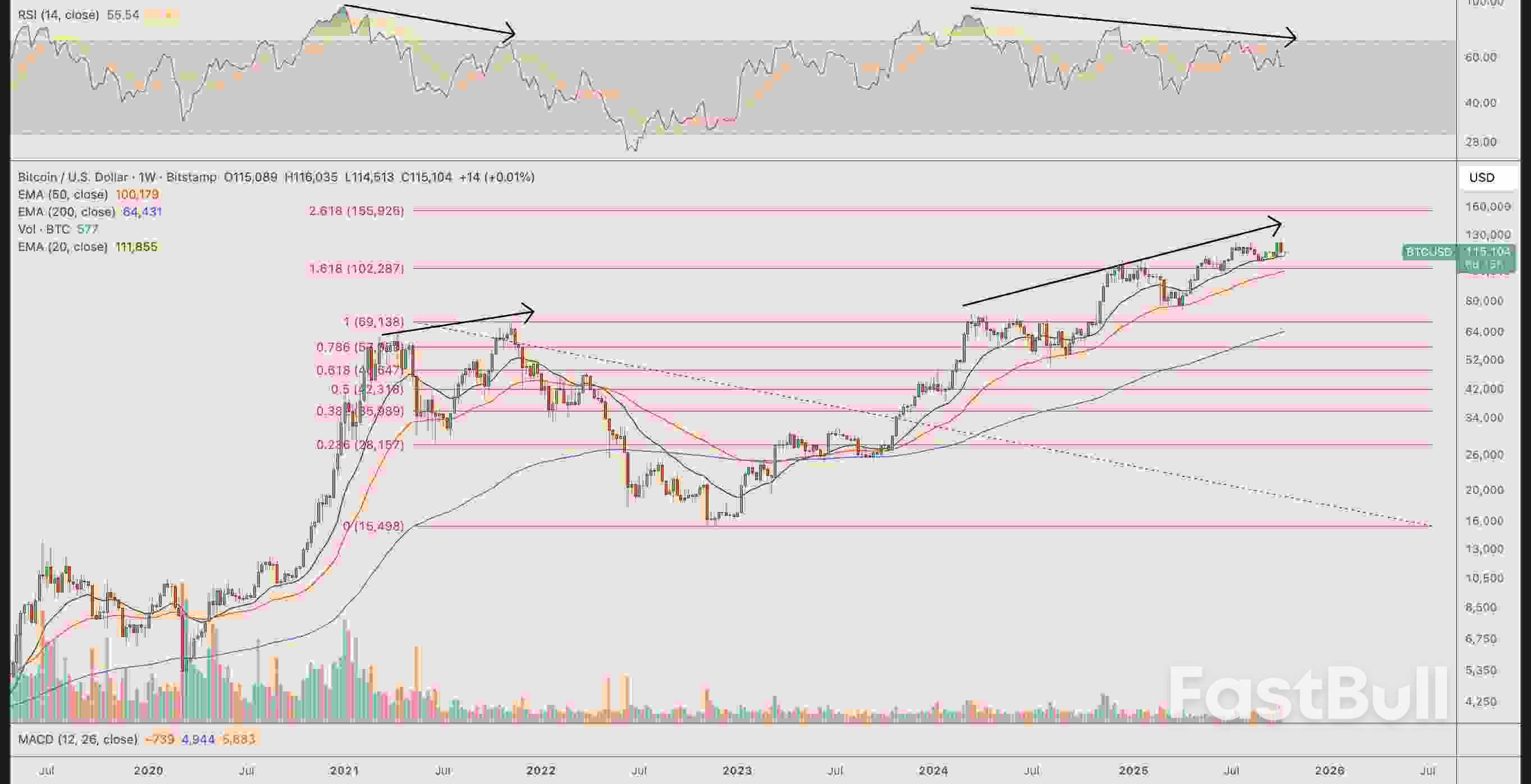
          Bitcoin’s weekly chart now mirrors a bearish divergence similar to the one that preceded the 2021–2022 bear cycle.
          While BTC price continues to notch higher highs, the relative strength index (RSI) has been making lower highs since June, a classic signal of waning bullish momentum.
          Can Bitcoin Rebound Sustain in October: These 3 BTC Indicators Have An Answer_3

          BTC/USD weekly price chart.

          For now, the cryptocurrency remains above its crucial 20-week EMA ($111,855), a level that has historically served as a mid-cycle support.
          A confirmed breakdown below this zone could expose BTC to the 50-week EMA near $100,000, while a rebound from current levels would likely reignite bullish momentum, potentially sending prices toward $150,000 or higher by year-end.

          Bitcoin Momentum Buyers Are Rising, But Long-Term Holders Still Dominate

          While short-term data suggests speculative dominance, the broader onchain picture paints a more nuanced view.
          Can Bitcoin Rebound Sustain in October: These 3 BTC Indicators Have An Answer_4

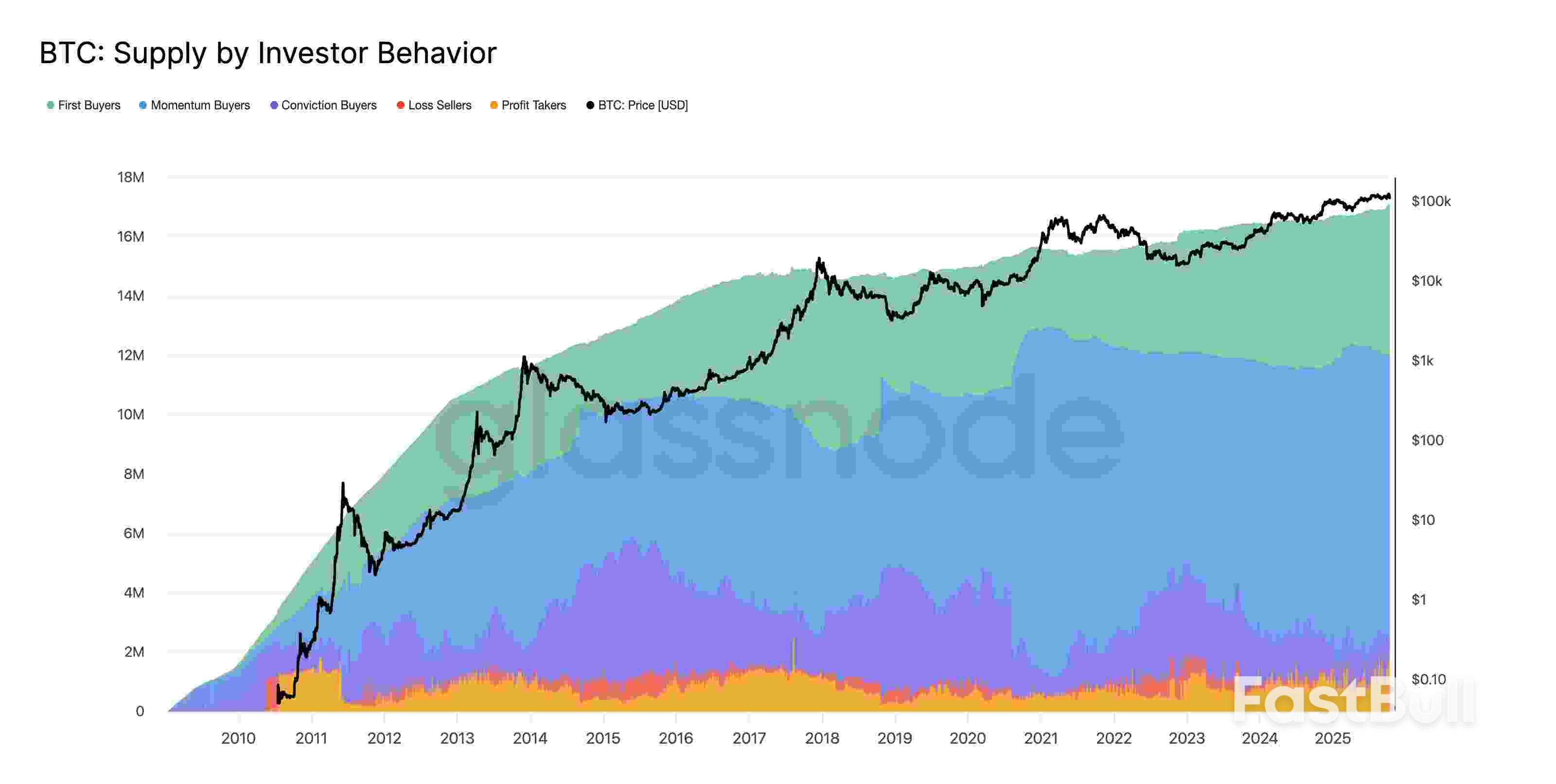
          BTC supply per investor behavior.

          Glassnode’s long-term supply composition shows that “first buyers,” long-term holders who accumulated BTC early or during prior cycles, still control the majority of supply, over 5.1 million BTC.
          Meanwhile, momentum buyers have indeed grown sharply this year, reaching about 8.8 million BTC, echoing the same behavioral pattern seen during mid-cycle tops in 2017 and 2021.
          However, unlike those periods, conviction buyers have not yet capitulated. Their share, around 1 million BTC, remains consistent, suggesting that while speculative activity is rising, the long-term investor base continues to underpin the market.
          This hybrid profile implies Bitcoin could be in a mid-cycle cooling phase rather than a full distribution top.
          A deeper correction remains possible if momentum demand fades, but the absence of large-scale long-term selling argues against a sustained bear market, at least for now.

          Source: fxempire

          Risk Warnings and Disclaimers
          You understand and acknowledge that there is a high degree of risk involved in trading. Following any strategies or investment methods may lead to potential losses. The content on the site is provided by our contributors and analysts for information purposes only. You are solely responsible for determining whether any trading assets, securities, strategy, or any other product is suitable for investing based on your own investment objectives and financial situation.
          Add to Favorites
          Share

          US Dollar Surges as Trade Tensions Reignite – Eyes on 99–101 Resistance Zone

          Adam

          Forex

          The US-China trade tensions spiked again, shaking global markets. US President Donald Trump announced a 100% tariff on Chinese imports starting November 1 and said he would skip the planned meeting with Chinese President Xi Jinping. These moves brought back fears of a full-blown trade war.
          China responded by tightening export controls on rare earth metals, raising concerns in Washington about access to key resources. As a result, US stock markets saw one of their biggest single-day drops since April. The S&P 500 lost about $2 trillion in value, and the cryptocurrency market fell by roughly $550 billion.
          US President Donald Trump said China was using rare earth elements as a tool of economic pressure. In response, he announced new tariffs and plans to restrict exports of key software products. China’s Ministry of Commerce said it does not want a trade war but is ready for any outcome.
          Trump hinted in his weekend posts that talks with China are still possible, but the planned meeting with President Xi in South Korea later this month now looks uncertain. A comment from US Vice President Vance suggesting that a fair negotiation process on tariffs could resume helped calm the markets slightly, though uncertainty remains high.

          US Dollar a Safe Harbor in the US-China Crisis

          The renewed tension between the US and China marks a critical phase for the US dollar index, especially in terms of strategic dependencies. The US remains strong in semiconductors and software, but it relies heavily on China for rare metals.
          These metals play a key role in industries such as automotive, defense, renewable energy, and electronics. By 2024, China is expected to produce about 70% of the world’s rare metals and handle 85% of global processing. This dependence explains why the Trump administration views the sector as a national security risk. The Pentagon’s $1 billion purchase of strategic minerals and its stockpiling of lithium and cobalt are seen as early steps to diversify supply sources.
          In the markets, reactions were similar to those seen during the tariff shock in April. Investors moved out of riskier assets, while the US dollar, gold, and bonds gained. The difference this time was in the bond market. Instead of selling, investors bought 10-year bonds, showing a shift toward defense rather than fears of a new recession.
          The US dollar index (DXY) began the week climbing toward the 99 level, after briefly falling on Friday. The US dollar also gained against the yen amid political uncertainty in Japan, and it held steady against the EUR/USD following a cabinet reshuffle in France.

          Eyes on CPI Data and Powell ahead of Fed Decision

          The US government shutdown, now lasting nearly 10 days, continues to create uncertainty around key economic data releases. Still, the Bureau of Labor Statistics (BLS) confirmed that it will publish the CPI data on October 24 as required by law. This data will play a key role in the Federal Reserve’s interest rate decision on October 29. Despite the shutdown, the Fed is expected to move forward with its decision based on the CPI figures.
          Officials have kept the option of an interest rate cut open, reinforcing expectations of continued monetary easing. However, the new tariffs and higher import costs could complicate this outlook. Rising input prices are likely to appear first in producer prices (PPI) and later in consumer prices (CPI).
          The Trump administration insists that the tariffs will have only a limited effect on inflation, but higher import prices and production costs could lift overall price levels over time. If inflation rises faster than expected, the Fed may be forced to delay or adjust its rate plans. This could renew tensions between Trump’s trade strategy and the Fed’s monetary policy.
          Global data flow remains light today, but Fed Chair Jerome Powell’s speech on Tuesday will be closely watched. His comments on how the latest tariffs might affect inflation and growth could guide the next moves in the US dollar index.

          US Dollar Technical Outlook

          US Dollar Surges as Trade Tensions Reignite – Eyes on 99–101 Resistance Zone_1
          Overall, the US dollar index is being supported by risk-averse investors. However, this strength reflects cautious positioning rather than real confidence in the US dollar. If the Trump administration eases tariffs or resumes talks with Xi Jinping, the US dollar may struggle to hold its recent gains. But if the trade conflict deepens or China tightens export restrictions, the US dollar could rise again, breaking above the 99 level and possibly testing 101.
          In short, amid growing trade and geopolitical uncertainty, the US dollar index (DXY) is returning to its traditional role as a safe haven. Technically, 98.5 is seen as short-term support, while 99.70–100 marks intermediate resistance and 101.6 is a strong resistance level. Movements within this range will likely depend on Trump’s statements, developments in US-China relations, and signals from the Federal Reserve.

          Source: investing

          Risk Warnings and Disclaimers
          You understand and acknowledge that there is a high degree of risk involved in trading. Following any strategies or investment methods may lead to potential losses. The content on the site is provided by our contributors and analysts for information purposes only. You are solely responsible for determining whether any trading assets, securities, strategy, or any other product is suitable for investing based on your own investment objectives and financial situation.
          Add to Favorites
          Share

          Oil Demand Led By Emerging Nations Still Robust, Aramco CEO Says

          Glendon

          Economic

          Commodity

          Global oil demand looks set to stay “robust” this year and next, led by growth in developing nations, according to the chief executive of Saudi Aramco.
          World consumption will grow at a pace of roughly 1.2 million to 1.4 million barrels a day in 2025 and 2026, Amin Nasser said at the Energy Intelligence Forum in London on Monday. Market fundamentals are currently “strong.”
          Given the “increase in population, living standards” in the developing economies of the so-called Global South, “we are confident that demand will continue to grow,” he added.
          The state-run oil company of Saudi Arabia, the world’s biggest crude exporter, maintains a maximum production capacity of 12 million barrels a day, Nasser said. The kingdom’s extraction costs for oil are just US$2 per barrel, he added.
          The company anticipates making “significant” growth in gas, he added.

          Source: Theedgemarkets

          To stay updated on all economic events of today, please check out our Economic calendar
          Risk Warnings and Disclaimers
          You understand and acknowledge that there is a high degree of risk involved in trading. Following any strategies or investment methods may lead to potential losses. The content on the site is provided by our contributors and analysts for information purposes only. You are solely responsible for determining whether any trading assets, securities, strategy, or any other product is suitable for investing based on your own investment objectives and financial situation.
          Add to Favorites
          Share

          CNBC Daily Open: Stocks rise and fall when Trump gives the word

          Adam

          Stocks

          Economic

          Artificial intelligence (in other words, “OpenAI and the companies in its ecosystem”) has been turbocharging stock markets since ChatGPT was released in 2022.
          The clearest example of the sustained rally we’ve been enjoying: In recent weeks, the S&P 500
          basically hit a record close each time the index rises — even if it’s a miniscule 0.05% tick upwards.
          That’s not to say investors aren’t worried about a possible AI bubble forming. If you squint a bit, Nvidia’s
          huge investment deal with OpenAI can look like one hand passing a wad of cash to another, while OpenAI’s ambitious Stargate project, despite only having one “star” in its name, might need something like the energy of five to power it.
          None of that, however, has halted stocks’ long-run march upward. Until one man said a few words.
          On Friday, U.S. President Donald Trump, in response to China tightening exports of rare earths, introduced new 100% tariffs on the Asian giant, on top of existing rates. “Also on November 1st, we will impose Export Controls on any and all critical software,” Trump added.
          That single measure wiped out almost $800 billion from major tech firms, with the S&P 500 and Nasdaq Composite
          falling the most since April, when, well, we all know what happened then.
          One of the few people that, with a single utterance, could move billions is Taylor Swift. Trump is another. And “the rest is History,” as Trump wrote.

          What you need to know today

          Trump slaps new tariffs on China. The president announced tariffs of 100% on imports from China starting Nov. 1, in response to Beijing tightening its exports of rare earth metals. However, Trump said Sunday that “all will be fine” with China.
          Chinese exports growth beats expectations. Shipments out of the country grew 8.3% in September from a year earlier, higher than the Reuters poll’s estimate for a 7.1% increase and rebounding from August’s six-month low. Imports also surpassed expectations.
          Israeli hostages released. Palestinian militant group Hamas on Monday released the first seven surviving Israeli hostages on Monday, marking the first stage of a ceasefire deal brokered with Trump’s help.
          Stocks hit by trade war reigniting. Major U.S. indexes slumped Friday, with tech behemoths losing $770 billion in market capitalization. On Sunday night stateside, U.S. futures rebound. Asia-Pacific markets, however, fell Monday, with Chinese stocks declining the most.
          [PRO] China will remain leader in robotics. That’s according to Morgan Stanley, which wrote in a Sept. 30 report — shared with the media last week — that there’s “potential in Chinese manufacturing” to grow rapidly in the next few years.

          And finally...

          Chinese shares had recently rallied to a multi-year high on expectations of government stimulus and a recent inflow of foreign capital into Chinese equities.
          However, the possibility of that rally continuing was predicated on stability in geopolitical risk, especially on trade. With tariff rhetoric back at the forefront, analysts warned sentiment could quickly unravel.

          Source: cnbc

          To stay updated on all economic events of today, please check out our Economic calendar
          Risk Warnings and Disclaimers
          You understand and acknowledge that there is a high degree of risk involved in trading. Following any strategies or investment methods may lead to potential losses. The content on the site is provided by our contributors and analysts for information purposes only. You are solely responsible for determining whether any trading assets, securities, strategy, or any other product is suitable for investing based on your own investment objectives and financial situation.
          Add to Favorites
          Share

          Market navigator: week of 13 October 2025

          Adam

          Economic

          What happened last week

          Ceasefire in Gaza: Israel and Hamas approved a peace plan proposed by the US and overseen by Turkey, Egypt and Qatar to establish a ceasefire in Gaza. The initial phase encompasses hostage exchange and humanitarian assistance. WTI crude oil plunged over 5% to $58.9.
          Intensifying trade tensions: The US plans to escalate tariffs from 30% to 100% commencing 1 November, responding to China's enhanced rare earth controls and Qualcomm investigation. China imposed reciprocal port fees on US vessels. Uncertainty remains whether Presidents Trump and Xi's potential Asia-Pacific Economic Cooperation meeting could de-escalate tensions. Nasdaq 100 plunged 3.5% on Friday, the largest single-day decline since April.
          Fed faces data uncertainty: September's Federal Open Market Committee (FOMC) minutes revealed majority support for additional rate reductions in 2025, though disagreement exists regarding magnitude. The government shutdown, now in its second week, has prevented release of critical employment and inflation data, potentially complicating the Federal Reserve's (Fed) justification for October rate cuts.
          RBNZ's jumbo cut: The Reserve Bank of New Zealand surprised markets by implementing a substantial 50 basis point reduction. The central bank projects inflation returning to 2% by mid-2026, citing significant spare domestic capacity. The committee signalled openness to further reductions. NZD/USD weakened 1.9%.

          Markets in focus

          Southbound flow failed to sustain Hang Seng Index momentum
          The Hang Seng Index (HSI) declined 3.1% last week, representing its steepest weekly contraction since July. Nearly all gains from the previous week have been eliminated. Profit-taking activity intensified as the prior week's top performers became last week's primary laggards, with SMIC plummeting 15% and Alibaba declining 11%.
          Hang Seng Bank emerged as the index's top performer, surging 26% following HSBC's announcement to acquire the company through a privatisation transaction. HSBC is offering HK$155 per share, representing a 30% premium to Hang Seng's closing price on 8 October. The $14 billion transaction will impact HSBC's capital ratio by 125 basis points negatively. HSBC's share price declined 6% last week. The proposal demonstrates HSBC's confidence in Hong Kong's business opportunities. Additionally, the deal is expected to enhance the group's operational efficiency in the territory over the long term.
          Hong Kong stocks trading volumes contracted significantly during the National Day Golden Week holiday. Market turnover reached only HK$121.2 billion on 6 October, compared with the daily average turnover of HK$316.5 billion recorded in September. With Southbound flows resuming on 9 October, trading activities are expected to gradually recover.
          From a technical perspective, the ascending channel established since mid-April continues to govern HSI's price movement. Following last week's correction, the relative strength index (RSI) has declined below the neutral threshold at 50, suggesting a potential rebound may be imminent. Upside potential extends towards 27,650, represented by the channel's upper boundary. Retracements would likely encounter support at the 50-day moving average near 25,000.
          Figure 1: Hang Seng Index (daily) price chart

          Market navigator: week of 13 October 2025_1as of 11 Oct 2025. Past performance is not a reliable indicator of future performance.

          Political uncertainty drives volatility in Yen
          Sanae Takaichi prevailed over prominent contenders Koizumi and Hayashi at the Liberal Democratic Party (LDP) presidential election on 4 October, yet her path to becoming Japan's first female prime minister faces substantial obstacles. The LDP's coalition partner Komeito terminated the 26-year partnership citing failure to strengthen political funding regulations. Takaichi appointed Koichi Hagiuda, who was previously suspended for involvement in a funding scandal, as LDP's acting secretary-general.
          With Komeito declining to support Takaichi in the upcoming parliamentary vote, she must secure alliances with alternative parties as the LDP remains 37 seats short of a lower house majority required to assume the prime ministership.
          Regarded as a hardline conservative and protégé of former Prime Minister Shinzo Abe, Takaichi is anticipated to support fiscal expansion and accommodative monetary policy. USD/JPY strengthened above 153, reaching the highest level since February, before retracing gains following the coalition's dissolution. 20-year government bond yields surged to 2.75%, the highest level since 1999.
          Given the political uncertainties and USD/JPY's decisive breakout above 150, the yen's strengthening trend from earlier this year appears to have reversed, with USD/JPY potentially targeting February's high at 154.8. Technical support is located near the 20-day moving average (MA) at 149.2. Should the yen continue trading within the current range or weaken further, yen carry trades will likely regain popularity. Investors should remain vigilant as an unwinding of carry trades could precipitate extremely volatile conditions in Japanese equity and currency markets, similar to the events of July 2024.
          Figure 2: USD/JPY (daily) price chart

          Market navigator: week of 13 October 2025_2as of 11 Oct 2025. Past performance is not a reliable indicator of future performance.

          Gold and silver achieve historic levels
          The gold rally extended to its eighth consecutive week, accumulating an impressive 20% performance during this period. Gold prices established another record high, reaching $4059 per ounce on 8 October.
          Concurrently, silver prices surged to $51.20 per ounce, the highest level since the Hunt brothers' squeeze event in 1980. This represents staggering year-to-date gains exceeding 70%, substantially outperforming gold.
          Beyond safe-haven demand, diversification from the US dollar and rate cut expectations, silver prices benefit from industrial demand including solar panels and wind turbines. Supply has lagged demand over the past four years and is projected to continue this deficit through 2025.
          Technical analysis indicates gold has achieved the target from our previous assessment based on a 100% Fibonacci extension of Elliott Wave 1 from November 2024. The pullback following the $4059 peak reveals profit-taking activity as the RSI reached 88, indicating extreme overbought conditions. The consolidation phase should receive support from the 20-day MA around $3840, with the subsequent rebound possessing potential to challenge resistance at $4200. Should this support level fail to hold, it may signal the commencement of corrective Wave A towards $3700.
          Figure 3: Spot gold (daily) price chart

          Market navigator: week of 13 October 2025_3 as of 11 Oct 2025. Past performance is not a reliable indicator of future performance.

          The week ahead

          This week presents critical inflection points for global markets, though considerable uncertainty surrounds US data releases following the federal government shutdown that delayed September's employment report and trade figures. Markets anticipate China's trade statistics and the commencement of third-quarter (Q3) earnings season featuring major financial institutions.
          China's September trade data assumes heightened importance as investors scrutinise export momentum with the tariff truce with the US scheduled to conclude on 10 November. August demonstrated resilience with exports advancing 4.4% year-on-year (YoY) and the trade surplus reaching $102.33 billion. However, import growth of merely 1.3% YoY signals continued weakness in domestic demand. Wednesday's consumer price index (CPI) data will provide additional insight into domestic economic recovery progress. Deflationary pressure is expected to persist due to intense pricing competition amongst businesses.
          The US consumer price index report, originally scheduled for Wednesday, has been postponed to 24 October due to the government shutdown, though will arrive in time for the Fed's assessment before its 28-29 October policy meeting. Thursday's producer price index (PPI) data, forecast to rebound 0.3% month-on-month (MoM) following August's contraction, will also likely face delays until further notice. Should inflation exceed expectations, markets may recalibrate rate cut probabilities for the remainder of 2025. Currently, the market is pricing in a 98% probability of a rate cut in October.
          Third-quarter earnings season officially commences with results from major US banking institutions including JPMorgan Chase, Goldman Sachs and Citigroup. Financial sector performance will illuminate the health of consumer lending and investment banking activity. Technology sector attention centres on results from ASML and Taiwan Semiconductor Manufacturing Company (TSMC), whose guidance will prove critical for assessing AI infrastructure demand. Strong earnings accompanied by optimistic forward guidance could catalyse renewed equity market momentum, while disappointments may trigger sector rotation or broader risk aversion.
          According to Factset's Earnings Insight report, analysts are estimating an earnings growth rate of 8% for the S&P 500 in Q3 following upward revisions during the period. The number of companies issuing positive earnings guidance (56) substantially exceeds the five-year average (43), driven by optimistic outlooks from technology companies. This forecast presents a stark contrast with sentiment prior to Q2's earnings season, when analysts expected earnings growth below 5%. With substantial optimism priced in and valuations significantly above long-term averages, questions emerge regarding whether elevated expectations for Q3 will face disappointment.
          Figure 4: S&P 500 earnings growth expectations by sector (3 October vs. 30 June)

          Market navigator: week of 13 October 2025_4as of 3 October 2025

          Source: ig

          To stay updated on all economic events of today, please check out our Economic calendar
          Risk Warnings and Disclaimers
          You understand and acknowledge that there is a high degree of risk involved in trading. Following any strategies or investment methods may lead to potential losses. The content on the site is provided by our contributors and analysts for information purposes only. You are solely responsible for determining whether any trading assets, securities, strategy, or any other product is suitable for investing based on your own investment objectives and financial situation.
          Add to Favorites
          Share

          Gold (XAUUSD) Price Forecast: Fed Cut Hopes and Geopolitics Lift Gold, But Reversal Risk Grows

          Adam

          Commodity

          Gold Price Hits $4079.92 as Record Rally Extends — But Is a Reversal Near?

          Gold (XAUUSD) Price Forecast: Fed Cut Hopes and Geopolitics Lift Gold, But Reversal Risk Grows_1Daily Gold (XAU/USD)

          Spot gold (XAU/USD) surged to another record high on Monday, briefly touching $4079.92 after clearing last week’s top at $4059.35. While there’s no defined resistance at all-time highs, the chart is starting to raise red flags for short-term traders. The rally is technically overbought, and price action now shifts focus to reversal signals rather than upside targets.
          At 10:26 GMT, XAU/USD is trading $4074.10, up $57.42 or +1.43%.
          With Relative Strength Index readings around 80 and no clear resistance overhead, bulls remain in control — for now. But a higher-high, lower-close or closing price reversal top would suggest a short-term top is forming. A clean downside break through the newly formed minor bottom at $3944.43 would flip short-term momentum negative and could spark a deeper correction toward the 50-day moving average at $3606.80.

          Trump’s Tariff Threats Send Safe-Haven Bids Into Gold and Silver

          Gold’s latest breakout was fueled by renewed trade war fears after former President Trump announced 100% tariffs on Chinese imports and threatened fresh export controls starting November 1. The safe-haven bid extended into silver, which also hit a record high, while Bitcoin and equities faced pressure.
          Trump later softened his tone, saying, “Don’t worry about China, it will all be fine!” on Truth Social. But the tariff threat hasn’t been retracted, keeping geopolitical risk firmly in play. UBS noted “ongoing strong investment and central bank demand” as tailwinds and sees upside to $4200. Meanwhile, Goldman Sachs warned that silver may face more volatility and downside risk than gold due to its industrial linkages.

          Fed Rate Cuts in Play as Traders Eye October and December

          Fed expectations are providing another layer of support. Markets are pricing in a 95% chance of a 25bps cut in October, and 79.8% for a second cut in December, according to FedWatch. Non-yielding gold has gained 53% year-to-date, supported by declining real yields and an aggressive central bank gold-buying trend.
          Traders will be watching closely for fresh guidance from Fed Chair Jerome Powell, who is scheduled to speak Tuesday at the NABE annual meeting. Several other Fed officials are also due to comment this week, potentially impacting short-term rate expectations and dollar flows.

          Gold Price Forecast: Bullish Bias Holds, But Watch for a Reversal Setup

          The gold market remains in a strong bullish trend with momentum intact above $3944.43. However, technical signals suggest caution is warranted. If sellers step in with a reversal pattern near current highs, a correction toward $3606.80 becomes a real risk. For now, the bias is bullish — but traders should be watching the close closely for signs the rally may be running out of steam.

          Source: fxempire

          Risk Warnings and Disclaimers
          You understand and acknowledge that there is a high degree of risk involved in trading. Following any strategies or investment methods may lead to potential losses. The content on the site is provided by our contributors and analysts for information purposes only. You are solely responsible for determining whether any trading assets, securities, strategy, or any other product is suitable for investing based on your own investment objectives and financial situation.
          Add to Favorites
          Share

          China's Exports Top Forecast But Fresh US Trade Spat Raises Risks to Outlook

          Michelle

          Economic

          Forex

          China's export growth bounced back in September, but renewed trade threats from Beijing and Washington have rekindled worries about jobs and further deflation in an economy heavily reliant on selling its manufactured goods overseas.
          The world's second-largest economy has greatly diversified its export markets this year to insulate itself from U.S. President Donald Trump's 35-percentage-point tariff hikes, helping to keep GDP growth on track towards a roughly 5% target for the year.
          However, this strategy could get a reality check should Trump carry out his threat of re-imposing triple-digit tariffs on China in retaliation for Beijing announcing sweeping rare earth export controls last week.
          "While China's economy has proven more resilient in the face of U.S. tariffs than many had feared, there is still significant potential downside from a deeper rift with the U.S.," said Capital Economics analyst Julian Evans-Pritchard.
          China's exports rose an annual 8.3% last month, customs data showed on Monday, beating a 6% increase in a Reuters poll and registering the fastest growth since March. They compared with a 4.4% increase in August.
          While the faster export growth is welcome news for a still-fragile economy, Trump's latest threat to raise U.S. tariffs above 100% would deal a deflationary shock to China and put smaller exporters and jobs of factory workers at risk.
          China's choke on rare earths and magnets, where its near-monopoly position gives it great leverage in the trade war, could also paralyse global supply chains in industries from autos to green energy and aircraft.
          These global risks have most analysts predicting that Beijing and Washington will work towards de-escalation in the coming weeks, and potentially preserve some chances that Trump and Chinese President Xi Jinping may still meet at an APEC summit in South Korea at the end of the month, as previously expected.
          But the range of outcomes is now much larger than it was only a few days ago - a level of uncertainty investors may have to get used to as the U.S.-China rivalry intensifies.
          "We believe both sides, after testing the other's boundaries, will likely make concessions again, and we still see a decent chance of a Xi-Trump in-person meeting during the upcoming APEC summit in South Korea at end October," Nomura analysts said.
          "We view this cycle of tension, escalation and truce as the new normal for U.S.-China relations."
          Monday's trade data was overshadowed by the fresh salvos in the U.S.-China trade war, denting Asian markets and sending Chinese stocks sinking sharply in volatile trade.

          EXPORTS UP IN NON-U.S. MARKETS

          Exports to the U.S. fell by 27% year-on-year, the data showed, while shipments bound for the European Union, Southeast Asia and Africa grew by 14%, 15.6% and 56.4%, respectively.
          "Chinese firms are actively tapping into new markets with the relative cost advantage of their goods, that's for sure," said Xu Tianchen, senior economist at the Economist Intelligence Unit in Beijing.
          "The United States now only accounts for less than 10% of China's direct exports," he added. "100% tariffs would no doubt add to the pressure China's export sector is under, but I don't think the impact will be as large as before."
          But Chinese exporters have described the scramble to grow market share elsewhere as a "mad rat race," squeezing their profit margins and prompting cost-cutting measures at home, such as reducing staff and wages.

          DEPRESSED DOMESTIC DEMAND

          Factory owners face little choice but to slash prices in pursuit of overseas buyers as domestic consumers are keeping their wallets shut.
          This puts pressure on Beijing to introduce more stimulus measures to boost household incomes and domestic demand.
          Indeed, while China's imports grew 7.4%, their fastest pace since April 2024, against a 1.3% gain a month prior, and a forecast rise of 1.5%, analysts attributed the uptick to stockpiling by the world's biggest buyer of commodities.
          China's steel imports rose again last month, keeping the country on track for an all-time record this year, while coal purchases rose to a nine-month high, as rising prices spurred buying.
          Soybean imports reached the second-highest level on record, driven by strong purchases from South America, with Chinese buyers still spurning U.S. soybean cargoes.
          Earlier this month, Trump said he hoped to discuss soybeans with Xi during their planned meeting in South Korea.
          China's trade surplus fell to $90.45 billion in September, from $102.33 billion a month prior, and missed a forecast of $98.96 billion.
          China hoped to get back to the negotiating table with its U.S. counterparts, Wang Jun, vice customs minister, told a press conference ahead of the data release.
          The trade outlook greatly depends on how the high-stakes game of threats between Beijing and Washington unfolds in coming weeks.
          Lynn Song, chief Greater China economist at ING, expects that neither would want to return to "mutually damaging tit-for-tat escalations and retaliations."
          "However, the past few weeks show that the possibility of miscalculation is always present," Song said.

          Source: Reuters

          To stay updated on all economic events of today, please check out our Economic calendar
          Risk Warnings and Disclaimers
          You understand and acknowledge that there is a high degree of risk involved in trading. Following any strategies or investment methods may lead to potential losses. The content on the site is provided by our contributors and analysts for information purposes only. You are solely responsible for determining whether any trading assets, securities, strategy, or any other product is suitable for investing based on your own investment objectives and financial situation.
          Add to Favorites
          Share
          FastBull
          Copyright © 2025 FastBull Ltd

          728 RM B 7/F GEE LOK IND BLDG NO 34 HUNG TO RD KWUN TONG KLN HONG KONG

          TelegramInstagramTwitterfacebooklinkedin
          App Store Google Play Google Play
          Products
          Charts

          Chats

          Q&A with Experts
          Screeners
          Economic Calendar
          Data
          Tools
          Membership
          Features
          Function
          Markets
          Copy Trading
          Latest Signals
          Contests
          News
          Analysis
          24/7
          Columns
          Education
          Company
          Careers
          About Us
          Contact Us
          Advertising
          Help Center
          Feedback
          User Agreement
          Privacy Policy
          Business

          White Label

          Data API

          Web Plug-ins

          Poster Maker

          Affiliate Program

          Risk Disclosure

          The risk of loss in trading financial instruments such as stocks, FX, commodities, futures, bonds, ETFs and crypto can be substantial. You may sustain a total loss of the funds that you deposit with your broker. Therefore, you should carefully consider whether such trading is suitable for you in light of your circumstances and financial resources.

          No decision to invest should be made without thoroughly conducting due diligence by yourself or consulting with your financial advisors. Our web content might not suit you since we don't know your financial conditions and investment needs. Our financial information might have latency or contain inaccuracy, so you should be fully responsible for any of your trading and investment decisions. The company will not be responsible for your capital loss.

          Without getting permission from the website, you are not allowed to copy the website's graphics, texts, or trademarks. Intellectual property rights in the content or data incorporated into this website belong to its providers and exchange merchants.

          Not Logged In

          Log in to access more features

          FastBull Membership

          Not yet

          Purchase

          Become a signal provider
          Help Center
          Customer Service
          Dark Mode
          Price Up/Down Colors

          Log In

          Sign Up

          Position
          Layout
          Fullscreen
          Default to Chart
          The chart page opens by default when you visit fastbull.com