

Markets
News
Analysis
User
24/7
Economic Calendar
Education
Data
- Names
- Latest
- Prev



Signal Accounts for Members
All Signal Accounts
All Contests
On Monday (February 2), At The Close Of Trading In New York (05:59 Beijing Time On Tuesday), The Offshore Yuan (CNH) Was Quoted At 6.9426 Against The US Dollar, Up 158 Points From The Close Of Trading In New York On Friday. The Yuan Traded In The Range Of 6.9630-6.9380 During The Day
The Philadelphia Gold And Silver Index Closed Down 0.40% At 380.81 Points. The NYSE Arca Gold Miners Index Fell 1.62% To 2699.52 Points, After A Sharp Rise Followed By A Fall In Early Trading. The Materials Index Closed Up 0.58%, And The Metals & Mining Index Closed Up 1.44%
On Monday (February 2nd) In Late New York Trading, Spot Silver Fell 6.73% To $79.4438 Per Ounce. Comex Silver Futures Rose 1.56% To $79.760 Per Ounce. Comex Copper Futures Fell 1.49% To $5.8345 Per Pound, Having Fallen As Low As $5.5640 At 14:40 Beijing Time. Spot Platinum Fell 2.93%, While Spot Palladium Rose 0.74%
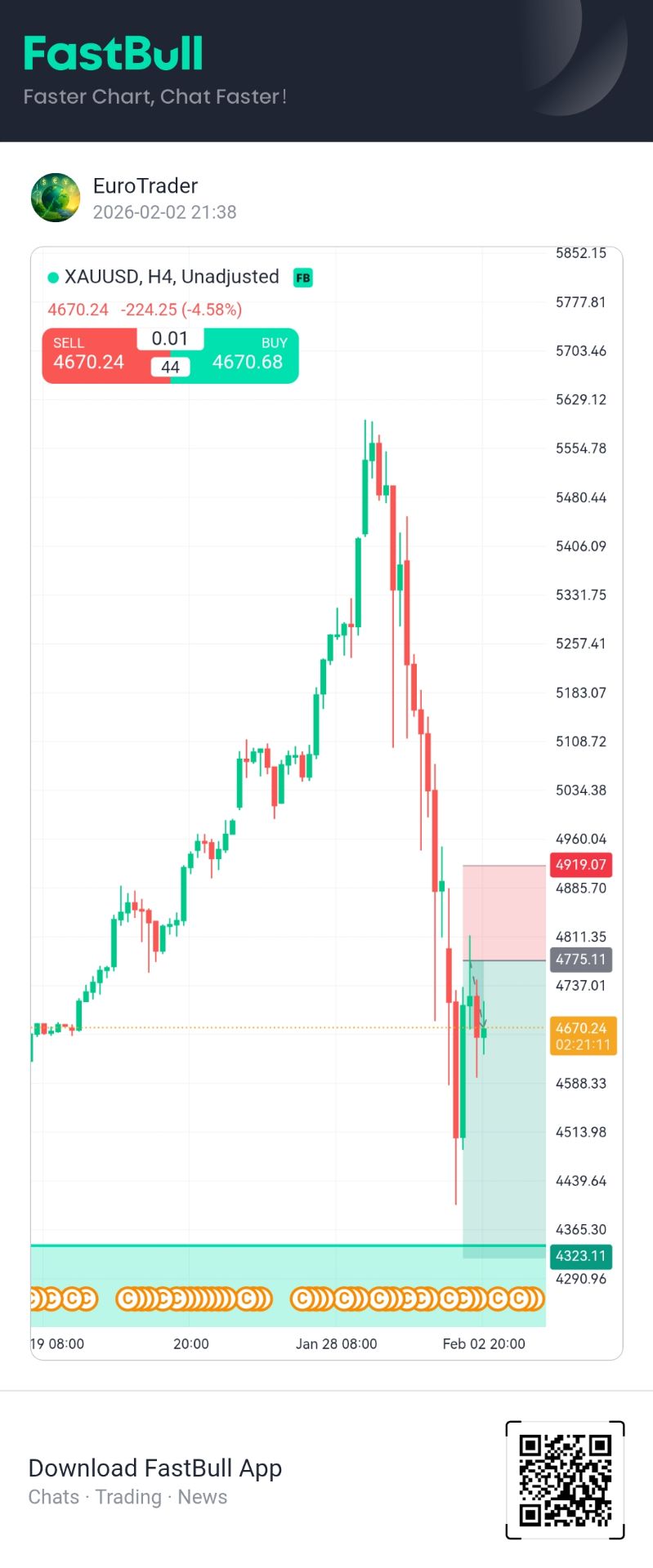
On Monday (February 2nd) In Late New York Trading, Spot Gold Fell 4.54% To $4671.58 Per Ounce, Remaining In A Downward Trend Throughout The Day. At 14:38 Beijing Time, It Had Fallen To $4402.95. On The Daily Chart, Gold Prices Have Fallen For Three Consecutive Trading Days, Approaching The December 31st Low Of $4319.37, And Briefly Breaking Below The 50-day Moving Average And Approaching The 100-day Moving Average (currently At $4483.43 And $4228.16 Respectively). Comex Gold Futures Fell 0.90% To $4702.60 Per Ounce, Also Briefly Falling To $4423.20 At 14:38
US President Trump, Speaking About The Justice Department's Investigation Into The Federal Reserve, Declared: "We'll See How It Goes."
U.S. Treasury Secretary Bessant: Federal Reserve Chairman Nominee Warsh Will Have A Great Start
[Airline ETFs Rise 3.5%, Leading US Sector ETFs; S&P Energy Sector Falls About 2%] On Monday (February 2), The Global Airline ETF Rose 3.51%, Regional Bank ETFs And Banking ETFs Rose Up To 1.79%, Semiconductor ETFs Rose 1.12%, Technology ETFs Rose 0.96%, And Energy ETFs Fell 1.96%. Among The 11 Sectors Of The S&P 500, Consumer Staples Rose 1.58%, Industrials Rose 1.26%, Financials Rose 1.02%, Information Technology/technology Rose 0.46%, And Energy Fell 1.98%
 China, Mainland NBS Non-manufacturing PMI (Jan)
A:--
F: --
P: --
 South Korea Trade Balance Prelim (Jan)
A:--
F: --
 Japan Manufacturing PMI Final (Jan)
A:--
F: --
P: --
South Korea IHS Markit Manufacturing PMI (SA) (Jan)A:--
F: --
P: --
 Indonesia IHS Markit Manufacturing PMI (Jan)
A:--
F: --
P: --
China, Mainland Caixin Manufacturing PMI (SA) (Jan)A:--
F: --
P: --
Indonesia Trade Balance (Dec)A:--
F: --
P: --
Indonesia Inflation Rate YoY (Jan)A:--
F: --
P: --
Indonesia Core Inflation YoY (Jan)A:--
F: --
P: --
 India HSBC Manufacturing PMI Final (Jan)
A:--
F: --
P: --
 Australia Commodity Price YoY (Jan)
A:--
F: --
P: --
 Russia IHS Markit Manufacturing PMI (Jan)
A:--
F: --
P: --
 Turkey Manufacturing PMI (Jan)
A:--
F: --
P: --
 U.K. Nationwide House Price Index MoM (Jan)
A:--
F: --
P: --
U.K. Nationwide House Price Index YoY (Jan)A:--
F: --
P: --
 Germany Actual Retail Sales MoM (Dec)
A:--
F: --
 Italy Manufacturing PMI (SA) (Jan)
A:--
F: --
P: --
 South Africa Manufacturing PMI (Jan)
A:--
F: --
P: --
 Euro Zone Manufacturing PMI Final (Jan)
A:--
F: --
P: --
U.K. Manufacturing PMI Final (Jan)A:--
F: --
P: --
Turkey Trade Balance (Jan)A:--
F: --
P: --
 Brazil IHS Markit Manufacturing PMI (Jan)
A:--
F: --
P: --
 Canada National Economic Confidence Index
A:--
F: --
P: --
Canada Manufacturing PMI (SA) (Jan)A:--
F: --
P: --
 U.S. IHS Markit Manufacturing PMI Final (Jan)
A:--
F: --
P: --
U.S. ISM Output Index (Jan)A:--
F: --
P: --
U.S. ISM Inventories Index (Jan)A:--
F: --
P: --
U.S. ISM Manufacturing Employment Index (Jan)A:--
F: --
P: --
U.S. ISM Manufacturing New Orders Index (Jan)A:--
F: --
P: --
U.S. ISM Manufacturing PMI (Jan)A:--
F: --
P: --
South Korea CPI YoY (Jan)--
F: --
P: --
Japan Monetary Base YoY (SA) (Jan)--
F: --
P: --
Australia Building Approval Total YoY (Dec)--
F: --
P: --
Australia Building Permits MoM (SA) (Dec)--
F: --
P: --
Australia Building Permits YoY (SA) (Dec)--
F: --
P: --
Australia Private Building Permits MoM (SA) (Dec)--
F: --
P: --
Australia Overnight (Borrowing) Key Rate--
F: --
P: --
RBA Rate Statement Japan 10-Year Note Auction Yield--
F: --
P: --
 Saudi Arabia IHS Markit Composite PMI (Jan)
--
F: --
P: --
RBA Press Conference Turkey PPI YoY (Jan)--
F: --
P: --
Turkey CPI YoY (Jan)--
F: --
P: --
Turkey CPI YoY (Excl. Energy, Food, Beverage, Tobacco & Gold) (Jan)--
F: --
P: --
U.S. Weekly Redbook Index YoY--
F: --
P: --
U.S. JOLTS Job Openings (SA) (Dec)--
F: --
P: --
 Mexico Manufacturing PMI (Jan)
--
F: --
P: --
U.S. API Weekly Refined Oil Stocks--
F: --
P: --
U.S. API Weekly Gasoline Stocks--
F: --
P: --
U.S. API Weekly Cushing Crude Oil Stocks--
F: --
P: --
U.S. API Weekly Crude Oil Stocks--
F: --
P: --
Japan IHS Markit Services PMI (Jan)--
F: --
P: --
Japan IHS Markit Composite PMI (Jan)--
F: --
P: --
China, Mainland Caixin Services PMI (Jan)--
F: --
P: --
China, Mainland Caixin Composite PMI (Jan)--
F: --
P: --
India HSBC Services PMI Final (Jan)--
F: --
P: --
India IHS Markit Composite PMI (Jan)--
F: --
P: --
Russia IHS Markit Services PMI (Jan)--
F: --
P: --
South Africa IHS Markit Composite PMI (SA) (Jan)--
F: --
P: --
Italy Services PMI (SA) (Jan)--
F: --
P: --
Italy Composite PMI (Jan)--
F: --
P: --








No matching data

Latest Views
Latest Views
Trending Topics
Top Columnists
Latest Update
White Label
Data API
Web Plug-ins
Affiliate Program
View All
No data


Almost all but the latest Antminer bitcoin miners are in the red following a collapse in the price of bitcoin, according to data from Antpool.
According to the data feed, only the Antminer S23 Hydro, Antminer U3S23H, and Antminer S23e U2H, all part of the S23 series unveiled last year that started shipping this month, are currently seeing healthy returns with a daily profit per hashrate measure of around $0.016/T.
Other leading models, like the Whatsminer M6 series, older Antminer products, and lesser-known brands, are currently running a deficit or nearing unprofitability, Antpool data shows. Older Antminers like the S21 series machines are nearly out of profit, according to Antpool.
Antpool and Antminer are affiliated through their associations with the Bitmain miner manufacturer.
Bitcoin has dropped to a low below $75,000 in recent days and is currently trading around $78,500, according to The Block's price page. The drop in price means miners earn less per unit of energy they provide to power the global network. This diminishing profitability comes despite a recent drop in network hashrate, attributed to the cold snap that has overtaken large parts of North America, reportedly forcing miners to curtail or shut down operations.
Still, Bitcoin's hashrate is near all-time highs, locking an all-time monthly high of 927.7 EH/s, according to The Block's data. A lower hashrate boosts block rewards per unit of hashpower for remaining online miners, improving margins temporarily despite the price decline, though the mining sector appears to remain highly competitive.
The best-performing miner, the Antminer S23 Hydro, is seeing daily returns of $ 18.53 per machine, according to Antpool. While the Antminer S21, while still in profit, is only returning $0.12 per day per machine. Whatsminer M63S, meanwhile, is reportedly losing $0.47 per day, according to Antpool.
Average monthly Bitcoin miner revenue per TH/s has been steadily declining since last August, The Block's data shows. This follows a longer trendline where miner profitability has been heading closer to the $1 per TH/s level since the market crash in 2022. Miners even faced a "profitability crisis" when bitcoin was trading at record highs last year.
Over the past several years, miners have increasingly diversified into HPC/AI services to diversify away from the increasingly competitive bitcoin mining landscape.
Of note, some of the leading publicly traded bitcoin mining stocks are also down in Monday's session, including MARA Holdings (down 2.5%), Cleanspark (6%), and HIVE Digital (10%).
Disclaimer: The Block is an independent media outlet that delivers news, research, and data. As of November 2023, Foresight Ventures is a majority investor of The Block. Foresight Ventures invests in other companies in the crypto space. Crypto exchange Bitget is an anchor LP for Foresight Ventures. The Block continues to operate independently to deliver objective, impactful, and timely information about the crypto industry. Here are our current financial disclosures.
© 2026 The Block. All Rights Reserved. This article is provided for informational purposes only. It is not offered or intended to be used as legal, tax, investment, financial, or other advice.
Key takeaways:
Bitcoin fell to $74,680 after futures market liquidations, yet derivatives data show no signs of panic or extreme bearishness.
Spot Bitcoin ETF outflows reached $3.2 billion, but represent less than 3% of assets under management.
Bitcoin (BTC) price plunged to $74,680 on Monday after a total of $1.8 billion in bullish leveraged positions were liquidated since the market downturn on Thursday. Traders moved into cash and short-term government bonds, especially after silver prices fell 41% over three days. Concerns over stretched valuations in the tech sector pushed investors into a more risk-averse stance.
Traders fear that further downside for Bitcoin remains possible as gold has been selected as a clear store of value, and saw its market capitalization reach $33 trillion, an 18% rise over the past 3 months. Despite the price downside, four indicators suggest that Bitcoin may hold above $75,000 through 2026, as macroeconomic risks have eased and traders overstate the scale of outflows and the impact of BTC derivatives.
Yields on the US 2-year Treasury stood at 3.54% on Monday, unchanged from three weeks earlier. A surge in demand for US government-backed assets would likely have pushed yields below 3.45%, similar to October 2025, when the US entered a prolonged government funding shutdown, and nonfarm payroll data weakened.
Likewise, the S&P 500 index traded just 0.4% below its all-time high on Monday, signaling confidence in a swift resolution to the latest US government partial shutdown, which began on Saturday. US House Speaker Mike Johnson told Fox News that an agreement is expected by Tuesday, despite limited support from House Democrats.
Bitcoin derivatives show resilience despite 40.8% price drop
Concerns around the artificial intelligence sector gradually eased after tech giant Oracle (ORCL US) announced plans to raise up to $50 billion in debt and equity during 2026 to meet contracted demand from its cloud customers. Investors had been unsettled by Oracle’s aggressive artificial intelligence expansion, which previously led to a 50% drop in the company’s share price, according to CNBC.
Resilience in Bitcoin derivatives suggests that professional traders have refused to turn bearish despite the 40.8% price decline from the $126,220 all-time high reached in October 2025. Periods of excessive demand for bearish positions typically trigger an inversion in Bitcoin futures, meaning those contracts trade below spot market prices.
The Bitcoin futures annualized premium (basis rate) stood at 3% on Monday, signaling weak demand for leveraged bullish positions. Under neutral conditions, the indicator usually ranges between 5% and 10% to compensate for the longer settlement period. Even so, there are no signs of stress in BTC derivatives markets, as aggregate futures open interest remains healthy at $40 billion, down 10% over the past 30 days.
Traders grew increasingly concerned after spot Bitcoin exchange-traded funds (ETFs) recorded $3.2 billion in net outflows since Jan. 16. Even so, the figure represents less than 3% of the products’ assets under management. Strategy (MSTR US) also fell victim to unfounded speculation after its shares traded below net asset value, fueling fears that the company would sell some of its Bitcoin.
Related: Saylor’s Strategy buys $75.3M in BTC as prices briefly dip below $75K
Beyond the absence of covenants that would force liquidation below a specific Bitcoin price, Strategy announced $1.44 billion in cash reserves in December 2025 to cover dividend and interest obligations. Bitcoin’s price may remain under pressure as traders try to pinpoint the drivers behind the recent sell-off, but there are strong indications that the $75,000 support level may hold.
An XRP analyst is pushing back against the growing sense of boredom surrounding XRP’s price action, with the outlook that people are misreading what is actually happening on the higher timeframes.
Taking to the social media platform X, an analyst known as XRP QUEEN said traders are overlooking a typical setup that has always preceded some of XRP’s most notable rallies. Her view is based on XRP’s weekly price structure and a comparison with how previous long consolidation phases eventually resolved.
Why XRP $1.50 To $3 Range Matters More Than It Looks
A look at the weekly candlestick timeframe chart shows that XRP’s price action over multiple months has been largely confined between support at $1.5 and resistance just above $3. Interestingly, according to the analysis from XRP Queen, XRP’s price action being pinned between roughly $1.50 and $3 is not a sign of weakness but a repeat of earlier accumulation zones.
The chart shows how the token has previously spent long stretches moving sideways for hundreds of days, highlighted on the chart as 200-day, 800-day, and even 1,000-day consolidation phases. In each case, price compression eventually gave way to a vertical move higher, labeled as MOON on the chart.
The key point being made is that these flat, frustrating periods tend to drain interest and attention from the market. That drop in engagement, according to the analyst, has always aligned with smart accumulation. The longer the range holds, the more pressure builds beneath the surface.
$2.72 And The Projection Of A Teleport Move
A notable level on the chart is the $2.72 zone, which is sitting around the 0.786 Fibonacci extension level projected from XRP price lows in 2018. Breaking and holding above $2.72 would be important to how XRP rallies to new all-time highs. As noted by XRP Queen, if $2.72 holds, then the next outlook is looking at $9-$15.
Once XRP leaves this range, it teleports. No pullbacks and no second chances. The projection on the chart shows Fibonacci extensions stretching far above the current price. These extensions include 0.786 at $2.71, the 1.0 extension around $3.40, followed by 1.618 at $5.47, 2.818 at $8.78, and the most extreme 4.764 extension around $15.89, all pointing to price targets to be broken once the current range is broken.
However, the altcoin is currently trading far below the $2.72 level needed to confirm the price teleportation to interesting highs. At the time of writing, XRP is trading around $1.60, meaning the price would need to climb by about 69% just to retest $2.72. Until that happens, XRP is in consolidation mode, and it is unclear how long it will keep trading sideways in the current range.
New York Attorney General Letitia James and other top prosecutors in the state are raising concerns over a recently enacted stablecoin law, arguing it doesn't include provisions requiring issuers like Circle and Tether to return stolen funds.
In a letter sent last week to key Democratic lawmakers, James and four New York district attorneys said that the Guiding and Establishing National Innovation for U.S. Stablecoins (GENIUS) Act, signed into law last year by President Donald Trump, leaves victims with little recourse to recover their losses. New York has been a leader in stablecoin and crypto regulation at the state level.
CNN earlier reported the news of the letter.
"Since being signed into law, the Genius Act has provided stablecoins and stablecoin issuers the imprimatur of legitimacy, while still allowing issuers to avoid significant regulatory requirements that are needed to combat financing terrorism, drug trafficking, money laundering, and especially cryptocurrency fraud," James and prosecutors said in the letter.
The stablecoin law is now entering its implementation phase, as agencies work to draft rules. GENIUS requires stablecoins to be fully backed by U.S. dollars or similarly liquid assets and mandates annual audits for issuers with a market capitalization of more than $50 billion. It also establishes guidelines for foreign issuance, among other requirements.
New York prosecutors said that those measures fall short, citing stablecoins' role in illicit finance. Stablecoins have often been used by bad actors who prefer them for their use in cross-border transfers and lower volatility. Chainalysis estimates 84% of all illicit crypto transaction volume in 2025 involved stablecoins, according to a recent report.
Circle and Tether
James' letter singles out Tether and Circle, the two largest stablecoins by market capitalization, in part for being able to generate interest from stolen customer funds. Both firms hold their reserves in cash or cash equivalents, like yield-bearing Treasuries. Prosecutors say Tether has frozen stolen funds "in some cases," while Circle is less cooperative with authorities.
"Moreover, although Tether may freeze, burn, and reissue USDT at the request of law enforcement in some limited circumstances, they acknowledge no legal obligation to do so," the prosecutors said in the letter.
In a statement to The Block, Tether said it takes fraud, abuse of USDT, and consumer harm seriously.
"Tether is not a U.S. domiciled issuer, and USDT does not operate under U.S. jurisdiction," Tether said. "As such, Tether does not have a blanket legal obligation to comply with state-level civil or criminal processes in the way a U.S.-regulated financial institution would. That said, Tether voluntarily works closely with U.S. law enforcement at the federal, state, and local levels and routinely assists investigations aimed at protecting victims and preventing further harm."
As for Circle, prosecutors accuse the stablecoin issuer of being worse than Tether for fraud victims.
"Unlike Tether, however, Circle refuses to temporarily freeze funds at the request of law enforcement, and will only do so after they have received a signed judicial order or warrant," they said in the letter. "Given the speed at which criminals and criminal networks operate, by the time it takes to obtain an order or warrant to freeze a given USDC address, the funds at issue have often already been moved to a different address, or been converted to a different virtual currency."
Dante Disparte, Circle's chief strategy officer and head of global policy and operations, said the stablecoin issuer prioritizes moving forward with global and U.S. regulations for stablecoins.
"Even in the rulemaking phase of this novel law, the GENIUS Act makes clear that stablecoin issuers must abide by applicable financial integrity rules for combating illicit activity, while enhancing clear consumer protection norms," Disparte said in a statement sent to The Block. "We have followed prevailing rules as a U.S. regulated financial institution, and we will continue to advance these standards once the GENIUS Act is in full effect."
The letter was sent to Democratic Sens. Chuck Schumer, Kirsten Gillibrand, and Mark Warner. Gillibrand and Schumer did not respond to a request for comment. A spokeswoman for Warner told The Block that they received the letter and said that stablecoin issuers "have a responsibility to comply with lawful court orders under the GENIUS Act and to cooperate fully with law enforcement to help victims recover stolen funds."
"While technical or operational hurdles can at times delay the freezing or recovery of illicit assets, those challenges must not be an excuse for inaction," the spokeswoman said. "Protecting victims is paramount, and Congress is continuing to evaluate whether additional legislative tools are needed to ensure issuers and law enforcement can act quickly to stop criminal activity and return stolen funds to their rightful owners.”
The Block also reached out to Republican Rep. French Hill and Sen. Tim Scott, both of whom were instrumental in passing GENUIS, but did not hear back.
Disclaimer: The Block is an independent media outlet that delivers news, research, and data. As of November 2023, Foresight Ventures is a majority investor of The Block. Foresight Ventures invests in other companies in the crypto space. Crypto exchange Bitget is an anchor LP for Foresight Ventures. The Block continues to operate independently to deliver objective, impactful, and timely information about the crypto industry. Here are our current financial disclosures.
© 2026 The Block. All Rights Reserved. This article is provided for informational purposes only. It is not offered or intended to be used as legal, tax, investment, financial, or other advice.
Physically targeting crypto users or their relatives, colloquially known as “wrench attacks,” significantly increased in the last year, according to blockchain security auditor CertiK.
In a report on wrench attacks released on Sunday, CertiK said there had been 72 verified cases worldwide in 2025 in which crypto users had been subject to physical attacks. According to the platform, such attacks were “no longer edge cases,” given that physical assaults and kidnappings had increased by about 75% over incidents in 2024.
“Beyond direct losses, the psychological and reputational fallout is reshaping behavior across the industry, pushing founders and high-net-worth individuals toward operational anonymity and geographical relocation,” said CertiK. “2025 marks a clear inflection point: physical violence is now a core threat vector in the crypto ecosystem.”
According to CertiK, there had been $40.9 million in confirmed losses due to wrench attacks in 2025, but the figure could be larger due to “under-reporting, silent settlements, and untraceable ransoms.” France recorded the largest number of attacks last year, with 19 confirmed incidents, while all of Europe accounted for about 40% of all attacks globally in 2025.
Among some of the most high-profile attacks in 2025 included crypto wallet Ledger founder David Balland and his wife, Amandine, being kidnapped and held for ransom in January. Another Italian crypto holder was reportedly kidnapped and tortured during a visit to New York City in May.
“Every week, there is a Bitcoiner, at least one in the world, who gets kidnapped, tortured, extorted, and sometimes even worse,” said SatoshiLabs founder Alena Vranova in August, adding:
Possible solutions to wrench attacks
One of the suggestions to address physical attacks or intimidation against crypto users has been the development of “panic wallets.” The wallets can potentially call for help, wipe balances when the holder is under duress, or send false decoys.
However, many experts advise that crypto holders to not openly discuss their wealth or holdings.
SVET Markets Weekly Update (January 26–31, 2026)
On Week 05, despite the weekly decline, January saw gains of roughly 1% across major indexes. Crypto markets crushed to their yearly lows.
On Monday, Major indexes advanced, with the S&P 500 up 1%, the Dow rising 1%, and the Nasdaq adding less than 1% as tech and communications led gains. Apple climbed 3%, Meta 2%, and Microsoft less than 1%, while Tesla slid 3%. Markets await Wednesday’s Fed decision amid talk of a possible new Fed Chair appointment by Trump and renewed government shutdown threats over a $1 trillion funding bill. Gold surged past $5,100 per ounce, marking record highs driven by risk aversion and global uncertainty. And threats of tariffs on South Korea. Bitcoin rose 2%, while Ether, Ripple, and Solana gained around 4%.
On Tuesday, Stocks climbed as the S&P 500 gained less than 1% to a record high and the Nasdaq rose about 1%, boosted by major tech names ahead of key earnings and Fed guidance. Microsoft and Apple gained around 2% and 1%, while chipmakers rallied on AI demand. GM jumped nearly 9% after raising its 2026 outlook, but UnitedHealth and CVS plunged about 20% and 14%, dragging the Dow down less than 1%. Brazil’s Ibovespa rose almost 2% to new highs as confidence grew that interest rates would stay near 15%. The Dollar Index slid to 96, down about 2% in four weeks and 11% annually. home prices rose less than 1% in November, and crypto gained broadly with Ether, Solana, Binance, and Bitcoin up 1–3%.
On Wednesday, Stocks rose slightly after the Fed kept rates unchanged, as expected, ahead of major AI firms’ earnings. The S&P briefly topped 7,000 for the first time before slipping less than 1%, while chip stocks boosted the Nasdaq 100 by less than 1%. The Fed paused rate cuts, signaling balanced inflation and job risks, sustaining bets on two cuts this year. Texas Instruments jumped about 10%, lifting Micron and Intel by roughly 6–11%, while AT&T gained about 5%. Gold advanced over 2% to nearly $5,300 per ounce and silver hovered around $115 at record highs, driven by a weaker dollar and safe-haven demand. In crypto markets, price changes were modest, with Solana leading declines of less than 1%.
On Thursday, Stocks ended mixed after a weak session, with the S&P 500 and Nasdaq down less than 1% while the Dow edged up less than 1%. Tech led losses as investors reevaluated AI valuations. Microsoft tumbled around 10% on slower cloud growth, while Meta soared about 10% on strong revenue forecasts. IBM and Caterpillar gained roughly 5% and 3% after upbeat results, and Apple rose less than 1% ahead of its earnings. Oil climbed on geopolitical worries, and gold eased slightly. Bitcoin slipped nearly 3% to about $82,000 — its lowest since November — amid $1 billion in ETF outflows, mostly from Fidelity, Grayscale, BlackRock, and Ark funds. Investor caution grew on Fed uncertainty and trade tensions, with Ether and Ripple down about 5–6%.
On Friday, stocks ended lower, with the S&P 500 and Dow Jones down about 0.4% and the Nasdaq falling 1%, as higher Treasury yields and a stronger dollar curbed risk appetite after President Trump nominated Kevin Warsh to replace Fed Chair Powell. The move signaled tighter policy expectations, lifting long-term yields and weighing on rate-sensitive sectors. Tech, materials, and communication stocks lagged, while healthcare gained. Apple edged up less than 1%, Visa fell nearly 3%, ExxonMobil slipped 1%, Chevron jumped 3%, and Verizon soared 12% on upbeat guidance. In crypto, losses led by Ripple and Ether (down about 4%), while Bitcoin and Binance fell less than 1%.
On Week 8, key data includes the jobs report, PMIs, and consumer confidence, alongside earnings from major tech firms like Alphabet and Amazon. Central banks, including the ECB and BoE, will set new rates, the Eurozone will release inflation data, and China’s PMIs will be closely watched.
Comment: Expectedly Unexpected.
The nomination of a hawkish Federal Reserve governor, if his stance remains true, reveals that the levers of global policy are still firmly in the hands of the baby boomer generation.
Despite reformist language about innovation, decentralization, and opportunity, today’s power centers remain anchored in the mindset of maintaining stability for large asset holders.
A hawkish Fed prioritizes price control over growth, keeping capital returns safe but choking innovation and small-enterprise expansion. That stagnation serves the interests of those who already control wealth — mainly older investors and institutions — while younger generations are left with higher debt costs and fewer pathways to build equity.
Many baby boomer leaders, including current heads of state, face political pressure to embrace reform. Yet their generational instincts — shaped by decades of asset accumulation and fear of volatility — pull them back toward caution.
The result is a policy rhythm of ‘one step forward, two steps back,’ where rhetorical modernization masks an underlying desire to preserve old hierarchies.
If this generational tug-of-war continues, it could lead to an economic prairie — vast, barren, and still controlled by the same few ranches. Without genuine generational turnover in power and policy mindset, monetary conservatism may quietly cement the very inequalities that reformists claim to dismantle.
Helping Founders To Raise Funds In The Silicon Valley.
For more join our Telegram : https://t.me/svetrating
SVET Markets Weekly Update (December 22–26, 2025)
On Week 52, major stocks indexes and crypto market were up. However, BTC closed this year in red.
Monday
On Monday, stocks opened higher in the holiday-shortened week, with the S&P 500 up 0.8%, the Nasdaq rising 0.7%, and the Dow gaining about 350 points. Energy stocks led gains as oil prices climbed amid U.S.-Venezuela tensions, while consumer discretionary, materials, and AI-related tech shares also advanced on improving optimism about the economy and earnings. Utilities lagged behind. Investors awaited delayed economic data due the next day, including GDP growth. Among major movers, Nvidia rose 1.3%, Micron 2%, and Oracle 1.4%. Amazon, Meta, and Tesla also gained, while Microsoft, Apple, Alphabet, and Broadcom posted small declines. Crypto market went side-way.
Tuesday
On Tuesday, Stocks hovered near the flatline Tuesday as strong economic data strengthened expectations that the Fed will hold rates steady in January and possibly delay future cuts. A delayed report showed the economy grew 4.3% annually in Q3, the fastest in two years, while the ADP report revealed private-sector job growth for a third straight week. Consumer staples and real estate lagged, but communication services and energy outperformed. Among megacaps, Nvidia, Microsoft, Amazon, Meta, and Alphabet rose, while Apple, Broadcom, and Tesla slipped. Eli Lilly gained 1% after recovering from early losses following the FDA’s approval of Novo Nordisk’s weight-loss pill. Crypto is up and down.
Wednesday
On Wednesday, stocks had a strong, shorter trading day, keeping up this week’s momentum as investors stayed upbeat about next year’s earnings potential. The S&P 500 rose 0.4% and the Dow climbed 0.7%, both hitting new records, while the Nasdaq 100 added 0.3%. Third-quarter GDP came in well above forecasts at a 4.3% annualized pace, driven by solid consumer spending and easing worries that tariffs hurt demand or pushed inflation higher. Jobless claims data still point to a labor market with low hiring and low firing. Big tech lagged a bit, and Intel slipped 0.5% after reports that Nvidia scrapped a test using Intel gear for advanced chips. Crypto market is in green.
Thursday
On Thursday, global commodity and currency markets saw brisk activity during of year-end holidays. Silver surged past $76 per ounce, its first-ever high, driven by geopolitical tensions and expectations of further U.S. rate cuts in 2026; it’s now up 158% YTD. Copper touched a five-month peak near $5.7/lb, benefiting from EV and renewable energy demand, while palm oil rose for a fourth straight session, supported by stronger edible oil markets and Indian imports. Singapore’s manufacturing expanded 14.3% YoY, beating forecasts, while the South Korean won led currency gainers. In Asia, Chinese stocks extended an eight-session rally as the yuan hit a 15-month high after PBOC support signals. Crypto markets traded brightly green during the holiday lull, with Bitcoin and Ethereum extending weekly gains.
Friday
On Friday, stocks edged higher in light holiday trading, with the S&P 500 and Dow each up 0.1% to fresh records and the Nasdaq also gaining 0.1%. Nvidia climbed 1% after sealing a licensing deal with AI startup Groq, fueling renewed interest in AI and megacap tech. Energy shares rose as U.S. moves on Venezuelan oil exports boosted crude. Investors also weighed data showing Q3 GDP grew a strong 4.3%, reinforcing economic resilience but cooling hopes for swift Fed rate cuts. Trading volume stayed thin, leaving markets steady into year-end. Meanwhile, the crypto market traded broadly in the green, with Bitcoin and Ethereum extending gains on upbeat sentiment and risk-on flows.
On Week 1, 2026, jobless claims, pending home sales and most importantly FOMC minutes will be om the traders’ radars.
Helping Founders To Raise Funds In The Silicon Valley.
For more join our Telegram : https://t.me/svetrating
SVET Markets Weekly Update - November 24–28, 2025
On Week 48, stocks closed November with modest gains while crypto market recovered a bit and then went side-way.
Monday
On Monday, stocks rallied , with the Dow up under 1%, the S&P roughly 2%, and the Nasdaq Composite about 3%, led by megacap tech. Broadcom jumped around 11%, Alphabet about 6%, Microsoft was briefly overtaken in value, and Tesla gained around 7% on AI chip progress. Dovish Fed commentary lifted December rate‑cut odds to roughly 80%, from about 40% a week earlier. Gold hovered near $4,140 after a roughly 2% rise the prior session, while the dollar index stayed near 100. In crypto, Ether advanced about 6% and Bitcoin rose roughly 2%.
Tuesday
On Tuesday, Stocks rallied on optimism over AI and anticipated Federal Reserve rate cuts, lifting the S&P 500 and Dow. While tech lagged, Meta and Alphabet gained on AI chip deal reports, though Nvidia and AMD fell. Economic data was mixed, with weak retail sales and payrolls strengthening the case for a December Fed rate cut. Meanwhile, the crypto market is rising on a technical correction, rebounding after a nearly month-long downturn. In commodities, oil prices dropped to a five-week low on potential Ukraine-Russia peace talks, while gold held near multi-month highs as weak economic data bolstered its safe-haven appeal.
Wednesday
On Wednesday, major stock indexes, including the S&P 500, Nasdaq, and Dow, climbed for a fourth consecutive session. The rally was fueled by growing investor conviction that the Fed will cut rates in December, a belief reinforced by reports that dovish candidate Kevin Hassett is the leading contender for the next Fed Chair. This spurred a rotation into large-cap tech stocks, with Nvidia and Microsoft gaining over 1%, though Alphabet fell. In economic news, strong jobless claims data challenged the case for imminent rate cuts, while the Chicago Business Barometer signaled a sharp economic contraction. Meanwhile, the crypto market saw positive momentum. Bitcoin led the charge with a +3% gain, and Ether followed closely with a +2.5% increase.
Thursday
On Thursday, during a quiet period with American markets closed, ECB notes revealed that policymakers agreed that holding interest rates steady was appropriate. While some argued no further rate cuts are needed, others urged keeping future options open, as the economy is resilient and inflation is near its target. In economic data, the Eurozone’s Economic Sentiment Indicator rose slightly in November 2025. Confidence improved in services and retail, but weakened among manufacturers. European stocks were mixed, with banks gaining and tech shares remaining volatile on sector uncertainty. Globally, China’s industrial profit growth slowed in the first ten months of 2025, with a notable drop in October. In commodities, tin prices hit a three-year high due to supply disruptions in Myanmar and Indonesia. Finally, Bitcoin led a quiet crypto market with a modest 1% gain.
Friday
On Friday, in a shortened post-Thanksgiving session the S&P rose 0.5%, the Nasdaq gained 0.8%, and the Dow added 0.6%. Investor confidence grew on expectations of a near-term Fed rate cut. Communication services led the gains, while healthcare underperformed. Major tech stocks were mixed. For the entire month, the S&P 500 was nearly flat, ending a seven-month winning streak for the Nasdaq, which fell 1.6%. Elsewhere, cryptocurrency movements were slight, with Solana declining more than 2%.
On Week 49, Investors are awaiting a flood of delayed economic data. Key releases include the PCE price index, industrial production, and PMI surveys, which will reveal tariff impacts and consumer sentiment. Labor market updates are also expected. Globally, attention is on China and Canada’s PMIs, third-quarter GDP for Australia and Brazil, the Eurozone’s inflation rate, and an interest rate decision from India’s central bank.
Helping Founders To Raise Funds In The Silicon Valley.
For more join our Telegram : https://t.me/svetrating
Jupiter said it has secured a $35 million strategic investment from ParaFi Capital, marking the first time the Solana-based onchain trading and liquidity aggregation protocol has taken outside capital after years of bootstrapped, profitable growth.
The transaction involved token purchases at market prices with no discount and an extended lockup period and was settled entirely in Jupiter’s JupUSD stablecoin, the companies said. Financial terms beyond the $35 million investment were not disclosed.
The investment comes as Jupiter has processed more than $1 trillion in trading volume over the past year and expanded beyond swap routing into perpetuals, lending and stablecoins, according to the company.
The deal also included warrants allowing ParaFi Capital to acquire additional tokens at higher prices, a structure the companies said was intended to reflect long-term alignment.
The investment follows a recent expansion of Jupiter’s product offerings. In October, Jupiter rolled out a beta version of its onchain prediction market developed with Kalshi, followed in January by the launch of JupUSD, a Solana-native, dollar-pegged stablecoin built in partnership with Ethena Labs.
Jupiter’s native token (JUP) was up around 9% over the past 24 hours, according to CoinGecko data.
Decentralized protocols attract VC attention
In 2025 and early 2026, venture firms have continued to deploy capital into decentralized protocols through token-based deals.
In October, a16z Crypto invested $50 million in Jito, a Solana-based liquid staking protocol, through a token-based deal that granted the firm an undisclosed allocation of Jito’s native tokens at a discount.
In January, Babylon, a decentralized protocol focused on Bitcoin-native staking and lending, raised $15 million from a16z Crypto through the sale of its BABY token, with the firm saying the funding would support development of the protocol’s onchain infrastructure.
Beyond decentralized finance, venture investors have also supported other categories of decentralized protocols in recent months.
In September, decentralized science platform Bio Protocol raised $6.9 million from investors including Maelstrom Fund and Animoca Brands to support the development of its AI-native, blockchain-based framework for biomedical research.
Last week, Humanity Protocol, a decentralized identity platform, raised $20 million from Pantera Capital and Jump Crypto at a reported $1.1 billion valuation to develop its Proof of Humanity onchain identity system based on biometric data.
728 RM B 7/F GEE LOK IND BLDG NO 34 HUNG TO RD KWUN TONG KLN HONG KONG


White Label
Data API
Web Plug-ins
Poster Maker
Affiliate Program
The risk of loss in trading financial instruments such as stocks, FX, commodities, futures, bonds, ETFs and crypto can be substantial. You may sustain a total loss of the funds that you deposit with your broker. Therefore, you should carefully consider whether such trading is suitable for you in light of your circumstances and financial resources.
No decision to invest should be made without thoroughly conducting due diligence by yourself or consulting with your financial advisors. Our web content might not suit you since we don't know your financial conditions and investment needs. Our financial information might have latency or contain inaccuracy, so you should be fully responsible for any of your trading and investment decisions. The company will not be responsible for your capital loss.
Without getting permission from the website, you are not allowed to copy the website's graphics, texts, or trademarks. Intellectual property rights in the content or data incorporated into this website belong to its providers and exchange merchants.
Not Logged In
Log in to access more features


Log In
Sign Up


