Markets
News
Analysis
User
24/7
Economic Calendar
Education
Data
- Names
- Latest
- Prev


Signal Accounts for Members
All Signal Accounts
All Contests


France Trade Balance (SA) (Oct)A:--
F: --
Euro Zone Employment YoY (SA) (Q3)A:--
F: --
Canada Part-Time Employment (SA) (Nov)A:--
F: --
P: --
Canada Unemployment Rate (SA) (Nov)A:--
F: --
P: --
Canada Full-time Employment (SA) (Nov)A:--
F: --
P: --
Canada Labor Force Participation Rate (SA) (Nov)A:--
F: --
P: --
Canada Employment (SA) (Nov)A:--
F: --
P: --
U.S. PCE Price Index MoM (Sept)A:--
F: --
P: --
U.S. Personal Income MoM (Sept)A:--
F: --
P: --
U.S. Core PCE Price Index MoM (Sept)A:--
F: --
P: --
U.S. PCE Price Index YoY (SA) (Sept)A:--
F: --
P: --
U.S. Core PCE Price Index YoY (Sept)A:--
F: --
P: --
U.S. Personal Outlays MoM (SA) (Sept)A:--
F: --
U.S. 5-10 Year-Ahead Inflation Expectations (Dec)A:--
F: --
P: --
U.S. Real Personal Consumption Expenditures MoM (Sept)A:--
F: --
U.S. Weekly Total Rig CountA:--
F: --
P: --
U.S. Weekly Total Oil Rig CountA:--
F: --
P: --
U.S. Consumer Credit (SA) (Oct)A:--
F: --
China, Mainland Foreign Exchange Reserves (Nov)A:--
F: --
P: --
Japan Trade Balance (Oct)A:--
F: --
P: --
Japan Nominal GDP Revised QoQ (Q3)A:--
F: --
P: --
China, Mainland Imports YoY (CNH) (Nov)A:--
F: --
P: --
China, Mainland Exports (Nov)A:--
F: --
P: --
China, Mainland Imports (CNH) (Nov)A:--
F: --
P: --
China, Mainland Trade Balance (CNH) (Nov)A:--
F: --
P: --
China, Mainland Exports YoY (USD) (Nov)A:--
F: --
P: --
China, Mainland Imports YoY (USD) (Nov)A:--
F: --
P: --
Germany Industrial Output MoM (SA) (Oct)A:--
F: --
Euro Zone Sentix Investor Confidence Index (Dec)A:--
F: --
P: --
Canada National Economic Confidence IndexA:--
F: --
P: --
U.K. BRC Like-For-Like Retail Sales YoY (Nov)--
F: --
P: --
U.K. BRC Overall Retail Sales YoY (Nov)--
F: --
P: --
Australia Overnight (Borrowing) Key Rate--
F: --
P: --
RBA Rate Statement
RBA Press Conference
Germany Exports MoM (SA) (Oct)--
F: --
P: --
U.S. NFIB Small Business Optimism Index (SA) (Nov)--
F: --
P: --
Mexico 12-Month Inflation (CPI) (Nov)--
F: --
P: --
Mexico Core CPI YoY (Nov)--
F: --
P: --
Mexico PPI YoY (Nov)--
F: --
P: --
U.S. Weekly Redbook Index YoY--
F: --
P: --
U.S. JOLTS Job Openings (SA) (Oct)--
F: --
P: --
China, Mainland M1 Money Supply YoY (Nov)--
F: --
P: --
China, Mainland M0 Money Supply YoY (Nov)--
F: --
P: --
China, Mainland M2 Money Supply YoY (Nov)--
F: --
P: --
U.S. EIA Short-Term Crude Production Forecast For The Year (Dec)--
F: --
P: --
U.S. EIA Natural Gas Production Forecast For The Next Year (Dec)--
F: --
P: --
U.S. EIA Short-Term Crude Production Forecast For The Next Year (Dec)--
F: --
P: --
EIA Monthly Short-Term Energy Outlook
U.S. API Weekly Gasoline Stocks--
F: --
P: --
U.S. API Weekly Cushing Crude Oil Stocks--
F: --
P: --
U.S. API Weekly Crude Oil Stocks--
F: --
P: --
U.S. API Weekly Refined Oil Stocks--
F: --
P: --
South Korea Unemployment Rate (SA) (Nov)--
F: --
P: --
Japan Reuters Tankan Non-Manufacturers Index (Dec)--
F: --
P: --
Japan Reuters Tankan Manufacturers Index (Dec)--
F: --
P: --
Japan Domestic Enterprise Commodity Price Index MoM (Nov)--
F: --
P: --
Japan Domestic Enterprise Commodity Price Index YoY (Nov)--
F: --
P: --
China, Mainland PPI YoY (Nov)--
F: --
P: --
China, Mainland CPI MoM (Nov)--
F: --
P: --


No matching data
Latest Views
Latest Views
Trending Topics
Top Columnists
Latest Update
White Label
Data API
Web Plug-ins
Affiliate Program
View All

No data
Bitcoin rose to $87,350 and now sits just below the key resistance zone at $88,500. Open interest fell sharply to $6.31B as market pressure built in early April 2025. Inflation touched 0.97%
Bitcoin (BTC) showed significant recovery momentum after a week of consolidation, rising by over 3% as of April 21, 2025, to reach $87,350 at press time. This upward movement brings BTC closer to the key $88,500 resistance level, a critical area that could trigger further liquidity movement. If it breaches this resistance effectively, BTC may target the $90k level given the current price action and patterns noted on previous breakouts tried in analogous zones.
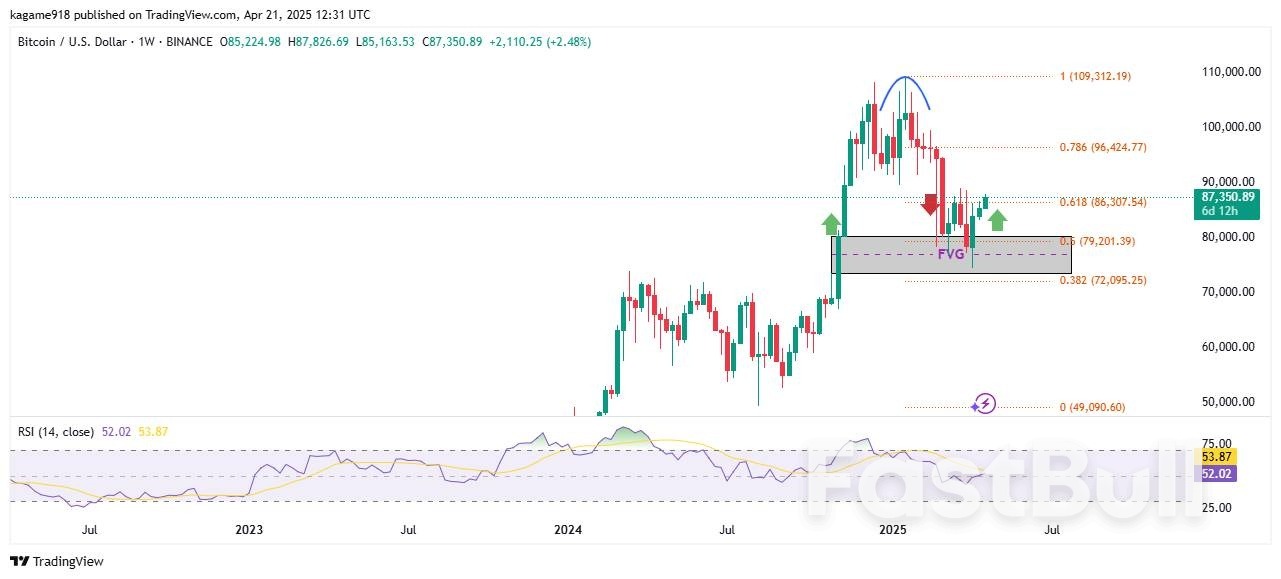
BTC has shown resilience, consolidating between $76,000 and $87,350 in recent weeks after failing to hold above $90,000 during earlier attempts. The chart analysis highlights $88,500 as a major resistance point, where BTC has previously struggled to maintain upward momentum. The 0.618 Fibonacci retracement level at $86,307 suggests that BTC is holding firm near this zone, signaling that the market could be preparing for another upward push if buying pressure continues and liquidity above $88,500 is taken.
Furthermore, the Relative Strength Index (RSI) at 52.02 relative to the 14-day close of 53.87 suggests a neutral market sentiment. This level suggests that BTC has potential for growth, as it is far from being overbought. The recovery of RSI from the low 40s confirms renewed buying interest after weeks of stagnation. In this case, should the buying side strengthen, BTC would push past resistance at $88,500 and move toward $90,000 before facing further obstacles near its $96,424 and $109,312 Fibonacci extensions.
If BTC fails to sustain above $88,500, it might retrace toward the $79,200 support level, aligning with the 0.5 Fibonacci zone. Additionally, if the sentiment declines, the $72,095 mark at the 0.382 retracement may act as the next downside buffer. The Fair Value Gap (FVG) formed earlier is still active below the current price and may act as a magnet should the momentum fade in the short term.

JD Vance is visiting India with his familyImage: India's Press Information Bureau/Handout via REUTERS.Key Takeaways:
Gold has surged to new all-time highs as escalating US-China trade tensions and a weakening US dollar affect markets globally in April 2025.
The latest spike in gold prices highlights significant market anxiety tied to geopolitical tensions and currency weaknesses, leading to potential shifts in investor behaviors.
Trade tensions between the US and China have intensified, with President Trump announcing substantial tariffs on imports. Gold prices have reacted sharply, fueled by fear of economic instability. Central banks, including China's, have increased gold holdings, highlighting a strategic diversification away from potentially risky assets. As tariffs become a critical factor, the direction of gold and related markets is under the spotlight.
The broader market has reacted strongly, with gold investments seeing historic inflows. This surge has occurred as economic players seek shelter from the storm of a weakened US dollar and geopolitical uncertainties. Trade policies enacted by global leaders have significantly impacted investor sentiment. Donald Trump has taken a firm stance on trade protectionism, causing ripple effects through gold and equity markets.
Central banks' increased gold purchases reflect a growing hedge against Western asset freezes, underscoring a cautious market approach. Government tensions have led to movements in both traditional and crypto markets, expanding the volatility range. However, Bitcoin and Ethereum remain range-bound amid these dynamics, suggesting a potential shift in asset favorability towards traditional safety nets.
The political climate surrounding these economic decisions continues to influence both monetary policy and market stability. The Federal Reserve's interest rate decisions may come under further pressure as risks from tariffs mount, shaping the narrative for future economic policy.
Experts suggest a prolonged effect on global markets, impacting future investment flows as the situation unfolds.
Jerome Powell, current Federal Reserve Chair, publicly dismissed the prospect of interest rate cuts in June, contradicting market expectations. This announcement, articulated last week, sparked substantial interest in financial sectors.
These developments matter as Powell's stance, aligned with persistent inflation and macroeconomic uncertainty, influences both traditional and crypto markets. Market volatility has intensified due to contrasting views on future rate policies.
Jerome Powell recently dismissed market expectations for aggressive rate cuts at the Federal Reserve's June meeting, emphasizing major risks like rising tariffs and unstable inflation. Bill Dudley, former New York Fed President, noted that the optimistic market pricing could be prematurely elevated:
Market adjustments have occurred as participants react to the Fed rejecting rate cut prospects this year. Powell's comments triggered recalibration in futures pricing as investors reevaluate earlier assumptions.
Responses within financial circles have varied, with notable figures emphasizing potential consequences. No direct reactions from prominent crypto leaders have emerged, but discussions intensify around the impact of monetary policies on digital assets.
Did you know? In 2020, amid emergency rate cuts, Bitcoin soared following a 150-basis-point reduction, signaling its sensitivity to monetary policy shifts.
As of April 21, 2025, CoinMarketCap reports Bitcoin's price at $87,993.05, with a market cap of $1.75 trillion and 24-hour trading volume at $32.73 billion, reflecting a 4.16% price increase over the past day. Such fluctuations show Bitcoin's responsiveness to policy environments.
Bitcoin(BTC), daily chart, screenshot on CoinMarketCap at 15:09 UTC on April 21, 2025. Source: CoinMarketCapAccording to insights from Coincu's research team, Bitcoin's future may hinge on Fed policies. Historically, crypto markets respond dynamically to interest rate news. A shift to lower rates in the future could potentially enhance Bitcoin's appeal as an alternative asset, contrasting with traditional market performances.

Donald Trump’s return to the White House in January 2025 has coincided with a $760 billion loss in crypto market value, with significant strategic policy shifts announced from Washington.
Trump's return marks a pivotal moment for cryptocurrency markets, driven by strategic policy implementations resulting in immediate market volatility. Investors are reacting to the significant economic and regulatory shifts.
Trump's return to power in early 2025 brought substantial changes in U.S. crypto policy. The government announced the creation of a Strategic Bitcoin Reserve, managed by the Treasury, aiming to facilitate a federal digital asset stockpile.
With the establishment of a digital asset stockpile, led by David Sacks, the U.S. is navigating new regulatory landscapes. The Treasury's role has expanded to include managing cryptocurrencies seized in criminal activities, marking a policy shift.
The policy changes have triggered a sharp decline in crypto market capitalization, wiping out $760 billion. Bitcoin prices experienced notable fluctuations with a decline from an all-time high to substantial lows. Regulatory actions led to the dissolution of certain enforcement activities, creating further market uncertainty.
The financial landscape is experiencing turbulence, impacting crypto holders and markets globally. The number of Bitcoin millionaire addresses fell, indicative of a shift in investor confidence post-policy implementation. Volatile market conditions continue to pose challenges.
Trump's policy actions reflect a significant departure from his earlier anti-crypto stance, focusing on national strategic reserves. Despite the optimistic economic assertions, markets responded negatively. Further analysis considers potential long-term regulatory impacts on market stability.
In response to reduced enforcement, the crypto market has yet to stabilize fully, suggesting potential challenges for governmental regulation and market resilience. The evolution of these strategic initiatives remains a focal point for economists and investors alike.
The content on The CCPress is provided for informational purposes only and should not be considered financial or investment advice. Cryptocurrency investments carry inherent risks. Please consult a qualified financial advisor before making any investment decisions. |
White Label
Data API
Web Plug-ins
Poster Maker
Affiliate Program
The risk of loss in trading financial instruments such as stocks, FX, commodities, futures, bonds, ETFs and crypto can be substantial. You may sustain a total loss of the funds that you deposit with your broker. Therefore, you should carefully consider whether such trading is suitable for you in light of your circumstances and financial resources.
No decision to invest should be made without thoroughly conducting due diligence by yourself or consulting with your financial advisors. Our web content might not suit you since we don't know your financial conditions and investment needs. Our financial information might have latency or contain inaccuracy, so you should be fully responsible for any of your trading and investment decisions. The company will not be responsible for your capital loss.
Without getting permission from the website, you are not allowed to copy the website's graphics, texts, or trademarks. Intellectual property rights in the content or data incorporated into this website belong to its providers and exchange merchants.
Not Logged In
Log in to access more features

FastBull Membership
Not yet
Purchase
Log In
Sign Up