


- EURUSD
- XAUUSD
- XAGUSD
- WTI
- USDX


Markets
Analysis
User
24/7
Economic Calendar
Education
Data
- Names
- Latest
- Prev











Bitcoin surges past $118,000, driven by institutional capital inflows and FOMO, leaving those waiting for a pullback disappointed and missing the rally. Institutional buying, especially through Bitcoin ETFs, accelerates BTC price growth as supply on exchanges dwindles, highlighting new dynamics in the 2025 bull market. Investors missing out on Bitcoin’s rise must adapt strategies, using staggered buying, emotional control, and derivatives to manage risk and seize opportunities.
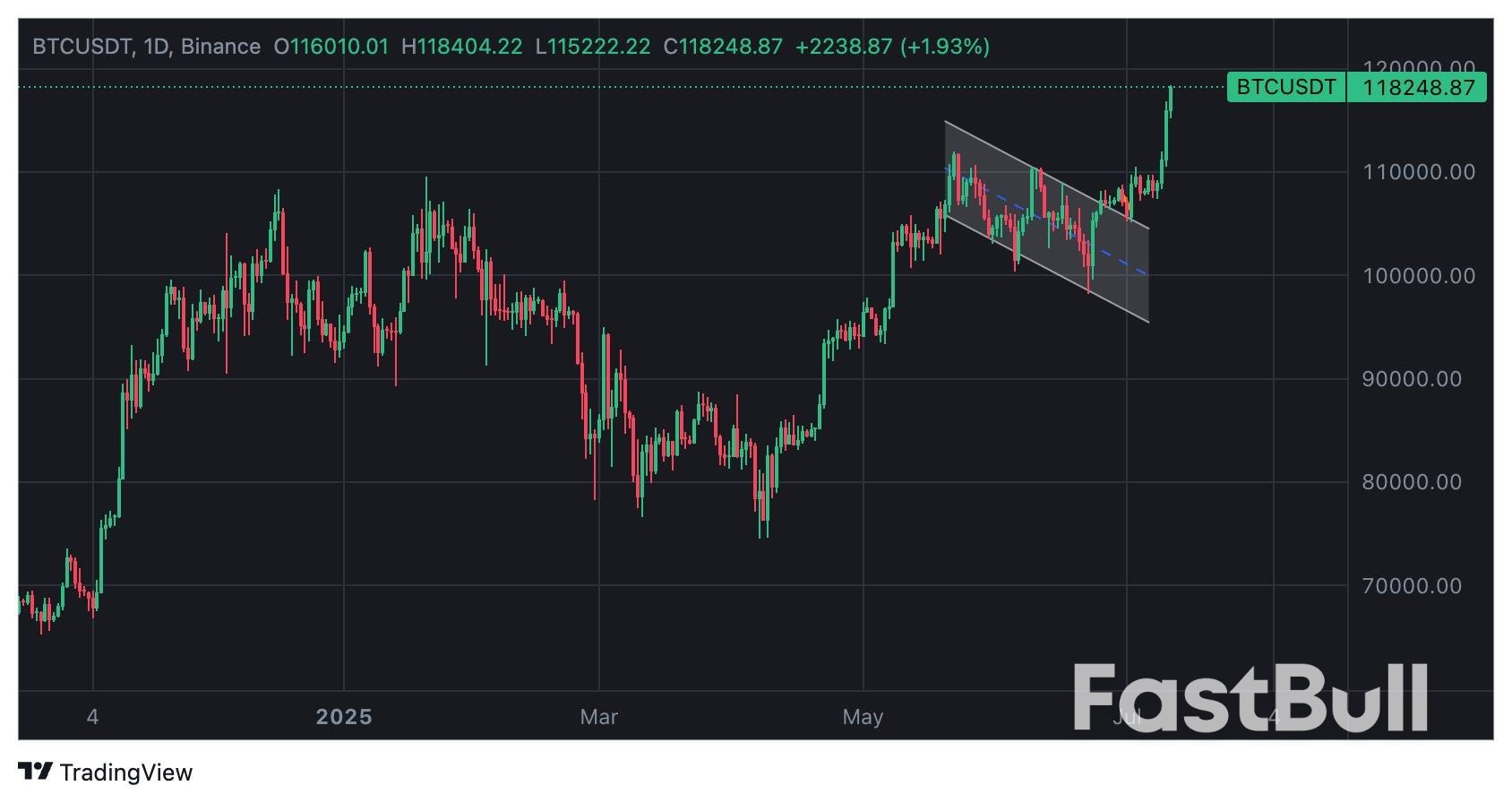
On July 11, 2025, Bitcoin (BTC) surged past $118,000, marking a historic high. According to CoinMarketCap real-time data, Bitcoin rose 6.56% in the past 24 hours, 7.5% over the week, and an impressive 152% year-to-date.
Market sentiment is blazing hot, with investors on social media cheering: “BTC broke $118,000, the Asian session is still soaring, those waiting for a pullback are missing out!”
However, the rapid ascent caught pullback-awaiting investors off guard, as no meaningful correction materialized—and FOMO took hold across the board.
The biggest short-term driver behind Bitcoin’s break above $118,000 is institutional capital inflows.
In particular, spot Bitcoin ETFs have served as the “rocket fuel” for this rally. According to Bloomberg, as of July 11, global Bitcoin ETFs saw record weekly net inflows, with BlackRock’s iShares Bitcoin Trust (IBIT) alone netting $448 million on July 10.
A market participant on social media noted: “Institutional buying is unstoppable—IBIT accumulation is directly pushing BTC to new highs, retail simply can’t keep up!”
Through massive ETF purchases, institutions have sharply reduced Bitcoin’s available supply on exchanges. Glassnode data shows that on July 11, BTC holdings on major crypto exchanges declined to 1.8 million BTC, the lowest level in three years.
The resulting supply-demand imbalance has directly propelled price gains. At the same time, ETF-driven FOMO has gripped retail investors.
Fearful of missing out on further gains, many abandoned their wait-and-see strategies and rushed in, amplifying upward momentum.
Social sentiment captures this echo: “ETF inflows are like a flood—BTC just won’t stop!” This synergy between institutions and retail stands at the heart of Bitcoin surpassing $118,000.
Bitcoin’s rise is underpinned by strong market momentum. On the night of July 10, BTC broke the key $114,000 level, and during the Asian trading session on July 11, it pushed past $118,000.
Glassnode shows on‑chain transaction volume spiked 35% at the breakout—reaching a monthly peak—indicating unprecedented market participation.
One social media trader stated: “Volume exploded when BTC crossed $114,000—this is a full-on bull signal, no pullback in sight.”
Asia’s trading surge injected massive energy. Crypto exchanges in Hong Kong and Singapore hit monthly highs in night trading, with Binance and OKX seeing BTC volume spike 45% during the early hours of July 11.
Especially between 2 AM and 4 AM HKT, activity surged and leveraged trading climbed. Investors commented online: “Asian session buys have gone crazy—BTC directly blasted past $118,000!”
This fervent activity not only cemented the upward move, but also squeezed out pullback opportunities.
Social media has become the sentiment barometer of investor frenzy. After Bitcoin topped $118,000, hashtags like #Bitcoin and #BTCnewhigh exploded, with discussions generating over 60 million views.
As one investor wrote: “BTC hit $118,000—retail still waiting for a $110k pullback? You don’t wait in a bull market, get on board now!” Such comments resonated widely, prompting even more investors to abandon wait-and-see postures and join the rally.
In this bull cycle, pullback windows have become extraordinarily brief—or non-existent. At the end of June, BTC dipped from $110,000 to $105,000, only to recover within 48 hours.
The July 11 breakout came without any discernible pullback—the price shot from $116,000 straight through $118,000, leaving those waiting for it in the dust.
One social media user complained: “Every time I wait for a pullback, the market just pumps instead—it feels like it’s mocking me.”
Several factors lie behind this phenomenon. First, institutional buying heavily suppresses pullback potential. ETFs and large institutions buying into dips quickly absorb selling pressure.
For example, when BTC briefly fell to $115,000 during trading on July 10, buying demand lifted it back above $116,500 in under two hours. Second, global crypto market liquidity is higher and order book depth deeper, meaning retail selling rarely moves the needle.
As one investor put it: “Institutions were waiting at $115k—retail hoping for $110k? No chance!” So those expecting 10–20% deep pullbacks were repeatedly disappointed, missing optimal entry points.
Compared to 2017 or 2021’s bull cycles, the 2025 Bitcoin market is fundamentally different. Previously, retail-driven speculation led to swings of 20–30%, creating entry windows. Now, with institutional dominance, everything has changed.
Companies like MicroStrategy have continued to buy: as of July 11, their holdings exceed 250,000 BTC, while exchange BTC supply sits at a three‑year low of 1.8 million BTC. This shortage has made prices highly responsive to buys and resilient to sells.
One trader commented: “Institutions setup at $110k—retail waiting for $100k? Forget it!” Institutional depth not only lifts the market floor, but compresses the pullback timeline.
For instance, after BTC broke $112,000 on July 9, a correction was expected—but institutions quickly drove it to $118,000, blindsiding patient traders. Under this new market regime, “waiting for pullback” is obsolete strategy—and missing out is inevitable.
DROP THE “PERFECT LOW” FIXATION
Historical BTC bull runs repeatedly show that chasing “the perfect dip” often means missing the rally entirely. Instead, adopt a staggered buying approach.
For example, gradually build positions around $105,000, balancing risk and participation. Disciplined entry trumps blind waiting for perfection.
Online discussions capture the regret of those left behind: “Every time a pullback seems possible, prices fly and my mindset collapses.”
Many retail traders give in to FOMO or regret, lacking clear plans. The takeaway: investors need structured strategies—like target-based approaches or dollar-cost averaging—to stay on course.
Emotional control is equally crucial. When BTC topped $118,000, social media buzz surged—and with it, panic and FOMO. Those who stayed calm, focused on on-chain data and fundamentals, were better equipped to make rational decisions.
As one analyst advised: “Don’t let hype on social media cloud your judgment—set your plan, that’s how you win in a bull market.”
For those hesitant to chase high prices, derivatives offer viable alternatives. Short-term call options—e.g., July expiration at $120,000—let you play the upside with fixed risk. One market participant said: “Don’t want to chase high?
Buy a call option—low cost, high potential upside.” Similarly, futures hedging can lock in profits or protect against dips.
Derivatives offer exposure with lower capital and reduced fear of missing out. For instance, on July 11, BTC options volume on Binance surged 60%, highlighting traders’ eagerness to deploy derivatives in this rally.
But caution is key—derivatives require sophistication, and high leverage can lead to liquidations. As shared online: “Options let me profit and sleep easy during the bull run.”
On July 11, 2025, Bitcoin rocketed past $118,000, fueled by institutional capital, market momentum, supply scarcity, and rampant FOMO.
Investors hoping for a pullback were left behind—pulled down by narrow correction windows, new market dynamics, and emotion-based trading. Social media captures the mood: “BTC won’t wait—you board now or get left behind.”
The lesson is clear: in bull markets, waiting for the perfect dip can mean missing the rally. Investors must rethink their approach—embrace staggered entry, reinforce discipline, and make smart use of tools like derivatives.

728 RM B 7/F GEE LOK IND BLDG NO 34 HUNG TO RD KWUN TONG KLN HONG KONG





The risk of loss in trading financial instruments such as stocks, FX, commodities, futures, bonds, ETFs and crypto can be substantial. You may sustain a total loss of the funds that you deposit with your broker. Therefore, you should carefully consider whether such trading is suitable for you in light of your circumstances and financial resources.
No decision to invest should be made without thoroughly conducting due diligence by yourself or consulting with your financial advisors. Our web content might not suit you since we don't know your financial conditions and investment needs. Our financial information might have latency or contain inaccuracy, so you should be fully responsible for any of your trading and investment decisions. The company will not be responsible for your capital loss.
Without getting permission from the website, you are not allowed to copy the website's graphics, texts, or trademarks. Intellectual property rights in the content or data incorporated into this website belong to its providers and exchange merchants.
Not Logged In
Log in to access more features


Log In
Sign Up


