Markets
News
Analysis
User
24/7
Economic Calendar
Education
Data
- Names
- Latest
- Prev


Signal Accounts for Members
All Signal Accounts
All Contests


U.K. Trade Balance Non-EU (SA) (Oct)A:--
F: --
P: --
U.K. Trade Balance (Oct)A:--
F: --
P: --
U.K. Services Index MoMA:--
F: --
P: --
U.K. Construction Output MoM (SA) (Oct)A:--
F: --
P: --
U.K. Industrial Output YoY (Oct)A:--
F: --
P: --
U.K. Trade Balance (SA) (Oct)A:--
F: --
P: --
U.K. Trade Balance EU (SA) (Oct)A:--
F: --
P: --
U.K. Manufacturing Output YoY (Oct)A:--
F: --
P: --
U.K. GDP MoM (Oct)A:--
F: --
P: --
U.K. GDP YoY (SA) (Oct)A:--
F: --
P: --
U.K. Industrial Output MoM (Oct)A:--
F: --
P: --
U.K. Construction Output YoY (Oct)A:--
F: --
P: --
France HICP Final MoM (Nov)A:--
F: --
P: --
China, Mainland Outstanding Loans Growth YoY (Nov)A:--
F: --
P: --
China, Mainland M2 Money Supply YoY (Nov)A:--
F: --
P: --
China, Mainland M0 Money Supply YoY (Nov)A:--
F: --
P: --
China, Mainland M1 Money Supply YoY (Nov)A:--
F: --
P: --
India CPI YoY (Nov)A:--
F: --
P: --
India Deposit Gowth YoYA:--
F: --
P: --
Brazil Services Growth YoY (Oct)A:--
F: --
P: --
Mexico Industrial Output YoY (Oct)A:--
F: --
P: --
Russia Trade Balance (Oct)A:--
F: --
P: --
Philadelphia Fed President Henry Paulson delivers a speech
Canada Building Permits MoM (SA) (Oct)A:--
F: --
P: --
Canada Wholesale Sales YoY (Oct)A:--
F: --
P: --
Canada Wholesale Inventory MoM (Oct)A:--
F: --
P: --
Canada Wholesale Inventory YoY (Oct)A:--
F: --
P: --
Canada Wholesale Sales MoM (SA) (Oct)A:--
F: --
P: --
Germany Current Account (Not SA) (Oct)A:--
F: --
P: --
U.S. Weekly Total Rig CountA:--
F: --
P: --
U.S. Weekly Total Oil Rig CountA:--
F: --
P: --
Japan Tankan Large Non-Manufacturing Diffusion Index (Q4)--
F: --
P: --
Japan Tankan Small Manufacturing Outlook Index (Q4)--
F: --
P: --
Japan Tankan Large Non-Manufacturing Outlook Index (Q4)--
F: --
P: --
Japan Tankan Large Manufacturing Outlook Index (Q4)--
F: --
P: --
Japan Tankan Small Manufacturing Diffusion Index (Q4)--
F: --
P: --
Japan Tankan Large Manufacturing Diffusion Index (Q4)--
F: --
P: --
Japan Tankan Large-Enterprise Capital Expenditure YoY (Q4)--
F: --
P: --
U.K. Rightmove House Price Index YoY (Dec)--
F: --
P: --
China, Mainland Industrial Output YoY (YTD) (Nov)--
F: --
P: --
China, Mainland Urban Area Unemployment Rate (Nov)--
F: --
P: --
Saudi Arabia CPI YoY (Nov)--
F: --
P: --
Euro Zone Industrial Output YoY (Oct)--
F: --
P: --
Euro Zone Industrial Output MoM (Oct)--
F: --
P: --
Canada Existing Home Sales MoM (Nov)--
F: --
P: --
Euro Zone Total Reserve Assets (Nov)--
F: --
P: --
U.K. Inflation Rate Expectations--
F: --
P: --
Canada National Economic Confidence Index--
F: --
P: --
Canada New Housing Starts (Nov)--
F: --
P: --
U.S. NY Fed Manufacturing Employment Index (Dec)--
F: --
P: --
U.S. NY Fed Manufacturing Index (Dec)--
F: --
P: --
Canada Core CPI YoY (Nov)--
F: --
P: --
Canada Manufacturing Unfilled Orders MoM (Oct)--
F: --
P: --
Canada Manufacturing New Orders MoM (Oct)--
F: --
P: --
Canada Core CPI MoM (Nov)--
F: --
P: --
Canada Manufacturing Inventory MoM (Oct)--
F: --
P: --
Canada CPI YoY (Nov)--
F: --
P: --
Canada CPI MoM (Nov)--
F: --
P: --
Canada CPI YoY (SA) (Nov)--
F: --
P: --
Canada Core CPI MoM (SA) (Nov)--
F: --
P: --


No matching data
Latest Views
Latest Views
Trending Topics
Top Columnists
Latest Update
White Label
Data API
Web Plug-ins
Affiliate Program
View All

No data
Bitcoin (BTC) surged above $114,000 for the first time since Aug. 24, extending its recent recovery as US inflation data came in far cooler than expected.
Key takeaways:
Bitcoin broke $114,000 as data showed PPI inflation cooled sharply in August.
Traders believe the data could push the Federal Reserve to cut rates in September.
Long-term onchain trends show short-term turbulence occurring after Fed rate cuts, then longer-term upside.
Bitcoin (BTC) surged above $114,000 for the first time since Aug. 24, extending its recent recovery as US inflation data came in far cooler than expected. The move follows the release of the August Producer Price Index (PPI), which dropped to 2.6% year-over-year versus forecasts of 3.3%. Core PPI, which strips out food and energy, fell to 2.8%, well below the 3.5% consensus.
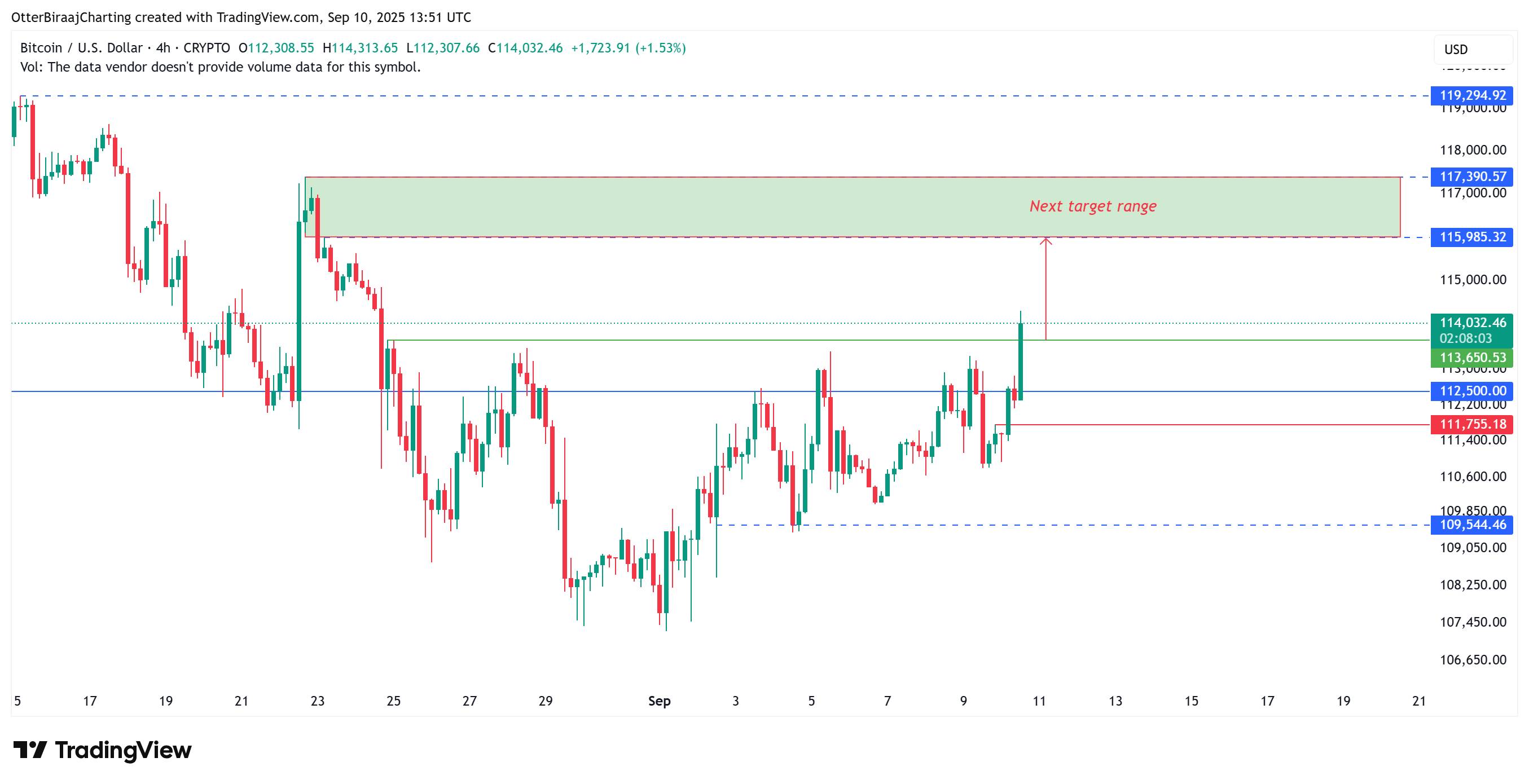
Source: Cointelegraph/TradingViewOn a monthly basis, PPI even turned negative, marking only the second contraction since March 2024, according to the Kobeissi newsletter. Adding to the dovish tone, inflation figures from July were revised lower as well, with headline PPI adjusted to 3.1% from 3.4% and core PPI to 3.4% from 3.7%. In addition to the historic US jobs data revision earlier this week, which erased 911,000 jobs from the past 12 months, markets are viewing interest rate cuts as increasingly imminent.
Market analyst Skew noted that producer inflation trends often lag behind those of the Consumer Price Index (CPI) by one to three months. This means sticky CPI readings could still appear in the short run, though the broader trajectory points to cooling inflation into Q4. While the PPI slowdown is encouraging, hedge flows may continue until CPI confirms the easing trend.
With Federal Reserve interest rate cuts looking extremely likely, Bitcoin’s history shows a consistent pattern of turbulence followed by upside. Two onchain metrics, Market Value to Realized Value (MVRV) and Whale Ratio, shed further light.
MVRV compares Bitcoin’s market capitalization to its realized capitalization (the aggregate value at which coins last moved). When MVRV hovers near 1, BTC is typically undervalued, and levels near 3–4 suggest overheated valuations.
Meanwhile, Whale Ratio measures the share of large holder transactions in exchange flows, showing when whales are sending coins to sell or pulling them back for storage.
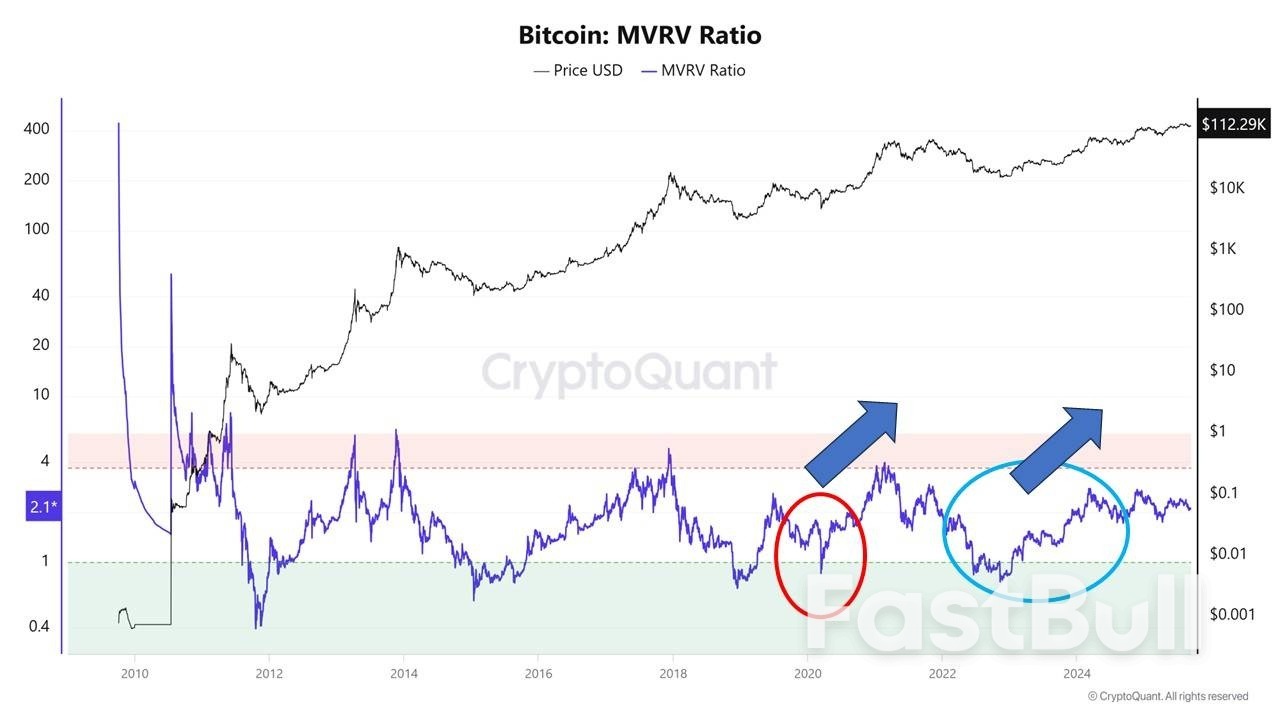
Source: CryptoQuantData from CryptoQuant highlights that in March 2020, interest rate cuts sent MVRV collapsing toward 1 as panic wiped out investors’ speculative gains, while the Whale Ratio spiked on heavy whale selling.
As liquidity flooded in, the MVRV rebounded, and whales shifted to accumulation, fueling Bitcoin’s 2020–2021 bull run. A similar pattern repeated during the late 2024 easing cycle, when both indicators reflected short-term selling before stabilizing into another rally.
If history rhymes, Fed easing in 2025 could again bring initial volatility, but overall provide the liquidity backdrop for Bitcoin to approach new highs.
Daily E-mini S&P 500 Index
Daily Oracle CorporationA Senate committee on Wednesday approved the nomination of White House economic adviser Stephen Miran to the Fed's board of governors, setting up a likely approval by the full Senate, which would make Miran the third Trump appointee to the seven-member board.
The White House has pushed for an expedited Senate approval of Miran, who was nominated by President Donald Trump to replace former Fed governor Adriana Kugler, who stepped down Aug. 1. Miran would, if approved, simply finish her term, which expires in January. He may be approved in time for the Fed's meeting next week, when it is widely expected to reduce its key short-term interest rate.
The committee voted to approve Miran on partisan lines, 13-11, with all Democrats voting against confirmation.
Miran's nomination has raised concerns about the Fed's independence from day-to-day politics, particularly since he said during a hearing last week that he would keep his job as head of the White House's Council of Economic Advisers while on the Fed's board, a historically unusual arrangement. Presidents have nominated members of their staffs to the Fed's board before, but the nominees have always given up their White House jobs.
The vote comes a day after a federal court blocked Trump's effort to fire Fed governor Lisa Cook, who he has accused of mortgage fraud.
“The Federal Reserve was designed to make decisions free from political interference, guided by data and the long-term stability of our economy, not the political agenda of any one president," Sen. Mark Warner, a Democrat from Virginia, said in a statement before the vote. “Donald Trump has made clear he wants to tear down that independence, just as he has with so many of the institutions that have kept our democracy and our economy strong.”
Miran said he would step down from his White House position if he is chosen for a longer term. Yet he can remain on the board after Kugler's term ends in January, if no replacement is named. He has said in that case he would consider keeping his White House job even if he remains on the board after January, sparking fresh criticism from Democrats.
Schroders Plc has become the latest global asset manager to be caught up in Hong Kong’s commercial property meltdown.Within just a few months, two assets managed by its property investment arm have been seized by bank creditors.Now it faces a new challenge relating to a loan for a three-floor commercial space at Harbourfront Landmark in Hong Kong’s Hung Hom district. The facility was not repaid on the original maturity date. The lender, Bank of Communications (Hong Kong) Ltd., is now weighing various options for the loan including potentially demanding immediate repayment and then enforcing it, according to people familiar with the matter. No final decision has been made, they added.
Schroders’ losses underscore the increasing strain global firms face from Hong Kong’s slumping property market. Like many other financial sponsors, Schroders uses special purpose vehicles to act as borrowers for loans against its Hong Kong property assets. When troubles arise, lenders’ main option is to seize the underlying collateral, even if its value doesn’t cover the outstanding debt.In recent months, some bank creditors have ramped up pressure on firms with property-related debt in the city, as they see few signs of a market recovery and are eager to offload troubled assets. Average prices of office buildings and retail space in the city are down by 48% and 39%, respectively, from their 2018 highs, according to Hong Kong government data, eroding the value of collateral backing many bank facilities.
Schroders’ three troubled assets were part of its Pamfleet portfolio, which the company acquired in 2020, in the midst of the Covid-19 pandemic and a crackdown on social unrest in Hong Kong. Pamfleet had $1.1 billion of assets under management at the time of the acquisition, which Schroders said would add expertise in the Asian real estate market.However, the cashflow generated by the properties had fallen short of expectations, according to people familiar with the matter.
The first property of the three to run into problems was the Nate, a serviced apartment tower located in the Tsim Sha Tsui district, which entered into receivership in July. A buyer later agreed to pay HK$272 million for the asset, a 49% discount from Schroders’ original purchase price of HK$530 million. Occupancy at the Nate dropped off during the 2019 protests in Hong Kong and didn’t pick up subsequently amid the city’s economic challenges, one of the people said.A Schroders’ spokesperson said the sale of the Nate is progressing and the company has secured a lease for all three floors of Harbourfront Landmark, but declined to comment further about other matters. Bank of Communications didn’t respond to a request for comment.
In August, bank creditors appointed receivers for another asset in the portfolio, the Worfu Mall in the North Point area, according to company registry records. The mall was used as collateral for a roughly HK$1.5 billion loan that a joint venture backed by Schroders and Chelsfield Asia Fund 1 defaulted on earlier this year. The shopping center was put up for sale in January, but no deal was reached.The venture paid HK$2 billion for the mall around the peak of the city’s commercial property boom in 2018, 88% above the appraised value at the time. The fund spent about HK$250 million on renovations to the property, aiming to boost rental prices, according to the people. The work was finished in 2020, just as the pandemic took hold.
As the property market in Hong Kong continues to languish, Brian Wong, a director at Quantuma International, a restructuring and insolvency services advisory firm, said his company has been fielding inquiries over potential receivership appointments.“We expect that more enforcement actions will occur in the next six months,” he added.
Gold – Chart

U.S. wholesale inventories increased a bit less than initially thought in July, suggesting businesses were not rushing to rebuild inventory after stocks were depleted in the second quarter.
Stocks at wholesalers edged up 0.1%, instead of rising 0.2% as estimated last month, the Commerce Department's Census Bureau said on Wednesday. Economists polled by Reuters had expected last month's estimate would be unrevised.
Inventories, a key part of gross domestic product, gained 0.2% in June. They advanced 1.3% on a year-over-year basis in July. Wholesale stocks of motor vehicles dropped 1.6%. But stocks of apparel surged 1.9%, while those of prescription medication increased 1.8%. Grocery inventories increased 2.0%.
Inventories decreased at a $32.9 billion annualized rate in the second quarter, subtracting 3.29 percentage points from GDP. That was, however, more than offset by a record 4.95 percentage point contribution from a smaller trade deficit.
The economy grew at a 3.3% annualized rate last quarter after contracting at a 0.5% pace in the first quarter.
Sales at wholesalers jumped 1.4% in July after rising 0.7% in June. At July's sales pace it would take wholesalers 1.28 months to clear shelves, down from 1.29 months in June.
White Label
Data API
Web Plug-ins
Poster Maker
Affiliate Program
The risk of loss in trading financial instruments such as stocks, FX, commodities, futures, bonds, ETFs and crypto can be substantial. You may sustain a total loss of the funds that you deposit with your broker. Therefore, you should carefully consider whether such trading is suitable for you in light of your circumstances and financial resources.
No decision to invest should be made without thoroughly conducting due diligence by yourself or consulting with your financial advisors. Our web content might not suit you since we don't know your financial conditions and investment needs. Our financial information might have latency or contain inaccuracy, so you should be fully responsible for any of your trading and investment decisions. The company will not be responsible for your capital loss.
Without getting permission from the website, you are not allowed to copy the website's graphics, texts, or trademarks. Intellectual property rights in the content or data incorporated into this website belong to its providers and exchange merchants.
Not Logged In
Log in to access more features

FastBull Membership
Not yet
Purchase
Log In
Sign Up